Category: Uncategorized

Youths sweep street to instill civic pride

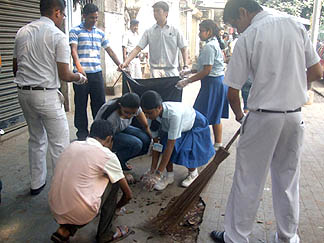
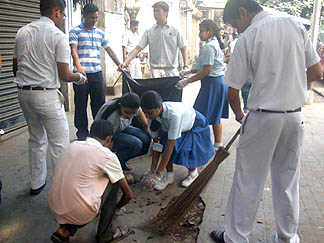
KOLKATA, India (UCAN) – Students, arming themselves with brooms, swept a busy street in Kolkata on Nov. 15 to highlight the need for civic consciousness.

HK859_3.jpg 


Students clean a stretch of a central
Kolkata street to mark Children’s Day

“We are responsible for the dirt and muck on the streets, so we need to take steps to keep the city clean,” said Tanay Saigal of St. Joseph’s College. Saigal was among some 160 young people from 20 educational institutions who cleaned a 200-meter stretch of Rafi Ahmed Kidwai Road that day.

The Jesuit-initiated Leadership Training Service (LTS) organized the initiative to mark national Children’s Day.

Students across India usually observe Children’s Day on Nov. 14, the anniversary of the birth of Jawaharlal Nehru, the country’s first prime minister, who loved children.

Jimmy Tangerine, a former LTS member who organized the event, said the group decided to hold the street clean-up a day late since most schools had their own programs on Nov. 14.

The LTS was introduced by the Jesuits of South Asia some 50 years ago to encourage leadership among students. The Kolkata-based service has thousands of members from various religions.


HK859_2.jpg 


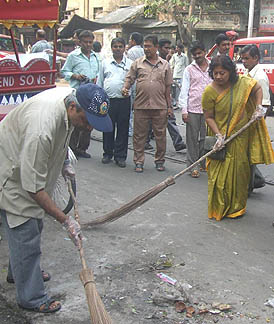
Father George Pattery and city councilor Sushmita Chatterjee clean Rafi Ahmed Kidwai Road

Saigal, 16, said he found the cleanliness drive useful. “At least it made us aware of the conditions of our city’s roads. Often the dirt on the road does not bother us because we are so used to it,” he told UCA News.

Radhika Kishore Puria of Loreto College said the clean-up helped her empathize better with those forced to live on the streets. She said prior to participating in the program, she had simply overlooked the dirt and filth.

Her friend, Upasana Rohia, said she was encouraged to see many bystanders volunteering to help the students. “I was fascinated by the people’s positive response,” she added.

Launching the event, Sushmita Chatterjee, who represents the area in the Kolkata Municipal Corporation, said the students have set an example for their elders whose lack of civic pride had spoilt the environment.

Chatterjee, a former teacher at Kolkata’s Don Bosco School, expressed regret at the lack of civic consciousness in the city and how people accept dirty streets as part of life. “We should be happy” if a few people “follow your example,” she told the students after symbolically sweeping part of the road with Calcutta Jesuit provincial Father George Pattery.

Tangerine, who owns a local shortwave radio station, said he hopes the “experimental drive” would become a movement with more schools joining in. The LTS has “great potential” to mobilize students, he said. His group plans to get more institutions to conduct similar initiatives regularly, he added.

Join us for an online Advent retreat

The Advent season should bring feelings of joy and anticipation, but we often get bogged down with parties, plans, and presents. Unfortunately, feelings of stress are more common than feelings of wonderment.

To help you get back on track, our Days of Deepening Friendship blog along with some of Loyola Press’s most inspiring authors will be hosting an Online Advent Retreat. Starting November 30 and lasting until Christmas, we will be shifting our focus to preparing our hearts for the coming of the Christ Child. To participate in the Advent retreat, please subscribe to the blog.

Jesuit Electronic News Service Vol. XIII, N. 19

Father General                                                                                                                 

Letter to all Major Superiors. In a letter addressed to all Major Superiors of the Society of Jesus, Father General discussed the ex officio letters that arrived during this past year. Because of his explicit request, these letters focused on the assimilation process of the General Congregation by Provinces as well as the initiatives taken in this regard; the letters also reported on the impact of the Congregation. “With this letter”, Father Nicolás writes, “I wish to continue the dialogue by sharing with you, in an honest and straightforward manner, some important points that emerged during our reflection. What follows is not a summary of all the correspondence received. Rather, I wish simply to share some lights and shadows for your reflection, to strengthen our hope, and also to challenge us to greater fidelity to our Jesuit spirit and to our service of the Church.” The letter focuses on some particular aspects including: the spiritual life, community life, the apostolate, a look to future opportunities, problems, challenges and the reception of GC35. He concludes by saying, “As I come to the end of this letter, I wish to return to the reality of the ex officio letters as an apostolic dialogue between the Society of Jesus and its General. In truth, however, this dialogue is, at its best, a dialogue carried out in the Spirit. Those who wrote and those who read have been seeking to listen to what the Spirit is saying in events, in people, in written words. And so, as I share with you these few points for reflection from the rich material received from hundreds of letters, I trust that you will seek to listen to the voice of the Spirit, present in our humble Society and drawing us forward to a future of more joyful and generous service where we are needed by the Church.”

Visit to Slovenia. Father General will visit Slovenia from the 6th to the 8th of November. He will arrive in Ljubljana on the evening of 6 November and meet with the Dravlje community for dinner. The next day, after courtesy visits to the Archbishop and the Apostolic Nuncio, he will meet the Jesuits of the Slovenian Province at Saint Joseph Spirituality Center. During the afternoon a Eucharistic celebration will take place at Dravlje church to commemorate the 40th anniversary of the Province. At that Eucharist, several Jesuits will make solemn profession. Later there will be meetings with Christian Life Communities and the Association of Slovenian Catholic Professors as well as a brief interview with the catholic radio program Ognjisce. He will have dinner that evening with the Province Consultors. To mark this visit the catholic weekly Druzina will publish an interview with Father General. He returns to Rome on Sunday 8 November.


From the Curia                                                                                                                 

Meeting of Socii from East Asia and Oceania (ASO). From the 26th to 29th of October, eleven Socii from the East Asia and Oceania Assistancy met in Rome. This meeting implements a decision made by the Major Superiors of the Jesuit Conference last January 2009 in Manila. The meeting aimed to help the Socii, most of whom are new to their jobs, to better know one another and the General Curia, and to enhance their familiarity with the various administrative and juridical procedures that a Socius has to deal with. Organized by the Regional Assistant and the Regional Secretary of East Asia and Oceania, the program had as its two main resource persons the Secretary of the Society, Father Ignacio Echarte, and the Procurator General, Father Robert Geisinger. Participants came from Australia, China, Indonesia, Japan, Korea, Malaysia-Singapore, Micronesia, Myanmar, the Philippines, Thailand, Vietnam and the Jesuit Conference of East Asia and Oceania.

From the Provinces                                                                                                             

MALTA: Statement on forced migrants

During their General Assembly held in Malta from the 18th to 20th of October, the European Jesuit Provincials reflected on various aspects of the tragic reality of refugees, asylum seekers and forced migrants. The Assembly was very aware of the serious burdens faced by this small country which is disproportionately exposed to the pressures of such migration. They published a statement calling for the respect of the rights of these forced migrants by individual governments and by the entire European Union, and called for the burdens of receiving such migrants to be shared in a more equitable manner. The document states, “Every year several hundred persons in search of asylum in Europe, take this route through Malta, or need to be rescued and are brought here. Except for the most desperate and vulnerable cases, they are held in prolonged detention, in conditions that deepen previous suffering. If they succeed in gaining international protection, they still face untold difficulties, stemming from overcrowding, Malta’s very limited capacity to receive them, and the scarcity of employment opportunities(…) We therefore urge the states most directly concerned, and the entire European Union, to make asylum in Europe truly accessible, and to deal more justly and humanely with the forced migrants who reach our shores. As this tragedy, with its roots in countries of origin in our neighboring continent of Africa, continues to unfold we make three requests to our governments and to the European Union: to show effective solidarity with persons urgently seeking protection; to assist over-burdened border states in the responsibility of meeting our shared human rights obligations; and to strengthen partnerships with African states so as to create new opportunities for their peoples to sustain a life with dignity”. The Assembly represents about 5.900 Jesuits, and their colleagues, working in twenty-three member states of the European Union, as well as in Russia, Ukraine, Croatia, Switzerland, the Western Balkans, the Middle East and the Maghreb. For the complete text: www.sjweb.info

ROME: Papal audience to the Pontifical Biblical Institute

On the 26th of October Pope Benedict XVI held an audience with the members of the Pontifical Biblical Institute on the occasion of the centenary of the foundation of the Institute by Pope Pius X, who desired to establish in the city of Rome a center of specialized studies on sacred Scripture and related disciplines. After mentioning his “sincere gratitude to the Society of Jesus, which, not without significant effort, commits financial and human resources to the management of the Ancient East faculty, the Biblical faculty in Rome, and the Institute’s faculty in Jerusalem,” the Pope said, “Dear friends, the celebration of the centenary is an end, and at the same time a point of reference. Enriched by the experience of the past, continue on your way with renewed determination, aware of the service to the Church requires of you, to bring the Scriptures closer to the life of the People of God, so that it will be able to address in an satisfactory way the yet to be discovered challenges that modern times poses to the new evangelization. (…) May the Pontifical Biblical Institute continue, therefore, growing as an ecclesial center of biblical research of the highest quality, making use of modern methodologies and in collaboration with specialists in dogmatic and other theological areas; may it ensure a careful formation in sacred Scripture for future priests so that, making use of the biblical languages and of the various exegetical methodologies, they will be able to have direct access to biblical texts.” He then spoke about the criteria set by the Second Vatican Council for the study of Scripture. He concluded by saying, “Dear brothers and sisters, in thanking you for your enjoyable visit, I encourage you to continue your ecclesial service, in constant adherence to the magisterium of the Church and I assure each one of you the support of my prayer, imparting to you from my heart, as a pledge of divine favor, my apostolic blessing.”

AFRICA: Reconciliation, justice and peace

Reconciliation has been one of the focal points of the recent special Synod of Bishops on Africa. The Great Lakes Region of Africa including, but not limited to: Rwanda, Burundi, Democratic Republic of Congo, Nigeria, has been the scene of massacres and persecutions producing thousands of refugees. During the Synod, Congolese Jesuit Father Rigobert Minani Bihuzo, working at the Centre d’Études pour l’Action Social (CEPAS) in Kinshasa, spoke about the Great Lakes Region during an interview with the Italian catholic newspaper Avvenire. He said, “during these past fifteen years the Great Lakes region of Africa has experienced a period of great instability that calls on the Church and all Christians to examine its collective conscience and asks some fundamental questions. Considering the fact that about 85% of the region’s population is Christian, it is the particular duty of priests of this region and in the whole African Church, to investigate without fear and with frankness the level of true conversion of the faithful. What do the Christians concepts of love, forgiveness, solidarity really mean? Is faith in Christ an effective and adequate instrument to prevent conflicts and promote peace? What is the relationship between faith and the need for forgiveness and reconciliation with God and the community?” These topics were discussed by the Synod and now should be put into concrete pastoral initiatives.

ITALY: 450 years of Jesuit presence in Sardinia

The 16th of November will be the 450th anniversary of the arrival of the Jesuits in Sardinia. The first residence was erected in the city of Sassari. The anniversary will be the beginning of several initiatives devoted to remembering and reflecting on the specific values of the Society’s work in the hope of encouraging a deepening of Ignatian spirituality, especially among young people. Inaugural celebrations will be held on November 15th lead by Archbishop Mani, of Cagliari, who will preside at a Mass in the Church of San Michele. On November 20th a seminar on the relationship between Jesuits and history, art and spirituality, will be held at the Theological Faculty of Cagliari. On November 27th Father Federico Lombardi, S.J. will speak on the role of the Jesuits today at the service of the Universal Church. A booklet on “the history of the Jesuits in Sardinia” will be published by the end of 2009. In 2010 the community wants to organize a photographic contest and three touring weekends to the most significant Jesuit sites on the island.

ITALY: Paul VI Award to Sources Chrétiennes

The prestigious French collection Sources Chrétiennes is the winner of the sixth international Paul VI award sometimes labeled the “Catholic Nobel prize”. Sources Chrétiennes was begun by a group of Jesuits in Paris in 1942 that included Henri de Lubac and Jean Danélou. It played a major role in the rediscovery of ancient and medieval Christian sources. The works published, especially Greek and Latin patristic writings, compose more than 530 volumes with the original on one page and faced by introductions and comments on the other for scholars to use. The prize was inaugurated 1984 and was presented to the theologian Hans Urs von Balthasar. The awards committee is located at the Brescia Institution for Christian education where the young Giovanni Montini, the future Pope Paul VI, was educated. The prize will be personally presented by Pope Benedict XVI on Sunday, November 8th in Concesio, Brescia.

PARAGUAY: The life of Saint Roque González on YouTube

A video has been placed on YouTube depicting the life of Saint Roque González de Santacruz (1576-1628), Jesuit martyr and founder of numerous missions that were part of the “reductions” in Paraguay. The video was prepared in Asunción, the capital of Paraguay, and San Ignacio Mini, and contains an interview with Father Antonio Rojas of Cristo Re Parish. The producers, Victor Valdés and María Luisa Ferriera, present a detailed history of the life of Saint Roque González from his birth till his martyrdom and includes his canonization by Pope John Paul II in Ñu Guasu in 1988. The work was done in order to honor Saint Roque González, who is considered part of the cultural and religious patrimony through which Paraguay identity is reinforced. His canonization has been a joy for Paraguayan people, especially at the approach of the 200th anniversary of the Republic of Paraguay as an independent nation.

UNITED KINGDOM: Plan for the Environment

At a ceremony in Windsor Castle, on November 4th, the Jesuit Seven Year Plan for the Environment has been launched together with hundreds of other plans by different faiths, denominations and religious orders. Jesuit Conferences, provinces, works, communities and individuals are encouraged, with the help of this plan, to fulfil the mandate of GC35 to “move beyond doubts and indifference and take responsibility for our home, the earth.” (D. 3, no. 31). The plan can be downloaded here (in English): http://www.amdgchinese.org/en/wp-content/uploads/sites/4/2009/11/Jesuit_7yearplan.pdf

See also: http://www.windsor2009.org/

ROME: Meeting of Jesuit Social Network

The annual meeting of the Jesuit Social Network (JSN) will be held in Rome from 6th to 8th November. The Network brings together Jesuits and lay colleagues working on social solidarity projects in Italy. The main topic is an analysis of the reality of Jesuit commitment to the poor and the challenges they face daily. “What should be our response as a network of social activities connected to the Society of Jesus? How does Ignatian pedagogy present a model for studying and reflecting on the area of social service?” These are the outlines for this year’s meeting. On Saturday, the 7th of November the group will begin a dialogue between the social service sector and the ecclesiastical world. “To open oneself to the outside means not only to open oneself to comparison and contributing concretely to building a social culture, but it becomes also an occasion for not loosing the historical point of time we are living and disregard the challenges coming from outside,” say the promoters. For more information: www.jsn.it

SPAIN: Fifth centenary of the birth of Saint Francis Borgia

The celebrations for the 5th centenary of the birth of Saint Francis Borgia opened on October 25th in Gandía with a Eucharistic celebration presided over by Carlos Osoro, Archbishop of Valencia. On October 28th, the birthday of Saint Francis Borja, the program of celebrations for the centenary was introduced at the ducal Palace in Gandía. The jubilee year, set in motion by Archbishop Osoro with a decree on 8 September 2009, will close 28 October 2010, in the presence of Father Adolfo Nicolás, Superior General of the Society of Jesus. Saint Francis Borgia was born on October 28th, 1510 and was the Fourth Duke of Gandía and Viceroy of Catalonia. He relinquished his titles to enter the Society of Jesus, becoming the second Superior General after the founder, Saint Ignatius. See: the 2010 Yearbook of the Society of Jesus, page 46 and www.franciscodeborja.es

UNITED STATES: Electronics moves forward

Every day the number of newspapers and reviews that put their issues on the web increases, sometimes leaving aside the paper edition. The review Theological Studies, sponsored by the U.S. Assistancy of the Society of Jesus, announced that “The content of the entire journal, except for the most recent five years, is available on line at: http://www.ts.mu.edu/content/index.html. Articles, book reviews, and shorter notices of books can be downloaded free of charge.”

Towards the 4th centenary of Matteo Ricci’s death                                                          
Holy See: Exhibition on Matteo Ricci.

On 29 October the exhibition At the Crests of History: Father Matteo Ricci (1552-1610) between Rome and Peking, was inaugurated at the Vatican’s Braccio di Carlo Magno gallery, that is entered from St Peter’s Square. The exhibition will be open until 24 January 2010, and consists of more than 150 works divided into five sections, celebrating the fourth centenary of Matteo Ricci’s death in Peking on 11 May 1610. The exhibition was organized by Professor Antonio Paolucci, director of Vatican Museums, with the contribution of a highly qualified committee of scientists. The five sections are: Matteo Ricci, from Macerata to Rome; The Society of Jesus and the Oriental Missions; a generation of giants: the scientific and geographic work of the Jesuits in China (containing an exceptional collection of scientific instruments, gathered from several museums and collections, including the Institute, the Museum of Science History in Florence, and a private collection. These are examples of a remarkable group of astronomical instruments and time measurements devices that Matteo Ricci introduced to China. There is also a collection of ancient representations and maps of China); China during Father Matteo Ricci’s time. This section presents many autographed works and texts printed in China by Matteo Ricci that are a testament to the major commitment of meeting and exchanging ideas that marked the birth of a new model of evangelization he began and his successors continued. They represent the religious and cultural inheritance from Father Ricci.

Treviso: Another exhibition.

The exhibition Secrets of the Forbidden City: Matteo Ricci at the Ming Court, was inaugurated on October 24th at the Casa dei Carraresi in Treviso. It is the third exhibition of the cultural project “The silk road and Chinese civilization”. Thanks to the initiative of the Fondazione Cassamarca, Treviso has hosted “The birth of the Celestial Empire” (2005-2006) and “Gengis Khan” (2007-2008), major presentations of Chinese technology and art. The fourth and final exhibition “Manchu, the last Empire” will be presented during the years 2011-2012. The present exhibition in Treviso devotes a special section to Matteo Ricci in which are presented quite rare autographed documents, ancient texts and ingenious workings for the study of astronomy.

DVD on Matteo Ricci available.

As of 10 November copies of the documentary film Matteo Ricci, a Jesuit in the Reign of the Dragoon, by Gjon Kolndrekaj presenting the life and works of the Jesuit of Macerata and produced on the occasion of the fourth centenary of his death may be ordered. The documentary film lasts about 55 minutes and is available in seven languages: Italian, English, French, German, Spanish, Portuguese and Chinese. It is possible to place bulk orders of 100 copies (10 euro each), 500 copies (9 euro each) and 1,000 copies (7 euro each). Orders are made via email to: [email protected] and will be shipped within 30 days. When placing your order please leave a contact phone number. For more information on the work of Gjon Kolndrekaj please visit www.matteoricci.it or write to: CDA Servizi Editoriali, Viale Liegi, 7 – 00198 Roma, Italia.

New in SJWEB                                                                                                                    
A podcast with the Rwandese Jesuit-bishop Alexis Habiyambere after the bishops Synod about Africa (in French).

Some important speeches of Fr. General from the last months:

– The Discourse on the occasion of the 150th Anniversary of Jesuit
Education in the Philippines (Ateneo de Manila University Philippines, 13 July 2009).
– The Allocution to the World Congress of World Union of Jesuit Alumni/ae (Bujumbura, Burundi, 26th July 2009).

Click on “Rome” in the Top menu / Documents and talks / Father Adolfo Nicolás SJ.

Notice                                                                                                                                
The next issue of the ELECTRONIC SERVICE will appear at the beginning of December.

A question of whom to trust

Jesuit Father Frank Brennan has just returned from Lahore, where he found a country on edge and Christians with special cause for concern over the notorious blasphemy laws.


HK841_1.jpg 


Father Frank Brennan

LAHORE, Pakistan (UCAN) — Last Sunday I attended a church service presided over by the Archbishop of Lahore, Lawrence Saldanha. There were armed guards at the entrance to the church plus nine plainclothes police placed in the congregation.

Pakistanis do not know whom to trust at this time.

Christians, who are less than 2 percent of the population, have cause to be on edge, for their fears are compounded by ongoing discrimination and a blasphemy law which has had catastrophic consequences.

With coups and increasing Muslim fundamentalism, Pakistan has strayed long past the declaration of Mohammad Ali Jinnah, its founding father. Jinnah proclaimed in 1947: “You may belong to any religion or caste or creed — that has nothing to do with the business of the state.”

The notorious blasphemy law in this Islamic state makes any derogatory remark about Prophet Muhammad, even indirectly or by innuendo, punishable by death.

This law has given license to Pakistanis seeking revenge against each other in the name of religion. On Sept. 16 a young Christian man arrested for blasphemy was killed in police custody. His family had to flee their home and the police claimed that he committed suicide in his cell.

In the run-up to US Secretary of State Hillary Clinton’s recent charm-offensive in the country, the Pakistan Christian Action Forum, which represents all major Christian Churches in Pakistan, issued a statement calling for immediate repeal of the blasphemy law:

“Several incidents in the current year have perturbed the nation where the minority communities were victimized under the false accusation of having desecrated the Holy Qur’an. Such acts of violence have grown sharply under the pretext of the Blasphemy Law, which is blatantly abused to cause harassment and marginalization of religious minorities, especially the Christians.”


HK270_5.jpg 


Gojra Christians outside homes destroyed in the August violence

Christians are still terrified by the events of August 2009, sparked by alleged sacrilege against the Qur’an by an illiterate Christian man in the village of Korian, in Punjab province. About 3,000 Muslims went on a rampage through the nearby township of Gojra. They destroyed the homes of 140 Christian families. Seven people were burned alive and another two died later.

Archbishop Saldanha told me: “The blasphemy law is the root cause of our problems. It is a law that can be misused at any time. If you are a ‘good Muslim,’ you cannot be seen to oppose this law.”

Anecdotally one hears stories of the blasphemy law being invoked in all manner of petty feuds and disagreements. Recently, a Christian who had upset a Muslim in a gambling game found himself subject to a blasphemy complaint.

A group called Minorities Concern of Pakistan have a newsletter which reported in September an interview with some of the Gojra Christians.

One man told them: “They killed us because we are Christians and we are poor. They were calling us dogs and American agents.”

Most Pakistanis, meanwhile, are very wary about the United States, and not just because US administrations have chopped and changed allegiances to militant groups in Pakistan. Muslim Pakistanis especially are very mistrustful of those who sponsored the Iraq War and who committed the atrocities at Abu Ghraib.

If things start to improve in Pakistan, greater cooperation between the United States, the civilian government and the Pakistani military may ensure that the Taliban militants and Al Qaeda are more contained. But military hardware alone is not going to be the answer.

While some of the best schools in the country have been told they are on hit lists, and ordinary schools have to close periodically and then expend precious resources on armed guards and security devices, there was a report during the week of Hillary Clinton’s visit that enrollment in madrassah, Islamic boarding schools, had increased by 40 percent in the last academic year.

Madrassah graduates do not tend to have much sympathy for those campaigning against blasphemy laws. They know nothing of Jinnah’s original vision for Pakistan.

This past weekend the Jesuit school in Lahore celebrated its silver jubilee.

Inside the school walls, and under the watchful eye of the armed guard and security personnel, Christian and Muslim children learn and play together, daily espousing the school motto, “Unity and Integrity.”

Ordinary Pakistanis are crying out for both. But whom do you trust once you walk outside the school gate?

Jesuit Father Frank Brennan is a professor at the Public Policy Institute, Australian Catholic University. This is an abridged version of an article that original appeared on the website Eureka Street.

Tribal Christians, Hindus pay tribute on cathedral centenary


HK763_1.jpg 


St. Mary’s Cathedral in Ranchi

RANCHI, India (UCAN) — Tribal Christians, including Protestants, credit a Catholic cathedral for fostering their faith for a century in the eastern Chotanagpur region.

Even Hindus respect St. Mary’s Cathedral in Ranchi, says Father Lucas Tirkey, the cathedral’s former parish priest. Many come to pray in the church regularly, while others stand outside, or on the road, joining their hands and bowing their heads, he added.

Various Church figures shared their views on the cathedral in the wake of its centennial celebrations held last month.

The cathedral “has become a shrine for the tribal church,” said Cardinal Telesphore Placidus Toppo of Ranchi, who celebrated the special jubilee Mass on Oct. 4.

The Church in the region, which comprises largely tribal people, has grown “enormously” and 11 dioceses in the region now trace their roots to the cathedral, Cardinal Toppo told UCA News.

Tribal Catholics from Chotanagpur now play “a key role in the Church in India,” he said. Cardinal Toppo, Asia’s first tribal cardinal, said the Chotanagpur Church had produced thousands of priests and nuns who now work in various parts of the world.

Jesuit missioners from Belgium built the cathedral in Ranchi, capital of Jharkhand state, as the region’s first Catholic church. It was consecrated in 1909. Cultural programs were also held to mark the occasion.


HK763_2.jpg 


Tribal people perform a traditional dance
at the start of the special jubilee Mass

Bishop Nelson Lakra, the chief executive of the Gossner Evangelical Lutheran Church, also paid tribute to the cathedral’s position in the community.

“St. Mary’s Cathedral is not simply a structure of bricks and sand but a milestone of Christian faith journey,” he told UCA News, adding that it “is a door of salvation for many.”

Auxiliary Bishop Binay Kandulna of Ranchi says the cathedral has become “the symbol of our faith, evangelization and identity of the Catholic Church in the region.” The church has played “a very important role” not only in the local Catholics’ spiritual growth but also in the socioeconomic and intellectual advancement of the region, he said.

The cathedral holds the remains of Belgian Father Constant Lievens (1856-1893), a Jesuit missioner whom the tribal Church reveres as the “apostle of Chotanagpur.”

Father Lievens worked more than seven years in Chotanagpur and left India for his homeland in 1893. When he left, the region had 36,000 Catholics. During his stay in India he visited hundreds of villages around Ranchi and evangelized thousands of tribal people.

The first Christian group to arrive in the region, however, were Lutheran missioners in the 1840s. The region now has 10 major Christian denominations with more than 1.2 million Catholics and 300,000 Protestants.

Jesuit Message Drives Detroit’s Last Catholic School

By AMY SULLIVAN / DETROIT

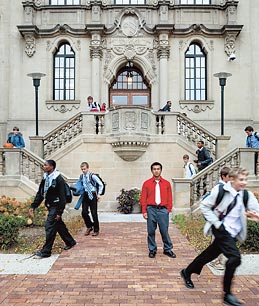
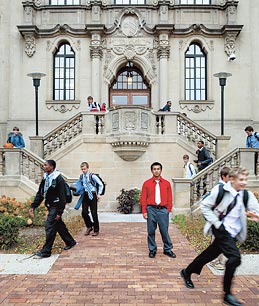
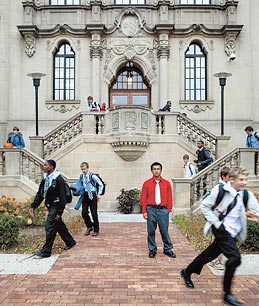
The University of Detroit Jesuit High School and Academy is the last Catholic college-prep school left in the city.

Corine Vermeulen for TIME

Today approximately one-quarter of the school’s 780 students are city residents, with the rest spread across the inner and outer suburbs. The school allocated $1.4 million in financial aid this year to students who could not afford the $9,990 tuition. “We will not turn away any student who is qualified to come here,” says U of D principal Gary Marando.

Jesuits tend to roll their eyes at portrayals of their order’s missionary zeal. (Jeremy Irons’ action Jesuit in The Mission, says Father Patrick Peppard, one of the school’s theology teachers, was “a bit romanticized.”) Still, by any measure, U of D’s service to the city of Detroit since the Jesuits decided to remain has been remarkable. During a period in the late 1970s and early ’80s, the school’s president, Father Malcolm Carron, was even made a Detroit police commissioner.
(See pictures of the remains of Detroit.)

U of D’s continued presence in Detroit offers inner-city boys a way out. But it also gives affluent suburban students a way into a city that has long been neglected by its neighbors. For them, an education at U of D doesn’t involve just driving across city lines to attend classes. Seniors are required to spend every Wednesday morning on a service project in the city. And students in all grades (7 through 12) volunteer their time for no credit. Last year they spent more than 3,500 hours in activities from tutoring public-school kids to delivering food to disabled residents. “We made a commitment to stay in the city,” says Holly Bennetts, the school’s full-time service director. “We have a responsibility to make it better.”
(See pictures of a diverse group of American teens.)

Students are told hundreds of times during their education at U of D that they are training to become community leaders, what the Jesuits call “men for others.” The phrase comes up in nearly every conversation with current and former students. “It’s kinda corny,” says Keith Ellison, class of 1981 and a Democratic Congressman from Minnesota, “but that motto really made me think about service. And it set a course for what I’m doing with my life now.”

The Jesuit ideal can also be found in more recent graduates like Will Ahee and Tom Howe. Both grew up in tony communities – Grosse Pointe and Birmingham – that may be geographically close to Detroit but are worlds away culturally. Through U of D, they volunteered with Earthworks, an urban garden project that is reclaiming for sustainable agriculture some of the thousands of acres of abandoned lots in Detroit. When they graduated a few years ago, Ahee and Howe could have had their pick of universities. They chose to stay in Detroit and attend Wayne State University, where they study comprehensive food systems. How do these college kids spend their weekends? Working in a community garden they started near Elmwood Park, nine miles from U of D.

See pictures of John 3:16 in pop culture.


Jesuit leaders pray at Hindu shrine


HK751_1.jpg 


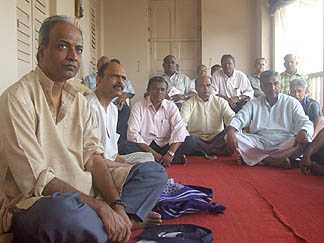
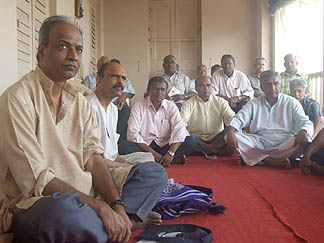
Jesuit provincials and regional
superiors at the Hindu shrine in Belur

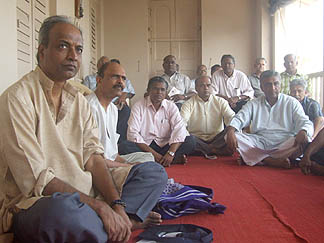
KOLKATA, India (UCAN) — Senior Jesuit leaders from South Asia who prayed inside a shrine dedicated to a Hindu ascetic say the visit and prayers have “enriched” them.About 20 provincials and regional superiors of the Jesuit Conference of South Asia spent 15 minutes at the shrine in Belur on Oct. 29, during an event designed to foster interreligious relations.

The Religious conference comprises provincials and regional superiors from Bangladesh, India, Nepal and Sri Lanka.

The shrine, which sits on the banks of the Ganges, north of Kolkata, is dedicated to Sri Ramakrishna Paramahamsa, a 19th century Indian mystic, who claimed to have had visions of Jesus Christ. Swami Vivekananda, the mystic’s most famous disciple, founded the shrine in 1886.

Calcutta Jesuit provincial Father George Pattery, who organized the visit, said the monks at Ramkrishna Mission, who manage the shrine, promote interfaith dialogue. The Jesuit priest has close ties with the monks.

Father Anthony da Silva, provincial of Goa, told UCA News the visit was “an enriching experience” and added the shrine’s mystical atmosphere “greatly impressed” him.


HK751_2.jpg 


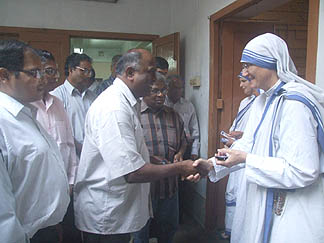
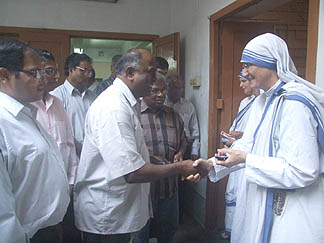
Jesuit leaders meet Sister Mary Prema,
superior general of the Missionaries of Charity

Gujarat provincial superior Father Keith Abranches commented that the visit was “inspiring and enriching. It was another way of God-realization.”Dipankar Basu, a Hindu teacher at Kolkata’s Jesuit-managed St Xavier’s School, guided the group during their visit.

He said it was remarkable to see Catholic priests praying in their own way in a Hindu shrine. An event like this “is sure to have greater effects in creating goodwill, and help people of all faiths to have a change in attitude toward other religions,” Basu told UCA News.

Swami Shantanu Maharaj, from the Sri Ramkrishna Mission headquarters, said Swami Vivekananda founded his religious order on Christmas night in 1886, after he and his friends spent an evening meditating on Christ.

He said Sri Ramkrishna had a vision of Jesus, after which he could not think of anything else for three days. Two of his disciples, Swami Brahmananda and Swami Shivananda, too had a vision of Jesus on Christmas eve 1903 at the Belur shrine.

Earlier in the day, the Jesuit superiors celebrated Mass at the tomb of Blessed Teresa in Kolkata and met Missionaries of Charity superior general, Sister Mary Prema.

The Jesuit provincial and regional superiors are attending their twice-a-year meeting at Konchowki, south of Kolkata.

A Commitment to Visibility


Download pdf 

Uta Sievers

Some impressions from Father General’s talk to the Social Apostolate Coordinators

The core of Father General’s talk to the coordinators this year was the question “Is the Society of Jesus moving away from the poor?” This had come up as an observation during our discussions and was a source of concern for our group.

Father General pointed out how a circle of invisibility has led to fewer and fewer young Jesuits wanting to live and work with and among the poor. The starting point is that there are now fewer Jesuits in all apostolates, not just in the social apostolate. This overall scarcity is one reason why Insertion Communities, which represent the closest way of “being with” the poor and marginalised and are often small, are sometimes the first ones to be closed when a province decides to consolidate its communities; and the closure of an Insertion Community means a story that will go untold to the next generation of Jesuits1. At the same time, there are fewer Jesuits who volunteer to live in Insertion Communities and provincials are aware that they cannot force people into this ‘difficult’ way of living. Why do the provincials perceive it as difficult? A possible reason is that however great the initial motivation based on the Gospel message to be with the poor, there is also a wish not to disturb other processes such as formation and university studies. Secondly (and this is the main reason for the small number of new faces in Insertion Communities), as we ourselves grow older in the social apostolate, we have lost contact with the Scholastics while focussing on the poor. Not all is lost, however. In places where the social apostolate has made visible a way to live as religious among the poor, where we have kept in touch with the Scholasticates, young Jesuits have in fact opted for this way of life.

Father General then shared some ideas with us as to what we, as persons active in the social apostolate, can do. One of his main concerns is the need to guard ourselves against the virus of success; working with the poor will never be ‘a success’ or make us successful in a secular sense. We need to discard the idea of success in our thinking, our mentality, our values – this is true for the whole Society of Jesus, but especially for the social apostolate. According to Father Nicolás’ vision of the Society, it is important to live in simplicity with the people whatever our field, pastoral or academic, or any other. This broad experience of commitment will inspire young people more than all-exclusive social justice work, which may send out the message that when you work with the poor, you cannot serve in any other way. In the same vein, he also warns against an “all or nothing” mentality in the social apostolate, since a purist’s vision of social justice will produce admirers but not followers. Instead, we need to plan this form of work with care; we need to plan our free time, our study, and our service in an interrelated and meaningful way. And last but not least, if we manage to make friends among the poor, we will never feel we are “moving away” even if we change assignments.

Father Nicolás also raised the issue of the way in which we deal with our institutions, especially those that have a long Jesuit tradition. He was quite clear in his analysis that attachment was one of the weakest points of our traditional ministries. We become attached to our ‘creations’ and are very reluctant to let go of the good works we are running. In the process, we are literally killing Jesuits, overloading them with up to five different jobs, infecting them with the virus of success. Mobility is essential to our charism; thus we need to learn a new way of discernment, to let go and move on. For example, when starting a school, we should immediately prepare our lay successors so that we can hand the work over to them after no more than 15 to 30 years. He also stressed the fact that the shrinking number of Jesuits is being compensated for by the growing number of competent lay people who wish to work in our institutions. This gives us the freedom to dream again, to be creative, flexible and mobile. He encouraged us to see our institutions as our children: let them go off, get married and go their own ways.

1For the stories of active insertion communities, see Promotio Iustitiae 100: http://www.sjweb.info/sjs/pj/.

Jesuit Message Drives Detroit’s Last Catholic School

By AMY SULLIVAN / DETROIT

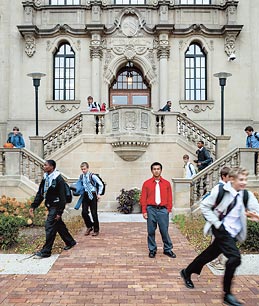
The University of Detroit Jesuit High School and Academy is the last Catholic college-prep school left in the city.

Corine Vermeulen for TIME

Today approximately one-quarter of the school’s 780 students are city residents, with the rest spread across the inner and outer suburbs. The school allocated $1.4 million in financial aid this year to students who could not afford the $9,990 tuition. “We will not turn away any student who is qualified to come here,” says U of D principal Gary Marando.

Jesuits tend to roll their eyes at portrayals of their order’s missionary zeal. (Jeremy Irons’ action Jesuit in The Mission, says Father Patrick Peppard, one of the school’s theology teachers, was “a bit romanticized.”) Still, by any measure, U of D’s service to the city of Detroit since the Jesuits decided to remain has been remarkable. During a period in the late 1970s and early ’80s, the school’s president, Father Malcolm Carron, was even made a Detroit police commissioner.
(See pictures of the remains of Detroit.)

U of D’s continued presence in Detroit offers inner-city boys a way out. But it also gives affluent suburban students a way into a city that has long been neglected by its neighbors. For them, an education at U of D doesn’t involve just driving across city lines to attend classes. Seniors are required to spend every Wednesday morning on a service project in the city. And students in all grades (7 through 12) volunteer their time for no credit. Last year they spent more than 3,500 hours in activities from tutoring public-school kids to delivering food to disabled residents. “We made a commitment to stay in the city,” says Holly Bennetts, the school’s full-time service director. “We have a responsibility to make it better.”
(See pictures of a diverse group of American teens.)

Students are told hundreds of times during their education at U of D that they are training to become community leaders, what the Jesuits call “men for others.” The phrase comes up in nearly every conversation with current and former students. “It’s kinda corny,” says Keith Ellison, class of 1981 and a Democratic Congressman from Minnesota, “but that motto really made me think about service. And it set a course for what I’m doing with my life now.”

The Jesuit ideal can also be found in more recent graduates like Will Ahee and Tom Howe. Both grew up in tony communities – Grosse Pointe and Birmingham – that may be geographically close to Detroit but are worlds away culturally. Through U of D, they volunteered with Earthworks, an urban garden project that is reclaiming for sustainable agriculture some of the thousands of acres of abandoned lots in Detroit. When they graduated a few years ago, Ahee and Howe could have had their pick of universities. They chose to stay in Detroit and attend Wayne State University, where they study comprehensive food systems. How do these college kids spend their weekends? Working in a community garden they started near Elmwood Park, nine miles from U of D.

See pictures of John 3:16 in pop culture.

Jesuit leaders pray at Hindu shrine


HK751_1.jpg 


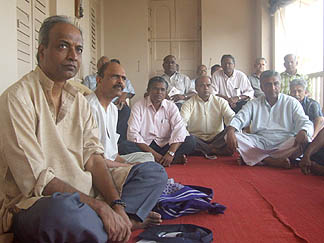
Jesuit provincials and regional
superiors at the Hindu shrine in Belur

KOLKATA, India (UCAN) — Senior Jesuit leaders from South Asia who prayed inside a shrine dedicated to a Hindu ascetic say the visit and prayers have “enriched” them.About 20 provincials and regional superiors of the Jesuit Conference of South Asia spent 15 minutes at the shrine in Belur on Oct. 29, during an event designed to foster interreligious relations.

The Religious conference comprises provincials and regional superiors from Bangladesh, India, Nepal and Sri Lanka.

The shrine, which sits on the banks of the Ganges, north of Kolkata, is dedicated to Sri Ramakrishna Paramahamsa, a 19th century Indian mystic, who claimed to have had visions of Jesus Christ. Swami Vivekananda, the mystic’s most famous disciple, founded the shrine in 1886.

Calcutta Jesuit provincial Father George Pattery, who organized the visit, said the monks at Ramkrishna Mission, who manage the shrine, promote interfaith dialogue. The Jesuit priest has close ties with the monks.

Father Anthony da Silva, provincial of Goa, told UCA News the visit was “an enriching experience” and added the shrine’s mystical atmosphere “greatly impressed” him.


HK751_2.jpg 


Jesuit leaders meet Sister Mary Prema,
superior general of the Missionaries of Charity

Gujarat provincial superior Father Keith Abranches commented that the visit was “inspiring and enriching. It was another way of God-realization.”Dipankar Basu, a Hindu teacher at Kolkata’s Jesuit-managed St Xavier’s School, guided the group during their visit.

He said it was remarkable to see Catholic priests praying in their own way in a Hindu shrine. An event like this “is sure to have greater effects in creating goodwill, and help people of all faiths to have a change in attitude toward other religions,” Basu told UCA News.

Swami Shantanu Maharaj, from the Sri Ramkrishna Mission headquarters, said Swami Vivekananda founded his religious order on Christmas night in 1886, after he and his friends spent an evening meditating on Christ.

He said Sri Ramkrishna had a vision of Jesus, after which he could not think of anything else for three days. Two of his disciples, Swami Brahmananda and Swami Shivananda, too had a vision of Jesus on Christmas eve 1903 at the Belur shrine.

Earlier in the day, the Jesuit superiors celebrated Mass at the tomb of Blessed Teresa in Kolkata and met Missionaries of Charity superior general, Sister Mary Prema.

The Jesuit provincial and regional superiors are attending their twice-a-year meeting at Konchowki, south of Kolkata.