Category: Uncategorized

Find the Story Behind the Christmas Stories

Bookmark and Share


Children enjoy hearing Christmas stories this time of year. Help them notice how the stories usually echo themes and values of the Bible’s account of how a great king of humble origins exalts the lowly, confounds the powerful, and brings salvation.


 

The Polar Express
A train full of children is taken on a magical ride to the North Pole to meet Santa Clause who selects one child to whom to present the first present of Christmas.

Rudolph the Red-Nosed Reindeer
When strong, powerful reindeer run into serious trouble, a lowly reindeer saves the day. This completely unexpected turn of events brings great joy to the world.

A Charlie Brown Christmas
Protesting the commercialization of Christmas, Charlie Brown buys a pathetic-looking, real Christmas tree. He is mocked for it, but Charlie and his friends learn the real meaning of Christmas when Linus tells the story of Jesus’ birth.

The Little Drummer Boy
A boy of humble origins grows to hate people after his family is killed and he is betrayed. His life begins to change when he meets the Magi and follows them to Bethlehem. Finally, when the boy encounters the Christ Child, he learns how to let go of hatred and embrace the true spirit of Christmas.

Presence in the Midst of Crisis

Bookmark and Share


by Vinita Hampton Wright

Of all times for the financial health of the world to end up in Intensive Care-just as the holidays entice us to splurge, to buy a little beyond ourselves because gift-buying and gift-giving are expressions of care, appreciation, even remembrance. We bake richer foods at Christmastime. And wrap things in shinier paper. And we like to spend a little more, just because this time is special. It is a time for feasting and lingering. It is a time for extravagance.

There is some justification for extravagance at this time of year. We are celebrating the love of an extravagant God. The Christ Child is the ultimate gift. God’s love is lavish, overflowing. God did not hold back from us, in sending Jesus, the son of God. In that birth we were given God’s very self.

And so, this year in which money is especially the focus of stress and strategy, perhaps we should think in terms of giving the self instead of stuff. God gave God’s self in fairly plain wrapping-the infant of two pilgrims with limited resources. No fine blankets or silky bassinet for Jesus. No huge basket of Ghirardelli’s chocolate treats for his parents. But the presence of that child was so rich and fine that poor shepherds, great intellects from far countries, a pious widow and an old prophet were all drawn to him with tears and joy.

What kind of presence am I to those I love? If I can’t give a hefty gift certificate or even a nice set of bathroom towels this year, how can I be more present to that person for whom I’ve been willing to pull out an overextended credit card in years past? If I can offer no great cash value, then what is left? My stories? My welcome? My precious time for a phone conversation? My visit that lasts longer than it takes to exchange wrapped boxes?

This has been a stressful autumn for my husband and me. Unemployment, then underemployment, then major house repairs, and family too far away to travel to easily. And what we are discovering is that, to come home in the evening and eat a simple meal together, to give a long hug and a word of encouragement, to spend a little more time with our dogs and cats doing nothing but petting and cooing-all of that is lavish enough for us. There will be no expensive dining out this year, no big party thrown for friends. There will be cooking together in the kitchen, looking for the best price on clementines. There will be one trip to a family wedding and brief stops at other relatives on the way back. On each stop we will enter the home and be there with smaller gifts but a bigger sense of us-us coming in the door, giving hugs, having a relaxed conversation, enjoying the presence of those we don’t get to see very often.

We tend to forget, don’t we, that God’s presence is enough. God’s grace is sufficient. We forget that and follow after the big pay-off, the nicer car, the gadget that will make life more convenient, the vacation that will be more romantic and exotic than all the others. We hanker after finer and pricier presents, when the only answer to our real desire is that awesome Presence.

This Christmas seems like a great time to spend more time in that Presence. And more time exploring the power and wonder of our own presence with others.


This article is written by Vinita Hampton Wright, author of Days of Deepening Friendship

Images of Servant Leadership

Bookmark and Share


by Daniel J. Harrington, S.J.

“For the Son of Man did not come to be served but to serve and to give his life as a ransom for many” (Mark 10:45)

A s our political campaigns draw near to election day, we hear much talk about leadership. While we tend to know it when we see it, leadership is hard to define and does not seem to follow any one pattern or formula. Today’s Scripture readings describe leadership as the service of others and portray Jesus as the best example of it. A series of images from Mark 10 and Hebrews 4 in today’s readings can help us grasp Jesus’ noble and paradoxical notion of servant leadership.

In Scripture “cup” and “baptism” are sometimes images of suffering. To drink the cup is to accept the reality of suffering and to do God’s will in the midst of it, as Jesus did in Gethsemane. To undergo a baptism is to be immersed in water and to suffer a kind of drowning. The point that Jesus makes to James and John is that those who follow the way of Jesus and seek to imitate his example of servant leadership must be willing even to suffer for others.

The images of leaders “lording” over others and making their authority felt stand in contrast to the leadership style of Jesus. Too often in our world, leadership involves a battle of wills and means exercising force over others and making others conform to the leader’s will. This all-too-prevalent pattern is far from Jesus’ ideal of servant leadership.

To be “the slave of all” appears at first glance to be the opposite of being a leader. Slavery was an accepted institution in the Roman empire and an integral part of the economic and social fabric of Greco-Roman society. To speak of a slave was not unusual. But to describe anyone as “the slave of all” made no sense. A slave had only one master. How can anyone be the slave of all, and how can such a person be a leader? Nevertheless, Jesus, as a master of paradox in word and deed, brings these two concepts together in his concept of servant leadership.

The image of “ransom” evokes the practice of buying someone out of slavery or kidnapping. Paying a ransom can sometimes bring that person back to safety and freedom. The image suggests that Jesus’ death on the cross was a kind of redemption or ransom that enabled us to gain freedom from sin and death and to share the intimate relationship that Jesus enjoyed with his heavenly Father. The idea is rooted in the Servant of the Lord described in Isaiah 53: “through his suffering my servant shall justify many.” The goal of Jesus’ life and death was not power over others but rather the service of others. As the one who came not to be served but to serve, Jesus provides the pattern and the measure of his own ideal of servant leadership.

To express the effects of Jesus’ servant leadership, the author of Hebrews uses the images of “sacrifice” and “priest.” Like other early Christians, he understood Jesus’ death on the cross to be an atoning sacrifice for sins. Because Jesus freely and willingly went to his death for us, he reasoned that Jesus can therefore be regarded as a priest (since priests customarily offered sacrifices). He further argued that unlike the Jewish high priests who offered sacrifices yearly on the Day of Atonement, Jesus, who offered himself once for all as the perfect sacrifice for sins, can be called the great high priest.

Like other New Testament writers, the author of Hebrews interpreted the passion, death, resurrection and exaltation of Jesus as one great comprehensive event (the paschal mystery). In describing the last element he employs the image of Jesus passing through the heavens to return to his Father. Because of the paschal mystery, the author of Hebrews could exhort his confused and weary audience to hold fast to their confession of faith. His point was this: the one truly efficacious sacrifice for sins has been offered in Jesus’ death on the cross. Christ the great high priest has done his saving work, and the victory has been won once and for all. We do not have to do what the Jewish high priests did yearly on the Day of Atonement, because what Jesus did is more than sufficient. This is the author’s word of consolation and exhortation.

Today’s passage from Hebrews 4 allows us to understand better the results of Jesus’ practice of servant leadership. As one like us in all things but sin, Jesus can be sympathetic toward us and can serve still as our advocate and defender. And because of his servant leadership, we can approach God confidently and even boldly and expect to find mercy at what is now the “throne of grace.” All this flows from and through the servant leadership of Jesus.

Praying with Scripture

• How do you define leadership? Who best exemplifies leadership for you? Why?

• In what respect is Jesus the best example of his own ideal of servant leadership?

• Why does the author of Hebrews express the effects of Jesus’ servant leadership in terms of sacrifice and priesthood? Do you find these images helpful? What images might you use?


Daniel J. Harrington, S.J., is professor of New Testament at Weston Jesuit School of Theology in Cambridge, Mass.

Africans Receive University Icon

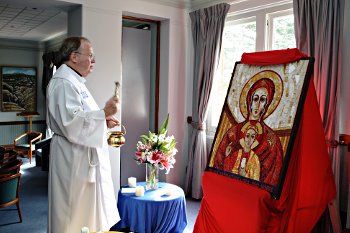
Our Lady, Throne of Wisdom, Completes Aussie Tour  Bookmark and Share

By Carmen Elena Villa

VATICAN CITY, DEC. 18, 2009 (Zenit.org).- The Sedes Sapientiae icon of Our Lady — commissioned by Pope John Paul II for university students in 2000 — has finished its tour of Australia and is headed now to Africa.

A climate of prayer, intercultural friendship, and naturally, the search for wisdom, marked the Thursday vespers service during which the icon was given to African students by their Australian contemporaries.

Breaking with tradition, Benedict XVI himself presided over a pre-Christmas vespers service with

 university students of Rome (usually the vicar for Rome celebrates the Mass and presides over vespers, and the Pope arrives at the end to give an address).

The icon of Our Lady, Throne of Wisdom — created by Jesuit Father Ivan Rupnik — spent the year visiting Australian universities. The Pope chose this venue following the July 2008 World Youth Day in Sydney.

Daniel Hill, of the University of Sydney, was with 10 other young Australians in a delegation that traveled to Rome to entrust the icon to Africa.

He said the icon’s time Down Under was “a beautiful experience,” explaining that the image visited 13 universities.

Hill recounted to ZENIT how during the tour, small groups of students gathered to reflect on the presence of Mary in university life. “It helped us to understand that the university should be a light that radiates the light of Christ through the example of his holy Mother,” he said.

Seminarian Nicholas Rynne spoke of the change experienced by many young Australians over the last two years. “As Catholics, it is easy to feel isolated, but with this icon and with World Youth Day, we have had a powerful experience of communion with the Church.”

As 2009 was an important year for the Church in Africa — with the Pope’s first apostolic visit there last March and October’s synod on Africa — 2010 will see the icon traveling to various universities across that continent.

The vespers service in Rome on Thursday already had an African feel, with the entrance and closing Marian hymns being sung to African melodies.

For young Father Paul Ubebe of Nigeria, the presence of the icon “enables us to be closer to the Church as university students. In this way, we value more the role of Mary in our salvation.”

Reine Marie Miranda of Senegal told ZENIT that the most moving experience at vespers was the Pope’s homily. Benedict XVI said, “Without the wisdom of God, not anything has been made of all that exists: A Christian professor or student reads everything in his light.”

For Miranda, “to be humble is to see study with the eyes of little ones. Reasoning as a child, one can make miracles, because for a child, there are no limits.”

Nativity Scenes

Besides having Christ as the focal point, Nativities capture a snapshot of the life of the people in these scenes. Yet each artist interprets the scene according to his or her particular culture. For example, an American artist might depict the Nativity in a garage, with dogs and cats roaming around instead of camels and sheep. By creating Nativity scenes that reflect their cultures, these artists show us that God is truly present in our lives here and now.

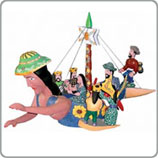
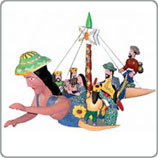
This wood carving was created by Agustín Cruz Tinoco, who was born in San Juan Oxolotepec, Oaxaca, Mexico. He is an excellent folk artist and woodcarver. Many of his creations are done in the Oaxacan style of alebrijes, which are representations of imaginary human- or animal-like creatures using vivid colors and images.

In the woodcarving “Nativity”, Tinoco has created a boat-like vessel with a masthead shaped like a woman. Sitting on the prow is Mary with Jesus on her lap. She is dressed in ordinary Mexican clothing. Her husband Joseph is rowing the boat. A figure representing a shepherd stands at the end of the boat, watching over the family. On the left side are two kings and on the right is another king and an angel. The kings bring gifts of a pig, a turkey, and a rooster.

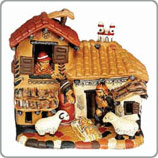
This ceramic nativity was created by Feriberto Aylas, who is from Ayacucho, Peru. Aylas specializes in ceramics and strives to keep the traditional techniques of the Andean people. In each of his creations, Aylas seeks to express the heart of Peru through depictions of the daily joys, rituals, and activities found in Andean villages.

In many Nativity scenes, each person, animal, and object is created separately. This Nativity, however, is different. The whole scene is composed out of a single piece of clay. The clay is hand-shaped and prepared for firing. After it is fired, it is painted by hand with natural pigments. When the paint is dry, a clear sealant is applied.


If you were to design a Nativity scene that showed how God is present in your life, what would it look like?

Jesuits urged to widen scope of mission

KOLKATA, India (UCAN) — Jesuits in Kolkata have been urged not to rest on their laurels but work harder to serve Indian society, during programs marking 150 years of their Bengal mission.

HK953_3.jpg

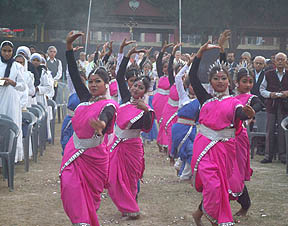
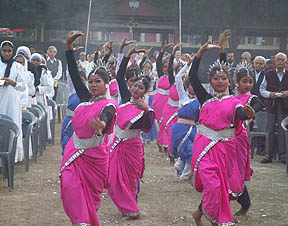
An entrance dance during the Mass celebrating
the 150th anniversary of the Bengal mission

The early missioners contributed a lot to the development of tribal communities in eastern India, noted Naresh Gupta, secretary of the national Jesuit Alumni Association of India, at a Nov. 28 function to mark the occasion.

However, he said he now wants the Jesuits to widen their scope and provide healthcare facilities in the country, which remain neglected.

Similarly, Jesuit Provincial of South Asia Father Edward Mudavassery, while paying tribute to the Jesuits’ contributions in Bengal, invited them not to bask in their past glory but get ready to face current challenges boldly.

More than 2,000 people, including 10 bishops, attended the jubilee celebrations at St. Xavier’s College in Kolkata (formerly called Calcutta), the capital of West Bengal state.

The program included a symposium on Jesuit contribution to the education and social life of people in eastern India, an exhibition on the Bengal mission’s growth and a multimedia presentation on the mission.

Cardinal Telesphore P. Toppo of Ranchi, in his homily during the jubilee Mass, compared the early Belgian Jesuit missioners to Abraham of the Old Testament, who left his homeland for a place that God had chosen for him. The cardinal expressed hope that the jubilee celebrations would renew the “missionary zeal in our time even though it may encounter many obstacles.”


HK953_4.jpg 


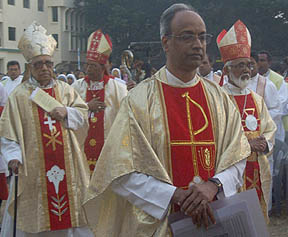
Concelebrants during the Mass: From left: Retired Archbishop Henry D’Souza of Calcutta, Cardinal
Telesphore Toppo, Calcutta Jesuit Provincial Father
George Pattery and Bishop Salvadore Lobo of Baruipur

Four Belgian and three English Jesuits landed in Kolkata port on Nov. 28, 1859. The mission they started now comprises two archdioceses, 21 dioceses, and seven Jesuit provinces, spread over Bihar, Chhattisgarh, Jharkhand, Orissa and West Bengal states.

Other guests at the event praised the pioneering spirit of the early missioners.

The Jesuits in Bengal have dedicated their life to enrich the lives of people with their quality education and cultural contributions, said Salomi Mamata, who works with Calcutta archdiocese’s social service center. “What I am today is thanks to the Kolkata Jesuits,” she said.

Snehashish Sur, a TV journalist, hailed the Jesuits’ values-based education and identification with local people. He said he was surprised when the late Belgian Father Gerard Beckers started living in a tribal Santal area after retiring from his work at St. Xavier’s College. “He moved around in a bicycle, and that was truly exemplary,” he added.

Jesuits look back on 150 years of Bengal mission

KOLKATA, India (UCAN) — Belgian Jesuits are celebrating the 150th anniversary of the establishment of their Bengal mission in eastern India.

HK933_1.jpg 


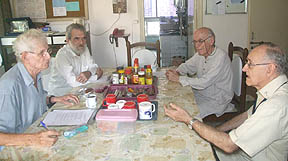
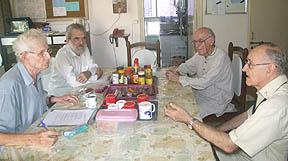
Belgian Jesuit missioners of Calcutta province have
a chat over a cup of coffee at the Jesuit provincial
house in Kolkata. From left: Father Jean Englebert, a liturgist, Father Charles Pollet, a theology professor,
Father Albert Huart and Father Andre Bruylants

The order has had a big impact on lives in the region through education, literary contributions and a translation of the Bible into Bengali.

Father Andre Bruylants, 83, former headmaster of the Jesuit-run St. Xavier’s College in Kolkata, has been working in the mission for 60 years. He is one of seven remaining Belgian Jesuits in the religious society’s Calcutta province.

Jesuit teachers had educated thousands of people and become icons of Catholic education in the region, he says.

Others have influenced the region’s socio-cultural leaders through scholarly interreligious exchanges, and reached out to Indians through the study of Hindu scriptures and engagement with Hindu intellectuals.

Jesuits have influenced literary thinking through publishing and translating Western Christian classics into Bengali, and also helped locals use their own language in worship.

Father Christian Mignon, 85, came to the mission at the age of 25. He was to make a unique contribution to religious life in Bengal, translating the Bible into Bengali over 40 years. The job, in which he was helped by Hindu poet and teacher, Sajal Banerjea, was completed in 2003.

He had previously translated liturgical texts after the Second Vatican Council, which opened the way to the use of local languages in the Mass.

English Jesuits first came to Kolkata in 1833 and started St. Xavier’s but left the country in 1849 after a conflict with the local bishop.

The Belgian Jesuits, who arrived in the city in 1859, were invited to restart the school, which they did within two months in January 1860.

Belgian Jesuit Father Albert Huart, 85, who translated a book on the Jesuits’ Bengal-mission history, is former vice-principal of St. Xavier’s College.

He said that the Belgians expanded from the English educational base to probe further the possibilities of village missions.

Initially the Jesuits’ focus was on the Chotanagpur area, in the present state of Jharkhand. This was where Jesuit Father Constant Lievens (1856-1893), whom the tribal Church reveres as the “apostle of Chotanagpur,” had worked to restore tribal dignity.

By 1869 the Jesuits were entrusted with the Bengal mission, at the time consisting of the present Indian states of West Bengal, Jharkhand, Bihar, Madhya Pradesh and Orissa.

Jesuit program breaks culture of violence in refugee camps

DAMAK, Nepal (UCAN) — The Jesuit Refugee Service has stepped in to break a cycle of violence, drug and sexual abuse that had been plaguing thousands of ethnic Nepali youths from Bhutan living in refugee camps in East Nepal.

HK926_5.jpg 


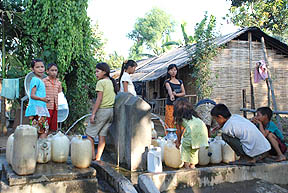
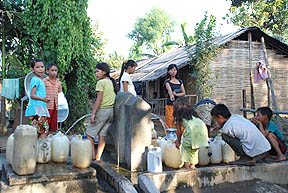
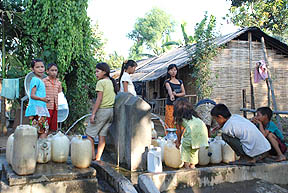
Bhutanese refugees collecting drinking water
at the Sanischare refugee camp in eastern Nepal

“All kinds of evils were plaguing the camps,” says Jesuit Father Peter Jong Lepcha, program coordinator of Youth Friendly Centres (YFC).

“We realized that there are so many programs being implemented for the refugees in general but nothing for the youth as such.”

The YFC program is part of the Jesuit Refugee Service’s(JRS) Bhutanese Refugee Education Program, supported by the United Nations High Commission for Refugees (UNHCR) and Caritas Nepal.

Ganesh Pradhan, 37, in charge of the YFC program in Sanischare refugee camp told UCA that the initiative has given the youths a platform to develop their skills and overall personality.

“The various programs under the YFC have changed the lives of the youths here. Instances of violence that existed earlier, the drug abuse, the sexual abuse and other problems have gone down dramatically,” he said.

The Bhutanese of Nepali origin — known as Lhotsampas — are caught in a no man’s land.

Thousands fled Bhutan fearing for their lives after new citizenship rules were introduced about two decades ago. The government says the refugees are migrants and have no right to live in Bhutan.

The refugees believe their only options are settling down in foreign countries or repatriation to the homeland they still love.


HK926_4.jpg 


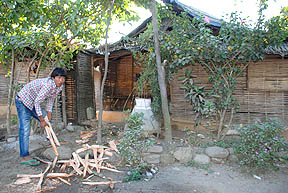
A Bhutanese refugee arranges firewood
in front of his hut at the camp

Sun Maya Tamang, 39, wants to go back to Bhutan, but she says she still has not made up her mind if she will opt for a third-country resettlement.

“I may just opt for it, I am not sure,” she said. “I still feel bad about leaving behind, 18 years ago, the home, the farmland we had, and the happy memories.”

According to the JRS, there are now more than 108,000 refugees living in the seven camps in East Nepal.

JRS field director Father PS Amalraj, told UCA News that young people are vital to conditions in the camps.

“The power of the youth can either build or destroy the refugee camps. Keeping this in mind, we established one youth friendly center in each camp and we now have 14,000 members,” Father Amalraj said.

The YFC initiative consists of education in journalism, television presenting, sports, music and awareness of HIV/AIDS and other social issues.

An online education program has recently been added to address the growing school drop-out rate in the camps, Father Lepcha says.

The UNHCR reported in September that more than 20,000 Bhutanese refugees had been resettled overseas — mostly in the US — with a further 5,000 expected to leave Nepal by the end of 2009.

Jesuit program breaks culture of violence in refugee camps

DAMAK, Nepal (UCAN) — The Jesuit Refugee Service has stepped in to break a cycle of violence, drug and sexual abuse that had been plaguing thousands of ethnic Nepali youths from Bhutan living in refugee camps in East Nepal.

HK926_5.jpg 


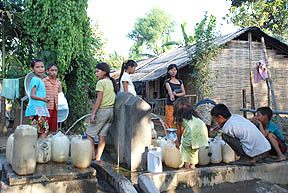
Bhutanese refugees collecting drinking water
at the Sanischare refugee camp in eastern Nepal

“All kinds of evils were plaguing the camps,” says Jesuit Father Peter Jong Lepcha, program coordinator of Youth Friendly Centres (YFC).

“We realized that there are so many programs being implemented for the refugees in general but nothing for the youth as such.”

The YFC program is part of the Jesuit Refugee Service’s(JRS) Bhutanese Refugee Education Program, supported by the United Nations High Commission for Refugees (UNHCR) and Caritas Nepal.

Ganesh Pradhan, 37, in charge of the YFC program in Sanischare refugee camp told UCA that the initiative has given the youths a platform to develop their skills and overall personality.

“The various programs under the YFC have changed the lives of the youths here. Instances of violence that existed earlier, the drug abuse, the sexual abuse and other problems have gone down dramatically,” he said.

The Bhutanese of Nepali origin — known as Lhotsampas — are caught in a no man’s land.

Thousands fled Bhutan fearing for their lives after new citizenship rules were introduced about two decades ago. The government says the refugees are migrants and have no right to live in Bhutan.

The refugees believe their only options are settling down in foreign countries or repatriation to the homeland they still love.


HK926_4.jpg 


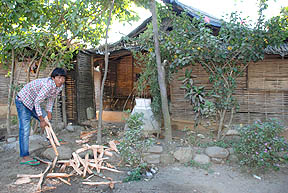
A Bhutanese refugee arranges firewood
in front of his hut at the camp

Sun Maya Tamang, 39, wants to go back to Bhutan, but she says she still has not made up her mind if she will opt for a third-country resettlement.

“I may just opt for it, I am not sure,” she said. “I still feel bad about leaving behind, 18 years ago, the home, the farmland we had, and the happy memories.”

According to the JRS, there are now more than 108,000 refugees living in the seven camps in East Nepal.

JRS field director Father PS Amalraj, told UCA News that young people are vital to conditions in the camps.

“The power of the youth can either build or destroy the refugee camps. Keeping this in mind, we established one youth friendly center in each camp and we now have 14,000 members,” Father Amalraj said.

The YFC initiative consists of education in journalism, television presenting, sports, music and awareness of HIV/AIDS and other social issues.

An online education program has recently been added to address the growing school drop-out rate in the camps, Father Lepcha says.

The UNHCR reported in September that more than 20,000 Bhutanese refugees had been resettled overseas — mostly in the US — with a further 5,000 expected to leave Nepal by the end of 2009.

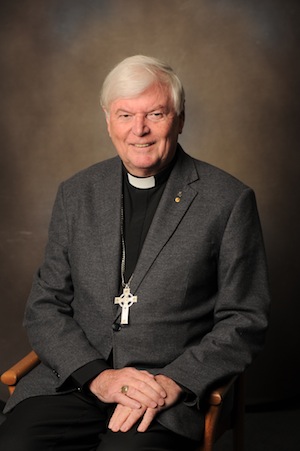
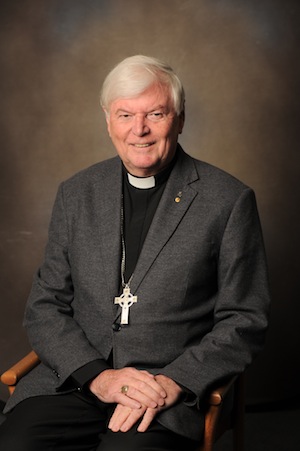
Bishop O’Kelly writes from Port Pirie

Bishop O'KellyHerewith a bit of a report on the last three months or so. In mid-October, Br Ian Cribb joins myself and a Josephite Sister on a five-day visit to homesteads in the Far North, going by four-seater plane to thirteen destinations, spending a half day in each and staying overnight with the families or in the Shearers’ Quarters. People come in from outlying Stations and we meet them and say Mass in some of the homesteads. The Josephite is roving Pastoral Associate, and Ian will reflect on what we might do in the way of the Exercises for such remote people. Our pilot is a farmer, not a Catholic, who has a property out of Carrieton in the north, and who offers this time for the bishop each year.

The names of the destinations are evocative of the Outback – Mintibie, Coober Pedy, Arkaroola, Oodnadatta, Marree, Mungerannie, Birdsville, Innamincka. Birdsville is just outside the diocese, but when Bill Morris, Bishop of Toowoomba, comes that far down, he also visits Innaminka (Pirie diocese) and when the Bishop of Pirie goes as far north as Innaminka, he visits Birdsville. Very relaxed arrangement – no worries re police checks etc!

For the rest, it is a matter of getting around over big distances. I have just clocked up 15000kms in just under four months, but have not yet got to the northernmost point at Uluru nor the westernmost just beyond Ceduna (though the diocesan boundary goes to the border). The people make an occasion of the visit, so lots of shaking of hands after the Mass and confirmations, and then suppers or luncheons abounding in cream.

I am very grateful for the support of the brethren, from the frequent hospitality of the South Australian communities (Fr Celso Romanin brought the whole Norwood parish team to Pirie one day for lunch), to the offer from Jesuit Theological College for two or four scholastics to come and help out in parishes for a couple of weeks after Christmas, to Fr Brendan Byrne and Fr Richard Leonard, who will be taking part in an in-service programme I am arranging for the Pirie priests to commemorate the Year for the Priest (YFP), to the frequent assistance given by the Sevenhill community. We are pushing the YFP a lot in the diocese – special prayers each Sunday, parish retreats, priestly in-service, prayer cards for students and families, weekly Exposition in each parish for the needs of the diocese, which clearly include vocations, as we have no seminarians (yet). There is such a need to support these priests in their isolated locales. Our priests are heroic in their commitment and are wonderful men, revered by the people, but age and health are energy and money matters of the diocese are issues that can wake up a bishop in the night. Therapy for the occasional addiction problem can be so contentious, and can be in price beyond our means. We are not free from scandals from the past; a former Vincentian who worked in the diocese 24 years ago has been extradited from Indonesia for abuse issues and has pleaded guilty to several of the charges, and I am dealing with some of the victims. Re personnel, I have written to a number of Religious Congregations here and overseas, seeking possible recruits. All the male religious have withdrawn from the diocese; I am the only male religious here. The Sisters, as they become frail, are also being withdrawn to the city, where they can be cared for, so fresh blood is needed.

I am investigating how we might appoint a Business Manager for the diocese, within our means. I am looking for someone to be a Vicar or spokesperson on issues affecting aboriginal people in the diocese (apart from health, educational and social issues, the north-west traditional communities are growing in size as people move away from the Intervention impact in the Northern Territory), a vicar or spokesperson to comment on issues arising out of the three major prisons in the diocese, and a vicar for religious, to care for the isolated Sisters. I attended the recent NATSICC conference in Brisbane, where Fr Mauri Heading was also present, to get some idea of the national Catholic scene and persons involved in indigenous ministry.

There are two Bishops Commissions of which I am a member. This month I attended the Sydney meeting of the Bishops Commission for Justice and Development; members are the bishops of Hobart, Broome, Darwin, Pirie and Julian Porteous. Its areas of responsibility are the Catholic Social Justice Commission, Catholic Earthcare Australia, and Caritas Australia. Jack de Groot, former SJ, is the Executive Officer and he and Archbishop Doyle were swimming at a beach in Samoa that two days later was devastated by the tsunami; they were there conferencing about how Caritas might respond to a natural disaster, and two days later … As chairman of the Bishops Commission for Education, I received an invitation recently to join a couple from the NCEC executive to have dinner with Julia Gillard (Deputy Prime Minister and Minister for Education) to discuss educational issues. I can’t go because of the station-hopping mentioned above. I am much sadder to miss Fr Wieslaw Slowik’s jubilee party, because of the same hopping.

The size of the diocese, dotted with small communities, keeps amazing me. Extraordinary features abound, flora and fauna. For example, the Government has just given an estimate that there are one million (!) wild camels in the State. There is a plan for private enterprise to establish a plant at Port Pirie to “process” up to one hundred thousand of these camels a year, mainly for pet food!!

My admiration for Fr Alois Kranewitter, our pioneer Jesuit, grows each day as I drive around, me in the comfort of a Holden Captiva and he on a horse bought with the butter Brothers Schreiner and Sadler made and hawked through the countryside. What company we keep in this Society!

Bishop O’Kelly was appointed Bishop of Port Pirie 15 April 2009 and ordained bishop on 14 September 2009.