Category: Uncategorized

Koreans honor Ricci’s pioneering mission

Bookmark and Share


By John Choi Seoul

Fully-fledged cultural exchanges between East and West began with Father Matteo Ricci, according to a prominent speaker at a seminar commemorating the 400th anniversary of the Jesuit missionary’s death.


A panel discussion during the symposium

“Father Ricci held in-depth discussions with intellectuals in China for years and documented them,” said Song Young-bae, honorary philosophy professor of Seoul National University. “Ricci was the pioneer of exchanges between East and West, so to speak,” he said.

Song was speaking at a Sept. 16-17 international symposium on Father Matteo Ricci organized by the Jesuit-run Sogang University.

According to Song, the Jesuit missioner used three methods in his evangelization efforts in China.

Ricci first drew people’s attention by introducing European science like world maps and alarm clocks. He also respected Chinese traditions and Confucian ancestral rites as a form of inculturation. Finally, by mixing with the upper classes, he tried to make Christianity known to ordinary people.

“He brought Western science technology, philosophy and religion to Chinese,” Song said. “In turn he enlightened Europe about the socio-political system, philosophies and religions of China through his letters and books.”

These exchanges “had a strong influence on Eastern and Western civilizations,” Song said.

Father Matteo Ricci’s presentation of world maps and theories of deduction had a major effect on the Chinese who until then believed China was at the center of the earth, and had only theories on inductive reasoning, Song said.

Some 14 local and foreign scholars reviewed the achievements of the Jesuit missionary and reflected the symposium’s theme: Cultural Encounters of East and West, Challenge and Opportunity.

They also studied tensions, struggles and challenges in ongoing exchanges between East and West by reviewing Father Matteo Ricci’s works.

Italian Father Matteo Ricci (1552-1610) traveled from Italy to China in 1582. He wrote The True Meaning of the Lord of Heaven in Chinese and transmitted Catholic teachings through it.

His missionary work was based on a cultural approach involving discussions, inculturation, fellowship and human development.

Podcast : What Is ‘The Good Word’?

Bookmark and Share


What Is 'The Good Word'?

John W. Martens, an associate professor of theology at St. Thomas University and the principal blogger for “The Good Word,”introduces America‘s Scripture blog by asking, what is the Bible? The answer depends on whether you are Jewish, Catholic, Orthodox or Protestant. Even among English speaking Catholics there is disagreement about which Biblical translation is the best. Professor Martens shares his favorite translation and his favorite book of the Bible. He also explores the deeper question of what it means to say the Bible is inspired by God.


Download 

The Jesus of History

Bookmark and Share


Two scholars respond to Luke Timothy Johnson.

by BERNARD BRANDON SCOTT AND ADELA YARBRO COLLINS

The relation of the Christ of faith to the Jesus of history is a topic fraught with controversy in theological circles. It also has implications for the way Christian believers understand and practice their faith. We invited Luke Timothy Johnson to reflect on the topic and state his own position, which he did in The Jesus Controversy,” published in America on Aug. 2. We have asked two biblical scholars with different views, one a Catholic, the other a Protestant, to respond to Professor Johnson’s article. The three articles together give an indication of the scope of current thinking by mainstream scholars. All three articles appear online, where readers can add their own insights, experience and viewpoints. -The Editors


Following the Troubadours

How the historical Jesus tests-and strengthens-our faith

Bernard Brandon Scott

The biblical scholar Luke Timothy Johnson has sung the same tune for a long time, one that reassures those who are satisfied with the status quo. The quest for the historical Jesus, however, was founded on a rejection of the status quo.

Professor Johnson’s argument plays out in a series of either/ors, the implication being that one side is the false position and the other the true one. A primary opposition for him is the historical Jesus and the real Jesus. Who can argue for the impoverished Jesus of historical efforts when one can have the real Jesus? But if one challenges both the obviousness of the categories and the necessity of the opposition, then suddenly the tune becomes discordant.

Scholars have created “apocryphal gospels,” Johnson charges. These modern apocryphal gospels stand in contrast, of course, to the true, canonical Gospels. He offers no proof that these are either apocryphal or gospels, but rhetorically, the category once established is irresistible. Who could possibility prefer an apocryphal gospel to a real Gospel?That the Jesus of these apocryphal gospels “is often a mirror image of the scholars’ own ideals,” is an old, well-worn charge. For the sake of argument, let’s grant that Johnson is right, that these are all mirror images of the scholars’ own ideals. Is that not also the case of the Jesus of Mark’s Gospel and every other Gospel? So the real Jesus turns out also to be a reflection of the various Evangelists’ ideals about Jesus. The real Jesus is just as constructed as the historical Jesus of the modern apocryphal gospels. Even more, the real Jesus turns out to be multiple, a different Jesus conjured up by each Evangelist, just as scholars conjure up multiple images or reconstructions of Jesus. If one is honest, the tradition has conjured up even more images of Jesus, perhaps an almost infinite number.

Johnson has a solution to this problem: “Each Gospel witnesses to the truth that Jesus as a human being was defined first by his radical obedience to God and second by his utter self-giving to others.” Johnson argues that this Platonic essence is reconstructed from the Gospels’ convergent pictures of Jesus by historical method, historically verified. His argument reminds me of Adolf von Harnack’s argument in What Is Christianity?: “In the first place, they [the Gospels] offer us a plain picture of Jesus’ teaching, in regard both to its main features and to its individual application; in the second place, they tell us how his life issued in the service of his vocation; and in the third place, they describe to us the impression which he made upon his disciples, and which they transmitted.”

This Platonic essence is convenient but not self-evident. It is not a historical statement, as Johnson declares, but a theological judgment, and not the only possible theological judgment about the Gospels. He maintains that the Gospels “converge impressively precisely on the historical issue that is of the most vital importance concerning the human Jesus, namely his character.” This raises inevitable historical questions. Where does this convergence come from? Would any Gospel writer acknowledge Johnson’s Platonic essence? So general is his Platonic essence that I wonder if it is helpful or even distinctive. Is it not true of other historical characters? Again, if we grant this as a valid summary of the character of Jesus in all four Gospels, where did those authors get their information? How does one know they are right in their judgment? Maybe they are just following the lead of Paul or Mark.

These questions lead back either to history or to Johnson’s preferred modality, faith. You have to take it on faith. Faith is not innocent. Push below the surface and faith is a stand-in for authority. To take it on faith means to take it on authority. But then, whose authority? How does one test that authority? Once again one faces historical questions.

Not only do I find Johnson’s categories not established by rigorous method; I also find his either/or method of argumentation unconvincing. There is another option. Historical criticism can be a both/and. Historical analysis is deconstructive and often corrosive to authoritarian claims. History does not grant certainty, only probabilities, but then neither does faith grant certainty. If it were certain, we would not need faith. A historical understanding of early Christianity presents a range of options and demonstrates development and difference within the early movements that sprang up from those seeking to follow Jesus. That can be liberating but also challenging and threatening.

Johnson concludes with a passionate plea about the proper focus of Christian awareness: “learning the living Jesus…in the common life and common practices of the church.” But how do we know this is the real Jesus? For Johnson, the either/or is history versus faith. That for me is a false dichotomy. Faith must always be tested, and that raises historical questions (as well as other kinds of questions), which provide only probability. There is no way around it, unless faith is an authoritarian claim. Given the bankruptcy of authority in the church today, we should take any such claim of authority with a historical and deconstructive grain of salt. That is why people are listening to the troubadours.


In Defense of the Historical Jesus

Empirical studies of the Gospel are limited. They are also necessary.

Adela Yarbro Collins

Luke Timothy Johnson makes a good case for the importance of, in his words, “the living Jesus-the resurrected and exalted Lord present to believers through the power of the Holy Spirit-in the common life and the common practices of the church.” But in his essay Professor Johnson also claims, “History is a limited way of knowing reality.” I must point out that all ways of knowing reality are limited. Even experience of “the living Jesus” is limited by the questions and needs of individual believers, by the leadership of professional ministers and by the ethos of particular congregations and churches.

Johnson praises (faintly) the excellent work of Msgr. John P. Meier in A Marginal Jew and cites with approval Monsignor Meier’s recognition that “the empirically verifiable Jesus is by no means the ‘real’ Jesus.” Both scholars are right in saying that historical methods can give us only a partial picture of Jesus. In my view, however, the “real” Jesus is absolutely unknowable. Anyone who makes a claim about “the real Jesus” is speaking rhetorically and not making a verifiable claim about reality. Historians are concerned with the human Jesus who was born, lived and died, leaving traces that can be studied using historical methods. The resurrected and exalted Lord is just as much a construction of those who worship and experience him as is the historical Jesus constructed by scholars.

In his book The Real Jesus, Professor Johnson was very critical of the Jesus Seminar. The basic idea and procedures of the seminar are, in principle, admirable. I attended a number of their meetings in the 1980s, which were early years in its history. Each meeting focused on a particular topic-for example, the parables. One or more scholars volunteered to research the parables of Jesus in preparation for the meeting to see what previous studies had concluded about them and to evaluate the evidence for their origin. Then these scholars gave presentations at the meeting itself, arguing that Jesus had spoken some of the parables and that followers of Jesus created others after his death. After the presenters had laid out the evidence and the arguments, the assembled scholars debated these findings. After extensive debate, a vote was taken on each parable. Every member of the seminar would place a bead in a basket: red for the view that Jesus most probably spoke the parable, pink for the view that he probably told it, gray for the view that he probably did not tell it and black for the view that he most probably did not.

In an ideal world, well-educated and well-informed scholars would assess the evidence and arguments with an open mind and vote in accordance with the stronger evidence and arguments. I am sorry to say that such was increasingly not the case in later meetings of the Jesus Seminar, notably in the 1990s. Scholars had preconceived ideas, such as the conviction that Jesus was a teacher or philosopher, not a prophet, and these ideas determined how they voted, regardless of the evidence.

This situation, however, is not a fault unique to the Jesus Seminar. It is characteristic of the human condition. There will always be more and less competent scholars and better and worse arguments and thus more and less reliable historical conclusions. Similarly, there are more and less competent professional ministers, better and worse types of common life and more and less helpful common practices in the church.

Johnson aims “to show how encountering Jesus as a literary character in each of the canonical Gospels enables a more profound, satisfying and ultimately more ‘historical’ knowledge of the human Jesus than that offered by scholarly reconstructions.” Such an attempt does indeed have value. But many Americans, inside and outside the church, care about history in a stronger sense and about historical methods and results. In other words, they want to know in what ways the Gospels represent the actual Jesus accurately and in what ways they are fictions or later theological interpretations of Jesus that contradict or go beyond what historians can determine about the past. Historians recognize that the Gospels are interpretations of Jesus from the perspective of faith in him as the Messiah, Son of God or Son of Man and that this faith is founded upon the experience and proclamation of his resurrection, an event that by definition is beyond history.

In Johnson’s view, “Each Gospel witnesses to the truth that Jesus as a human being was defined first by his radical obedience to God and second by his utter self-giving to others” (emphasis added). Imitation of the character of Jesus has long been a high value in the church. It would truly be the manifestation of the kingdom of God on earth if all members of the church would imitate these two aspects of Johnson’s reconstruction of the character of Jesus. The trouble is that in the history and present life of the church, radical obedience and utter self-giving are moral values that only some members of the church are seriously expected to practice. Already in the second century, Ignatius of Antioch taught that the members of Christian communities should obey the bishop as they would obey God. Such advice creates too great a gulf between the clergy and the laity. The value of obedience can serve to increase the power of the hierarchy in the church and to limit the participation of lay people in general and women in particular.

The study of the historical Jesus, however limited the reliable results may be, is an important means of testing theological interpretations of Jesus that claim to be based on the intentions and life of Jesus. Those with a good grasp of the current state of research on Jesus can discern whether such interpretations are indeed congruent with the probable mission and aims of Jesus.


Bernard Brandon Scott is the Darbeth Distinguished Professor of New Testament at Phillips Theological Seminary, in Tulsa, Okla. Adela Yarbro Collins is the Buckingham Professor of New Testament Criticism and Interpretation at the Yale Divinity School in New Haven, Conn.


The Catholic Schools We Need

Bookmark and Share


by TIMOTHY M. DOLAN

When St. Paul describes the gifts God has given the church, he includes teaching among the most important (1 Cor 12:28). No surprise there. “Go teach!” was the final mandate of Jesus. History has long taught that without teachers to announce the Gospel and educate the young, the church struggles to survive. Evangelization through good teaching is essential to Catholic life. Pastoral leaders in developing nations say that Catholic education is what attracts people to Jesus and his church. When it comes to education, nobody has a better track record than the church.

In the 20th century, for example, there was no greater witness to the effectiveness of Catholic schools than the Nazi and Communist efforts to destroy them. Pope Benedict XVI’s own beloved homeland-where to be Bavarian was to be Catholic-was perhaps hardest hit in all of Germany. By January 1939 nearly 10,000 German Catholic schools had been closed or taken over by the Nazi Party. Tyrants know and fear the true strength of a Catholic education: what parents begin in the home, Catholic schools extend to society at large.

But what of today’s Catholic schools that exist in a world largely free of those sorts of 20th-century threats? Are we not facing our own crisis of closure for the Catholic school in America?

The answer is yes. Statistics from the National Catholic Educational Association tell a sobering tale about Catholic schools in the United States. From a student enrollment in the mid-1960s of more than 5.2 million in nearly 13,000 elementary and secondary Catholic schools across America, there are now only half as many, with just 7,000 schools and 2.1 million students enrolled.

The reasons for the decline are familiar: the steady drop in vocations to the religious teaching orders who were the greatest single work force in the church’s modern period; the drastic shift in demographics of the late-20th century that saw a dramatic drop-off in Catholic immigration from Europe; the rising cost of living since the late 1970s that forced nearly every American parent to become a wage-earner and put Catholic education beyond their budget; and the crumbling of an intact neighborhood-based Catholic culture that depended upon the parochial school as its foundation.

The most crippling reason, however, may rest in an enormous shift in the thinking of many American Catholics, namely, that the responsibility for Catholic schools belongs only to the parents of the students who attend them, not to the entire church. Nowadays, Catholics often see a Catholic education as a consumer product, reserved to those who can afford it. The result is predictable: Catholics as a whole in the United States have for some time disowned their school system, excusing themselves as individuals, parishes or dioceses from any further involvement with a Catholic school simply because their own children are not enrolled there, or their parish does not have its own school.

Widespread Benefits

The truth is that the entire parish, the whole diocese and the universal church benefit from Catholic schools in ways that keep communities strong. So all Catholics have a duty to support them. Reawakening a sense of common ownership of Catholic schools may be the biggest challenge the church faces in any revitalization effort ahead. Thus, we Catholics need to ask ourselves a risky question: Who needs Catholic schools, anyway?

The answer: We all do. Much of the research on Catholic education conducted over the last five decades-from the Rev. Andrew Greeley to the University of Notre Dame; from the National Opinion Research Center to the work of independent, often non-Catholic scholars-has answered with a unanimous voice that without a doubt Catholic schools are an unquestioned success in every way: spiritually, academically and communally. More to the point, the graduates they produce emerge as lifelong practitioners of their faith. These Catholic graduates have been, are and will be our leaders in church and society.

Consider:

• The academic strength of Catholic schools is unassailable. Researchers like Helen Marks, in her essay “Perspectives on Catholic Schools” in Mark Berends’s Handbook of Research on School Choice (2009), have found that when learning in a Catholic school is done in an environment replete with moral values and the practice of faith, its test scores and achievements outstrip public school counterparts.

• Updating the work of John Coleman in the early 1980s, Professor Berends also estimates that two factors-the influence of Catholic values and the fostering of Catholic faith and morals-are the single biggest supports for the success of many young people, Catholic or not, educated in inner-city Catholic schools.

• Sociologists like Father Greeley, in his book Catholic Schools in a Declining Church (1976), and Mary Gautier, in her more recent article “Does Catholic Education Make a Difference?” (National Catholic Reporter, 9/30/05), have found that graduates of Catholic schools are notably different from Catholic children not in parochial schools in four important areas: 1) fidelity to Sunday Mass and a keener sense of prayer; 2) maintaining pro-life attitudes, especially on the pivotal topic of abortion; 3) the personal consideration of a religious vocation and 4) continued support for the local church and community, both financially and through service projects, for the balance of their adult lives.

• Catholic school graduates make good citizens, deeply committed to social justice, the care of the poor and the planet, proud volunteers in the church and in community. The widespread institution of service program requirements in Catholic schools over the last two decades has helped to create an entire generation of generous, socially minded alumni ready to help, no matter the need.

More could be written, of course, about how Catholic schools continue to excel in so many ways, helping to form citizens who are unabashedly believers in the way they live out what is most noble in our American identity. The few points listed above are potent reminders of the many long-term effects that Catholic schools have on the formation of their students. As both history has shown and researchers have documented, there are plenty of reasons for all American Catholics to take proud ownership of Catholic schools.

Reviving Catholic Schools

Not only should the reasons behind changes in attitude toward Catholic schools give us pause, but also the consequences of letting this school system decline. If Catholic education promotes lifelong commitment to faith and virtue, a high sense of social justice, greater numbers of religious vocations and an embrace of a way of life based on responsible stewardship, then will not its continued decline risk further erosion in all of these areas? Catholic history can answer this clearly.

In New York, for example, a nagging concern from the 19th century is re-emerging at the start of the 21st. My predecessor, Archbishop John Hughes-famously known as Dagger John for his fearsome wit and readiness to fight for Catholic rights-struggled to rid the New York public schools in the 1840s of their anti-Catholic bias. He was convinced, after watching immigrant families fight discrimination, that “the days had come, and the place, in which the school is more necessary than the church” (from James Burns’s A History of Catholic Education in the United States, emphasis added). Quite a statement-one echoed by several of his brother bishops, including a saint, John Neuman, bishop of Philadelphia, and the scholar and reformer John Lancaster Spalding of Peoria, who said that “without parish schools, there is no hope that the Church will be able to maintain itself in America” (see David Sweeney’s The Life of John Lancaster Spalding). These men understood that until Catholic schools were up and running, Catholic life would be stagnant. They made the establishment of Catholic schools their priority, and, thank God, most other American bishops followed their example. In 1956, for instance, my own parish in Ballwin, Mo., built its school even before its church, and I am sure glad they did, because that year I entered first grade to begin the most formative eight years of my life.

Given the aggressive secularization of American culture, could it be that Catholics are looking at the same consequences that met those 19th-century prelates? Today’s anti-Catholicism hardly derives from that narrow 19th-century Protestantism, intent on preserving its own cultural and political hold. Those battles are long settled. Instead, the Catholic Church is now confronted by a new secularization asserting that a person of faith can hardly be expected to be a tolerant and enlightened American. Religion, in this view, is only a personal hobby, with no implications for public life. Under this new scheme, to take one’s faith seriously and bring it to the public square somehow implies being un-American. To combat this notion, an equally energetic evangelization-with Catholic schools at its center-is all the more necessary.

The 21st-century version of the Hughes predicament, which tried to establish Catholic rights in the face of a then anti-Catholic America, would seem to suggest that without Catholic schools the church in the United States is growing less Catholic, less engaged with culture and less capable of transforming American life with the Gospel message. As long as we Catholics refuse to acknowledge that the overall health of the church in the United States is vitally linked not only to the survival but the revival of the Catholic school, we are likely to miss the enormous opportunity this present moment extends.

It is time to recover our nerve and promote our schools for the 21st century. The current hospice mentality-watching our schools slowly die-must give way to a renewed confidence. American Catholic schools need to be unabashedly proud of their proven gritty ability to transmit faith and values to all their students, particularly welcoming the immigrant and the disadvantaged, whose hope for success lies in an education that makes them responsible citizens. This is especially true for the Catholic Hispanics in the country, whose children account for a mere 4 percent of the Catholic school population. Failure to include the expanding Hispanic population in Catholic education would be a huge generational mistake.

To re-grow the Catholic school system, today’s efforts need to be rooted in the long-term financial security that comes from institutional commitment through endowments, foundations and stable funding sources and also from every parish supporting a Catholic school, even if it is not “their own.” Catholic education is a communal, ecclesial duty, not just for parents of schoolchildren or for parishes blessed to have their own school. Surely American Catholics have sufficient wealth and imagination to accomplish this.

It is both heartening and challenging to remember that Catholic churches and schools were originally built on the small donations of immigrants who sacrificed nickels, dimes and dollars to make their children Catholics who are both well educated and fully American. Have we Catholics lost our nerve, the dare and dream that drove our ancestors in the faith, who built a Catholic school system that is the envy of the world?

We cannot succumb to the petty turf wars that pit Catholic schools against religious education programs and other parish ministries. Pope Benedict XVI reminds us that the church is all about both/and, not either/or. Strong Catholic schools strengthen all other programs of evangelization, service, catechesis and sanctification. The entire church suffers when Catholic schools disappear.

As the Most Rev. Roger J. Foys, Bishop of Covington, has said: “While there may be alternatives to Catholic education, there are no substitutes.”


Most Rev. Timothy M. Dolan, archbishop of New York, has just released “Pathways to Excellence,” a new course of long-term planning for Catholic schools in the Archdiocese of New York.

16 Things to Consider When Leading a Prayer Service

Bookmark and Share


Communal prayer is when two or more people gather together to raise their minds and hearts to God. A prayer service is a form of communal prayer that follows a set order with designated parts (Leader, Reader, All).

In general, prayer services follow a basic pattern.


16 Things to Consider When Leading a Prayer Service

Gathering/introduction-song, greeting, opening prayer

The Word of God-Scripture reading, response, silence

Shared prayer-petitions, traditional prayers, litanies, composed prayers, and so on

Conclusion-closing prayer, blessing, song

In addition, a prayer service may include nonverbal expressions such as gesture and ritual.

As a catechist, you will be called upon to lead prayer services from time to time. Here are some things to consider when leading such services.

The Role of the Holy Spirit

The Holy Spirit guides all prayer. Prayer leaders do not perform, but offer themselves as a vehicle of the Spirit for those at prayer. Pray to the Holy Spirit to guide and inspire you.

Scripture

Prayer services should always involve the Word of God so that participants can listen to God speaking to them.

Music

Singing and instrumental music are not just frosting on the cake. They are essential ingredients in prayer services.

Environment

Introduce elements into the environment to create a greater awareness of the sacred. Consider candles (when appropriate), dimmed lights, enthroned Bible, cross, and objects from nature such as flowers, rocks, and shells.

Assembly Participation

Don’t think of what just you are doing during prayer. Ask yourself what the assembly is doing. Be sure to involve the assembly as a whole in the prayer, not just those taking the Leader or Reader roles.

Nonverbal Elements

Consider the elements of movement and gesture (procession, bowing, venerating the Bible, outstretching hands, laying on hands, blessing) and of symbols (water, oil) as well as of silence.

Verbal Elements

Follow and borrow from the prayer of the Church (Sacramentary, Liturgy of the Hours): introductory rites, psalm responses, antiphons, penitential rites, collects, intercessions, and blessings. These prayers are rich and evocative and therefore, powerful.

Liturgical Feasts and Seasons

Pay special attention to the time of the liturgical year (Advent, Lent, feasts, solemnities) when selecting themes and prayers.

As a catechist, you will be called upon to lead prayer services from time to time. Here are some additional things to consider when leading such services.

Know your assembly.

Be aware of the age level of your assembly and their faith development as well as their level of maturity.

Prepare.

As when planning a session, be sure of your focus, theme, and goal. Envision the prayer, feel the flow, get a sense of space, time, sound, silence, and so on. Select Readers and assign roles ahead of time. If possible, rehearse with those chosen to read.

Include silence.

Our lives are noisy already. Much of our prayer is too wordy. Allow for periods of silence. Be sure to include silence during the prayer service, perhaps after a prayer or a reading.

Give instructions beforehand.

There’s nothing worse than interrupting a prayer to give directions such as “the left side takes this part, and the right side takes that part!”

Be creative.

Consider using appropriate visuals (video, DVD, slides, PowerPoint, and so on).

Encourage spontaneous prayer.

Not everyone is comfortable with spontaneous prayer, but it is a form of prayer that needs to be taught and fostered.

Proclaim.

Throughout the prayer service speak clearly and slowly. Proclamation is more than merely reading the text and less than a dramatic performance. As you speak, try not to bury your head in the text; look at the assembly as much as possible. Speaking in this way will help to involve the participants.

Move with reverence.

Moving with reverence means moving not too quickly or slowly, and not stiffly, but with ease and regard for what you are doing.

By following these simple suggestions, you can involve yourself effectively and wholeheartedly in a prayer service so that others will follow.


St. Peter Claver Feast Day

Bookmark and Share


St. Peter Claver, SJ (1581-1654)

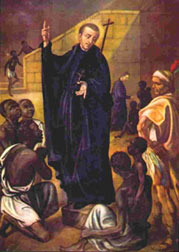
peter-claverSt. Peter Claver, SJ, was a member of the Society of Jesus and is the patron of African missions and of interracial justice, due to his work with slaves in Columbia.

Peter Claver was born to a prosperous family in Verdu, Spain, and earned his first degree in Barcelona. He entered the Jesuits in 1601. When he was in Majorca studying philosophy, Claver was encouraged by Alphonsus Rodriguez, the saintly doorkeeper of the college, to go to the missions in America. Claver listened, and in 1610 he landed in Cartagena, Columbia. After completing his studies in Bogotá, Peter was ordained in Cartagena in 1616.

Cartagena was one of two ports where slaves from Africa arrived to be sold in South America. Between the years 1616 and 1650, Peter Claver worked daily to minister to the needs of the 10,000 slaves who arrived each year.

When a ship arrived, Peter first begged for fruits, biscuits, or sweets to bring to the slaves. He then went on board with translators to bring his gifts as well as his skills as a doctor and teacher. Claver entered the holds of the ships and would not leave until every person received a measure of care. Peter gave short instruction in the Catholic faith and baptized as many as he could. In this way he could prevail on the slave owners to give humane treatment to fellow Christians. Peter Claver baptized more than 300,000 slaves by 1651, when he was sickened by the plague.

In the last years of his life Peter was too ill to leave his room. The ex-slave who was hired to care for him treated him cruelly, not feeding him many days, and never bathing him. Claver never complained. He was convinced that he deserved this treatment.

In 1654 Peter was anointed with the oil of the Sacrament of the Sick. When Cartagenians heard the news, they crowded into his room to see him for the last time. They treated Peter Claver’s room as a shrine, and stripped it of everything but his bedclothes for mementos. Claver died September 7, 1654.

St. Peter Claver was canonized in 1888. His memorial is celebrated on September 9.

Quote: “We must speak to them with our hands before we speak to them with our lips.”


Related Links


Saint Peter Claver
Video introduction to the life of St. Peter Claver, produced by the Apostleship of Prayer.

St. Alphonsus Rodriguez, SJ (1533-1617)
Biography of the saint who influenced Peter Claver to consider service in foreign missions.

Supporting local needs with a local response

Bookmark and Share


by Jesuit Communications Australia 

Jesuit Social Services is working with communities around Alice Springs to support Eastern and Central Arrernte to improve their situation and to have more control over their lives.


Supporting local needs with a local response

A few years ago, their leaders approached friends in the local Catholic Church network seeking support to access mainstream services in ways that give them a voice about what matters to them.

Jesuit Social Services was then approached to assist, by supporting community members to develop plans and to engage stakeholders from various sectors of the community.

Eastern and Central Arrernte people made this approach to the Church network because they were deeply concerned about the impact of the changes in government business and service delivery. These changes have resulted in a reduction in the community’s ability to access these mainstream systems and programs in culturally appropriate, meaningful, effective and sustainable ways.

This new project will be based on community development principles and will be commencing work at the family group level. Our agreed approach will:
embrace the importance of culture, family and sovereignty
embrace the centrality of strong, respectful relationships and reciprocity in partnerships
build on the strengths of Indigenous people, families and communities
follow sound sustainable community development principles.

Through local family and community meetings, this project will undertake a local assessment of needs, identify priorities and develop plans to address these. Opportunities to directly address ‘closing the gap’ will be identified. Community governance structures will be established and strengthened and areas for corporate, philanthropic and government engagement will be identified.

‘We were really honoured to be asked to play a role in trying to improve the lot of Indigenous people in central Australia’, says Jesuit Social Services CEO Julie Edwards. ‘The reality of the situation is a great cause of shame for all of us. There’s a lot to do and a lot for us to learn.’

Jesuit Social Services is urgently seeking support for this project. If you would like to support it, or find out more, please contact Jesuit Social Services on (03) 9427 7388

How Ignatian Spirituality Gives Us a Way to Discern God’s Will

Bookmark and Share


By David L. Fleming, SJ
From What Is Ignatian Spirituality?

What shall we do? We should not do anything wicked and we should not do anything absurd. Between these boundaries lie a vast number of possibilities. We face large decisions: schooling, career, work, state of life, relationships, weighty commitments. Every day we face smaller decisions about our priorities and goals, how to spend our time, what to pay attention to and what to put off for another day. How do we make these choices? How do we weigh competing values? How do we discern the right path?

Ignatian spirituality gives us a way to approach these questions. To follow Jesus we need to know how to make good decisions. Ignatian spirituality helps us approach this challenge in a practical way.

What Do We Want?

Ignatius would first have us be clear about the ends that we seek. Again we return to the Principle and Foundation for clarity about the values that should govern our choices. Everything in this world is presented to us “so that we can know God more easily and make a return of love more readily.” Thus, “our only desire and our one choice should be this: I want and I choose what better leads to God’s deepening life in me.” Our loving relationship with God is the goal and end of our life. All of our choices are means, steps toward reaching our goal. We enter marriage or choose a career or start a business as a way to deepen our relationship with God. All of these important choices are means, not ends in themselves. It is easy to lose sight of this and treat choices as the ends. Our first choice or decision is simply to be a follower of Christ. Everything else—all our choices, big and small—follows from this.

The Analytical Approach

When we have our end clearly in sight, then we are able to tackle the complexities of decision making. One way is the analytical approach. In trying to choose between two goods, we might list pros and cons in two columns on a sheet of paper. If we are perplexed, we might also ask some friends what they think. Then we make a decision, offer our decision to God for his blessing, and pray for a consolation of peace as God’s gift to us.

Ignatius calls this type of decision making a “third-time” choice. “First-time” and “second-time” choices are decisions guided by our hearts, where confirmation comes not from the reasoning intellect but through a discernment of the meaning of the different movements of the emotions and feelings. This is Ignatius’s greatest gift to us about decision making. It may be called the gift of the reasoning heart.

Sometimes the Choice Is Clear

A first-time choice is a decision that is unmistakably clear. We know what is right. Ignatius cites two examples of first-time choice in the New Testament: the conversion of the apostle Paul, and the call of the tax collector Matthew. Neither man had any doubt about what God wanted of him (at least in these situations). First-time choices are not rare. We probably know people who never had any doubt about what they should do at major turning points in their lives. Some people are sure about their marriage spouse at a first meeting in this graced manner. Others are sure about their religious-life vocation or priestly vocation in a similar way. You may have had this experience yourself, at least in some circumstances.

When the Choice Isn’t So Clear

Second-time choices are situations where the preferred choice is not entirely clear. We are presented with alternative courses of action that all seem attractive to some degree, and we are not blessed with the gift of a clear certainty about what to do. In these cases, Ignatius says that we can discern the right choice by attending to the inner movements of our spirit. In particular, feelings of “consolation” and “desolation” will signal the correct course of action. Ignatius always carefully puts the word spiritual before consolation and desolation. For him spiritual consolation is our experience “when some interior movement in the soul is caused, through which the soul comes to be inflamed with love of its Creator and Lord.” Ignatius more simply describes consolation as every increase in hope, faith, and charity. Spiritual desolation is just the opposite. The words Ignatius uses to describe it include darkness of soul, disturbance, movement to things low and earthly, disquiet of different agitations and temptations. Ignatius’s understanding of the importance of these feelings dates back to the very beginning of his conversion to a fervent Christian faith when he learned to pay close attention to his feelings.

Second-time choice is not simply a matter of “feeling peaceful” about a proposed decision. The feelings of spiritual consolation and spiritual desolation must be carefully assessed. Complacency and smugness about a decision can masquerade as consolation. At times, desolation can be a timely sense of restlessness pointing us in a new direction. Ignatius discusses how to work with his guidelines for discerning at some length in his “rules for discernment of spirits” at the end of the Spiritual Exercises.

Trusting Your Feelings

It seems surprising (and somewhat risky) to trust our feelings to the degree Ignatius does, but this approach to discernment is entirely consistent with his vision of the Christian life. The Ignatian perspective tells us that we live in a world that is permeated by God, a world God uses to keep in touch with us. We seek to follow Jesus. We carefully observe him in the Gospels and we enter into these Gospel scenes using the methods of Ignatian contemplation through imagination. We come to know who Jesus is and strive to make him the center of our lives. We make our decisions within the context of this relationship of love. It is a relationship of the heart. Our heart will tell us which decisions will bring us closer to Jesus and which will take us away from him.

Ignatian discernment, then, holds that our Christian choices are often beyond the merely rational or reasonable. “The heart has its reasons of which the mind knows nothing,” Pascal said. This is fine—as long as the heart has been schooled by Christ.

It is often said that Ignatian spirituality forms us to be “contemplatives in action.” We can understand this somewhat paradoxical term if we see that the goal is action and discernment is the means. Discernment guides us to decisions that will join us ever more closely with Christ and with our working with Christ in the world. Contemplation of Jesus in the Gospels is the essential discipline that makes discernment possible. The practice of imaginative prayer teaches us who Jesus is and how he acts and how he decides. This kind of contemplation schools our hearts and guides us to the decisions that bring us closer to God.

Excerpt from What Is Ignatian Spirituality? by David L. Fleming, SJ.


Related Links

Discernment in a Nutshell by Joseph Tetlow, SJ
A Spirituality of the Heart by David L. Fleming, SJ

Blessed Teresa of Calcutta

Bookmark and Share


Feast Day September 5

If you had to pick out the most important thing you did this week, what would it be?

Making a B on a test you thought you’d failed? Protecting the goal on that last shot and saving the game? Convincing your mom to buy you that new outfit?

Was that it? Or might it be something else-a different kind of “important”?

Sometime, somehow in the last week, you’ve listened to someone who was sad or angry. You’ve defended someone who’s been picked on. You bit your tongue when you wanted to mouth off to your dad. You thanked your mom for the dinner she fixed. You went through your clothes and picked out some good stuff to send to kids at the homeless shelter.

In other words, the most important thing you’ve done today, yesterday, and last week is love. One act of love, no matter how quiet, can change a person’s day-even his or her whole life! Now that’s important.

When we think about the difference that love can make, many people very often think of one person: Blessed Mother Teresa of Calcutta. A tiny woman, just under five feet tall, with no tools except prayer, love, and the unique qualities God had given her, Mother Teresa is probably the most powerful symbol of the virtue of charity for people today.

Mother Teresa wasn’t, of course, born with that name. Her parents named her Agnes-or Gonxha in her own language-when she was born to them in Albania, a country north of Greece.

Agnes was one of four children. Her childhood was a busy, ordinary one. Although Agnes was very interested in missionary work around the world, as a child she didn’t really think about becoming a nun; but when she turned eighteen, she felt that God was beginning to tug at her heart, to call her, asking her to follow him.

Now Agnes, like all of us, had a choice. She could have ignored the tug on her heart. She could have filled her life up with other things so maybe she wouldn’t hear God’s call. But of course, she didn’t do that. She listened and followed, joining a religious order called the Sisters of Loreto, who were based in Dublin, Ireland.

After two months in Ireland, spent mostly learning how to speak English, Agnes got on a boat (in 1928, hardly anyone took trips by plane), and thirty-seven days later she arrived in the beautiful, busy, complicated country of India.

In India, Agnes took her final vows as a sister and took the name Teresa, after Thérèse of Lisieux, the Little Flower. She spent fifteen years teaching in a girl’s school in Calcutta, a job that she loved and was very good at. But then one day, she heard that call again.

The voice in her heart was telling her that she was to make a very big change in her life-that she should leave her teaching position and go into the streets of Calcutta and care for the poor.

Again, Teresa could have ignored the voice and just gone on teaching the wealthy girls behind the high walls of her school. But you know how it feels to ignore the voice of God in your heart, right? You can’t rest easy until you obey that voice. Do you know why?

It’s not because God wants to play games with you or test you. No, it’s because God created you and knows you better than anyone else does. He knows what all of your talents are and he knows what you can do with those talents. He also knows that he made you, above all, to love. That pull on your conscience is a nudge, giving you a hint about where you’re going to find happiness and peace, and where the charity you practice is going to have the greatest impact.

So Sister Teresa listened and said yes. She had lived in India for years, and she knew how desperate the poor of that country were, especially in the big cities. It was these people, the dying poor, that Sister Teresa felt a special call to love. After all, these were people who had absolutely no one else in the world to love them. Not only were they poor, but they were also dying. Why did their feelings matter? Wouldn’t they be gone soon enough?

Teresa saw these people differently. She saw them through God’s eyes, which means that she saw each of them as his dear child, suffering and yearning for some kind touch or word, some comfort in their last days on earth. She heard that call and chose to live it out-to let God love the forgotten ones through her charity.

As is the case with all great things, Teresa’s efforts started out small. She got permission to leave her order, to live with the poor, and to dress like them, too. She changed her habit from the traditional one to the sari worn by Indian women. Her sari would be white with blue trim, the blue symbolizing the love of Mary. She didn’t waste time, either. On her very first day among the poor of Calcutta, Mother Teresa started a school with five students, a school for poor children. That school still exists today. She quickly got some training in basic medical care and went right into the homes of the poor to help them.

Within two years, Teresa had been joined by other women in her efforts, all of them her former students. She was soon “Mother Teresa” because she was the head of a new religious order: the Missionaries of Charity.

The Missionaries of Charity tried to care for as many of the dying as they could. They bought an old Hindu temple and made it into what they called a home for the dying. Hospitals had no room or interest in caring for the dying-especially the dying poor-so the dying had no choice but to lie on the streets and suffer. The sisters knew this, so they didn’t wait for the poor to come to them. They constantly roamed the streets, picking up what looked from the outside like nothing but a pile of rags, but was actually a sick child or a frail old person.

When a dying person came or was brought to Mother Teresa and her sisters, they were met with nothing but love. They were washed and given clean clothes, medicine, and-most important-someone who could hold their hand, listen, stroke their foreheads, and comfort them with love in their last days.

One of the most feared diseases in the world is leprosy. It’s a terrible sickness that deadens a person’s nerves and can even cause their fingers, toes, ears, and nose to eventually fall away. You know that in Jesus’ time, lepers were kept away from communities. Lepers in poor countries like India, where they have a hard time getting the medicines to treat the disease, are often treated the same way.

You can probably guess what Mother Teresa thought and-more important-what she did about this. After all, a person with leprosy isn’t a thing or an animal with no feelings. A person with leprosy is, above all, a person whom God loves and cares deeply about.

So Mother Teresa saw people with leprosy in the same way-through God’s loving eyes. She got the help of doctors and nurses, gathered lepers from the slums, and began treating and caring for them in a way that no one before her had tried to do.

Mother Teresa’s work of love started out small, but it isn’t small anymore. There are more than four thousand Missionaries of Charity today, living, praying, and caring for the helpless in more than a hundred different houses around the world, including in the United States.

Mother Teresa died in 1997, but even now, when we think about her work, we can learn all we need to know about love: It doesn’t take any money or power to love. It doesn’t take great talent or intelligence. It simply takes love.

Mother Teresa did wonderful, brave work in caring for the forgotten, but if there’s one thing she would want you to remember about love, it’s that you don’t have to travel to foreign countries to practice the virtue of charity.


from Loyola Kids Books of Heroes 
© 2003 Amy Welborn


How to Start a Catholic Book Club

Bookmark and Share


by JAMES MARTIN, S.J.

F or the past nine years, James Martin, S.J. has run a popular book club for adult Catholics at the Church of St. Ignatius Loyola, in New York City. As a way of helping readers who might want to begin a similar club in their own parishes, we offer a brief description of a plan that Father Martin has used, as well as the list of books selected for the club

Overall structure of the club

The book club members read a mixture of fiction, spirituality, theology, biography and Scripture. All the books are currently in print and easily obtained either from either Amazon.com or directly from the publisher. The majority (particularly those books published more recently) are also available from major bookstores. All the books are of reasonable lengths (no more than around 200 pages) and if they are any longer (for example, The Seven Storey Mountain) we break them up into two sessions.) Around Christmas, since most people are so busy, I usually assign a Gospel. Not only is it shorter and more easily fit into this hectic time of year, but it is a great devotional tool for the season. Often participants say that it is the first time they have ever read a gospel straight through.

There are two groups: one for adults under 35 and one for those over 35. This helps the participants, especially the younger Catholics, feel that they are meeting and speaking with people with more or less similar life experiences. (Our separate discussions of books like Cardinal Bernardin’s The Gift of Peace, which focuses on issues of death and dying made this very evident.)

We meet once monthly, on a Wednesday evening in the rectory. We begin at 6:30 p.m. with a simple dinner (usually pizza and sodas). This avoids the problems of “assigning dinners” to a single person, etc., or providing elaborate meals for a large group. Everyone chips in at the end of the night for expenses–no more than a five dollars per person. The casual dinner lasts for roughly an hour, and is an excellent way of helping people get to know one another before the discussion, as well as building community in the parish. Many book club members say that they enjoy this part of the evening as much as the actual book discussion.

At 7:30 we begin with a brief prayer, and then I ask everyone to introduce themselves. This is especially important at the beginning, but even later on everyone appreciates being reminded of people’s names. (We are always open to new members as well; notice of the meeting times and the month’s book appears in the parish bulletin on a regular basis.)

During their introductions people are also asked to mention something interesting or significant that has happened to them over the past month. This has proven a wonderful way of very gently encouraging some “faith sharing,” and is another way of building community. As the members grow more comfortable with one another, what they offer about the past month often grows more personal. Still, this should only be a few minutes per person. If you have, say, 20 people, you don’t want to spend 40 minutes on introductions.

The actual book discussion begins at 7:30 and lasts until 8:30. I begin with a simple question, “How did you like the book?” and then try to facilitate a friendly discussion, paying particular attention to any of the more “spiritual” questions that come up. When there is a question of fact, say, about church history or teaching, about Scripture, I try to explain things, and do a bit of catechesis, but otherwise I try to stay in the background. When possible, I have invited any of the authors who are in the area to join us when discussing their book: this is always a great success.

There are only three requirements that I set out: first, to read the book; second, to respect everyone’s opinions; and, third, not to “hog” any of the discussions. The evenings end at 8:30 with a prayer and a brief description of next month’s book. Sometimes, I will hand out supplementary material beforehand, for example, if the book is about an historical figure. For the gospels, I always hand out a brief two-page synopsis, taken from any good commentary.

The book club is a great deal of fun, very little work for the organizer (just publicizing it, getting a room, ordering the pizza and selecting the books) but a great way to build community, do a little catechesis, and encourage faith sharing in the parish in a non-threatening way.

Here are the selections for the last five years:

1998
Jan. — Mariette in Ecstasy, Ron Hansen
Feb. — Virgin Time, Patricia Hampl
Mar. — Meditations from a Moveable Chair, Andre Dubus
Apr. — The Cloister Walk, Kathleen Norris
May — This Our Exile: A Spiritual Journey with the Refugees of East Africa, James Martin, S.J.

1999-2000
Oct. — The Gift of Peace, Joseph Cardinal Bernardin
Nov. — St. Augustine, Garry Wills
Dec. — God and You: Prayer As a Personal Relationship, William A. Barry, S.J.
Jan. — The Gospel of Luke
Feb. — Anthony DeMello: Writings, edited by William Dych, S.J.
Mar. — The Long Loneliness, Dorothy Day
Apr. — Traveling Mercies, Anne LaMott
May — The Moviegoer, Walker Percy

2000-2001
Sep. — The Diving Bell and the Butterfly, Jean-Dominique Bauby
Oct. — Signatures of Grace: Catholic Writers on the Sacraments
Nov. — Opening to God: A Guide to Prayer, Thomas H. Green, S.J.
Dec. — Joan of Arc, Mary Gordon
Jan. — The Gospel of Mark
Feb. — Return of the Prodigal Son, Henry Nouwen
Mar. — In Good Company: The Fast Track from the Corporate World to Poverty, Chastity and Obedience, James Martin, S.J.
Apr. — The Sacred Journey: A Memoir of Early Days, Frederick Buechner
May — Wise Blood, Flannery O’Connor

2001-2002
Sep. — Lying Awake, Mark Salzman
Oct. — Armchair Mystic: Easing Into Contemplative Prayer, Mark Thibodeaux, S.J.
Nov. — The Power and the Glory, Graham Greene
Dec. — Jesus Before Christianity, Albert Nolan
Jan. — The Gospel of Matthew
Feb. — How Can I Find God?: The Famous and Not-So-Famous Consider the Quintessential Question, James Martin, S.J., ed.
Mar. — Dakota: A Spiritual Geography, Kathleen Norris
Apr. — Thérèse of Lisieux, Monica Furlong
May — God Moments: Why Faith Really Matters, Jeremy Langford

2002-2003
Sep. — Brideshead Revisited, Evelyn Waugh
Oct. — Professions of Faith: Living and Working As a Catholic, James Martin, S.J., and Jeremy Langford, eds.
Nov. — Salvation: Scenes From the Life of St. Francis, Valerie Martin
Dec. — For the Love of God: The Faith and Future of the American Nun, Lucy Kaylin
Jan. — The Gospel of Mark
Feb. — The Seven Storey Mountain (Part I), Thomas Merton
Mar. — The Seven Storey Mountain (Part II)
Apr. — Finding Grace at the Center: The Beginning of Centering Prayer, M. Basil Pennington, O.C.S.O., Thomas Keating, O.C.S.O., Thomas E. Clarke, S.J.
May — Death Comes for the Archbishop, Willa Cather

2003-2004
Sep. — Conclave, John Allen
Oct. — The Holy Longing, Ronald Rolheiser
Nov. — Running From the Devil, Steve Kissing
Dec. — Shadows on the Rock, Willa Cather
Jan. — The Gospel of John
Feb. — The Saints’ Guide to Happiness, Robert Ellsberg
Mar. — Contemplatives in Action, William A. Barry, S.J., and Robert G. Doherty, S.J.
Apr. — The End of the Affair, Graham Greene
May — Awake My Soul: Contemporary Catholics on Traditional Devotions, James Martin, S.J., ed.

2004-2005
Sept. — The Genesee Diary: Report from a Trappist Monastery, Henri J. M. Nouwen
Oct. — Father Joe: The Man Who Saved My Soul, Tony Hendra
Nov. — Consider Jesus: Waves of Renewal in Christology, Elizabeth A. Johnson
Dec. — The Gospel of Luke, NRSV or any mainstream translation (e.g., RSV, NAB)
Jan. — Poverty of Spirit, Johannes Baptist Metz
Feb. — Dead Man Walking: An Eyewitness Account of the Death Penalty in the United States, Helen Prejean
Mar. — Mere Christianity, C. S. Lewis
Apr. — Sacred Silence: Denial and the Crisis in the Church, Donald Cozzens
May — Celebrating Good Liturgy: A Guide To The Ministries Of The Mass (Loyola Press, 2005), James Martin, S.J., ed.

2005-2006
Sep. — Gilead, Marilynne Robinson
Oct. — Mr. Blue, Myles Connolly
Nov. — Celebrating Good Liturgy: A Guide to the Ministries of the Mass, ed., James Martin, SJ
Dec. — Dangerous Memories: A Mosaic of Mary in Scripture, Elizabeth Johnson, CSJ
Jan. — The Gospel of Matthew
Feb. — Letters from the Desert, Carlo Carretto
Mar. — All We Know of Heaven, Remy Rougeau
Apr. — My Life with the Saints, James Martin, SJ (first half of the book)
May — My Life with the Saints, James Martin, SJ (second half)

2006-2007
Sept. — The Sparrow, Mary Doria Russell
Oct. — Joan of Arc: In Her Own Words, Willard Trask
Nov. — Simple Ways to Pray, Emilie Griffin
Dec. — So Long, See You Tomorrow, William Maxwell
Jan. — Deus Caritas Est (“God is Love”), Benedict XVI
Feb. — Becoming Who You Are, James Martin, S.J.
Mar. — From Union Square to Rome, Dorothy Day
Apr. — Barabbas, Pär Lagerkvist
May — Cosmas, or the Love of God, Pierre de Calan

2007-2008

Oct: Come Be My Light, Mother Teresa
Nov. A Jesuit Off-Broadway, James Martin, SJ
Dec. God, I Have Issues, Mark Thibodeaux, SJ
Jan. The Selfless Way of Christ, Henri Nouwen
Feb: Jesus: A Historical Portrait, Daniel J. Harrington, SJ
Mar: Atticus, Ron Hansen
Apr. Radical Gratitude, Mary Jo Leddy
May. Silence, Shusako Endo

2008-2009 (A year for longer books)

Oct. The Duty of Delight, Dorothy Day
Dec. The Sign of Jonas, Thomas Merton
Feb. The Song of Bernadette, Franz Werfel
Apr. Acedia & Me, Kathleen Norris
May. Exiles, Ron Hansen


James Martin, S.J., is an associate editor at America and author of My Life with the Saints.