Category: Uncategorized

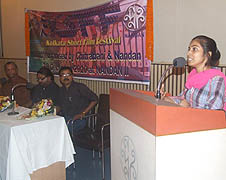
Film festival showcases creative power of women

Bookmark and Share


By Julian Das, Kolkata

A film festival organized by a Jesuit media center is providing a platform for women to showcase their creative talents.


Film festival showcases creative power of women thumbnail
Filmmaker Santwana Chatterjee introduces her film at the Short Film Festival in Kolkata

Women have produced or directed nearly half the films to be screened during the Seventh Short Film Festival, festival director Jesuit Father Joseph Pymbellikunnel told ucanews.com.

The priest heads the 40-year-old Chitrabani (sight-sound) organizing the film festival, together with the West Bengal Film Center Nandan. The event is being held from Dec. 3 to 9 in Kolkata.

Most women directors are young, and a sizable number of them are students of media schools in the country, he said.

The festival has selected 94 films for screening, with a total 24 hours of running time, in five Indian languages. The shortest film is 2.30 minutes and the longest 39 minutes, the priest said.

Shoma Banerjee, a woman director, said she makes short films that addresses the issue of borderline psychological disorders. Her 17-minute film, Madhyabarti Olinde (By the by lanes of borderline) in Bengali was screened on Dec. 5.

Santwana Chatterjee combined journalistic skills and culture in her fourth film Amar Sonar Bangla (My golden Bengal), screened on the opening day.

She said her outlook complements that of other male colleagues. This creates a healthy balancing of content and style, she added.

Subha Das Mallick, who has made over 40 video films, said women find it easier to break through the male domain in short films that involve less investment. She also said women directors handle better themes related to women.

Podcasts:About the holiness of a letter

Bookmark and Share


About the holiness of a letter

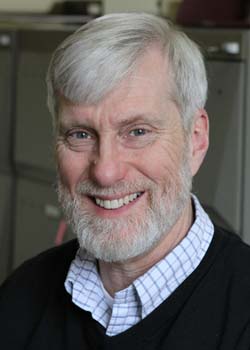
Father Bill Oulvey S.J.
Bill Oulvey served 4 years as secretary of the US Assistancy in Rome


Length: 16:52

Father Bill Oulvey is a Jesuit from the Missouri Province (USA). For the past four years he has served the Society of Jesus as Secretary of the US Assistancy in Rome. This clerical position, involving both paperwork and computers, put him in touch with the rich tradition of the Society which views correspondence as holy since it represents a person made in God’s image and likeness. From his office in the General Curia he has been in touch with Jesuits from all over the world and their ministries; he served at the most recent General Congregation held in Rome and has come to understand the profound relationship between the Society of Jesus and the Holy Father.


Download ‘ About the holiness of a letter podcast  

Nepal Jesuit school expands to meet demand

Bookmark and Share


By Chirendra Satyal, Kathmandu

Sixty years after establishing their first school in Nepal,


Nepal Jesuit school expands to meet demand thumbnail
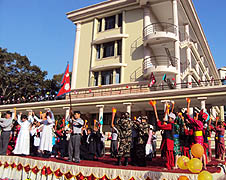
Students at the Dec. 3 celebrations at St. Xavier’s High School in Kathmandu

 the nation’s Jesuit community is expanding its educational program across the country.

Bishop Anthony Sharma, apostolic vicar of Nepal, blessed the new four-floor wing of St. Xavier’s School in central Kathmandu on Dec. 3, the feast of the great missionary Jesuit Saint Francis Xavier.

The $US2 million building is one of the largest of its size in the nation.

After Catholic prayers by the Jesuit bishop, students of various faiths recited prayers separately invoking Allah, Ram and Buddha.

“The red color of my stole signifies the sacrifices of many well-wishers, parents, teachers, students and Jesuits that made it possible to see this day so more will carry on this school’s motto `Live for God, Lead for Nepal’,” Bishop Sharma said.

Previously a boys-only school, St Xavier’s started accepting female students ten years ago.

The Jesuit community opened two new schools targeting poorer students in Nepal’s east in 1999.

The schools in Deoniya and Maheshpur are located fewer than 10 kilometers from the Nepal-India border.

“Among 580 students we have 95 Catholics and over a dozen other non-Catholic Christians – making this Nepal’s foremost school in terms of the Catholic students ratio,” Jesuit Fr. Roy Sebastian, principal of St. Xavier’s school in Maheshpur told ucanews.com.

Located amidst green fields of tea, the school draws most of its students from the families of tea garden workers, who earn around $US2 per day.

The Nepal Jesuits have also acquired several acres of land on the outskirts of Pokhara town 210 kilometers west of Kathmandu where they also plan to open new programs.

A Ratzinger from Four Centuries Ago, in Beijing

Bookmark and Share


The remarkable resemblance between the missionary method of Matteo Ricci in seventeenth-century China and the dialogue between Christianity and cultures proposed today by Benedict XVI

by Sandro Magister 


ROME, October 1, 2010 – In the important speech given in London at Westminster Hall on September 17, Benedict XVI stated in the clearest of terms:

“The objective norms governing right action are accessible to reason, prescinding from the content of revelation.”


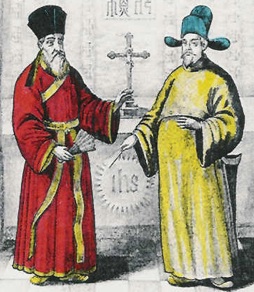
A Ratzinger from Four Centuries Ago, in Beijing

And he continued:

“The role of religion in political debate is not so much to supply these norms, as if they could not be known by non-believers, […] but rather to help purify and shed light upon the application of reason to the discovery of objective moral principles.”

Insistence on the positive relationship between faith and reason is one of the hallmarks of this pontificate. But even before he was elected pope, Joseph Ratzinger had insisted on it repeatedly. For example, in the memorable debate he had with the German philosopher Jürgen Habermas in Munich in 2004.

On that occasion, Ratzinger said that rational principles accessible to all should be at the basis of intercultural and interreligious dialogue. And he made reference to China: “What for Christians has to do with the creation and the Creator, in Chinese tradition would correspond to the idea of celestial order.”

*

China is one of the most colossal challenges that the Church is called to face today. And not only for reasons involving religious freedom.

In fact, the distance between the Western and Christian vision of the world and that of the great civilizations of the East – not only China, but also India and Japan – is decidedly more vast than with Islam, an historical religion that has always had many features in common with Judaism and Christianity.

The challenge is all the greater today, with China rising to become a new global superpower. But it has been one before.

Between the sixteenth and seventeenth centuries, this challenge was taken up by a brilliant missionary, Jesuit Fr. Matteo Ricci, the fourth centenary of whose death is being marked in 2010 with exhibits, studies, and conferences, including in China, where he is considered a national treasure. His beatification process is also underway.

In dialoguing with the intellectual circles of Beijing at the time, Ricci adopted an approach remarkably similar to the one proposed by Benedict XVI today. He knew very well that the Christian Gospel was an absolute innovation, come from God. But he knew that human reason also has its origin in the one Lord of Heaven, and is common to all who live under the same sky.

He was therefore confident that the Chinese could also accept “the things of our holy faith,” if these were “confirmed by much evidence of reason.”

His proclamation of the Christian news was therefore gradual. He took his cues from the philosophical principles of Confucianism, from the traits it had in common with the Christian vision of God and of the world, in order to build gradually to the absolute novelty of the Son of God made man in Jesus.

Matteo Ricci did not do the same thing with Buddhism and Taoism, instead subjecting them to severe criticism. A little like the Fathers of the Church had done before him, being extremely critical of pagan religion but in respectful dialogue with the wisdom of the philosophers.

This masterstroke of the the missionary work of Matteo Ricci has been profiled in an important book by one of his modern successors in the missions: Fr. Gianni Criveller, 49, of the Pontifical Institute for Foreign Missions in Milan, active in China for twenty years, a professor at the Holy Spirit Seminary College and at the Chinese University of Hong Kong, and the author of numerous works.

The following excerpt is taken from the central chapter of the book. And it sheds light not only on what Matteo Ricci did four centuries ago, but also on how Christianity can face the challenge of China today, with a method that is the same as the one proposed by the current pope.


English translation by Matthew Sherry, Ballwin, Missouri, U.S.A.


Suggested Reading for Advent

Bookmark and Share


Advent Books for Kids

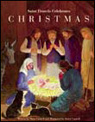
 Saint Francis Celebrates Christmas

Saint Francis Celebrates Christmas

This  delightful Christmas book for children tells the true story of the world’s first nativity scene.


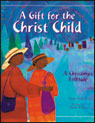
 A Gift for the Christ Child

A Gift for the Christ Child

This meaningful book offers a lesson in the importance of generosity and sacrifice during a season where so much of the focus is on receiving.


Advent Books for Adults

 2011: A Book of Grace-Filled Days

2011: A Book of Grace-Filled Days

This annually popular book provides daily inspiration beginning with the start of the Church year in Advent 2009 and continuing through the calendar year 2010.


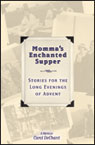
 Momma's Enchanted Supper

Momma’s Enchanted Supper: Stories for the Long Evenings of Advent

This engaging collection of Advent stories and reflections presents a wonderful opportunity for us to recall our own unique family histories during the reflective season of Advent.


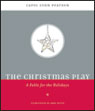
 The Christmas Play

The Christmas Play: A Fable for the Holidays

This fresh take on the Christmas story addresses every person’s need for personal meaning during the Christmas season.

Indonesian gov awards German-born priest

Bookmark and Share


By Konradus Epa, Jakarta

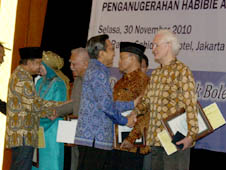
A German-born Jesuit priest has received the Habibie Award 2010 for his role in promoting interfaith dialogue and religious harmony in Indonesia.


Indonesian gov awards German-born priest thumbnail
Vice president Boediono (in blue) greets Jesuit Father Franz Magnis Suseno (extreme right)

“I was surprised and touched…I have a task to keep in holding my commitment as an intellectual in Indonesia,” said Jesuit Father Franz Magnis Suseno.

He said the Nov. 30 award presentation by Indonesian Vice President Boediono in Central Jakarta showed the country’s commitment to fighting for an independent, civilized and democratic nation.

“I do support your struggle to improve religious harmony in our country,” said Boediono acknowledging the Jesuit priest’s writings and views on religious harmony.

Father Suseno was born in Eckersdorft in 1936 and ordained priest in 1967 in Yogyakarta. The government in 1977 approved his Indonesian citizenship.

He has been a philosophy professor at the Driyarkara School of Philosophy in Jakarta since April 1996.

The award, named after Indonesia’s third president Bacharuddin Jusuf Habibie, is given annually to individuals with achievements in science, biotechnology and medical care, sociology and economics, engineering, and history.

This year’s recipients include Eniya Listiani Dewi, a researcher in engineering science, Adrian Bernard Lapian, an expert of maritime history, and Ahmad Syafii Maarif, former chairman of Muhammadiyah, Indonesia’s second-largest Muslim organization.

Two new Institutes at Fu Jen Catholic University

Bookmark and Share


Education and Social Communication 

Taiwan’s Fu Jen Catholic University has launched an Institute for Education and an Institute for Social Communication in conjunction with the 85th anniversary of the founding of the first Chinese university which moved from Beijing to Taiwan in 1949.


Two new Institutes at Fu Ren Catholic University: Education and Social Communication

During the solemn opening, both Cardinal Paul Shan and Archbishop Peter Liu of Kaohsiung stressed the importance of education and social communication to build the future of the country and the Church, Fides reports.

They also said they hoped that the Catholic University, with its 11 institutes, “leads society along the right ethical path.”

Fu Jen Catholic University is directly related to the Holy See. It was founded in Beijing in 1925 by a group of American Benedictines. The transfer to Taiwan occurred in 1961.

Fu Jen’s graduates number nearly 120,000 from all over the world.

Over the years the University wanted to remain faithful to its mission of the holistic formation of the person, based on the principles of Truth, Goodness, Beauty and Holiness, in an academic community of students and teachers closely united.

Fu Ren has also brought about and continues to pursue dialogue between the Chinese culture and Christian faith, carrying out academic research and fostering a genuine knowledge of the world, thereby contributing both to the development of a society that progresses mankind.

The goals are: to affirm the value of human dignity and recognize fundamental rights; to continue the search for the meaning of life; to devote themselves to academic research; to create group consciousness; to stimulate cultural exchange; to offer religious cooperation; to promote the spirit of service in the social contexts of all countries in the world.

Jesuit Electronic News Service Vol. XV, No. 23

Bookmark and Share


From the Curia

Juridic Commission. In Decree 5 (numbers 2-6), General Congregation 35 directed and authorized Father General to undertake a comprehensive revision of the Formula of a General Congregation (FCG), to be approved by GC 36 in its first sessions. Revisions in the FCG that would take effect before GC 36, as well as any related changes in the Formulae of the Congregation of Procurators and of the Province Congregation, may be approved by the General after consulting with the Major Superiors and with the deliberative vote of the General Council. From 8-13 November, a Juridic Commission met at the General Curia to compose specific imminent revisions for consideration and possible implementation, as well as to draw up the particular concepts and concrete matter regarding the deeper and comprehensive revision foreseen by GC 35. Committee members who met in this week-long session are: Carlos Cardó (PER), Joseph Daoust (DET), Robert Geisinger (CHG), Geoffrey King (ASL), and Ulrich Rhode (GER).  Due to unforeseen reasons, M. Devadoss (MDU) needed to cancel plans to participate. Mark Rotsaert (BSE) is also appointed to the commission as a consultant. In early December, Father General with his Council will review the commission’s proposals so that the project may enter its next phase.


From the 11th  to the 14th of November the Curia hosted the first meeting of theBoard of Advisors for Communication. The board was created by Father General to help the director of the Communication and Public Relations office, and it is composed by five members (two laymen) from various parts of the world. The program was very intense. It started with the study of Basic Statement, a mission statement on the purposes and way of proceeding of the Roman office. Then the participants took into account all the main activities of the office: the new Curia website, the biweekly news bulletin, the Yearbook of the Society.  Suggestions have been asked for improving the service. Another subject on the agenda was the discussion of a draft of job description for the Director of the Communication and Public Relation Office in view of the search for a new director. The meeting was very cordial, and decision was taken to repeat these encounters at least once a year. In the meeting, apart from Fr. Bellucci, Fr. Debruyne and Fr. Tshibamfumu, from the Curia, were present the following Fathers: George Martinson (CHN), José Martinez De Toda y Terrero (VEN), Jacob Srampickal (PAT), and two lay partners: Renato Reggiani (Italy) e Jeremy W. Langford (United States).


Final meeting of the Jesuit Mission and Ecology Task Force. The Task Force, set up in April this year (see Electronic Service no. 7 of 12 April 2010) in order to discern the way ahead on ecology within the Society, concluded its work with a final meeting from 15 to 20 November. Over the last four months, the members have collaborated online, consulted with a number of people and drafted a document with concrete recommendations. On Friday 19 November, they met Father General to discuss the work they have done. The Task Force consists of a five Jesuits and one lay person: José Alejandro Aguilar S.J. (Colombia), Leonard Chiti S.J. (Zambia), José Ignacio García S.J. (Spain), Pedro Walpole S.J. (Philippines), Joseph Xavier S.J. (India) and Nancy C. Tuchman (USA). The co-conveners of the Task Force are Fernando Franco S.J. (Secretary for Social Justice and Ecology) and Ron Anton S.J. (interim Secretary for Higher Education); Patxi Alvarez S.J., the designated Secretary for Social Justice and Ecology, has participated as an observer. Also present at the meeting was Uta Sievers, from the Roma office.

          In the meantime, Jesuits and friends in ecology have started Ecology and Jesuits in Communication, an e-newsletter as a response as we respond to the global invitation (GC35 Decree 3) to understand the universal importance of engaging in ecological concerns and the need for reconciliation with creation. Initially to be distributed monthly in Spanish and English. For more information and to subscribe: http://ecojesuit.com/subscribe/


About the new Cardinals. On November 20, Pope Benedict has installed 24 new cardinals, more than half of whom are graduates of premier educational institutions of the Society of Jesus in Rome. Cardinals who are former students of the Pontifical Gregorian University or the Pontifical Biblical Institute come from Brazil, Congo, Egypt, Guinea, Italy, Spain, Sri Lanka and the United States. Two of them have also taught on the Canon Law Faculty of the Gregorian for a total of almost 50 years. They have joined the College of Cardinals, over one-third of whom are graduates of the Jesuit Pontifical Institutions in Rome.


From the Provinces

ARGENTINA: The first incunabulum in guaraní language

The occasion was the commemoration of the bicentennial of the Revolution of May, the most important political event in the history of Argentina. To underline the country’s cultural origins, the Instituto Bonaerense de Numismática y Antigüedades proposed to the publishing house of Buenos Aires and Rosario to reprint in facsimile De la diferencia entre lo Temporal y Eterno, a book written by Fr. Juan Eusebio Nierember and published by Misiones Jesuitícas de Loreto in 1705. The famous book, published for the first time in Madrid in 1640 and translated into various languages, was translated into Guaraní by Jesuit Joseph Serrano and it is considered the first incunabulum rioplatense (River Plate area) because of his peculiarity of having been printed by typographer Fr. Juan Bautista Neumann, in a mission with native material and equipments and in the local language.  For his peculiarity the book is considered the first printed work of American origin. The special edition, 485 total pages, will carry also a CD with the Spanish version of 1684 Fr. Serrano used to translate it into Guaraní.


AUSTRALIA: “Where the Hell is God?”

This is the title of the book written by the Australian Jesuit Richard Leonard after becoming convinced that his struggle and reflection in dealing with his own family’s suffering could help other people hold on to faith in God when tragedy hits their lives. The title of the book comes from a question that his mother, a daily Mass-goer, asked repeatedly in 1988 when her daughter was left a quadriplegic after a car accident.  Interviewed in Rome, where he is teaching a communications course at the Pontifical Gregorian University, Father Leonard said that if he thought God was responsible for his sister’s accident, then he would have to leave “the priesthood, the Jesuits and the church. A God who would hurt a 28-year-old like that is not a God that I can believe in, and I don’t want to serve that God,” he said. And he continued: “God does not send people pain, tragedy and suffering, and I think God is as devastated as we are. After 20 years ministering among people who were hurting or struggling to help them to find God in midst of pain instead of walking away from faith, I decided to write the book to avoid this withdrawal.”


BURKINA FASO: Tribute to Fr. Libralato

The President of the Republic of Burkina Faso awarded the honor of “Great Knight to the Merit of the Republic of Burkin Faso” to Fr. Umberto Libralato, vice-president of Magis (the NGO of Italian Jesuits for development), for the vast work done throughout the years, through Magis, on behalf of the poorest populations. The presentation took place at the end of the inauguration ceremony of two projects realized in Kaya Region as part of a larger project, entitled A challenge to the desert: an agricultural high school for the training of technical experts in all that concerns the improvement of production in Burkina Faso; and a new dam, in Lebda, with water capacity of four million-cubic meters, for the production of vegetables during the dry season, capable of giving work to 4000 people.  “I dedicate the medal, said Fr. Libralato, to Magis and to all those who collaborated in these years to bring ahead this work, often heavy, always hidden, but concretely effective for the good of everybody.” 


CHINA: An unknown Jesuit bishop

Hardly anyone today knows Bishop Gottfried Xavier von Laimbeckhoven. Born of a noble family in Vienna on Jan. 9, 1707, he entered the Jesuit Order in 1728, and sailed for the Chinese Mission in 1736. He arrived in Macao in 1738, after a two-year journey interrupted by stops in Mozambique and Goa . Foreigners were banned from the Chinese empire, and to gain entry, he disguised himself. He often changed boats, lost part of his luggage at sea, and had to be covered with sails which almost suffocated him. While escaping government surveillance, his life was characterized by unceasing apostolic labors until his death.  At night he visited the Christians to catechize them, listening to their confessions, celebrated the Holy Eucharist with them, solemnized their weddings, and administered the sacrament of the sick to those who needed it.  But, he wrote, “all this is nothing, compared to the joy I share with the Christians who welcome.”


INDIA: In loving memory of deceased members

To celebrate 150 years of Bengal mission and to honor all who had toiled and died in eastern India in these past years, on November 2, during a commemoration ceremony, two stone slabs bearing the names of 220 deceased Jesuits carved have been erected at the cemetery at Dhyan Ashram (“abode of prayer”), a Jesuit centre near Kolkata. “By placing the names of all those who died in the Bengal Mission, we wish to pass on a tradition to the younger members undergoing training to become Jesuits,” said Jesuit Father Jeyaraj Veluswamy, rector and master of novices. Some 500 Jesuits had worked in the Bengal Mission for the past 150 years. Most of the 220 who had died and buried within the Calcutta territory are from Belgium, with some Yugoslavians and Maltese. Four Belgian and three English Jesuits established the Bengal Mission in 1859, which is now divided into seven Jesuit provinces.


NEPAL: The situation of the Catholic Church

Largely mountainous Nepal has a population of 28 million, 80 percent of whom are Hindus, and most of the rest are Buddhists. There are one million Christians. Elevated to Apostolic Prefecture by the Vatican on 1997, exactly 10 years after it was elevated to the rank of Apostolic Vicariate. Anthony Sharma, who was ordained the first ethnic Nepali Jesuit in 1968, in 2007 was proclaimed the country’s first Bishop. During an interview with Ucanews, bishop Sharma declared that Nepal is a very tolerant country, and even when Nepal was officially Hindu, the Catholic Church rendered services freely.  Then he continued saying that while the Church is working on obtaining government approval required to start Nepal’s first Catholic university, run by the Jesuits, the major service is in the field in education, followed by health work. Vocations are increasing, even if slowly, especially in tribal parishes, where city attractions do not distract the youth much. The hope is to open new churches in different places, apart from a church in central Kathmandu.  But these projects are hold because of budget constraints. However the hope remains that in the future things could change.


SLOVAK:  Musical-drama “Martyrs of Kosice

The premiere of a fresh new musical-drama oratorio “Martyrs of Kosice”, written by Slovak composer Pavol Krska, highlighted the 350th anniversary of the Jesuit University of Kosice. Sponsored by the Mayor and authorities of the City, the spectacle was staged on October 9 in Trinity Church, which is the historical place of the martyrdom of Stephen Pongracz, Melchior Grodziecki and Mark Krizevcanin. The three martyrs died in 1619 and were canonized in 1995 by John Paul II during his visit of Kosice. Reactions of the audience to the spectacle were extremely positive. The artistic event was a conclusion for a two-days conference focused on the history and presence of Jesuits in Kosice, with participation of historians and representatives of Jesuit Provinces from Slovakia, Hungary and the Czech Republic, lay collaborators and friends.


UNITED KINGDOM: Unprecedented interest for The Big Silence

The Big Silence, a three-part documentary that was shown in England on October 22 and on the following two Fridays, has generated unprecedented interest. The program is a series about five men and women struggling to build silence into their daily lives and their experience of an eight-day silent retreat at the Jesuit Centre in Wales. They all believed that their lives were too hectic, with insufficient opportunities for exploring deeper questions about their lives and their relationship with God. After the documentary, the British Jesuit Curia has had a flood of orders for copies of a booklet to accompany the series. Published to help people step back from their busy lives to experience stillness, it is entitled “Growing into Silence”.


New in SJWEB

– A slide show about the visit of Father General to Paraguay, Uruguay, Argentina and Chile. Click on “sjweb Media”.


– A podcast (in Spanish) with Fr. José Ignacio García Jiménez, a Jesuit from the Castilla Province (Spain). He received a formation in economical studies and worked two years with JRS in Malawi. As director of the Brussels office of OCIPE (Jesuit European Office) he has been invited to be member of the Task group on ecology of the Social Justice and Ecology Secretariat of our Curia in Rome.

 

Podcast : The Change Decade

Bookmark and Share


Podcast : The Change Decade

In a discussion of his book, The American Catholic Revolution, Mark S. Massa, S.J. introduces the major moments and figures of the 1960s, including Frederick McManus and the liturgical changes introduced by Vatican II, Charlie Curran and and the resistance to Humanae vitae and the political activism of Daniel Berrigan, S.J. Scroll to minute 15 to hear Father Massa discuss the legacy of Cardinal Avery Dulles, S.J. 


Download ‘ The Change Decade podcast