


The remarkable resemblance between the missionary method of Matteo Ricci in seventeenth-century China and the dialogue between Christianity and cultures proposed today by Benedict XVI
ROME, October 1, 2010 – In the important speech given in London at Westminster Hall on September 17, Benedict XVI stated in the clearest of terms:
“The objective norms governing right action are accessible to reason, prescinding from the content of revelation.”
And he continued:
“The role of religion in political debate is not so much to supply these norms, as if they could not be known by non-believers, […] but rather to help purify and shed light upon the application of reason to the discovery of objective moral principles.”
Insistence on the positive relationship between faith and reason is one of the hallmarks of this pontificate. But even before he was elected pope, Joseph Ratzinger had insisted on it repeatedly. For example, in the memorable debate he had with the German philosopher Jürgen Habermas in Munich in 2004.
On that occasion, Ratzinger said that rational principles accessible to all should be at the basis of intercultural and interreligious dialogue. And he made reference to China: “What for Christians has to do with the creation and the Creator, in Chinese tradition would correspond to the idea of celestial order.”
*
China is one of the most colossal challenges that the Church is called to face today. And not only for reasons involving religious freedom.
In fact, the distance between the Western and Christian vision of the world and that of the great civilizations of the East – not only China, but also India and Japan – is decidedly more vast than with Islam, an historical religion that has always had many features in common with Judaism and Christianity.
The challenge is all the greater today, with China rising to become a new global superpower. But it has been one before.
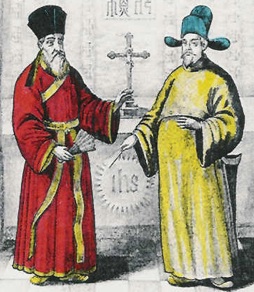
Between the sixteenth and seventeenth centuries, this challenge was taken up by a brilliant missionary, Jesuit Fr. Matteo Ricci, the fourth centenary of whose death is being marked in 2010 with exhibits, studies, and conferences, including in China, where he is considered a national treasure. His beatification process is also underway.
In dialoguing with the intellectual circles of Beijing at the time, Ricci adopted an approach remarkably similar to the one proposed by Benedict XVI today. He knew very well that the Christian Gospel was an absolute innovation, come from God. But he knew that human reason also has its origin in the one Lord of Heaven, and is common to all who live under the same sky.
He was therefore confident that the Chinese could also accept “the things of our holy faith,” if these were “confirmed by much evidence of reason.”
His proclamation of the Christian news was therefore gradual. He took his cues from the philosophical principles of Confucianism, from the traits it had in common with the Christian vision of God and of the world, in order to build gradually to the absolute novelty of the Son of God made man in Jesus.
Matteo Ricci did not do the same thing with Buddhism and Taoism, instead subjecting them to severe criticism. A little like the Fathers of the Church had done before him, being extremely critical of pagan religion but in respectful dialogue with the wisdom of the philosophers.
This masterstroke of the the missionary work of Matteo Ricci has been profiled in an important book by one of his modern successors in the missions: Fr. Gianni Criveller, 49, of the Pontifical Institute for Foreign Missions in Milan, active in China for twenty years, a professor at the Holy Spirit Seminary College and at the Chinese University of Hong Kong, and the author of numerous works.
The following excerpt is taken from the central chapter of the book. And it sheds light not only on what Matteo Ricci did four centuries ago, but also on how Christianity can face the challenge of China today, with a method that is the same as the one proposed by the current pope.
English translation by Matthew Sherry, Ballwin, Missouri, U.S.A.