

Author: 爵醒
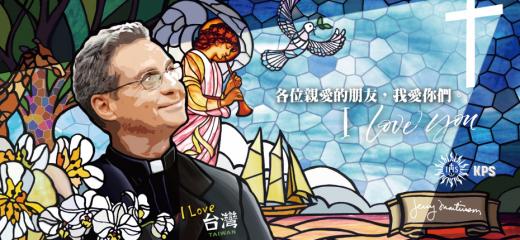
Fr George Gerald “Jerry” Martinson SJ died on May 31 in Taiwan, 50 years after he first arrived in 1967 from the California Jesuit Province. At the age of 25, he was sent to Taiwan and began working at the Jesuit-run Kuangchi Program Service (KPS). He became a renowned television producer and host, known to many in Taiwan and China as Uncle Jerry, his screen name in an English teaching television programme he hosted. Continue reading “Remembering Fr Jerry Martinson SJ”
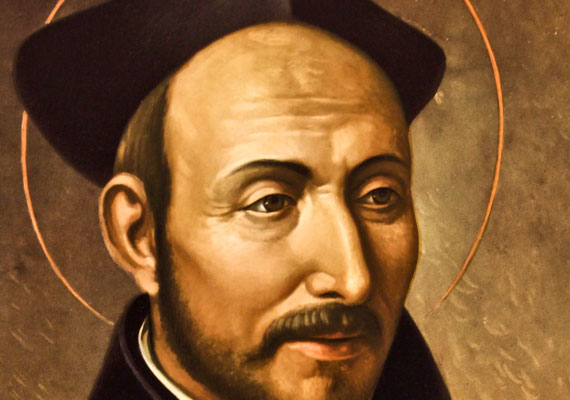
St. Ignatius came from a family of minor nobility in Spain’s northern Basque region. One thing to know about Ignatius is that he was far from saintly during much of his young adult life. He was vain, with dreams of personal honor and fame. He gambled and was not above sword fighting. As some have noted, he might have been the only saint with a notarized police record: for taking part in a nighttime brawl. Continue reading “Ignatius of Loyola”
Finding God in All Things
Throughout much of the world, the Jesuits are best known for their colleges, universities, and high schools. But in a time when many are searching for greater meaning, another aspect of Jesuit life is attracting wide interest. And that is the unique spirituality introduced nearly 500 years ago by St. Ignatius Loyola, founder of the Jesuits.
Ignatius was a Spanish soldier and aristocrat who discerned his calling after suffering nearly fatal wounds on the battlefield. He established the Society of Jesus in 1540, instructing the early Jesuits — to go out and “find God in all things.” That is the signature spirituality of the Jesuits.
Ignatian spirituality is grounded in the conviction that God is active in our world. As the great Jesuit paleontologist Pierre Teilhard de Chardin wrote: “God is not remote from us. He is at the point of my pen, my pick, my paintbrush, my needle — and my heart and my thoughts.” The spiritual path laid out by Ignatius is a way of discerning God’s presence in our everyday lives. And doing something about it.
The Jesuits have a handbook for this search. It is The Spiritual Exercises of St. Ignatius Loyola, composed by the saint before he was even a priest. Often described as Ignatius’s greatest gift to the world, these exercises unfold a dynamic process of prayer, meditation, and self-awareness. The basic thrust is to make us more attentive to God’s activity in our world, more responsive to what God is calling us to do. Ignatian spiritual directors accompany or guide people through the exercises in retreat houses, parishes, and other settings.
One of the most popular Ignatian exercises is the Daily Examen. It’s a spiritual self-review that involves prayerfully recollecting moments during the day and reflecting on how God was present at those times, followed by a decision to act in some way. The Examen is concrete: It focuses your mind on segments of time (no more than a day, preferably), and the feelings that stirred within you, at those specific moments. Walk through the five steps of the Examen here.
There are a number of outstanding resources devoted to Ignatian spirituality. Sacred Space is a popular prayer site run by the Irish Jesuits, and Jesuitprayer.org was created by the Chicago-Detroit Province of the Society of Jesus to provide daily online prayers and facilitate prayer requests. In addition, The Jesuit Post, founded by a group of Jesuit scholastics (those in the process of religious formation), provides a contemporary look at Jesus, politics, and pop-culture in our secular age.
Ignatian spirituality is not merely an inward journey, much less a self-absorbed one. It aims to bring people closer to God and more deeply into the world — with gratitude, passion, and humility — not away from it. Ignatius called on the Jesuits to be “contemplatives in action.” Today, Jesuits and their lay collaborators work with people in many walks of life, such as education and business. They help nurture “men and women for others.”
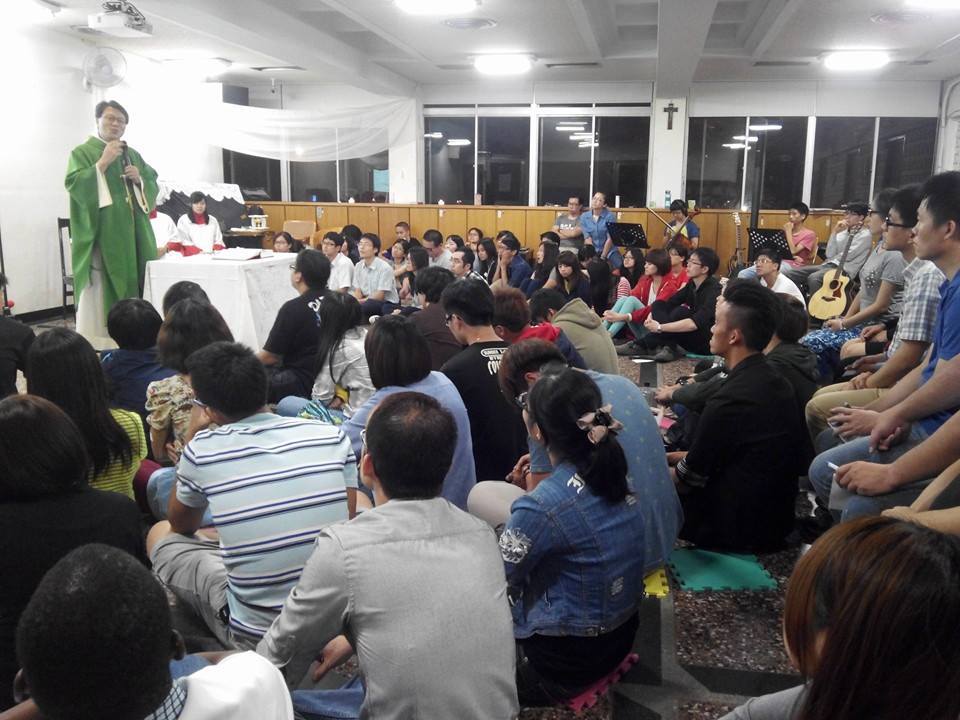
-1024x685.jpg) Whether it is at home, in the community or in the Church, care and concern of youth is a number one priority, and the Society of Jesus is no exception. From the very beginning, the ministry for youth has been a prime apostolate. The Constitution of the Society (No. 538) pledges the Society to undertake “the education of children and adults” as a “sacred task.”
Whether it is at home, in the community or in the Church, care and concern of youth is a number one priority, and the Society of Jesus is no exception. From the very beginning, the ministry for youth has been a prime apostolate. The Constitution of the Society (No. 538) pledges the Society to undertake “the education of children and adults” as a “sacred task.”
For this reason the earliest members of the Society established throughout the world educational institutions at both high school and college levels, in order to provide and nurture their students intellectually, culturally and spiritually so they could lead meaningful, significant lives.
In this same spirit, the Commission for Youth Ministry of the Jesuits of the China Province seeks to escort the young as they face the challenges of an ever changing world on their journey toward the Presence of God, not just to enrich their own lives, but to reach out to better the lives of others.
The Commission for Youth Ministry
On August 25, 1997 98 Jesuits together with over 10 collaborators and observers came together at the Manresa Center of Spirituality at Jing Shan, Changhwa City for a three day meeting entitled “A Vision to Share.” At this time the Fr. Provincial Beda Liu Jia-zheng appointed Fr. Howard Lui Jing-qi, Fr. Ignatius Hung Wan-liu, Fr. Olivier Lardinois (Ding Li-wei) and Scholastic John Li Hua to form the Youth Ministry Commission. Though they were from far different backgrounds, they blended together for a common purpose and united effort.
 Our activities
During these few years the Youth Ministry Commission together with the collaboration of Sisters who share the Ignatius tradition has organized “Encounter with the Lord” prayer camps, “Listen and Respond”dis-cernment camps to introduce and share with young people the methods of prayer and discernment found in St. Ignatius’ Spiritual Exercises. We also arranged for a series of “Sitting together” and “Watching a Movie Together”” activities and accompanied Chinese youth for international activities in different countries in Asia and Europe, such as World Youth Day, Asian Youth Day, Magis Life Encounters, Discover Spain Pilgrimage, etc. These were all intended to nourish their spiritual lives and satisfy their longing for the love of God.
Vision and Mission
In order to combine and integrate all present resources, the Commission for Youth Ministries is called upon to be a group that appeals to and is familiar with youth, to assist them as they mature spiritually and discern their direction in life. It is all so that they will know Jesus more intimately, love Him more ardently, and follow Him more closely.
Our mission objectives
.To specifically support and participate in the Church’s Apostolate for youth.
.To promote the importance and dedicate ourselves to the youth ministry through contact and companionship through personal effort and ongoing attention.
.To organize and sponsor youth activities such as prayer camps, discernment camps, pilgrimages, emersion experiences, etc. to deepen their faith and their understanding of life.
.To produce spiritual publications for youth, such as “Companions: A News letter for friends of the Sciety of Jesus, China Province”, “To Go on a Pilgrimage”, and “Dream, Vision and Practice”.
 In one way or another, we have all felt moved by Christ’s call:
Come! Follow me!
Inspired by the example of Ignatius,
we want to be companions of Jesus, sharing his work of love in our world.
Jesuits ordinarily live together in communities, some small and others large, depending on the kinds of ministries in which they are engaged.
Sometimes a Jesuit will live alone because his work or study places him at a distance from a local community, but he remains attached to a larger community.
Jesuits share all things in common, owning nothing in their own name.
Jesuits derive strength for their ministries from their relationship with Jesus in prayer, as well as from the mutual support, understanding and encouragement they receive from their brother Jesuits.
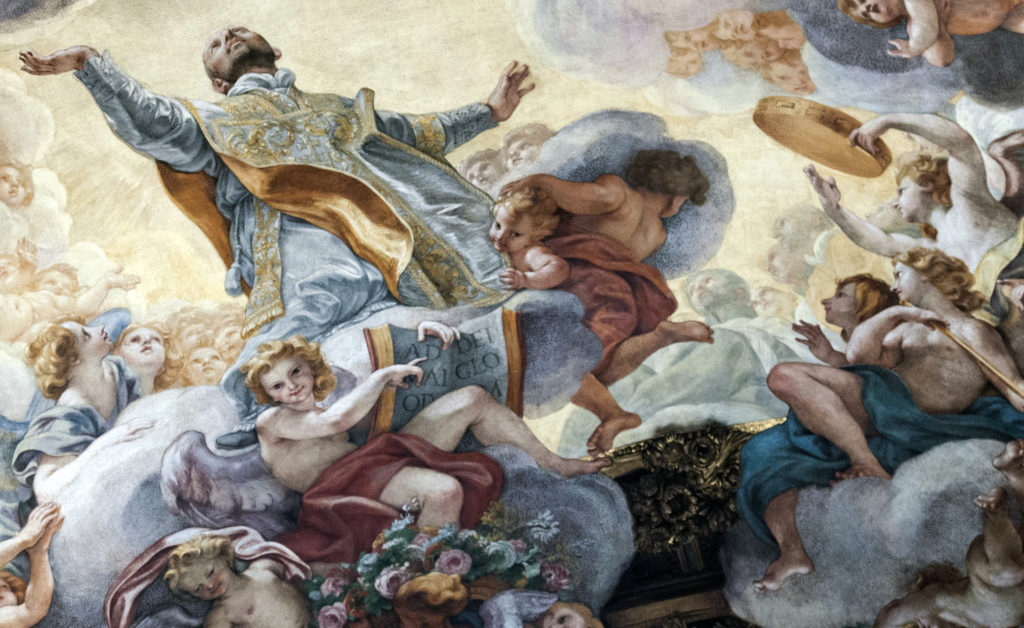
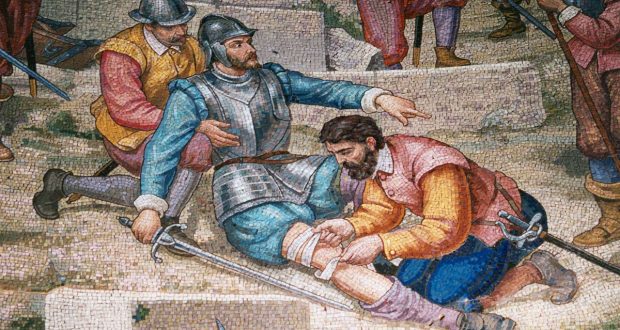
Ignatius was born Inigo Lopez de Loyola in 1491, the youngest son of a Spanish nobleman in the Basque area of northern Spain. “Up to the age of twenty-six, he was”, as he says in his Autobiography, “a man given to the follies of the world: and what he enjoyed most was warlike sport, with a great and foolish desire to win fame.” His ambition to pursue the glorious career of a soldier and knight at court was cut short in a battle at Pamplona. Refusal to surrender in a losing cause against French invaders resulted in one of his legs being shattered by a cannonball. The French soldiers were so impressed with his bravery they had him carried back to his home in Loyola.
“As he was much given to reading worldly books of fiction … when he felt better he asked to be given some of them to pass the time. But in that house none of those that he usually read could be found, so they gave him a Life of Christ and a book of the lives of the saints…” (Autobiography). In this way God kindled in him an entirely new and different ambition, namely to make a pilgrimage to Jerusalem and dedicate his whole life to following completely in the footsteps of Jesus.
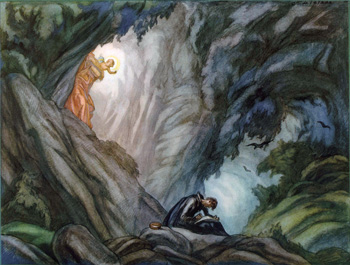
As soon as he had recovered enough strength Ignatius left home intending to spend his life in prayer and penance. In a symbolic gesture at a shrine of the Blessed Mother in Montserrat, Ignatius placed his sword at her feet, gave his fine clothes away to a beggar and, dressed in rags, retired to a cave at Manresa. Here for eleven months he lived a life a great austerity, underwent a period of scruples and depression until he had a mystical experience sitting by the banks of the River Cardoner, following which he enjoyed great consolation and began writing down his reflections on prayer and how to respond to the will of God. These eventually became his famed Spiritual Exercises.
Ignatius left Spain intending to spend the rest of his life as a pilgrim in Jerusalem, but was not allowed to remain in the Holy Land. Returning to Spain, he decided to become a priest, but first had to sit down with grammar school students to learn Latin. Following the study of philosophy in Alcala, he went to Paris to study theology.
While he was in Paris he became good friends with six companions whom he led through thirty days of his Spiritual Exercises. Imbued with the same ideals, they called themselves “friends in the Lord” and in 1534 in the church of Montmartyr in Paris promised that when their studies were finished they would continue their association, live lives of evangelical poverty and go on mission to Jerusalem.
When it became obvious that going to Jerusalem was not possible, they offered themselves to the Pope to be sent wherever and to undertake whatever task he would ask them to do. They were soon traveling all over Europe on various missions entrusted to them for the defense and propagation of the faith. Eventually they decided to form themselves into a permanent group under obedience to a leader.
On September 27, 1540 Pope Paul III in a papal decree formally established the Society of Jesus as a new religious order that would be apostolic and not confined to any monastery and in addition to the ordinary vows of poverty chastity and obedience would add a fourth vow to go anywhere the Pope would send them. In 1541 Ignatius was unanimously elected the first Superior General and served until his death in 1556.
The right man at the right time
In the final analysis, did the times make the man or did the man make the times? In the case of Ignatius both statements are true. He was born right at the end of the eight hundred year long Middle Ages. Europe was just beginning to enter the Renaissance. The life of Ignatius bridged the turn over from one to the other. European adventurers had discovered America and Africa, scholars were rediscovering the long forgotten cultures of Rome and Greece. As luck would have it, 1521, the year Ignatius was injured, was also the very year that Martin Luther was excommunicated beginning the Protestant Reformation. In the next twenty years England, Holland, Switzerland and Northern Europe broke from the Catholic Church under a cloud of deep religious differences. In society a hitherto non-existent middle class was emerging and the invention of the printing press began to fulfill the thirst for knowledge. The knights of the Middle Ages gave way to the humanists. Society was racked by turmoil and wars.
They were earthshaking times. The Catholic Church had an urgent need for a new “shake-proof” company of defenders and promoters. Thanks to Ignatius the Church had such a champion in the Society of Jesus.
A Man in Pursuit of an Ideal, A Man on Pilgrimage, A Man of Discernment
Throughout his life, Ignatius was a man hot on the trail of an ideal. In the beginning it was a selfish pursuit of worldly glory. This changed to pursuing the will of God, consecrating his life to selflessly follow in the footsteps of Jesus in service for the church.
Ignatius always referred to himself as a pilgrim. In the beginning this meant literally going to the Holy Land. Then it became wandering around aimlessly from place to place, penniless and homeless. This finally changed to the journey of a man on fire with the desire to serve Christ wherever the guidance of the Holy Spirit would lead.
It was his first discernment how to distinguish between the consolations that came from God and those which did not that launched Ignatius on his spiritual journey, led to his composition of the Spiritual Exercises and moved him to dedicate his life to teaching others how to discern the will of God for them and led ultimately to the discernments that established the Society of Jesus and guided him in his years as its father and leader.
※ N.B. The three periods of pursuit of an ideal, pilgrimage, and discernment are described by Fr. Chang Ch’un-Shen in “A Man in Search-From Birth to Manresa”, Fr. Weng Te-Shao in “The Pilgrim” and Fr. Hsü K’e–chih “The Discerner” in the Fu Jen Journal of Theology, No. 90.
Chronology of St. Ignatius Loyola
| 1491 | Birth at Loyola in Spain |
| 1521 | Injured in battle at Pamplona and convalescence at home in Loyola |
| 1522 | Retreat at Manresa, spiritual experiences (begins to compose the Spiritual Exercises) |
| 1523 | Goes on pilgrimage to Jerusalem |
| 1525 | Begins to study Latin in Barcelona |
| 1526 | Studies philosophy at Alcala |
| 1528 | Begins study of theology in Paris |
| 1529 | At St. Barbe College meets St. Francis Xavier and Blessed Peter Favre |
| 1532 | At Paris University finishes study of philosophy |
| 1534 | Receives Licentiate at Paris University, directs his companions through the 30 day spiritual exercises after which they make vows of poverty and chastity at Montmartyr |
| 1537 | Ordination to priesthood in Venice where they wait for permission to go to Jerusalem; prevented from going by war, they decide to unite as a group they will call the Company of Jesus; on their way to Rome at La Storta a small church near the city Ignatius has a vision of God the Father promising him success in Rome and receiving Ignatius as a companion of Christ on the cross |
| 1538 | In Rome helping the poor and leading the spiritual exercises |
| 1539 | The companions discuss whether to become a religious order and obtain the approval of Pope Paul III for the Formula of the Institute |
| 1540 | St Francis Xavier is sent to India to propagate the faith; Paul III signs a Papal Bull formally establishing the Society of Jesus |
| 1541 | Ignatius is elected the first Superior General |
| 1551 | The first draft of the constitutions is finished; the Roman College becomes the first Jesuit university |
| 1553 | Ignatius begins to dictate his autobiography |
| 1554 | Construction of the Gesu Church begins in Rome |
| 1556 | Ignatius dies in Rome; there are already about 1000 Jesuits |
| 1609 | Ignatius declared blessed |
| 1622 | Ignatius declared a saint |
| 1922 | Pope Pius XI makes Ignatius patron of retreats |
References for further information…. http://www.ignatiushistory.info/
 The first step in the creation of the Society of Jesus was taken in 1534 when Ignatius Loyola and seven companions in the church of Montmarte in Paris promised that when their studies were finished they would continue their association, live lives of evangelical poverty and go on mission to Jerusalem. They called themselves “friends in the Lord”.
The founder of the Jesuits, St. Ignatius Loyola, was born in Spain in 1491 in the northern Basque Region. The son of a nobleman, he grew up with the dream of becoming a courageous soldier and courtier in the service of the king.
However in 1521 at the age of 30 his right leg was shattered in battle by a cannon ball and he had to be carried home for a long period of convalescence. During that time he had nothing to read but some religious books about the life of Christ and the saints. Under the influence of these books in isolation from the world, Ignatius began to pray and fast, do penance and good works and resolved to offer his life to Christ. The first seeds of the Society of Jesus had been planted.
Whenever we reflect on the life of a great man, we can ask ourselves “in the final analysis, did the times make the man or did the man make the times?” In the case of Ignatius both statements are true. Ignatius was born right at the end of the eight hundred year long Middle Ages. Europe was just beginning to enter the Renaissance. The life of Ignatius bridged the turn over from one to the other.
European adventurers had discovered America and Africa, scholars were rediscovering the long forgotten cultures of Rome and Greece. As luck would have it, 1521, the year Ignatius was injured was also the very year that Martin Luther was excommunicated beginning the Protestant Reformation. In the next twenty years England, Holland, Switzerland and Northern Europe broke from the Catholic Church under a cloud of deep religious differences. In society a hitherto non-existent middle class was emerging and the invention of the printing press began to fulfill the thirst for knowledge.
The knights of the Middle Ages gave way to the humanists. Society was racked by turmoil and wars. They were earthshaking times.
In 1540 Pope Paul III gave formal approval to the Society of Jesus. Ignatius was elected first Superior General and served until his death in 1556 at the age of 65.

“The Jesuit vocation means going directly and radically to the Gospel and living its message fully, generously and in this historic moment perhaps even heroically. It is not an easy life. It is a wonderful vocation. Everything is for the greater glory of God; more is not possible. Continue reading “Join Us”
 Apostolates of the Society of Jesus
Youth Ministry
To escort the young as they face the challenges of an ever-changing world on their journey toward the Presence of God, not just to enrich their own lives, but to reach out to better the lives of others. Continue reading “What we do”

Companions of Jesus
The Society of Jesus (the Jesuits) is a religious order of the Roman Catholic Church with members spread throughout the world. There are presently in Taiwan 200 Jesuits coming from 25 countries.
Jesuits are continuing the mission of Jesus Christ to preach, teach, heal, and reconcile. We ponder and interpret what God is saying in our hearts and we hope that finding God in all things we may with all our strength proclaim His glory.
We are ready to follow God under even the most difficult circumstances, to enter into and engage in dialogue with those of other faiths, cultures and value systems, and to stand in the front lines in the pursuit of justice and peace, bringing the message of the gospel that all men are yearning for deep in their hearts.