

Author: cfliao


Joe Paprocki, National Consultant for Faith Formation at Loyola Press, provides simple answers to frequently asked questions about Lent.



Fish played a role in Jesus’ ministry. His apostles were mostly fishermen, and he called his disciples to be “fishers of men.” He fed thousands of people with a couple of fish, and he ate fish with his disciples after his Resurrection. The fish symbol was widely used in the Roman Empire by pagan religions, so Christians felt compelled to make it their own. Some historians think that Christians may have seen in the Greek work for fish, ichthus, an acrostic for “Jesus Christ, of God, the Son, the Savior” [Iesous (Jesus) CHristos (Christ) THeou (of God) Uiou (the Son) Soter (the Savior)].
Whether or not that is so, the fish symbol was used in the early Church as a hidden reference to their faith in Christ. Precisely because it had a pagan history, the fish symbol aroused little suspicion and could be used safely by persecuted Christians. Etchings of fish are found in the catacombs, where the persecuted Christians buried their dead.
FR. LUIS REMIGIO BOLUMBURU went peacefully to the Lord on Feb. 7, 2010 in the Infirmary in Taipei at 6:03 a.m. Fr. Bolumburu was born in Placencia de las Armas-Soraluce (Guipúzcoa), Spain, on Oct. 1, 1910. He entered the Society at Loyola (Guipúzcoa), Spain, on Aug. 25, 1926, was ordained to the priesthood on May 30, 1940 at St. Ignatius Church, Zikawei, and professed his last vows on Feb. 2, 1944 at Wuhu, China. All priests of the Chinese Province will celebrate one Mass first intention for Fr. Bolumburu’s eternal rest. Those who are not priests will offer one Mass and Communion and recite one “corona”. The members of Theologate community will offer two Masses, etc. 


Given the many challenges facing today’s families, now is the perfect time and home is the perfect place to experience Lent. After all, home is where we rush and rest, where we hope and worry, where we love and forgive. It is home where we most often experience day-to-day salvation. Lenten experiences can take place in nearly every room of the house.
Here are some ideas to try to enrich your celebration of Lent at home:
Family Lenten Crafts
Make a decorative family “works of mercy” tree by following the directions on these PDFs. Work as a family to follow through on your promises. You can find more activities like this in Crafting Faith.
 A Prayer Book of Catholic Devotions
Lenten Family Mealtime
In addition to “Friday fish day,” designate one evening a week to prepare a meal together. Assign a different dish or task to each family member. Before starting, discuss how each family member is giving to the others-giving time, effort, and care to nourish the entire family to go out and do God’s will. Begin with a prayer of thanks and petition.
Family Lenten Reading
Prominently display the Bible and other books that feature topics such as the following: Lent, forgiveness, prayer, Scripture, generosity, social justice and service for others. You might wish to display Praying Lent: Renewing Our Lives on the Lenten Journey, a small booklet by Andy Alexander, SJ, or A Prayer Book of Catholic Devotions by William G. Storey, which offers a special section dedicated to Lenten reflection in addition to prayers for other seasons and normal time. Invite family members to choose books and discuss what you read.
Family Kindness and Sharing
On slips of paper, write random acts of kindness, such as give a compliment, say hi to an old friend, carry someone’s heavy load. Present each family member with a slip of paper as he or she leaves in the morning. Invite each family member to perform the kindness without seeking recognition. Afterward, talk together about what happened. Pray with one another that your kindnesses will be passed on throughout Lent and beyond.
Giving to Charities
Ask each family member to find three to five high-quality, useful items that would be appreciated by those who are less fortunate. Donate the items to a favorite charity. Pray together for those who will receive them.


KOLKATA, India (UCAN) – Former students of St. Xavier’s College, a premier Jesuit-run institution in Kolkata, have paid tribute to India’s first printing press that the Jesuits set up.
They helped erect the replica of the gate of the College of St. Paul in Goa at the popular Kolkata Book Fair . The Jesuits in Goa had set up India’s first printing press in 1556.
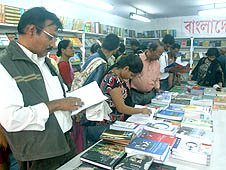
Visitors at the Kolkata Book Fair browsing books at the Jesuit stall
Since the book fair deals with printing, it is appropriate to pay tribute to the Jesuits who set up the first press, said Snehasis Sur, secretary of St. Xavier’s College’s alumni association.
The 10-day book fair scheduled to end Feb. 2 is regarded as the largest attended book fair in India. Media reports say more than two million people visit it annually.
Sur said the effort was undertaken to mark the completion of 150 years of St. Xavier’s College and 25 years of the alumni.
He said most people are unaware that Jesuit missioners began printing in India. The replica of the gate of St. Paul’s College will educate people of the Jesuit contribution, he added.
In 1542, Saint Francis Xavier, who was based in Goa at the time, requested the king of Portugal to send a printing press for India, Ethiopia and Japan. The ships sailing to Ethiopia had to pass through Goa since the Suez Canal was not in service then.
When the Jesuits in Goa received news that the king of Ethiopia was not keen on receiving the missioners with the printing press, it was setup at the college in Goa.
Sur, a journalist with a national television channel, said the College of St. Paul, began in 1542, was abandoned when a plague ravaged Goa in 1570, but the gate still stands as a historic witness to the first college the Jesuits built in India.
The replica of the gate at the book fair also is to acknowledge the Jesuits’ educational service to the nation, Sur told UCA News.
The alumni association has also setup a stall at the book fair with literature, books, photos of and on Calcutta Jesuits and their institutions. The gate of the College of St. Paul stands at one of the main entrances to the fair.
At the stall, visitors can read literature on the College of St. Paul, and appreciate the works of the Jesuits, said Sunil Ghorai, who manages the stall. Ghorai said this was the first time that the Jesuits had found a place at the annual fair.
“This is the only stall where Christian literature” including the Holy Bible in Bengali, lectionaries, lives of saints, is available at the fair, and “there is a lot of enthusiasm among visitors,” he said. He added that more than 300 people visited the stall on the first day.


by Joe Paprocki

New Year’s resolutions are much maligned nowadays. Some people feel that they’re a waste of time. I think it’s admirable that people want to accomplish something positive, turn over a new leaf, and become a better version of themselves. So why do so many New Year’s resolutions fail?
I can only speak for myself. My resolutions often fail for two reasons: I think I can do it on my own and I think it can be “once and done” instead of ongoing. As for thinking that I can accomplish my resolutions on my own, I tend to forget one tiny little detail: I can do nothing without God! In her book, Simple Acts of Moving Forward: A Little Book About Getting Unstuck, Vinita Hampton Wright reminds us that “Sooner or later God figures in.” Personally, I prefer sooner rather than later. Ultimately, that’s why I go to Mass on Sunday and receive the Eucharist – it’s my way of admitting repeatedly that, at my deepest level, I am incapable of sustaining myself: “but only say the word and I shall be healed.” People in twelve-step programs know this well: change can only come with reliance on a higher power.
As for thinking that this can be “once and done,” I too often forget that Jesus said, “If anyone would come after me, let him deny himself and take up his cross daily and follow me.” (Luke 9:23) Not “take up his cross once” or “take up his cross for a little while” but “take up his cross daily.” At first that may sound like a downer, but when we realize that following Jesus doesn’t end with the cross but with Resurrection and new life, we can find the patience, endurance, and determination to remain committed to our goals even in the face of hardship.
And so, have a happy new year. And with the help of God’s grace, may we resolve each day of the new year to become the people God knows we can be.
This article is written by Joe Paprocki,
author of A Well-Built Faith
For further information on Ignatian Spirituality,
please visit our sister site: www.IgnatianSpirituality.com


Many of us have heard this question when we arrive at school, work, or home with the blackened cross on our forehead. The observance of Ash Wednesday is the most popular weekday celebration in the Catholic Church’s liturgical year. During the celebration, children and adults process to the altar to receive ashes on their forehead in the shape of a cross. Ash Wednesday is also a day when people discover how many Catholics there are in their community. This can nurture in children a greater sense of religious community. And because receiving the ashes is a sign of humility and contrition, children will also see how many people recognize the need for repentance.
The Ash Wednesday Ritual
Ash Wednesday is always the first Wednesday of the Lenten season and marks the beginning of Lent. The distribution of blessed ashes is typically done before the altar and, depending on the custom of the parish, people will hear the distributor say, “Turn away from sin and be faithful to the Gospel” or “Remember, man, you are dust and to dust you will return.” The atmosphere in the Church is quiet and the observance solemn. People reflect on how quickly human life can pass. All are reminded of the need for repentance.
Ash Wednesday Readings
The readings for Ash Wednesday offer a number of important images that help children understand the meaning of this experience. The first reading calls us to repentance but also emphasizes that God is gracious and merciful, slow to anger, and rich in kindness (Joel 2:13). In the second reading, Paul reminds us that the world sees the presence of Christ in the way we act. So, be reconciled to God today! (2 Corinthians 5:20-6:1). We are called to be the love and change we wish to see in the world. In the third reading, Jesus reminds us that the sacrifices and prayers called for in Lent are between God and us. It is insincere for us to show off contrite actions to win the praise of others-let others only see how our sacrifices and prayers help us love them.
Children and Preparing for Lent
Ash Wednesday begins a wonderful season of reflection and preparation. Receiving the ashes as a member of the church community helps children recognize that they are an important part of the Catholic community and are united with the Church in its Lenten preparation.
Resources that can help children reflect on Lent are:
 Guided Reflections for Children, Volume 1
 Guided Reflections for Children, Volume 2
 52 Simple Ways to Talk with Your Kids about Faith
 Raising Kids Who Will Make a Difference – for support with fasting and ideas for abstinence and almsgiving
Dear Brothers in Christ,
FR. LUIS REMIGIO BOLUMBURU went peacefully to the Lord on Feb. 7, 2010 in the Infirmary in Taipei at 6:03 a.m.
Fr. Bolumburu was born in Placencia de las Armas-Soraluce (Guipúzcoa), Spain, on Oct. 1, 1910. He entered the Society at Loyola (Guipúzcoa), Spain, on Aug. 25, 1926, was ordained to the priesthood on May 30, 1940 at St. Ignatius Church, Zikawei, and professed his last vows on Feb. 2, 1944 at Wuhu, China.
All priests of the Chinese Province will celebrate one Mass first intention for Fr. Bolumburu’s eternal rest. Those who are not priests will offer one Mass and Communion and recite one “corona”. The members of Theologate community will offer two Masses, etc.
Yours in Our Lord,
Luciano Morra, S.J.
Socius
February 7, 2010


And You Welcomed Me
MIGRATION AND CATHOLIC SOCIAL TEACHING
BY Thomas Massaro, S.J.
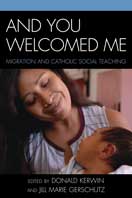
Migration is a phenomenon with many faces. Some are visible to U.S. observers: day-labor pick-up points that dot our rural and urban landscapes, news stories about human trafficking and various exploitative practices, and angry rhetoric from anti-immigrant voices. Other aspects of migration remain invisible or at least in the shadows: the 33,000 hopefuls languishing in U.S. detention centers, the growing value of remittances sent by guest workers to their homelands, the thousands of aspiring immigrants who die each year on the high seas or while attempting dangerous border crossings through sweltering deserts.
This collaborative volume of six essays skillfully brings into the light all these faces of migration, and many others beyond the U.S. arena as well. Each essay provides a wealth of relevant information and rich analysis crucial to understanding this topic of growing importance in our interdependent world. Especially valuable are the sections that supply historical context for contemporary U.S. immigration policy debates, documenting how Americans have been arguing (rarely dispassionately) about migration for centuries. Two scholars of immigration law collaborate on a particularly insightful essay that situates U.S. immigration policy within the context of the larger legal establishment, along the way providing an eminently clear explanation of the often baffling array of visa categories in U.S. law. Other essays focus on the economics, sociology and theology of migration, but each finds a judicious way of situating its analysis solidly in the inescapable context of globalization.
The unity this volume achieves is rightly attributed above all to the deftness of each author in following the common thread of Catholic social thought. No single discipline is capable of providing as wide a perspective as Catholic social teaching in the evaluation of global migration patterns. The distinctive Catholic theological themes of the common good, human dignity and authentic human development cannot, of course, in themselves determine national policies or direct international relations to specific conclusions or reforms. But the values and ethical principles proposed by the social teachings of the Catholic Church (and reflected by many other religious traditions) do rule out certain practices. Contributors to this volume do not shy away from pointing out morally objectionable policies and institutions. Examples include the exploitation of undocumented workers, human trafficking, denial of basic services to vulnerable immigrants and policies that leave families separated by political borders.
Further, this volume exposes a fundamental pattern that lies behind these abuses and rights violations. When governments, market actors or international agencies focus only on a narrow slice of the overall human context, they invariably neglect vital values and overlook pressing human concerns. An exclusive and all-consuming focus on trade liberalization or labor market flexibility or national security, to cite three prime examples, in isolation from the wider social ecology that promotes the well-being of actual people, yields irrational and inhumane policies. The harvest reaped by adopting such narrow approaches includes arbitrary immigration raids, the heartless breakup of families and the criminalizing of people in desperate straits.
Without a doubt, each of these essays contains an advocacy angle, one that tends to favor a broad conception of migratory rights and fewer immigration restrictions. Yet nowhere does the volume oversimplify the picture or deny the reasonable principle, recognized in international law as well as Catholic teaching, that nations have a right and duty to control their borders and regulate the flow of immigrants. As Daniel Groody explains in the lead essay: “My primary purpose is not to make a case for or against open borders, but to give a new way of conceptualizing a difficult and contentious global issue.” Each of the contributors displays a refreshing tendency to pose insightful questions and a studied deliberateness about leaving somewhat open-ended these queries regarding appropriate approaches to migration.
By bringing together such excellent analysis from several disciplines, this volume fills a large gap in scholarship surrounding migration. In a package that could be used to good effect in many college courses on social ethics, it provides a satisfying theological perspective on the global forces that push and pull migrants across borders. The authors draw on the latest statistics and trends. They also display commendable rigor in defining the slippery and often contested terms applied to various categories of migrants (asylum seekers, refugees, forced migrants, undocumented and internally displaced persons, among other terms).
While And You Welcomed Me deserves praise for its attention to detail, its relentless focus on the “big picture” is its greatest contribution. These essays make a persuasive case for framing issues concerning global migration in the broadest of terms, that is, in light of the global common good, of universal solidarity and of human aspirations for favorable work opportunities upon which hopes for a good life depend. Without the type of scholarship found here, the world may never grow beyond the mistrust and hostility that all too often characterize discussions of migration.
Thomas Massaro, S.J., teaches social ethics at the Boston College School of Theology and Ministry, Chestnut Hill, Mass.
Dear Brothers in Christ,
 FR. RAYMOND PARENT went peacefully to the Lord on Feb. 3, 2010 at the National Taiwan University Hospital in Taipei at 8:23 p.m.
Fr. Parent was born in Montreal, Canada, on Jan. 30, 1932. He entered the Society at St. Joseph, Sault-au-Recollet, Montreal, on Aug. 14, 1951, was ordained to the priesthood on March 18, 1962 at the Cathedral, Taipei, and professed his last vows on May 7, 1977 in Taipei.
All priests of the Chinese Province will celebrate one Mass first intention for Fr. Parent’s eternal rest. Those who are not priests will offer one Mass and Communion and recite one “corona”. The members of St. Peter Canisius Residence will offer two Masses, etc.
Yours in Our Lord,
Luciano Morra, S.J.
Socius
February 3, 2010
 Crafting Faith
 Praying Lent
