

Author: cfliao
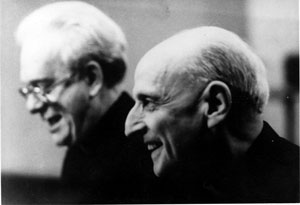
Fr. Adolfo Nicolás, Superior General of the Society of Jesus Visiting the Jesuits and their collaborators in Flanders Heverlee (Belgium) 26 September 2010

by Vincent T. O’Keefe, S.J.
He would have been 90 on Nov. 14, 1997. The man we knew as Pedro Arrupe or, more affectionately, Don Pedro. His brother Jesuits, led by his successor as superior general, Peter-Hans Kolvenbach. S.J., celebrated the day in a special way in the church of the Gesù in Rome. The ceremony had a disarmingly simple title: Commemoration of the Transferral of the Remains of Father Pedro Arrupe. S.J. In reality it was a family gathering of Jesuits and friends, including some members of Father Arrupe’s family, who filled the church. All shared in a Eucharistic celebration that was simple, prayerful, joyful and very moving.
As Father Kolvenbach pointed out, it was a fitting occasion for us to thank the Lord for his wonderful gift of Father Arrupe to the church and to the Society of Jesus. Four Jesuits flanked Father Kolvenbach at the altar, evoking different stages of Father Arrupe’s Jesuit life: Ignacio Echarte, S.J., the current provincial superior of Loyola, Father Arrupe’s original province in Spain; José María Maruri, S.J., and Giuseppe Pittau, S.J., his longtime associates in Japan; and I, who had been an assistant to Father Arrupe during his term as superior general from 1965 to 1983.
My thoughts kept drifting back to Feb. 5. 1991, when Pedro Arrupe died in his small, plain infirmary room after a long and painful illness of 10 years. We had gathered there day after day during the final week, and watched and prayed as life drained out of him. His body was waked in the church of our Jesuit curia for several days, and it seemed as though all of Rome passed by to pay their final respects.
His face had become utterly peaceful and composed and bore a striking resemblance to the death mask of Ignatius of Loyola. As I gazed at his face in profile, I recalled how Don Pedro loved to visit the rooms where Ignatius lived and died in the residence next to the Gesù. Before the feast of St. Ignatius on July 31 each year, he would take real delight in stealing away to spend three days there in prayer and reflection. He would laugh when 1 reminded him that he could not count on osmosis in this ease.
Father Arrupe’s funeral liturgy in the Gesù church had been marked by an appealing simplicity. An open book of the Scriptures lay on top of the simple wooden casket that rested on the bare floor of the church. (At Pope Paul VI’s funeral in August 1978, in St. Peter’s Square, a gentle breeze had played gracefully with a page of the Scriptures, also open upon his wooden casket.) When the final blessing had descended on Don Pedro’s remains, a group of his brother Jesuits carried the casket out of the church. Their measured pace met its counterpoint, a spontaneous burst of applause, both heartwarming and heartbreaking, from the congregation.
Father Arrupe’s body was taken to the Jesuit section of Rome’s communal cemetery at Campo Verano. There it remained until June of 1997, when it was brought back to the Gesù, the burial site of many Jesuit superiors general over the centuries, to be placed in the Chapel of St. Joseph Pignatelli. The return, although a quiet and simple ceremony, was the result of a long and patient effort to obtain all the necessary approvals from the Italian Government. (Italy can produce as much red tape as it does great pasta.)
At the start of the Mass commemorating the return of Father Arrupe’s body to the Gesù, Father Kolvenbach set the appropriate tone. He invited us, as we gathered together in the name of the Lord on this feast day of St. Joseph Pignatelli, which was also the anniversary of Father Arrupe’s birth, “to celebrate a Eucharist of thanksgiving and of praise, in affectionate and grateful recall.”
The Scripture readings had been chosen with the lives of St. Joseph Pignatelli and Father Arrupe very much in mind. The first reading, from the Second Letter to the Corinthians (4:6-15) seemed especially fitting:
We are only the earthenware jars that hold this treasure, to make it clear that such an overwhelming power comes from God and not from us. We are in difficulties on all sides, but never cornered; we see no answer to our problems, but never despair; we have been persecuted, but never deserted; knocked down, but never killed: always, wherever we may be, we carry with us in our body the death of Jesus, so that the life of Jesus, too, may always be seen in our body.
Many in the congregation, aware of the life of Pedro Arrupe and how this reading applied to him, were visibly moved. The Gospel passage read at the Mass was from Mark (3:31-35). Jesus asks the people gathered about him: “Who are my mother and my brothers?” He replies: “Anyone who does the will of God, that person is my brother and sister and mother.” Father Kolvenbach applied this text to St. Joseph Pignatelli and Father Arrupe: “Together with Father Jan Roothaan [superior general, 1829-52] who is buried in the same chapel, they are deeply united in the mission proclaimed in this evening’s Gospel: to fulfill the will of the Father of Jesus and in this way to become the brothers and sisters of the Lord; to gather in one family all those who live, in their flesh and in their hearts, according to the will of God in Jesus.”
Father Kolvenbach’s homily was masterful in depicting the parallel traits that linked St. Joseph Pignatelli to Father Arrupe, and the both of them to St. Ignatius. “We are together this evening…to celebrate a man who is a saint (un uomo santo), Joseph Pignatelli, and a saintly man (un sant’uomo), Father Pedro Arrupe. Both served the church in troublesome and critical times for the life of Society of Jesus. St. Joseph Pignatelli, with great patience and loyalty, acted as a bridge between the suppressed Society and the restored Society. Father Arrupe, with courage and enthusiasm, carried out what the Second Vatican Council desired for the renewal of all consecrated life, and thus also for the Society.”
A word about Joseph Pignatelli. Born in Spain in 1737 of an Italian father and a Spanish mother, both of noble descent, he joined the Society of Jesus in Spain and was ordained a priest at age 25 in 1762. When Charles III of Spain expelled the Jesuits in 1767, Pignatelli was placed in charge of 600 Jesuits, who embarked in 13 ships from Tarragona for Civitavecchia, near Rome on Italy’s western coast. Thus began an odyssey replete with physical hardships, heartbreaking rejections and endless wanderings that lasted 40 years.
After three difficult months at sea, the exiles were refused entry at Civitavecchia and also at Bastia in Corsica before finding refuge at Ajaccio, Corsica, where Pignatelli managed to house and feed them. This was the first demonstration of his legendary ability to provide lodging, food and work for his brother Jesuits in exile. When Corsica came under the control of France, the exiles had to put to sea again, since France had banished the Jesuits in 1762. On landing in Genoa, they learned that they could find asylum in Ferrara, a part of the Papal States. Pignatelli led his group of Jesuits, which had now doubled in size, on foot to Ferrara, 300 miles away. With the help of some of his relatives, Pignatelli managed to settle the exiles and provide classes and academic projects for them.
Then in 1773 the terrible blow fell. Pope Clement XIV suppressed the Society of Jesus. The Jesuits in Ferrara were disbanded, and Pignatelli moved to Bologna, where he lived from 1773 to 1797, working for the restoration of the Society. He managed to remain in contact with a group of Jesuits still in existence in White Russia. When Ferdinand became Duke of Parma and wished the Jesuits to return, Pignatelli encouraged him to seek the approval of Pius VI for this initiative.
With papal permission, Ferdinand received approval from the Jesuit superior general in White Russia to have a vice province in Parma, attached to the Society in White Russia. Pignatelli joined the group in Parma, renewed his vows in 1797 and was named provincial superior of Italy by the superior in Russia in 1803. When the French occupied Parma in 1804, once again the Jesuits were expelled; but they found a home in Naples. Many former Jesuits joined them; and, with the authorization of Pius VII, Pignatelli presided over the restoration of the Society in Naples. In 1806 the French seized Naples, and the Jesuits were again dispersed. This brought Pignatelli to Rome, where Pius VII turned over the Gesù and the Roman College to them. From Rome Pignatelli directed the restoration of the Society in Sardinia in 1807 and opened colleges in Rome, Orvieto and Tivoli. He died in 1811, completely exhausted from his life of continual struggle in exile, three years before the restoration of the whole Society of Jesus by Pius VII in1814. Pius XI beatified him in 1933 and Pius XII canonized him in 1954.
Father Kolvenbach, in his homily, pictured Pignatelli and Arrupe as true successors of St. Ignatius Loyola. The ruling passion of Ignatius, he said, “was to search for and discern what God wants for the life of the world, not in any abstract sense, but very concretely, here and now, in the life of each individual, of the church, and of the world.
For Ignatius this meant following Christ who came among us to do the will of the Father in all things. It is only in this way that we can become servants of the mission of Christ. Then Father Kolvenbach made some applications: “In this search for the will of God, St. Joseph Pignatelli looked for what the Lord was saying to us by means of the sorrowful suppression of the Society and then what he wanted from a Society that was reborn. In the same spirit, Father Pedro Arrupe read and sought to read in the conciliar movement what the Lord was asking of our Society in these modern and demanding times.”
Father Kolvenbach had arrived at the heart of the matter. The congregation listened, rapt, as he discussed the common concern of these two Jesuits “to maintain a creative fidelity to the spiritual experience of Ignatius.” Father Kolvenbach said: “It is the same passion for the will of God that energized the love of these two companions of Jesus for the church, which they loved as the spouse of the Lord. When he is faced with the painful decision of the suppression of the Society, Pignatelli reacts with a loving patience and understanding because he has seen in it the will of God whose ways are not always our ways, but are, however, always for our salvation. Father Arrupe, too, was sorely tried in his love for the church because his efforts to renew the Society in the dynamic movement of Vatican 11 collided with misunderstandings, and with painful interventions on the part of the church which he loved with an Ignatian heart. Both entered into the mystery of a will of God that involves suffering for the life of the church, but which also entails at times the need to suffer with loving humility from the church.”
The mission of the Society of Jesus must always be in the church and for the church. Therefore, explained Father Kolvenbach, “despite their passionate love for the Society of Jesus, neither Joseph Pignatelli nor Pedro Arrupe considers the apostolic body of the Society as an end in itself. If they desire the restoration and renewal of the Society, its growth and apostolic well-being is for a mission that they want to receive from the Lord for and in his church. With Ignatius, both want to help persons ‘to meet their Savior and Creator.’ This explains their passion to be of help, above all, whenever the will of God in Jesus for the world is not yet known or badly known. To prepare the Society for this mission-the continuation of the mission of Christ-was the end and meaning of the lives of these two Jesuits whom we commemorate this evening.”
Father Kolvenbach’s homily, as powerful as it was brief, gripped and moved the congregation. Words and phrases from it kept running through my mind as the Mass continued. After members of Father Arrupe’s family had brought the gifts of bread and wine to the altar, the liturgy of the Eucharist followed in a reverent, prayerful and joyous manner. The full-throated singing of the congregation revealed its vibrant mood. Just before the final blessing, Father Kolvenbach and the four concelebrants made their way to the Chapel of St. Joseph Pignatelli for a moment of silent prayer. Then came the final blessing, and it was over.
There was electricity in the air of the sacristy as we removed our liturgical vestments. A Basque television crew had filmed the Mass and was now asking for comments from us. It was clear that this had been no ordinary event. This was a day to savor and reflect on, a moment not to be forgotten, a defining moment.
Father Kolvenbach’s happy phrase, “creative fidelity to the Ignatian charism,” struck just the right chord. It is a graphic description of the whole generalate of Pedro Arrupe. He embraced with all his heart and soul the call of the church in Vatican II to return to the original charism of the founder. His last public statement in 1981, before the stroke that disabled him, was the last of a series on that charism and was entitled: “Rooted and Grounded in Love.”
Don Pedro worked tirelessly to carry out Vatican II’s mandate for renewal and adaptation to the changed conditions of the times. Fidelity, for him, meant change. Instead of a wooden and mindless repetition of what we had always done, he promoted spiritual discernment to read the signs of the times, to find God in all things, especially in our brothers and sisters in need, and in the major events and movements of the day. That is precisely the meaning of “creative” fidelity. He had taken to heart the mandate given him in 1965 by the 31st General Congregation, the Society’s legislative body: “In order that our Society may more aptly fulfill in the new age its mission under the Roman Pontiff, the 31st General Congregation has striven with all its power so to promote a renewal that those things may be removed from our body which could constrict its life and hinder it from fully attaining its end, and that in this way its internal dynamic freedom may be made strong and vigorous, and ready for every form of the service of God.”
Because of the consistency in his life between what he did and what he said, Pedro Arrupe had the great gift of making the vision of a truly Ignatian life, the life he articulated, not only credible but also infectious. And he did this both in the full vigor of his life and in the long years of silent and patient suffering.
Father Kolvenbach ended his homily with these words: “May St. Joseph Pignatelli and Father Pedro Arrupe unite us this evening in the bread that is broken and the blood that is shed, to celebrate the great paschal feast that God our Father has willed for our salvation, for the salvation of our planet, through the obedience of his Son.”
To which, I am sure, Pedro Arrupe would have added his favorite prayer: “Amen. Alleluia.”



by Jim Manney
To mark St. Ignatius’s feast day, I thought I would tell one of my favorite stories about him.
In 1552, Pope Julius III announced plans to make another Jesuit a cardinal. Ignatius detested the idea; Jesuits were committed to poverty, and the office of cardinal at the time brought with it wealth and a luxurious life. Ignatius lobbied hard to scuttle the idea, writing that “If I did not act thus, I would be quite certain that I would not give a good account of myself before God Our Lord.” But he went on to say that others were free to disagree with him: “the same Spirit could inspire me to take one point of view for some reasons and inspire others to the contrary for other reasons.” (The pope eventually changed his mind.)
Think about that. Ignatius thought that it was OK for people to disagree with him about a matter he thought was important. In fact, God could be moving each party in the dispute to hold the views they had. Ignatius could be wrong (though he thought he was right). God could be allowing this clash of views for some larger purpose.
Imagine what debate in the church would be like if people held their views as humbly as Ignatius did. Imagine our politics conducted this way. That’s a lovely thought on St. Ignatius’s feast day.


by Tim Muldoon
This week Sue and I are celebrating 19 years of marriage. Nineteen! Coincidentally, just yesterday I heard some radio person opining that our whole notion of marriage is changing, and that the norm for the future will be some kind of serial marriage contracts with a shelf life of some 10 years or so. That may be true, but what has become abundantly clear to me is that when Christians talk about marriage they mean something radically, radically different from that.
What have I learned about true love through the religious profession of Christian marriage? Here’s a snapshot.


17th Week in Ordinary Time
18th Week in Ordinary Time
19th Week in Ordinary Time
20th Week in Ordinary Time
21st Week in Ordinary Time


by Becky Eldredge
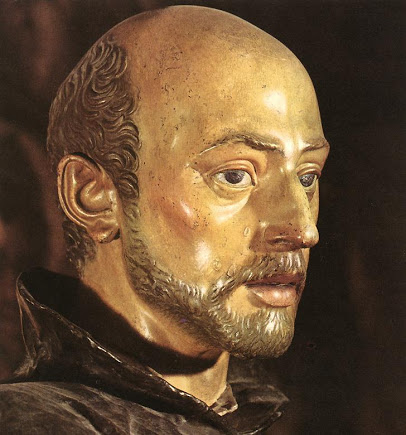
What would my encounter be like with a man whose very life, core beliefs, and legacy are an enormous part of my life today?
What would I say if St. Ignatius came to visit me? Answering this question has moved me to tears as I rummaged backwards through my life thinking of all the ways St. Ignatius’s present day “soldiers” impacted my life by sharing with me the wisdom of Ignatian spirituality and the Spiritual Exercises. What do I say to the man whose teachings allowed me to find inner freedom, whose Spiritual Exercises helped me completely re-situate my life around God, and whose belief that God can be found in all things allowed me to understand the invisible mysteries of God through visible people, experiences in nature, and in Scripture? My encounter with St. Ignatius would be enfolded in gratitude.
I can’t think of anything other than to say “thank you.” St. Ignatius, thank you for being a man of authentic, lived faith, who struggled as we do today to journey through change and unsettled times, and who radically changed your life to follow Christ. Thank you for being a man so solidly rooted in prayer that you were able not only to capture the Spiritual Exercises in writing, but you were also able to teach others how to give them. The fact that your Exercises are still being handed on generations later shows me the fruits of your deep prayer life.
The people who are part of your army of Ignatian teachers, mentors, and friends have impacted my life in ways that I cannot even begin to capture here. They shared your wisdom with me, they taught me your prayer methods, and they journeyed with me through your challenging and life-giving Exercises. St. Ignatius, because of you, I know who I am-a woman deeply loved by God, whose authenticity and integrity come from God, and who understands that God’s love calls me beyond myself.
Did you understand back then, St. Ignatius, that your personal struggles, your surrender to God, and your openness to be molded by God would continue to impact the world over 500 years later? While you may not have understood it then, your life and your work are very much part of my life-a young adult woman attempting to live a life of faith as a wife, as a mother of two, and as a person called to ministry.
Thank you!


 |
by Jim Manney
Ignatius really means it when he says that we need to be “indifferent to all created things.” In his Principle and Foundation at the beginning of the Spiritual Exercises, he says “we ought not to seek health rather than sickness, wealth rather than poverty, honor rather than dishonor, a long life rather than a short one.”
To make it even more challenging, Michelle Francl-Donnay suggests that we write our personal version of that sentence, inserting things we especially love and loathe. This is hers:
I should not fix my desires on wet socks or dry feet, placemats or tablecloths, silence or noise, order or utter chaos.
Here’s mine:
I should not prefer Mozart to Lady Gaga, New York City to Las Vegas, steamed lobster to a tofu burger, baseball to soccer.
It’s very hard to be indifferent.


From Nairobi
Press release n. 1
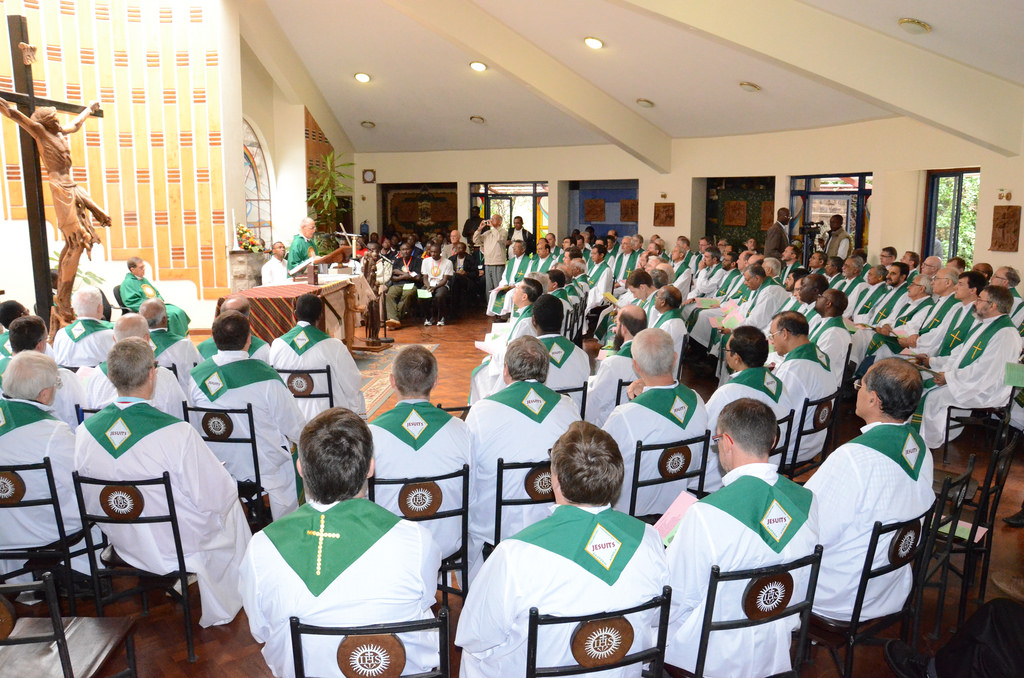
From 28 June, Jesuit delegates from around the world will arrive in Nairobi for the Congregation of Procurators of the Society of Jesus. Many of them will join the pre-Congregation retreat which ends on 7 July. The Congregation will start on 9 July, and last for one week.
What is a Congregation of Procurators?
St. Ignatius of Loyola, looking at the hard labour and distraction could involve, discouraged meeting of General Congregation at definite intervals (Const. n 677). But later clarified that the Superior General maintains communication with the Society through letters and through the persons who should come from the provinces, at least once every three years from each province (and every four years from the Indies) (Const. n. 679).
These texts of Ignatius, and the wish expressed by the Pope, led the second General Congregation (1565), presided over by St. Francis de Borgia the newly elected Superior General, to propose the establishment of a Congregation of Procurators which will be called every three years. The first Congregation of Procurators was called in 1568 and until the beginning of the 18th century the General Congregations and the Congregations of Procurators proceeded regularly. General Congregation 34 (1995) ruled that the Congregation of Procurators should be held every four years

Most of the Procurators’ Congregations were held in Rome, except those of 1886 and 1889, which took place in Fiesole (Florence) and that of 2003, which took place in Loyola.
The next Congregation of Procurators, which is number 70 in the series, will be held in Nairobi (Kenya), for the first time outside Europe, from July 9 to 15, 2012. There will be 84 Procurators elected by their Provinces and 13 others who participate ex officio. The Procurators are 7 from Africa, 14 from Latin America, 18 from South Asia, 7 from Asia pacific, 29 from South, Central- Eastern and Western Europe, 9 from the United States.
The Congregation of Procurators is called into session by Father General every four years after the end of a General Congregation. Procurators are called those who have been elected by the Provincial Congregations (one per Province) to represent them at the Congregation of Procurators. Dependent and Independent Regions are not entitled to send a member, but they send a report to Rome, and Father General can invite them to be present.
The most important purpose of the Congregation of Procurators is to decide whether a General Congregation should be called.
Another important task of the Procurators is to discuss the overall state of the Society especially in its more universal dimension. The discussion could clarify if a General Congregation is warranted.
The Congregation of Procurators has no power to legislate, but if the members think it necessary, they can suspend decrees issued by previous General Congregations. The suspension will be valid until the next General Congregation meets.



by Anthony de Mello,S.J.
A Quaker had this sign put on a vacant piece of land next to his home: “This land will be given to anyone who is truly satisfied.”
A wealthy farmer who was riding by, stopped to read the sign and said to himself, “Since our friend the Quaker is so ready to part with this plot, I might as well claim it before someone else does. I am a rich man and have all I need, so I certainly qualify.”
With that he went up to the door and explained what he was there for. “And art thou truly satisfied?” the Quaker asked.
“I am, indeed, for I have everything I need.”
“Friend,” said the Quaker, “if thou art satisfied, what dost thou want the land for?”


by James Martin, S.J.
Dear God, sometimes I get so frustrated with your church.
I know that I’m not alone. So many people who love your church feel frustrated with the Body of Christ on earth. Priests and deacons, and brothers and sisters, can feel frustrated, too. And I’ll bet that even bishops and popes feel frustrated. We grow worried and concerned and bothered and angry and sometimes scandalized because your divine institution, our home, is filled with human beings who are sinful. Just like me.
But I get frustrated most of all when I feel that there are things that need to be changed and I don’t have the power to change them.
So I need your help, God.
Help me to remember that Jesus promised that he would be with us until the end of time, and that your church is always guided by the Holy Spirit, even if it’s hard for me to see. Sometimes change happens suddenly, and the Spirit astonishes us, but often in the church it happens slowly. In your time, not mine. Help me know that the seeds that I plant with love in the ground of your church will one day bloom. So give me patience.
Help me to understand that there was never a time when there were not arguments or disputes within your church. Arguments go all the way back to Peter and Paul debating one another. And there was never a time when there wasn’t sin among the members of your church. That kind of sin goes back to Peter denying Jesus during his Passion. Why would today’s church be any different than it was for people who knew Jesus on earth? Give me wisdom.
Help me to trust in the Resurrection. The Risen Christ reminds us that there is always the hope of something new. Death is never the last word for us. Neither is despair. And help me remember that when the Risen Christ appeared to his disciples, he bore the wounds of his Crucifixion. Like Christ, the church is always wounded, but always a carrier of grace. Give me hope.
Help me to believe that your Spirit can do anything: raise up saints when we need them most, soften hearts when they seem hardened, open minds when they seem closed, inspire confidence when all seems lost, help us do what had seemed impossible until it was done. This is the same Spirit that converted Paul, inspired Augustine, called Francis of Assisi, emboldened Catherine of Siena, consoled Ignatius of Loyola, comforted Thérèse of Lisieux, enlivened John XXIII, accompanied Teresa of Calcutta, strengthened Dorothy Day and encouraged John Paul II. It is the same Spirit that it with us today, and your Spirit has lost none of its power. Give me faith.
Help me to remember all your saints. Most of them had it a lot worse than I do. They were frustrated with your church at times, struggled with it, and were occasionally persecuted by it. Joan of Arc was burned at the stake by church authorities. Ignatius of Loyola was thrown into jail by the Inquisition. Mary MacKillop was excommunicated. If they can trust in your church in the midst of those difficulties, so can I. Give me courage.
Help me to be peaceful when people tell me that I don’t belong in the church, that I’m a heretic for trying to make things better, or that I’m not a good Catholic. I know that I was baptized. You called me by name to be in your church, God. As long as I draw breath, help me remember how the holy waters of baptism welcomed me into your holy family of sinners and saints. Let the voice that called me into your church be what I hear when other voices tell me that I’m not welcome in the church. Give me peace.
Most of all, help me to place all of my hope in your Son. My faith is in Jesus Christ. Give me only his love and his grace. That’s enough for me.
Help me God, and help your church.
Amen.