

Author: cfliao

by Mark E. Thibodaux, SJ
“Ignatius warns against the false spirit’s trick of getting me to keep things secret from my mentors and companions. Common sense requires that I not tell everyone everything all the time. However, if my companions and mentors are well chosen and are trustworthy, there is virtually no reason to keep any part of my inner life secret from them. If I find myself doing so, chances are, the false spirit is afoot. When I am in desolation, I cannot trust my own judgment; I will need the objectivity and sensibility of the wise and loving people around me. Otherwise, I will be lost in my own private fog and will not even be aware of the fog’s existence. The spirit of desolation will attempt to leave me in this fog by keeping me from those who are standing outside it. I will convince myself that
– He wouldn’t understand.
– She’ll overreact.
– We don’t have time to talk about it now
– It’s not that important anyhow.
– It’s too embarrassing to mention.
– He’ll be ashamed of me. It will disappoint him.
– I need to work this out before I tell her about it.
– I’ll deal with it later-it can wait.
– It will resolve itself.
– He’s too busy to be bothered with this.
– She’s dealing with her own personal issues right now.
– I know what she’ll say.
– He’ll be hurt… angry… disappointed
– She’s too old fashioned… liberal… judgmental to understand.”
 |
The International Commission on the Apostolate of Jesuit Education (ICAJE) Panel
“It is as a worldwide community – and, simultaneously, as a network of local communities – that we seek to serve others across the world.” (G.C. 35, Decree 2, 20)
We will begin the ICJSE by taking the time to come to know one another through a panel discussion. Without having a better understanding of the global network, collaborative efforts will be more challenging. Brief presentations from each ICAJE member will include a short report on the state of Jesuit education in each region. Panel members will share basic statistics about the region, educational strengths of the region, the main educational challenges of the region, and current projects from the region.
“G.C. 35 and the Mission”
Curia Secretariats Panel
The Curia Secretariats Panel will be composed of four secretaries leading the following apostolic sectors: Promotion of Faith, Collaboration with Others, Social Justice and Ecology, and Higher Education.
The purpose of this session is for each secretary to share his perspectives on the challenges that lie ahead for the Jesuit schools in our present global context and to propose how our school leaders can go about meeting those challenges. This presentation aims to help the schools’ leadership frame the Colloquium within the broader picture of the Society’s mission today.
This session will also allow each secretary to share his reflections on General Congregation 35 as it relates to the Jesuit mission in our schools and educational institutions. After all the secretaries have given their presentations, there will be time allocated for questions and answers.
Collaboration Sessions
The Collaboration Sessions will be a flexible meeting time for participants to meet with one another and discuss issues of interest, exchange contact information, and explore collaboration ideas. The session will provide an opportunity for personal networking interests that arise during the ICJSE. For example, this could be time for two participants to discuss the creation of a partnership. The session may also serve as an opportunity for further group discussions regarding topics that have arisen during the ICJSE and warrant further attention. These “topics,” should they arise, will be posted with a room number and facilitator. This time can also be used for members of the network to connect on issues not necessarily pertaining to the ICJSE. Perhaps participants from the same region would like to discuss an issue only relevant to their region.
Regional Discussions and “Ite Inflammate Omnia“
The purpose of the Regional Discussion session is to review, discuss and solicit feedback from participants that will help provide direction for our continued collaborative efforts – after all, the success of our gathering will very much be measured by our future work together as a network! Participants will be grouped according to ICAJE regions and will be lead by regional ICAJE members. The overall benefits of our time together, the vision we have as a network, and the possibility of a future gathering of Jesuit secondary schools will all be discussed during Regional Gatherings. The ICJSE Steering Committee has begun planning a vision statement for how we hope to proceed as a global network, and regional gatherings will ensure that the voice of each region is truly heard before a final vision statement is produced.
During the “Ite Inflammate Omnia” session, ICAJE members will share with the entire ICJSE audience suggestions, feedback, and hopes for the future direction of our network as discussed by each region during their separate gatherings.
Workshops
The following is a small sampling of workshops that will be featured at the ICJSE.
Ethos and Identity Review for Jesuit An Ignatian Framework for Staff Formation
Schools in a Jesuit School
Christopher Gleeson Dr. Kang John Tan
Australian Province Wah Yan College
Hawthorn, Victoria, Australia Kowloon, Hong Kong, China
The Basics of Fundraising Fe y Alegría
John Baptiste Ganza Enrique Oizumi, S.I.
Saint Ignatius Secondary School Fe y Alegría
Kigali, Rwanda Bolivia
Face to Faith: Engaging the Global Jesuit High Schools and the Cristo Rey
Dimensions of Jesuit Education Work-Study Model
Johnny Go & Mary Katherine Sheena Michael O’Hagan & Gary Menard
Xavier School & Regis High School Arrupe Jesuit High School
Manila, Philippines & New York, NY, USA Denver, CO, USA
Humanizing Globalization through 20 Years of Experience of International
Ignatian Arts Education Partnerships
Christina Helms Olivier Surel
Istituto Leone XII Le Caousou
Milan, Italy Toulouse, France
Pasión por La Misión, en un grupo de Can We Teach Social Justice?
Laicos directivos de un Colegio de la Emphasizing Social Justice in our
Compañia Curriculum
Claudio Vinicio Soliz Cortez Norbert Menezes, S.J.
Liceo Javier Jesuit Education Association
Zona, Guatemala New Delhi, India
De una Red de Escuelas Jesuitas, How Can We Guarantee Jesuit Ethos in
a unas Escuelas Jesuitas en Red a New African School?
Xavier Aragay Peter Henriot, S.J.
Fundació Jesuïtes Educació Loyola Jesuit Secondary School
Barcelona, Spain Kasungu, Malawi
Reanimating IPP (Ignatian Pedagogical A Multicultural and Multi-Religious
Paradigm) for Maximum Population in a Catholic Jesuit High School:
Instructional Effectiveness Management and Strategic Choices
Jane Cacacho Johan Verschueren, S.J.
Xavier School Xaveriuscollege
Manila, Philippines Borgerhout, Belgium
Are you troubled by division in the church? Frustrated by the church you love? Pray this prayer along with our friend Jim Martin SJ.

Alberto Hurtado Cruchaga was born in Viña del Mar, Chile, on 22 January 1901; he was orphaned when he was four years old by the death of his father. His mother had to sell, at a loss, their modest property in order to pay the family’s debts. As a further consequence, Alberto and his brother had to go to live with relatives and were often moved from one family to another. From an early age, therefore, he experienced what it meant to be poor, to be without a home and at the mercy of others.
He was given a scholarship to the Jesuit College in Santiago. Here he became a member of the Sodality of Our Lady and developed a lively interest in the poor, spending time with them in the most miserable neighborhoods every Sunday afternoon.
When he completed his secondary education in 1917, Alberto wanted to become a Jesuit, but he was advised to delay the realization of this desire in order to take care of his mother and his younger brother. By working in the afternoons and evenings, he succeeded in supporting them; at the same time, he studied law at the Catholic University. In this period, he maintained his care for the poor and continued to visit them every Sunday. Obligatory military service interrupted his studies, but once he fulfilled this duty he went on to earn his degree early in August 1923.
On 14 August 1923 he entered the Novitiate of the Society of Jesus in Chillán. In 1925 he went to Córdoba, Argentina, where he studied humanities. In 1927 he was sent to Spain to study philosophy and theology.
However, because of the suppression of the Jesuits in Spain in 1931, he went on to Belgium and continued studying theology at Louvain. He was ordained a priest there on 24 August 1933, and in 1935 obtained a doctorate in pedagogy and psychology. After having completed his Tertianship in Drongen, Belgium, he returned to Chile in January 1936. Here he began his activity as professor of religion at Colegio San Ignacio and of Pedagogy at the Catholic University of Santiago. He was entrusted with the Sodality of Our Lady for the students, and he involved them in teaching catechism to the poor. He frequently directed retreats and offered spiritual direction to many young men, accompanying several of them in their response to the priestly vocation and contributing in an outstanding manner to the formation of many Christian laymen.

In 1941 Father Hurtado published his most famous book: “Is Chile a Catholic Country?” The same year he was asked to assume the role of Assistant for the Youth Movement of the Catholic Action, first within the Archdiocese of Santiago and then nationally. He performed these roles with an exceptional spirit of initiative, dedication and sacrifice.
In October 1944, while giving a retreat, he felt impelled to appeal to his audience to consider the many poor people of the city, especially the numerous homeless children who were roaming the streets of Santiago. This request evoked a ready and generous response. This was the beginning of the initiative for which Father Hurtado is especially well-known: a form of charitable activity which provided not only housing but a home-like milieu for the homeless: “El Hogar de Cristo”.
By means of contributions from benefactors and with the active collaboration of committed laity, Father Hurtado opened the first house for children; this was followed by a house for women and then one for men. The poor found a warm home in “El Hogar de Cristo”. The houses multiplied and took on new dimensions; in some houses there were rehabilitation centers, in others trade-schools, and so on. All were inspired and permeated by Christian values.
In 1945 Father Hurtado visited the United States to study the “Boys Town” movement and to consider how it could be adapted to his own country. The last six years of his life were dedicated to the development of various forms in which “El Hogar” could exist and function.
In 1947 Father Hurtado founded the Chilean Trade Union Association (ASICH) to promote a union movement inspired by the social teaching of the Church.
Between 1947 and 1950, Father Hurtado wrote three important works: on trade unions, on social humanism, and on the Christian social order. In 1951 he founded “Mensaje”, the well-known Jesuit periodical dedicated to explaining the doctrine of the Church.
Pancreatic cancer brought him, within a few months, to the end of his life. In the midst of terrible pain, he was often heard to say, “I am content, Lord.”
After having spent his life manifesting Christ’s love for the poor, Father Hurtado was called to the Lord on 18 August 1952.
From his return to Chile after his Tertianship to his death, a matter of only fifteen years, Father Hurtado lived and accomplished all the works described above. His apostolate was the expression of a personal love for Christ the Lord; it was characterized by a great love for poor and abandoned children, an enlightened zeal for the formation of the laity, and a lively sense of Christian social justice.
Fr. Hurtado was beatified by John Paul II on October 16, 1994.
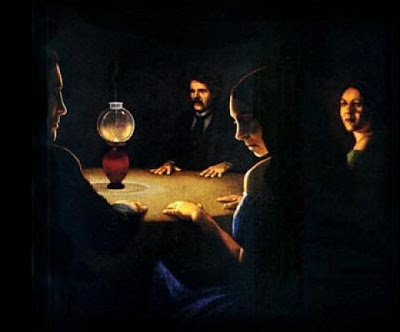

St. Ignatius of Loyola began to learn about the discernment of spirits while convalescing from serious battle injuries. He noticed different interior movements as he imagined his future. In his autobiography, Ignatius writes (in the third person):
He did not consider nor did he stop to examine this difference until one day his eyes were partially opened and he began to wonder at this difference and to reflect upon it. From experience he knew that some thoughts left him sad while others made him happy, and little by little he came to perceive the different spirits that were moving him; one coming from the devil, the other coming from God (Autobiography, no. 8).
Good and Evil Spirits
Ignatius believed that these interior movements were caused by “good spirits” and “evil spirits.” We want to follow the action of a good spirit and reject the action of an evil spirit. Discernment of spirits is a way to understand God’s will or desire for us in our life.
Talk of good and evil spirits may seem foreign to us. Psychology gives us other names for what Ignatius called good and evil spirits. Yet Ignatius’s language is useful because it recognizes the reality of evil. Evil is both greater than we are and part of who we are. Our hearts are divided between good and evil impulses. To call these “spirits” simply recognizes the spiritual dimension of this inner struggle.
Consolation and Desolation
The feelings stirred up by good and evil spirits are called “consolation” and “desolation” in the language of Ignatian spirituality.
Spiritual consolation is an experience of being so on fire with God’s love that we feel impelled to praise, love, and serve God and help others as best as we can. Spiritual consolation encourages and facilitates a deep sense of gratitude for God’s faithfulness, mercy, and companionship in our life. In consolation, we feel more alive and connected to others.
Spiritual desolation, in contrast, is an experience of the soul in heavy darkness or turmoil. We are assaulted by all sorts of doubts, bombarded by temptations, and mired in self-preoccupations. We are excessively restless and anxious and feel cut off from others. Such feelings, in Ignatius’s words, “move one toward lack of faith and leave one without hope and without love.”
The key question in interpreting consolation and desolation is: where is the movement coming from and where is it leading me? Spiritual consolation does not always mean happiness. Spiritual desolation does not always mean sadness. Sometimes an experience of sadness is a moment of conversion and intimacy with God. Times of human suffering can be moments of great grace. Similarly, peace or happiness can be illusory if these feelings are helping us avoid changes we need to make.
Rules for Discernment
In the Spiritual Exercises, Ignatius provides various rules for the discernment of spirits (Spiritual Exercises, 313-336). Good and evil spirits operate according to the spiritual condition of the individual.
For people who have closed themselves off from God’s grace, the good spirit disturbs and shakes up. It stirs feelings of remorse and discontent. The purpose is to make the person unhappy with a sinful way of life. On the other hand, the evil spirit wants such people to continue in their confusion and darkness. So the evil spirit tries to make them complacent, content, and satisfied with their distractions and pleasures.
For people who are trying to live a life pleasing to God, the good spirit strengthens, encourages, consoles, removes obstacles, and gives peace. The evil spirit tries to derail them by stirring up anxiety, false sadness, needless confusion, frustration, and other obstacles.
Discernment of spirits is a challenging task. It requires maturity, inner quiet, and an ability to reflect on one’s interior life. Discernment takes practice. It is something of an art. Ignatius Loyola’s rules for discernment provide a framework, not a program. We must be ready to improvise and adjust because God works in each of us so uniquely. That is why most counselors recommend undertaking discernment of spirits with the assistance of a spiritual director.
 |
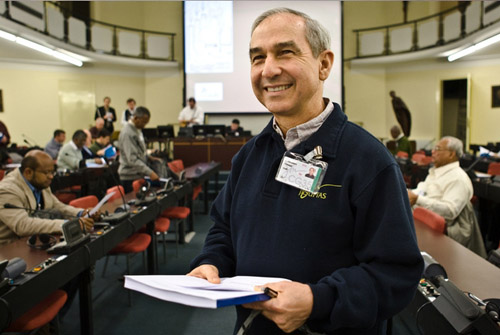
Fr. Orlando Torres, S.J. is Fr.General’s Assistant for Formation at Jesuit Curia in Rome.
He talks about the preparations, mode of organization and the need of the Congregation of Procurators in the Society of Jesus.

by Margie Copeland

So how do we find future catechists? I propose we INVITE people to consider the call to be a catechist.
I = INITIATE a conversation.
N = NOTICE who lingers and seems curious about the happenings at faith formation sessions.
Thinking of Becoming a Catechist? is a great page to share with prospective volunteers. It includes reasons to become a catechist, the Catechists in Action video series, and Joe’s popular webinars.

I = INVITE these parents to help, even if it is just one time.
T = THANK everyone involved with the program:
E = ENCOURAGE everyone who enters into the catechetical space to:
May your efforts at catechist recruitment be fruitful!
What methods do you use to invite parishioners to consider becoming a catechist?


Prayer is simply an ongoing conversation with God.
Jesus called us friends, and friends talk to each other anytime about anything. You can help your children understand prayer as an ongoing conversation with God, one that is both talking and listening.
Children (and adults) pray a lot already.
Explain to your children that throughout the day they are already sending prayers up to God. Something gets broken, and the prayer is “Oh, don’t let Mom be too mad!” There’s a test at school: “Please help me do okay!” Grandpa is sent to the hospital: “Please take good care of him.” All of these are prayers. They are honest, they take our needs to God, and they place our trust in God’s love for us.
Children (and adults) can talk with God while doing other things.
One good time is when you first get up in the morning. Some of the best conversations with loved ones happen in the kitchen or in the car. In the same way you and your children visit while chopping up a salad or when running errands, people can talk to God in the middle of their daily routines.
Children can talk with God or sing to him while picking up their clothes or walking the dog. Look for activities that lead naturally to quiet time, such as coloring or playing in the sand. Help your children recognize opportunities to pray with their hearts by letting God know what’s going on inside, heart to heart, while they are working with their hands or feet. Do younger children have a daily nap time? Talking with God can make it more interesting. Why, even those time-outs used for discipline can turn into something meaningful and less stressful because God is invited to sit there too.
Why not pray for others when wrapping gifts for birthdays, graduations, weddings, and baby showers? You and your children can do this together, talking to God about the loved one while you wrap.
We can pray to God anytime because God is paying close attention to us all the time.
Life is full of little opportunities to say “hi” to God and just catch up on what’s happening in life. When your children learn that prayer is simply being with or having a conversation with a constant companion, they will begin to turn to their loving heavenly Father no matter what is happening or how they feel.
You too will notice a huge difference when you simply stay in touch with God throughout the day and discuss life as it happens. Then be quiet a moment with the One whom you know always loves you, no matter what.

By Guy Consolmagno,S.J.
“No, the God Particle has nothing to do with God…” I must have repeated that a dozen times last week, to casual friends and inquisitive reporters, following CERN’s announcement of the possible detection of the Higgs boson… the so-called “God Particle”. I am an astronomer, not a particle physicist, but answering questions about anything new in science that might have a connection to religion is one of the unofficial tasks of anyone who works at the Vatican Observatory.
Yes, I am an astronomer at the Vatican. A lot of people are surprised to hear that the Vatican supports a fully functional astronomical observatory. We are a dozen priests and brothers, coming from four continents, mostly Jesuits with advanced degrees in astronomy and related fields from universities around the world, including Padua, Oxford, and MIT. Our research covers the gamut of astronomy – string theory and the Big Bang, galaxies and stellar evolution, meteorites and meteor showers.
We attend the same meetings and publish in the same journals as any other astronomer; after all, we studied alongside those other astronomers, we collaborate with them on our projects today, and many of them are our students. We participate in the same scientific societies; indeed, several of us have been elected to leadership positions in the International Astronomical Union and American Astronomical Society.
Our history goes back to before Galileo. In 1582, we helped develop the Gregorian Calendar that the world uses today. We made the first accurate telescopic maps of the Moon, with the nomenclature system still in use (including 35 craters named for Jesuits; it helps to have friends in high places). In the 19th century, we were the first to recover comet Halley and were pioneers in stellar spectroscopy. In the 20th century, our astronomers established an astrophysical spectra laboratory and founded the journal Spectrochimica Acta, which was actually produced at the Vatican in the years following World War 2. And today our telescope in the Arizona desert, built in collaboration with the University of Arizona, is a test bed for 21st century astronomical techniques.
This history should raise two questions. Why, with such a history of supporting astronomy, do people still believe that our religion is somehow anti-science? And on the other hand, why does a religious institution continue to support astronomers even today?
Certainly, the answer to the second is tied to the prejudices of the first; the observatory is a living witness against those who want to believe the worst of the church. (I live in the church, and know it well, faults and all. There are enough things we do badly; why do our critics still insist on making up stuff?) And we work closely with the Pontifical Academy of Sciences, who advice the papacy on scientific issues. (The president of that academy in the mid 20th century was Father George Lemaître, the astrophysicist who came up with what we now call the Big Bang theory. Alas, we can’t claim him for the observatory; he was a diocesan priest teaching at the Catholic University of Louvain, Belgium.)
But the real reason we do science is in fact related to the reason why so many people ask us about things like the God Particle. The disciplines of science and religion complement each other in practical ways. For example, both are involved in describing things that are beyond human language and so must speak in metaphors. Not only is the “God Particle” not a piece of God, it is also not really a “particle” in the sense that a speck of dust is a particle. In both cases we use familiar images to try to illustrate an entity of great importance but whose reality is beyond our power to describe literally.
The mysteries revealed by modern science are a constant reminder that reality is bigger than our day-to-day lives. But while particle physics can seem unimaginably remote, anyone can see the stars and be moved to contemplation. As Pope Pius XI said in 1935, dedicating our telescopes on the roof of the papal summer palace, “from no part of creation does there arise a more eloquent or stronger invitation to prayer and to adoration.”
One aspect of that contemplation is to recognize both how limited our human understanding is, and yet how privileged we are to be able to learn as much as we have. One astonishing thing about the universe is that it can be, at least in part, understood. It follows laws that we can deduce, laws which are rational but also elegant and beautiful. In them we find expressed the personality of the one who fashioned those laws.
Br. Guy Consolmagno SJ, writes in advance of a workshop on “The Nature of the Evolving Universe,” sponsored by INCAI, the International Network of Catholic Astronomical Institutions, to be held at the Catholic University of America July 16-20.
 Radio New Zealand Nation had a fascinating interview yesterday with South African born Justin Glyn a former Auckland barrister and academic lawyer now training to be a Jesuit priest in Australia (interview duration: 22′14″).
I was struck again by the value of the insights of those who move more deeply into the Christian narrative and tradition from significant so-called “secular” and professional roles in wider society. This isn’t the first time that this courageous journey and this quest for a richer and deeper humanity, for something “more” to life and living have been explored this year on RNZ-National. I’m encouraged by that. The spiritual search and the spiritual dimension of what it means to be human feels as though it’s being valued and appreciated more widely.
I commend the interview to you. You will find it here – scroll down. It can be listened to and downloaded as an Mp3.
|
|