

Author: cfliao
Dear Fathers and Brothers,
Greetings from sunny Rome and from General Congregation 35! John Lee and I have now been in Rome 40 days! No decree yet, only a new General and a renewed team of Regional Assistants, as you know. Today Fr. General appointed two more General Counselors, Mark Rotsaert from Belgium and Arturo Sosa from Venezuela. I have learned that the most important responsibility of Regional Assistants in not to represent the Assistancy but to be a counselor of Fr. General for his government of the whole Society. These two new counselors are not regional assistants and they will continue to live in their own country but they will fly to Rome whenever they are needed.
In the first days of the Chinese New Year, Fr. Bernard Chu and Fr. John Ts’ai have left us. Although I knew that both were at the end of their pilgrimage and I had visited them before leaving for Rome, I felt sorry not to be able to be at their side at the end of their life and unable to send them to their final resting place in Changhua. This is normally an important part of my mission as provincial. When my own parents died, I was not at their bedside, but each time I was able to go back home, greet friends and family, preside at the funeral and accompany them to the cemetery. This time, the duty to be at the congregation did not make it possible to be present to my two Jesuit brothers.
Our new General seems to adapt very well to his new responsibilities, and he is still the same jovial, active, easy-to-approach person. According to Chinese custom, he has to receive a Chinese name (He was not given a new name in Japan.) We thought of a family name that would have some resemblance with his original Spanish family name, and we decided on 倪, for Nicolás. Then we tried to find two other characters that would express the original meaning of “Nicolas”, a name which comes from two Greek words and means “victory of the people.” We also had to find Chinese characters that would sound well both in Mandarin and Cantonese. Finally we settled for 胜民. Consequently our new General Superior is 倪胜民 总会长.
You must have read in several different reports how our discernment leading to the election of Fr. General was a great experience of communal discernment. The experience of deep unity in our great diversity led all of us to much consolation. Now that we are working on documents like identity, mission, governance, collaboration with others, etc., and that we have to write documents, we experience our diversity in a very different way. We have so many diverse points of view, and the views are not easily reconciled. This becomes very obvious when we are faced with the draft of a decree, which we examine in Assistancy groups, followed by summary reports in the Aula and individual expression of opinions in the same Aula. We pray very well together, and in several different languages, but when it comes to expressing what we think on important matters of our Jesuit life we realize that we often have quite diverse ways of looking at it. And we are a group of Jesuits very committed to our vocation and trying our best to express what we are and what our mission is. I now realize better that “unity in diversity” is something that results only from great efforts and much listening, and it finally comes only as a gift from the Spirit. It was not different in the time of Ignatius and the First Companions.
Please continue to accompany us, especially with your prayers!
Louis Gendron, SJ.
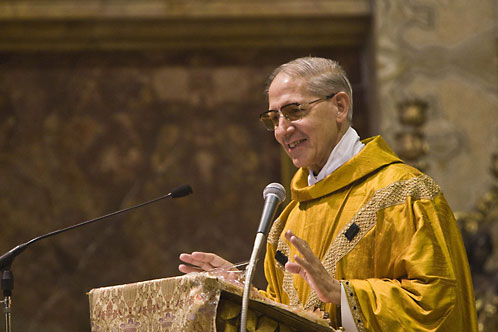
(Jan. 19, 2008) A Spanish-born missionary priest working in Asia has been elected the new Superior General of the worldwide Jesuit order. Fr. Adolfo Nicolas, the moderator of the Jesuit Conference of East Asia and Oceania, was elected Jesuit General on Saturday in Rome by 217 Jesuit electors during the current 35th General Congregation of the order. The 72-year old new superior general succeeds Fr. Peter-Hans Kolvenbach, an 80-year old Dutch priest who headed the world’s largest religious order for 24 years. Fr. Nicolas thus becomes the 29th successor of St. Ignatius of Loyola, the 16th century founder of the Jesuits.
Fr. Adolfo Nicolas was born on April 29, 1936, in Palencia, Spain. After entering the Jesuit novitiate of Aranjuez of the Toletana Jesuit province in 1953, he studied philosophy in Madrid. While studying theology in Tokyo, Japan, he was ordained priest in 1967. Among the posts that he held in the past are professor of systematic theology at the Jesuits’ Sophia University in Tokyo, the director of the Pastoral Institute of Manila, in the Philippines and the Provincial of the Japan Jesuit province. Besides his native Spanish, Fr. Nicolas speaks Japanese, English, French and Italian.
(06 Jan 08 – RV) 225 Jesuit priest have arrived here in Rome over the weekend ahead of tomorrow’s opening mass for the 35th General Congregation of the Society of Jesus. The Congregation was called by outgoing General Superior, Fr. Peter Hans Kolvenbach in 2006, when he announced his retirement from the post of leading the worlds’ 19 thousand Jesuits after almost 25 years. Emer Mc Carthy caught up with Jesuit Communications director, Fr. Thomas Rochford and to find out more about this once in a lifetime gathering.
by Hon Ying Wang
Q. When you were young, you aspired to be a doctor, a hydro engineer. Why then did you become a priest?
 A. When I was in primary school, one day I fainted. I thought that I was about to die. After a very long time I woke up and saw my crying mom holding my hand. She was helpless as there was no hospital in the village. Another night, I was awakened by our neighbor’s loud voice of pain. He was having stomach ache and trying to find a doctor. It turned worse and he died after having severe pain for 3 days and 3 nights. I was very much affected, wondering how such a healthy person could die so suddently. So my first goal was to be a doctor to save the lives of people in the villages.
When I was in the secondary school, there was a great drought in Wabei, the north part of China, the largest such drought in 150 years. It was also war time and food supply was not coming to our area. Moreover, the Japanese soldiers, the solidiers of the Nationalist and Communist parties were seizing food supply from the common people, robbing their domesticated birds and animals. What was left were old people and sick women who ran and wandered, many just dropped dead, not even having the breath to call for help. In the water and trenches we saw the corpses of children which became the food of wild dogs. When I witnessed such atrocities, I felt that doctors could only cure a small number of people. If in the future I study to become a hydro engineer, perhaps I can make the Yellow River more beneficial, so as to better control the disasters of flood or famine, and as a result it will have a greater impact on mankind.
The elementary school I went to is one run by the Catholic Church. The principal was a Hungarian priest of German heritage. His Chinese name is Lung Ke Fa (my translation in Cantonese). When I was in secondary school, the Japanese invaded China, and many Chinese hid in churches. As Japanese soliders were about to rush into his church, Fr. Lung Ke Fa opened his two arms and blocked them at the front door. The sharp knife at the top of the rifle from the Japanese soldier was so near touching his eye and face, and yet he was not afraid. The soldiers were rebuffed by his bravery. As a result, Fr. Lung saved many thousands of people.
The temperature in Wabei, North China area, was often 7 to 8 degree below zero. And snow sometimes were as tall as half of the height of an adult person. Yet Fr. Lung rode his bike to the villages to care for the sick. I thought that he was a great person. Not every one could be a priest who offered himself, made the sacrifice to help others. That’s when I decided to become a clergy. If I transmit my vision and mission to the parishioners, some of them would become doctors, hydro engineers, and in turn they will save many other people.
Q. How did the unstable and uncertain living during the war affect you?
A. During the war between China and Japan, many highways were controlled by the Japanese army. There was a guard station every few meters. All those who pass must slow down, to be interrogated. Non-Chinese foreigners were exempt. When I was in secondary school, we had a missionary from Hungary. He often rode the motorcylce with his huge beard flying. His beard became his entry permit as the Japanese would not make it hard for him. One day, this priest rode his motorcycle to my village. I followed him by riding my bike to go home. I was very excited and so I rode very fast, but then I became tired and there was a large distance between us. When I went by a guard station, I heard a loud voice from a Japanese soldier, but I did not understand what he said. So I panicked and increased my speed. Then with a banging noice, a bullet passed by my ear. When the priest heard the gun shot, he immedidately gestured to the solider and asked them not to fire his gun again. If that bullet was closer by a few centimeter, I would have lost my life.
Though the experiences of war were hard, but they gave me the opportunties to be God’s witness. Life is full of crises and difficulties. We need to find ways to overcome them, and our lives will be uplifted.
Q. Please share with us the change in your mental response when you learned you had lung cancer, and how did you become at peace with it?
A.. When the diagnosis of lung cancer came out I was quite shocked. I said to myself: I never smoked and I never indulged in drinking, then “Why me”? After praying for half an hour I calmed down and became peaceful. Instead of why me, I thought “Why not me”? I don’t have a special privilege of not having illness. Nowadays with pollution & contamination of the environment, more and more people got cancer. I thought it was God’s plan to let me experience first hand. Through this terminal illness I can learn to be positive, rather than wailing or complaining. I shall value each day and to live meaningfully the remainder of my life.
Q. You had said: “Cancer brings to body and mind many good things”. You called lung cancer “a little angel”. Please tell us your view of illness and death?
A. Don’t become the slave of illness. Rather let illness become your aide, your little angel. There is a Chinese poem which said in part: “Only in death will there be an end to the silk worm, and only when the candle turns into ashes will the tears dry up”. If we read this poem in a positive way, it means that we offer our life until the very last minute, the very last second. There is an end to one’s life, whether the life is long or short, so long as we try our best to offer and to contribute. The power of faith can turn fear around into peace and comfort. Death is a tunnel, passing through it we can live in God’s great love eternally. There is always the light at the end of the tunnel, be not afraid.
Q. How did you come up with the idea of having an ongoing round of seminars on “Farewell to the Journey of Life”? What message do you try to transmit?
A. When I came up with this idea, many people tried to tell me that the title is too blunt or direct. But I persist.
Chinese people are too afraid of death. Many hospitals don’t have the fourth floor, as the sound of four in Chinese is very similar to the sound of the character death. We don’t have to think that way. I hope that through my talks, I can tell others not to be controlled by illness or death. That we should all spend our lives meaningfully, that life can be enriched and full of joy, and that when we leave this world, we can do so freely and serenely.
Q. After you have this terminal illness, how do you take care of yourself?
A. My doctors asked me: “What kind of medical treatment do you prefer”? I said: “You doctors are the experts. I am just a lay person. But I will be a most cooperative patient.” I believe that treating cancer is the job of my doctors, taking my health and daily caring is my responsibility. Some patients think that medications will cause side effects and therefore don’t take any.. Some patients lie in bed all day, and that will do no good to the body. Members of my church wanted to assign a special care nurse to me, but I declined. As long as I can take care of myself, I don’t need to trouble others. Every day, I cook my breakfast, I take care of plants and flowers, I sweep the floor, wash my clothes as routine exercises. Only one thing was different from my past. I became a vegetarian, taking in food and nutrition that are alkaline rather than acidic, which inhibits the growth or spread of cancer cells.
Q. You have publicly called for the abolition of capital punishment. Why?
A. Life is invaluable. Life does not belong to an individual; it is a gift from God. So how can we just destroy life? There have been cases in which people were sentenced to death and later found out they were innocent after they died. By then it was too late and no remedy. Also, many convicts came from broken families, and behind them were often some very sad stories.
I often went to prisons to give talks. I asked the inmates: “Where do you think you would feel more freedom? Outside or inside?” All answered in unison and loudly: outside the prison. I then said: Freedom is not always absolute. Yes, you are not free in a prison. But it gave you a place to be away from the former bad venue or friends. Perhaps your soul and your heart might become more free. Seize the time and opportunity while inside to reflect and repent: Yes I had made a mistake and I fell. But I could climb back up, and perhaps I could have a better future. Many inmates were moved by my talks; some cried. As long as one lives, there is always hope.
Q. You had tried to build the “Blessed Mountain/Garden District”. Any special meaning?
A. There are many problems in modern society. Aging resulted in many elderlies not properly cared for. High rate of divorce, and innoncent children were bounced around like a ball. Devoid of love, they can become full of hatred. Schools want to have high rate of student advancement, and students end up not receiving the true value of education. 15 years ago, we received some land, and planned to build “Blessed Mountain/Garden District”. When we were about to begin, government legislation was passed to forbid the development within 1 mile from the proposed area. So the project was suspended until 2002 when the law was changed. The project re-started. The district will include activity center, seminary, nursing home, day care center, and a religious museum. The name “Blessed Mountain” is used to reflect the Beatitudes in the gospel. It also aspires to give hopes to those who go there to find true joy and happiness.
Q. You had held a dialogue with Buddhist Grand Master Sing Wan (my translation in Cantonese, Star and Cloud), based on the theme “Mercy and Love – When Christ met Buddha”. How should different religions interact with one another?
A. All religions aspire to be truly good derive their origin from conscience. During those times with confusion of thoughts, religions could help to uplift morals, and enhance the gift of mercy.
Of course, there are many differences between religions. But there are also many areas of agreement. We should focus more on those that unite us. Inter-religious dialogue is very important. 12 years ago, we co-sponsored with the Buddha Light Mountain a series of international seminars. During those few days, Catholics and Buddhists lived together, learned from one another. We were there not to persuade the Buddhists to abandon their religion. Rather, we respected them and we tried to understand and appreciate their religion.
Q. Are you happy?
A. This is the happiest and most joyful time of my life. I often said: “I shall leave my physical body behind for the good earth. And my possession to my friends.” When I died, my remains will turn into organic nutrients which repay the good earth. I have no money; my faith is my property. I shall leave behind this invaluable property for all my friends. Every listener is my friend.. Life’s ultimate joy and happiness is when you are embraced by love. Love reminds me: “This race is coming to an end. I shall press forward, seize every minute and second. Victory is at hand.” Because I offer my body, mind and soul to God, I am truly very happy and full of joy and peace.
Cardinal  Paul Shan Kuo Hsi
Born 1923 in Heipei Province, China; served as Catholic bishop in Dioceses of Qua Lin, and Kaohsuing, and many times as Chair of the Bishop Conference in Taiwan. In 1998 was elevated Cardinal by Pope John Paul II, first such cardinal from Taiwan. Diagnosed with lung cancer in 2006, and launched ongoing seminar on “Farewell to the Journey of Life”. Seize the opportunity to promote the message of living.
讲义杂志 vol.249, Mon, 03 Dec, 2007
by Hon Ying Wang
Q. When you were young, you aspired to be a doctor, a hydro engineer. Why then did you become a priest?
A. When I was in primary school, one day I fainted. I thought that I was about to die. After a very long time I woke up and saw my crying mom holding my hand. She was helpless as there was no hospital in the village. Another night, I was awakened by our neighbor’s loud voice of pain. He was having stomach ache and trying to find a doctor. It turned worse and he died after having severe pain for 3 days and 3 nights. I was very much affected, wondering how such a healthy person could die so suddently. So my first goal was to be a doctor to save the lives of people in the villages.
When I was in the secondary school, there was a great drought in Wabei, the north part of China, the largest such drought in 150 years. It was also war time and food supply was not coming to our area. Moreover, the Japanese soldiers, the solidiers of the Nationalist and Communist parties were seizing food supply from the common people, robbing their domesticated birds and animals. What was left were old people and sick women who ran and wandered, many just dropped dead, not even having the breath to call for help. In the water and trenches we saw the corpses of children which became the food of wild dogs. When I witnessed such atrocities, I felt that doctors could only cure a small number of people. If in the future I study to become a hydro engineer, perhaps I can make the Yellow River more beneficial, so as to better control the disasters of flood or famine, and as a result it will have a greater impact on mankind.
The elementary school I went to is one run by the Catholic Church. The principal was a Hungarian priest of German heritage. His Chinese name is Lung Ke Fa (my translation in Cantonese). When I was in secondary school, the Japanese invaded China, and many Chinese hid in churches. As Japanese soliders were about to rush into his church, Fr. Lung Ke Fa opened his two arms and blocked them at the front door. The sharp knife at the top of the rifle from the Japanese soldier was so near touching his eye and face, and yet he was not afraid. The soldiers were rebuffed by his bravery. As a result, Fr. Lung saved many thousands of people.
The temperature in Wabei, North China area, was often 7 to 8 degree below zero. And snow sometimes were as tall as half of the height of an adult person. Yet Fr. Lung rode his bike to the villages to care for the sick. I thought that he was a great person. Not every one could be a priest who offered himself, made the sacrifice to help others. That’s when I decided to become a clergy. If I transmit my vision and mission to the parishioners, some of them would become doctors, hydro engineers, and in turn they will save many other people.
Q. How did the unstable and uncertain living during the war affect you?
A. During the war between China and Japan, many highways were controlled by the Japanese army. There was a guard station every few meters. All those who pass must slow down, to be interrogated. Non-Chinese foreigners were exempt. When I was in secondary school, we had a missionary from Hungary. He often rode the motorcylce with his huge beard flying. His beard became his entry permit as the Japanese would not make it hard for him. One day, this priest rode his motorcycle to my village. I followed him by riding my bike to go home. I was very excited and so I rode very fast, but then I became tired and there was a large distance between us. When I went by a guard station, I heard a loud voice from a Japanese soldier, but I did not understand what he said. So I panicked and increased my speed. Then with a banging noice, a bullet passed by my ear. When the priest heard the gun shot, he immedidately gestured to the solider and asked them not to fire his gun again. If that bullet was closer by a few centimeter, I would have lost my life.
Though the experiences of war were hard, but they gave me the opportunties to be God’s witness. Life is full of crises and difficulties. We need to find ways to overcome them, and our lives will be uplifted.
Q. Please share with us the change in your mental response when you learned you had lung cancer, and how did you become at peace with it?
A.. When the diagnosis of lung cancer came out I was quite shocked. I said to myself: I never smoked and I never indulged in drinking, then “Why me”? After praying for half an hour I calmed down and became peaceful. Instead of why me, I thought “Why not me”? I don’t have a special privilege of not having illness. Nowadays with pollution & contamination of the environment, more and more people got cancer. I thought it was God’s plan to let me experience first hand. Through this terminal illness I can learn to be positive, rather than wailing or complaining. I shall value each day and to live meaningfully the remainder of my life.
Q. You had said: “Cancer brings to body and mind many good things”. You called lung cancer “a little angel”. Please tell us your view of illness and death?
A. Don’t become the slave of illness. Rather let illness become your aide, your little angel. There is a Chinese poem which said in part: “Only in death will there be an end to the silk worm, and only when the candle turns into ashes will the tears dry up”. If we read this poem in a positive way, it means that we offer our life until the very last minute, the very last second. There is an end to one’s life, whether the life is long or short, so long as we try our best to offer and to contribute. The power of faith can turn fear around into peace and comfort. Death is a tunnel, passing through it we can live in God’s great love eternally. There is always the light at the end of the tunnel, be not afraid.
Q. How did you come up with the idea of having an ongoing round of seminars on “Farewell to the Journey of Life”? What message do you try to transmit?
A. When I came up with this idea, many people tried to tell me that the title is too blunt or direct. But I persist.
Chinese people are too afraid of death. Many hospitals don’t have the fourth floor, as the sound of four in Chinese is very similar to the sound of the character death. We don’t have to think that way. I hope that through my talks, I can tell others not to be controlled by illness or death. That we should all spend our lives meaningfully, that life can be enriched and full of joy, and that when we leave this world, we can do so freely and serenely.
Q. After you have this terminal illness, how do you take care of yourself?
A. My doctors asked me: “What kind of medical treatment do you prefer”? I said: “You doctors are the experts. I am just a lay person. But I will be a most cooperative patient.” I believe that treating cancer is the job of my doctors, taking my health and daily caring is my responsibility. Some patients think that medications will cause side effects and therefore don’t take any.. Some patients lie in bed all day, and that will do no good to the body. Members of my church wanted to assign a special care nurse to me, but I declined. As long as I can take care of myself, I don’t need to trouble others. Every day, I cook my breakfast, I take care of plants and flowers, I sweep the floor, wash my clothes as routine exercises. Only one thing was different from my past. I became a vegetarian, taking in food and nutrition that are alkaline rather than acidic, which inhibits the growth or spread of cancer cells.
Q. You have publicly called for the abolition of capital punishment. Why?
A. Life is invaluable. Life does not belong to an individual; it is a gift from God. So how can we just destroy life? There have been cases in which people were sentenced to death and later found out they were innocent after they died. By then it was too late and no remedy. Also, many convicts came from broken families, and behind them were often some very sad stories.
I often went to prisons to give talks. I asked the inmates: “Where do you think you would feel more freedom? Outside or inside?” All answered in unison and loudly: outside the prison. I then said: Freedom is not always absolute. Yes, you are not free in a prison. But it gave you a place to be away from the former bad venue or friends. Perhaps your soul and your heart might become more free. Seize the time and opportunity while inside to reflect and repent: Yes I had made a mistake and I fell. But I could climb back up, and perhaps I could have a better future. Many inmates were moved by my talks; some cried. As long as one lives, there is always hope.
Q. You had tried to build the “Blessed Mountain/Garden District”. Any special meaning?
A. There are many problems in modern society. Aging resulted in many elderlies not properly cared for. High rate of divorce, and innoncent children were bounced around like a ball. Devoid of love, they can become full of hatred. Schools want to have high rate of student advancement, and students end up not receiving the true value of education. 15 years ago, we received some land, and planned to build “Blessed Mountain/Garden District”. When we were about to begin, government legislation was passed to forbid the development within 1 mile from the proposed area. So the project was suspended until 2002 when the law was changed. The project re-started. The district will include activity center, seminary, nursing home, day care center, and a religious museum. The name “Blessed Mountain” is used to reflect the Beatitudes in the gospel. It also aspires to give hopes to those who go there to find true joy and happiness.
Q. You had held a dialogue with Buddhist Grand Master Sing Wan (my translation in Cantonese, Star and Cloud), based on the theme “Mercy and Love – When Christ met Buddha”. How should different religions interact with one another?
A. All religions aspire to be truly good derive their origin from conscience. During those times with confusion of thoughts, religions could help to uplift morals, and enhance the gift of mercy.
Of course, there are many differences between religions. But there are also many areas of agreement. We should focus more on those that unite us. Inter-religious dialogue is very important. 12 years ago, we co-sponsored with the Buddha Light Mountain a series of international seminars. During those few days, Catholics and Buddhists lived together, learned from one another. We were there not to persuade the Buddhists to abandon their religion. Rather, we respected them and we tried to understand and appreciate their religion.
Q. Are you happy?
A. This is the happiest and most joyful time of my life. I often said: “I shall leave my physical body behind for the good earth. And my possession to my friends.” When I died, my remains will turn into organic nutrients which repay the good earth. I have no money; my faith is my property. I shall leave behind this invaluable property for all my friends. Every listener is my friend.. Life’s ultimate joy and happiness is when you are embraced by love. Love reminds me: “This race is coming to an end. I shall press forward, seize every minute and second. Victory is at hand.” Because I offer my body, mind and soul to God, I am truly very happy and full of joy and peace.
Cardinal Paul Shan Kuo Hsi
Born 1923 in Heipei Province, China; served as Catholic bishop in Dioceses of Qua Lin, and Kaohsuing, and many times as Chair of the Bishop Conference in Taiwan. In 1998 was elevated Cardinal by Pope John Paul II, first such cardinal from Taiwan. Diagnosed with lung cancer in 2006, and launched ongoing seminar on “Farewell to the Journey of Life”. Seize the opportunity to promote the message of living.
讲义杂志 vol.249, Mon, 03 Dec, 2007
Today, the members of the Congregation  elect the Secretary and his two Assistants for the rest of their work together. These three members will take charge of the running of the sessions. A group of members called “Deputatio ad negotia” will also be elected; it is in charge of the presentation of the topics to be discussed. During the afternoon this group will make some starting proposals for the agenda of the following days; specific responsibilities will also be given to the Assistancies.
(25 Jan 08 – RV) The new Superior General of the Jesuit order met journalists in Rome Friday. Fr. Adolfo Nicolàs began by thanking fellow Jesuits who affirmed their faith in him during elections in the Society of Jesus’ General Congregation this month.
Fr. Adolfo Nicolàs was born in Spain in 1936 but told journalists he has spent most of his life in Asia, after moving to Japan at the age of 24 to study philosophy. “Living in Japan” where he was also ordained a priest he said, “opened my eyes to the world.” Introduced to Buddhism and Hinduism, he found these two eastern faiths helped him to explore his own Catholic faith more deeply.
Fr. Nicolàs reiterated the Jesuit order’s loyalty and obedience to the Holy Father, saying that “the community has and will always be in communion with the Pope.”
And, it’s clear that the new Jesuit leader expects to dedicate a lot of attention in his new job to the region where he has spent so many years.
He noted the challenges and the potential for the Church in Asia, pointing to China’s 27 different ethnic groups and multiple languages including Arabic; he listed Korea and Vietnam, and the Philippines where he joked the majority Catholic country is infamous for obeying traffic laws as suggestions rather than the rule.
Indonesia, Asia’s most populous Muslim country, and Malaysia offered different challenges, while Australia, he said “can act as a bridge between Asia and the West.” Indeed, he said, “Australia has greatly contributed to the dialogue between cultures.”
He also mentioned as other challenges: Cambodia and Myanmar where he noted the Jesuits have been expelled, and the small Jesuit community in Timor where, after years of conflict, peace is struggling to take hold.
Fr. Nicolàs said he expected to receive his mandate from the Pope and from the Jesuits themselves as they reflect in their General Congregation on the order’s priorities and the challenges to be met. In responding to these challenges and implementing his mandate, Fr. Nicolàs said transparency would be an integral part of his leadership, and that he “hoped to follow the principles of Gandhi – truth, gentleness, charity and goodness to others.”
Fr. Chu Meng-Chuan Bernard went to the Lord peacefully on February 8th, 2008 at 5:39 p.m. at Cardinal Tien Hospital, Taipei.
Fr. Chu was born in Beijing on April 17th, 1925. He entered the Society at Zikawei, Shanghai on August 30th, 1947; was ordained to the priesthood on March 18th, 1960 in Hsinchu, Taiwan and professed his last vows on June 7 th, 1973 in Rome.
Fr. Ts’ai hao-ch’ien went to the Lord peacefully on February 11th, 2008 at 12:55 a.m. in the Infirmary in Taipei.
Fr. Ts’ai was born in Nangaoluo, Laishui Xian on October 24th, 1929. He entered the Society at Villa Flor, Macau, on April 15th, 1949; was ordained to the priesthood on March 18th, 1962 in Taipei, Taiwan and professed his last vows on February 2nd, 1965 at St. Ignatius High School, Luchow, Taipei.
Fr Louis Gendron, in his province letter dated October 24, wrote, “Today I was in Beijing for a meeting of the Board of Directors of The Beijing Center, and I am transiting in Macau on my way to Taipei, where we have a meeting of the Board of Trustees of Fu Jen University. I bring with me two new books published by Fr Ron Anton and his collaborators at the Historical Archives of Beijing.
One is a fully documented book on the second Jesuit cemetery of Beijing: pictures of all the steles, transcription of the texts, and a detailed introduction. The second book, published at only 500 copies, reproduces twelve paintings of Brother Castiglione, who had been asked by the emperor to paint battles in West China. Also reproduced are poems written by the emperor to accompany the paintings, as well as the official history of these battles as recorded in the archives of the Forbidden City. The meeting of the Directors of The Beijing Center discussed substantial issues, as we are going to celebrate the 10th anniversary of the Center and are making plans for future development. For instance, we will most probably start a branch at Yunnan University, focused on environmental issues, a very hot topic these days. The president of the Jesuit Conference of our Assistancy, Fr Adolfo Nicolas, and our sinologist, Fr Nicholas Standaert, are also Directors of The Beijing Center and they were present at the meeting.
Afterwards, the three of us had a common feeling: this was a very productive meeting, and an important reason was the great quality of our lay directors. Three of them have lived in Beijing for many years, they are chief executives of big multinationals, and they share our faith. I am deeply impressed by the generosity of these laypersons who volunteer their time and their expertise to help us run a first-class teaching and research institution. I am touched by their great love for the Society and their desire to support our mission. I am also impressed by the ability of Fr. Anton to invite these men to join our mission.”