Category: Uncategorized

Advent Amid the Gift Wrap

Bookmark and Share


“Are you ready for Christmas?” asked a guy I see at the train station every day. I thought of the long list of gifts I still needed to buy and the calendar crammed with holiday events and parties, and I shook my head. “Hardly,” I said, and we both laughed knowingly.

On my train ride downtown I turned off my iPod and let my mind ponder that question a little deeper. “Am I ready for Christmas?” This time I thought about the meaning of the holiday-the Son of God coming to earth to dwell among us and show us the way to eternal life. Again I shook my head and murmured to myself, “Hardly.”

It was then that I vowed to take advantage of every opportunity to prepare my heart for the coming of the Christ Child into the world-the world you and I live in.

What I discovered was that if we know what we’re preparing for, everything we encounter on the way to Christmas can prepare us for the coming of Christ, not only in Bethlehem 2,000 years ago but also into our homes, our families, our workplaces, and our communities. The usual December distractions can instead become holy moments when we find the Christ Child in our midst.

Having the right attitude and perspective on the season will help you and your family avoid the excesses that make certain Christmas preparations frantic, yet draining and disappointing. As theologian John Shea says, “The task seems to be the delicate one of learning to make the customs and traditions of Christmas serve the Spirit.”

Take a look at some of December’s demanding activities with new eyes, eyes that fully expect to find God in every moment of this season of hope.

Four Jesuits deacons ordained

Bookmark and Share


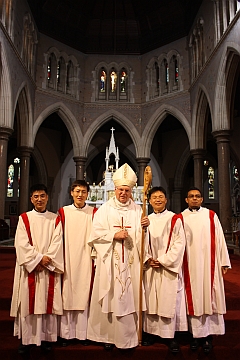
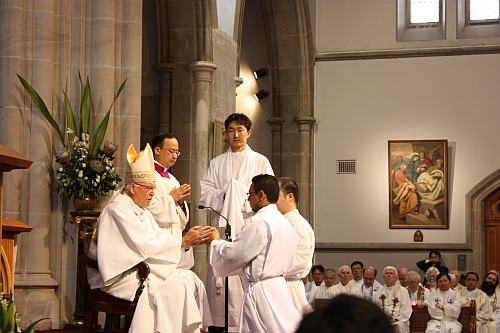
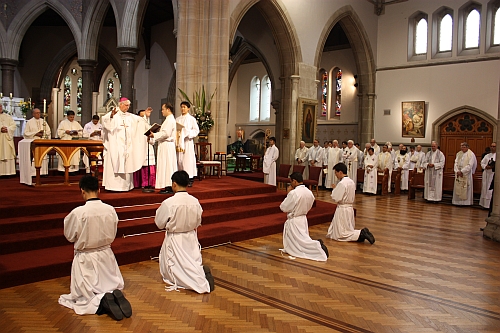
Four Jesuits were ordained as deacons in a joyful celebration at St Ignatius Church in Richmond on 3 December.

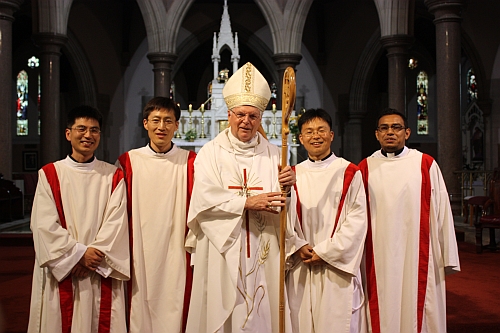
Korean Jesuits Shin-jae Youh, Jin-hyon Lee, and Jin-hyuk Park, were joined by East Timorese Jesuit Plínio Gusmão Martins at the ordination, with Bishop Greg O’Kelly presiding.

In his homily, Bishop O’Kelly spoke of the journeys of the four young men into their vocation.

Jin-hyon Lee was born in South Korea, on Je-ju Island, in 1972. He entered the Jesuit novitiate in 2000, and took his first vows in 2002. He completed his Master’s Degree in Philosophy at the Sogang Graduate School of Theology in Seoul, and did his regency working in the ‘Window on Life’ Café as part of the Social Apostolate.

Jin-hyuk Park was born in Seoul, Korea, in 1973. While studying at university, he came across a book about people working with families who had been forcibly displaced from their homes. Describing the experience of reading the book as a ‘kind of electric shock’, he decided to enter the priesthood. He entered the Jesuit Novitiate in 2000 and took his vows in 2002. He spent his regency in Cambodia, working for Banteay Prieb, the vocational training centre for the disabled.

Shin-jae Youh was born in Seoul, Korea, in 1964. As a young man, he discovered the writings of Pedro Arrupe and decided to aspire to the life of a Jesuit. He joined the Jesuits in 2000, and did his regency working for the campus ministry at Sogang University in Seoul.

Plínio Gusmão Martins was born in Dili, East Timor, in 1976. His childhood was amid the violence of the country’s national struggle for liberation. In 1992, he was wounded and nearly killed in the massacre at the Santa Cruz cemetery in Dili. He entered the Society of Jesus in 1996 at the novitiate in Indonesia, and studied in the Philippines and Indonesia before coming to Australia.

Bishop O’Kelly said he was intrigued to learn that both Shin-jae and Plínio, in their younger days, had been told by different people that they had the ‘face of a Jesuit’.

‘This is intriguing me’, he said. ‘I have fears about what some people might think a Jesuit face might look like. That’s clearly an avenue that might be explored by the Jesuit vocations committee.’

Ordination to the diaconate is a special sacrament within the Catholic Church, said Bishop O’Kelly.

‘Holy orders has three levels of practice as is reflected in the apostolic church where we find deacons, priests and bishops. Something does happen to the inner person with these sacraments. The sacrament imposes an inner configuration – to use a term favoured by Pope John Paul II and Pope Benedict – an orientation of the person that can never be revoked.’

As deacons, the four young men have the tasks of proclaiming the Gospel, preparing the Eucharist, giving communion, bringing God’s word, presiding over public prayer, as well as saying baptisms, marriages, providing last rites, and leading the rites of burial.

‘For me, it’s a great privilege to be a servant of God’, said Shin-jae after the ordination. ‘I feel like I am the mediator of God’s grace to the people, and to show God’s love and grace to others.’

Members of the Melbourne Korean and East Timorese communities came out to celebrate the ordinations, along with family and friends of the four men. Shin-jae said he was surprised and happy that members of his old choir, Polyphony Ensemble, were able to fly to Australia and perform at the ordination.

‘I never expected my friends would come and sing for us. It was a real privilege for me and my community’, he said.


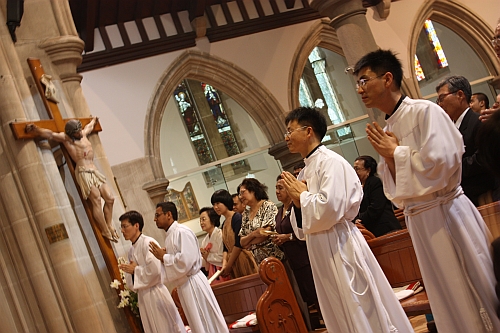
Below are some pictures from the ordination.


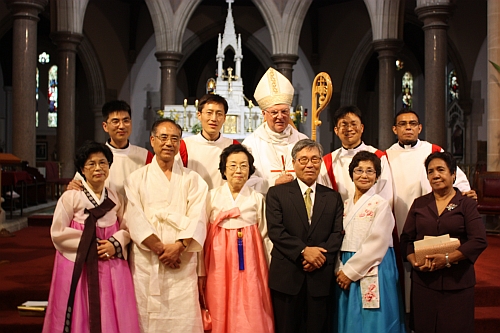
 Pictured above: Jin-hyuk Park, Shin-jae Youh, Bishop Greg O’Kelly, Jin-hyon Lee and Plinio Martins.


The deacons and their families.

Photos Michael McVeigh, Jesuit Communications Australia. 

Guidelines for Small Group Sharing

Bookmark and Share


1. Respect privacy and confidentiality. Refrain from repeating to others what another person shares.
2. Listen carefully. Allow the person to complete his or her sentence or thought. Be patient with another.
3. Remember that some people process thoughts and ideas interiorly; some also process as they speak. Accommodate both types of people.
4. Shy away from commenting directly on what another says.
5. Withhold your advice. If you feel inclined to give advice, ask the person’s permission to talk about the situation or ask if he or she wants to receive advice.
6. Refrain from criticizing or judging what another person says.
7. Embrace the silence. People need time to process ideas and form their thoughts.
8. Give others a chance to speak. Everyone who wants to share ought to have sufficient time to do so. Limit your own time. Speak pithily. Use brevity.
9. Respect another’s desire for privacy. No on has an obligation to share.
10. Use “I” statements rather than “we” statements. I can speak for myself. You can represent yourself.
11. When you feel yourself beginning to say, “You should….” or “What you need to do is…,” stop yourself. Just stop.
12. Use connecting words like “yes…and” instead of phrases like “but” or “not.”

Notes for Facilitators for Faith-Sharing Groups

1. Allow everyone to have a chance to speak.
2. Ask someone to be the time-keeper.
3. Ensure confidentiality.
4. Help them stay focused on the reflection questions. Feel free to choose whatever is conducive to the group’s sharing.
5. Use the “Faith Sharing” guidelines as your guide.

Jesuits launch environment plan

Bookmark and Share


The Society of Jesus is looking to find more ecologically sensitive ways to operate as part of a seven year plan announced in Rome last month.

The plan follows the commitments made as part of the 35th General Congregation in 2008, which said: ‘In our preaching, teaching, and retreat direction, we should invite all people to appreciate more deeply our covenant with creation as central to right relationships with God and one another, and to act accordingly in terms of political responsibility, employment, family life, and personal lifestyle.’

An eight-page document outlines a number of suggestions that came out of consultations that the Social Justice Secretariat has carried out since 1999.

It asks Jesuit Conferences, provinces, works, communities and individuals to consider projects from the list and implement them. The list covers faith-consistent use of assets, education and young people, pastoral care, lifestyles, media and advocacy, partnerships, academic research and celebration.

According to the document, the Father General is considering setting up a Task Force on Ecology and Jesuit Mission to suggest concrete steps for making the care of the earth an aspect for all ministries.

To read the plan, click here http://www.amdgchinese.org/en/wp-content/uploads/sites/4/2010/01/Jesuit_7yearplan.pdf

Live from Copenhagen

Meanwhile, the Ignatian Network on Environment has launched a blog site, providing links, thoughts and discussion from the COP 15 meeting in Copenhagen.

Jesuits José-Ignacio Garcia and Jacques Haers are providing updates in English and Spanish on the site.

For more, go to http://ignatianeconet.wordpress.com/

Narrative: Amazonia is burning! Ñande rekoha )our home) is on fire!

Bookmark and Share


by Minerva Vitti

A forest in agony, that’s what Brazil’s Amazonia is. Called the “lung of the planet,” that name may cease, at any moment, to be an appropriate description. No longer can we drink its waters or fish therein for they are poisoned. Mammals, reptiles, birds – all are disappearing. The riches that make Amazonia what it is are under constant threat from drug-trafficking, militarization of communities and borders, exploitation of natural resources, and now, bio-piracy, the practice by which big companies from rich countries create medicinal and cosmetic products out of Amazonia’s botanical treasures. The pressures and assaults on nature are unending; indigenous peoples are struggling to preserve their identity; innocent people are killed for a piece of land. And Amazonia is no longer so green.

This area is also populated by those who live on the banks of the rivers and by the poor who exist on the margins of the cities. A transnational reality now encompasses Brazil, Bolivia, Ecuador, Peru, Columbia, Venezuela, Guyana, Surinam, and French Guiana – nine of the thirteen countries that make up South America.

Spanish Jesuit Fernando López has been carrying out his mission on the waters of the Amazon River and in the thick jungle forests since 1998. He is part of an itinerant team (‘equipo itinerante’) consisting of some twenty persons and fifteen institutions. The team has two working groups: one, called “Trinity,” is located in Manaus, and the other, called “Three Borders,” is based in the critical zone where three countries meet: Tabatinga (Brazil), Leticia (Colombia) and Santa Rosa (Peru).

The missionaries live in the same way in simple houses built on stilts, just like the people of the communities in which they are located. The specific aims of the itinerant team include getting to know what daily life is like for the people, offering advice whenever the special skills of team members are needed, helping to form communities, establishing and strengthening ties of solidarity with non-governmental organizations in the area, and studying and analyzing topics of interest for the people and the region. The team also seeks to record, systematize, analyze, and publicize the experiences and the histories of the communities and the team itself.

According to López, “the political borders, which were established in Latin America and Amazonia during the 16th century, have divided many indigenous peoples. … The divergent public policies of each country in relation to the native peoples do nothing to help those peoples become more integrated and strengthened. Rather, the policies tend to divide and weaken them, often to the point of extinction.”

In Amazonia the land has a fundamental value for the communities because it constitutes their future. “We are caretakers of the realm of nature, so that our children and the children of our children can dance upon the earth” – that is indigenous logic.

Nevertheless, the din of power saws and tractors is gradually taking the place of ‘purahei’ or birdsong. The vast lands of the indigenous peoples are being reduced to tiny, unprotected islands. The Amazon forests are being converted into grasslands. The cattle ranches and the sugar cane plantations are considered more important than the lives of the native peoples. The new element fertilizing the land is human blood.

López reports what happened last September, in Mato Grosso do Sul, Brazil, a few kilometers from the Paraguay border: “Two villages of the Kaiowa Guaraní were burned: Laranjeira Ñande Ru on 14 September and Apyka’i on 18 September. The women were beaten, and a Guaraní man was wounded by gunshot. … The Guaraní people were assaulted and evicted, and forced to live in fragile shelters made of black plastic, set up between the fences of the ranches and the asphalt of the highways.”

López insists that there is an urgent need to protect the natural resources of Amazonia. Otherwise, in a very short time there will be nothing left for anybody. Meanwhile, the pressures and attacks continue, and people keep dying. The Brazilian jungle is no longer so green, and the indigenous populations ask themselves: “Can it be that Tupãna (God) made a mistake in creating these tribes of ours in Amazonia?”

Minerva Vitti
Assistant for Communication and Advocacy
Jesuit Refugee Service in Latin America and the Caribbean

Jesuit influence helps filmmaker tackle social issues

Bookmark and Share


KOLKATA, India (UCAN) — A Catholic documentary filmmaker says the values imparted by his former Jesuit teachers have helped him portray social issues and spread Christian values in his work.

Ranjan Kamath, who spent 17 years at St. Xavier’s Collegiate School and College in Kolkata presented his 75-minute documentary, “Tanvir ka safarnama” (Tanvir’s travelogue) at Kolkata’s Goethe-Institut/Max Mueller Bhavan recently.


HK1074_1s.jpg 


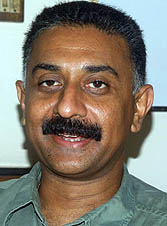
Ranjan Kamath

The film deals with the making of an essentially Indian stage genre by the late Habib Tanvir, a popular Muslim playwright, in Chhattisgarh, a central Indian state.

Tanvir’s Naya (new) Theatre uses indigenous performance forms to create a new theatrical language.

Kamath, 47, told UCA News he uses documentaries to discuss social problems and that his Jesuit teachers had helped him gain a deeper understanding of societal issues. He says he has made four films on societal issues, ranging from casteism to rural theater.

His latest documentary on Tanvir, who died on June 8 aged 89, shows how Tanvir employed both village performers alongside urban actors to bring his “theater of the people” to the urban “educated.”

Kamath also says the humanism his Jesuit teachers taught him is projected in his films and it also helps him connect to people of other religions.

Jesuit Father Albert Huart, who taught Kamath political science, says many past students have taken up social work after having been influenced by their Jesuit teachers. However, the 85-year-old Belgian Jesuit said he was nevertheless “pleasantly surprised” to know that a student has made documentaries on social issues.

Last January, Kamath and his friends, mostly former students of St. Xavier’s College, also launched C+ve, a social networking group committed to social change through non-violence.

C+ve is a shortened form of “see positively,” and implies that true citizenship is to engage in a process of change in the nation, Kamath explained.

The group also started its “Billion Beejams” (beejams means seedlings), a nationwide reforestation project in July.

Members have asked various groups to donate five rupees (US$0.09) each to green one square foot of the nation. The group uses the money to provide jobs to village women to plant trees, Kamath said.

Loyola Press announces online resources for Family Fun

Bookmark and Share


Family, Faith, and FunLoyola Press has two new resources to help families grow in faith. The newly launched Family Fun page provides a weekly conversation-starting question, related faith tip, and mealtime prayer. The site provides opportunities for families to have fun together while growing closer to God.

Subscribe to the Family, Faith, and Fun e-newsletter for monthly tips to encourage fun-filled conversations and faith-filled family living

God can be found everywhere

Bookmark and Share


Fr. Pat Peppard, S.J.

It may seem very vain to claim to have a calling from God – and even more so to talk about it. But I believe all men and women have a calling – given not through voices from heaven but revealed in the details of daily life. I am 66 years old, 48 years a Jesuit. 43 years a high school religion teacher and 35 years a Roman Catholic priest.

I am the first born of four children. My paternal grandfather was an Irish-American railroad worker. My maternal grandfather was a German-American Ohio farmer. I grew up in a devout Roman Catholic family in an increasingly secular suburban America in the 1950’s.

When I was born, my German grandfather, Frank, prophesied I would be a priest.
My grandmother worked in the student cafeteria at John Carroll University. My father, my Uncle Jim, my brother Tim and I all went to St. Ignatius High School.

My Dad and my brother Tim went to John Carroll, where Tim is the head of security today. After being wounded in World War I, my uncle Jim studied for the priesthood. For over 30 years, he was pastor of St. Joseph’s, a central city parish in the steel town of Massillon, Ohio.

My talents in writing and public speaking were identified and encouraged by the Sisters of St. Ursula in grade school and the Jesuits in high school. At St. Ignatius, the Jesuits introduced me to retreats based on the Spiritual Exercises and to social service work.

In 1960, I began Jesuit studies at the Colombiere College of the University of Detroit. Annual retreats and daily experiences confirmed my decision to become a Jesuit. In 1962, I made first vows. I continued college studies at Loyola University in Chicago. Jesuits work all over the world, but my ministry has been in Jesuit high schools in the Midwest.

In 1965, I was sent to teach at St. John’s High School in Toledo, Ohio. I loved it and worked for nine years teaching religion and directing plays. Since then, I have done similar ministry for ten years at Walsh Jesuit High School in Cuyahoga Falls, and twenty years at University of Detroit Jesuit High School and Academy.

God can be found everywhere.”

I believe God lead me to this ministry through my Jesuit teachers and guides during my college years. But I also believe that God confirmed me on my spiritual journey through the hundreds of lay colleagues, students and retreatants through the years. St. Ignatius teaches us that God can be found everywhere; and I believe him.

Fr. Pat Peppard, S.J. is teacher of theology at University of Detroit Jesuit High School and Academy in Detroit, Mich


Feast of Saint Ignatius Loyola

Bookmark and Share


My Photo
Ryan Duns, SJ
Detroit, Michigan, United States

Today the Church, and especially Jesuits around the globe, celebrates the Feast of Saint Ignatius of Loyola.

As I went for a run this morning – a 6.2-mile run from Villa Marquette to Barb’s Bakery in Northport – I reflected for most of the 47:08 minutes on my life and the Society of Jesus. On October 19th this year, I will celebrate my 30th birthday (on this date, too, the Church in the United States celebrates the Feast of the North American Martyrs). Looking back on the three decades of my life, I’m struck with how each decade bears basically two particular graces that have shaped and influenced my life tremendously.

As a child, I would locate the two primary graces in faith and music. I grew up in something of a Catholic ghetto; with the exception of my Lutheran father and his family, I think that nearly everyone I knew was Catholic. Indeed, the great childhood distinction between kids on our block fell between those who went to the parish school and those who were designated simply as “publics,” so dubbed because they went to the local public school.

I cannot claim that I loved going to Mass. I didn’t. I found it boring. Nevertheless, it became a practice, a discipline, that gave me the space and time to grow up spiritually. One priest in particular, Father Stephen Moran, really captivated my imagination…I still remember a homily whose tagline was “Think Mink” and involved a contest his mother participated in to win a mink stole. Serving Mass for Father Moran and for Monsignor Corrigan – who always referred to me as his ‘Number One Server’ – helped to cultivate a healthy respect for the priesthood and inspired in me, from an early age, a desire to serve the Church.

I’m grateful that my parents decided that a tin whistle and an accordion were better ways to express my Irish heritage than Irish dancing would have been. I have played Irish music for nearly twenty-two years. I will readily admit that I’m not as polished as I used to be, or could be, but I still love the musical tradition that I have been graced to be a part of. Music, as I look back on it, became my second language, another way of expressing myself. For a time, I reckon, I was most fully myself when I was playing and performing. After over two decades of music, of playing with other musicians, by myself, and for Irish dancers, I cannot begin to describe how important music has been to my life. Some of my closest friendships have been forged in and through Irish music and dancing. It has been, truly, a privilege to be an active participant in my Irish culture.

As a teenager, the great graces were a love of learning and a deepening of faith. I struggled terribly during my first two years of high school. I guess I was a late-bloomer. But with a six-month go at Weight-Watchers (I lost over 60 pounds) and some personal maturing, I found the last part of my high school experience to be overwhelmingly positive. I fell in love with learning and especially with writing. It was stamped on my heart that, in the future, no matter what it was that I studied it would have to be something that I loved enough to teach. It may be a shock for people to learn that I began my college studies as a science major (Biology and then Chemistry) but abandoned that to study Theology.

With a growth in my love for learning came a profound deepening of my faith. I was so blessed to have encountered numerous Jesuits in high school and college and these men were formative in my development as a Catholic. They were, to a man, smart and faithful, funny and sincere, intellectually adroit and yet humble. One once told me that the four pillars of a functional Jesuit were “Intelligence, Independence, Cynicism, and Sarcasm.” He may have overstated the case just a bit, but the love and passion of these men helped to give a sense of how I, too, might live my own life in service to the Church as a companion of Jesus.

Finally, in the last ten years, there has been no grace greater in my life than the Society of Jesus. I pray with gratitude each day that I continue to live out my discipleship as a Companion of Jesus. I am humbled to think that I stand in a line of Jesuits such as Ignatius and Xavier, Matteo Ricci and Friedrich Spee, Alfred Delp and Karl Rahner, Henri De Lubac and Teilhard de Chardin, Pedro Arrupe and John Hardon. I look more immediately and consider that the men I consider to be the greats – Howard Gray, Walt Farrell, Bill Verbryke, Frank Canfield, Ben Fiore, Mark Massa, Jim Keenan, Paul Crowley, Tom Schubek, John O’Malley, Robert Welsh – are all men I call proudly “brother.” Men of such wide and varying talents who have dedicated themselves wholly and unabashedly to serving Christ and his Church.

There are certain corners of the Church who seem to revel in calling attention to every fault and failing of any member of the Jesuits. As I have said in the past, I think this trend is itself satanic and a profound mark of the evil spirit. This is not to say that neither individuals nor the corporate Society is without blemish; far from it. But we are, all of us, sinners who struggle day in, day out, to discern how Christ is calling us to love more deeply and to “help souls” and, in so doing, help to bring about God’s Kingdom on earth.

I include the aforementioned comments simply because I think it can be forgotten that part of our lives as disciples involves a continual discernment of God’s Spirit. This is one of the great graces of Ignatius, one that he offers to the entire Church through the Spiritual Exercises. Ignatius teaches us that God deals directly with the human person and that we must pay attention to our affective responses, the innermost stirring of our hearts, as we attempt to know more clearly how we are being called. Discernment of God’s Spirit makes us vulnerable: very often, what we want immediately is not what we sincerely desire. It is this, in the deepest and most vibrant desires of our heart, that God speaks to us. And, at times, in order to live fully this desire, we have to sacrifice some of our wants. (Case in point: if I desire to lose weight in order to be healthy, I will sacrifice eating dessert each night even though I want the decadent slice of cake. So, too, if I desire to be available to be missioned even though my immediate want is to stay in my current location.)

One of the things I treasure mostly about Ignatian Spirituality is that it is passionate. It calls forth the entirety of the person, demanding a commitment of mind, body, and soul to cause of God’s Kingdom. It is an exciting, vibrant spirituality that asks us to give ourselves fully. It wrings out from us all that we think we can give, and then uncovers within us resources we never dreamed we possessed. When I look back upon my time in the Jesuits, I am struck by this most of all: I walk with men who are passionately committed to Jesus Christ and who offer themselves unabashedly to the service of God’s Kingdom.

Today, at Villa Marquette, we will celebrate the Feast with a feast! Bishop Cooney will join us for Eucharist and then we will have social and dinner (tonight, discernment of spirits will be necessary to decide between Gin and Vodka). As Companions of Jesus, we will bring ourselves to the Lord’s Table in order to be nourished at the true source of our strength; and then we will head to another table where we will continue our celebration as brothers gathered together, a disparate group of disciples, drawn together as Friends in the Lord.

I ask today that you remember in pray all of those who claim Ignatian spirituality as their way of coming to know God’s desires more deeply. In a special way, I ask for prayers for Jesuits throughout the world. Pray that we grow closer to the Lord through the Eucharist and, as men called to eat from the same plate and drink from the same cup, that we can unite our hearts with a passionate zeal for proclaiming the Gospel in word and deed, thereby dedicating ourselves wholly and completely to God’s Kingdom.

Happy Feast!

Loyola Press Releases Its First iPhone™ Application

Bookmark and Share


Life is fast, and the speed of life whisks people away from the very thing they need most-spiritual “time outs” to reconnect with God and experience much-needed peace of mind.

With Loyola Press’s highly popular 3-Minute Retreatnow available on the iPhoneTM and iPod touch®, people can enjoy a daily reflective prayer retreat wherever they are, whenever they need it most. Each day, a new retreat featuring soothing music, Scripture verses, and reflective thoughts and questions comes their way. So whether they’re at home or at work, sipping coffee in a café or standing in line at the grocery store, meaningful time with God is always just a touch away.

“Saint Ignatius always talked about learning the language of the culture. iPhone apps and modern technology are the language of our contemporary culture,” said JesuitPaul Campbell. “Our 3-minute retreat iPhone app uses today’s technology to provide a convenient place for busy people to deepen their friendship with God.”

This is the first iPhone? and iPod touch application released by Loyola Press, a publishing company serving the community of Faith since 1912.

For more information, please visit www.loyolapress.com/app or contact Colleen Fahey, Marketing & PR Assistant, [email protected] 773-281-1818 x252

The 3-Minute Retreat application is also available in the App Store.