Category: Uncategorized

Ricci is model for dialogue, mission in globalized world

Bookmark and Share


By Cindy Wooden
Catholic News Service

ROME (CNS) — Italian Father Matteo Ricci, the 16th-century Jesuit known for his positive relations with the Chinese, is a model for dialogue and evangelization in the 21st-century globalized society, said speakers at a conference in Rome.

Father Ricci’s experience and writings remind people “that there are basic similarities in all human beings, in human nature: hope, suffering, questioning the meaning of life. We all share those whether we are Westerners or Chinese,” said Jesuit Father Augustine Tsang Hing-to.

Father Tsang was born in mainland China to a Catholic family, “but I escaped by swimming to Hong Kong — four hours to Hong Kong, at night — and then went to the States.”

The priest, who now teaches at Fu Jen Catholic University of Taiwan, spoke to Catholic News Service March 1 before speaking the next day at a conference marking the 400th anniversary of Father Ricci’s death.

Father Ricci, who was born in 1552 and arrived in China at the age of 30, delved into studies of the Chinese language, culture and Confucianism. His respect for the Chinese gradually paved the way for his dialogue with China’s government and cultural leaders.

At the same time, “he was very frank and strict, explicit and direct on the goodness of the Christian faith,” Father Tsang said, and “he did not hesitate to point out the defects of Taoism and Buddhism.”

While Father Ricci found great fault with what he understood about Taoism and Buddhism, he believed that Confucianism in its purest form was a philosophy open to Christianity. After his death, missionaries developed the so-called “Chinese rites” — Confucian-based social rituals involving ancestor veneration and offerings to the emperor — which allowed Chinese converts to preserve elements of their heritage while being Catholic.

Centuries of controversy ensued and although the rites developed after Father Ricci’s death, he was so strongly identified with that disputed form of inculturation that his sainthood cause was not opened until the 1980s.

Father Tsang said it was unfortunate that the controversy led some to question Father Ricci’s holiness.

It is true, he said, that Father Ricci “was very friendly with the Chinese, respecting the Chinese culture, but in terms of the faith, he was very unabashedly Catholic.”

In his speech at Rome’s Pontifical Gregorian University March 2, Father Tsang said Father Ricci was not so “narrow-minded as to regard non-Christian cultures or religions as nothing good; indeed, he saw quite a lot of compatibility between early Confucianism and Christianity,” and recognized that Confucian teachings could be seen as preparing the Chinese to receive the Gospel.

Father Ricci’s respect for the Chinese and his commitment to sharing the Gospel with them offer the still-relevant lesson that Christians cannot claim God is at work only among Christians, but at the same time they cannot claim that all religions are equally valid paths to salvation, Father Tsang said.

Father Tsang said the Chinese today need the Gospel just as much as they did in Father Ricci’s age.

The country is enjoying economic prosperity, but “there are grave, hidden problems,” including the repression of human rights, a growing divide between rich and poor, widespread use of abortion and “alarming pollution.”

Father Ricci “did not befriend the Chinese and stop there. He intended to bring them the much greater blessing — the knowledge of Jesus Christ,” he said.

Italian Bishop Claudio Giuliodori of Macerata, where Father Ricci was born, said the Jesuit is still a model for dialogue and evangelization because “he entered into the Chinese culture without losing himself and in a way that allowed him to introduce themes from the Gospel into the culture.”

His relationship with the Chinese “took place in the context of dialogue, with respect, but without forgetting that his mission was to bring the Gospel,” the bishop said.

Roberto Sani, rector of the University of Macerata, said Father Ricci’s example could help people today deal with hopes and fears about their increasing contacts with people of other cultures and religions.

Just as the global expeditions of the 1500s gave Europeans a sense of an expanding world filled with previously unknown cultures, globalization today is challenging people to recognize their common humanity and share their knowledge and beliefs, Sani said.

“Ricci is a model for young people today. He was strong in his faith and culture, but able to establish a real dialogue with the Chinese,” he said. “He is a model of a Christianity that does not close itself within four walls, but goes out into the world.”

Abortionfest at the University of San Francisco

Bookmark and Share


University of San Francisco Chapel

SAN FRANCISCO, CA. (California Catholic Daily) – The University of San Francisco, a Jesuit institution, will host the “Global Women’s Rights Forum” from Monday, March 8 through Thursday, March 11. The forum is sponsored by the College of Arts and Sciences, the Leo T. McCarthy Center for Public Service and the Common Good, the Sociology Colloquium, the School of Nursing, the Politics Department, the Gender and Sexuality Studies Department, and curiously, the Theology and Religious Studies Department.

The three speakers at the forum´s Wednesday event, “Bringing Home the right to Health: Critical Interventions in Women’s Health Care,” are Lori Freedman, visiting scholar at the Department of Obstetrics, Gynecology, and Reproductive Sciences and the Bixby Center for Global Reproductive Health at UCSF; Destiny Lopez, executive director, ACCESS, Oakland; and Eve Zaritsky, a physician at Oakland Kaiser, and the medical director of the Women’s Community Clinic, San Francisco.

At UCSF, Professor Freedman works as a research associate at the ANSIRH (Advancing New Standards in Reproductive Heath) think tank. ANSIRH´s “Later Abortion” Web page says: “This website is dedicated to the memory and spirit of Dr. Tiller and is a resource for women, clinicians, researchers and journalists who want to learn more about later abortion care.” The reference is to notorious partial-birth abortionist Dr. George Tiller who was murdered in 2009. ANSIRH spearheaded the “Second Trimester Abortion Initiative” which “…promotes a strategic vision for securing access to and provision of second trimester abortion care in the United States,” and provides a list of clinics that provide what they call “Later Abortion.”

Freedman also has a forthcoming book called Willing and Unable: Doctors´ Constraints in Abortion Care, which “…examines how abortion politics affect medical practice, focusing on the challenges to integrating abortion into physician practice. Unexpected findings from the interviews led her to research and write about the intersection of religion and health care, especially in the case of Catholic-owned hospitals.” Freedman also expressed concern with Catholic Hospitals´ policies in a August 13, 2008 paper published in the American Journal of Public Health, “When There´s a Heartbeat: Miscarriage Management in Catholic-Owned Hospitals.” From the abstract: “As Catholic-owned hospitals merge with or take over other facilities, they impose restrictions on reproductive health services, including abortion and contraceptive services.”

The second speaker at the forum is Destiny Lopez, executive director of ACCESS. Prior to her work at ACCESS, Lopez was vice president of programs at NARAL Pro-Choice New York. She currently sits on the boards of both the National Latina Institute for Reproductive Health and California Latinas for Reproductive Justice. Ms. Lopez received her BS from another Jesuit institution, Georgetown University.

From the ACCESS “Direct Services” page: “Our Practical Support Network ensures that all women can obtain safe abortion services without isolation or delay. When a woman cannot rely on her personal resources to get to a clinic, our network of more than 100 volunteers can provide rides, overnight housing, child-care, translation or other assistance.” From ACCESS´s “Policy Advocacy” page: “We are active members of the California Coalition for Reproductive Freedom, the National Network of Abortion Funds, the National Abortion Federation and the Having Our Say Coalition.”

In 2007, Lopez made three appearances before the Oakland City Council, urging adoption of Oakland´s “bubble ordinance,” a restriction on speech applicable only outside abortion businesses and only to abortion opponents. The passage of the ordinance resulted in the imprisonment of Oakland pastor, Rev. Walter Hoye. Rev. Hoye´s conviction is currently being appealed in Alameda County Superior Court, and the constitutionality of the ordinance is being challenged in federal court.

The third speaker is Dr. Eve Zaritsky. In addition to her work for Kaiser Permenante, Dr. Zaritsky is the medical director of the Women´s Community Clinic in San Francisco. The Women´s Community Clinic “Services” page offers “Emergency Contraception,” which, depending on the timing, can be an abortion. The Women´s Community Clinic does not offer non-emergency contraception abortions, but will refer women to organizations that do. According to her biographical page, other fields of interest for Dr. Zaritsky include “queer health.”

The forum will be held at USF´s Fromm Center. All events are free and open to the public.


Film in a Faith Context

Bookmark and Share


The Oscars are over, and casual moviegoers around the country are likely debating why “this” movie won and “that” movie lost. Most of these discussions will revolve around plot, characters, and acting ability. But according to film critic and Jesuit Richard Leonard, what we often fail to notice in movies is the rich spiritual insight they offer and how they can actually draw us closer to the divine. Watch this video or click on the image below to see how you can get closer to God through secular movies. 


40 Ideas for 40 Days

Bookmark and Share


From Joe Paprocki 

When it comes to practicing our faith, Lent is a time of heightened intensity. Catechists of all age groups are always looking for creative Lenten activities so as to heighten that intensity. With Lent upon us, I’m pleased to offer these FORTY lenten activities arranged in a convenient interactive calendar (pdf) that I hope will be of use to you.


40 Ideas for 40 Days [pdf]

(Note: Simply click on the activity title on each day to visit the activity detail.)

These activities come from a variety of sources: from my own experience as a catechist, from various Web sites that I credit accordingly, and from catechists like you who shared their creative ideas with me. The activities are grounded in the symbols, Scripture readings, devotions, and traditions of the Lenten season. Be sure to check this calendar each day to find another Lenten activity that you can adapt for your own setting.

May this Lent be a time of heightened focus on faith formation for you and for those you teach!


Joe Paprocki is an eighth-grade catechist in the Archdiocese of Chicago with over 30 years of experience in pastoral ministry. Joe, national consultant for faith formation at Loyola Press, is the author of numerous books including the best-selling The Catechist’s Toolbox and A Well-Built Faith, as well as the host of the blog Catechist’s Journey.

If you would like to receive Joe’s blog posts by e-mail, click here.


How to Find Time in Your Day for Lent

Bookmark and Share


The fast pace of your life may seem to leave little time and energy for the traditional Lenten practices. But you can weave moments of spiritual awareness and service into even the busiest of schedules. The trick is to see Lenten practice as part of, rather than in addition to, each activity of your ordinary hectic day.

The three foundational practices of Lent are prayer, fasting, and almsgiving. Here’s how to think about them in a new way:

Praying Daily

If you make a habit of saying a little prayer whenever someone irritates you, cuts you off in traffic, or makes life difficult; when someone does you a favor, you experience great and friendly service, or when something joyful happens to you-you will soon find yourself praying your way through the day. Try this simple practice and you will be observing the Catholic Church’s call for greater prayer during the Lenten season. You will also find that this habit makes your life flow smoother, your self more centered, and your Spirit more aware of God’s presence.

A Different Type of Fasting

There are many ways to fast. Why not fast from criticism, gossip, judging others, or passing on rumors? Why not abstain from unwarranted fear and anxiety? You can also tell that inner voice inside your head that criticizes you to abstain from eroding your ability to be the confident, blessed person God calls you to be. These are beautiful ways to observe the Lenten call to fasting and abstinence. In the book, Praying Lent, the authors offer suggestions on different ways to fast during Lent.

Give of Yourself

Daily life also offers countless opportunities to give of yourself to others (alms), and most don’t involve dipping into your wallet. Give encouragement to the doubting, give a word of praise to the insecure, show kindness to someone who could use a friend, and offer a word of thanks to those whose service of others often goes unappreciated. Give the gift of your attention to someone who simply wants to be noticed. Tell your children stories about people whose values you admire when you gather at mealtime. Don’t be stingy with your smiles-give them freely to everyone you meet. And most important, give your love to those close to you. Hug them, hold them, and tell them what they mean to you. In this way you open your heart to God and others.

So no matter how busy your are in life, with some greater awareness and new perspectives you can consciously pray, fast, and give of yourself this Lent-and you will be ready to celebrate when a joyful dawn breaks upon you Easter morning.


For related Lenten resources, see:

Praying Lent Praying Lent: Renewing Our Lives on the Lenten Journey
They Come Back Singing They Come Back Singing
Radical Compassion Radical Compassion
Raising Faith-Filled Ki Raising Faith-Filled Kids
Raising Kids Who Will Make a Difference Raising Kids Who Will Make a Difference
A Still More Excellent Way A Still More Excellent Way
Praying the Way Jesus Prayed Praying the Way Jesus Prayed


Estate workers mourn their Jesuit ‘Gandhi’

Bookmark and Share


Estate workers mourn their Jesuit ‘Gandhi' thumbnail
Father Angelo Stefanizzi

RATNAPURA, Sri Lanka (UCAN) – Poor tea and rubber estate workers are mourning the death of an Italian Jesuit missioner who worked for 58 years in Sri Lanka and who was “more important than Gandhi” to them.

Father Angelo Stefanizzi passed away at Lewella in Kandy on Feb. 3 due to illness. His funeral was held today [Feb. 5] at 3 p.m.

“He is considered a saint among [tea and rubber] estate workers,” said S.P. Anthonimutthu, a Tamil coordinating officer of Caritas Sri Lanka who knew Father Angelo for more than 30 years.

For poor Tamils, he took the place of “Gandhi,” Anthonimutthu said. “He went through painful struggles to free them from poverty.”

Father Maria Anthony, the Jesuit provincial in the country, said, “We have lost a veteran missioner, a man for the poor. He was ready to work under any inconvenient circumstances [and] never liked to lead a comfortable life,” Father Anthony said.

Fluent in Tamil, Sinhalese, Latin and many European languages, the priest often preached in Tamil and Sinhalese.

He frequently trekked into tea and rubber estates to spend time with the poor workers of Indian origin, who are mostly Hindus.

Tamil plantation workers were cruelly exploited by the British and, after independence, by the local masters. They were constantly mired in debt.

“His flesh and bones are to be buried in our soil,” said Edward Kumaragamage, a Kolping worker and Christian activist in the plantation sector.

Kumaragamage said the priest had “dared to come to their aid” during the anti-Tamil riots of 1958 and 1983.

Father Stefanizzi joined the Kolping Movement and was deeply impressed by its potential to help in faith and community development.

He started the Kolping Centers and developed the group’s work in the plantation sector.

During his final days, he was in the Jesuit Infirmary at Lewella, confined to his wheelchair due to arthritis.

There are five Jesuit missioners presently serving in Sri Lanka.

Father Stefanizzi was born in Matino Lecce, Italy, in 1919. He entered the Jesuit novitiate in Naples in 1936 and did his philosophical studies in Gallarate.

After his practical work experience in Bari, he came to Kurseong in India to study theology and was ordained a priest there on Nov. 21, 1949. After studying Tamil, he came to Ceylon, as Sri Lanka was then known, in 1952.


Jesuit economists vow to guide development

Bookmark and Share


Jesuit economists vow to guide development thumbnail
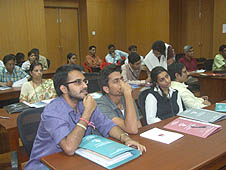
Participants of the Jesuit Economics Association of India workshop

KOLKATA, India (UCAN) – Jesuit economists say development must be given a “human face” if it is to reach the majority of India’s poor.

Most of the country’s most vulnerable are missing out on the benefits of aid programs, said Father Dominic Savio, who organized the first national seminar of the Jesuit Economics Association of India (JEAI) in Kolkata on Sunday [Feb. 28].

The 14 Jesuits attending vowed to continue the work, engaging their confreres around the country.

Subhash Seraphim, assistant general manager of National Bank for Agriculture and Rural Development (NABARD), said there were some “major grey areas” in economic policies.

Economic students and researchers as well as NGOs working for the poor need to translate government policies into reality, he said.

Jesuit Father John Felix Raj, the association’s convener and principal of the city’s St Xavier’s College, said he had recommended to the Jesuit Provincial of South Asia to bring together all Jesuits of India involved with teaching or researching economics.

Father Raj said any Jesuit with a master’s degree in economics would be eligible to become a member of JEAI. Jesuit seminarians studying economics at master’s level, and Jesuits engaged in economic fields are also eligible, he told UCA News.

The association aims to examine Jesuit economists’ contribution through research, encourage them to undertake research projects and influence policy-makers of the country, he said.

The Jesuits have already made a notable contribution in education, Father Raj said. The new association should aim to influence policy-makers.

“It may take some years,” he acknowledged.

Father Ajay Kumar Xess from Ranchi, Jharkhand state, said the association would help members clarify many economic issues.

The principal of St Xavier’s School in Duranda expects the association to “make concrete contributions” in policy-making at the national and state levels.


Veteran soldiers given Lunar New Year treat

Bookmark and Share


Veteran soldiers given Lunar New Year treat thumbnail
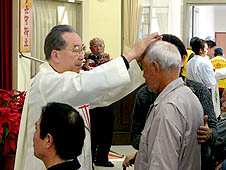
Archbishop Thomas Yeh Sheng-nan blesses an elderly resident at the home

KAOHSIUNG, Taiwan (UCAN) – Catholics from two southern dioceses in Taiwan celebrated the Lunar New Year with 800 retired soldiers recently.

Cardinal Paul Shan Kuo-hsi, retired Kaohsiung bishop, presided over a special Mass at Gangshan Veterans Home on Feb. 21. Some lay Catholics and clergy from Kaohsiung and neighboring Tainan dioceses attended the Mass to mark the new year that fell on Feb. 14 this year.

The 50-year-old veterans’ home accommodates retired Kuomintang (Nationalist Party) soldiers who fled to Taiwan when the communists took over mainland China in 1949.

Many of the retired soldiers are bachelors and have no relatives on the island. However, advanced age and poor health make it impossible for them to return to their home towns.

The government takes care of these soldiers, who are called “honorary citizens” in Taiwan. The oldest among the 800 residents is now 103.

In his homily, Cardinal Shan empathized with their feelings of homesickness as he too had never returned to his hometown in Puyang, Henan province (now Hebei), to take part in the festivities since he left mainland China 64 years ago.

The Jesuit prelate, who was diagnosed with lung cancer three years ago, said he views his homesickness and illness as a spiritual sacrifice.

Suffering helps people ‘come closer to God’

Sufferings are like a “ladder that one climbs to come closer to God,” he said.

During Communion, Archbishop Thomas Yeh Sheng-nan, the Taiwanese apostolic nuncio to Algeria, and his seminary classmate Bishop Bosco Lin Chi-nan of Tainan blessed able-bodied veterans who were not yet baptized.

After Mass, Archbishop Peter Liu Cheng-chung of Kaohsiung and priests prayed over and blessed those who were bedridden.

Catholics from Kaohsiung’s Holy Name Parish gave a musical-instrument performance for the residents, who enjoyed snacks and fruits prepared for them.

The Gangshan Veteran Home comes under Gangshan parish. Congregation of Mission priests visit the facility regularly.

Han Hung-ming, an organizer of the program, told UCA News that the priests often bring along laypeople to visit the elderly and administer the sacraments. They have built good relations with the residents over the years, he noted.

Han hoped the festival celebration would show the younger generation how to love the elderly and help them experience God’s love.

According to the government’s Veteran Affairs Commission, there are 471,306 veterans, most of them men. About 12,600 of them live in 12 homes for the elderly.


I Will Make You Fishers of Men

Bookmark and Share


Fish played a role in Jesus’ ministry. His apostles were mostly fishermen, and he called his disciples to be “fishers of men.” He fed thousands of people with a couple of fish, and he ate fish with his disciples after his Resurrection. The fish symbol was widely used in the Roman Empire by pagan religions, so Christians felt compelled to make it their own. Some historians think that Christians may have seen in the Greek work for fish, ichthus, an acrostic for “Jesus Christ, of God, the Son, the Savior” [Iesous (Jesus) CHristos (Christ) THeou (of God) Uiou (the Son) Soter (the Savior)].
Whether or not that is so, the fish symbol was used in the early Church as a hidden reference to their faith in Christ. Precisely because it had a pagan history, the fish symbol aroused little suspicion and could be used safely by persecuted Christians. Etchings of fish are found in the catacombs, where the persecuted Christians buried their dead.