Category: Uncategorized

Jesuit center educates dropouts in Gujarat

Bookmark and Share


Jesuit center educates dropouts in Gujarat thumbnail
A karate session for children at the Xavier Centre for Migrant workers

AHMEDABAD, India (UCAN) – A Jesuit program in Gujarat has come to the rescue of school dropouts and neglected children by helping them sit for school examinations and continue their studies.

Dhanyalxmi Malete had completed third grade at a primary school in Bapod near Vadodara, but could not read the local Gujarati language she spoke. So she joined the Xavier Centre for Migrant Workers on the outskirts of Vadodara three years ago for its non-formal education.

The 13-year is now among 29 students, who sat for the fifth grade examinations of the National Institute of Open Schooling (NIOS) in March. Now they are awaiting the results.

Malete said she is “sure” she passed the exam and is now preparing to enter the eighth grade in March 2011 by skipping the seventh.

The centre is educating 87 students from socially and economically deprived families. All of them are Hindus.

Her classmate Rajesh Sureshbhai Bharwad said he had “lost interest in studies” because his teachers “had no interest in teaching.” But the Jesuit center has “revitalized his interest,” he told UCA News.

The Xavier Education Trust, which runs the center, has been managing a pre-school program for the last 10 years in the area.

It started the five-days-a-week, non-formal school program in 2004 “to educate dropouts and ensure that no one remains illiterate,” said Father Jolly Nadukudiyil, who manages the program.

He said Gujarat has thousands of migrant workers and a great many of their children are lacking an education.

School principal Sister Fatima Lopes from the Daughters of the Cross said the “task is very challenging.” The children are interested in education “but not their parents.”

The center also runs personality development programs and organizes karate and dance classes. One of its 11-year-old students, Prakash Kunwarji Solanki, recently won a karate competition.

Time is ripe to follow Ricci’s lead

Bookmark and Share


Time is ripe to follow Ricci's lead thumbnail
Jesuit Father Michael Kelly

BANGKOK (UCAN) – May 11th is the 400th anniversary of the death of Matteo Ricci (Li Madou) the legendry Jesuit who was born in 1552 and died in 1610. His life and the example of his approach to China have been a matter of constant fascination, study and research, not least in the last six months with three international conferences – in Taipei, Paris and San Francisco -assessing his significance.

He is not only someone novel in Catholic missionary approaches. He was the first to propose and successfully live a completely fresh way for the West to engage with China. Fascination with his achievement extends well beyond Church circles.

But why did he not simply replicate the example of Francis Xavier, credited with baptizing tens, if not hundreds of thousands across Asia? Born in the year Xavier died (1552), Ricci followed a completely different path.

Where did this come from? His mentor was Alessandro Valignano (1539-1606), his Jesuit novice master in Italy and later Superior in Asia, who hand picked him and a few others to pioneer a completely different approach to the Church’s mission in Asia: “an Indian Catholicism for India, a Japanese Catholicism for Japan, a Chinese Catholicism for China.”


A painting of Father Matteo Ricci

To achieve this – and Ricci is the most vivid instance and most successful embodiment of it – the Christian missionary has to undertake a journey: into the minds and hearts, language and culture, symbols and sensibility of those he or she seeks to evangelize. And, coming out the other side, a new account of God’s presence in the world, the meaning of Jesus and the life of the Church can unfold.

But what was the trigger for such an adventurous departure from common missionary practice that put Christian faith and European culture together.

Clearly, the imagination of Valignano was essential. He thought outside the square of European culture. And the enterprising genius and dazzling linguistic facility of Ricci made a spectacular Renaissance man into a stunning global figure.

But maybe one other possible element in this unfolding is the brief window of opportunity that opened at just the time Ricci arrived in China, entering Middle Kingdom through the Portuguese colony of Macau. It was just these years – the 1580s – that witnessed the eclipse of Portuguese colonialism, which provided a powerful and confining boundary.

It was between 1580 and 1640 that Portugal completely lost its presence and initiative as an expanding colonial empire. In those 60 years, Portugal was run by Spain and Portuguese management of their colonies lapsed. Arriving in China when he did meant that his time of engagement with Asia and China was one free of colonial baggage and the resentment that always came to Europeans who were seen as the enemy. Portugal’s time as the dominant colonial power in Asia and China was finished.

As colonialists, the Portuguese don’t get good press. And deservedly so. When Saint Francis Xavier visited Batavia (today’s Jakarta) in the 1540s, he was so appalled by the behavior of the Portuguese that he felt compromised in preaching a Gospel they were meant to exemplify. So he moved on.

But in 1582, with Portugal a spent force, Ricci could arrive with a clean slate: He was not encumbered by that connection as he began his engagement with Chinese scholars and administrators eventually reaching the Imperial Court. As a Catholic country, the Portuguese Kings accepted spreading the Gospel (which mostly meant also imposing European culture) as part of their challenge. Francis Xavier came to Asia as missionary sent not by the Pope so much as someone who set out from Europe following a personal request by the Portuguese King to the founder of the Jesuits, Ignatius Loyola. Not so Ricci.

It is part of Ricci’s enduring significance that he models a missionary approach whose context and presuppositions have never been more relevant than they are today. In Asia, liberated in the last 60 years from the burden of any identification with Europe, its politics and cultures, Christianity is in the right space to further develop Valignano’s dream and the practice of Ricci and his companions in China, Vietnam and India: Christianity and Church life that are “an India Catholicism for India, a Japanese Catholicism for Japan and a Chinese Catholicism for China.”

Father Michael Kelly SJ is executive director of UCA News since Jan. 1, 2009. He has worked in radio and TV production since 1982 and as a journalist in Australia and Asia for various publications, religious and secular.


Hopes for Ricci’s helper to become a saint too

Bookmark and Share


Hopes for Ricci's helper to become a saint too thumbnail
A poster from the Matteo Ricci exhibition


SHANGHAI, China (UCAN) – Catholics are hoping that Paul Xu Guangqi, the first Catholic in Shanghai, may also be proclaimed a saint along with Father Matteo Ricci.

Italian Jesuit Father Matteo Ricci (1552-1610) and Catholic Chinese imperial official Paul Xu Guangqi (1562-1633) collaborated closely in Beijing to translate Western texts on mathematics, hydraulics, astronomy, trigonometry and geography into Chinese.

They also translated Confucian classics into Latin so as to introduce the dominant Chinese philosophy to Europe.

Father Ricci arrived in Beijing in 1601 and the Chinese emperor allowed him to stay in the capital until his death on May 11, 1610. His native Macerata diocese in Italy re-launched the process of his beatification in January.

Some Shanghai Catholics told UCA News that they hoped Xu could also enjoy the same honor, as their diocese would begin a similar process soon.

Jesuit Bishop Aloysius Jin Luxian of Shanghai, 94, is known as a “fan of Xu Guangqi,” Church sources said.

They pointed out that the bishop has included “Guangqi” in the names of many diocesan organizations including the publishing house, social service center, formation center, a school and a home for the elderly.

Xu, a Shanghai-born bureaucrat, agricultural scientist, astronomer and mathematician of the Ming dynasty, first met Father Ricci in 1600 and was impressed by his knowledge and holiness.

Xu was baptized three years later and took on the name of Paul. He then invited another Jesuit priest to spread the Gospel in his birthplace. His family became the first Catholic family in Shanghai.

Xu died in Beijing in 1633 and was buried in today’s Xujiahui district in downtown Shanghai, where his family used to live. In 1847, Jesuit missioners built their missionary headquarters on a large piece of land in Xujiahui.

Ricci exhibition in Shanghai

Father Ricci and Xu translated Euclid’s Elements, the mathematical and geometric treatise by the Greek mathematician, and their work is on display at the Shanghai Museum from April 3-May 23.

Shanghai is the second stop of the touring exhibition titled Matteo Ricci: An Encounter of Civilizations in Ming China, which would coincide with the Shanghai World Expo, which runs from May to October.

The exhibition has attracted crowds of visitors, including local priests, nuns and laypeople. They described it as “worth seeing” and “very fruitful.”

Maria, a laywoman told UCA News that she was moved at seeing many books, musical instruments, religious statues, priests’ garb of the 16-17th centuries, as well as Father Ricci’s first catechism book in Chinese, a world map he drew, and an ancient costume worn by Confucian scholars at the exhibition.

“As Catholics, we have to understand [that Father Ricci] contributed not only to the local Church, but also to the development of science and culture of China,” said Maria, who said she had read Father Ricci’s biography.

The exhibition is organized by Italy’s Marche Region, which covers Macerata, to mark the death anniversary of Father Ricci and the 40th anniversary of diplomatic ties between China and Italy. The 113 exhibits come from museums in mainland China and Italy.

Symbols of the Holy Spirit

Bookmark and Share


In our churches, religious art, and liturgical prayers, we use a variety of symbols to represent the Holy Spirit, all of which come from the Bible. Here are some of those symbols.


Symbols of the Holy Spirit

One of the most common symbols of the Holy Spirit is a dove. It comes from the story of Jesus’ baptism, when Jesus saw “the Spirit, like a dove, descending upon him.” (Mark 1:10) The other three Gospel writers use similar wording to describe the event (see Matthew 3:16Luke 3:22, and John 1:32).

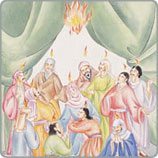
Fire is another popular representation of the Holy Spirit. The fire that appeared on Pentecost (Acts of the Apostles 2:3) was reminiscent of the burning bush on Mount Sinai from which God spoke to Moses. (Exodus 3:2) During the Exodus, the people of God were led by a pillar of fire at night. (Exodus 13:21) Fire calls attention to the strength and force of the Holy Spirit.

The Holy Spirit is also represented by wind. In fact, the original Hebrew and Greek words for “Spirit” can be translated as “wind.” The wind that appeared on Pentecost (Acts of the Apostles 2:2) was reminiscent of the wind that blew over the waters at the beginning of Creation. (Genesis 1:2) The wind calls attention to the Holy Spirit breathing life into the Church.

Water signifies birth and life. From a faith perspective, it represents the cleansing and life-giving action of the Holy Spirit at Baptism. (Matthew 3:11John 3:5) The symbolism of water is addressed in the Catechism of the Catholic Church (#694):

As “by one Spirit we were all baptized,” so we are also “made to drink of one Spirit.” (1 Cor 12:13) Thus the Spirit is also personally the living water welling up from Christ crucified (Jn 19:34; 1 Jn 5:8) as its source and welling up in us to eternal life. (Cf. Jn 4:10-14; 7:38; Ex 17:1-6; Isa 55:1; Zech 14:8; 1 Cor 10:4; Rev 21:6; 22:17)

The cloud is used as a symbol of the Holy Spirit because clouds provide life-giving water. In the Old Testament, God often leads his people with a cloud or appears to them in a cloud. (Exodus 16:10) The image of a cloud is often combined with the image of light to symbolize the God who is hidden and mysterious but also revealing and luminous.

Anointing with oil is a symbol of the Holy Spirit’s uniting us with Jesus, the Messiah, the Anointed One. (Acts of the Apostles 10:381 John 2:20-27)

Official documents in the past (Nehemiah 9:38Esther 8:8), and some documents today, were sealed with hot wax. Then an imprint was made on the wax with the official seal of the person sending the document. In a similar way, we are “sealed” by the Holy Spirit to show that we are forever part of God’s family. (Song of Songs 8:6John 6:27)

If you were to draw a representation of the Holy Spirit, what would it look like? What would be your reasoning for drawing the Holy Spirit that way?

Symbols of the Holy Spirit

In our churches, religious art, and liturgical prayers, we use a variety of symbols to represent the Holy Spirit, all of which come from the Bible. Here are some of those symbols.


Symbols of the Holy Spirit

One of the most common symbols of the Holy Spirit is a dove. It comes from the story of Jesus’ baptism, when Jesus saw “the Spirit, like a dove, descending upon him.” (Mark 1:10) The other three Gospel writers use similar wording to describe the event (see Matthew 3:16Luke 3:22, and John 1:32).

Fire is another popular representation of the Holy Spirit. The fire that appeared on Pentecost (Acts of the Apostles 2:3) was reminiscent of the burning bush on Mount Sinai from which God spoke to Moses. (Exodus 3:2) During the Exodus, the people of God were led by a pillar of fire at night. (Exodus 13:21) Fire calls attention to the strength and force of the Holy Spirit.

The Holy Spirit is also represented by wind. In fact, the original Hebrew and Greek words for “Spirit” can be translated as “wind.” The wind that appeared on Pentecost (Acts of the Apostles 2:2) was reminiscent of the wind that blew over the waters at the beginning of Creation. (Genesis 1:2) The wind calls attention to the Holy Spirit breathing life into the Church.

Water signifies birth and life. From a faith perspective, it represents the cleansing and life-giving action of the Holy Spirit at Baptism. (Matthew 3:11John 3:5) The symbolism of water is addressed in the Catechism of the Catholic Church (#694):

As “by one Spirit we were all baptized,” so we are also “made to drink of one Spirit.” (1 Cor 12:13) Thus the Spirit is also personally the living water welling up from Christ crucified (Jn 19:34; 1 Jn 5:8) as its source and welling up in us to eternal life. (Cf. Jn 4:10-14; 7:38; Ex 17:1-6; Isa 55:1; Zech 14:8; 1 Cor 10:4; Rev 21:6; 22:17)

The cloud is used as a symbol of the Holy Spirit because clouds provide life-giving water. In the Old Testament, God often leads his people with a cloud or appears to them in a cloud. (Exodus 16:10) The image of a cloud is often combined with the image of light to symbolize the God who is hidden and mysterious but also revealing and luminous.

Anointing with oil is a symbol of the Holy Spirit’s uniting us with Jesus, the Messiah, the Anointed One. (Acts of the Apostles 10:381 John 2:20-27)

Official documents in the past (Nehemiah 9:38Esther 8:8), and some documents today, were sealed with hot wax. Then an imprint was made on the wax with the official seal of the person sending the document. In a similar way, we are “sealed” by the Holy Spirit to show that we are forever part of God’s family. (Song of Songs 8:6John 6:27)

If you were to draw a representation of the Holy Spirit, what would it look like? What would be your reasoning for drawing the Holy Spirit that way?

Death Threats against a Jesuit in Colombia

Bookmark and Share


Death Threats against a Jesuit in Colombia

Since April 22, 2010 in various places in Bogota, Colombia graffiti have appeared against the Jesuit priest and investigator of CINEP/PPP (The Center of Investigation and Community Education – Program for Peace), Father Javier Giraldo.

The graffiti express death threats against Father Giraldo because he has denounced crimes and assassinations committed by the Colombian National Army, the paramilitaries and guerrilla groups since July 1996 in the Peace Community of San José de Apartadó. Moreover, he has organized and signed petitions to denounce countless criminal actions by armed groups, the majority of which have gone unpunished.

Death Threats against a Jesuit in Colombia


Because of this, CINEP/PPP, as well as the the Jesuits of Colombia, demand that the National Government of Colombia conduct an investigation to find those responsables for these threats and clearly define the methods of protection that will be offered to those affected. Without this assistance from the Colombian Government there is no guarantee that the defenders of human rights will be able to continue their work in safety.

A Reflection on a Marian Celebration

Bookmark and Share


It is my first “Catholic” memory and my first memory as a Catholic: May Crowning. The songs are still-and always-in my head.
Hail, holy Queen enthroned above, oh Maria.
Hail, mother of mercy and of love, oh Maria.
Triumph all ye cherubim, Sing with us ye seraphim.
Heaven and earth resound the hymn.
Salve, Salve, Salve Regina.

I wish that all children were welcomed into the fold of Catholic faith with the innocence and tenderness of singing seraphim, with a mother of mercy and love.

One of the defining aspects of being Catholic is devotion to Mary. I favor no Marian celebration more highly than May Crowning, the feast that recognizes Mary as queen of heaven and earth. To a person of any age, this is a mighty big title, but to a child of five or six or seven, it expands to enchanting, magical proportions. How many queens does one get a chance to meet in a lifetime, much less crown?

Thus, preparing for the May Crowning procession each spring at St. Raphael’s, the church of my childhood, was a monumental and joyful task. My imagination may be filling in some of the details, but this is what I remember most. We practiced “Immaculate Mary” and “Hail, Holy Queen” until we knew the lyrics by heart. We girls put on our spring dresses and white tights, the boys their scratchy Sunday shirts and ties. We practiced “processing” with dignity and grace and with as few wiggles and squirms as our young bodies could manage. Some lucky second-grade girl would be chosen to crown Mary, not based on merit, but rather based entirely on whether she fit into the dress one of the local women had made for the ceremony many years earlier.

The rest of the children at St. Raphael’s were assigned a very simple but very important role in the procession: we were each charged with bringing one flower to place at Mary’s feet. We would literally cover the area around her in flowers, pretty much the most charming and romantic expression my young heart could imagine. I took on the selection of my flower with zeal: it was serious business, not to be dashed off quickly. The consideration required time and precision; like young parents trying to name their firstborn child, I thought about the future of the flower. How would it look lying prostrate as it was bunched with all the other local flora of the season? Would it hold its shape, its scent, its crowning beauty? Would it be worthy?

Spring came late to rural Minnesota. In the month of May, tulips were the first flowers to spring from the patch of garden in front of our garage. My mother (her name also Mary) planted them. As a five-year-old, I hovered over that patch of flora, examining each early bud while my large and loud family waited impatiently in the car. Finally, my mother, who often bore the brunt of my family’s size and volume and impatient energy, said, “Just hurry up and pick one.”

It was a strain to make a choice under such duress, but I finally settled on one pink and one yellow tulip-one flower for the Virgin Mary, and one flower for my mother, Mary. Scrubbed and dressed, with tights pulled up, and armed with my two prized tulips, I joined my brother and sisters in the backseat of our brown-paneled station wagon, and Dad drove us off to St. Raphael’s.

Once there, and with as much pageantry and pomp as a farming community church could muster, we processed away, singing our “Ave Maria” and crowning our Mary while the angels kept us company. I imagined angels turned out in especially big numbers for Marian events, those “singing seraphim” that seemed often to appear in Mary’s songs. I still think of that church as filled with angels, country angels, angels meant to protect country people, whose days were spent in labor over soil and crops and barnyard animals. Simple angels for simple people, scrubbed squeaky-clean for Mary and the Mass. I still remember the aroma of flowers, the coolness of the spring air, the lightness of spirit that lingered. The promise of everything made new.

May Crowning marked a new spiritual season. Our Mary, queen of heaven and earth, lifted us right out of the last long, cold days of winter and firmly planted our hearts in the warm and promising soil of spring.

I will be forever grateful to the church for bringing me Mary, and grateful to Mary for bringing me her Son. For that was my route. I might not have discovered the gaze of Jesus if I had not first felt the maternal, nurturing, and safe embrace of my mother in heaven. That’s why we crown her on our Catholic version of Mother’s Day. That’s why I hovered over the tulips in front of the garage looking for just the right one. Through Mary, I became enamored of the holy family. Through Mary, I was invited into the Catholic fold. It was her feminine presence and the safety of her motherhood that helped me grow. My child’s heart was so full of love for my mother in heaven and understood already what my head could not yet know: Mary would bring me to Jesus. The growing would be toward Jesus, for Jesus, with Jesus. Through Mary, Jesus was brought to you and to me. She was delivered up like an innocent, perfect spring flower to lighten our spirits, complete our senses, bring the very aroma of heaven to our world in need of warming, and welcome our hearts into the eternal mystery of spring and growing things.



May Crowning, Mass, and Merton from May Crowning, Mass, and Merton: 50 Reasons I Love Being Catholic © 2006 Loyola Press


Jesuits Revealed! – What is Jesuit Spirituality

Bookmark and Share


“What is Jesuit Spirituality?” — “What is Ignatian Spirituality?”

In this episode of “Jesuits Revealed!” we hear Fr. Greg Boyle, SJ talk about his experience of Ignatian Spirituality and what it has meant in his life and formation as a Jesuit.

Fr. Gregory Boyle, SJ is a Los Angeleno born to a third-generation Irish-American family. He joined the Society of Jesus in 1972 after graduating from Loyola High School and was ordained to the Roman Catholic priesthood in 1984.
.
With a history of ministries to the poor in Los Angeles, Bolivia and Mexico, Fr. Greg was missioned to Boyle Heights in 1986 where he served as pastor of Dolores Mission until 1992. . In 1988, Fr. Greg created the “Jobs for a Future” program as a way to address the problems of gang violence in Boyle Heights.
.
This program would evolve into Homeboy Bakery, launched in 1992, which sought to find solutions to the civil unrest in Los Angeles. . Bringing rival gang members together to build a business that could provide job-training and an environment for personal growth, Homeboy Bakery proved that many gang members were eager to leave street life for a legitimate chance at a constructive future.
.
In 2001, Fr. Greg launched Homeboy Industries which expanded the mission of the bakery enterprises including Homeboy Silkscreen, Homeboy/Homegirl Merchandise, Homegirl Cafe and Homeboy Maintenance. Now more than two decades old, Fr. Greg’s ministry is recognized as the largest gang-intervention program in the United States and a model for such ministry around the world.


Index of Shalom May 2010

Bookmark and Share


 Index of Shalom  May 2010