Category: Uncategorized

Index of Shalom June 2011

Bookmark and Share


16 Things to Consider When Leading Group Prayer

Bookmark and Share


16 Things to Consider When Leading Group Prayer

Communal prayer is when two or more people gather together to raise their minds and hearts to God. A prayer service is a form of communal prayer that follows a set order with designated parts (Leader, Reader, All).

In general, prayer services follow a basic pattern.

Gathering/introduction-song, greeting, opening prayer

The Word of God-Scripture reading, response, silence

Shared prayer-petitions, traditional prayers, litanies, composed prayers, and so on

Conclusion-closing prayer, blessing, song

In addition, a prayer service may include nonverbal expressions such as gesture and ritual.

As a catechist, you will be called upon to lead prayer services from time to time. Here are some things to consider when leading such services.

The Role of the Holy Spirit

The Holy Spirit guides all prayer. Prayer leaders do not perform, but offer themselves as a vehicle of the Spirit for those at prayer. Pray to the Holy Spirit to guide and inspire you.

Scripture

Prayer services should always involve the Word of God so that participants can listen to God speaking to them.

Music

Singing and instrumental music are not just frosting on the cake. They are essential ingredients in prayer services.

Environment

Introduce elements into the environment to create a greater awareness of the sacred. Consider candles (when appropriate), dimmed lights, enthroned Bible, cross, and objects from nature such as flowers, rocks, and shells.

Assembly Participation

Don’t think of what just you are doing during prayer. Ask yourself what the assembly is doing. Be sure to involve the assembly as a whole in the prayer, not just those taking the Leader or Reader roles.

Nonverbal Elements

Consider the elements of movement and gesture (procession, bowing, venerating the Bible, outstretching hands, laying on hands, blessing) and of symbols (water, oil) as well as of silence.

Verbal Elements

Follow and borrow from the prayer of the Church (Sacramentary, Liturgy of the Hours): introductory rites, psalm responses, antiphons, penitential rites, collects, intercessions, and blessings. These prayers are rich and evocative and therefore, powerful.

Liturgical Feasts and Seasons

Pay special attention to the time of the liturgical year (Advent, Lent, feasts, solemnities) when selecting themes and prayers.

As a catechist, you will be called upon to lead prayer services from time to time. Here are some additional things to consider when leading such services.

Know your assembly.
Be aware of the age level of your assembly and their faith development as well as their level of maturity.

Prepare.
As when planning a session, be sure of your focus, theme, and goal. Envision the prayer, feel the flow, get a sense of space, time, sound, silence, and so on. Select Readers and assign roles ahead of time. If possible, rehearse with those chosen to read.

Include silence.
Our lives are noisy already. Much of our prayer is too wordy. Allow for periods of silence. Be sure to include silence during the prayer service, perhaps after a prayer or a reading.

Give instructions beforehand.
There’s nothing worse than interrupting a prayer to give directions such as “the left side takes this part, and the right side takes that part!”

Be creative.
Consider using appropriate visuals (video, DVD, slides, PowerPoint, and so on).

Encourage spontaneous prayer.
Not everyone is comfortable with spontaneous prayer, but it is a form of prayer that needs to be taught and fostered.

Proclaim.
Throughout the prayer service speak clearly and slowly. Proclamation is more than merely reading the text and less than a dramatic performance. As you speak, try not to bury your head in the text; look at the assembly as much as possible. Speaking in this way will help to involve the participants.

Move with reverence.
Moving with reverence means moving not too quickly or slowly, and not stiffly, but with ease and regard for what you are doing.

By following these simple suggestions, you can involve yourself effectively and wholeheartedly in a prayer service so that others will follow.

Narrative: Peter Daniel SJ, Andhra Jesuit Province, India

Bookmark and Share


A village of Fire

by Peter Daniel, S.J. 

This is the story of the village of ‘Agnipuri‘ (A village of Fire). When I was appointed parish priest in Darsi, in the state of Andhra Pradesh, I soon heard of a neighbouring village called Erraobanapalli, which is more than 100 years old. In this village, there was a group of 65 high caste farmers, divided into two political groups, who used to win the elections for local government (Panchayat) every time. On the other side of the village lived 250 Dalit families who served them, and who were also split into two groups, and never allowed to come together. Most of the Dalits were either Christians or Catholics, but some Dalit Muslim and Hindu families had joined them over time. All the Dalits were landless labourers. The Government Primary School was situated in the high caste part of the village and hence the Dalit children had no access to education. The Dalit part of the village was 100% illiterate.

When I started visiting the village and found out about this situation, I met with the Dalits, first with the two groups separately and then eventually with everybody together. It took four years, but when the next elections for local government were called, the Dalits were ready to vote for their ‘independence’. They chose a single candidate and regardless of their great fear of taking a stand against the high caste farmers, they won the elections. As soon as the high caste farmers found out about the election results, they burned down the Dalits’ houses.

The homeless Dalits, men, women and children, fled with only the clothes they were wearing into a nearby forest. When I found out about this, I immediately organised food for them. The next morning, we marched together to Darsi, to the office of the governor of our county. We sat in front of his office for seven days until the sub-collector came to meet us. He agreed to build a new village, where the government would take care of building the road, a drinking water facility, electricity and a new school. Since the government was only going to rebuild the same number of houses that had been destroyed by the fire, and which had been shared by three families each, I found a private sponsor from Austria who agreed to finance the remaining new houses, so each family would have their own space. With the help of the Jesuit province, the community built temporary huts on the ground that had been identified five kilometres from the original village. Together, we then built the 250 houses.

We named the village ‘Agnipuri’ (A village of Fire) and blessed the new colony in July 1996. That day was also the day of reconciliation with the high caste farmers who came for the inauguration of the new village and made peace with the Dalits. I felt about this whole experience like Moses leading the people of Israel from Egypt to the Promised Land. Each of us had a role to play in this modern exodus and we all experienced God walking along with us.

JHS Dallas students help refugees

Bookmark and Share


by Kim Miller
Jesuit Refugee Service/USA


JHS Dallas students help refugees

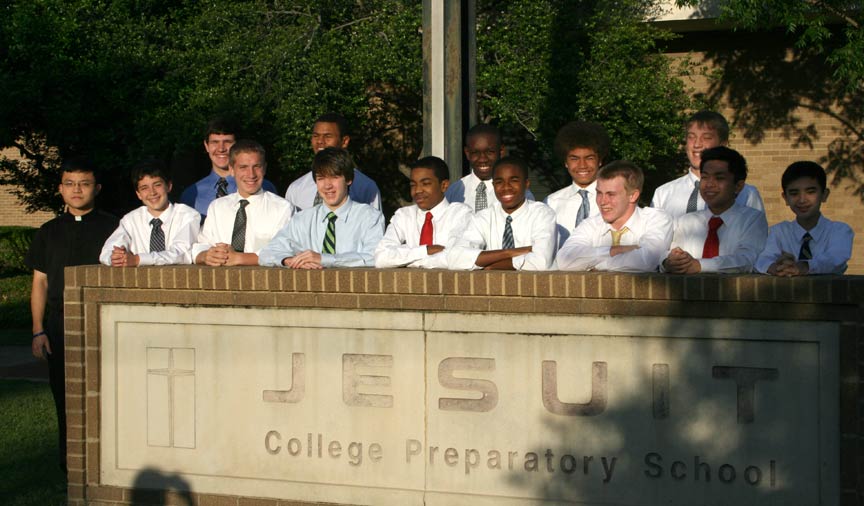
Quang D. Tran, S.J. poses with
AAOS founding members Andrew Zaugg,
Jason Nguyen, Daniel Eboagu, Orion Salters, Connor Robison,
Justin Montgomery, Grant Uy, Jimmy Bucklar,
Tyler Kromkowski, Christian Koeijmans,
Kyle Shannon and Kellen McAlone. (JHS Dallas photo)

At Jesuit High School in Dallas, freshmen Brocke Stepteau and Justin Rotich are gearing up to spread the word about refugee issues and support JRS’ mission to accompany, serve, and defend refugees worldwide. Last week the students launched the American/African Outreach Society (AAOS), an official JRS Action Team, on their high school’s campus.

“Having watched the many natural disasters that have occurred across the country recently, and learning more about the lives of displaced persons and refugees overall, I am excited about the opportunity to help and support refugees through our JRS action team,” said JRS Action Team co-founder Brocke Stepteau.

Co-founder Justin Rotich added that he’d like their Action Team to “be a voice for the forgotten and vulnerable [refugees], especially the children, and raise awareness of their cry for help.”

The AAOS members know “that issues involving Christ’s poor, no matter where they are, are local issues that call for prayer, discernment, and action,” said Mr. Quang D. Tran, S.J., a teacher at the school and AAOS Faculty Moderator.

The two students have spent weeks planning out their club’s mission and projects as well as gathering support from the school’s faculty and students. While the Action Team hopes to support refugees worldwide, they will focus their efforts on refugees in the Kakuma Camp in Kenya. JRS runs multiple projects in the bustling camp of nearly 85,000 refugees including pastoral care, trauma counseling, and special education.

AAOS hopes to support these programs by raising funds for solar paneled lighting to improve safety and accessibility as well as gathering special education games to meet students’ developmental needs. AAOS also hopes to “educate more on the needs of refugees, particularly those located at the Kakuma Refugee camp,” said Rotich. Their Action Team already has planning underway for a Refugee Awareness Day to be held next year.

Students and faculty at Dallas Jesuit have been very receptive to the formation of AAOS, and the group already boasts 12 members. As a campus dedicated to social justice in the Jesuit tradition, it seems the Action Group is a natural fit:

Richard Perry, Director of Community Service at Dallas Jesuit and another AAOS Moderator shared, “In the tradition of Catholic Social Teaching, justice is about the formation of relationships across borders and boundaries. This program will lead us past boundaries and toward friendship, awareness, and action.”

“JRS-AAOS gives me a chance to serve on a global level those whose needs are vast. As a member of this JRS Action Team, I have been given an opportunity to carry out the mission of ‘Men for Others,’ a mission entrusted to me as a student of a Jesuit ” said Daniel Eboagu, AAOS’ Secretary.

JRS Action Teams are groups of anywhere from three to 100 members that rally around their common concern for refugee and forcibly displaced persons, and their drive to effect positive social change in their local and global neighborhoods. These teams support JRS/USA’s advocacy efforts by forming a grassroots movement to inform, educate, and empower local communities to take action and demand responsible actions from the U.S. government and beyond.

While teams vary in size, structure, and activities, they share the common goal to support JRS/USA’s advocacy efforts and refugee and forcibly displaced issues at large. Further, JRS Action Teams commit to meeting regularly and coordinating activities and events that promote a brighter future for our refugee brothers and sisters.

To form your own JRS Action Team, please contact Kim Miller at kmiller (at) jesuit.org

Jesuit Refugee Service/USA is an international Catholic non-governmental organization whose mission is to accompany, serve and defend the rights of refugees and other forcibly displaced persons.

JRS/USA witnesses to God’s presence in vulnerable and often forgotten people driven from their homes by conflict, natural disaster, economic injustice, or violation of their human rights.

As one of the ten geographic regions of the Jesuit Refugee Service, JRS/USA serves as the major refugee outreach arm of U.S. Jesuits and their institutional ministries, mobilizing their response to refugee situations in the U.S. and abroad. Through our advocacy and fund raising efforts, JRS/USA also provides support for the work of JRS throughout the world.

JRS/USA gives help, hope, ear and voice to vulnerable people on the move by being present to and bearing witness to their plight; by relieving their human suffering and restoring hope; by addressing the root causes of their displacement and improving international responses to refugee situations.

In addition, JRS/USA inspires the Ignatian family and others to respond together to the needs of refugees and displaced persons worldwide and forges strong partnerships with like-minded institutions and agencies devoted to the cause of refugees and displaced persons.

JRS works in more than 57 countries worldwide to meet the educational, health, social and other needs of refugees and other forcibly displaced persons. JRS services are made available to refugees and displaced persons regardless of their race, ethnic origin, or religious beliefs.

JRS provides primary and secondary education to approximately 170,000 children, and undertakes advocacy to ensure that all displaced children are provided with a quality education.

Jesuit Refugee Service/USA is a registered 501(c)(3) non-profit organization. Donations are tax-deductible to the fullest extent allowed by law.

Make an Online Retreat

Bookmark and Share


Online Retreat

If you would like to make a retreat, but can’t get away for a weekend at a Jesuit retreat house, take a look at the online retreats offered by the team at Creighton Online Ministries. You can choose from among retreats by Larry Gillick, SJ, Dennis Hamm, SJ, Jim Kubicki, SJ, Rob Kroll, SJ, and Kevin Schneider, SJ. They are MP3 recordings of half-hour conferences given at weekend retreats in the last couple of years. You can listen to them on your computer or download them onto your iPod or other MP3 player.

You might also consider Creighton’s 34-week online retreat that follows the four weeks of the Spiritual Exercises. It’s also available in the book Retreat in the Real World, published by Loyola Press.

Challenges to our mission today

Bookmark and Share


Sent to the frontiers

In this new world

of instant communication and digital technology ,
of worldwide markets ,
and of universal aspiration for peace and well being ,

we are faced with growing tensions and paradoxes

We live in a culture that shows partiality to autonomy and the present

and yet we have a world so much in need of building a future in solidarity ;

we have better means of communication

but often experience isolation and exclusion ;

some have greatly benefited ,

while others have been marginalized and excluded ;

our world is increasingly transnational ,

and yet it needs to affirm and protect local and particular identities;

scientific knowledge has reached the deepest mysteries of life ,

and yet the very dignity of life itself

and the world we live in are threatened.

In this global world marked by such profound changes
we want to deepen our understanding of

the call to serve faith,

promote justice

and dialogue with culture and other religions

in the light of the apostolic mandate to establish right relationships
with God, with one another, and with creation

[35 th General Congregation Society of Jesus, 2008, Decree 3]


Jesus: A fire that kindles other fires

Sacrament of Marriage: Sign of Faithful Love

Bookmark and Share


by Thomas Richstatter, O.F.M., Th.D.


The sacrament of marriage

What is marriage? It may seem that a priest like me is not the one to answer that question. I am not married; I have never been married and I don’t intend to get married-which doesn’t exactly qualify me to talk about marriage. Yet marriage is certainly a worthy topic for discussion. It is something that needs to be more clearly understood and more deeply appreciated. But this Catholic Update is not about marriage, it is about the Sacrament of Marriage.

Although I am not married myself, I have experienced the Sacrament of Marriage. I have witnessed the marriages of friends and parishioners. I have participated in the wedding ceremony many times. In fact, the Sacrament of Marriage was the first sacrament that I experienced. Even before my infant Baptism I was born into a Christian marriage. What I am going to say about the sacrament is drawn from my experience of my parents and the many married couples with whom I have discussed the meaning of the sacrament-couples from the Christian Family Movement and Marriage Encounter-and the hundreds of couples whom I have helped prepare for marriage. These couples have often told me of the meaning which they find in this sacrament. As I have meditated on the passages of Scripture which couples have selected for their wedding ceremonies and asked me to preach about, I have come to the following conclusion: Marriage involves embarking on a new life project.

A new life project

We each have something that we want to do with our lives: something we want to become. It may take us a while to find out what that “something” is, but eventually a life project forms, either consciously or unconsciously. And it seems to me that as people pursue this goal, whatever it may be-to be a skilled surgeon, to be the best kindergarten teacher that ever lived, to own a farm or whatever else they may see their life to be about-they sometimes encounter another human being to whom they are so attracted that the love of this other person supersedes all other life goals and ambitions. They undertake a new life project.

Little by little they decide that first on their agenda is now going to be the life, the happiness, the holiness of this other person. The good of this other takes precedence even over the desires and dreams they have for themselves. And when that other makes the same decision, together the two embark on a whole new adventure. It seems to me that this is the basic meaning of the Sacrament of Marriage.

The sacrament reveals the religious dimension of marriage. Besides the human, social and legal dimensions of marriage-the public sign that one gives oneself totally to this other person-sacramental marriage is also a public statement about God. The celebration of each of the sacraments reveals something of this ultimate reality: who God is and who God is for us.

In the Scriptures the relationship between God and God’s people is often described in terms of a marriage. The early Christians, reflecting on Christ’s love for us, also used this image. Christ and the Church embrace in mutual love and self-giving, even as do husband and wife (see, for example, Ephesians 5:21-33). “‘For this reason a man will leave his father and mother and be joined to his wife, and the two will become one flesh.’ This is a great mystery, and I am applying it to Christ and the church” (Ephesians 5:31-32).

The Catholic wedding

Marriage was around a long time before Jesus. His parents were married, and at least some of the apostles were married. For example, in all three of the Synoptic Gospels we hear of Peter’s mother-in-law (Matthew 8:14; Mark 1:30; Luke 4:38). In the early Church, Christians got married like anyone else in the cultures where they lived. Gradually, Christians began to see that the loving union of husband and wife spoke to them not only about family values but also about God’s values.


The sacrament of marriage

Historically speaking, it was not until the 12th century that marriage took its place among the other ritual actions which we now name the seven sacraments. Throughout the Middle Ages there was no singular wedding rite for Christians. The Catholic wedding ceremony that you might witness today dates in large part from about the 16th century.

The rite has basically the same “shape” as all the other sacraments: gathering, storytelling, the sacramental action and commissioning. The gathering rites are similar to Sunday Mass, although the entrance procession is more elaborate. (Sometimes the entrance procession is so elaborate that it can steal the whole show, but I don’t want to talk here about abuses.) There was a time when the bride’s father (owner) brought (dragged) the bride before the magistrate and exchanged her for a sum of money (the bride price) paid by the groom. When the father no longer “sold” the girl, he “gave her away.”

Many couples today find this symbol works against the meaning of their wedding ceremony. They want their ceremony to speak of families, couples, mutuality. They arrange the procession so that the attendants enter together as couples. The groom enters with his father and mother and the bride with hers. At the front of the church they symbolically take leave of their parents and come together and speak a word of welcome to the assembly and invite them to pray that God will bless what they are about to do. The community is led in prayer by the presider and the gathering rites end.

We are seated and listen to the readings from Scripture. Here again the rite will resemble the storytelling at Sunday Mass. The couple select Scripture passages according to the religious meaning they wish their wedding to express. Thus, the readings will sometimes refer to creation, for husband and wife are creating something new: a new life project, a new relationship, a new family. They are sign and sacrament of the new love project God embarked upon in creating the world. Or the readings will refer to the two becoming one: Husband and wife are joined in one flesh. Christian marriage is the sacrament which shows us God’s desire to be one with us.

The couple then come before the Christian assembly and vow that their love will be a sign and sacrament of God’s love for us. And the community prays for them and with them that we may receive this sign and that we may, by our faithful love, support their vows.

It is the bride and groom who perform the marriage. The priest, the attendants and the congregation witness what the bride and groom do. The bride and groom come forward and, before the congregation, the priest and the official witnesses, pronounce their vows. Today most couples choose to say the entire text of their vows to one another rather than merely saying, “I do.” They exchange rings as a sign of their love and fidelity and seal their vows with a kiss.

When two Catholics exchange these vows, they do so in the context of Eucharist. All that marriage says about God’s love and desire to be one with us, Eucharist says in an even more all-embracing way. Bread and wine are brought to the altar, the priest proclaims the great prayer of praise and thanksgiving (the Eucharistic Prayer) and we approach the altar to receive Holy Communion-the living sign of God’s desire to be one with us. And then a final blessing sends the bride and groom and the whole Christian community forth to bear witness to God’s love for the world.

What makes a marriage

Sometimes you can learn a lot about something by looking at its opposite. We can learn about the marriage sacrament by considering what leads the Church, in the case of annulments, to see that two people never were truly married.

“An annulment is just a Catholic way of getting a divorce.” I have heard this said by many people in many different circumstances (and there are times when I feel that there is an element of truth in this statement). Yet I remain convinced that an annulment is a very different thing from a divorce. Divorce is the legal dissolution of a marriage. An annulment is the legal declaration that a valid sacramental marriage never existed.

In order for a Christian marriage to take place the man and woman must be capable of entering into such a sacrament. The individuals must have the capacity to give such a gift. This capacity develops gradually. When we were children our parents taught us little by little to be generous-first with things, then with ourselves. We were taught to share toys, playthings, bicycles and birthday cake. Little by little, we learned to share our time and ourselves.

This gradual learning to give of ourselves is the necessary preparation for marriage. A person who has not journeyed sufficiently on the road to maturity and generosity is not capable of a true marriage, even though he or she may be quite capable of sharing an apartment or conceiving a child.

There are many reasons why two particular people cannot join their lives in the marriage project. It is not always a culpable lack of generosity. Sometimes it becomes apparent only years after the wedding ceremony that there was no marriage there in the first place. To declare publicly that the marriage never existed is what Catholics call an “annulment.”

The Church does not want to say that a sacramental marriage comes to an end because we consider the love of the husband and wife to be a sign of God’s unending love for us.

God’s love for us can never end in divorce. God is faithful even if we are not. The Church desires that even if one of the partners of a marriage is faithless to the marriage bond, the other, by remaining faithful, gives a powerful witness to the community of the way God loves us.

Our marriage covenant with God


The sacrament of marriage

In each of the sacraments a window opens and we can glimpse the mystery of God and God’s plan for the salvation of the world. In Christian marriage we see that God was not content to be alone, but embarked on a whole new life project. Out of love God created us and all that is. God is faithful no matter what. Whether we are faithful or faithless, God is faithful; whether we wander away in sin or remain in the embrace of love, God is always there and is ever ready to embrace us.

This sacramental sign, which the husband and wife give to each other, they also give to the entire community of witnesses. I too have made commitments to God and God has made commitments to me. There are times when I wonder if God will be faithful. I have never seen God, but I can see the fidelity of Christian husbands and wives. Their love for each other is a sacramental sign and witness of God’s love for me. I believe that our human lives are interconnected, like a fabric, woven together by many commitments. The fidelity of their commitment strengthens my own commitments.

This indeed is a great mystery. It is something that touches me deeply each time I experience a Christian wedding and each time I experience the sacramental love of husband and wife.


Whose Wedding Is It?

Marriage is a covenant “by which a man and woman establish between themselves a partnership for the whole of life” (Catechism of the Catholic Church, #1601). Usually we think of this covenant in a rather personal and individual context: It exists for the good of the spouses and the good of their children. We sometimes think of the wedding ceremony which establishes this covenant as belonging to the bride and groom, as if it were their wedding alone. They can invite whomever they want, sing their favorite songs and arrange the ceremony as they please, we might think.

The Second Vatican Council reminds us that the marriage covenant exists not only for the good of the partners and their children, but also for the good of the Church and the good of society at large (see Church in the Modern World, #48).

In the years following the Second Vatican Council one of the important changes that has taken place in our understanding of the sacraments is that we are coming to realize more and more that sacraments are “not private functions, but are celebrations belonging to the Church….Liturgical services involve the whole Body of the Church; they manifest it and have effects upon it” (Constitution on the Liturgy, #26).

Clearly, a wedding has an intimate and personal relation to the bride and groom. In many important ways, it is their wedding. But a Christian wedding is also an ecclesial event; this is why it is celebrated at Eucharist. Every marriage is important to the entire parish.

“In the Latin Rite the celebration of marriage between two Catholic faithful normally takes place during Holy Mass, because of the connection of all the sacraments with the Paschal mystery of Christ. In the Eucharist the memorial of the New Covenant is realized, the New Covenant in which Christ has united himself forever to the Church, his beloved bride for whom he gave himself up. It is therefore fitting that the spouses should seal their consent to give themselves to each other through the offering of their own lives by uniting it to the offering of Christ for his Church made present in the Eucharistic sacrifice, and by receiving the Eucharist so that, communicating in the same Body and the same Blood of Christ, they may form but ‘one body’ in Christ” (Catechism, #1 621).

In the years to come, it may be impossible to celebrate the Eucharist for each couple who desire a Catholic wedding. The decreasing number of priests and the number of Masses each priest will be required to celebrate on any given weekend will make it increasingly difficult to have one or more nuptial Masses on Saturday.

There are at least two possible solutions to this situation. First, someone other than a priest could serve as the official witness to receive the marriage vows. Ordained deacons are allowed to do this in many places. It is also possible that unordained ministers could be authorized to witness the wedding. (Remember that “the spouses, as ministers of Christ’s grace, mutually confer upon each other the sacrament of Matrimony by expressing their consent before the Church” [Catechism, #1623.]) But Mass would not be possible in these situations, because the official witness to the sacrament would not be an ordained priest.


The sacrament of marriage

An alternate solution, which is being tried in various parishes across the country, is to celebrate Christian marriage during Sunday Mass. At first this may seem a totally unacceptable solution. When we give this solution a second thought, however, we find that it contains many positive elements.

Admittedly, on the wedding day there are many different cultural rituals: videotaping the bride as she leaves the house, the ceremonies in the Church, the reception, cutting the cake, throwing the bouquet, and the first dance. But at the center of all of these rituals is the sacrament itself, the exchange of consent between the bride and groom. This ritual promise to be faithful to one another even as God is faithful to us is of a different order than all the other rituals which take place on the wedding day. This ritual is a sacrament. It has effects for the whole Church, especially the assembled parish community.

In parishes where this exchange of consent takes place in the presence of the Sunday community, the sacramental dimension of the marriage is more easily seen and appreciated. What the couple says to each other is not for themselves alone. Their promise speaks to all of us: It tells us who God is for us.


Getting Married?

You will need to:

1. Contact your parish many months in advance. Parishes usually require 3-6 months’ advance notice, or even more depending upon local circumstances.

2. Participate in a marriage preparation program. This might include meeting with staff or laity from your parish, going to pre-Cana presentations, workshops or weekend retreat (such as Engaged Encounter).

3. Know where you were baptized. If you are not marrying in your home parish, you will need a recent copy of your baptismal certificate to show you are free to marry in the Catholic Church.

4. Interview with a priest or deacon. During this interview you will be asked if you are free to marry, and about your understanding of the commitment you are making and your ability to live it out. This is a good opportunity for you to ask questions, too.

5. Learn about or perhaps help plan your wedding liturgy. Local customs vary on who selects music, plans the liturgy and so on. Your parish staff will tell you what the next steps are for you.

Consult your parish staff for further guidance on each of these practical points.


Thomas Richstatter, O.F.M., Th.D., teaches sacramental theology at St. Meinrad School of Theology. His doctorate in liturgy and sacramental theology is from the Institut Catholique of Paris. His latest book is Sacraments: How Catholics Pray (St. Anthony Messenger Press).


Notes on Jesuit Education

Bookmark and Share


by John W. Donohue, S.J. 


Notes on Jesuit Education

Myths. “Jesuit education” is a familiar couplet like “Roman Empire” or “Viennese waltz.” Most people associate Jesuits with education, although not all they have heard about this association is so. From time to time, for instance, a journalist or a student writing a term paper will call the switchboard of a Jesuit school to ask what Jesuit source contains the remark that goes something like this: “Let us have the education of children until they are seven, and you may have them thereafter.”

No reference can be given, however, because that legendary saying is not just spurious but is the exact opposite of what actually was said in the first draft of the famous Jesuit plan for schools, the Ratio Studiorum. The six veteran teachers who in 1586 wrote the Latin essays making up that draft recommended that no boy be admitted to a Jesuit school before he is seven. Children less than that age, it explained, are troublesome and need nannies, not schoolmasters: “Molestissimi et nutricibus potius indigent quam ludimagistris.”

The second draft of the Ratio in 1591 was equally cool toward the kindergarten bunch. Beginning students, it said, must not be so young that they fuss about trifles (nor so old that they upset class discipline), and they must have learned to read and write correctly. Otherwise, the sight of their compositions will turn their teacher’s stomach. Nevertheless, besides the myths, there is also a reality.

Origins. The third and final draft of the Ratio Studiorum was promulgated in 1599 by Claudio Acquaviva, who in 1581 had been elected the fifth General of the Society of Jesus, an office he held until his death 34 years later.

This definitive version was really a collection of 30 sets of practical regulations for the administrators, teachers and students of a Jesuit school. It had mostly in mind what we would call secondary education, and in the United States today it is easier to find traces of the Ratio in Jesuit high schools than in Jesuit universities.

The various commissions that produced those three drafts did not work off the top of their birettas. The first Jesuit school for boys had been opened in Messina, Sicily, in 1548, so the Ratio was distilled from a half-century of corporate experience. Moreover, the drafts of 1586 and 1591 were reviewed not only by Father Acquaviva and his advisers, but also out in the field, so to speak, by committees in each of those Jesuit administrative units that are organized along geographical lines and called provinces.

That 1599 document remained in effect until Pope Clement XIV suppressed the Society of Jesus in 1773. After Pope Pius VII restored the order in 1814, there was talk of redoing the Ratio. An experimental revision that paid more attention to science and vernacular literature did appear in 1832 but was never officially decreed. By the 19th century, only a few airborne generalizations could have been applied to widely different schools in widely different nations around the world.

The Ratio of 1599, however, is steadily specific. It is not in the least a treatise on the philosophy of education and does not belong to the same company as Plato’s Republic, Jean-Jacques Rousseau’s Emile and John Dewey’s Democracy and Education. It is simply a manual prescribing exact ways of organizing schools and teaching classes. J.B. Herman, a Belgian Jesuit who shortly before the First World War wrote one of the best books on the origins of Jesuit education, remarked that the only theoretical principle in the Ratio is one that says variety in pedagogical methods is good, because satiety is bad.

Of course, a full-bodied theory of Jesuit education can be worked up. Its major themes, however, would be those required for any adequate Catholic philosophy of education. The characteristic Jesuit emphases flavoring this philosophy would be inspired not so much by the Ratio as by two documents from the founder of the Society of Jesus, St. Ignatius Loyola (1491-1556): his book of the Spiritual Exercises and the Society’s Constitutions.

Past and Present. Next year will mark the fourth centenary of the 1586 Ratio, a circumstance that prompts these notes. As school ventures go, four centuries are a long time and make one deduction certain. Jesuit education must have continually evolved and adapted itself to new situations, for otherwise it would not have survived. Schools exist to help pass on a people’s way of life, and since ways of life are continually and sometimes rapidly changing, schools must also change or disappear. They must conserve what is valuable without becoming stuck in the past. Newman’s celebrated sentence in Development of Christian Doctrine fits education as well as everything else: “In a higher world it is otherwise; but here below to live is to change, and to be perfect is to have changed often.” Of course, the inverse is not equally true; to have changed often is not necessarily to be perfect.

After 400 years of changes that sometimes inched and sometimes swept along, it would seem unlikely that any event at this point in the history of Jesuit education could literally be unprecedented. But in December 1980, a true first was recorded when a woman who had graduated from a Jesuit high school won a Rhodes scholarship.

Neither Claudio Acquaviva nor Cecil Rhodes could have imagined that accomplishment because until recently both American Jesuit high schools and the Rhodes scholarship program were male preserves. In 1977, however, women became eligible for Rhodes grants. That was also the year in which Mary Murphy, whose parents were a New York City fire lieutenant and a nurse, was one of the first group of young women to complete the full four-year course at Loyola School in Manhattan. She went on to become an American studies major at Yale as well as a member of the student government, an intramural basketball player and one of the 32 Rhodes scholars chosen from the United States during her senior year.

No Better Work. When St. Ignatius died in 1556, the Society of Jesus was already conducting 33 institutions that were called “colleges” and occupied a position midway between the primary schools below them and the university above. In a commentary on the Society’s rules, Pedro Ribadeneira, one of the most distinguished of the second generation of Jesuits, observed that it is doubtful if any other work gives so much glory to God as the education of youth. It certainly became a major, although not the only, Jesuit business; and in 1947 the 27th General of the Society, John Baptist Janssens, a Belgian, described education as the work that the Society “has esteemed beyond others and cultivated with the greatest zeal.”

There was some questioning of that preeminence in the years immediately following the Second Vatican Council. The Mexican Jesuits, for instance, announced in 1971 that they would close a school enrolling more than 2,000 upper-class boys. “Most of our students have come to us in search of an education that will assure their future within the present social order,” said a Jesuit spokesman. “In most cases we have implicitly furthered individualistic goals and class prejudices. Mexico’s social structure is unjust and unacceptable. In order to place ourselves at the service of the poor we must sever our link with the power structure.”

Still, it appeared that serving the poor would involve the Mexican Jesuits in some teaching. For it is truer today than it was in the 16th century that, if you want to work for the good of your neighbor, there is no better place, no more sensitive and difficult area, than the school. So it is really not surprising that the present Father General, Peter-Hans Kolvenbach, should have said, at a meeting in Rome on Nov. 18,1983, that education “in spite of its difficulties remains one of the principal apostolates of the Society.”

Numbers. In the United States, which has a greater number of Jesuits than any other country, education is easily the largest Jesuit ministry. In 1984-85, the 5,218 American Jesuits, who were organized into 10 provinces, sponsored 28 colleges and universities with a total enrollment of 169,806 (of whom 106,174 were undergraduates) and 46 high schools with a total enrollment of 38,074. All the colleges and universities are coeducational, and so are nine of the high schools.

Report Card. Appraisals of this extensive activity are predictably diverse. Parents are likely to make agreeable comments. Talking once about his many children, John Wayne said: “All I can take credit for, I guess, was my
smart decision to have them educated in Jesuit schools. Other than that, I’m just an average father.”

Academic observers and alumni have not always been so complimentary. Writing about Jesuit higher education in Commonweal in March 1967, Martin F. Larre´y said: “In many ways, the Society of Jesus operates the best second- rate colleges and universities in the nation.” After graduat- ing in 1948 from Fordham Prep, a Jesuit high school in New York City, Nicholas von Hoffman set out for Chicago’s Loyola University. Twenty years later, when he had become a well-known journalist, he recalled that he had lasted only one day at Loyoia: “I looked at what they had to offer and said to myself: They’ve got to be kidding.'”

An earlier Fordham Prep student, novelist John O’Hara of the class of 1924, claimed that he had actually lost his faith at Fordham, where he spent two years: “The priests ruined it for me.” That was not a fair charge, though, since O’Hara admitted that his faith had begun to fade even before he left his home in Pottsville, Pa., to become a boarder at the Prep in the Bronx.

Along with brickbats, there are tributes. Marty Pasetta, a Hollywood director, is a graduate of Santa Clara University in California. While he was preparing for the telecast of the 1980 Academy Awards, he told a reporter from the Catholic weekly, Twin Circle: “I thank God for my Jesuit education. The Jesuits really taught me how to think.”

Edward Bennett Williams, the celebrated Washington, D.C., lawyer, is a 1941 graduate of Holy Cross Coiiege in Worcester, Mass., and currently chairman of its board. In an interview for the college newspaper a year ago, he talked about his student days: “They taught me to work hard here….No matter what I did, the indispensable condition was to tax my mind and body to the ultimate….”

In The Chief: A Memoir of Fathers and Sons, published last year, Lance Morrow, a Time magazine writer, remembers Gonzaga College High School in Washington, D.C., as it was when he graduated from it in 1958: “The boys were tough. The Jesuits were also tough….Gonzaga had the Jesuit virtues, a mental toughness and energy.”

Among older alumni, sentiments of this sort are common, but they can also be somewhat embarrassing. In his 1980 autobiography, bluntly entitled Will, G. Gordon Liddy, the unrepentant foreman of the Watergate break-in, writes about his undergraduate years, 1948-52, at Fordham University, where his father had preceded him: “The most valuable course I took at Fordham was logic, a part of the required program. It honed the mind and thinking process along mathematical lines and prepared us for the study of Aristotle and Aquinas.” There is the whiff of the myth in that last phrase. A reader who can believe that Mr. Liddy spent much time on Aristotle and St. Thomas can probably believe anything.

Caution. These trickles of opinion prove nothing but they do serve to introduce a caution. Generalizations about Jesuit education are worse than useless if they do not take accurate account of differences in time and place. When Lance Morrow revisited Gonzaga after 20 years, he found the building looked much the same, but the school’s atmosphere had changed. There was less regimentation, he said, and surprising informality between students and Jesuit administrators.

Robert Hughes, the Time magazine art critic who wrote and narrated the 1981 television series “The Shock of the New,” told an interviewer that the Jesuit boarding school he attended in his native Australia in the 195O’s had been “tremendously authoritarian.” But in New Orleans a few years earlier, Dominique Lapierre, future coauthor with Larry Collins of best-selling suspense novels, found that city’s Jesuit High wonderfully liberating. He enrolled there when his father was assigned to New Orleans as French consul general at the close of Worid War II, and he remembered Jesuit High as “a marvelous school without overseers or censors, where we played football, had the weekends free and each Saturday night danced the swing with giris who seemed to have stepped from a scene in Gone With the Wind. It was two years of perfect happiness that awakened in me an intense desire to know the rest of the vast world.”

The truth is that not only do the Jesuit schools of one country differ greatly from those of another, but nowadays any given school is likely to change considerably from one decade to another, thereby discontenting those alumni who like the old way better.

Definition. Twenty years ago, all the trustees of American Jesuit universities and colleges were themselves Jesuits who met infrequently and then only to rubber-stamp the plans of the Jesuit president. Today these institutions are really governed by their boards of trustees, most of whose members are laymen and laywomen. These directors are regularly occupied with scrutinizing budgets, building plans and long-range policies. On occasion, however, they may refresh themselves by raising the question of just how Jesuit education is to be defined. This is easier to ask than answer. Many people who have thought about it are likely to agree with the conclusion reached, after exceptional experience, by Robert J. Henle, S.J. As a young Jesuit, Father Henle wrote a five-volume series of high school Latin textbooks that sold more than one million copies. Later on, he became an influential professor of philosophy as well as an administrator-president of the national Philosophy of Education Society in 1958 and president of Georgetown University from 1969 to 1976.

“There is no way,” Father Henle wrote in 1967, “in which Jesuit education can be defined as a set of specific traits. I myself have made various attempts so to define it, but I finally became convinced that the effort was futile. I think we must say that Jesuit education is education given by Jesuits. Jesuit education cannot be described in a set of specific educational traits, specific subjects, procedures or methods; it can be described in terms of Jesuits, in terms of Jesuit character.”

Certainly Jesuit education cannot be defined in terms of the Ratio. That was only one of many Renaissance school plans, Protestant as well as Catholic, all of which looked alike on paper. They were all inspired by the ideal of perfect Latin eloquence that Cicero had exemplified and Quintilian, the first-century teacher of rhetoric whom some 16th-century Jesuits called “our Quintilian,” had codified. In any case, the Ratio bears as much relationship to contemporary Jesuit education as Harvey on the circulation of blood bears to contemporary medical practice.

If Father Henle is right, however, another and even more formidable question surfaces at once.

Question. In The New York Times last March, Gene I. Maeroff, a journalist whose special beat is school news, reported that in the 1984-85 academic year, there were only 950 Jesuits among the 15,408 teachers and administrators in the 28 Jesuit universities and colleges in the United States. To underline the obvious question raised for Jesuit schools that are “running out of Jesuits,” Mr. Maeroff quoted a first-class authority, Paul A. FitzGerald, S.J., the author of a definitive study, The Governance of Jesuit Colleges in the United States: 1920-1970. Father FitzGerald, who is currently the archivist and was once the graduate dean at Boston College, said: “If we get down to a very minimal number of Jesuits at these institutions, there is a chance of their losing some of their Jesuit identity. I don’t know how you can run an authentic Jesuit university without Jesuits.”

Or a high school either. Last year there were 677 Jesuits among the 2,699 full-time teachers and administrators of the 46 American Jesuit secondary schools. Moreover, changes brought about by declining numbers of Jesuits are not limited to the United States. The English Jesuits once conducted two distinguished boarding schools-Stonyhurst, founded in 1704, and Beaumont, founded in 1861. Four years after Beaumont celebrated its centenary with festivities that included a ceremonial visit by Queen Elizabeth II, the school was closed-or, as it was discreetly said, “amalgamated” with Stonyhurst, much to the outrage not only of its alumni but also of the (London) Times Educational Supplement.

Stonyhurst itself does not exactly match the memories of the oldest of its Old Boys. Next year it is to have the first lay headmaster in its history. In the British Catholic weekly. The Universe, Hugh Kay, managing editor of the Jesuit magazine, The Month, commented on that projected change: “This is an extension of the fast-growing collaboration between Jesuits and lay people that has been such a feature of Stonyhurst in recent decades. What is important at Stonyhurst is its Jesuit style; what is so interesting is that that is achieved by Jesuits and lay people working together.”

An Answer. What Mr. Kay said of Stonyhurst is equally true of Jesuit high schools and colleges in the United States. In 1974, groups of Jesuit teachers and administra- tors at both Creighton University in Omaha, and Boston College issued statements summarizing the ideals of Jesuit higher education and anticipating, along the way, the question asked by The Times’s Mr. Maeroff: “How to preserve the character of a Jesuit education when there are fewer Jesuits?” It can be done, the statements said in effect, if on the faculty and in the administration there are enough Jesuits to constitute a significant corporate presence, and if these Jesuits collaborate with their non-Jesuit colleagues to conserve that Jesuit character.

Precisely how many are enough, they did not say. Four years earlier, however, the American Jesuit high schools had formed the Jesuit Secondary Education Association and the preamble to this organization’s constitution observes: “If the faculty at a Jesuit school are men and women whose lives are inspired by the Ignatian vision, then the question about the percentage of Jesuits on the faculty is not an overriding issue.” In other words, Father Henle’s descriptive definition can be expanded. What is called the Jesuit style, or more ponderously but more accurately, the Ignatian spirit in education, need not be limited to Jesuits.

Plenty has been written about that Ignatian spirit, but these long-winded notes will wind up by circling the topic once again, although in very general terms.

Envoi: The Ignatian Spirit. At the Rancho del Cielo, in Santa Barbara, Calif., on August 24, President Reagan talked about education in his weekly radio address to the nation. “A recent Gallup poll,” he said, “found that an overwhelming majority of Americans want their schools to do two things above all else: to teach students how to speak and write correctly and, just as important, to teach them a standard of right and wrong.”

Whether they knew it or not, that majority reaffirmed the oldest theme in Western humanism. The conviction that schooling’s first business is to cultivate power with words, along with moral virtue, has its roots in fourth-century B.C. Greece. It was upheld by what H. I. Marrou in his great book, Education in Antiquity, called the two columns of the temple. It combines Plato’s ideal of goodness achieved through wisdom with the ideal of literary culture advocated by Isocrates, the most infiuential of Athenian teachers, whose slogan was: “The right word is a sure sign of good thinking.”

All the 16th-century schoolmasters, including the Jesuits, subscribed to those ideals. If students in the early Jesuit schools had enough stamina to stay with the program all the way, they followed the sort of orderly curriculum that St. Ignatius had experienced and admired at the University of Paris. The study of grammar, literature and rhetoric pre- ceded three years of philosophy and science. “In this school,” said Julius Negrone, S. J., advertising a new Jesuit
establishment in Brescia in 1574, “philosophy and elo- quence collaborate in most friendly fashion.”

Isocrates taught Athenian young men to be eloquent in the language they spoke at home. For centuries, however, Jesuit schools, like all respectable secondary schools in Europe and the Americas, proposed to cultivate eloquence by the indirect method of studying Latin and classical Greek, languages that almost no one spoke even in the 16th century. Today, Greek has all but disappeared, and Latin is fast losing altitude. Nevertheless, a tradition of literary humanism remains the vertebrae of the secondary school curriculum not just in Jesuit institutions but in the college preparatory programs of all high schools. That is because people who acquire language skills have the keys to further learning and can keep on educating themselves for the rest of their lives.

A century ago, philosophy was the core of the liberal arts curriculum in most American colleges. It was still so in Jesuit colleges as recently as the 195O’s. By now, it is a much shrunken core surrounded by an immense variety of other disciplines: science and mathematics, history and social studies, religion and fine arts, vocational and professional subjects. This complexity is constantly expanding. In the 198O’s, we are told, anyone who lacks computer literacy cannot be considered educated.

Because of these changes, some cranky professors of the humanities accuse Jesuits of having abandoned the spirit of the Ratio. But Jesuit educators have never found it hard to modify and enlarge a curriculum because they have never considered even those indispensable studies of letters and philosophy to be final ends in themselves. As Christians, they must regard all human culture as ultimately instrumental, a means rather than a term. St. Ignatius made this point firmly not only in his Spiritual Exercises but even in polite letters to aristocratic correspondents. He advised Asconius Colonna, a rich Italian duke: “In this life a thing is good for us only insofar as it is a help toward life eternal and evil insofar as it is an obstacle to it.”

This is not to deny that intellectual and aesthetic values are intrinsically precious and are not merely useful tools for reaching something else. Much less is it to say that the prime aim of schooling is to be equipped to make money. It is only to say that in the final reckoning, all things human, including civilizations and the schools that conserve and transmit them, are ordered as means to union with God in life-without-end.

Since the exact curriculum that served this purpose in 17th-century Europe could not do so indefinitely and everywhere, Jesuit schools zestfully adjusted to changes in climate. In the United States, for example, the 1832-33 catalogue of St. Louis University informed the citizens of a bustling river town that the course of studies in this Jesuit institution “embraces both a mercantile and classical education”-bookkeeping as well as Latin, Greek “and the higher branches of the mathematics. ” In Micronesia today, American Jesuits run both an academic high school and the Ponape Agriculture and Trade School, And on the U.S. mainland, students arrive early at Jesuit high schools to do their homework on computers.

Education in the widest sense has two great purposes: the development of intelligence and the development of character. Since, as Pope John XXIII once said, “The only way to be a Christian is by being good,” it is no surprise that Christian teachers, including Jesuits, give moral education primacy. In fact, so do most people, celebrated or anonymous. “The older I get,” said Prime Minister Jawaharlal Nehru to Andre Malraux, “the more I judge people by their character, not by their ideas.” When parents are asked what they want for their children, they usually say they want them to become good men and women. Indeed, every great philosopher of education not only has said that virtue must be joined to learning but has put virtue first.

Of course, character is not the principal concern of every particular educational agency. Just as gymnasiums train the body and conservatories train musicians, so high schools and colleges have a primarily academic function. But if they take moral education seriously, these schools can make two contributions. They can, as Mr. Reagan said, teach a standard of right and wrong, and they can create an environment that offers young people some chance to put their ethical convictions into practice.

Although it is possible to teach a purely secular moral code, church-related schools, like parents who are believers, teach a morality linked with faith. For a Christian school, that means an effort to nourish both a knowledge of the Gospel and fidelity to its word.

Occasionally this effort attracts the sort of favorable publicity that money cannot buy. In June of this year, the Gonzaga College High School that Lance Morrow attended was the subject of a series of three full-page articles in The Washington Post. Although Gonzaga’s curriculum is heavily weighted with the academic subjects so often praised by another of its alumni, Education Secretary William J. Bennett, the Post was mainly interested in what it called the school’s ways of teaching values.

Post reporter Elsa Walsh gave a detailed account of a senior theology class’s discussion of the morality of nuclear weaponry. She noted that in order to graduate, every Gonzaga student must serve for a semester as a volunteer worker in one of five neighborhood poverty centers. Her third article was devoted to a privileged form of this community service, a project in which eight students accompanied by two teachers spent four weeks working in a Mexican orphanage during the summer before their senior year.

It is not news if a good private school prepares students for Harvard, where Lance Morrow went, or Williams College, where Secretary Bennett went. What Miss Walsh found significant about Gonzaga was, as she put it, the way “the Jesuits and lay teachers force students to explore their moral values and the social consequences of their decisions.” It is only fair to add that she would have encountered similar programs in all the American Jesuit high schools as well as in many other church-affiliated schools and colleges here and abroad.

In a 1909 essay called Moral Principles in Education, John Dewey argued that the chief business of a teacher is to see to it that the greatest possible number of ideas acquired by students are so acquired as to become true motivating forces of conduct. Jesuits have always tried to make that their business, although the results have sometimes been ambiguous. In his autobiographical Fragments of the Century (1973), Michael Harrington, who wrote the enormously influential study of poverty in the United States, The Other America (1963), describes himself as “a pious apostate, an atheist shocked by the faithlessness of the believers, a fellow traveler of moderate Catholicism who has been out of the church for more than 20 years.”

In the 194O’s, however, Mr. Harrington was a student at Saint Louis University High School where, he recalls, “Our knowledge was not free floating; it was always consciously related to ethical and religious values.” One of his classmates was a carefree young man who was to become the famous Dr. Tom Dooley, physician to the Vietnamese war victims in the 1950’s. “I never saw Tom Dooley after the mid-1940’s,” Mr. Harrington writes, “but it is clear that we had developed profound political differences. And yet, I suspect, each of us was motivated, in part at least, by the Jesuit inspiration of our adolescence that insisted so strenuously that a man must live his philosophy.”

St. Ignatius would have mourned Michael Harrington’s loss of faith, but he might also have been gratified by that testimony.


John W. Donohue, S.J. served as an associate editor at America from 1972 until 2007.

School offers hope to Haitians

Bookmark and Share


Outside this small town on the southern coast, Jesuit Refugee Service is supporting an education project of the Altagracia Parish in the Diocese of Barahona.

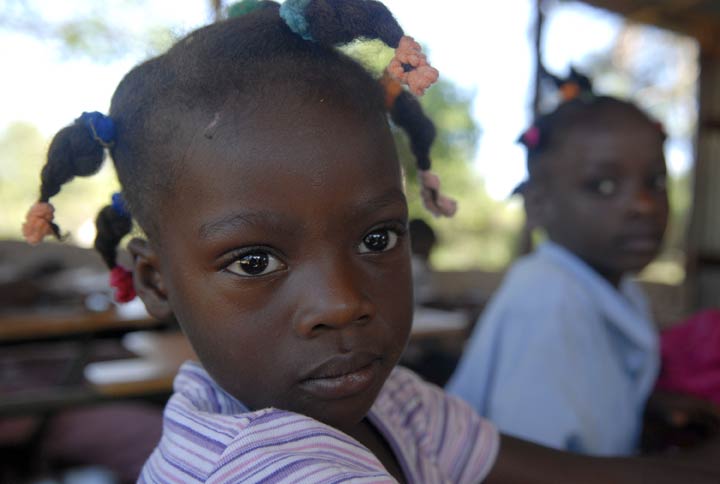
A student at El Manacle outside Pedernales, Dominican Republic, 28 April 28 2011. (Christian Fuchs/ JRS)

A student at El Manacle outside Pedernales, Dominican Republic, 28 April 28 2011. (Christian Fuchs/ JRS)

Two migrant-worker villages in the area are home to Haitians and Dominican-born people of Haitian descent. Following the January 2010 earthquake in Haiti the area witnessed an influx of Haitians displaced by the natural disaster.

Alcoa once operated a large bauxite mine in the area, and the road the company built there still provides the main access to the inland area, but the mine closed in 1982. Although odd formations still dot the landscape, nature has mostly covered the mine’s scars and the overall view of green mountains descending gently to the blue Caribbean Sea is a tranquil one. But life here can be far from tranquil.

“Haitian migrant life here is very difficult”, said Fr Antonio Fernandez Rodriguez of Altagracia Parish.

“Fifty percent of what they grow they have to give the owner of the land. Sometimes they take loans at high interest (a 15 percent to 20 percent monthly rate) to buy fertiliser for the land. If there is no good harvest, they are saddled with many debts which cause them additional problems”, he added.

Haiti and the Dominican Republic share the island of Hispaniola, and although Haiti is about half the size of its neighbour, it has a slightly larger population. The increased population density and the centralisation of the population in Port-au-Prince have resulted in additional challenges for food security and sustainable agriculture initiatives.

In his book, Collapse: How Societies Choose to Fail or Succeed, the writer Jared Diamond notes that the Haitian side of the island is drier because the “barrier of high mountains blocking rains from the east … Compared to the Dominican Republic, the area of flat land good for intensive agriculture in Haiti is much smaller, as a higher percentage of Haiti’s area is mountainous. There is more limestone terrain, and the soils are thinner and less fertile and have a lower capacity for recovery.”

“In this area there is no drinking water, just rain water …. There are no official medical services, just those provided by the parish. There is no public transportation, and the closest school is many kilometers away,” said Fr Antonio.

Fr Antonio asked the local Dominican government about providing educational services to the migrants, but the government declined to intercede, stating that, by definition, the migrants and their Dominican-born descendants may be here one day and gone the next.

“But I told them that these children have been here for many years and they’ve had no education at all,” he said.

“What I want is for those children to go to school and learn a little, and if the schools remain open here one or two more years, I pressure the Dominican government take over the administration of the schools. Even if this group of children doesn’t stay here, another group will come. And the parish will continue to provide this service, to provide education for the children,” said Fr Antonio.

Further complicating Fr Antonio’s hopes for public education for the children of the area, the government does not view the Dominican-born children of Haitians as Dominican citizens, and a 2010 constitutional change codified what was once ad hoc denial of nationality to these young people.

Haitian migrants and Dominicans of Haitian descent are among the most marginalised people in the country. Though there are Dominicans living in conditions of extreme poverty in the country, Haitian migrants and persons of Haitian descent born here face racial discrimination, exploitation and mass deportation.

Along with anecdotal evidence, the experience of Jesuit Refugee Service has demonstrated that the experience of many persons in the Dominican Republic born to Haitian parents, or whose last names denote Haitian ancestry, is characterised by limited or lack of access to education, health care, employment and due process before the law.

With its mission to protect the human rights of Haitians on the border Jesuit Refugee Service believes providing education in any circumstance will lead to a more stable future for the migrants, their children and their country at large.

To start this new programme in Pedernales, semi-permanent buildings rather than more expensive permanent structures are being built to serve as classrooms to provide basic literacy education to the children of the migrant workers.

“I know that education does not just teach a person how to read and write. An educated student is more open, and has a bigger vision for the future,” said Fr Antonio.

“And I really want to thank the Jesuit Refugee Service, because I used to have the school under a tree, and it was like that for five months. And now with your help we have started this little school, so rain or shine the children can be in the classroom. The children feel they’re in a more dignified setting, and the parents feel their children are actually going to school”, Fr Antonio added.

Christian Fuchs, Communications Officer, Jesuit Refugee Service USA