Category: Uncategorized

Marriage in the Christian Sense

Bookmark and Share


by Tim Muldoon

This week Sue and I are celebrating 19 years of marriage. Nineteen! Coincidentally, just yesterday I heard some radio person opining that our whole notion of marriage is changing, and that the norm for the future will be some kind of serial marriage contracts with a shelf life of some 10 years or so. That may be true, but what has become abundantly clear to me is that when Christians talk about marriage they mean something radically, radically different from that.

What have I learned about true love through the religious profession of Christian marriage? Here’s a snapshot.


  1. As a religious profession more akin to priesthood or religious life than (say) a business contract, marital love is fundamentally sacramental.That’s to say that every external act is a manifestation of a hidden grace. It’s never about just dishes or driving kids to soccer or even sex. It’s always, always, always about grace. God is there, as long as I get my biases out of the way to see it.
  2. It is nourished by the practice of indifference. In the (paraphrased) language of Ignatius of Loyola, everything on the earth is to help me to be the person God created me to be, and I should never mistake means for ends. Sure I want things, but none of them are half as important as learning how to love Sue and my children every day.
  3. It is also nourished by the self-knowledge that comes from the practice of the Examen. The more I know about myself and the ways that God is present throughout my day, the more capable I am of seeing how God is loving Sue and my children through me. Awareness instills in me a powerful sense of gratitude.


Index of Shalom August 2012

Bookmark and Share


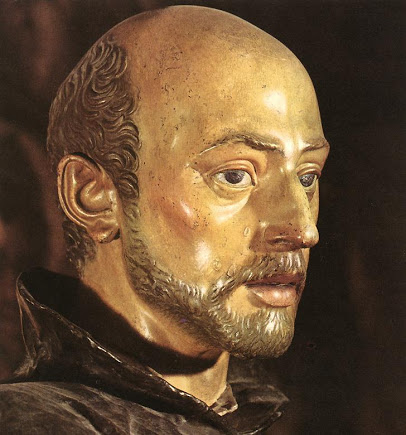
What Would You Say if St. Ignatius Came to Visit?

Bookmark and Share


by Becky Eldredge

What would my encounter be like with a man whose very life, core beliefs, and legacy are an enormous part of my life today?

What would I say if St. Ignatius came to visit me? Answering this question has moved me to tears as I rummaged backwards through my life thinking of all the ways St. Ignatius’s present day “soldiers” impacted my life by sharing with me the wisdom of Ignatian spirituality and the Spiritual Exercises. What do I say to the man whose teachings allowed me to find inner freedom, whose Spiritual Exercises helped me completely re-situate my life around God, and whose belief that God can be found in all things allowed me to understand the invisible mysteries of God through visible people, experiences in nature, and in Scripture? My encounter with St. Ignatius would be enfolded in gratitude.

I can’t think of anything other than to say “thank you.” St. Ignatius, thank you for being a man of authentic, lived faith, who struggled as we do today to journey through change and unsettled times, and who radically changed your life to follow Christ. Thank you for being a man so solidly rooted in prayer that you were able not only to capture the Spiritual Exercises in writing, but you were also able to teach others how to give them. The fact that your Exercises are still being handed on generations later shows me the fruits of your deep prayer life.

The people who are part of your army of Ignatian teachers, mentors, and friends have impacted my life in ways that I cannot even begin to capture here. They shared your wisdom with me, they taught me your prayer methods, and they journeyed with me through your challenging and life-giving Exercises. St. Ignatius, because of you, I know who I am-a woman deeply loved by God, whose authenticity and integrity come from God, and who understands that God’s love calls me beyond myself.

Did you understand back then, St. Ignatius, that your personal struggles, your surrender to God, and your openness to be molded by God would continue to impact the world over 500 years later? While you may not have understood it then, your life and your work are very much part of my life-a young adult woman attempting to live a life of faith as a wife, as a mother of two, and as a person called to ministry.

Thank you!

How Indifferent Are You?

Bookmark and Share


by Jim Manney 

Ignatius really means it when he says that we need to be “indifferent to all created things.” In his Principle and Foundation at the beginning of the Spiritual Exercises, he says “we ought not to seek health rather than sickness, wealth rather than poverty, honor rather than dishonor, a long life rather than a short one.”

To make it even more challenging, Michelle Francl-Donnay suggests that we write our personal version of that sentence, inserting things we especially love and loathe. This is hers:

I should not fix my desires on wet socks or dry feet, placemats or tablecloths, silence or noise, order or utter chaos.

Here’s mine:

I should not prefer Mozart to Lady Gaga, New York City to Las Vegas, steamed lobster to a tofu burger, baseball to soccer.

It’s very hard to be indifferent.

Jesuit Electronic News Service CP 70-1

Bookmark and Share


From Nairobi


Press release n. 1


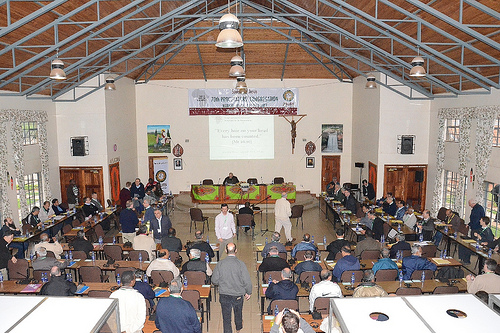
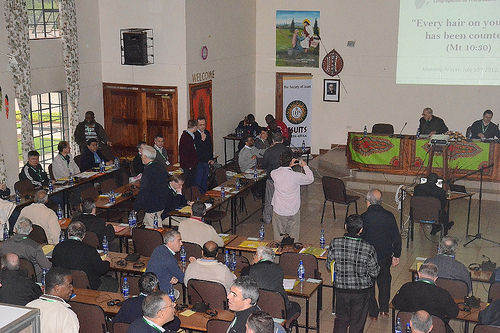
From 28 June, Jesuit delegates from around the world will arrive in Nairobi for the Congregation of Procurators of the Society of Jesus.  Many of them will join the pre-Congregation retreat which ends on 7 July.  The Congregation will start on 9 July, and last for one week. 

What is a Congregation of Procurators?

St. Ignatius of Loyola, looking at the hard labour and distraction could involve, discouraged meeting of General Congregation at definite intervals (Const. n 677). But later clarified that the Superior General maintains communication with the Society through letters and through the persons who should come from the provinces, at least once every three years from each province (and every four years from the Indies) (Const. n. 679).

These texts of Ignatius, and the wish expressed by the Pope, led the second General Congregation (1565), presided over by St. Francis de Borgia the newly elected Superior General, to propose the establishment of a Congregation of Procurators which will be called every three years. The first Congregation of Procurators was called in 1568 and until the beginning of the 18th century the General Congregations and the Congregations of Procurators proceeded regularly. General Congregation 34 (1995) ruled that the Congregation of Procurators should be held every four years


Most of the Procurators’ Congregations were held in Rome, except those of 1886 and 1889, which took place in Fiesole (Florence) and that of 2003, which took place in Loyola.

The next Congregation of Procurators, which is number 70 in the series, will be held in Nairobi (Kenya), for the first time outside Europe, from July 9 to 15, 2012. There will be 84 Procurators elected by their Provinces and 13 others who participate ex officio. The Procurators are 7 from Africa, 14 from Latin America, 18 from South Asia, 7 from Asia pacific, 29 from South, Central- Eastern and Western Europe, 9 from the United States.

The Congregation of Procurators is called into session by Father General every four years after the end of a General Congregation. Procurators are called those who have been elected by the Provincial Congregations (one per Province) to represent them at the Congregation of Procurators. Dependent and Independent Regions are not entitled to send a member, but they send a report to Rome, and Father General can invite them to be present.

The most important purpose of the Congregation of Procurators is to decide whether a General Congregation should be called.

Another important task of the Procurators is to discuss the overall state of the Society especially in its more universal dimension. The discussion could clarify if a General Congregation is warranted.

The Congregation of Procurators has no power to legislate, but if the members think it necessary, they can suspend decrees issued by previous General Congregations. The suspension will be valid until the next General Congregation meets. 

Wisdom Story 39

Bookmark and Share


by Anthony de Mello,S.J.

A Quaker had this sign put on a vacant piece of land next to his home: “This land will be given to anyone who is truly satisfied.”

A wealthy farmer who was riding by, stopped to read the sign and said to himself, “Since our friend the Quaker is so ready to part with this plot, I might as well claim it before someone else does. I am a rich man and have all I need, so I certainly qualify.”

With that he went up to the door and explained what he was there for. “And art thou truly satisfied?” the Quaker asked.

“I am, indeed, for I have everything I need.”

“Friend,” said the Quaker, “if thou art satisfied, what dost thou want the land for?”

A Prayer for Frustrated Catholics

Bookmark and Share


by James Martin, S.J.

Dear God, sometimes I get so frustrated with your church.

I know that I’m not alone. So many people who love your church feel frustrated with the Body of Christ on earth. Priests and deacons, and brothers and sisters, can feel frustrated, too. And I’ll bet that even bishops and popes feel frustrated. We grow worried and concerned and bothered and angry and sometimes scandalized because your divine institution, our home, is filled with human beings who are sinful. Just like me.

But I get frustrated most of all when I feel that there are things that need to be changed and I don’t have the power to change them.

So I need your help, God.

Help me to remember that Jesus promised that he would be with us until the end of time, and that your church is always guided by the Holy Spirit, even if it’s hard for me to see. Sometimes change happens suddenly, and the Spirit astonishes us, but often in the church it happens slowly. In your time, not mine. Help me know that the seeds that I plant with love in the ground of your church will one day bloom. So give me patience.

Help me to understand that there was never a time when there were not arguments or disputes within your church. Arguments go all the way back to Peter and Paul debating one another. And there was never a time when there wasn’t sin among the members of your church. That kind of sin goes back to Peter denying Jesus during his Passion. Why would today’s church be any different than it was for people who knew Jesus on earth? Give me wisdom.

Help me to trust in the Resurrection. The Risen Christ reminds us that there is always the hope of something new. Death is never the last word for us. Neither is despair. And help me remember that when the Risen Christ appeared to his disciples, he bore the wounds of his Crucifixion. Like Christ, the church is always wounded, but always a carrier of grace. Give me hope.

Help me to believe that your Spirit can do anything: raise up saints when we need them most, soften hearts when they seem hardened, open minds when they seem closed, inspire confidence when all seems lost, help us do what had seemed impossible until it was done. This is the same Spirit that converted Paul, inspired Augustine, called Francis of Assisi, emboldened Catherine of Siena, consoled Ignatius of Loyola, comforted Thérèse of Lisieux, enlivened John XXIII, accompanied Teresa of Calcutta, strengthened Dorothy Day and encouraged John Paul II. It is the same Spirit that it with us today, and your Spirit has lost none of its power. Give me faith.

Help me to remember all your saints. Most of them had it a lot worse than I do. They were frustrated with your church at times, struggled with it, and were occasionally persecuted by it. Joan of Arc was burned at the stake by church authorities. Ignatius of Loyola was thrown into jail by the Inquisition. Mary MacKillop was excommunicated. If they can trust in your church in the midst of those difficulties, so can I. Give me courage.

Help me to be peaceful when people tell me that I don’t belong in the church, that I’m a heretic for trying to make things better, or that I’m not a good Catholic. I know that I was baptized. You called me by name to be in your church, God. As long as I draw breath, help me remember how the holy waters of baptism welcomed me into your holy family of sinners and saints. Let the voice that called me into your church be what I hear when other voices tell me that I’m not welcome in the church. Give me peace.

Most of all, help me to place all of my hope in your Son. My faith is in Jesus Christ. Give me only his love and his grace. That’s enough for me.

Help me God, and help your church.

Amen.

Jesuit Electronic News Service CP 70-3

Bookmark and Share


From Nairobi


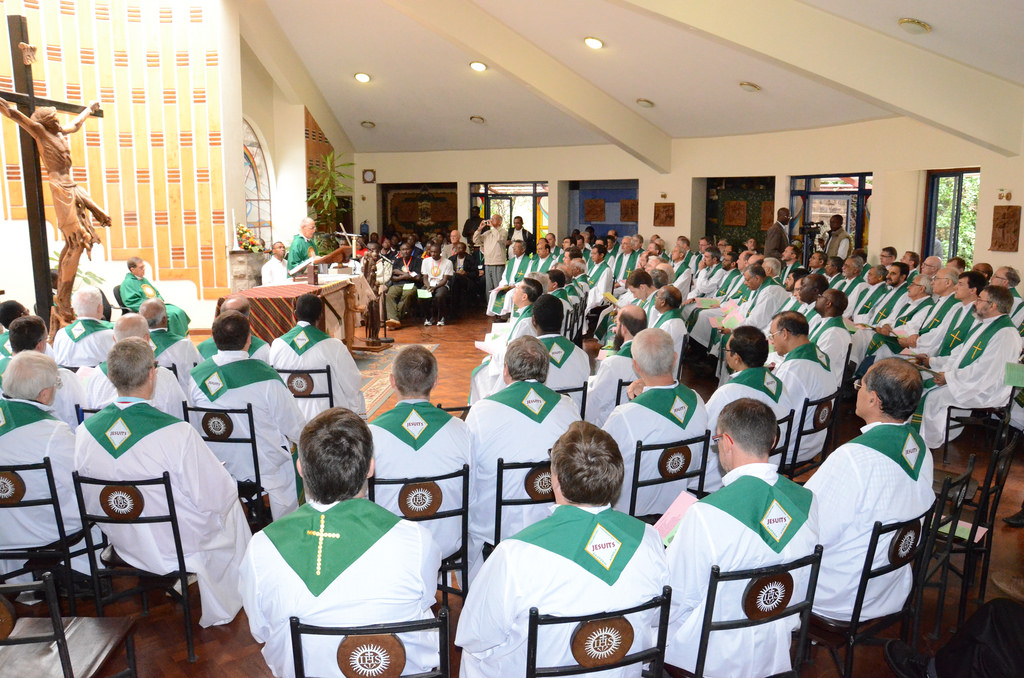
The 70th Congregation of Procurators began this morning with a concelebrated mass at 9:00 am presided by Father General. Two members of the Congregation are absent for different reasons, Father Federico Lombardi and Father Lisbert D’Souza.

The liturgy was well prepared and was a true spiritual experience for all. The readings were proclaimed in different international languages, while the songs were in various African languages.

In his homily, Fr Nicolas commented on the readings of the day’s liturgy, highlighting that we had been gathered here from all over the world and called to unity because God has chosen us. Therefore, we can say with the prophet Hoseah: “You are my Lord”. Turning to the Gospel, he reminds us that we are sinners, but that God is fully alive in us and gives us strength and life as He did with the girl in the Gospel of Matthew.

The first informal session that followed gave a historical overview of the Congregations of Procurators in the Society of Jesus and communicated some general information. During this session there was distribution of working material. Afterwards, each Conference met in separate groups to suggest possible names for the secretary of the Congregation, and to propose to Fr. General names for the Steering Committee.

The first session of the congregation took place in the afternoon. The Formula (procedures) was explained together with some juridical aspects. At the end Father General gave a brief exhortation to the participants to live with intensity this experience of the Society celebrated for the first time in Africa .


Jesuit Electronic News Service CP 70-2

Bookmark and Share


From Nairobi


Today end the eight days of Spiritual Exercises of the procurators who have come to participate in the Congregation of Procurators here in Nairobi. All, whether in the English or the Spanish group, expressed satisfaction in their experience of retreat together.


Tomorrow, Sunday, will be a day of rest and relaxation. The organizers here in Nairobi  have prepared various possibilities: cultural (for example, a visit to the “Bomas of Kenya,” a panoramic view of the culture and peoples of Kenya, or the Nairobi National Museum); ecological (a visit to the Nairobi National Park); pastoral (participation at Eucharist in some parishes of the city, such as Joseph the Worker in Kangemi, run by the Jesuits, or the Chapel of St. Paul.)

Some points of interest regarding the Congregation. 84 Procurators are present in Nairobi, of whom 7 are from Africa, 14 from Latin America, 18 from South Asia, 7 from Asia Pacific, 29 from Europe, and 9 from the United States. 13 others will participate in the Congregation by virtue of their office.

The average age of all the Procurators is 51.79, while the average age of all the participants (including those participating ex officio) is 53.41. By continent, Africa is the youngest, with an average age of 46.14, followed by Central and Eastern Europe with an average age of 47.83. The highest average ages are those of South Asia and the U.S.A., both of which have an average age of 54.78. 


Why Go to Church?

Bookmark and Share


by Tim Muldoon

In this age when more and more people describe themselves as spiritual but not religious, it is helpful to recall Ignatius’s understanding of the purpose of prayer, devotions, and participation in liturgy.

In what pertains to prayer, meditation, and study and also in regard to the bodily practices of fasts, vigils, and other austerities or penances, it does not seem expedient to give them any other rule than that which discreet charity dictates to them, provided that the confessor should always be informed…. (Constitutions 582)

All these acts of worship, public and private, are to help conform ourselves to Christ so that we may labor with the rest of the Church in the Lord’s vineyard. There is always an “ecclesial” dimension to spirituality–that is, it is never private. It must always be part of Christ’s work in the world. Prayer is to the work of discipleship what exercise is to performance in competition: both make us ready.

Ignatius, ever the realist, is aware of our tendency toward laziness in devotion:

they should be vigilant that these practices may not be relaxed to such an extent that the spirit grows cold and the human and lower passions grow warm.

While going to church is not the end of our existence–rather, laboring to do Christ’s work in the world is–still it is necessary because it reminds us constantly that the work is not our own.