Category: Uncategorized

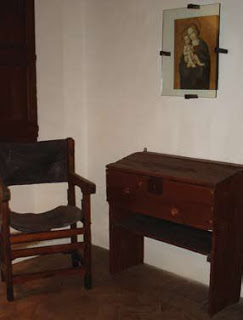
Where St. Ignatius Lived


St. Ignatius wrote and revised the Constitutions of the Society of Jesus in this room.

by Jim Manney 

I’ve been to Rome twice. Both trips happened before I was interested in St. Ignatius, so I’ve never been to the house where he lived and worked for the last 14 years of his life running the Jesuit order as its first superior general. When I finally go there, I’ll think about the fact that this wasn’t Ignatius’s plan for himself. He thought he should be an itinerant evangelist and teacher; he wound up as a great churchman firmly planted in a small suite of offices in Rome. So it often is with us. Our journey to God can be a meandering one.

Here is a very interesting video visit to Ignatius’s home and office. (To watch the video on YouTube, click here.)


St Peter Claver, Human Rights Pioneer


Saint Peter Claver, Human Rights Pioneer

St. Peter Claver, SJ, was a member of the Society of Jesus and is the patron of African missions and of interracial justice, due to his work with slaves in Columbia.

Peter Claver was born to a prosperous family in Verdu, Spain, and earned his first degree in Barcelona. He entered the Jesuits in 1601. When he was in Majorca studying philosophy, Claver was encouraged by Alphonsus Rodriguez, the saintly doorkeeper of the college, to go to the missions in America. Claver listened, and in 1610 he landed in Cartagena, Columbia. After completing his studies in Bogotá, Peter was ordained in Cartagena in 1616.

Cartagena was one of two ports where slaves from Africa arrived to be sold in South America. Between the years 1616 and 1650, Peter Claver worked daily to minister to the needs of the 10,000 slaves who arrived each year.

When a ship arrived, Peter first begged for fruits, biscuits, or sweets to bring to the slaves. He then went on board with translators to bring his gifts as well as his skills as a doctor and teacher. Claver entered the holds of the ships and would not leave until every person received a measure of care. Peter gave short instruction in the Catholic faith and baptized as many as he could. In this way he could prevail on the slave owners to give humane treatment to fellow Christians. Peter Claver baptized more than 300,000 slaves by 1651, when he was sickened by the plague.

In the last years of his life Peter was too ill to leave his room. The ex-slave who was hired to care for him treated him cruelly, not feeding him many days, and never bathing him. Claver never complained. He was convinced that he deserved this treatment.

In 1654 Peter was anointed with the oil of the Sacrament of the Sick. When Cartagenians heard the news, they crowded into his room to see him for the last time. They treated Peter Claver’s room as a shrine, and stripped it of everything but his bedclothes for mementos. Claver died September 7, 1654.

St. Peter Claver was canonized in 1888. His memorial is celebrated on September 9.

Quote: “We must speak to them with our hands before we speak to them with our lips.”


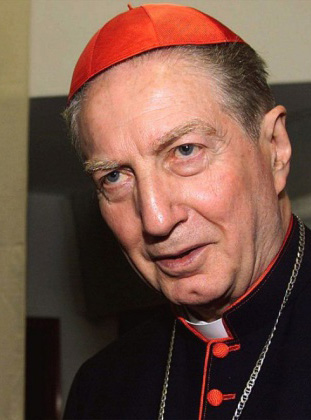
The Church remembers Cardinal Martini

Italian Cardinal Carlo Maria Martini, a renowned biblical scholar and former archbishop of Milan, died Aug. 31 at the age of 85 after a long battle with Parkinson’s disease. After six years in the Holy Land, where he had retired to continue his studies biblical scholar, in 2008 he returned to Italy and was treated at Gallarate for Parkinson’s disease that affected him for 16 years. However he continued his work and released several books and until recently held a column in the newspaper “Il Corriere della Sera” of Milan. In last June, Pope Benedict XVI met him in private during his visit in the Archdiocese.

Born in Orbassano, near Turin, Italy, Feb. 15, 1927, Carlo Maria Martini entered the Society of Jesus in 1944, was ordained a priest July 13, 1952, and took his final vows as a Jesuit in 1962. The cardinal, a biblical scholar, never held a parish post. With doctorates in theology and biblical studies, he was a seminary professor in Chieri, Italy, 1958-1961; professor and later rector of the Pontifical Biblical Institute in Rome, 1969-1978; and rector of the Pontifical Gregorian University from July 1978 until his December 1979 appointment to Milan.


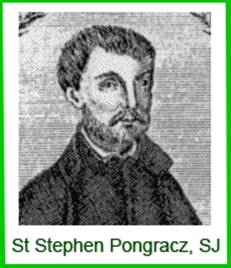
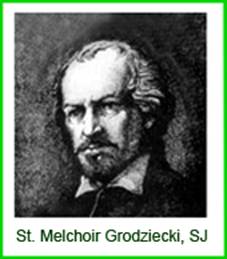
St Stephen Pongracz, Melchior Grodziecki


Today we remember three priests who died heroically for their faith, two of whom – Stephen Pongracz and Melchior Grodziecki – were Jesuits and one – Mark Krizevcanin – a diocesan priest.
Stephen was born in Transylvania, in central Romania, about the year 1582 and entered the Jesuits in 1602.

Melchior was born into the Polish aristocracy in Grodiec, near Cieszyn in Silesia, Poland, about 1584 and entered the Jesuits in 1603. He met his companion, Stephen Pongrácz, in the Jesuit novitiate at Brno in 1603.
Stephen could have lived an honourable pleasant life in his native Transylvania, but chose to
preach the Gospel in Prague, eastern Slovakia.

Mark was born in Krizevci in Croatia and did his studies in Graz and in Rome at the Germanicum and Hungaricum. After his ordination he returned to his homeland and served in the Zagreb diocese until he was put in charge of the seminary Trnava, Slovakia. Later, his former professor, Cardinal Pazmany, invited him to the Esztergom Archdiocese in Hungary and entrusted him with the very responsible task of the administration of the seminary and the training of future priests.

In 1619 both Jesuits were sent to the Kosice region (then in Hungary) to care for the religious needs of Catholics living in that Calvinist-dominated region. The king of Hungary had requested the services of Jesuits to care for Roman Catholics neglected during the 30 Years War of the early 17th century. At that time Kosice was a stronghold of Hungarian Calvinists, and the few Catholics who lived in the city and its outlying districts had been without a priest for some time.

Pongracz worked with Hungarians, while Grodziecki evangelised Slavic- and German-speaking peoples. Their ministries were so successful that they became targets of Calvinist antagonism.
Wanting to take advantage of Hungary’s involvement in the Thirty Years War, Gabriel Bethlen, a Calvinist prince in Transylvania tried to expand his own territory.

When the Calvinist Minister heard the Jesuits had arrived in Kosice, he sent his soldiers to arrest them. On news that the Protestant army was marching on the city, the two Jesuits who had been working in small towns returned to Kosice, where they were joined by the diocesan priest Mark Krizevcanin, who was then administrator of the nearby Szeplak Abbey and a canon in Kosice Cathedral.

In July 1619 the Catholics were accused of intentionally causing a fire. The commander of the Calvinist Armed Guard, Juraj Rakoczy, entered the city with the army on 5 September 1619 and on 7 September had all three Catholic priests thrown into a dungeon. They were urged to repudiate their faith in the Successor of St. Peter, stop being “papists” and become Calvinists.

When the priests refused to do so, the soldiers began beating Mark, stabbing him, crushing his fingers and rubbing flaming torches into his side. Finally they beheaded him.

Stephen Pongrácz was tortured next, with the soldiers twisting a rope around his head and almost crushing it. They hung him from the ceiling and cut him deeply before finally turning to Melchior Grodziecki who was beaten and beheaded. The soldiers threw the three bodies into a sewer ditch outside the house but Stephen Pongrácz did not die for another 20 hours.

The news of their martyrdom spread with the speed of lightning but Prince Bethlen did not want to allow the martyrs to be buried with dignity. Only after six months was the Countess Katarina Palffy allowed to bury them with his permission. Today, their graves are in the Ursuline church in Trnava.

Wisdom Story 40


by Paul Brian Campbell, SJ

The devotee knelt to be initiated into discipleship. The guru whispered the sacred mantra into his ear, warning him not to reveal it to anyone.

“What will happen if I do?” asked the devotee.

Said the guru, “Anyone you reveal the mantra to will be liberated from the bondage of ignorance and suffering, but you yourself will be excluded from discipleship and suffer damnation.”

No sooner had he heard those words, than the devotee rushed to the marketplace, collected a large crowd around him, and repeated the sacred mantra for all to hear.

The disciples later reported this to the guru and demanded that the man be expelled from the monastery for his disobedience.

The guru smiled and said, “He has no need of anything I can teach. His action has shown him to be a guru in his own right.”

Best Ignatian Songs: The Burning Babe


by Jim Manney

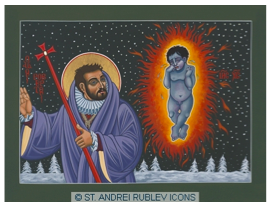
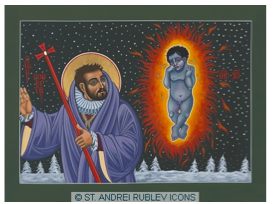
The latest edition of our occasional Best Ignatian Songs feature is a complete novelty. It’s the poem “The Burning Babe,” by St. Robert Southwell, SJ set to music and performed by the British rocker Sting. The poem describes a vision of Christ on Christmas Day. It’s best to read the poem while listening to the music, so here it is:

As I in hoary winter’s night stood shivering in the snow,
Surprised I was with sudden heat which made my heart to glow ;
And lifting up a fearful eye to view what fire was near,
A pretty babe all burning bright did in the air appear ;
Who, scorchëd with excessive heat, such floods of tears did shed
As though his floods should quench his flames which with his tears were fed.
Alas, quoth he, but newly born in fiery heats I fry,
Yet none approach to warm their hearts or feel my fire but I !
My faultless breast the furnace is, the fuel wounding thorns,
Love is the fire, and sighs the smoke, the ashes shame and scorns ;
The fuel justice layeth on, and mercy blows the coals,
The metal in this furnace wrought are men’s defilëd souls,
For which, as now on fire I am to work them to their good,
So will I melt into a bath to wash them in my blood.
With this he vanished out of sight and swiftly shrunk away,
And straight I callëd unto mind that it was Christmas day.


Chiayi, the seventh Youth Day and legacy of Card. Shan


by AsiaNews 

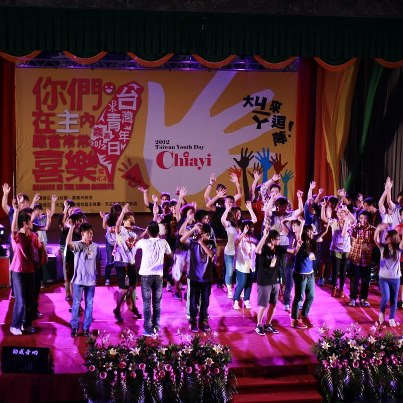
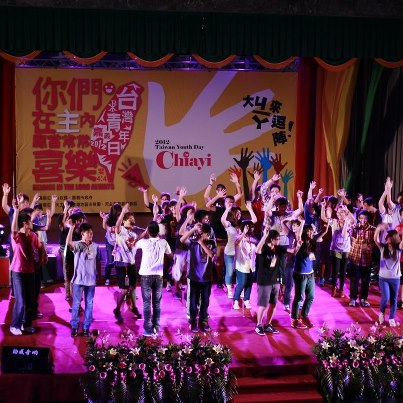
Today in Taiwan the school year began for all students. Young Catholics will greet classmates and share with them the experience that they have just had during the seventh national Youth Day, held in Chayi August 23 to 27.

This year’s theme was “Rejoice in the Lord always!” (你们在主内应当常常喜乐), a phrase taken from the letter to the Philippians, chapter four. In the five-day meeting, more than 300 young people from parishes, schools and Catholic movements throughout Taiwan were able to enrich their faith through sharing. The bishops of the island were present along with many priests and religious. The vigil of reconciliation during the late evening and the rich and emotional final Eucharistic celebration were the high points of the meeting, giving all present a strong sense of hope and the desire to continue to build a community of joyful faith around the message of Jesus

The Church of Taiwan is also preparing to celebrate this weekend, on 1 September in Kaohsiung, the funeral of Cardinal Shan Kuo-hsi, and the young faithful of the island have decided to pick up the baton from where he left off.

The first national Youth Day in Taiwan was organized in 2004 by a group of young Catholics who had participated in the previous World Youth Days and asked the bishops for something similar for Taiwan. Since then, the national Youth Day is organized in turn by one of the seven dioceses of the island.

Since 2004 seven days have been held, with different themes: “Walk toward God, walking towards love” (向主走, 向爱走 – 2004, Nantou), “Love one another as I have loved you” (就如我爱了你们, 你们应当彼此相爱 – 2007, Tainan), “Receive the power of the Spirit to be my witnesses” (领受圣神的德能, 为主作证 – 2008, Taipei), “Youth, stand up! Be the hope of Taiwan: My thoughts, my words, my walk with Christ “(年轻人 ‧ 站出来 ‧ 让台湾 ‧ 有希望 – 我思, 我言, 我行跟耶稣 – 2009, Taichung ), “Good Teacher, what must I do to inherit eternal life?” (善师, 为承受 永生, 我该做什么? – 2010, Hsinchu), “Love and communion renew all things in Christ” (爱 ‧ 融合 – 在耶稣基督内 重建一切 – 2011, Kaohsiung).

Since Hsinchu 2010, the organization has also provided hospitality to participants in among local families, allowing a more personal and engaging experience in the annual event.

During the opening Mass of 2010, the Vatican Nuncio to Taiwain, Msgr. Paul Russell, proclaimed: “Some say that the church in Taiwan is old, but I tell you, seeing so many of you, that the church of Taiwan is really young. ” His words were met with a standing ovation. And since then, the Facebook page entitled “台湾青年日 Taiwan Youth Day” has overflowed with comments and shares, with references to other blogs of young Catholics in Taiwan in a network that helps them to keep in touch and be informed of new initiatives and enrich their mutual friendship.

Reasons to Believe

Bookmark and Share


In the Valley of the Shadow
ON THE FOUNDATIONS OF RELIGIOUS BELIEF

by JAMES L. KUGEL


辅大社会学系及社会工作系创系系主任罗四维神父

In the Valley of the Shadow
ON THE FOUNDATIONS OF RELIGIOUS BELIEF
by JAMES L. KUGEL
FREE PRESS. 256P $26

One of the abiding mysteries in the Book of Psalms, a work that James Kugel, Starr Professor of Hebrew Literature emeritus at Harvard, has studied probably as fruitfully as any living person, is the sudden pivot in many of the so-called Psalms of Lamentation (or Complaints). Four-fifths of the way through, songs intensely devoted to bemoaning their authors’ dire straits abruptly shrug off their sackcloth and seem to proclaim, “Despite the fact that my bones are melting and my heart failing, I assert my faith in You.”

In his latest, most personal book, In the Valley of the Shadow, Kugel advances a proposal that solves that particular mystery, although it extends beyond the psalms: that rather than “Despite all that,” it is “because of all that”-because of the experience of helplessness, because of the “eerie proximity” to death illustrated in the Complaints-that we profess faith. Tragedy lies in the loss of that sense of helplessness.

This insight did not come cheap. Ten years ago, when he was 54, Kugel’s doctors diagnosed him with cancer (he never specifies what kind) and gave him two years, perhaps five, to live. Obviously, he has beaten the odds-the doctors now say he is cancer-free. (In the years since, in fact, he produced his magnificent and provocative How to Read the Bible.) But during his illness and grueling treatment, he inhabited the place where, as he puts it, the background music suddenly stopped -that is, “the music of daily life…of infinite time and possibilities…now suddenly…replaced by nothing.”

Most people lucky enough to experience that state and survive would hurry to forget it. Kugel does not chase the memories, but he regards the fact that “they keep following me around” as a “privileged insight.” For him, the eerie proximity, the sense of his life as a “compact, little thing,” of having a “semi-permeable soul,” of inhabiting “a stark world”-the book is poetic, as obsessed with naming and renaming the condition as analyzing it-is both the door to faith at its elemental level and the reason moderns find it increasingly hard to enter.

For if Kugel’s subject is the “small” state of mind, his goad was his hospital-bed reading on scientific explanations for religion and the New Atheist literature that cites them. In the Valley is Kugel’s own idiosyncratic volley in the God/no-God wars. He found himself both fascinated and exasperated by evolutionary biologists’ contention that religion is a “hyperactive agency detection device,” the reflex of attributing agency to every random ripple of the tall grass because back in the day, a saber-tooth tiger would often jump out. As big predators declined, goes the argument, the hypersensitivity to inexplicable phenomena lived on; and God or gods, the ultimate Agent, became the (erroneous) receptacle for all the corresponding emotion.

Kugel demurs. He concludes that however archaic our agency detection device may be, it remains valid regarding the one irreducible mystery of material life: death. Our error, really our calamity, which he tracks back as far as the early Middle Ages, is that as we have gradually subtracted phenomena from the inexplicable list we have come to think of our own role as progressively “bigger,” to the point where all agents outside of those huge selves have been crowded out, rendering faith incomprehensible. At which point death, the exception, becomes unbearably terrifying. Nor does Kugel think that moderns can recover our former sense of the cosmos: “There we hang, so big that we can barely see that which is real but…outside ourselves, and utterly unable to return to what was an earlier, truer sense of things.”

This is plausible but hardly conventionally uplifting, first, because one hates to feel this lost. And also because even if we could recover the old way of seeing, we would regain our reason to believe, but not (by this particular argument) any content for that belief. This is an occupational hazard of arguing God/no-God; but Kugel once wrote a book called On Being a Jew, so presumably there was some kind of faith ready when he needed it. He does not explore it here.

Offsetting the aridity of his destination, however, is the ride. Kugel has always worn his great erudition not just lightly but alluringly, and a memoir/polemic frees him as never before. He unveils a stream of perfectly framed illustrations, associations and digressions featuring everything from African witchcraft to the psalms (exemplifying art that expresses both death’s starkness and the only useful response) to Leonard Cohen to Wittgenstein to the ancient radio punch line “Was you dere, Charlie?” to the enduring puzzle of why we hit the elevator button when it clearly has already been pressed.

In the Valley of the Shadow‘s other virtue is Kugel’s indelible insistence on his experience, in all its small, eerie particularity. At one point he compares himself to Tiresias, the mythical Greek who (involuntarily) shuttled back and forth from male to female and back again. This rendered him uniquely wise, but inquirers sometimes found his wisdom disquieting. In the admittedly vast American genre of near-death tales, it is hard to imagine another book simultaneously so tough-minded, so uncanny and yet, despite all, so enjoyable. Kugel’s last line is, “From way up here…I can see you all, floating.” What makes this unnerving is that he is still down here, writing. What makes us grateful is the same thing.


 David Van Biema is writing a book on the history and cultural interpretation of the Psalms.

 

Some Fine Books

Bookmark and Share


by Jim Manney

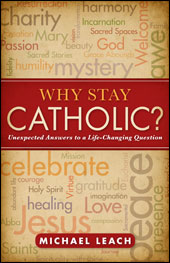
I thought I’d mention a couple of books from Loyola Press that recently won awards from the Catholic Press Association.  Why Stay Catholic? by Michael Leach won first place in the category for Popular Presentation of the Catholic Faith. The judges called it “practical, joyous, and spirit-lifting.” It is all of those things, and well-written too. Why Stay Catholic? also won third place in the Spirituality category.

Third place in the Popular Presentation category went to Practice Makes Catholic by Joe Paprocki. The judges said it is rich with wisdom and “short on preachiness.” That’s what we like to hear about our books.

Rounding out Loyola Press’s awards is Living the Mass by Joe Paprocki and Fr. Dominic Grassi. The judges said it was “a gem.”

Finally the National Jesuit News took first place for best electronic newsletter. Not surprisingly, the Jesuits are leading us into the digital future.


Cardinal Paul Shan ‘belongs forever to Christ’: the funeral on 1 September


Agenzia Fides 

There is deep emotion in the Chinese Catholic world, after the death of Cardinal Paul Shan Kuo-Hsi, SJ, Bishop Emeritus of Kaohsiung, who died yesterday afternoon in the Catholic hospital of GengXin in Taipei (Taiwan). Masses for his soul and remembrance are celebrated all over the Catholic Chinese world in mainland China, in Hong Kong, Macao and Taiwan, especially in the diocese of Kaohsiung, where the body was taken this morning in the Holy Family Parish. As reported to Fides Agency by a statement from the diocese of Kaohsiung, the funeral will be held on September 1, “with a simple ritual, according to the will expressed by the Cardinal in his will.” As desired by the Cardinal, all donations collected will be donated to the “Foundation of Shan Guo Xi for Social Assistance of ethnic and disadvantaged groups.” Always according to his will, the gravestone epitaph on his tomb will report the phrase: “Born in Christ, lived in Christ, died in Christ: forever belongs to Christ,” in tune with his episcopal motto which was “Establishing all things in Christ. ” Great appreciation for his figure was expressed by religious leaders and civil authorities. “Cardinal Shan was not only a religious personality of great mercy, but he is above all a person of immense generosity, peace and serenity that I always admired,” said the well-known Buddhist leader Xing Yun. “In the face of life and death, Cardinal Shan showed great foresight, turning a difficult time in life as an opportunity at the service to all. His thoughts and his wisdom elicit a profound reflection on all of us,” said the Great Buddhist Master Sheng Yan.

Among civilian authorities, a message of condolence was sent by Ma Ying Jiu, President of the Republic of China (Taiwan). Card Shan, after finding out he had cancer in 2006, intensified his efforts to promoting evangelization, with particular care regarding the Church in mainland China. Despite his age and illness, he never failed to lend support to the Bishops and faithful in China, as evidenced by his affectionate and authoritative ” A Letter from Cardinal Paul Shan to All Brother Bishops “, written in 2010, which called for unity and reconciliation in a spirit of great understanding and brotherhood. He spent his energies for evangelization: from November 2007 until April 2012, he held between 219 speeches, lessons and lectures in the university, the hospital and the prison in Taiwan. Cardinal Shan was born on December 3, 1923 in Puyang (today in Henan), in China (diocese of Taming). He entered the Society of Jesus on 11 September 1946 in Beijing and took his first vows on September 12, 1948 in Beijing. He was ordained a priest on March 18, 1955 in Baguio, Philippines, from 1959 to 1961 he studied for his PhD in spiritual Theology at the Pontifical Gregorian University in Rome. After a period in Vietnam, in 1976 he was appointed Episcopal Vicar of Taipei. On 15 November 1979 he was appointed Bishop of Hwalien. On 14 February 1980 he received the episcopal ordination and took possession of the diocese. In 1983 he was commissioned to celebrate the 400th anniversary of the arrival in China of Father Matteo Ricci. On 4 March 1991 he was appointed bishop of Kaohsiung, and took possession of the new diocese on June 17. He was general rapporteur of the Special Assembly for Asia of the Synod of Bishops, held in Rome from 19 April to 14 May 1998. It is due to his desire to invite two Bishops from China to the Synod, to whom the Chinese government did not give permission to participate: during the Synod there were two empty chairs to remember them. That same year, Pope John Paul II created him Cardinal. He was always a figure of authority of the Vatican Commission for the Church in China. (NZ) (Agenzia Fides 23/08/2012)