Category: Uncategorized

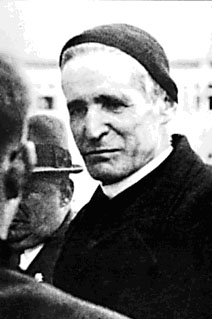
Bl. Rupert Mayer , SJ


Rupert Mayer was born in Stuttgart, Germany. When he was eighteen and had completed his secondary education, he told his father of his desire to become a Jesuit but was advised that he should get himself ordained as a priest first and to enter the Society later if he was still keen to do so. Rupert accepted his father’s advice and pursued university studies in philosophy initially at Fribourg, Switzerland and Munich and then theology at Tubingen for 3 years before going to the seminary at Rottenburg for his final year. He was ordained on May 2, 1899 and celebrated his first Mass on May 4.

He served for a year as an assistant pastor in Spaichingen and then entered the Jesuit novitiate at Feldkirch in Austria on Oct 1, 1900. After his noviceship he went for further studies in the Netherlands and between 1906 to 1911, he traveled through Germany, Switzerland and the Netherlands, preaching missions in many parishes. Fr Mayer’s characteristic apostolate began when he was transferred to Munich in 1912 where he devoted the rest of his thirty-one years to the migrant people who came from farms and small towns seeking employment and a place to stay .

Fr Mayer responded to the needs of the migrants; he collected food and clothing and searched for jobs and housing for them, and helped them preserved their faith as the city was becoming “pagan.” When Germany entered into World War I, Fr Mayer volunteered his services initially at a camp hospital, but later made Field Captain and traveled with his men to France, Poland and Romania where he was in the front line of battle. His courage became a legend among his soldiers; he was with them in their trenches, and stayed with those dying until the end. His courage was infectious and his presence gave the men hope.

In Dec 1915 he was awarded the Iron Cross for bravery, a rare honour for a chaplain but his army career came to a swift end in 1916 when his badly shattered left leg had to be amputated.

After his convalescence, Fr Mayer went back to Munich and did all he could to help its citizens to recover from the war’s aftermath. He was appointed director of the men’s sodality and within nine years the membership grew to 7000 with men coming from fifty-three different parishes which meant the indefatigable Fr Mayer had to sometime give seventy talks a month to speak to each group. For the convenience of travelers, Fr Mayer introduced Sunday Masses in 1925 at the main railroad terminal and he himself celebrated the first two, beginning at 3:10am. Fr Mayer’s apostolate extended to the entire city and if Munich were a single parish, then the pastor would have been Fr Mayer!

Postwar Munich saw the rise of communist and social movements. Fr Mayer kept a close watch on them, attending their meetings and even shared the platform with their speakers, not to praise them but to raise Catholic principles to point out falsehoods and to indicate the evils to which these speakers were leading their audiences. Fr Mayer also witnessed the rise of Adolf Hitler and also boldly spoke out against the falsehoods Hitler was propagating by stressing Catholic principles. Fr Mayer could not be a National Socialist and it was inevitable that conflict would arise between him and the Nazi movement as the religious response to evil.

In 1933 when Hitler became chancellor of the German Reich, he showed his true colours and began to close church-affiliated schools and started a campaign to defame the religious orders in Germany. Fr Mayer spoke out against this persecution from the pulpit of St Michael’s in downtown Munich and because he was a powerful influence in the city, the Nazis could not tolerate such a force to oppose them. On May 16, 1937, the Gestapo ordered Fr Mayer to stop speaking in public which he obeyed but he continued to preach in church. Within two weeks, he was arrested and was imprisoned for six weeks before his trial where he was given a suspended sentence.He obeyed his superiors’ orders to remain silent but the Nazis took advantage of his silence to defame him in public. To exonerate himself, his superiors allowed him to return to the pulpit to defend himself against the Nazis’defamatory attacks. He was arrested six months later and served his suspended sentence in Landsberg prison for five months until a general amnesty freed him to return to Munich and work in small discussion groups

As the Nazis were still fearful of him, they arrested him again in Nov 1930 under the pretext that he had cooperated with a royalist movement.

Fr Mayer was sixty-three and was sent to the Oranienburg -Sachsenhausen concentration camp near Berlin. After seven months his health deteriorated so badly that camp officials feared he would die and as they did not want to turn the popular priest into a martyr, they sent him in solitary confinement in the Benedictine abbey in Ettal in the Bavarian Alps. Fr Mayer spent his confinement in prayer, waiting for the disposition of Divine Providence. He remained in the abbey for almost 6 years until American soldiers freed him in May 1945.

Fr Mayer returned to Munich on May 11, 1945 and immediately resumed his apostolic work at St Michael. The years in prison and solitary confinement took a tool on his health. On Nov 1, 1945 Fr Mayer was celebrating the 8.00 am Mass on the feast of All Saints in St Michael’s and after reading the Gospel began his sermon. His topic was the saints in heaven and the Christian’s duty to imitate them to gain Paradise. In the middle of his sermon, while his thoughts were on heaven, his heart stopped, and the sixty-nine old Fr Mayer collapsed and died shortly afterwards. He was buried in the Jesuit cemetery at Pullach, outside Munich but his remains were brought back to the city and interred in the crypt of the Burgersaal, the church next to St Michael’s, where the men’s sodality regularly met.

Fr Mayer the preacher in Munich and the staunch opponent of Hitler was beatified by Pope John Paul II in Munich on Nov 3, 1987.


Scholastics in Cambodia and the Philippines “greening” their houses


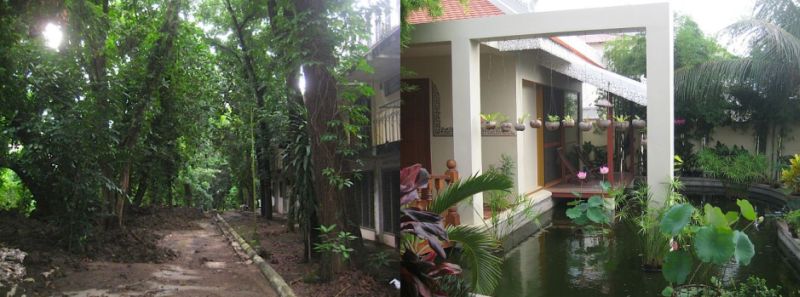
Beautiful area for use by community to enjoy and give gratitude in the mornings for the gift of creation in prayerful silence at LHS, Philippines and garden pool, lotus, and koi at Prieb So.

Iris Legal and Mariel de Jesus

Young Jesuits in Cambodia and the Philippines are initiating and practicing environmental management within their houses, seriously responding to the call of “getting their act together” so they can be more credible in engaging with broader environmental concerns in society.

Prieb So, Cambodia

Prieb So, translated as the “white dove,” is the residence of Jesuit priests, brothers, and friends in Phnom Penh. Fr Gabriel Je, SJ heads the house, which was built in 2009. Fr Mardi Widayat, SJ was also appointed as house minister at that time and he is responsible for starting the “greening.”

Cultural and sustainable “green” design was integrated in constructing the house. Although the house is made of concrete, Cambodian culture is evident in the architecture, especially the garden pool and bridge, which has lotus and vegetables growing at the side. The wide windows, open hallways, and skylight give opportunities to appreciate nature, and the natural light and ventilation allow for energy conservation and efficiency.

In April 2010, Fr Mardi together with Scholastic Mark Lopez, SJ set up a segregation and compost system. In this system, kitchen wastes are disposed directly into compost bins, while recyclables and non-biodegradable are separated. The system continues now with the whole community participating.

The compost bins have plastic receptacles set up at least one foot above the ground. The receptacles are covered with removable lids to facilitate the decomposition process and keep the compost fly and odour-free. A tap or plug at the bottom of the bin makes it possible to drain off excess liquid. A layer of bedding materials is placed inside the bins in this sequence: stone lining at the bottom, then kitchen wastes such as peelings, leaves, and others, then rice husks on top. The main “ingredients” that help to manage the odour and absorb the excess liquids are the rice husks. The composting bins are strictly “vegetarian” and no cooked food is disposed in these bins.

Thrice a week, the compost is turned over and mixed. After the bin is filled, it is left to decompose becomes compost in six to eight weeks. Fr Mardi religiously monitors these compost bins and collects the liquids from the compost, which he uses to fertilize the plants around the house. Aside from the diluted liquids, he uses the compost to fertilize the plants. Fr Mardi also dries the compost by exposing to sunlight and air, before applying it to the plants.

Such simple gestures may have limited impact. Yet, through these actions, the Jesuit people at Prieb So set an example and make a strong statement: “Yes, we do care and work ecologically, in our backyard, and hopefully, can inspire others.”

Loyola House of Studies (LHS), Philippines


Jesuit scholastics getting inputs from Pedro Walpole for their “green” community initiatives.

Jesuit scholastics of the LHS community located in the Ateneo de Manila University Campus in Quezon City embarked on a series of environmental initiatives to raise awareness about community lifestyle and house management.

The initiative began with a group of junior philosophers who shared a common interest in the environment. It was not a highly organized project because they were basically new to the field, and the group was largely informal, with projects few and far between. Most of those who were in the group signed up for a summer apostolate, while others were assigned to the Environmental Science for Social Change (a Jesuit research institute in the Philippines) and were previously involved in activities of the institute.

The current group is made up of mostly theologians, with one from the first studies sub-community. Two regents were very active last year, which was when there was renewed interest to address environmental issues. This renewed initiative or “second wind,” was prompted by the mandate of General Congregation (GC) 35, where for the first time, environment and ecology were given more emphasis. GC 35 also encouraged a more proactive engagement with these issues. This was further fuelled by the document “Healing a Broken World,” which serves as a guiding document for activities focused on the environment.


Indigenous tree seedlings at LHS.

Working from the adage “if you can’t measure it, you can’t manage it,” the scholastics are conducting a waste audit for a two-week period. This survey will enable them obtain data on the amount and types of waste generated by the community. They will also include information on the frequency of garbage collection and whether segregation is practiced at the end-point of waste collection.
In line with their solid waste management efforts, they are also undertaking a small-scale composting activity. At present, they are doing “backyard” composting, pending the identification of an appropriate site that will be used for the long-term. Site identification is ongoing, but the scholastics admit that it will take further planning for the composting program to take off.

Aside from the waste management, the scholastics are also focusing on greening activities. They are currently recovering and rehabilitating the seedlings that were planted during the last school year. Due to other summer activities and duties, some of the seedlings perished, but new seedlings are already being germinated. A few years ago, the scholastics conducted a tree-planting activity in San Juan, Batangas. Their rector approved their proposal to revisit that site to conduct another round of tree planting. The scholastics are also implementing small-scale projects, such as seed collection, seed banking, germination, and propagation.

Despite the fact that these environment initiatives are not a mainstream focus of the Philippine Province, it is encouraging to see the fervour and zeal in the young Jesuits. Recently, they put up the first issue of Green Jesuits, an online magazine where they share their initiatives and experiences. This advocacy stems from a true love and concern for the environment, and a commitment to this new dimension of the Jesuit mission.

Bl Dominic Collins, S.J.


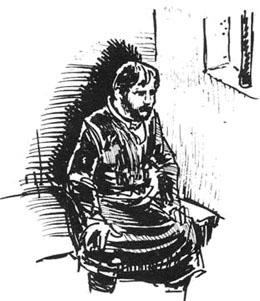
Born in Cork County, Ireland c. 1566 he entered the Society of Jesus in 1598 after working on the continent. His vocation was to be a professed Jesuit brother. Captured by the English who attempted to get Dominic to reject Christ, he was tortured and hanged under the charge of being a traitor. With 16 other Irish martyrs (non-Jesuits) Brother Dominic was beatified by Pope John Paul II in 1992.


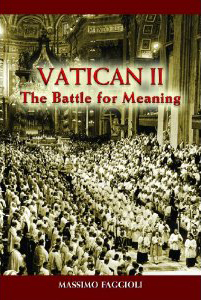
Book Club:Vatican II-The Battle for Meaning


by Drew Christiansen, S. J.

MASSIMO FAGGIOLI
PAULIST. 199P $14.95

As the celebration of the 50th anniversary of the Second Vatican Council unfolds over the next four years, the struggle over its legacy and meaning will intensify. It is a struggle that began almost as soon as the Council concluded in December, 1965. In Vatican II: The Battle for Meaning, Massimo Faggioli traces the multiple debates that constitute that struggle.

In 2005 those exchanges reached a new turning point with the rise of Jozef Ratzinger, a leader of one of the contending schools of interpretation, to the chair or Peter. As Pope Benedict XVI, he has continued to promote “the continuity” of Vatican II with the whole Catholic tradition as the hermeneutic for interpreting the Council. The countervailing school stresses Vatican II as a Council of reform or, in Pope Benedict’s characterization, of “discontinuity.”

The basic convictions dividing the two major schools concerns their understanding of the relationship of church and world. The defenders of continuity stress the distinction between the church and world; the proponents of reform, their interpenetration. From the fault line of church-world relations follow other divisions over ecclesiology, liturgy and canon law, likewise disputes over doctrinal discipline, pastoral practice and ecumenical dialogue.

Faggioli offers a step by step overview of the still ongoing debate among theologians, historians, bishops, curialists and ecumenical interlocutors. His is a tightly written narrative, giving a detailed roadmap of the scholarly debates, ecclesiastical pronouncements and church events that set the scene for current tensions in Catholic life.

More like an extended bibliographical essay than a compact history, Vatican II: The Battle for Meaning will be of greater use to scholars and graduate students than to ordinary readers. But even scholars in one field, say, systematics, will benefit from its survey of the debates in others, like church history; or, liturgists, for example, will gain insight from the mapping of alternative approaches to pastoral strategy. But even lay readers whose interest has been stirred by the anniversary of the council will find Faggioli’s Vatican II a rich source of suggestions for further reading.

Jesuit Companions in Indigenous Ministry: Around a fire that enkindles our hearts


by Jojo Fung, SJ

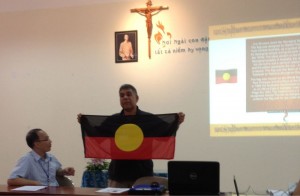
From Australia, East Timor, Malaysia, Philippines, Thailand, and Vietnam, the Jesuit Companions in Indigenous Ministry (JCIM) gathered at Thu Duc, Ho Chi Minh City, Vietnam from 20 to 24 September to reflect on our communal experience of accompaniment and formation of the indigenous communities in the light of GC 34, D. 4 Our Mission and Culture.

The document affirmed our engagement of indigenous cultures, enriching our understanding of the local knowledge and wisdom in a manner that brings about more context-specific and sensitive responses. These responses range from proclamation of the Good News with the resultant baptism, pastoral-sacramental ministry, and more prophetic and social-action oriented services like community-based education, appropriate healthcare, income generation, concerted struggle for the rights to ancestral domains and sustainable livelihoods.

The meeting began with a sharing on the ministry of accompaniment and formation, giving us a corporate sense of our indigenous ministry in the Conference of Asia Pacific. We have much to learn from the indigenous traditions and wisdom especially their cosmology on sustainability that speaks of a web of sacred relationships with the ancestors, spirit world, the land, and all of creation.

There was a short presentation on the Ignatian Pedagogy,[i] the common values of the indigenous peoples as highlighted by John Paul II and Asian theologians (Felix Wilfred and J. Gnanapiragasam),[ii] and the Rio+20 Declaration of the International Conference of Indigenous Peoples on Self-Determination and Sustainable Development and the Kari-Oca II Declaration of 2012, with the accompanying theological presuppositions and the call for Ignatian gratitude for God’s presence and actions in everyone and everything.[iii]

The plenary session enabled us to realize the importance of discernment in our community engagement so that we recognize what is good and noble in indigenous traditions (including the elders, spiritual leaders, reverential relationship with the land, spirit-world, ritual celebration of planting and mourning). Instead of a tabula rasa approach, our Ignatian tradition proposes that we recognizes God’s antecedent presence and that God’s Spirit is already active in the community so that our accompaniment entails discovering and revealing God’s omnipresence and collaborating with God’s actions amidst the indigenous communities. This incarnational approach calls for a prophetic engagement that involves personal sacrifices in which we take the risk in standing up against divisive and unacceptable practices in indigenous communities influenced by local politics of greed and selfishness.

To plan ahead for the 2014 meeting, the group felt that it is important to hold a meeting where we can learn how the local church engages with and responds to the challenges and issues of indigenous communities in the process of accompaniment and formation. On the other hand, our presence needs to lend moral encouragement to efforts of a local church, Jesuits and indigenous communities.

Some of us articulated the aspiration of gathering approximately 25 to 30 indigenous Jesuits (scholastics and priests which may be the first of its kind in any Jesuit Conference) in the near future. The aim is to reflect on the contribution of indigenous cultures to Jesuit religious life in Asia Pacific.

For the many graces of this gathering, we are grateful to God’s omnipresence and actions in all indigenous peoples as we strive for greater sustainability of indigenous cultures and traditions that webs humankind to the life-giving creation of God.
Jojo Fung, SJ is the Coordinator of Jesuit Companions in Indigenous Ministry (JCIM) of the Jesuit Conference Asia Pacific.

[i] In his 2010 Address at Mexico City entitled “Depth, University and Learned Ministry: Challenges to Jesuit Higher Education Today,” Father General highlighted an Ignatian Pedagogy “that involves a profound engagement with the real, a refusal to let go until one goes beneath the surface. It is a careful analysis (dismembering) for the sake of integration (remembering) around what is deepest: God, Christ, the Gospel. The starting point, then, will always be what is real: what is materially, concretely thought to be there; the world as we encounter it; the world of the senses so vividly described in the Gospels themselves; a world of suffering and need, a broken world with many broken people in need of healing. We start there.”

[ii] The common values highlighted are belief in God, their awareness of God’s presence, their ability to discover God in creation, their dependence upon God, their desire to worship God, their sense of gratitude for the land, their responsible stewardship of the earth, their reverence for all God’s great works, their respect for the elders, a sense of the sacred (space, life, ancestry and the land), a commitment to the pursuit of fullness, a thirst for self-realization, a taste for prayer and commitment, a desire for self-renunciation, a struggle for justice, an urge to basic human goodness, an involvement in service, a total surrender of the self to God, an attachment to the transcendent in their symbols, rituals and life itself, reverence for Creator, harmony with creation, sustainable livelihood.

[iii] The Indigenous Peoples International Declaration on Self-Determination and Sustainable Development during Rio+20 in Rio de Janeiro, Brazil last 19 June 2012 emphasized the importance of the implementation of the UN Declaration on the Rights of Indigenous Peoples for Sustainable Development and culture as the fourth pillar for development. This includes the right to land, territories, and natural resources, the promotion and respect for traditional knowledge, the full and effective participation of Indigenous Peoples for sustainable development that involves self-determination or Buen Vivir (Living Well) promoted by Indigenous Peoples, food sovereignty and right to food, and the role of women and indigenous youth.

Buddha and Ignatius


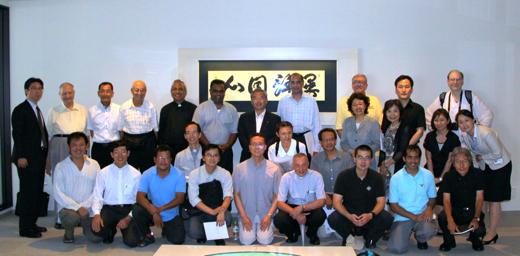
A group of 20 – 19 Jesuits and a Protestant pastor – gathered in Tokyo in August to explore the links between Ignatian Spirituality and Buddhism in the third Buddhist Christian Dialogue Workshop. Held in Tokyo from August 14 to 16, the workshop was themed “Buddha and Ignatius”.

Dialogue with people of other faiths is particularly important for Jesuits working in Asia, which is home to several major religions such as Buddhism, Islam and Hinduism, and inter-religious dialogue is a major dimension of the Jesuit commitment to be companions of Jesus and servants of his mission.

The Jesuits consisted of 14 priests, four scholastics and a brother from eight Provinces and two Conferences, Asia Pacific and South Asia.

The discussions included topics such as the links between the basics of Buddhism and the teachings of Christ as revealed in the Spiritual Exercises, a comparative evaluation of the Exercises and the rudiments of Buddhism, Christian Identity and Buddhism, and Buddhist Psycho-Spirituality at the Service of Ignatian Spirituality. Also discussed was the revival of Buddhism in China and prospects there for inter-religious dialogue.

There were also sessions in sharing that encouraged richer reflection. These included the poignant tale by Fr Wajira Nampet SJ of his earlier life as a Buddhist and the factors that led to his acceptance of Christ, and the deeply personal account by Fr Bernard Senecal SJ of Sogang University, of his initial encounters with Buddhism and the effect they had on his worldview which until then was almost wholly Catholic. Fr Christian Cochini SJ also inspired the group with his account of his contact with various Buddhist monks and nuns in China.


The group was also led through the intricacies of Vipassana and Zen meditation, and they visited a Buddhist group called the Rissho Koseikai.


This was the first time the workshop was opened to scholastics, and it had a major impact on those who attended. Joseph Nha SJ (Vietnam) said he admired the fact that so many Jesuits were striving for dialogue with Buddhism, while for Arun D’Souza SJ (India), it was his first opportunity to contrast and evaluate Christian and Buddhist ways of thinking.

“The workshop was a profoundly edifying experience for everyone,” said workshop organiser Fr Cyril Veliath SJ, adding that Fr Lawrence Soosai SJ had expressed the group’s feelings well when he said “it evoked within us a spiritual upsurge, an outcome of the convergence of the wisdom of the Buddha and the spirituality of St. Ignatius”.

17 Jesuits ordained deacon


by Jesuit Conference of Asia Pacific

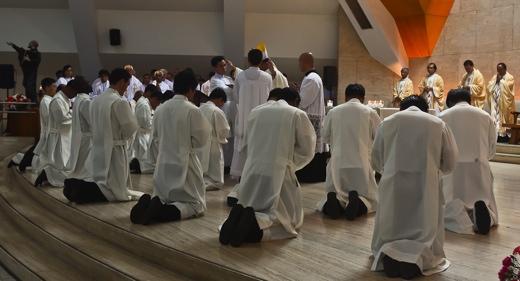
Seventeen Jesuit scholastics were ordained deacon in Manila on September 8. They were an international group from nine Provinces and Regions in three Conferences, Asia Pacific, South Asia and Africa. Six of the new deacons are from the Philippine Province and the other 11 from Arrupe International Residence (AIR).

“The ordination to the diaconate marks a threshold in their formation since with this, they become members of the “clergy” technically speaking, and that, at least 6 months from this, God willing, they will become priests, finally,” said Fr Renato Repole SJ, Rector of AIR.

“Diakonia is Greek for service and as deacons, they are meant to serve in various ways – baptize, proclaim the Gospel, preach homilies, etc. In more technical terms, the deacon performs a three-fold ministry: Ministry of Worship, Ministry of the Word, Ministry of Service.”


The newly ordained deacons are:

China: Paul Zhai

Eastern Africa: Eric Simiyu Wanyonyi

Indonesia: Bernadus Dirgaprimawan

Korea: Dong II Andrew Kim

Malaysia-Singapore: Mark Aloysius, Sebastian Koh Siong Yong, Alvin Frederick Ng Sze Syn

Myanmar: Wilbert Mireh

Philippines: Gil Donayre, Arthur Nebrao Jr, Francisco Parilla, Joseph Raymund Sanchez, John Lester Tajon, and Chester Yacub

Sri Lanka: Sanjeeva Fernando, Thushara Sampath

Thailand: Sigit Setyo Wibowo

At dinner a few days before their diaconal ordination, Fr Bill McGarry SJ gave them “six bits of advice”.

1. Learn to wash peoples’ feet. Get on your knees and wash the feet and look up to the people you serve. Never look down on them. Our ordination to the diaconate is not your initiation into a club or caste of noblemen. You are commissioned by this ordination to be a servant. Servants are not supposed to look down. They wait at table standing up but the attitude is one of looking up, not down. Please remember that priestly ordination does not erase your status as a deacon. Nor will your ordination as a bishop or election as Cardinal or Pope. You will always be a deacon, always a servant. Beware of clericalism. My experience is that practically all my penitents in confession are better Christians than I.

2. Please don’t rejoice that studies are over. I hope that they never will be over for you. Too many priests short-change their parishioners by not keeping up to date or not trying to get deeper and deeper into the Word of God. Some bore the faithful almost to tears. Read books and articles? Yes. But most importantly use your ears more that your mouth and learn from people, especially the poor but also everybody, even dithery old men. I believe that praxis/reflection is the best book you can read. You try to change yourself or apostolic situations and then reflect on what you learned from that praxis. Never skip the Examen. Of course, the best way to do praxis/reflection is to do it with others, your fellow Jesuits, your partners in the apostolate. Do it with others. I suspect that this practice would eliminate the need of many sabbaticals. You learn on the job.

3. Multi-tasking except in very moderate forms is a synonym for superficiality or inferior service. Father General is begging us for depth, the enemy of superficiality. Sometimes rather heavy multi-tasking becomes a temporary necessity. But it should always be temporary unless we want superficiality or inferior service to become a policy. No time for prayer, study, reflection, serious conversation with the brethren, rest? If this ever happens, drop something, like TV, Face Book, surfing, or ask your superior for relief. These things we say we have no time for cannot be dropped responsibly. We’re called to depth in our lives and work.

4. Our much-loved church (That means us.) tends lately to be quite expert in communicating bad news, I hope you Deacons will become expert at communicating good news. Want to help the world and the church? Be a witness to the resurrection. We are sent to bring good news, THE Good News. Take care of your emotional health. You can’t communicate the good news with a glum face. Pray to be cheerful.


5. When I was one-and-twenty I heard a wise man say, ‘Give crowns and pounds and guineas but not your heart away… But I was one-and-twenty; no use to talk to me. …I heard him say again, ‘The heart out of the bosom was never given in vain. ‘Tis paid with sighs a plenty and sold for endless rue. And I am two-and-twenty and oh ‘tis true, ‘tis true.” Excessively pessimistic? I think so. Too selfish? I think so. However if you with your celibate chastity want to be happy and avoid endless rue, I ask you to try not to fall in love. “‘Tis paid with rue, maybe not endless but tends to bring great sadness. A.E. Housman wrote that poem and he seems to have been selfishly self-protective. Hold on to your hearts but don’t spend your life in cold self-protection. Love people. Mix with people. Be their friend. But hold on to your heart not for the sake of protection from liebesschmertz, but in order that you may warmly love and serve many and with a joyful face.

6. I strongly recommend Karl Rahner, Der Glaube des Priestes Heute, Orientierung 1962, Translated in Woodstock Letters with the title, “The Faith of the Priest Today”. This has turned out to be something like a charter for priesthood for me. It really talks about the depth we’ve mentioned above. It talks about walking with and learning from and with the people of the world of today. It repeats what Father Arrupe said about choosing tough over soft ministries. It agrees with the mission given to the Society by Paul VI to combat Atheism. It led the 32nd General Congregation to tell us clearly that our mission today is the Service of Faith and that Promotion of Justice which Faith includes. It is another reason for serious study. It asks us to face the fact that secularism and agnosticism are on the rise in all of our countries. We need to see that we Jesuits are not called just to repeat what other church people are doing no matter how wonderful these apostolates are. We should do what others don’t do for whatever reason. I think we are called to many kinds of people but I judge that the highest priority is to the poor, those allergic to the church, to agnostics. Yes, always the poor but also in the words of Father Rahner, “It is by entering into the world of today, and being with men in their difficulties, their anxieties, their doubts, that we can bring this world to faith, and not by posing as somehow different….Our faith must be such that even the unbeliever cannot deny that here a man believes who is like himself, a man of today, on whose lips the word God does not come easily or cheaply, who doesn’t think he has mastered everything, and in spite of all this, rather because of all this, he believes.” A hard challenge but we can only do our best with the talents we have. At least no canonizations of saving the saved, superficial multi-tasking, only the majus servitium.

The diaconal ordination was held at the Church of the Gesù in Ateneo de Manila University. The Most Reverend Leopoldo C Jaucian, SVD, the Bishop of Abra in the Province of Bangued in Northern Philippines presided.

After his ordination, Wilfred Mireh SJ said, “I am grateful to God who has called us to this Jesuit vocation and I am grateful to the people who have supported us in various ways,” he said. Wilbert is the first Myanmar Jesuit to reach this stage of formation.

St. Isaac Jogues, John de Brébeuf and Companions


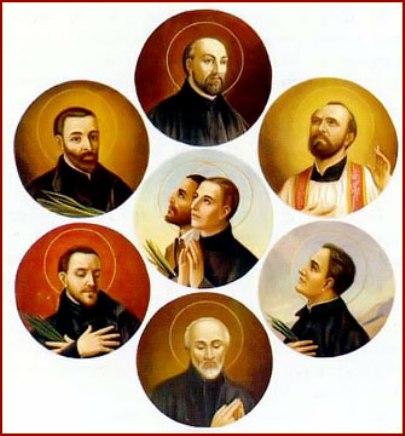
Isaac Jogues (1607-1646): Isaac Jogues and his companions were the first martyrs of the North American continent officially recognized by the Church. As a young Jesuit, Isaac Jogues, a man of learning and culture, taught literature in France. He gave up that career to work among the Huron Indians in the New World, and in 1636 he and his companions, under the leadership of John de Brébeuf, arrived in Quebec. The Hurons were constantly warred upon by the Iroquois, and in a few years Father Jogues was captured by the Iroquois and imprisoned for 13 months. His letters and journals tell how he and his companions were led from village to village, how they were beaten, tortured and forced to watch as their Huron converts were mangled and killed.

An unexpected chance for escape came to Isaac Jogues through the Dutch, and he returned to France, bearing the marks of his sufferings. Several fingers had been cut, chewed or burnt off. Pope Urban VIII gave him permission to offer Mass with his mutilated hands: “It would be shameful that a martyr of Christ be not allowed to drink the Blood of Christ.” Welcomed home as a hero, Father Jogues might have sat back, thanked God for his safe return and died peacefully in his homeland. But his zeal led him back once more to the fulfillment of his dreams. In a few months he sailed for his missions among the Hurons.

In 1646 he and Jean de Lalande, who had offered his services to the missioners, set out for Iroquois country in the belief that a recently signed peace treaty would be observed. They were captured by a Mohawk war party, and on October 18 Father Jogues was tomahawked and beheaded. Jean de Lalande was killed the next day at Ossernenon, a village near Albany, New York.

The first of the Jesuit missionaries to be martyred was René Goupil who, with Lalande, had offered his services as an oblate. He was tortured along with Isaac Jogues in 1642, and was tomahawked for having made the Sign of the Cross on the brow of some children.

Jean de Brébeuf (1593-1649): Jean de Brébeuf was a French Jesuit who came to Canada at the age of 32 and labored there for 24 years. He went back to France when the English captured Quebec (1629) and expelled the Jesuits, but returned to his missions four years later. Although medicine men blamed the Jesuits for a smallpox epidemic among the Hurons, Jean remained with them.

He composed catechisms and a dictionary in Huron, and saw 7,000 converted before his death. He was captured by the Iroquois and died after four hours of extreme torture at Sainte Marie, near Georgian Bay, Canada.

Father Anthony Daniel, working among Hurons who were gradually becoming Christian, was killed by Iroquois on July 4, 1648. His body was thrown into his chapel, which was set on fire.

Gabriel Lalemant had taken a fourth vow-to sacrifice his life to the Indians. He was horribly tortured to death along with Father Brébeuf.

Father Charles Garnier was shot to death as he baptized children and catechumens during an Iroquois attack.

Father Noel Chabanel was killed before he could answer his recall to France. He had found it exceedingly hard to adapt to mission life. He could not learn the language, the food and life of the Indians revolted him, plus he suffered spiritual dryness during his whole stay in Canada. Yet he made a vow to remain until death in his mission.

These eight Jesuit martyrs of North America were canonized in 1930.


NGOs urge governments to protect stateless people


Jesuit Refugee Service and other humanitarian organizations are deeply concerned about stateless populations. Roughly 12 million people globally are deprived of rights to citizenship, access to education, health, and employment through statelessness.

On the first of September, JRS, in collaboration with civil society groups working in more than two dozen countries worldwide, signed a statement calling on governments attending the High-Level Rule of Law meeting during the General Assembly on September 24, 2012, to sign and ratify the two human rights conventions on statelessness:

When individuals or groups are made stateless and denied full equality before the law as a result of discrimination or arbitrary decision making, the rule of law is undermined. We, … civil society organizations, call on all Member States to commit to ending statelessness at the High-Level Rule of Law meeting during the General Assembly on September 24, 2012.

Specifically, we urge Member States to use this occasion to accede to or pledge to accede to the 1954 Convention Relating to the Status of Stateless Persons and the 1961 Convention on the Reduction of Statelessness, to introduce procedures to identify and protect stateless persons subject to their jurisdiction and to amend nationality laws that discriminate against women, children and specific populations based on ethnicity, religion, or other impermissible factors.

While every person has a right to nationality, at present upwards of 12 million people are not recognized as citizens of any country in the world. Without the protection of a government, they are stigmatized and often live in extreme poverty without access to education, health care or legal processes that protect them from abuse and exploitation. Many stateless individuals live on the margins of society, and this invisibility is the direct consequence of their constant fear of systematic discrimination, detention, exclusion or deportation. Throughout the world, hundreds of thousands of others are at a heightened risk of statelessness because they do not possess proof of birth in the country in which they live.

In December 2011, the United Nations Refugee Agency (UNHCR) organized a ministerial meeting in Geneva to commemorate the anniversaries of the statelessness and refugee conventions. Member States were encouraged to accede to the statelessness conventions, amend their domestic nationality laws to include safeguards against statelessness or to pledge to take other forms of action to prevent and reduce statelessness and to protect stateless persons.

The meeting revealed a new and growing global commitment to end statelessness, with 61 countries making statelessness-related pledges and 33 pledging to accede or take steps to accede to the statelessness conventions. Follow through on the pledges, however, remains an outstanding task for many Member States. Those States should make a concerted effort to fulfill the pledges before the upcoming Rule of Law Meeting, or be prepared to discuss obstacles to doing so during the meeting.

Subsequently, on July 5, 2012, two resolutions on statelessness were passed by the Human Rights Council, one of which focused on ensuring that all women and girls have the right to maintain, acquire and confer nationality on their spouses and children, equal to the rights of men. In at least 30 countries, women do not possess these rights so when they marry a foreign or stateless man they may lose their nationality or be unable to confer nationality on their spouse and children, which can result in statelessness.

Ending gender discrimination in nationality laws is a critical step to ending the perpetuation of statelessness in families. Member States should commit to amending domestic nationality, family and related laws that discriminate against women and children, and lift reservations placed on Article 9 of the Convention on the Elimination of Discrimination Against Women that undermine a woman’s full enjoyment of the right to nationality. ThoseStates with non-discriminatory nationality laws should pledge to provide legal and technical support to States pursuing positive changes in law.

Provision of access to effective and widespread birth registration is one of the most effective ways to combat the risk of statelessness. All parents, regardless of geographic location or socioeconomic status, should be made aware of and have access to birth registration for their children. Consistent with Article 7 of the Convention on the Rights of the Child, Member States should commit to free and accessible birth registration and States with functioning systems should pledge to provide technical and financial resources to those States requiring assistance in creating widespread birth and civil registration systems.

There is no legal, political, economic or social justification for the arbitrary denial of nationality to individuals. We hope that Member States will take the opportunity to recognize and support the enjoyment of the right to nationality by all stateless children, women and men throughout the world at the High-Level Rule of Law Meeting.

Jesuit Electronic News Service Vol. XVI, N. 15

Appointments


Pope Benedict XVI has appointed:


– Mgr Pedro Ricardo Barreto Jimeno S.J., archbishop of Huancayo (Perù), member of the Pontifical Council for Justice and Peace. Mgr Barreto was born in 1944, entered the Society of Jesus in 1961, was ordained a priest in 1971 and consecrated bishop in 2002.


– Fr. Felix Körner S.J. (GER), professor of the theology of religions at the Pontifical Gregorian University in Rome, as consultor of the Commission for Religious Relations with Muslims within the Pontifical Council for Inter-religious Dialogue. Father Körner was born 1963, entered the Society of Jesus in 1985 and was ordained a priest in 1995.


From the Provinces


AUSTRALIA: The Missionary History

The internet is providing opportunities for organizations such as the Jesuits to make publicly available material that previously might only have resided in archival collections.  The Irish Jesuits’ online archive, containing records of their history from 1575 to 1980, now also features a collection of materials on the Australian Mission.  The collection, which contains photographs of the first Jesuit churches and schools, a will, several letters regarding the mission and its work, maps and advertisements, gives an account of the mission’s history from 1865 to 1931.  Frs William Lentaigne and William Kelly were the first Irish Jesuits to arrive in Australia in 1865, following the arrival of the Austrians in 1848.  The Irish began their work immediately to establish a vibrant Catholic community and system of education, when they opened schools in Melbourne and Sydney. The Austrian and Irish missions merged in 1901, and the work continued.  Australia became a vice-Province in 1931, and a Province in 1950, with Fr Austin Kelly as its first Provincial.  Fr Kelly helped establish university colleges around Australia, as well as the Australian mission in India. The archival collection is available onhttp://www.flickr.com/photos/jesuitsireland/sets/72157626090480847/.


CANADA: A New Website

Canadian Jesuits International (CJI) has launched its new website atwww.canadianjesuitsinternational.ca   The colourful new site showcases CJI, its educational advocacy in Canada, and the work of its partners overseas.  There are feature articles, news, testimonies, updated country profiles, videos and other resources.  The site holds invitations too: visitors can pray, volunteer, learn and read about social justice issues, and they may make donations as well.  The site is uncluttered and easy to navigate.  Seamless integration with social media featured on the site will help CJI widen its audiences and significantly improve its online presence.  The inaugural home page features a tribute to the late Fr Jim Webb SJ, former Provincial of the Jesuits in English Canada.  There are also a report and videos of the talks given in Toronto by Fr Agbonkhianmeghe E. Orobator SJ, the Provincial of Eastern Africa, who is a noted theologian.


CHINA: A Museum for Matteo Ricci

A museum dedicated to Jesuit missionary Matteo Ricci has recently been set up in China.  It is located in Zhao Qing, a city of Guangdong province, where Matteo Ricci with his companion Fr Michele Ruggeri arrived in 1583, when they set foot on mainland China for the first time.  The official and complete name of the museum is: “Museum of the Exchange between China and the West by Matteo Ricci”.  It is located near Xian Hua Si (the temple of the flowers of the saints), the first church, dedicated to the Virgin Mary, built by Matteo Ricci in China.  Besides manuscripts, clothing and astronomical instruments, the museum displays objects and photographs associated with other missionaries.


COLOMBIA: Meeting of Latin American Socii

The Socii of the Provincials of Latin America and the Caribbean met from the 24th to the 29th September in Bogotá, Colombia.  The Socii of Ecuador and Puerto Rico were not able to attend.  The representatives of the General Curia were Fr Ignacio Echarte, the Secretary General of the Society, and Fr Benjamin Crespo, Secretary of both Latin American Assistancies.  Colombian, Fr Fernando Mendoza, who will be the new assistant to the Attorney General, was also present.  The secretaries who came from Rome spoke about the General Curia (its work, practical themes, various issues), using the web page of the Curia itself.  The issues they raised centered on the database of the Society, correspondence, statistics, Practica Quaedam, and the universal catalogue.  The secretary for CPAL (the Conference of Latin American Provincials), Fr Miguel Zaldua, from the Venezuela Province, spoke about CPAL and its mission.  Fr José Adolfo González, the former Provincial of Colombia, and Fr Luiz Fernando Klein, Socius to the Provincial of Brazil, focused on the work of the Socius as the first collaborator, consultant and admonitor of the Provincial, as well as on his relationship with the Provincial himself and with the Province.  This second meeting of the Socii of CPAL (the first one was held in 2007 in Rio de Janeiro) provided a clearer understanding of both the General Curia in Rome and CPAL.  It strengthened the sense of inter-provincial collaboration, and of commitment to the realization of the Common Apostolic Project of the Society of Jesus in Latin America and the Caribbean.


ITALY: Conference on Cristophorus Clavius

Jesuit Fr Cristophorus Clavius, one of the teachers of Matteo Ricci at the Roman College, is often called the “second Euclid”.  This year we mark the 400thanniversary of his death.  To celebrate the occasion, the Pontifical Gregorian University has organized, on 19th October, a day of study on the astronomer.  The title of the conference is: “Christophorus Clavius (1538-1612) at the Threshold of Science: his Teaching and his Networks.”  Clavius is widely known and respected as the outstanding mathematician of the pontifical commission which reformed the calendar, known today as the Gregorian Calendar.  Clavius epitomizes perhaps the best example of the dialogue between science and faith.  During the conference, a number of digital items, drawn from the Historical Archives of the Gregorian, will be presented in collaboration with Fondazione Rinascimento Digitale and the National Council for Research (CNR).


MICRONESIA: Jesuits in Video Series

Jesuits in Micronesia is a video series on the Jesuits of the New York Province who minister throughout the many islands in the Pacific.  It made its debut this September.  The series consists of an introductory episode, followed by five others.  Jesuits in Micronesia: An Introduction, is about the history of the New York Province Jesuits in Micronesia, and it presents an overview of their work today.  The first episode, on Faith & Spirituality in Action, concerns some of the Jesuits who serve in the parishes and schools on the islands of Yap and Chuuk.  The second episode is on Jesuits in Formation: two Jesuit novices, who work at Yap Catholic High School and Xavier High School on Chuuk, discuss their faith and experiences.  In episode three, on Preparing Tomorrow’s Leaders, you will learn about Jesuits and their lay collaborators as they prepare a new site for Yap Catholic High School.  Also featured are those who are preparing young men and women to serve others at Xavier High School, as well as Jesuits who work in some of the parishes of the region as they provide spiritual guidance and the sacraments.  For more information on the history and culture of Micronesia, and the Jesuits’ presence on the various islands, visit the Micronesian Seminar website at http://www.micsem.org/


SPAIN: One Province in 2014

At the suggestion of the Jesuit Provincials of the five Provinces of the Society of Jesus in Spain, Father General, Adolfo Nicolás, has approved setting the definitive integration of them all to 2014 instead of 2016.  That is when the new “Province of Spain” will be born. The current five Provincials of Aragon, Andalusia, Castilla, Loyola and Tarragona, and the Provincial of Spain, Francisco José Ruiz Pérez SJ, recently proposed to Father General the desirability of this development.  For them, “it need not be necessary that the diverse transformations be fully fulfilled to unite our five Provinces.  Some of these changes will have to be extended and completed in the early phases of the Province of Spain.” The decisions of recent years “suggest that we should not unduly delay the passage of the moment of integration.” “Setting a deadline for this final phase will activate the energies in the direction of greater decision-making.  The Provincials would then have a clearer calendar of governance and clearer foresight to plan more steps which are still unavoidable. ” Father General, in his letter dated 21 September 2012, has accepted this proposal and offers to the Provincials his “full support to the proposal to consider the year 2014 as the time of the creation of the unified Province and the appointment of a Provincial.”  The two years that lie ahead will involve, on the one hand, the consolidation of the choices made so far and, on the other hand, will provide space for the development of other very important options that have been part of the preparation.  In both cases, affirm the Provincials, “2014 is sufficiently close enough to indicate to us as Jesuits and as Provinces that our common future will soon become our present in our shared lives and in our vocation.”


USA: Review for Religious Online

Review for Religious, a journal published by the Missouri Province Jesuits from 1942 through January 2012, has made its complete archives available online.  The collection documents the dramatic changes that have taken place in religious life over a span of 70 years.  The journal published articles of interest for women and men religious across the spectrum of religious life, from active apostolic communities to contemplative monastic communities.  Articles covered a range of topics pertinent to religious life, including prayer and spirituality, current best practices and canonical guidelines.  The digital archives provide a unique window into religious life during the 30 years leading up to Vatican II, and document the impact the Council has had on religious communities during the 40 years that followed.  Browse the archives here:http://cdm.slu.edu/cdm/landingpage/collection/rfr


VATICAN CITY: Ratzinger Prize to a Jesuit and a Layman

An American Jesuit theologian, Fr Brian E Daley, and a French layman and scholar, Rémi Brague, are the winners of Ratzinger Prize 2012, awarded by “Joseph Ratzinger-Benedict XVI Foundation”: in its own way, this prize can be seen as the “Nobel” for theology.  Rémi Brague, born in 1947, is married and the father of 4 children.  He is emeritus professor of medieval and Arabic Philosophy at the Université Panthéon-Sorbonne (Paris 1), and the professor of philosophy of European religions at the Ludwig Maximilian University in Munich, Bavaria.  He studied philosophy and classical languages at the École Normale Supérieure in Paris, and went on to study Hebrew and Arabic later.  He taught philosophy for two years at the University of Bourgogne (Dijon), followed by twenty years at the Sorbonne.  Fr Brian E Daley has the chair of theology, funded by “Catherine F. Huisking”, at the University of Notre Dame (Indiana, USA).  In 1961 he graduated from Fordham University (New York), and later, from 1961 to 1964, he studied ancient history and philosophy at Merton College in Oxford.  In 1964, he entered the Society of Jesus.


ZAMBIA: Farmers to Benefit from Training

In a new three-year project by the Kasisi Agricultural Training Centre (KATC), one hundred young farmers in Zambia will successfully complete a course which is focused on sustainable and organic agriculture.  Women comprise half the participants in the course.  Zambia is one of the world’s poorest countries, where poverty and food insecurity are widespread in both rural and urban areas. The KATC is a farmer-training institution run by the Jesuits in the Chongwe District.  It was set up in 1974 by Br Paul Desmarais SJ.  In 1990, the Centre changed its emphasis from conventional agriculture to organic, sustainable farming.  Thousands of farmers have benefited from the short courses which KATC has offered over the years.  The government of Canada, through the International Development Agency (CIDA) and CJI, supports the new project.