Category: Uncategorized

Why Resolutions Fail

Bookmark and Share


New Year’s resolutions are much maligned nowadays. Some people feel that they’re a waste of time. I think it’s admirable that people want to accomplish something positive, turn over a new leaf, and become a better version of themselves. So why do so many New Year’s resolutions fail?

I can only speak for myself. My resolutions often fail for two reasons: I think I can do it on my own and I think it can be “once and done” instead of ongoing. As for thinking that I can accomplish my resolutions on my own, I tend to forget one tiny little detail: I can do nothing without God! In her book, Simple Acts of Moving Forward: A Little Book About Getting Unstuck, Vinita Hampton Wright reminds us that “Sooner or later God figures in.” Personally, I prefer sooner rather than later. Ultimately, that’s why I go to Mass on Sunday and receive the Eucharist – it’s my way of admitting repeatedly that, at my deepest level, I am incapable of sustaining myself: “but only say the word and I shall be healed.” People in twelve-step programs know this well: change can only come with reliance on a higher power.

As for thinking that this can be “once and done,” I too often forget that Jesus said, “If anyone would come after me, let him deny himself and take up his cross daily and follow me.” (Luke 9:23) Not “take up his cross once” or “take up his cross for a little while” but “take up his cross daily.” At first that may sound like a downer, but when we realize that following Jesus doesn’t end with the cross but with Resurrection and new life, we can find the patience, endurance, and determination to remain committed to our goals even in the face of hardship.

And so, have a happy new year. And with the help of God’s grace, may we resolve each day of the new year to become the people God knows we can be.

This article is written by Joe Paprocki, author of A Well-Built Faith

Fr. General in Southern Africa


Fr. General in Southern Africa

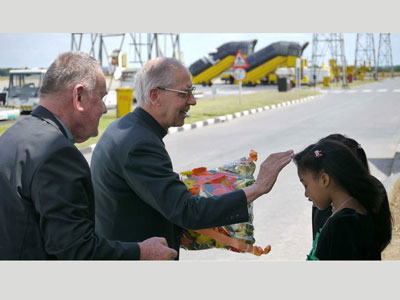
Father General received a warm welcome by the Provincial, Fr. Emmanuel Mumba, Fr. Klaus Cieszynsk , the honorary chaplain at the airport and Fr. Charles Chilinda, the director of Loyola Productions, on his first ever visit to Zambia-Malawi Province.

The young girls presented him with flowers. He is attending the Conference of Jesuit Major Superiors of Africa and Madagascar (JESAM) before visiting other missions in Southern Africa.

A Gratitude Deficit


God Finds Us

by Jim Manney

Ignatius thought that a particular type of ignorance was at the root of sin. The deadliest sin, he said, is ingratitude. It is “the cause, beginning, and origin of all evils and sins.” If you asked a hundred people to name the sin that’s the origin of all evils, I’ll bet none of them would say ingratitude. They would say pride or disobedience or greed or anger. The idea that we sin because we’re not sufficiently aware of God’s goodness probably wouldn’t occur to too many people.

By emphasizing gratitude, Ignatius was saying something about the nature of God. God is the generous giver, showering us with blessings like the sun shining on the earth. If we truly understood this, we would return God’s love with love. We wouldn’t sin. Gratitude is a good word for this fundamental quality of our relationship with God. Ingratitude, our blindness to who God truly is, is thus the root of all sin.

Ignatius had a particular experience of sin that may have contributed to the high value he placed on gratitude. For a time, he was tormented by morbid scrupulosity. He didn’t think his sins had been forgiven, so he tried to drive out his guilt and shame with heroic ascetic practices. He fasted, he prayed for hours, he let his hair grow-but these things only made matters worse. It got so bad that he entertained thoughts of suicide. Eventually, Ignatius threw himself on God’s mercy and found peace. He saw himself as a sinner but as a loved sinner.

In his short story “The Repentant Sinner,” Leo Tolstoy tells of a man, a great sinner, who calls out to God for mercy just before he dies. He arrives at the gates of heaven, but they are locked. The apostle Peter explains that a sinner such as he can’t enter heaven, but the man reminds Peter of his sins-he denied Christ three times after swearing to be loyal. Peter goes away and is replaced by King David, who also says that sinners can’t enter heaven. The man reminds David that God had mercy on him despite his many sins, including adultery and murder. Finally the apostle John arrives. You are the beloved disciple, the man says. You wrote that “God is love” and “Brethren, love one another.” Surely, you must let me in. And sure enough, John embraces the man and escorts him into heaven.

That’s the purpose of the first week of the Exercises-to bring us to see that we are loved sinners. Seasoned preachers and speakers know that they’ve done a good job if people can take one idea away from their talk. If you take one idea away from the Spiritual Exercises, this is the one: you are a sinner who is loved by God.

Adapted from God Finds Us: An Experience of the the Spiritual Exercises of St. Ignatius Loyola.

By deeds and words


Pope Francis

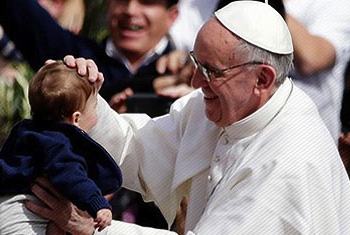
From his very first words as Bishop of Rome, our new Pope Francis revealed a gracious respect for the religious belief, freedom of conscience and dignity of each person – values and behaviour so essential for Christians in Asia Pacific. His first blessing was a simple, modest acknowledgement of the conscience of each person: “Since many of you are not members of the Catholic Church, and others are not believers, I cordially give this blessing silently, to each of you, respecting the conscience of each, but in the knowledge that each of you is a child of God. May God bless you!”

His choice of the name Francis speaks to a desire for peace, for reconciliation with creation and for respect of the poor. “For me he is the man of poverty, the man of peace, the man who loves and safeguards creation. In this moment when our relationship with creation is not so good – right? – He is the man who gives us this spirit of peace, the poor man … Oh, how I wish for a Church that is poor and for the poor!”

Francis of Assisi reportedly urged his followers, “Go into all the world and preach the Gospel. And, if necessary, use words.” It appears that Pope Francis is similarly encouraging by his first actions as much as by any words, reminding us of the calling of the Church today. He is demonstrating what every Jesuit knows from the Spiritual Exercises – that “love ought to manifest itself more in deeds than in words” (Spiritual Exercises, No. 230). As Jesuits, we are committed to serving others “by the ministry of the word, by spiritual exercises and works of charity”.

Pope Francis has chosen the motto “Miserando atque eligendo”, meaning lowly but chosen; literally in Latin ‘by having mercy, by choosing him’. It is the motto he chose as Bishop, and is taken from the homilies of the Venerable Bede on Saint Matthew’s Gospel relating to his vocation: “Jesus saw the tax collector and by having mercy chose him as an Apostle saying to him: Follow me.”

In his homily at his inauguration, Francis urged his listeners to care for creation, for one another and for our own selves. As we conclude our Lenten waiting, a time of inner silence and preparation, let us give thanks for the encouragement and insight revealed in the words and actions of Pope Francis.

Mark Raper SJ
President, Jesuit Conference of Asia Pacific
March 26, 2013

Jesuit Reflects on His Friend, Pope Francis


Jesuit Reflects on His Friend, Pope Francis

Jesuit Father Hernán Paredes studied at Colegio Maximo San Jose in Buenos Aires, Argentina, as a Jesuit in formation when Pope Francis, then Jesuit Father Jorge Mario Bergoglio, was the rector and spiritual director. Fr. Paredes, a native of Ecuador who currently teaches at Loyola School in New York City, shared his thoughts on the election of his friend in an interview that will be published in an upcoming issue of JESUITS magazine. Excerpts of the interview follow:

How did you learn of the election of Pope Francis?
I was attending a Broadway show with Loyola School freshmen. At intermission, a student told me there was a new pope but he couldn’t pronounce the name. He showed me the news story on his phone. I cried and prayed for my friend. It did not surprise me that he asked for prayers from the crowd when he first appeared on the balcony after his election. He always asked for prayers, even in his e-mails.

What can you tell us about his influence in your life and vocation?
I am very lucky to have had him as my superior and spiritual companion and to call him a friend. I’m a Jesuit some 30 years because of him. I learned from Jorge … to be humble, practical and available. He wants priests who are faithful to God and willing to serve.

It did not surprise me that his formal installation as pope took place on Saint Joseph’s Day, when we honor a humble and faithful servant of God. As his installation approached, I traveled to Belize with 10 Loyola faculty members and administrators to build homes for the needy. That is the way Pope Francis would have wanted me to celebrate his installation.

What are some of the characteristics and gifts that Pope Francis brings to the Church?
Pope Francis is a man who stands for and with the poor. He knows the poor by name, and I have witnessed this many times. Last year, I visited him in his office in Buenos Aires. Later in the same week, I visited a friend’s home in a poor barrio. Our friend praised then Cardinal Bergoglio for giving what money he had to help. He is known for his humility and generosity. Jorge was the community’s superior but he served others in so many ways, including cooking on Sundays for the scholastics.

What does his election mean for Latin America and the Church?
It’s overwhelming. We are the Catholic Church, and the word catholic means universal. I’ve received calls from people around the world, in the United States, Ecuador, Argentina and many other places, and they are so very happy. … Long life to Pope Francis, the pope of the poor!

Kabina’s Cry: Why Building a House on Rock Doesn’t Mean Rain Won’t Fall

Bookmark and Share


by Rev. James Martin, S.J.

Catholic priest and author of ‘The Jesuit Guide to (Almost) Everything‘ 

Editor’s Note: Huffington Post Religion has launched a scripture commentary series, which will bring together leading voices from different religious traditions to offer their wisdom on selected religious texts. Next month we will have Muslim commentaries for Ramadan, and in September Jewish commentaries for the High Holidays. Each day this week we will have commentaries on the Gospel featuring reflections by Rev. Jim WallisDr. Serene JonesDr. Emilie TownesSister Joan Chittister, and Rev. James Martin, S.J. They will all be offering their meditations on the same passage from Matthew 7: 24-27, in which Jesus says:


24Everyone then who hears these words of mine and acts on them will be like a wise man who built his house on rock. 25The rain fell, the floods came, and the winds blew and beat on that house, but it did not fall, because it had been founded on rock. 26And everyone who hears these words of mine and does not act on them will be like a foolish man who built his house on sand. 27The rain fell, and the floods came, and the winds blew and beat against that house, and it fell — and great was its fall!

What’s a parable? Hard to say. Like the form itself, the word is notoriously hard to pin down. My favorite explanation comes from the Protestant Scripture scholar C. H. Dodd, who defined a parable as “a metaphor or simile drawn from nature or common life, arresting the hearer by its vividness or strangeness, and leaving the mind in sufficient doubt about its precise application to tease it into active thought.”

In other words, a parable is a kind of poetic answer. In his ministry on earth, Jesus of Nazareth favored the parable style, particularly when responding to difficult questions. Whereas a strictly worded definition or precise answer can close down people’s minds, a story, a metaphor or a parable opens them up. And that’s what we see in the story of the two builders: one who builds his house on rock, the other on sand.

Unlike many other parables which left the disciples scratching their heads, this one, which comes during the Sermon on the Mount in Matthew’s Gospel, is straightforward. If you act on Jesus’s words (not just listen but act on them) you’ll be like the fellow who builds on rock. Your life will be steady, unshaken, permanent. Notice that Jesus does not say that you won’t encounter any storms in your life. The one who builds on rock still has to face the rains and the winds. Believing in God, and acting on Jesus’s words, does not guarantee that your life will be free of suffering.

That goes against the grain of much of contemporary Christianity, which says that if you believe in Jesus your life will be one of ever-greater success and comfort. In other words, free of suffering. Just looking at the great Christians of our age shows how false that is. Did the Rev. Dr. Martin Luther King, Jr. suffer because he somehow had insufficient faith? Did Mother Teresa suffer because she didn’t act on Jesus’s words? More to the point, did Jesus suffer because his belief in God was inadequate? No. Suffering is part of everyone’s life — from the devout believer to the doubtful seeker.

But, as Jesus says in this parable, following the word of God means that the suffering will not shake you.

When I worked with refugees in East Africa in the mid-1990s I knew someone who had built his house on rock. By the time I had met him, Kabina, a refugee from Ivory Coast, had already led a difficult life. At one point, fleeing from West Africa into East, seeking a better life, he was pursued by police — since he had no papers — into a Kenyan game reserve. Running through the thorn trees that dotted the arid landscape, he told me, his clothes were virtually torn off. In desperation Kabina knelt in the dirt and cried out to the one who was at the center of his life: “Help me God,” he said, “I have nothing!”

In time, he made his way to Nairobi, where the Jesuits sponsored him in a micro-financing project, and he was able to start a small business. Though he knew he was in danger, he said, he also knew that God was with him. Kabina would never say that his life was free of suffering. But he knew who his foundation was.

Our culture encourages all of us — me included — to build our psychic homes in the wrong kinds of ground. Our foundations are sometimes status, money and power. But Jesus knew the ultimate emptiness that comes when we build on those unstable soils. The same kind of sadness that came to the foolish builder, who watched his house swept away, probably cursing himself as it did so.

Christian teachings are often seen as overly restrictive. Here, however, they are shown in all their beauty. Jesus offers us parables not to browbeat us with rules, but to invite us into a life that is not without suffering, but filled with joy. The only thing we have to do is build in the right place.

James Martin, SJ, is a Jesuit priest, culture editor of America magazine, and the author of The Jesuit Guide to (Almost) Everything.

Wisdom Story 54


by Paul Brian Campbell, S.J.

Mulla Nasrudin was invited to solve a long dispute between three feuding families. Each head of the family recounted the history of the dispute in considerable detail and each ended by saying, “And I am certainly right.”

Afterward, Nasruddin was asked to judge who was telling the truth. He thought for a moment and then said, “What is the problem if you are all right?”


Overcoming Our Temptations


by Becky Eldredge

What is a temptation, really? We make feeble attempts with ardent effort to overcome our temptations during Lent, but what is it we are really trying to overcome?

We are trying to overcome those things in our lives that hinder our relationships with God and prevent us from putting God first. So often we try to decide for ourselves what is right or wrong for us without any thought of God’s will for us. We naturally turn first to our desires for fun, to our inclinations for busyness, to food or alcohol for comfort, and to others for company.

God often comes behind these things in our thinking and often is not even considered as the source that can calm all of the chaos and desires in our lives. Instead, we put our human desires first, and we find ourselves in a state of restlessness, tiredness, or desolation. We feel lost as to the problem but also to the solution.

When it comes to deciding what is right or wrong for us, we can look to Jesus as our teacher. Jesus was led by the Spirit into the desert and leaned heavily on his Father during his time there. It is only with his Father’s help that Jesus was able to overcome the temptations presented to him by the devil. Jesus surely felt the desires of his humanity in the desert—hunger, pride, and power. How ardently he must have fought against his human desires! How weak he must have felt! Jesus understood, though, that his strength to overcome temptations came by turning to his Father and letting God help him decide what was right and wrong for him.

This Lent, we are invited to make that same bold turn toward God. And we do not make this turn alone. Both Jesus and the Spirit are here helping us as we turn to God to give us the strength and wisdom to overcome our temptations.

My God? – eRenlai Newletter April 2013


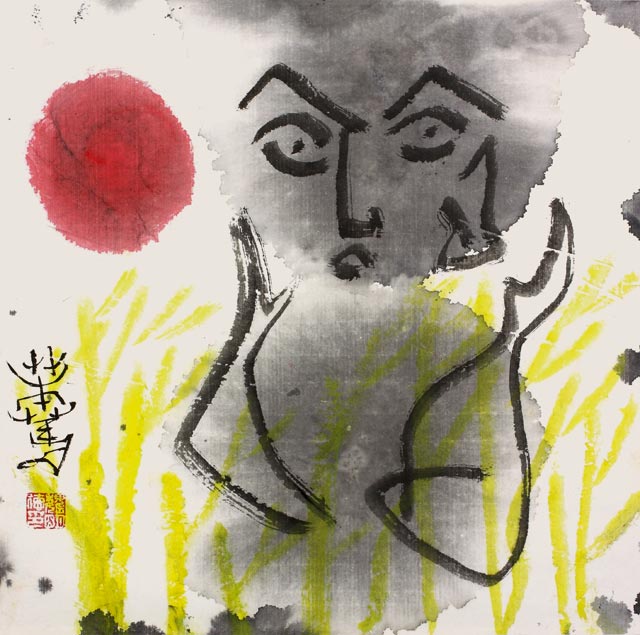
Illustration by Bendu

by eRenlai team

Taiwan is often cited as one of the most tolerant states in terms of religion so this month eRenlai decided to approach the topic of personal faith from a variety of perspectives, to examine the differences in beliefs that appear nominally the same, and the rich diversity behind umbrella terms like “Buddhism”, “Atheist” or “Christian”, which give the illusion of uniformity to our personal gods, or indeed our individual conception of the world.

First we look at how different people have come to their beliefs or lack of beliefs – whether through reason or by a more spiritual approach. We then look at what faith means for these people, whether it means living faith in a higher being or simply faith in human perception. Following on from this we examine the different ways that people, believers and non-believers conceive of the world around them, and how their faith or lack thereof goes to shape this; how they imagine god in terms of physcial shape; how they interact with God; if their morality is shaped by their belief or lack of belief; and what it is like to be religious in Taiwan.

In editos this month, Antoine Lemaire attempts to spread awareness of the serious problems arising in Papua New Guinea due to increasing HIV infection, and how to combat the resulting social inequalities. Also within the realm of international cooperation and communication is Fabrizio Bozzato’s article describing the ways Taiwan might work to achieve a more prominent status in the international community. In March 2013, Taiwan was indeed under international scrutiny as a panel of experts was sent to the island to examine the country’s complying with the UN covenant signed in 2009; here, Caterina Pavese, our new volunteer at eRenlai, reports on the discussions and debates. Former eRenlai coworker Maddy King discusses her life in Taiwan and tells us all she has learned and experienced in her brief stint on the island. Also discussing his life here is Fernando Luis Barreto Mercado who tells us his Jesuit story from the beginning and ponders what it means to be a brother in Taiwan. Benoit Vermander continues to discuss church matters as he puts the previous Pope’s mandate into perspective and praises his vision. Jin Lu also writes in praise, but hers is directed towards readers, and highlights the importance of standing on the shoulders of giants before attempting one’s own work. Finally, Sodom Chen also discusses work, the sacrifices it demands and the way it affects our everyday relationships.