

Author: cfliao


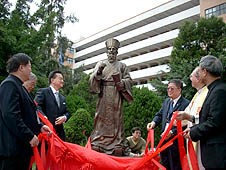
Guests unveiling the bronze statue of Father Matteo Ricci
TAIPEI (UCAN) – More than 90 scholars will present papers at Fu Jen Catholic University in a four-day symposium to commemorate the 400th anniversary of the death of Jesuit Father Matteo Ricci.
More than 300 participants from around the world, including 25 from mainland China, gathered on April 19 to discuss East-West dialogue in terms of philosophy, history, religion, culture, science and education.
Father Ricci, an Italian missioner commonly known as Li Madou to Chinese people, was praised for his promotion of dialogue between the East and the West.
Chen Fang-chung, symposium spokesperson, told UCA News organizers had invited some mainland Church people who are involved in cultural research. They hoped this could enhance and deepen cultural exchanges between mainland China and Taiwan.
Larry Wang Yu-yuan, Taiwan’s ambassador to the Holy See, told UCA News it was good to see the mainland participants coming.
There should be more cross-straits exchanges in the academic and religious circles, especially for the Catholic Church, and not just exchanges focusing on the economy, he said.
Wang was among the guests who made opening addresses for the event.
Others included Father Barthelemy Adoukonou, secretary of the Pontifical Council for Culture, and Cardinal Paul Shan Kuo-hsi, retired bishop of Kaohsiung in southern Taiwan.
A ‘master’ of intercultural dialogue
In his speech delivered in French, Father Adoukonou said that FatherRicci was, in fact, not a messenger of culture but a messenger of evangelization.
“However, a good missioner should be a man of culture in the first place. Ricci was a model in both aspects,” he said.
Father Adoukonou said that, as an African, he saw the theme on dialogue as very important for the times. Cultural exchange could bring about a new kind of humanism, he said.
Father Ricci was “a master of intercultural dialogue.” Living in a globalized world, people these days should inherit what he has done, he said.
Cardinal Shan said in his speech that 400 years ago, Father Ricci had achieved the principles of interreligious dialogue as proposed in the Second Vatican Council, namely “mutual respect, mutual understanding and cordial cooperation.”
“The secret to Ricci’s success” was respecting Chinese culture without blindly following it and humbly introducing Western science and technology to China.
This went against the culture of empty talk among the Chinese scholars of his time, the cardinal said.
The international symposium also premiered a documentary film, Matteo Ricci, a Jesuit in the Kingdom of the Dragon, directed by Gjon Kolndrekaj.
Dignitaries unveiled a bronze statue of Father Ricci in front of the Ricci Building of Fu Jen.


Be Fearless, Be Joyful, Be Renewed
The Easter season – beginning on Easter Sunday and continuing for 50 days – is an opportunity for us to cultivate a spirit that defines who we are as Christians. So what does living the spirit of the Easter season mean in practical terms? Here are three concrete suggestions.
Live with Joy
Joy is a deep-down gladness that cannot be taken away, even in the midst of sorrow. The Passion and Resurrection of Jesus teach us that suffering is transformed through faith in the Risen Christ. With this faith, we are able to hold on to an enduring sense of joy even in the midst of the sadness we experience from the loss of a loved one, a failure to achieve an important goal, or a setback during recovery from an illness.
Live without Fear
The Resurrection teaches us that God can overcome anything, even death. When the Risen Christ appears to the women at the tomb and later to his disciples, his first words are “Do not be afraid!” (Mt 28:5,10) These words speak to our hearts, helping us cope with the fear from the loss of a job, a serious illness, or a crumbling relationship. Our faith allows us to trust that God can overcome our most serious problems.
Live with New Eyes
Easter means to live with a sense of newness. Just as the return of spring lifts our spirits and makes us feel like the whole world is new, the Resurrection of Jesus makes “all things new.” (Rev. 21:5) The Easter spirit is a spirit of renewal that enables us to show up at work with a positive attitude, to renew relationships that have been taken for granted, and to express appreciation and affection to those closest to us. It means to see the world through new eyes-God´s eyes.
We can use these 50 days to cultivate an Easter spirit that enables us to be truly Christian: embracing joy, living without fear, and seeing the world again-as if for the first time.
Related Products:
The Easter outfits are put away and the egg hunts are over, yet the joy of the Easter season remains. Try these creative activities to help children live out the spirit of Easter:
Grade 1: Song: We Know that Jesus is Alive
Grade 2: Joy for Easter
Grade 3: Messengers of Good News!
Grade 4: Special Prayers for Peace
Grade 5: Living Stones
Grade 6: Group Role-Play of “The Disciples Bear Witness”
Junior high: The Right Hand of the Father
Find more creative ideas in our online activity finder. You can search activities by age, grade, subject, and learning style.


NEW DELHI (UCAN) – A Jesuit school in the national capital became the first institution to experience the impact of India’s new law on universal education.
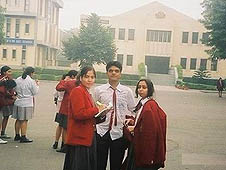
Students in front of St. Xavier’s School
On April 5, the Delhi High Court stayed the expulsion of a girl by St. Xavier’s School, citing the Right to Education Act.
The law that came to force on April 1 seeks free and compulsory education for students between 6 and 14 years of age and restrains schools from expelling students during this period.
With the new law’s enforcement, India became one of 135 countries to make education a fundamental right for its citizens.
The Jesuit school expelled Suman Bhati on March 27 after she failed her sixth grade exams. School regulations stipulate that a child who fails twice cannot continue in school. Bhati had failed in the fourth grade also.
The girl’s father asked the Delhi High Court to act against the school’s decision to expel her.
The court reportedly criticized the school management for taking unlawful action. It said the girl was expelled without considering how such an act would affect her. It asked the school to take back the girl.
School principal Father Jose Philip was not available for comment despite several attempts to contact him.
However, Jesuit provincial of Delhi, Father John Ariappilly, told UCA News April 6 that the school only followed its rules. The Jesuit superior said the school would respect the court order and take Bhati back. “We have to follow all the regulations of the new act,” he added.
Father Ariappilly says schools now are not required to make separate rules after the enforcement of the new law.
Father Kuriala Chittattukalam, secretary of the Indian bishops’ education commission, says the court order was hasty. “They have gone too fast. The Act came into force only on April 1. Implementation takes time,” the Salesian priest told UCA News.
The Church official maintained that the school had given the girl “a fair chance according to its rules.” Maintaining that the Church is willing to follow government laws, he asserted, “We are doing a good job and not harassing anybody.”


From the Curia
NEWS FROM THE JESUITS IN HAITI
We reprint a letter from Father Kawas François, S.J. to the French Canada Provincial, Father Daniel LeBlond, S.J., describing the condition of the Jesuits, their residences and apostolates in Haiti after the earthquake. The letter is dated Wednesday, 13 January 2010, the day after the earthquake. Father François is the French Canada Provincial’s Delegate for Apostolic Ministries in Haiti. Of course the situation remains critical and constantly changing.
Dear Daniel,
I will describe the present situation of the Jesuits in the area:
Ouanaminthe: Pedro Arrupe’s House and Apostolate (Solidarité transfrontaliére et Fe y Alegria) are not damaged. All Jesuits and lay colleagues fine. Communication by phone is impossible. I will remain in contact with them via the Internet.
Biassou: Karl Lévêque House is intact; the house was not damaged and the Jesuits are fine. The house next door was destroyed. The Jesuits are trying to rescue their neighbours.
Canapé-Vert: Ignatius Loyola House was slightly damaged and the Jesuits are fine though in shock. Houses in the neighborhood were damaged or destroyed. Father Sainfariste Dérino, S.J. was not at home at the time of the earthquake; we do not know where he is. We will try to locate him this afternoon. We are assisting our neighbors in need; many spent the night with us in the garden. We believe that Brother Charlot Mathurin, S.J. is safe in Dulagon, given that the Artibonite Region was not hit hard by the earthquake.
The Novitiate, Tabarre District, Port-au-Prince: The house was slightly damaged; the water tank on the roof collapsed and caused some destruction. The Jesuit Fathers, the first year novices and all the retreatants are well. The Rural Development Support Group (GADRU) house was destroyed. Jean-Marie and lay colleagues were able to escape from the house as the shaking began. They are safe.
As yet, we have not received news about the National Bureau of Solidarité Transfrontaliére et Fe y Alegria house on Lespinasse street,, Delmas 75, or the residence that houses the CEDAR on 27, 1st Avenue du Travail, Bois Verna. Soon, we hope to have some information.
Compared to what happened throughout Haiti and particularly in Port-au-Prince, the houses and apostolates of the Society of Jesus have largely been spared. We give thanks to the Lord and to Mary, venerated in Haiti under the patronage of Our Lady of Perpetual Help. We look forward to hearing news about our colleague Dérino.
Thank you and see you soon!
Kawas François, S.J.
Provincial Delegate for Apostolic Ministries in Haiti
N.B. Father General has sent an initial gift of € 20,000.00 from the FACSI Fund for emergency aid as he waits further information on exact needs and ways of giving assistance. Meanwhile, news has arrived that Father Dérino is alive but injured.
LETTER OF THE PROVINCIAL OF FRENCH CANADA
Les jésuites et l’aide à Haïti
The Jesuits and Aid to Haiti
Los jesuitas y la ayuda para Haití
Montréal, January 14, 2010
To all Provinces of the Society
and to all the companions who are expressing their solidarity with Haiti:
As Provincial of the Province du Canada français et d’Haïti, I first want to thank the Jesuits and the Jesuit organizations who manifested their solidarity in these times of trial in the capital of Haiti, Port-au-Prince. Thank you very much for your prayers and your desire to help.
I would also add that, right now, all the Jesuits of our Province who live in Haiti are safe, only one, Fr. Derino Sainfariste, has been hurt by a tumbling building. Our residences and works have been affected less than others although they will need some repairs and will have to get involved in helping the people they minister to.
And so, very concretely, if you want to contribute financially to the emergency efforts (we will do it through the JRS Republica Dominicana that confirmed its willingness to participate in this special effort), or to help the Jesuits in Haiti, please send your contributions:
To Missions jésuites (a bank draft with the mention: Haiti 2010), here in Montreal: 25, rue Jarry ouest, Montréal, Québec, Canada H2P 1S6
or go through the Roman Treasurer Office, asking to credit our account: GLC # 222701-6. Specifying clearly in the transfer: “Missions jésuites – for Haiti”.
[If you use the Roman channel, please send us an e-mail so that we could quickly make the funds available in Haiti, at [email protected]]
Thanks again for your solidarity; of course, we will keep you informed of the use of the funds.
With my best regards,
Your companion in the Lord,
Daniel LeBlond, S.J.
Provincial – Province du Canada français et d’Haïti


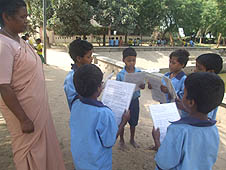
Sister Jagarani Toppo supervising students at St Xavier’s School in Gurap
GURAP, India (UCAN) – An innovative Jesuit system is revolutionizing education among tribal people in the eastern Indian state of West Bengal.
“All our children can now read and write in Bengali, and recite mathematical tables up to 10,” claims Father Amulya Kannanaikal, headmaster of the Jesuit-run St. Xavier’s School in Gurap, some 60 kilometers northeast of state capital Kolkata.
The Jesuit priest credited the Skills Targeted Academic Growth (STAG) system for the upturn in education standards.
STAG is an alternative method of teaching-learning his confrere Father Mongal Kumar Das developed among Santal tribal people.
Father Kannanaikal said his school introduced the system in March 2009 after it realized traditional classroom methods were not effective for Santal tribal dropouts and adult learners. The traditional system, he said, cares only for bright students.
The new system allows children to learn in peer groups with the teachers acting as facilitators. It helps identify each student’s intellectual capacity and group them accordingly. It then helps people learn reading and writing using small learning modules.
Father Das said he began experimenting with primary education in 1971. He said he kept improvising over the years the system of “ladder of learning” that allows each child to progress at his or her own pace. “This helped meet all the needs of the dropouts and adult learners,” the 79-year-old priest added.
Over the years, some 3,000 students have gone through his “integral system where one who is successful in learning teaches others,” Father Das said.
The STAG system teaches skills related to Bengali, English and mathematics. A child would usually take about one year to complete the course and get admitted to grades three or four in a formal school, he added.
The Gurap school took on 30 dropouts this year, all aged 8 to 12, Father Kannanaikal said. “Intelligent students have the opportunity to progress, instead of waiting for the entire class to finish its lessons,” he told UCA News.
Sister Jagarani Toppo, who teaches in the school, said the new system has generated greater determination among students to complete the lessons and proceed further.
The Charity of Jesus and Mary nun told UCA News she was surprised to see a 10-year-old learn 15 new words in an hour. The children progress at their own pace and even small ones compete with their seniors, she added.


JAKARTA (UCAN) – A Jesuit priest is backing a judicial review of a law which bans books deemed detrimental to public order.
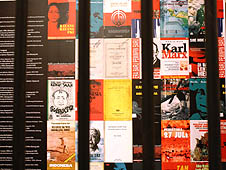
More than 40 books have been banned in the last 30 years since the law was ratified
A request for the review of the 1963 law was submitted in late February by several NGOs to the Constitutional Court. The first hearing was conducted mid-March, while the second was held April 5.
“This review must be done because the law was drafted under the Old Order regime and is no longer relevant to today’s context,” Jesuit Father Franz Magnis-Suseno, a lecturer at the Jesuit-run Driyarkara School of Philosophy in Jakarta, told UCA News April 6.
“The law must be revoked since it is contrary to the 1945 Constitution,” he added.
His book, Pemikiran Karl Marx: Dari Sosialisme Utopis ke Perselisihan Revisionisme (Karl Marx’s Thoughts: From Utopian Socialism to Revisionism Conflict), is one of 41 books banned under the existing law.
In April 2001, members of the Anti-Communist Front burned books regarded as leftwing, including Father Magnis-Suseno’s book.
“The book is not about Marxism,” Father Magnis-Suseno said.
According to him, banning books is against people’s fundamental rights, “which must be respected.”
The priest, however, agreed that books containing pornography and false allegations should be banned.
During the second hearing, Gatot Goei, lawyer for the NGOs, urged the court to review the law, which he said was contrary to articles in the 1945 Constitution guaranteeing people’s freedom to express their opinions and obtain information.
Goei said the 1963 law has allowed people to burn books and commit violent acts against authors. “In fact, people write books to develop the nation,” he remarked.
In his view, the law “is a betrayal of intellectual and democratic values.”
He urged the court to revoke the law, which has seen writers and readers “jailed or fined.”


Joe Paprocki, DMin, is National Consultant for Faith Formation at Loyola Press. He has over 25 years of experience in pastoral ministry and is the author of numerous books. He is also the father of two grown children. Joe shares why he enjoys The Story of the Cross. Watch the video here or click on the image below.
Holy Week is an opportunity for families to come together around the story of Jesus’ suffering, death, and Resurrection. I find The Story of the Cross: The Stations of the Cross for Children to be a wonderful introduction for young children to the delicate subject of Jesus’ death on the Cross.
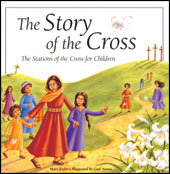
As a child, I remember being frightened by the life-size and very graphic statue of the crucified Jesus in the rear corner of my Church. Let’s face it: the topic of death is not something that parents are eager to expose their children to, and yet the story of Jesus is centered around his selfless suffering and death. The Story of the Cross enables parents to introduce their children to the events of Holy Week in an age-appropriate manner. The book begins by inviting children to first meet Jesus through the joyful story of his birth and then briefly describes his teaching and his invitation to love God and neighbor. It goes on to explain that some people did not like Jesus’ teaching and began to plot to have him put to death.
From this point on, The Story of the Cross becomes a reflection on each of the traditional Stations of the Cross while still retaining its storybook form. The illustrations creatively include children looking on with sad expressions on their faces, enabling parents to help their own children to deal with the emotion of this powerful story. Each station also includes a very short and simple prayer that parents and children can pray together. Beginning with the tenth station (Jesus is stripped of his garments), the illustrations offer a perspective of Calvary from a distance so as not to frighten children with graphic images of Jesus’ suffering. Instead, the focus is on the people sadly witnessing Jesus’ death. A fifteenth station is included, focusing on the joy of Jesus’ Resurrection. The concludes by describing how the Risen Christ appeared to his followers, “bringing life and love that will never end.”
I highly recommend The Story of the Cross for parents of young children as we enter into this holiest time of the year as Christians.


AHMEDABAD, India (UCAN) – Jesuit activists in Gujarat have criticized the recent arrests of two people who worked among tribal people in the western Indian state.
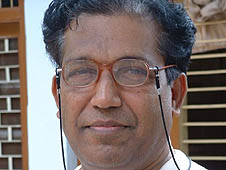
Father Xavier Manjooran
“It appears that to demand one’s legal rights and to be a terrorist is the same thing in Gujarat,” Father Xavier Manjooran, a member of the Adivasi Mahasabha (federation of tribal organizations) of Gujarat, told UCA News April 5.
The Jesuit was referring to the arrest of Avinash Kulkarni and Bharat Powar on March 21 on charges of being linked with Maoists who planned to wage war against the nation.
The two members of a labor union affiliated to the tribal federation have worked for the advancement of Gujarat’s indigenous people for the past 15 years.
On April 4, a tribal outfit held a big public meeting at Zankhvav in Navsari district and asked the government to stop arresting people under the pretext of cracking down on Maoists.
Father Manjooran condemned the arrests and pointed out that the two had played a significant role in making the federal government enact the Forest Rights Act in 2006 that gave tribal people rights over forest land.
Tribal people account for about 15 percent of Gujarat’s 50.7 million people.
‘Illegal arrests, tortures and murders‘
Father Manjooran also said the tribal federation condemned increasing incidents of illegal arrests, and custodial torture and murders. He alleged a state conspiracy to undermine tribal rights.
He also alleged police tortured Kulkarni and Powar in violation of Supreme Court guidelines for police officers making arrests. Even the judge asked the police to follow the guidelines when they presented the two for hearing, he added.
Father Manjooran demanded the government deal with human rights activists in a just and transparent manner.
His confrere, Jesuit Father Cedric Prakash, who directs a human rights center in Ahmedabad, Gujarat’s commercial capital, says the arrests indicated “a strong nexus” among the government, industrialists and powerful people to grab forest land by ousting tribal people.
“Anyone fighting for tribal rights and justice is being hounded, intimidated and harassed,” Father Prakash told UCA News. He hailed the arrested duo as “people totally committed to fighting for tribal rights.”
Another Jesuit, Father Jolly Nadukudiyil, said Kulkarni and Powar acted as spokespersons of poor tribal people and prevented their exploitation by state agencies and powerful anti-forest lobbies.
On March 22, an opposition member raised the matter in the state legislative assembly and described the arrests as “undemocratic and suppression of tribal” people.


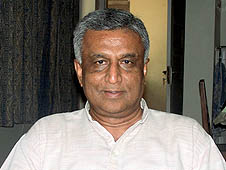
Father Edward Mudavassery
NEW DELHI (UCAN) – As the Indian government reportedly scales down its presence in Afghanistan amid growing security concerns, Jesuits say they will continue their work in the troubled nation.
“We cannot suspend our work here. We have made a commitment and we need to go ahead,” says Father James Kalapura, one of the Jesuit priests working in Afghanistan.
The Jesuit decision comes amid reports that recent attacks on its missions and staff have compelled the Indian government to close its operations in several places in Afghanistan.
“India may keep insisting that it is in Afghanistan for the long haul, but on the ground there are signs that it is gradually winding down its presence following persistent attacks on Indian interests there,” the Daily News and Analysis newspaper reported today.
Even Indian business people and NGOs have also reportedly left the troubled nation.
However, Jesuits and their collaborators, the major Catholic group present in Afghanistan, have no plan to retreat, says Father Edward Mudavassery, provincial of Jesuits in South Asia.
The priest, who heads more than 4,000 Jesuits in the region, says he is in “constant contact” with his people in Afghanistan. All his men and their collaborators not only want to continue there but also plan to expand their outreach programs to new areas, he added.
“I am convinced the spirit of the Risen Lord is strengthening and guiding our men in this difficult mission,” Father Mudavassery told UCA News today. He says his people “are well aware of the security situation there. I have made sure no one stays there under compulsion.”
Father Kalapura, who works in Herat province, “a comparatively safer place,” says the Jesuit team there goes about its work. “We are moving around freely as usual. We have not faced any threat yet,” he said and added, “but then anything can happen at any time in Afghanistan. This is a fact we have to live with.”
The Jesuit priest said the security of Indians in Afghanistan became “a major concern” after an attack on Indians in Kabul past February.
Even in Herat, the road in front of the Indian consulate is closed to traffic and the Indian Medical Mission suspended its activities indefinitely, the priest said in his letter to Father Mudavassery.
Father Kalapura said even the Indian vice consul in Herat sounded “much concerned and a bit frightened” after hearing about a Taliban plan to kidnap Indian diplomats in Afghanistan.


