

Author: cfliao
KATHMANDU (UCAN) – Knowing that somebody cares is a great pick-me-up for Sher Bahadur Gurung as he sits in a wheelchair enjoying the sun on a cold November morning.
St. Xavier’s Social Service Centre in Nakhipot, on the southern outskirts of Kathmandu, can accommodate 16 mentally and physically challenged men like Gurung, whom society has effectively discarded.
Gurung uses a wheelchair to move around the grounds, unable to walk due to a spinal problem and leprosy. “Whatever has been happening in my life is God’s will,” the Hindu man told UCA News on Nov. 13.
“This center has given me fresh hope of reuniting with my family,” said Gurung, who comes from Rupandehi district, 300 kilometers west of Kathmandu. His wife is working in Saudi Arabia, and their three young daughters live with her parents back home.
Gurung was working as a gatekeeper at a cinema hall when he was struck with yellow fever, which led to spinal problems. He then contracted leprosy while recuperating from the fever, he recounted.
The Jesuit-run center also looks after 85 poor and disabled boys at a separate facility nearby and runs Freedom Center, a rehabilitation facility for alcoholics and drug abusers. These services began in 1976 on the initiative of Jesuit Father Thomas Gafney, an American missioner who was murdered in 1997 in an unsolved crime.
Father Lawrence Maniyar, who heads the Jesuits in Nepal, told UCA News Dilip Kumar Toppo, a Jesuit seminarian, runs the facilities. Funds come from the Nepal Jesuit Society, occasional foreign donations and the small contributions some of the people using the services can afford.
According to Lal Bahadur Thami, 23, the nighttime caretaker of the men’s facility, some residents and former residents eke out a living selling cigarettes, tobacco and sweets on the streets.
“The center helps by training them to make envelopes, candles and chalk,” added Thami, who formerly lived at the Jesuit-run home for disabled and poor boys.
Every Sunday, groups of students from St. Xavier’s College in Kathmandu visit the men and organize recreational activities. Some take the men for short walks around the grounds, the caretaker related.
“This is to make the men feel they have people who care for them,” he said. “Protestant pastors also visit and talk to the inmates about Jesus Christ.”
Suresh Khadki, 33, feels the center has finally given him a “new lease on life,” but he longs to go back to his family in Kathmandu and live a normal life.
“I have done a lot of repenting here and back in jail,” said Khadki, who killed his father 15 years ago in a drunken rage and went to prison for it.
“My family members don’t want me back, while my fellow inmates at the jail once thrashed me so badly that I lost my mental balance and finally landed here,” he recounted.
Another inmate, Gorakh Thapa, a 39-year-old Protestant, told UCA News his hopes of him returning home have faded, but he thanks God and the Jesuits for being there for him when he “needed them most.”
“I heard my parents are no more, and I don’t know of any relatives who may be around, so I am happy here,” said Thapa, who was crippled by polio. He added that he has peace of mind now “in a society that looks down upon disabled and homeless people.”
Gurung too feels good when pastors visit him and pray for him. He said he hopes to become a Christian one day and lead a normal life with his family.
He recalled that a Christian neighbor back home told him his ailments would be cured if he went to church and prayed earnestly. “I started going to the church and have felt a lot better since then,” Gurung continued, with tears in his eyes.
Pastors at a Protestant church referred him to the center, he added, thanking God for this.
KATHMANDU (UCAN) – Knowing that somebody cares is a great pick-me-up for Sher Bahadur Gurung as he sits in a wheelchair enjoying the sun on a cold November morning.
St. Xavier’s Social Service Centre in Nakhipot, on the southern outskirts of Kathmandu, can accommodate 16 mentally and physically challenged men like Gurung, whom society has effectively discarded.
Gurung uses a wheelchair to move around the grounds, unable to walk due to a spinal problem and leprosy. “Whatever has been happening in my life is God’s will,” the Hindu man told UCA News on Nov. 13.
“This center has given me fresh hope of reuniting with my family,” said Gurung, who comes from Rupandehi district, 300 kilometers west of Kathmandu. His wife is working in Saudi Arabia, and their three young daughters live with her parents back home.
Gurung was working as a gatekeeper at a cinema hall when he was struck with yellow fever, which led to spinal problems. He then contracted leprosy while recuperating from the fever, he recounted.
The Jesuit-run center also looks after 85 poor and disabled boys at a separate facility nearby and runs Freedom Center, a rehabilitation facility for alcoholics and drug abusers. These services began in 1976 on the initiative of Jesuit Father Thomas Gafney, an American missioner who was murdered in 1997 in an unsolved crime.
Father Lawrence Maniyar, who heads the Jesuits in Nepal, told UCA News Dilip Kumar Toppo, a Jesuit seminarian, runs the facilities. Funds come from the Nepal Jesuit Society, occasional foreign donations and the small contributions some of the people using the services can afford.
According to Lal Bahadur Thami, 23, the nighttime caretaker of the men’s facility, some residents and former residents eke out a living selling cigarettes, tobacco and sweets on the streets.
“The center helps by training them to make envelopes, candles and chalk,” added Thami, who formerly lived at the Jesuit-run home for disabled and poor boys.
Every Sunday, groups of students from St. Xavier’s College in Kathmandu visit the men and organize recreational activities. Some take the men for short walks around the grounds, the caretaker related.
“This is to make the men feel they have people who care for them,” he said. “Protestant pastors also visit and talk to the inmates about Jesus Christ.”
Suresh Khadki, 33, feels the center has finally given him a “new lease on life,” but he longs to go back to his family in Kathmandu and live a normal life.
“I have done a lot of repenting here and back in jail,” said Khadki, who killed his father 15 years ago in a drunken rage and went to prison for it.
“My family members don’t want me back, while my fellow inmates at the jail once thrashed me so badly that I lost my mental balance and finally landed here,” he recounted.
Another inmate, Gorakh Thapa, a 39-year-old Protestant, told UCA News his hopes of him returning home have faded, but he thanks God and the Jesuits for being there for him when he “needed them most.”
“I heard my parents are no more, and I don’t know of any relatives who may be around, so I am happy here,” said Thapa, who was crippled by polio. He added that he has peace of mind now “in a society that looks down upon disabled and homeless people.”
Gurung too feels good when pastors visit him and pray for him. He said he hopes to become a Christian one day and lead a normal life with his family.
He recalled that a Christian neighbor back home told him his ailments would be cured if he went to church and prayed earnestly. “I started going to the church and have felt a lot better since then,” Gurung continued, with tears in his eyes.
Pastors at a Protestant church referred him to the center, he added, thanking God for this.
In a letter dated 19 October 2008, Father General shared with the Society the questions he and his Counselors have reflected on during the seven months since the end of General Congregation 35: what have we done with the new fire, the decrees and the new approaches to governance and mission. He also offered his “first impressions” of these months in which he has been learning about the Curia, Church life in Rome and the universal Society. He has visited a number of Cardinals in the Vatican with whom we work closely. Father Nicolás reports that his meetings were “pleasant and full of gentleness, respect and appreciation of the Society.”
A few days later, to mark the closing of the General Synod on The Word of God in the life and the mission of the Church, Father General sent another letter to the whole Society in which he noted the Society’s participation. Of the 253 Fathers of the Synod (Cardinals, Archbishops and Bishops) six were Jesuits, seven Jesuits were part of the group of 41 “experts” and 70 members of the Synod are graduates of the Gregorian University and Pontifical Biblical Institute.
On the 1st of November, Father General visited the “Alberto Hurtado Formation Center” in Naples and met with 50 young members of the Italian Province. The Center is located in one of the most run-down parts of the city, a place where Jesuits have worked for a number of years. The next day one of the local newspapers published an article written by Fr. Domenico Pizzuti (ITA). In the article he noted: “Father Nicolás is an authentic master of the spirit, enriched by the best spiritual tradition of the Society of Jesus and the encounter with Asian religions.”
In a letter dated 31 October, the feast of Saint Alphonsus Rodrigues, and addressed to all major Superiors, Father General announced the appointment of Fr. Anton Witwer, of the Austrian Province, as General Postulator of the Society and President of the Liturgical Commission. He succeeds Father Paolo Molinari, of the Italian Province, who was appointed to that position by Father General Janssens on July 31, 1957.
RUSSIA
On October 29 the Curia communicated to the Society the news about the violent deaths of two Jesuits in Moscow: Fathers Otto Messmer and Victor Betancourt. The funeral took place in the cathedral of Moscow on November 5; it was celebrated by the Archbishop of Moscow, Msgr. Paolo Pezzi, and concelebrated by the Apostolic Nuncio, Archbishop Antonio Mennini; the Archbishop of Astana (Kazakhstan), Msgr. Tomasz Peta; the Bishop of Saratov, Msgr. Klemens Pickel; the Apostolic Administrator of Kyrgyzstan, Msgr. Nikolaus Messmer, S.J. (brother of Fr. Otto); and the Bishop of Novosibirsk, Msgr. Joseph Werth, S.J. Ten Jesuits and approximately 50 priests and religious of other Congregations took also part in the liturgy as well as over 250 of the faithful. The Society has received many condolence messages and promises of prayers as a result of this tragedy.
After the funeral the bodies of Frs. Messmer and Betancourt were transported to Germany and Ecuador for burial.
The Russian press has reported the apprehension of a suspect and his confession. He has an arrest record and shows signs of being psychopathic. It is certain that the death of both Jesuits occurred on October 27 with a lapse of 15 to 17 hours between them. The police are continuing their investigation but the Society has not been given access to its findings.
Saddened by the violent death of the two Jesuits, the Society of Jesus renews its commitment to sustain the Jesuits and their apostolic work in the Region.
INDIA
Twenty two Jesuit lawyers and human rights activists from India and Sri Lanka met in New Delhi to mark the 6oth anniversary of the Universal Declaration of Human Rights. In the South Asian Assistancy there are 69 Jesuit lawyers, 15 of whom are practicing in various parts of the country. The rest use their legal knowledge to create awareness among people of their human rights. Of the 132 Social Centers mentioned in the catalogue of Jesuits in social action, approximately 15-20 are Legal and Human Rights Centers.
ROME
In collaboration with Notre-Dame University (USA), the Pontifical Gregorian University has announced an International Conference on Biology Evolution: Facts and Theories. A critical appraisal 150 years after “The Origin of Species”. The Conference, under the special patronage of the Pontifical Council for Culture, will be held 3 – 7 March 2009 at the Gregorian University. It is part of the “Science, Theology and Ontological Quest (STOQ) Project.”
 Tony O’Riordan SJ was quoted by the Irish Examiner for his advocacy of non-custodial alternatives to prison for women offenders. Using the JCFJ’s research into female prisoners, he pointed out that more than three quarters of them are being punished for ‘non-serious offences’, and are imprisoned for six months or less. “If, as is planned, the number of prison spaces in Thornton Hall is doubled so as to accommodate female offenders, it will discourage the search for alternatives to prison for women.” JCFJ has also brought out the November issue of Working Notes. Read below for a write-up of it.
Immigration Bill, Hidden Children, Agency Work, Prison Expansion, Justice in Recession
Five topics covered in the November Issue of Working Notes: In Recession who will be left Stranded?
 The editorial of the Jesuit Centre for Faith and Justice’s journal Working Notes, begins with a quote by L.P. Hartley, ‘The past is a foreign country: they do things differently there’. It is however ‘the present that feels like a foreign country’, retorts the editor.
The opening article ‘Justice in Recession: Statement on the Current Economic Situation’ juxtapositions the familiar past of economic prosperity, growth in personal wealth and job creation, with the economic uncertainty Ireland now faces. The need to think seriously about the values that will guide us through these difficult times was the core theme of the statement. It argues that social solidarity, a concern for the common good and care for the people who are vulnerable ought to underpin the policies and measures adopted in response to the current crisis.
The framing of legislation and the devising of policy are tasks of government that must go on in good times and bad: these tasks are the core theme of the remaining four articles in the November issue of Working Notes.
In an analysis of the Immigration, Residence and Protection Bill 2008, Eugene Quinn, sets the Bill’s provisions on asylum and protection in the wider context of international migration from the poorer to the richer parts of the world and in the context also of trends in asylum policy within the EU.
Over the past decade, more than 5,000 unaccompanied children from outside the country have come to the attention of the authorities in Ireland. Maria Corbett examines the response of the State’s asylum and child care systems to the needs of these children.
The consequences of Ireland’s failure to ensure adequate legislative protection for temporary agency workers – a group which grew rapidly during the economic boom – is the subject of an article by Brendan MacPartlin SJ.
In the final article, Daragh McGreal and Tony O’Riordan SJ argue that current plans to double the number of prison places for women are not supported by statistics on the crimes for which women are convicted. There are strong grounds, the authors conclude, for questioning government plans to increase the number of prison places for women.
Working Notes: In Recession who will be left Stranded, can be accessed at the Jesuit Centre for Faith and Justice website: http://www.jcfj.ie/.
 By Thomas F. Ryan , S.J.
Book No. 209007b
Pirce: NT$280 / 156 pages / ISBN: 978-957-546-609-1
In the era of Great Discoveries, China was an enigma to the world. The man who penetrated this inscrutable empire and deciphered for the West its code was Matteo Ricci. Ricci was a man of both gentle and indomitable character. He not only knocked open China’s tightly closed door, but he also built a bridge between China and western civilization. After mastering the latter’s mathematics, geography, astronomy, and other sciences, he flew to the Celestial Empire on the wings of Christianity. Thanks to Ricci and the Jesuit missionaries who succeeded him, perennial Chinese philosophy, culture and wisdom found their way to Europe. The encounter of these two civilizations was not without shocks and conflicts.
Ricci’s approach consisted of assimilating the culture of the place and integrating into one’s own life the thinking and the customs of the country adopted. Though he experienced setbacks and tribulations, sufferings and struggles, he nevertheless wrote an extremely fascinating page in the history of Church and culture by enabling the works of the Society of Jesus to flourish in China. Today while China is opening her arms to welcome the whole world, it is worthwhile to have a look at the history of the Jesuits in China and reflect on their experiences.
This book follows the story of Matteo Ricci and his successors through four centuries of dramatic developments in the history of China and Catholic Church.
By Thomas F. Ryan , S.J.
Book No. 209007b
Pirce: NT$280 / 156 pages / ISBN: 978-957-546-609-1
In the era of Great Discoveries, China was an enigma to the world. The man who penetrated this inscrutable empire and deciphered for the West its code was Matteo Ricci. Ricci was a man of both gentle and indomitable character. He not only knocked open China’s tightly closed door, but he also built a bridge between China and western civilization. After mastering the latter’s mathematics, geography, astronomy, and other sciences, he flew to the Celestial Empire on the wings of Christianity. Thanks to Ricci and the Jesuit missionaries who succeeded him, perennial Chinese philosophy, culture and wisdom found their way to Europe. The encounter of these two civilizations was not without shocks and conflicts.
Ricci’s approach consisted of assimilating the culture of the place and integrating into one’s own life the thinking and the customs of the country adopted. Though he experienced setbacks and tribulations, sufferings and struggles, he nevertheless wrote an extremely fascinating page in the history of Church and culture by enabling the works of the Society of Jesus to flourish in China. Today while China is opening her arms to welcome the whole world, it is worthwhile to have a look at the history of the Jesuits in China and reflect on their experiences.
This book follows the story of Matteo Ricci and his successors through four centuries of dramatic developments in the history of China and Catholic Church.
The XII Synod of Bishops on The Word of God in the Life and Mission of the Church has finished the second week of its deliberations and is facing the difficult task of drawing the final conclusions of the long process. Attendance at the daily sessions (morning and afternoon) and other events related to the Synod have left Father General with little room for other activities. In spite of it, he has kept an appearance of “all is normal” at the Curia. Albeit briefly, to meet the European Provincials who were meeting in Madrid, he even managed to fly to Spain on Saturday, October 18 at noon and get back for the morning session of Monday, October 20.
The members of the Synod have the possibility of addressing directly the assembly or submitting in writing their interventions. Father Nicolás chose the writing alternative and his intervention was published in the Official Bulletin of the Synod, on October 15. The text, original in English, follows:
In these days of the Synod we have heard a good number of those aspects that make the Holy Scriptures such a precious gift from God.
And yet we continue to feel that there will always be new or unanswered. The questions that reach us most often are of a pastoral character. The people of God continue to ask the pastoral question: How can we read the Scriptures so that they produce in us, in our hearts, in our families and in our communities all the good effects that Christian Tradition has proclaimed through the Centuries?
Allow me to address just one concrete aspect within the wider pastoral breadth of the question. This aspect is the so-called “Medicinal” or “Transforming” power of the Word of God. It is my conviction that the Word of God can claim in a high degree a “therapeutic” role in the life of the Christian community.
Every time we “enter” the World of the Bible, we are exposed to a New World: God’s World; God’s Action; God’s teaching of his people. The encounter, if real, can be shocking, surprising, enlightening, soothing or consoling. It can also be misunderstood and lost.
Thus the conditions of the encounter are all important. Pastors and Ministers of the Word have to become good helpers for good and fruitful encounters. We need to know where people really are (diagnosis); we need the skills for presenting the Word (teaching, preaching, biblical catechesis); we are expected to be good company in the search for depth (contemplation); and we are ordained or commissioned for good Christian leadership (service of love for community and Christian living).
Which means that Pastors and Ministers of the Word need training for good diagnosis, for wise application of forms of reading, for deeper prayer and interiorization of the Word of God, and for a meaningful accompaniment that helps the faithful discern the action of the Spirit in and through the reading of the Bible.
Since this is a fine skill that requires deep spiritual sense, adequate training and discerned commissioning, it seems highly needed that this training be included in the preparation for the pastoral ministry and in programs of ongoing formation for all Priests. Moreover all Parishes and/or Dioceses should have access to Centers or Trained persons that can offer this service to individuals or communities and who can train catechists and other lay ministers in this important service.
The Osservatore Romano of October 14 communicated that the Holy Father had appointed Father Adolfo Nicolás , Member of the Congregation for the Institutes of Consecrated Life and Societies of Apostolic Life.
In a letter of October 15 addressed to Fr. Ernesto Cavassa, President of the Conference of Provincials in Latin America (CPAL), Father General approved the selection of Centers at Belo Horizonte (Brazil), Santiago de Chile (Chile) and Bogotá (Colombia) as interprovincial Schools of Theology for the formation of Ours in Latin America. Father General noted in the letter his appreciation for the discernment carried out by the Provincials. He also underlined that other Theological Centers operating in various parts of the continent continue to have a full mission as apostolic works at the service of the local or regional Church.
Father General has appointed Father Giuseppe Bellucci, of the Italian Province, Director of the Press and Information Office. He replaces Father José M. de Vera, of the Japanese Province. Father Bellucci was associated with Popoli e Missioni (at present Popoli) since 1972, and became Director from 1976 to 1998. He will take office at the beginning of November.
Africa
The Jesuit Center of Research and Action for Peace (CERAP) in Ivory Coast opened on October 1st a School of Moral and Political Sciences modelled on the famous Institute of Political Sciences (IEP) of Paris. The West African School of Moral and Political Sciences offers a Master degree in “good governance”. The program has a core curriculum of political science, economics and law along with management and intensive English language courses. Its objective is to help students gain an education necessary to take over executive positions in their countries. Lectures on regional integration, migration, corruption and similar matters concentrate on the challenges that African graduates will have to confront. In the public announcement of its opening, the school communicated its aim to train men and women in regard to “how to make choices combining ethics, efficiency and performance with concern for the common good and respect for human dignity”.
East Asia-Oceania
The Jesuits in the seven Provinces and five regions of the Assistancy number 1686. The Province of Indonesia is the largest with 350 members followed by the Philippines with 305, Japan with 234, China with 187, Australia with 154 and Vietnam with 125.
Engaged in special studies are 75 Jesuits:
Theology: 20
Spirituality: 9
Philosophy: 6
Education, Psychology, Sciences: 5 in each field
Social Sciences: 4
Biblical Studies, Culture: 3 in each field
Canon Law, Communications, Management: 2 in each field
Catechesis, Religious Studies, Ethics, Agriculture, History, Labor Law: 1 in each field.
Rome
November 6-8, in the 50th anniversary of the death of Pius XII, the Gregorian University in cooperation with the Lateranense will hold a Congress on “The Legacy of PiusXII’s Teaching”. At the end of the congress the participants will be received by Benedict XVI.
The XII Synod of Bishops on The Word of God in the Life and Mission of the Church has finished the second week of its deliberations and is facing the difficult task of drawing the final conclusions of the long process. Attendance at the daily sessions (morning and afternoon) and other events related to the Synod have left Father General with little room for other activities. In spite of it, he has kept an appearance of “all is normal” at the Curia. Albeit briefly, to meet the European Provincials who were meeting in Madrid, he even managed to fly to Spain on Saturday, October 18 at noon and get back for the morning session of Monday, October 20.
The members of the Synod have the possibility of addressing directly the assembly or submitting in writing their interventions. Father Nicolás chose the writing alternative and his intervention was published in the Official Bulletin of the Synod, on October 15. The text, original in English, follows:
In these days of the Synod we have heard a good number of those aspects that make the Holy Scriptures such a precious gift from God.
And yet we continue to feel that there will always be new or unanswered. The questions that reach us most often are of a pastoral character. The people of God continue to ask the pastoral question: How can we read the Scriptures so that they produce in us, in our hearts, in our families and in our communities all the good effects that Christian Tradition has proclaimed through the Centuries?
Allow me to address just one concrete aspect within the wider pastoral breadth of the question. This aspect is the so-called “Medicinal” or “Transforming” power of the Word of God. It is my conviction that the Word of God can claim in a high degree a “therapeutic” role in the life of the Christian community.
Every time we “enter” the World of the Bible, we are exposed to a New World: God’s World; God’s Action; God’s teaching of his people. The encounter, if real, can be shocking, surprising, enlightening, soothing or consoling. It can also be misunderstood and lost.
Thus the conditions of the encounter are all important. Pastors and Ministers of the Word have to become good helpers for good and fruitful encounters. We need to know where people really are (diagnosis); we need the skills for presenting the Word (teaching, preaching, biblical catechesis); we are expected to be good company in the search for depth (contemplation); and we are ordained or commissioned for good Christian leadership (service of love for community and Christian living).
Which means that Pastors and Ministers of the Word need training for good diagnosis, for wise application of forms of reading, for deeper prayer and interiorization of the Word of God, and for a meaningful accompaniment that helps the faithful discern the action of the Spirit in and through the reading of the Bible.
Since this is a fine skill that requires deep spiritual sense, adequate training and discerned commissioning, it seems highly needed that this training be included in the preparation for the pastoral ministry and in programs of ongoing formation for all Priests. Moreover all Parishes and/or Dioceses should have access to Centers or Trained persons that can offer this service to individuals or communities and who can train catechists and other lay ministers in this important service.
The Osservatore Romano of October 14 communicated that the Holy Father had appointed Father Adolfo Nicolás , Member of the Congregation for the Institutes of Consecrated Life and Societies of Apostolic Life.
In a letter of October 15 addressed to Fr. Ernesto Cavassa, President of the Conference of Provincials in Latin America (CPAL), Father General approved the selection of Centers at Belo Horizonte (Brazil), Santiago de Chile (Chile) and Bogotá (Colombia) as interprovincial Schools of Theology for the formation of Ours in Latin America. Father General noted in the letter his appreciation for the discernment carried out by the Provincials. He also underlined that other Theological Centers operating in various parts of the continent continue to have a full mission as apostolic works at the service of the local or regional Church.
Father General has appointed Father Giuseppe Bellucci, of the Italian Province, Director of the Press and Information Office. He replaces Father José M. de Vera, of the Japanese Province. Father Bellucci was associated with Popoli e Missioni (at present Popoli) since 1972, and became Director from 1976 to 1998. He will take office at the beginning of November.
Africa
The Jesuit Center of Research and Action for Peace (CERAP) in Ivory Coast opened on October 1st a School of Moral and Political Sciences modelled on the famous Institute of Political Sciences (IEP) of Paris. The West African School of Moral and Political Sciences offers a Master degree in “good governance”. The program has a core curriculum of political science, economics and law along with management and intensive English language courses. Its objective is to help students gain an education necessary to take over executive positions in their countries. Lectures on regional integration, migration, corruption and similar matters concentrate on the challenges that African graduates will have to confront. In the public announcement of its opening, the school communicated its aim to train men and women in regard to “how to make choices combining ethics, efficiency and performance with concern for the common good and respect for human dignity”.
East Asia-Oceania
The Jesuits in the seven Provinces and five regions of the Assistancy number 1686. The Province of Indonesia is the largest with 350 members followed by the Philippines with 305, Japan with 234, China with 187, Australia with 154 and Vietnam with 125.
Engaged in special studies are 75 Jesuits:
Theology: 20
Spirituality: 9
Philosophy: 6
Education, Psychology, Sciences: 5 in each field
Social Sciences: 4
Biblical Studies, Culture: 3 in each field
Canon Law, Communications, Management: 2 in each field
Catechesis, Religious Studies, Ethics, Agriculture, History, Labor Law: 1 in each field.
Rome
November 6-8, in the 50th anniversary of the death of Pius XII, the Gregorian University in cooperation with the Lateranense will hold a Congress on “The Legacy of PiusXII’s Teaching”. At the end of the congress the participants will be received by Benedict XVI.
Channeling the Voices of Africa’s Lost Children
By CHARLES McGRATH
Published: July 3, 2008
 In 2004, when the Rev. Uwem Akpan applied to the graduate program in creative writing at the University of Michigan, his folder attracted a lot of attention. He was both a Nigerian and a Jesuit priest, and the program was unused to applicants from either category. And though Father Akpan’s talent was abundantly evident, if a little raw, Eileen Pollack, the director of the program, recalled recently, there was some hesitation on the part of the admissions committee. “There were discussions about having a priest be part of workshops where students would be writing about sex and drugs,” Ms. Pollack said.
Chester Higgins Jr./The New York Times
The Rev. Uwem Akpan, a Nigerian Jesuit and the author of “Say You’re One of Them.”
Related
Excerpt From ‘Say You’re One of Them’: ‘An Ex-mas Feast’ (June 27, 2008)
‘Say You’re One of Them,’ by Uwem Akpan: As Africa’s Horrors Rage, Suffer the Little Children (June 27, 2008)
But in the end Father Akpan was admitted, and he endeared himself, Ms. Pollack recalled, by showing up on the first day of class wearing a University of Michigan sweatshirt. “Everyone loved him,” she said. “It turned out he had had more experience of the dark side of the world than all the other students put together.”
Much of that experience is on display in “Say You’re One of Them,” Father Akpan’s debut collection of stories, just published by Little, Brown & Company and already attracting attention among critics and booksellers. “As translucent a style as I’ve read in a long while,” Alan Cheuse wrote in The Chicago Tribune, adding that the subjects “nearly render the mind helpless and throw the heart into a hopeless erratic rhythm out of fear, out of pity, out of the shame of being only a few degrees of separation removed from these monstrous modern circumstances.”
 Each of the book’s five stories (some are novella length) is set in a different African country, and each is told from the point of view of a child subjected to poverty, dislocation or worse. One story is about a Kenyan street family in which the breadwinner is a 12-year-old prostitute and the parents give their children glue to sniff because it’s cheaper than food and dulls their hunger.
In one story a brother and sister from Benin are literally fattened up and sexually initiated by an uncle who plans to sell them into slavery. In another a young Rwandan girl watches her father, a Hutu, kill her mother because she’s a Tutsi. The collection’s title comes from this story. “Say you’re one of them” is the mother’s final advice to her daughter.
Father Akpan, 37, is a big, cheerful man with a barrel chest and a ready, bubbling laugh. Over lunch recently at Merkato 55, an African restaurant in New York, he was relaxed and thoughtful, already thinking ahead to his imminent return to Africa and to his main job these days, teaching at a seminary in Zimbabwe.
“I’m very, very thankful,” he said about his literary success, and added that when he was first called by The New Yorker, which published the opening story in the collection, “An Ex-Mas Feast,” in its 2005 debut-fiction issue, he was so excited he jumped up from his seat. “I was so restless, so excited, that I walked one mile and a half to church,” he said. “But I still couldn’t sit down. So I said to God, ‘I’ll come back to you later.’ ”
Father Akpan is from the southern Nigerian village of Ikot Akpan Eda. His parents were both teachers, and his mother in particular insisted that he and his three brothers speak English as well as their native language, Annang. He grew up reading her abridged editions of Shakespeare and the Brontës but also listening to the village elders, who gathered after Mass every Sunday to drink palm wine and tell long tales.
He entered the Jesuit order at 19, and began writing about 10 years later, while he was still a seminarian. His original goal was to publish nonfiction and possibly get a column in The Guardian, a Nigerian newspaper, and when his submissions were turned down, he began writing for the paper’s Saturday fiction page instead.
By the time he arrived at Michigan, Father Akpan had several hundred pages’ worth of fiction stored in his laptop, thanks in part to his habit of working on several stories at once and revising them over and over. Even after this first book, he has hundreds more pages that he’s working on.
“I understood the major part of the puzzle — that there had to be suspense in a story,” he said. “But pacing, dialogue, characterization — I still had a lot to learn about fiction. But I kept pushing. I would go away from a story and then come back again. The style came very slowly.”
Ms. Pollack recalled: “He had so much to say, it was mostly just a matter of slowing him down. In the first version of ‘An Ex-Mas Feast’ he wanted to tell everyone’s story, not just the story of the two main characters. But he’s a very quick learner, and he knows what to be stubborn about not changing.”
From the beginning Father Akpan had an ear for African speech in all its variety — pidgin and patois and local dialects. His story “Luxurious Hearses” has people from all over Nigeria debating on a bus, and the result is an immensely pleasing cacophony in which people are characterized not so much by what they say as how they say it.
“Listen,” one character says, “dis foreign TV channels dey spoil de image of our country…. We no bad like dis. O.K., why dem no dey show corpses of deir people during crisis for TV? Abi, people no dey kill for America or Europe?” And another character shouts back, “You dey speak grammar!”
He wrote the story “Fattening for Gabon” in what he calls “the Queen’s English,” but then spent months on the Gabon border to pick up the French-tinged dialect there, which produces wonderful sentences like: “God done reward our faitfulness…. nous irons to be rich, ha-ha!”
“I try to listen,” Father Akpan said, shrugging, “and I try to really get into my characters. But a big part of this is mysterious to me when I get into the writing process. There are people who know their culture through and through and still can’t write about it.”
A great help to him, he said, was his order’s tradition of Ignatian spirituality, which encourages the visualization of certain biblical scenes — the Sermon on the Mount, say. “You try to imagine Jesus 2,000 years ago. You try to see the faces, picture the scenery. I used to really get into it, and I thought if I could imagine 2,000 years ago, surely I could do it for the contemporary world.”
He explained that he wrote the stories not just with an American and European audience in mind but also thinking of Africans. “The people in Nigeria don’t necessarily know what’s going on in Rwanda, and the Rwandans don’t know what’s going on in Nigeria,” he said. “You can live in Nigeria or Benin and not fully understand the evils of human trafficking.”
He added: “In church I can say: ‘Repent! Believe! Don’t steal!’ But fiction doesn’t work that way. It can’t be propaganda. When I’m writing, I have a sense that the characters are not aware of the audience. I like the reader to be eavesdropping.”
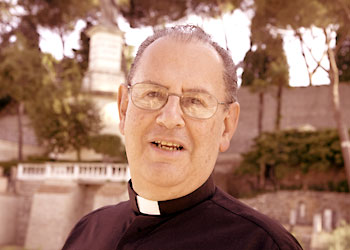
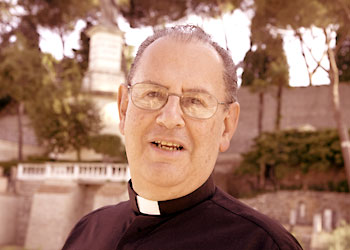 Bishop Rodrigo Mejía Saldarriaga SJ
Bishop Rodrigo Mejía Saldarriaga follows a tradition of Jesuit missionaries who went to Ethiopia in the very earliest days of the history of the Society of Jesus. This native of Colombia now serves a growing Church in the south of the country and faces challenges of multiple languages, limited resources and strong social problem-which he confronts with humor and patience.
Posted: November 7 | Listen now:
 MP3 file