

Author: cfliao
FATHER GENERAL
On February 20 Father General left the Curia for a visit to India; his first stop is Vidyajyoti College of Theology in Delhi before flying to Patna where he will visit the major houses and apostolates of the Province. Father Nicolás will next visit the Province of Poona; here he will participate in the meeting of the Conference of South Asian Provincials, in addition to visiting Jesuit houses and ministries. The final stops will be Goa and Mumbai; in Mumbai he will have a meeting with local Jesuits before returning to Rome on March 9.
CURIA
The Permanent Inter-Provincial Commission (CIP), chaired by Father General, met at the General Curia in Rome from February 16 to 19. These were four days of intense discussions. The agenda included meetings at the Pontifical Biblical Institute, the Pontifical Gregorian University and Collegio Bellarmino. Representatives of the Roman Houses of the Society participated in these meetings. The lived experience of these institutions was examined particularly from the view points of academics and finances. Discussion topics encompassed the questions of recruitment and retention of students and teachers. The Commission is composed of nine Major Superiors, representing every continent.
APPOINTMENT
Father General appointed:
Father Myles N. Sheehan, Provincial of New England Province. Fr. Myles was born in 1956, entered the Society of Jesus in 1985 and was ordained a priest in 1994. He was a member of Loyola University Jesuit community in Oak Park, Illinois.
Twenty-three Jesuit colleges and universities have been named to the 2008 President’s Higher Education Community Service Honor Roll. The Honor Roll included 635 colleges and universities in the United States and Puerto Rico. Nineteen Jesuit schools were named to the Honor Roll, and four more were named with distinction.
Now in its third year, the Honor Roll recognizes schools for their community service programs and student involvement. It is sponsored by the President’s Council on Service and Civic Participation, and the U.S. Departments of Education and Housing & Urban Development. Additionally, Campus Compact and the American Council on Education serve as partners. Last year, eighteen Jesuit schools were included on the Honor Roll.
Commenting on this achievement, Fr. Charles L. Currie, S.J., President of the Association of Jesuit Colleges and Universities, noted that the Jesuit commitment to educate women and men for lives of leadership, service and justice is central to the mission of these schools. He added that “this commitment is reflected in a wide variety of campus programs and projects sponsored by Jesuit colleges and universities, but most importantly, in the lives of graduates lived generously in service to their communities.”
The following AJCU institutions were listed on the President’s Honor Roll: Boston College, Canisius College, College of the Holy Cross, Creighton University, Fairfield University, Gonzaga University, John Carroll University, Loyola College in Maryland, Loyola Marymount University, Loyola University Chicago, Regis University, Rockhurst University, Saint Joseph’s University, Saint Louis University, Santa Clara University, Seattle University, Spring Hill College, University of Detroit Mercy and Xavier University. Georgetown University, Le Moyne College, Marquette University and University of San Francisco were named to the Honor Roll with Distinction.
For more information on the President’s Honor Roll, please click here.
CHINA: Predictions for Chinese New Year
On January 26 the Chinese people celebrated New Year. In a video-editorial of Renlai published on the web, Fr. Benoît Vermander, director of Ricci Institute in Taipei, declared that while it is always difficult to make predictions, he would venture three regarding China for the year of the Ox. They are: “Social conflicts in China will noticeably increase, due not only to unemployment but also to land-use and environmental issues; the relationships between China and Taiwan will continue to improve for the first half of the year, but accrued Chinese requests might cause renewed tensions later on; on a more optimistic note, the US and Europe might be able to engage China and encourage the reform of world governance, especially of financial markets. The Chinese leaders will take advantage of China’s clout in international affairs for securing more political space for themselves and, possibly, diffuse part of its social tension.”
BRAZIL: Meeting of Brothers
The Sixth National Seminar of Jesuit Brothers was held in Salvador, Bahia, January 25-31. On the agenda was the recent 35th General Congregation. A number of Jesuits presented and analyzed the various decrees in the context of the Jesuits and civil society in Brazil. Fr. Acrizio Vale Sales, Provincial of North-Eastern Brazil (BNE) introduced the study-week with a panoramic description of Jesuit identity and mission as well as with the presentation of lay collaboration related to the vocation of the Jesuit brother. Br. Raimundo Oliveira Barros, one of the brothers who participated in GC35, submitted a report on the reflections and recommendations made during General Congregation about the vocation of the Brother. Fr. Orlando Torres, Fr. General’s Counsellor for Formation, introduced the decree on obedience. Consideration also has been given to the proposal of a “Alphonso Month”, in order to help brothers to reflect on their vocation of service to the Church in the Society of Jesus. There were more than 30 participants, including brothers from neighbouring countries; their presence is a welcomed norm at these meetings.
BRAZIL-AMAZONIA: World Social Forum (WSF)
From January 27 to February 1 Belém do Pará (Brazil), one of the most important towns of Amazonia, will host the Ninth edition of the World Social Forum (WSF). For WSF it is a return to the country that was a founding contributor to the birth of this meeting and which hosted the first gathering in Porto Alegre. During these years WSF, both its world conferences and those at the local level, have offered the opportunity for social movements, development agencies, NGO, religious organizations and civil societies to meet, to confront and to share information and actions inspired to present an alternative economic model to neo-liberalism. This spirit is summarized in the WSF motto: Another world is possible.
As in the past, Jesuits were active participants in the WSF. In fact, Jesuits of the Brazil-Amazonia Region have organized a meeting called Fé’namazônia pré-forum on the theme Religious Faiths and defense of life in Amazonia. The meeting, held from January 24 to 27, examined the specific contribution that faith offers to social and political engagement both at individual and at group levels. The participants – Jesuits, colleagues, other religious, lay men and women from all over the world, have been helped in their reflections by the presentation of some striking experiences from Latin America, India and Africa, and from the speeches of three important speakers, Frei Betto, P. José Comblin and Marina Silva. The proposals produced by this meeting were presented at a seminar held during the WSF. The agenda included two other seminars organized by groups connected with the Society of Jesus, Fe y Alegría- Brazil, and SAPI – South Asian Peoples‘ Initiative.
Finally, on January 30, groups and individuals connected with the Society of Jesus came together for the Ignatian Day, a day of exchange and discernment on the theme of Reconciliation with Creation (CG 35a, Decree 3, nos. 31 ss.).
For further information: http://preforumfenamazonia.wordpress.com/
ROME: Red Javier Meeting
The meeting of Red Javier was held in Rome, January 12-13. On the agenda was the preparation of the calendar of activities for this year and to review the accomplishments to date. Red Javier is the European network of Non-Governmental Organizations (NGO) working in the field of international cooperation connected with the Society of Jesus. “It is an interprovincial collaboration”, says Dr. Marco Petrini, President of Magis, “born in 2002 from the desire to better operate at world level, to improve competences and peculiarities of everybody to work together and give new pulse to intercultural and interreligious dialogue.” Members of the network are: Magis (Italy), Alboan and Entreculturas Foundations (Spain), Leigos para o Desenvolvimento Association and Gonçalo da Silveira Foundation (Portugal), Jesuitenmission, and the Jesuit Mission Secretariate (Germany). These organizations are characterized by the unity of professional and voluntary engagement, the collaboration between lay and Jesuits and the promotion of intercultural and interreligious dialogue. For more information: www.magisitalia.org
THAILAND: New Director Union of Catholic Asian News (Ucanews)
Fr. Michael Kelly, an Australian Jesuit, is the new director of Ucanews (Union of Catholic Asian News), the Asian Catholic News Agency which has its chief bureau in Bangkok, Thailand. He succeeds Fr. Robert Astorino, an American Maryknoll missionary and founder of the Agency. When Ucanews began in Hong Kong in 1979, it was staffed by three journalists and was able to send a few weekly reports in English; it has become one of the most important catholic news agencies in the world, with a permanent staff of forty professional journalists, 250 correspondents throughout Asia and national bureaus in many countries. There are editions in several Asian languages, including Cebuan (a language spoken in the Philippines), Indonesian and Vietnamese. Clearly the Internet has contributed to this expansion since the agency has invested heavily in recent years in this crucial resource. The appointment of Father Kelly signals the wish to continue in this direction, improving the multi-media character of the agency so as to be able to reach a larger audience, particularly the more remote areas of the Asian continent and to reach young people who are more attuned to these new technologies. A professional journalist and a long time contributor to Ucanews, Father Kelly for the past ten years, has been the executive director of resources management for the Church in Australia, position he will retain for the moment, along with his commitments to the Australian Province.
SPAIN: Charges Against the Alleged Murderers of El Salvador Jesuits and Colleagues
The Jesuits of the Province of Castille in Spain have issued a statement on the possible reopening of the trial against those who may have committed murder on November 16, 1989 at the Central America University (UCA) in San Salvador (ref. Electronic Service n. 12, November 21, 2008). The Spanish Jesuits say that, in agreement with the Jesuits of El Salvador, it is better that justice occur inside the country and not outside. The declaration states: “We are not in favour of the reopening of the case in Spain. Nevertheless, if the families of the victims (five of which were of Spanish origins) have the intention to start the trial at the Madrid tribunal, we note their legitimate right and in this case we are ready to offer necessary assistance.” At the Central America University in San Salvador six Jesuits, the cook and her young daughter of 15 years old were shot to death.
BILBAO: Deusto University
BURUNDI: First Anniversary
INDIA: Saint Xavier School and College
LUXEMBOURG: Meeting of Provincials and Treasurers
ROME: A New Blessed
VENEZUELA: Eight Young Boys Killed For a Motorbike
The victims, aged 4 to 20, some of whom were students and alumni of the Scuola Tecnica Santiago de Onia run by Fe y Alegría, suddenly found themselves attacked by soldiers. It appears the military was looking for a group that had stolen a motorbike and erroneously mistook the students for the thieves, without making the necessary inquiries.
It is yet a further demonstration of the level of violence present in Venezuela; this incident generated outrage and dismay throughout the country. The presumed perpetrators of these murders, all police officers, were arrested, and the government stated that everything will be done to guarantee an objective and fair trail. Manuel Aristorena, Director General of Fe y Alegría, working in the region with a program of peace education (Un corazón para la paz y la vida) declared in his message of solidarity for the families involved and to the school, “we ask for a clear description of the events and for justice, but we have no desire to seek revenge. The path of violence will never bring peace to us. It is necessary to continue to educate the heart of our students and representatives, since it is inside it that violence hides. This is in accord with the logo coined by Fe y Alegría for the new year: “chase away violence we have in our heart”.
BRAZIL-AMAZONIA: REFLECTION ON WORLD SOCIAL FORUM
As mentioned in our previous Bulletin, the ninth edition of the World Social Forum (WSF), took place in Belém do Pará (Brazil) from January 27 to February 1, with a total of 130,000 participants from 142 countries. They were representatives of social unions, associations, churches and non-governmental organizations (NGOs). After six days of meetings and discussions the Forum ended with a call for the 20 richest countries of the planet to reform the economic system that is shared with the poorest countries. We asked Fr. Sergio Sala, a student of theology in Belo Horizonte and who was at the WSF, to offer us some insights on the meeting.
First of all, which was the role of the Jesuits in this Forum?
In total 120 Jesuits, friends and collaborators, from 28 different countries, participated in the Forum; they took a very active role. On January 30th they held an “Ignatian Day” filled with many working sessions. Father Fernando Franco, Secretary for Social Justice, explained the evolution of Jesuit and their collaborators’ participation in the WSF; Father Roberto Jaramillo, Regional Superior, described the presence and mission of the Jesuits in Amazonia; this was followed by a period of exchange and discernment on the theme Reconciliation with Creation (GC 35, Decree 3, no. 31-35). In the afternoon we had a session on the theme Religious Faiths and Defense of Life in Amazonia (January 24-27); we prepared a message to the Society of Jesus, and the day ended with a fascinating Eucharistic celebration organized by indigenous groups of India and Amazonia.
How can be summarized the final message of the Forum?
The delegates’ conclusions can be summarized in three points: faith pushes us to social commitment and to political participation: this requires formation and militancy; faith contributes to a new model of development for the world; our network has to be improved because it shown to be indispensable for a critical analysis of reality and for a more effective strategy. Among the many proposals emerging from working groups, the assembly highlighted the following: 1) increase collaboration among universities and indigenous cultures; the hope is the creation of a new indigenous university of Amazonia, or at least the opening of new degree programs on environment and sustainable development in existing universities; 2) to strengthen the équipe, a group of lay and religious visiting indigenous populations via boats; 3) to cultivate a new creation spirituality which will bring to life the “ecobionomy”, as Frei Betto called the good administration of our life, of our world, of our relationship with God.
Indigenous people has played the leading role during the Forum and also in its final message
The protection of indigenous people has to be considered a commitment for everyone, first of all because a person should have his rights respected and secondly because the preservation of the rain forest is linked to their continuation. These folks have lived symbiotically with nature for centuries, while the rest of humanity preferred to react against nature and create a physical and cultural rift with the environment. We have to learn from them to respect and take care of Amazonia. Jesuits are understood to have an important insight: they have ministered to the indigenous people of Amazonia for a long time, and therefore have an important role to play in their defense. But this is something one cannot do all at once. From the novitiate onward, young Jesuits should be educated according to the new “ecobionomic” paradigm and our educational institutions should consider seriously the protection of Amazonia, which has become an apostolic priority both for the Society of Jesus and for the universal Church. It is not only a question of sending Jesuits to work there. It is necessary to work as advocates at various levels. To this end, the Secretariate for Social Justice, together with Ocipe, have organized a meeting among experts to draw up a declaration to prepare for this year’s UN Summit on environment in Copenhagen. For further information: http://preforumfenamazonia.wordpress.com.
 FATHER GENERAL
CURIA
APPOINTMENT

Father General visits Homeboys Bakery during his visit to the California province. | View slide show »»
[Photo: Fr. John Mossi SJ]
With Father General, Adolfo Nicolás in attendance, the California Province will begin to celebrate the 100th anniversary of its foundation. Italian Jesuits (from the Province of Turin) arrived in California from Oregon during the 1849 “Gold Rush”. After becoming independent from the Turin Province in 1909, the California Province quickly developed a distinct American identity and mission geared towards the needs of people living in the western United States. Today California Province serves an area comprised of Arizona, California, Hawaii, Nevada and Utah. In 1996 the Jesuits of California adopted four major apostolic goals which continue to guide them and their lay partners. These are: fostering partnership in our Ignatian mission; strengthening solidarity with the poor; responding to the diversity of our Province, and evangelizing contemporary culture.
During this centenary year, the Jesuits of California have underlined two apostolic priorities for the years ahead. The first is the improvement of the Jesuit Retreat Center of the Sierra in Applegate; it presently offers individuals and groups a special place to reflect, pray, learn and relax in a beautiful and tranquil setting. The center is committed to serving the spiritual needs of people of modest means who might not otherwise be able to go on retreat. The idea is to improve the services for groups, families and the young, in an atmosphere of simplicity and friendship. The second priority is the launch of Kino Border Initiative (KBI) along the Mexican border; it is the land the beloved “Padre on Horseback”, the Italian Jesuit Missionary Francisco Kino rode from 1687 to 1711, when no border between the United States and Mexico existed. The KBI is based on Nogales-Arizona, USA and Nogales-Sonora, Mexico, two cities which are the region’s major ports of trade, entrance and deportation.
On January 18th a new community was established; the four members are Jesuits belonging to the California, Mexico and New England Provinces. They will work in close partnership with Jesuit Refugee Service/USA, the diocesan clergy of Tucson and Hermosillo dioceses, as well as the Missionary Sisters of the Eucharist, to offer basic help to migrants deported from USA. “By making a concrete and visible commitment to the KBI”, noted Fr. John P. McGarry, Provincial of California, “the Society of Jesus is making a public and prophetic commitment to stand, with one foot on each side of the border, in a context of suffering, misunderstanding, humility and hope. Through the KBI the Province seeks to serve the Church by creating opportunities for pastoral formation, providing faith-based social analysis, and advocating for the protection of human rights and the common good.”
VATICAN CITY (UCAN) — The new Vatican YouTube channel will make information from the Holy See more accessible to the world, Pope Benedict XVI told thousands of pilgrims on Sunday, two days after the launch.
 Speaking in St. Peter’s Square on Jan. 25, he said new technologies had made the Internet a resource of utmost importance.
“Undoubtedly, the wise use of communications technology enables communities to be formed in ways that promote the search for the true, the good and the beautiful, transcending geographical boundaries and ethnic divisions,” he said. “To this end, the Vatican has launched a new initiative which will make information and news from the Holy See more readily accessible on the World Wide Web.”
He said he hoped the Vatican channel on the video-sharing website (www.youtube.com/vatican) would “enrich a wide range of people, including those who have yet to find a response to their spiritual yearning, through the knowledge and love of Jesus Christ.”
At a Vatican press conference on January 23, Jesuit Father Federico Lombardi said Vatican media understood the importance of getting their images, sounds and texts about the Pope and Vatican events onto the Internet.
“It is a wholly natural evolution, which corresponds to the presence of the Church in the world”, explained Father Lombardi, director of the Holy See’s Press Office.
The priest also directs Vatican Radio and the Vatican Television Center (CTV), which have been cooperating to produce video news available on the Vatican Radio website in different languages for 18 months. The new venture will reach beyond the regular Catholic audience to a global audience.
The channel offers video news of the pope and Vatican events through two-minute clips that are updated once or twice daily in English, German, Italian and Spanish. The channel’s homepage includes links to Vatican Radio, CTV and the websites of the Holy See and Vatican City State. YouTube also facilitates messaging.
“The launching of a channel like this is obviously the beginning of a journey,” Father Lombardi said, adding that significant developments were expected in cooperation with Google, which owns YouTube.
Henrique De Castro, Google’s managing director for media solutions, told the press conference that technology brings people together. About 1.4 billion people are already online, with more joining them every day, he said.
Sites like YouTube are enabling people to foster existing communities and create new ones around interests, issues and faith, at both local and global levels, he continued, saying more than 15 hours of material is uploaded to YouTube every minute.
“There has been a communications revolution, and video has become one of the world’s common languages,” he remarked. “(The Catholic Church) understands this opportunity, and has embraced it,” De Castro said, hailing the initiative as “a landmark announcement for YouTube.”
Referring to the evolution of the Vatican media from a 16th-century printing press to today’s multi-media approach, he described the new channel on as “a perfect combination of continuity and innovation.”
During the same press conference, Archbishop Claudio Maria Celli, president of the Pontifical Council for Social Communications, said the pope had personally approved the YouTube channel.
By choosing to appear online to viewers, he “is making a pilgrimage to the person in his or her room … to the heart of every person,” the archbishop said.
The pope also is making himself vulnerable by taking the risk of having his message distorted and abused, Archbishop Celli acknowledged, but he added that this is the path of incarnation, chosen by God who became man.
Monsignor Paul Tighe, the council’s secretary, said a revolutionized culture of communications is part of the world the new digital generation lives in.
The new technology and culture “have changed the ways people communicate, the ways they associate and form communities, the ways by which they learn about the world, the ways in which they engage with political and commercial organizations,” he said.
In the past, “we tended to see the reader, listener or watcher of media as a passive spectator of centrally generated content.” But today “we must understand the audience as more selectively and interactively engaging with a wider range of media.”
In a word, “the logic of communications has … radically changed,” Monsignor Tighe said.
LONAVALA, India (UCAN) – Good health is linked to faith in God, says an Indian physician who has studied the role of religion in medicine.
Religious involvement and doing good for others can help maintain one’s physical and mental health, S. Chattopadhyay told a recent Church-organized science seminar.
Chattopadhyay researched the relevance of religion and spirituality in medicine and bioethics for his master of bioethics program. He holds a doctorate from the University of Connecticut, in the United States, and presently teaches physiology at the Kalinga Institute of Medical Sciences in Bhubaneswar, in Orissa state, eastern India.
Neuroscientific Revolution, the Human Soul and Spirituality was the theme of the Jan. 1-5 seminar in Lonavala, near Mumbai, 1,410 kilometers southwest of New Delhi. About 200 people, including university professors, researchers and activists from India and abroad, attended the event.
The Indian Institute of Science and Religion (IISR), which Jesuit Father Job Kozhamthadam started 10 years ago, organized the seminar in collaboration with three colleges, a major seminary and a university, all in Maharashtra state. Mumbai is the capital of Maharashtra state.
In his presentation, Chattopadhyay spoke on Neuroscience and spirituality: beyond outright rejection and blind acceptance.
He said the human person cannot be reduced “to super-conscious matter” as asserted by some neuroscientists. Human beings are “not hard-wired for belief in God, but deep down, human beings hunger for God,” he said.
He also asserted that faith in God is beyond the intellect and is not something that can be measured. “But it triggers love, compassion, empathy, forgiveness, brotherhood and such eternal values among faith people.”
Faith in God, he said, has played a great role in healing some of the worst diseases suffered by people, such as cancer, and this has surprised doctors. “Also, studies have shown that religious people live healthier lives, and are generally happier.”
He noted that the World Health Organization had accepted spirituality as an important aspect of people’s quality of life.
The use of scientific tools to explore religious and spiritual phenomena and the knowledge thus acquired have evoked myriad responses, ranging from outright rejection to blind acceptance, he said.
“Much of modern biomedical research, including neuroscience, reflects reductionism theory, an approach to understand a system by reducing it to component parts.”
He said spectacular advances have been made using the reductionist scientific approach. However, such an approach cannot fully explain religious experiences, such as spiritual enlightenment achieved by spiritual leaders.
Such experiences, he added, cannot be researched and quantified on the psychological basis of the neuronal functions of the brain.
TAIPEI (UCAN) — Contracting polio as a missioner inspired American Jesuit Father Robert J. Ronald to dedicate himself to help others in Taiwan overcome the limitations of that and another disabling disease.
 |
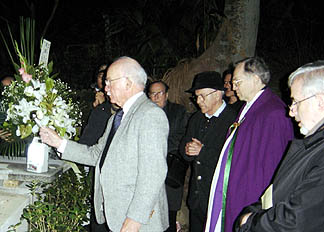
| Younger brother (extreme left) of deceased Jesuit Father Robert Ronald sprinkles Holy Water on the coffin during the burial at Chingshan Jesuit Residence in Changhua county on Jan. 10. |
Taipei-based Operation De-Handicap, which he founded in 1973, remains as a living legacy following his death at age 76 on Jan. 2. The funeral Mass was held on Jan. 10 at Jesuit-run Tien Educational Center in Taipei. His body was buried that evening at Chingshan Jesuit Residence in Changhua county, 145 kilometers southwest of Taipei.
Father Ronald, who contracted polio in Taiwan in 1958, a year after arriving as a seminarian to study Chinese, established Operation De-Handicap to empower youths with polio and muscular dystrophy to assume ultimate responsibility for their own rehabilitation. It also stresses the role of the family in this process.
Besides psychological and vocational counseling, it provides referral services for those who need medical equipment and social-welfare assistance. The center also organizes educational programs and recreational activities to help counselees build solidarity among themselves.
Father Ronald was born in the United States on Oct. 1, 1932, and entered the Society of Jesus in 1950. Polio, relatively common in Taiwan when it struck him eight years later, left him dependent on a wheelchair from that time.
This physical setback, however, did not stop him from serving the people of Taiwan. An obituary from Jesuit-run Kuangchi Program Service, which produces Catholic multimedia programs, quotes him as having once said: “I am healthy. More healthy than before polio even, just limited in local motion, that’s all.”
Father Ronald was ordained a priest in 1965 and returned to the United States three years later to work on a master’s degree in rehabilitation counseling. When he returned to Taiwan in 1971, he served as a consultant at Veteran’s Hospital in Taipei, a position he held until he retired in 2002.
People said they were often amazed at the “joyful disposition” of the priest, who often claimed that the “two greatest gifts he had received from God were his polio affliction and his car accident,” according to the obituary. Father Ronald suffered major injuries in that accident, which occurred in 1974. A year later, infection set in and doctors had to amputate his left leg.
Undaunted, he continued his work and was able to visit foundations and benefactors to support his organization through lecturing and fund-raising activities that included a 21,000-kilometer van trip across the United States.
 The missioner also produced manuals for people working with disabled people and their families, taught classes and workshops, and gave presentations at international conferences on rehabilitation throughout the world.
Ignatius Huang, director of Operation De-Handicap, who worked with the founder for 30 years, told UCA News on Jan. 13 that Father Ronald kept to himself but was always concerned about the needs of others.
The obituary also cites the priest’s care provider of the last seven years recalling how his own life changed through Father Ronald’s “kindness and patient companionship, always reaffirming and encouraging, never scolding, criticizing or complaining.”
Over the years, Father Ronald became recognized as an authority on rehabilitation in Taiwan. The prestigious Medical Contribution Award that the government’s Department of Health presented him in 2003 was one of many honors he received.
Although he seldom had the occasion to explicitly speak about God or the Church in his work, the obituary says he was well aware of the apostolic dimensions of his work. It quotes Father Ronald as having said, “My identity as a priest and as a Jesuit is nearly universally known and my motives respected.”
After his retirement, Father Ronald volunteered to edit English scripts for Kuangchi. In his final years, he became a prolific writer of editorials, poems and fables for the Jesuit Chinese monthly Renlai (flute of humankind), which publishes articles on social, cultural and spiritual issues for readers of all religions.
Kuangchi Program Service and the Guanachi Cultural Group, the radio-TV production center and the publishing house of the Jesuits of Taiwan, celebrated 50 years of service to evangelization. In 1958 Fr. Philip Bourret, S.J., an American Jesuit who had foreseen the great prospects mass media held in terms of social progress and evangelization, founded the Kuangchi Recording Studio (today Kuangchi Program Service), for the production of radio and TV programs. Taiwan television technology was then quite primitive, especially Catholic TV. Kuangchi began doing radio programs and building the technical capacity of what has become one of the largest production centers in the country. In 1961, ‘Kuangchi Cultural Audiovisual Program Service’ registered as a not-for-profit organization under Taiwan’s Ministry of Education. Its mission was to be a media production center dedicated to training professional broadcasting personnel and producing programs beneficial to society.
In the celebration of the 150th anniversary of the evangelization of Taiwan, the department of social communications of the Bishop Conference of Taiwan has asked the Kuangchi program Service to prepare a series of multimedia products (DVDs and CDs) for the apostolate of evangelization. Kuangchi Program Service’s productions have received numerous prizes for excellence, such as Taiwan’s coveted Golden Horse and Golden Bell awards. Among them are KPS’ science series-Summit and Mr. Science & Miss Technology; KPS’ children’s series-Remarkable Professor, Popcorn, and House Angels; and KPS’ documentary film on Cambodian refugees-Beyond the Killing Fields.
In half a century the people of Kuangchi Program Service and Guanachi Cultural Group have made a noteworthy contribution to social, cultural and religious education following the principles of truth, goodness and beauty.