

Author: cfliao
From Spencer Tracy to Ewan McGregorGuerric DeBona, O.S.B.
The future of priests on the silver screen is a good question to ask in this “Year of the Priest.” American film culture has maintained something of an ambivalent relationship with the Catholic priesthood, an institution that it has both revered and reviled. In the early days of sound film, the 1934 Production Code secured that all representations of religious figures “not be used in comedy, villains or as unpleasant persons.” Buoyed by New Deal optimism and middle-class sensibilities, the golden age of Hollywood made the Roman collar primarily an instrument of cultural stability, presenting priests as caretakers of wayward kids (Spencer Tracy’s Fr. Flanagan in “Boy’s Town,” 1938), heroic chaplains in the armed forces (Pat O’Brien’s Fr. Duffy in “The Fighting 69th,” 1940) and anchors of empathy and social reconstruction (Bing Crosby’s Fr. O’Malley in “Going My Way,”1944 and “The Bells of St. Mary’s,” 1945). Fr. O’Malley, in particular, struck a deep chord among American viewers during wartime, making both Crosby features number one at the box office for their respective years. If the Fr. Flanagan and Fr. O’Malleys of the studio period functioned as reassuring paternal figures to a troubled nation, then priests on film served practically the opposite purpose in peacetime, disclosing an America on the edge of monumental change, especially about attitudes towards sexuality and the establishment. When Fr. Barry (Karl Malden) is pelted with garbage during a sermon defending a murdered longshoreman in “On the Waterfront” (1954), we sense a culture already questioning its institutional allegiances. Fr. Logan (Montgomery Clift) is suspected of murder in “I Confess” (1953); an amorously conflicted and ambitious Fr. Fermoyle (Tom Tryon) is almost lynched by the Ku Klux Klan in “The Cardinal” (1963); Fr. Spellacy (Robert De Niro) in the underrated “True Confessions” (1981) winds up in a tiny desert parish dying of cancer, having been overly entangled in church and city politics. More recently, John Patrick Shanley’s adaptation of his Broadway hit, “Doubt” (2008), marks a fascinating terminus to this long line of “priest films” in Hollywood. In a way, “Doubt” and “The Bells of St. Mary’s” are like estranged twins, showcasing an evolution of a subgenre. Not unlike Fr. O’Malley, Fr. Flynn (Philip Seymour Hoffman) wants to modernize conditions at his parish, St. Nicholas, urging a new, open-minded inclusiveness. (Tellingly, the film is set near the end of the Second Vatican Council.) Both priests clash with a powerful nun. But the difference between the two clerics is striking: O’Malley has been cast as a priest-savior, Flynn as a potential menace to the church and society. O’Malley has come to the inner city not only to save a school, but also his erstwhile rival, Sister Mary Benedict, (Ingrid Bergman) gently informing her that the good woman has “a touch of tuberculosis.” Sister may be off to Arizona to recover, but no matter: anytime there’s a snag, “just dial ‘O’ for O’Malley.” By contrast, Sr. Aloysius (Meryl Streep) is convinced that Flynn has come to radicalize her territory with a progressive theology and worse, to prey upon young children-particularly a needy, sexually ambivalent African-American boy. In effect, Sister Aloysius, a kind of feminist sage for the early sixties, subverts any efforts Flynn might make to play the redeemer, doggedly steeling herself from his pleading siren song. “Where’s your compassion?” he asks her. “No where you can get at it,” she tells him. In the end, “Doubt” deprives the audience of precisely the kind of comfort provided by priests like O’Malley: the need to know that there was someone who would take care of things and make the world a more secure place. The potent “doubt” we are left with at the end of the film is a reminder that priests are not messiahs but flawed (and sometimes tragic) human beings who nonetheless seek to bring faith, hope and love to their congregation. European cinema has been better at acknowledging the complexities of the priesthood. “Diary of a Country Priest” (1951) reveals the very unheroic life and death of a curé (Claude Laydu) whose personal suffering and loneliness become instruments of grace. The film is unafraid to depict a minimalist priesthood, stripped of its glamorous ties to power, prestige and otherworldliness. The British film “Priest” (1994) explores with considerable depth the homosexual awakening of Fr. Greg (Linus Roach) and its attendant consequences after he hears a confession of a girl being abused by her father. “Priest” is particularly good at using a prime activity of priesthood (the sacrament of reconciliation) as a plot device, an aspect that other priest films often overlook. Also, the ending features an ecclesial moment that few movies of this type can boast: an intense challenge to the gathered liturgical assembly to reconcile itself to Fr. Greg before celebrating the Eucharist. Costa-Gavras’s neglected “Amen” (France, 2002), relates the true story of a disillusioned S.S. Lieutenant and a compassionate Jesuit, Fr. Fontana (Mathieu Kassovitz), who were unable to convince Vatican officials about the atrocities of the Holocaust. Astonishingly, the priest offers himself up as a Jew destined for a concentration camp. One of the film’s most chilling moments comes when Fontana’s cassock is discovered in the camp’s rubble with a yellow Star of David he had pinned to it. Hollywood, by contrast, has other missions for its priests. Occasionally, a film like “Doubt” will surface and delve into the rich complexity and ambivalence of the priest as a human subject. Yet they are exceptions. Two recent American films continue the trend of depicting clergy as one-dimensional figures, used either to further the plot or play into preexisting prejudices. I am thinking here of the mild mannered, zealous young Fr. Janovich (Christopher Carley) in “Gran Torino” (2008), and the diabolical Vatican camerlengo Patrick McKenna (Ian McGregor) in “Angels and Demons” (2009). Fr. Janovich performs his pastoral duties intrepidly, even inducing a very reluctant Walt Kawalski (Clint Eastwood) to go to confession. Yet Janovich comes across as naïve and somewhat simple-minded, and ultimately the film minimizes his pastoral importance by having Walt disclose his most serious sin to his new friend, Thao Vang Lor (Bee Vang). Meanwhile, the twinkle-eyed Fr. McKenna of “Angels and Demons” is an Irish marvel who manages not only to be the perfect Vatican administrator, a devoted spiritual son of the late Holy Father, but also masterfully flies through the air in a Medevac, saving the Eternal City and every trattoria within a hundred mile radius from total annihilation. Just dial “M” for McKenna. Even though the camerlengo turns out to be a Machiavellian climber for the papacy, Fr. McKenna is just credible enough to make us believe that he can do anything. In the end, it seems, we just can’t let our savior priests go. Yet maybe in this Year of the Priest what we need is a little more Doubt. Guerric DeBona, O.S.B., is associate professor of homiletics and communication at Saint Meinrad School of Theology in St. Meinrad, Indiana. His most recent book, Preaching Effectively, Revitalizing Your Church: The Seven-Step Ladder Toward Effective Homilies(Paulist) will be released this fall.
America magazine
Cambridge, MA. In my last entry, I promised a series of five reflections on my India trip (unless your questions, comments, prompt a sixth). Today I would like to say something about caste in India – a reality all around us, whenever we travel there. I assume for this that you know that caste is very old in India, reaching back thousands of years, and that the simple classification of Brahmin (priest, educated leader), Kshatriya (warrior, ruler), Vaishya (farmer, businessman), and Shudra (worker, servant), was always too neat, and even in ancient times was subdivided into many smaller and more local birth categories, which governed who you could eat with and who you could marry. Moreover, the simple system was further complicated by the very large group of “untouchables” – Gandhi’s harijans (children of God), today’s Dalits (the crushed) – who make up a large section of Indian society today. You should also remember that Hinduism did not invent caste, but adapted to what seems to have been older patterns of social order. For millennia, Hindu and Buddhist religious intellectuals have had to juggle religious values that tend toward radical equality with a sense of the givenness and inevitability of hierarchy in society. It is very hard to be Indian without owning up to caste in some way or another; Christians in some parts of India, particularly the south, remain very caste-conscious, and so too Jesuits. Personally, I am rather clueless as to people’s castes, and try not to let what I do recognize make a difference. Like many an American in India, I have no tolerance for discrimination (though often I do not act strongly enough to resist social patterns of discrimination), but also in fact miss the clues as to caste, and treat people alike. Often I simply do not notice, and no one really expects me to. Two weeks ago I was at the railway station in Trichy at 10PM, waiting for the night train back to Madras (Chennai) with a senior Jesuit administrator from the college. When a friend of his joined us, a professor at another local college, our conversation made it clear that both of them were Dalits, and had fought long and hard for their rightful place as leaders in education. We have a fine conversation about the latest moves toward equality, and likewise about my studies in traditional orthodox Hinduism. For as this trip also made vividly clear, many of my longest-term friends in India are Brahmins, learned representatives of Hindu traditions, educated elites who know religion deeply and articulately. By instinct, I would turn away neither from a Dalit nor from a Brahmin, though I am offended if either a Brahmin or a Dalit thinks I should not talk to the other. 
There is a long history of Jesuits and caste in India. Even in the 17th century, Portuguese and Italian Jesuits were fascinated by Brahmins and their learning, accommodated to the system, and had high hopes for converting Brahmins, so as to open the door to convert everyone else. And when that did not happen, Jesuits tended to vilify Brahmins as selfish, ignorant, and ill-willed, because not open to our persuasive speech and example. In the 19th century, the French Jesuits saw caste as a fact of life, something we needed to take for granted in doing the work of the Church and in building what was to become a famous educational system. It has only been more recently, due to deep changes in Indian culture and new sensitivities to the demands of liberation, that many Indians, Christians included, have turned more harshly, in large numbers, against caste structures, and against Brahmins in particular, even to the point of rejecting learned Sanskrit religious traditions because of their caste taint.
Today the divisions are real, and the degree of progress since 1947 still leaves much to be desired. Just recently, Frontline had a piece on discrimination at temples in Tamil Nadu: people are still excluded at some temples, because they are Dalit. Positively speaking, though, there is much that Indians are now doing, at governmental and local levels, and in which the Church and Society of Jesus have important roles to play, to foster wider educational possibilities for the lowest castes, affirmative action in jobs at every level, and true fairness in society. All of this is wonderful, and I can only admire those who give their energies and lives to true equality.
But on this trip too, I spent time with a wide variety of people of different castes, and was very conscious of my affinity to the most educated Hindu religious leaders, who were usually Brahmins. This confirmed for me that it would be a great mistake to hope to polarize Indian society – Brahmins versus everyone else – or to dismiss thousands of years of culture for the sake of equality now. Anger is never a complete solution, and polarities do not help; animosity based solely on caste is not practical, and will not change Indian society deeply enough. Just as we realize that the old and new inequities of European society and of the Church do not justify entirely abandoning the riches of Christian tradition nor denying the religious heritage of our faith, we do well to work for justice and respect for all in India – while still be open to learning from the great literate traditions of Hinduism. 
While it is easier for me to say this as a foreigner (and white male American cleric and professor) who does not suffer any such discrimination, I think it is still true that for Indian Christians and Jesuits as well, some such balance makes the most sense, particularly in a society whose future that will not be determined by its tiny Christian minority. It is particularly important not to burden Indian society with the social ideals of the modern West, and likewise not to use caste as the latest in a long series of reasons for dismissing the value of learning from Hindu religious traditions. Oppression is evil, but the fact of oppression is no single group’s fault, and in any case it never a reason to miss the larger good realities surrounding us. And if we are against discrimination, best to root it out in the Church and Society first.
I close by admitting that India is changing greatly. The society is growing dynamically, change is everywhere, the vast cities are affecting deeply how people are relating to one another, and the large number of Indians living in the West are bringing new ideas about social relationships home with them to India. India is not the timeless East, and caste is no monolith. I suspect we will be seeing many more changes in the decades to come even if, at the end of it all, India will thankfully still not be the same as the United States.
But if you have other ideas, I’d love to hear from you.
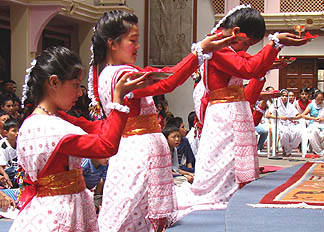
KATHMANDU (UCAN) — Catholic priests in Kathmandu say they will mark the Year for Priests by highlighting priestly and religious vocations for youths in Nepal. Young parishioners of the Church of Our Lady of Assumption bearing the offertory during the Mass that marked the launch They also say threats from Hindu extremists will not deter them and that they will work during this year with “greater determination” and “renewed vigor.” Priests from around Kathmandu gathered on Aug. 8 at the Church of our Lady of Assumption to mark the start of the Year for Priests. Bishop Anthony Sharma, apostolic vicar of Nepal, was the main celebrant. Talking to UCA News afterward, Father Silas Bogati, director of Caritas-Nepal, said the “ever growing challenges” for the priests in the country will not stop them from performing their duties, “but will help us move ahead with greater determination.” He was referring to the May bomb blast at the Assumption church and threats from Hindu extremist groups asking the 1.5 million Christians to leave the country or face dire consequences. The bomb blast on May 23 killed three Catholics and left 13 others injured. “This year is specially a year for prayers for and by the priests and a year to lay emphasis on increasing vocations in the country,” said Father Bogati. Of the 70 priests — 14 diocesan and 56 Religious — in Nepal, only six are Nepalis. The rest are foreigners, mostly Indians and Americans.
The Jesuit regional superior in Nepal, Father Lawrence Maniyar, echoed Father Bogati’s words. “Why should we be afraid and leave the country and go away when some terrorist or anti-social group asks us to leave?” he asked. “It is the people that we serve and if they want us to leave then we will, but not at the behest of a section of people,” he said. He added that the Year for Priests is a year for “all of us” to always remember that there is a group of ordained people serving God and a year to remember them in prayers. “It is also the year to lay special emphasis on the need for more priests from Nepal,” he added. According to him, the Jesuits have appointed a full time “vocational Father Robin Rai, parochial vicar at the Church of the Assumption, also said the year will be marked with prayers by and for priests. “There are great challenges for the priests in Nepal and I think we should face them as they come,” he said. Parishioners congratulating priests during During Mass on Aug. 8, leaflets containing prayers for priests were handed out to Catholics, while Father Rai urged all to remember priests in their daily prayers. Bishop Sharma, in his homily, said, “We want our young people to know that Religious life” is a viable option. “If you feel there is a calling, stop for a moment and think about it; don’t ignore it.” Meanwhile, parishioners and Religious in Kathmandu said the Year of the Priests will give them an opportunity to appreciate their priests “for what they do for us.” Brother Rakesh Zeno, founder of the Poor Servants of Jesus the Master,’ the first indigenous Religious community in Nepal, quoted Pope Benedict XVI in saying, “Without priests there would be no Eucharist and without the Eucharist there would be no Church.” Binod Gurung, president of Nepal Catholic Society, said it is the responsibility of all lay people to pray for the priests all around the world. According to him, a committee has been formed to plan and organize events to mark the Year for Priests. “Events having to do with the priestly vocation will be organized across the country to encourage young people to take up the religious life,” Gurung said.

of the Year for Priests in Nepal — Photo by Ashish Pradhan
promoter” for Nepal to encourage young men to take up the priestly vocation.

the Mass — Photo by Ashish Pradhan
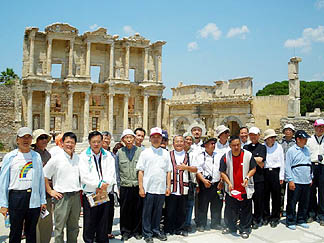
TAIPEI (UCAN) — Reflections by priests on their pilgrimage experiences in Turkey will be published into a book as a means of evangelization during the Year for Priests. Clergy from Taiwan at a pilgrimage site in Turkey — UCAN Photo Bishop Thomas Chung An-zu of Chiayi and 20 priests working in Taiwan visited Turkey June 28-July 11. Jesuit Father Mark Fang Chih-jung, spiritual director during the pilgrimage, said the trip, along the route that Saint Paul took in what was then Asia Minor, was especially meaningful for the priests as this was where Saint Paul did most of his evangelizing. He said that participants have been asked to write reflections on their experiences. These will be published into a book, illustrated with photos. “Such reflections are helpful for the priests and also are a good means of evangelization during the Year for Priests,” Father Fang said. “Though Turkey is an Islamic country, it is a significant place for Catholics too, as the early Church was planted and developed there,” said the 83-year-old theologian. Visiting the beginnings of the early Church with priests from all seven dioceses of Taiwan, some of whom are Koreans, Vietnamese and mainland-born clergy, helped him to experience the universality of the Church, he said. During the trip, he encouraged his fellow priests to model themselves after Saint Paul, not to fear challenges to evangelization and to build up the Church, he added. Father Joseph Huang Ching-fu, executive secretary of the Commission for the Clergy of the Taiwan bishop’s conference, said it was the first time for clergy in Taiwan to undertake such a pilgrimage to Turkey. It aimed to refresh their knowledge of the Church and to celebrate the closing of the Year of Saint Paul and the opening of the Year for Priests. June 29 concluded the Pauline Year, a year marking the 2,000th birth anniversary of Saint Paul. It overlapped with the start of the Year for Priests on June 19. Pope Benedict XVI promulgated both years. “The apostles of the early Church were in a dangerous environment, without freedom. It was not easy for them to keep their faith but yet they managed to do so,” said Father Huang, who is also rector of the Taiwan Catholic Regional Seminary. Priests celebrating Mass outdoors in Turkey — UCAN Photo “We as priests should learn to persevere as Saint Paul did, who gave his life for evangelization,” he added. Sharing his pilgrimage experience, Father Antonius Kuo noted how in Turkey, Catholics are a minority and “are unable to evangelize very openly” even though the “government allows religious freedom.” In contrast, though Taiwan enjoys freedom of religion, Father Kuo said he is worried about the declining number of local priestly vocations. Tour guide Chang Shu-tseng, the only layperson in the pilgrimage, said she felt nervous preparing for the trip “as the clergy were more familiar with the Bible” than she was. Throughout the trip, Chang said she noted the priests’ earnest attitude in “jotting down notes and taking pictures and videos at sites,” and how the young priests looked after the older ones.


17th Week in Ordinary Time
18th Week in Ordinary Time
19th Week in Ordinary Time
20th Week in Ordinary Time
21st Week in Ordinary Time
22nd Week in Ordinary Time
During the military coup d’état in Honduras on 28 June, the Jesuit radio station “Radio Progreso” was shut down by the Army. The Provincial Commission of the Social Apostolate of the Society of Jesus’s Central American province issued a statement on 7 July condemning this action, explaining that the radio station had re-opened but faces constant threats. The statement, signed by Francisco Iznardo SJ, the coordinator of the social apostolate of the Central American province, continues: “Radio Progreso thinks that beyond the disputes between two factions of government, ‘civil society has the right to walk the streets and make its voice heard, not because the government of Miguel Zelaya has been a good one, but because a coup d’état will bring us a much worse political and social illness than what we had with the chaotic administration’ of President Zelaya and his group. The Provincial Commission of the Social Apostolate of the Society of Jesus’s Central American province shares the analysis of Radio Progreso, and considers that the path to political freedom can only be guaranteed if the various sources of public opinion can make their own contribution in the search for truth.” Read the full statement here (in English):http://www.entreculturas.org/noticias/news/jesuits_stand_on_honduras_events or here (in Spanish): http://www.alboan.org/portal/seccion.asp?N=388 This statement, as well as the position of Radio Progreso and the social apostolate in Honduras, was strongly supported by the 57 participants at the Latin American Social Apostolate meeting in Cochabamba, Bolivia. Read their statement (in Spanish) here:http://gumilla.org/?p=news&id=12478300168934 On the Sunday following the start of the crisis, local people came to Radio Progreso’s office to pray together for a solution. They came in such large numbers to show their support that Mass had to be celebrated outside. Although the website of Radio Progreso, www.radioprogresohn.com, is currently not functioning, you can listen to Radio Progreso’s programme live through this link:http://www.edgardramos.com/radiotv/radio-progreso-honduras-internet.
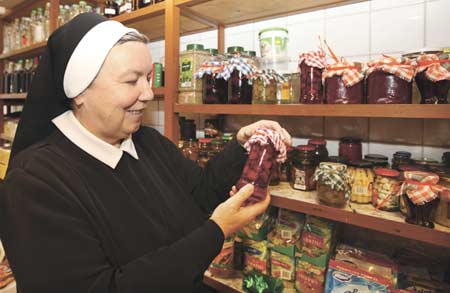
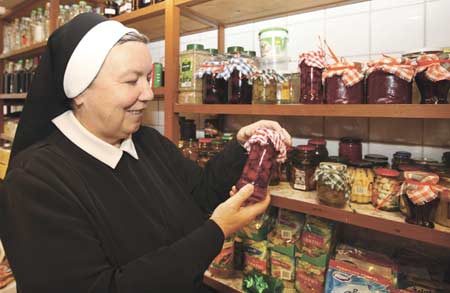 KRAKOW, Poland — Emerging from the quiet of her convent, Sister Anastazja Pustelnik was confronted by a jarring image – her smiling face on posters plastered around town to hawk the cookbooks that have made the 59-year-old nun one of Poland’s best-selling authors.It’s fame Sister Anastazja never bargained for when she left the material world as a young woman, expecting to toil in obscurity for God. But her ability to create easy-to-follow recipes for delectable cakes and traditional home cooking has resulted in five cookbooks since 2001 that have sold a combined 1.1 million copies in this country of 38 million.
Today, her cookbooks are found in shops and online, their glossy covers showing Pustelnik with an apron over her black nun’s habit and a mixing bowl or serving platter in hand, generating the unwelcome fame thrust upon her.
Sister Anastazja’s success comes amid a broader trend of men and women of God earning renown and profit in Europe with cookbooks and TV shows. A Spanish television channel, for example, broadcasts “Bocaditos de Cielo” – Little Mouthfuls of Heaven – in which Sisters Liliana and Beatriz of the Franciscan Conceptionist Sisters Convent guide viewers through the culinary steps for making ancient sweet recipes while also offering insight into their cloistered life.
In Poland, a deeply Roman Catholic country with a strong bond to the late Polish pope, John Paul II, the appeal of Sister Anastazja also reflects how the Catholic church is still present in daily life even as economic growth and European Union membership push the country toward secularization.
Priests and nuns are common characters in Polish television serials. And a nun is a much more likely kitchen guide to Polish village housewives than such sultry cooking superstars as Britain’s Nigella Lawson or the American Rachael Ray.
Despite worldly success, Sister Anastazja says all her efforts are in service to God. After morning prayers, she walks every day from her convent to the Jesuit center in downtown Krakow to cook lunch for 20 priests, giving them “strength when they go out into the world.” At Easter she bakes each priest a lamb-shaped cake to take on visits to their families.
One of her cakes, she said, came to her in a dream. The creation, dubbed “A Nun’s Secret,” layers cheesecake, pink fruity gelatin and yellow cake all beneath a shell of chocolate icing.
“It is only God who gives me the recipes. Who else?” Sister Anastazja, a member of the order Daughters of Divine Love, said in an interview with The Associated Press at the Jesuit center.Sister Anastazja had been cooking for the Jesuits for years when they got the idea to put some of her best recipes together in a brochure, said Father Bogdan Calka, a director at the Catholic publishing house WAM. That evolved into her first book, “103 Cakes of Sister Anastazja,” which was published in 2001 and became a surprise success. With 400,000 copies sold to date, it is her most popular book.
Later books include recipes for Polish classics: hearty casseroles, a cabbage-and-sausage stew called bigos, and golabki, or stuffed cabbage rolls. Her latest book, published this year, brings together 123 salad recipes.
The publishers say Sister Anastazja’s books owe their success to recipes that are easy to follow and don’t intimidate new cooks.
Most of her recipes are Polish classics, but a few international favorites are included, such as Greek moussaka, Hungarian lecso and Italian dishes like spaghetti carbonara. She said she began to embrace Italian dishes when some of the Jesuits priests requested them after returning from studies in Rome.
Through the years, Sister Anastazja has included more of her own inventions, recipes that get tweaked and perfected with feedback from the Jesuits.
“Her latest book would have never come out 10 years ago because there wouldn’t have been any way to prepare such unusual salads,” Calka said. The book offers up a ravioli salad with sun-dried tomatoes and other entrees that use capers, bamboo shoots and the leafy green known as rocket or arugula.
The conference is sponsored by the Ministry to Catholic Charismatic Renewal. For more information about the event, click here. Loyola Press author Bert Ghezzi will speak at the 27th annual Holy Toledo Catholic Charismatic Conference on October 17. In conjunction with this year’s conference theme of “The Cross: Our Door to Mercy”, Ghezzi will present themes from his book, The Sign of the Cross. Ghezzi is also the author of Mystics and Miracles and the newly released Voices of the Saints.
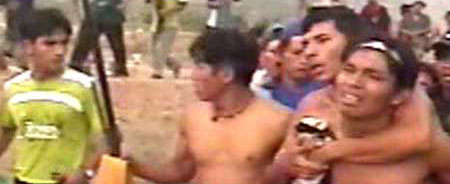
Violent clashes between police and indigenous people in northern Peru on 5 June left, according to official sources, 23 police officers and 10 protesters dead. Two hundred indigenous were injured, 61 are said to have disappeared and 83 have been arrested, of whom 61 are now on trial. Those who have been released from prison said they had been subjected to physical and psychological abuse. The indigenous had been peacefully blocking a road for weeks to protect their land from the effects of a law passed in 2008 allowing its exploitation through the growth of biofuels, mining and oil drilling The violence was unleashed when police officers, who were given the word from the capital Lima to remove the protesters, moved in with tear gas and automatic weapons. The protesters were armed largely with spears. The law was subsequently revoked on 18 June. A number of Jesuits are closely involved with the indigenous tribes of Awajun and Wampis in the area and are supporting the affected communities by reporting events, helping the wounded, visiting those in prison, advocating for detainees and facilitating the return of the displaced. César Torres SJ, coordinator of the social apostolate in Peru, said in a statement issued on 10 June: “It is our vocation to protect the life of all people and we feel sadness and outrage about any act to the contrary. Our presence in the area (Vicariato de Jaén) responds to a mission that the Society of Jesus has been entrusted with by the Holy Father; therefore we cannot stay on the sidelines of events.” YouTube video of the events on 5 June
Bringing Hippos to the Amazon: Alan García’s indigenous policy in Peru (Javier Arellano Yanguas, 8 June) Related SJS articles: Brazil: Indigenous people celebrate court victory (April 2009) WSF 2009: Indigenous people’s participation at the World Social Forum 2009 (January 2009) Latin America: Indigenous Apostolate meets (October 2008) Brazil: Indigenous peoples’ rights: join the Jesuit campaign (June 2008) Chile: Jesuit support for Mapuche people (April 2008) Picture above by Canal Telersat Service, Peru (enlacenacional.com)
AUSTRALIA: Awards for Collaborators
Nearly 230 people from Jesuit works across Australia came together for the Province Gathering on the 3rd and 4th July at St. Ignatius College in Sydney. It was the first Gathering with the new Provincial, Father Steve Curtin. The theme “A heart for mission” focused on what inspires and sustains people in their mission and work. The personal stories of some participants highlighted the various ways that the mission is viewed and energized in the Province’s works. A session focused on mission formation and ways to ensure that people from the Province’s various ministries understand the broader story of the Australian Jesuits. Father Mark Raper, actually President of the Jesuits Conference of East Asia and Oceania, said that the three actual priorities in the Assistancy are the formation of young Jesuits, supporting Cambodia, Myanmar and East Timor, and promoting cooperation internationally. The meeting was also the occasion for recognizing with the Companions Medal Awards five people for making a significant contribution to the work of the Australian Province. This year awardees were one sister religious and four lay collaborators, three men and a woman. The Companions Medal was created two years ago during the Jubilee Year.
BURUNDI: International Congress of Jesuit Alumni/ae
The 7th Congress of the World Union of Jesuits Alumni/ae will be held in Bujumbura, capital of Burundi, in the heart of Africa from 22 – 27 July. Participants will come from all over the world. The choice of Africa, and especially Burundi, for this occasion is full of significance, especially given the political turmoil in the country, widespread malnutrition and the AIDS pandemic suffered there. The Society of Jesus has a long tradition in Africa, especially in the field of education. The tradition of the old Collège Saint-Esprit continues today with the Lycée Saint-Esprit serving nearly 900 boys and girls. The theme of the Congress embodies a program in itself: For a better Africa: What have we done, What are we doing, What must we do? The event will be preceded by a week long program of “spiritual experiences” for young alumni/ae. These experiences will consist of activities in centers for vulnerable children (AIDS orphans) and visits to hospitals. The program will take place in Burundi and in the Bukavu Region in the East of the Democratic Republic of Congo.
COLOMBIA: A Jesuit named Secretary General of the Episcopal Conference
Bishop Juan Vicente Córdoba, auxiliary bishop of Bucaramanga, is the new secretary general of the Episcopal Conference of Colombia, in place of Bishop Fabián Marulanda, who left the position after seven years of service. It is the first time a member of the Society of Jesus (though present in the country for more than 400 years) has been elected to this high post. Bishop Córdoba is 58 years, old, did graduate studies in bioethics, was ordained bishop five years ago by Pope John Paul II and is one of the youngest members of the ecclesiastical hierarchy of Colombia. He is the only Jesuit bishop of the country (in its entire history there have been only five!), and thanks to his formation he brings to this position an innovative spirit: “We have to give up the old image of a conservative Church” he said, “and think about new ways of evangelization as a humble, servant church.” Talking about the need to change the conception of morality, he continued, “We do not have to condemn the faithful, but we have to motivate them. We do not have to say to them do not do this or that, because it is a sin, and God will punish them, but we have to stimulate them to be at the service of others, to take care of their own person and environment.”
IVORY COAST: Inauguration of a Health Centre
On the 13th of June, a new Health Centre was inaugurated in Niamkey Konanko, Ivory Coast. Father Umberto Libralato, vice-president of Magis, the non-governmental organization of the Italian Jesuits, Tomaso Spingardi, member of the board of directors of Magis, and Antonio Rampinini were present at the ceremony as well as local authorities and many others both, young and old. All were there to celebrate this important event for so many local communities. The center was dedicated to the memory of the mother of one of the benefactors and a plaque with her name was placed at the entrance. The inscription reads: “En memoire de Giovanna Ponza par ses enfants qui ont perdu trop tôt son amour et ses soins” (“In memory of Giovanna Ponza from her children who lost her love and care too early”). The Centre was an idea born in 2001 and its realization has been possible thanks to the help of many benefactors, the work of Magis and the Sisters Filles de Saint Camille. The Niamkey Konanko dispensary serves a large region of 30 square km, home to nearly 25.000 people. Each month over 1.000 come for help. The most common diseases are Bouruli ulcer and malaria. Many of these diseases are curable if treated in time; the real secret, of course, is prevention. In addition to treating diseases, the dispensary will, as far as it is possible, to diagnose them at an early stage of development.
HONDURAS: Jesuits Caught in the Political Earthquake
The political turmoil that erupted on the 28th of June in an already earthquake devastated Honduras touched the Jesuits in Progresso. On that day, the president of the country, Manuel Zalaya Rosales, was removed from office and at 10:30 a.m. Radio Progresso, run by the Jesuits was invaded and silenced by a group of 25 soldiers. Father Ishmael Moreno, director of the radio station wrote, “While the soldiers were inside our workrooms, a large group of people besieged our offices and wanted to enter to defend the Radio and the staff. Thanks to numerous mediations we avoided any incidents that could have resulted in violence.” The next morning the soldiers left and the station resumed its broadcasts knowing that it could again be silenced. Radio Progresso is in contact116 radio stations throughout the country in order to follow events as they happen. During the 1970’s, Radio Progresso was the symbol of resistance against Central America military dictatorships.
RUSSIA: Vocations in Kazakhstan
Vocations to religious and priestly life is one of the signs of life in the Kazakhstan Mission; ten or more men and women have entered religious life or seminaries. Three sisters from the Pavlodar region made their solemn religious profession on the 7th of June during a ceremony attended by many parishioners and celebrated by Father Ryszard Matejuk. Two colleagues of the Jesuits in Kazakhstan are Sisters Theresa and Mariana. They prepare people for the reception of the sacraments and do so in a variety of settings: private homes, churches and pubic gathering spaces. After evening Mass, they will gather people for a cup of tea and share fellowship. All are welcome including parishioners, casual visitors, children and those looking for something to do.
SPAIN: Eurojess Congress in Granada
“Muslim populations in European Societies” will be the title of Eurojess 2009 meeting, that will be held in Granada from the 25th to the 29th of August. The meeting is one of the initiatives of the Society of Jesus in Europe in order to address the challenges linked to the growing number of Muslims on the continent; it is organized by Jesuits experts in Social Sciences (Eurojess). After some necessary preparation so as to better understand the Muslim reality in Europe, time will be given to deepen ideas regarding integration at the local and national level. Finally, the participants will try to identify some action steps for Jesuit institutions in light of promoting justice and dialogue.