

Author: cfliao
 The people of San Salvador have processed every November 16 for the past 20 years to remember and honor the six Jesuits, their housekeeper and her daughter who were murdered by the Salvadoran military. In a remarkable turnabout, the government bestowed the country’s highest award on the murdered Jesuits. The right-wing governments that have run the Central American country since its civil war always preferred to keep the case at a safe distance in the past. The new government led by a former journalist from a leftist party made an abrupt, 180-degree turn.
“We want this to be an act of recovering our collective memory,” President Mauricio Funes said in the ceremony. “For me, this act means [we] pull back a heavy veil of darkness and lies to let in the light of justice and truth. We begin to cleanse our house of this recent history.”
Funes was educated by the Jesuits; he presented golden medallions to relatives of the priests “for extraordinary service to the nation.”
The big surprise of the day came from the minister of defense who said the army was prepared to ask for forgiveness and that he was willing to open military archives to judicial investigators. For more on this story, see the account from the Los Angeles Times.
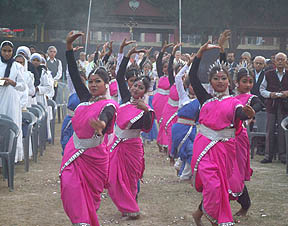
KOLKATA, India (UCAN) — Jesuits in Kolkata have been urged not to rest on their laurels but work harder to serve Indian society, during programs marking 150 years of their Bengal mission. An entrance dance during the Mass celebrating The early missioners contributed a lot to the development of tribal communities in eastern India, noted Naresh Gupta, secretary of the national Jesuit Alumni Association of India, at a Nov. 28 function to mark the occasion. However, he said he now wants the Jesuits to widen their scope and provide healthcare facilities in the country, which remain neglected. Similarly, Jesuit Provincial of South Asia Father Edward Mudavassery, while paying tribute to the Jesuits’ contributions in Bengal, invited them not to bask in their past glory but get ready to face current challenges boldly. More than 2,000 people, including 10 bishops, attended the jubilee celebrations at St. Xavier’s College in Kolkata (formerly called Calcutta), the capital of West Bengal state. The program included a symposium on Jesuit contribution to the education and social life of people in eastern India, an exhibition on the Bengal mission’s growth and a multimedia presentation on the mission. Cardinal Telesphore P. Toppo of Ranchi, in his homily during the jubilee Mass, compared the early Belgian Jesuit missioners to Abraham of the Old Testament, who left his homeland for a place that God had chosen for him. The cardinal expressed hope that the jubilee celebrations would renew the “missionary zeal in our time even though it may encounter many obstacles.” Concelebrants during the Mass: From left: Retired Archbishop Henry D’Souza of Calcutta, Cardinal Four Belgian and three English Jesuits landed in Kolkata port on Nov. 28, 1859. The mission they started now comprises two archdioceses, 21 dioceses, and seven Jesuit provinces, spread over Bihar, Chhattisgarh, Jharkhand, Orissa and West Bengal states. Other guests at the event praised the pioneering spirit of the early missioners. The Jesuits in Bengal have dedicated their life to enrich the lives of people with their quality education and cultural contributions, said Salomi Mamata, who works with Calcutta archdiocese’s social service center. “What I am today is thanks to the Kolkata Jesuits,” she said. Snehashish Sur, a TV journalist, hailed the Jesuits’ values-based education and identification with local people. He said he was surprised when the late Belgian Father Gerard Beckers started living in a tribal Santal area after retiring from his work at St. Xavier’s College. “He moved around in a bicycle, and that was truly exemplary,” he added.
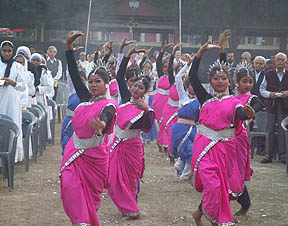
the 150th anniversary of the Bengal mission
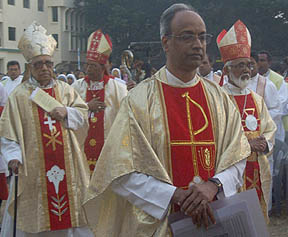
Telesphore Toppo, Calcutta Jesuit Provincial Father
George Pattery and Bishop Salvadore Lobo of Baruipur
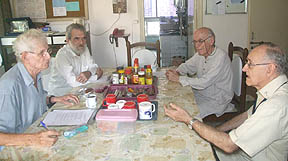
KOLKATA, India (UCAN) — Belgian Jesuits are celebrating the 150th anniversary of the establishment of their Bengal mission in eastern India. Belgian Jesuit missioners of Calcutta province have
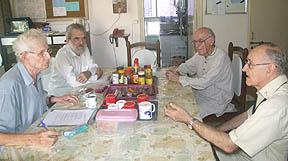
a chat over a cup of coffee at the Jesuit provincial
house in Kolkata. From left: Father Jean Englebert, a liturgist, Father Charles Pollet, a theology professor,
Father Albert Huart and Father Andre Bruylants
The order has had a big impact on lives in the region through education, literary contributions and a translation of the Bible into Bengali.
Father Andre Bruylants, 83, former headmaster of the Jesuit-run St. Xavier’s College in Kolkata, has been working in the mission for 60 years. He is one of seven remaining Belgian Jesuits in the religious society’s Calcutta province.
Jesuit teachers had educated thousands of people and become icons of Catholic education in the region, he says.
Others have influenced the region’s socio-cultural leaders through scholarly interreligious exchanges, and reached out to Indians through the study of Hindu scriptures and engagement with Hindu intellectuals.
Jesuits have influenced literary thinking through publishing and translating Western Christian classics into Bengali, and also helped locals use their own language in worship.
Father Christian Mignon, 85, came to the mission at the age of 25. He was to make a unique contribution to religious life in Bengal, translating the Bible into Bengali over 40 years. The job, in which he was helped by Hindu poet and teacher, Sajal Banerjea, was completed in 2003.
He had previously translated liturgical texts after the Second Vatican Council, which opened the way to the use of local languages in the Mass.
English Jesuits first came to Kolkata in 1833 and started St. Xavier’s but left the country in 1849 after a conflict with the local bishop.
The Belgian Jesuits, who arrived in the city in 1859, were invited to restart the school, which they did within two months in January 1860.
Belgian Jesuit Father Albert Huart, 85, who translated a book on the Jesuits’ Bengal-mission history, is former vice-principal of St. Xavier’s College.
He said that the Belgians expanded from the English educational base to probe further the possibilities of village missions.
Initially the Jesuits’ focus was on the Chotanagpur area, in the present state of Jharkhand. This was where Jesuit Father Constant Lievens (1856-1893), whom the tribal Church reveres as the “apostle of Chotanagpur,” had worked to restore tribal dignity.
By 1869 the Jesuits were entrusted with the Bengal mission, at the time consisting of the present Indian states of West Bengal, Jharkhand, Bihar, Madhya Pradesh and Orissa.
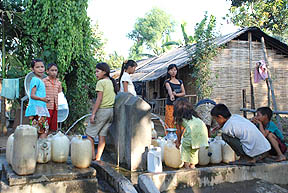
DAMAK, Nepal (UCAN) — The Jesuit Refugee Service has stepped in to break a cycle of violence, drug and sexual abuse that had been plaguing thousands of ethnic Nepali youths from Bhutan living in refugee camps in East Nepal. Bhutanese refugees collecting drinking water “All kinds of evils were plaguing the camps,” says Jesuit Father Peter Jong Lepcha, program coordinator of Youth Friendly Centres (YFC). “We realized that there are so many programs being implemented for the refugees in general but nothing for the youth as such.” The YFC program is part of the Jesuit Refugee Service’s(JRS) Bhutanese Refugee Education Program, supported by the United Nations High Commission for Refugees (UNHCR) and Caritas Nepal. Ganesh Pradhan, 37, in charge of the YFC program in Sanischare refugee camp told UCA that the initiative has given the youths a platform to develop their skills and overall personality. “The various programs under the YFC have changed the lives of the youths here. Instances of violence that existed earlier, the drug abuse, the sexual abuse and other problems have gone down dramatically,” he said. The Bhutanese of Nepali origin — known as Lhotsampas — are caught in a no man’s land. Thousands fled Bhutan fearing for their lives after new citizenship rules were introduced about two decades ago. The government says the refugees are migrants and have no right to live in Bhutan. The refugees believe their only options are settling down in foreign countries or repatriation to the homeland they still love. A Bhutanese refugee arranges firewood Sun Maya Tamang, 39, wants to go back to Bhutan, but she says she still has not made up her mind if she will opt for a third-country resettlement. “I may just opt for it, I am not sure,” she said. “I still feel bad about leaving behind, 18 years ago, the home, the farmland we had, and the happy memories.” According to the JRS, there are now more than 108,000 refugees living in the seven camps in East Nepal. JRS field director Father PS Amalraj, told UCA News that young people are vital to conditions in the camps. “The power of the youth can either build or destroy the refugee camps. Keeping this in mind, we established one youth friendly center in each camp and we now have 14,000 members,” Father Amalraj said. The YFC initiative consists of education in journalism, television presenting, sports, music and awareness of HIV/AIDS and other social issues. An online education program has recently been added to address the growing school drop-out rate in the camps, Father Lepcha says. The UNHCR reported in September that more than 20,000 Bhutanese refugees had been resettled overseas — mostly in the US — with a further 5,000 expected to leave Nepal by the end of 2009.
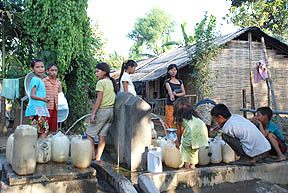
at the Sanischare refugee camp in eastern Nepal
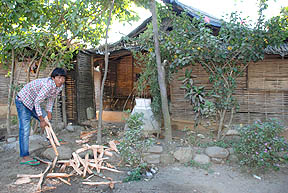
in front of his hut at the camp
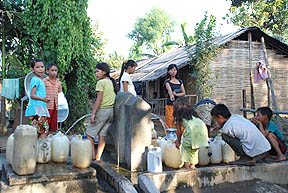
DAMAK, Nepal (UCAN) — The Jesuit Refugee Service has stepped in to break a cycle of violence, drug and sexual abuse that had been plaguing thousands of ethnic Nepali youths from Bhutan living in refugee camps in East Nepal. Bhutanese refugees collecting drinking water
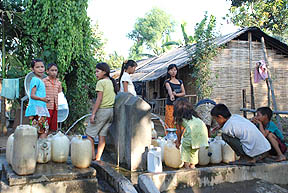
at the Sanischare refugee camp in eastern Nepal
“All kinds of evils were plaguing the camps,” says Jesuit Father Peter Jong Lepcha, program coordinator of Youth Friendly Centres (YFC).
“We realized that there are so many programs being implemented for the refugees in general but nothing for the youth as such.”
The YFC program is part of the Jesuit Refugee Service’s(JRS) Bhutanese Refugee Education Program, supported by the United Nations High Commission for Refugees (UNHCR) and Caritas Nepal.
Ganesh Pradhan, 37, in charge of the YFC program in Sanischare refugee camp told UCA that the initiative has given the youths a platform to develop their skills and overall personality.
“The various programs under the YFC have changed the lives of the youths here. Instances of violence that existed earlier, the drug abuse, the sexual abuse and other problems have gone down dramatically,” he said.
The Bhutanese of Nepali origin — known as Lhotsampas — are caught in a no man’s land.
Thousands fled Bhutan fearing for their lives after new citizenship rules were introduced about two decades ago. The government says the refugees are migrants and have no right to live in Bhutan.
The refugees believe their only options are settling down in foreign countries or repatriation to the homeland they still love.
A Bhutanese refugee arranges firewood
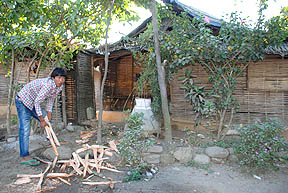
in front of his hut at the camp
Sun Maya Tamang, 39, wants to go back to Bhutan, but she says she still has not made up her mind if she will opt for a third-country resettlement.
“I may just opt for it, I am not sure,” she said. “I still feel bad about leaving behind, 18 years ago, the home, the farmland we had, and the happy memories.”
According to the JRS, there are now more than 108,000 refugees living in the seven camps in East Nepal.
JRS field director Father PS Amalraj, told UCA News that young people are vital to conditions in the camps.
“The power of the youth can either build or destroy the refugee camps. Keeping this in mind, we established one youth friendly center in each camp and we now have 14,000 members,” Father Amalraj said.
The YFC initiative consists of education in journalism, television presenting, sports, music and awareness of HIV/AIDS and other social issues.
An online education program has recently been added to address the growing school drop-out rate in the camps, Father Lepcha says.
The UNHCR reported in September that more than 20,000 Bhutanese refugees had been resettled overseas — mostly in the US — with a further 5,000 expected to leave Nepal by the end of 2009.
1st Week of Advent
2nd Week of Advent
3rd Week of Advent
4th Week of Advent
Christmas Octave
 Twenty years later: remembering the martyrs of El Salvador. The soldiers also murdered Elba and Celina Ramos, the Jesuits’ housekeeper and her daughter.
William Reiser
Worcester / Issues – A group of highly trained Salvadoran soldiers entered the campus of the University of Central America in San Salvador shortly past midnight on Nov. 16, 1989. While their primary target was the president of the university, Ignacio Ellacuría, S.J., they murdered and mutilated nearly the entire Jesuit community -Ignacio and five others-. A seventh member of the community, Jon Sobrino, S.J., was in Thailand teaching a course on Christology. The soldiers also murdered Elba and Celina Ramos, the Jesuits’ housekeeper and her daughter, who slept on campus that night to escape the anxiety caused by the bullets and artillery around the neighborhood where they lived.
What happened that night brought home grimly yet powerfully the prophetic dimension of teaching and research, when these activities are informed by an option for the poor. The 32nd General Congregation of the Society of Jesus, which met in 1974-75, put the entire order on record: “The mission of the Society of Jesus today is the service of faith, of which the promotion of justice is an absolute requirement”. The 33rd General Congregation (1983) reaffirmed that direction and insisted that “we wish to make our own the church’s preferential option for the poor”.
A WEAK-WILLED CONGRESS
The civil war in El Salvador lasted 12 years, from 1980 to 1992, and claimed 75,000 lives. The incompetence of American foreign policy with respect to the conditions that led to the conflict and in understanding who benefitted from the U.S. support of the Salvadoran military was appalling. As a result of the assassinations at the university, a weak-willed U.S. Congress finally began to face the problem of U.S. complicity in the Salvadoran situation. Representative Joe Moakley, Democrat of Massachusetts, was appointed to lead an investigation that turned out to be as courageous as it was eye opening. El Salvador was not the only place in Latin America where the poor were being abased. Nine years earlier, four North American women who were returning to El Salvador -two Maryknoll sisters, an Ursuline nun and a co-worker- were raped and murdered on their way from the airport. And two days before Archbishop Oscar Romero was gunned down at the altar on March 24, 1980, another Jesuit, Luis Espinal, was ambushed in La Paz, Bolivia,and silenced for his defense of the rights and dignity of the poor.
The stories of such “martyrs for justice”, as Father Jon Sobrino calls the slain Jesuits and many others, do not begin with the martyrs themselves but with the people on the bottom -the victims of poverty, miscarriages of justice and class prejudice; the throwaways and the “disappeared”.- The story of the Salvadoran Jesuits, for example, takes us to the political, social and economic oppression endured by peasants so poor that they needed to be catechized before they could imagine that the world could be different. What would El Salvador look like if God’s will were done on earth, just as it is in heaven?
Father Ellacuría and his companions understood that the mission of a Christian university as an apostolic instrument is not disconnected from the economic and political conditions of the society in which it is located. On the contrary, the university’s mission derives directly from its awareness of the everyday reality that poor people endure. But as Father Sobrino explains in his essay “The University’s Christian Inspiration”, because a university needs resources it is almost by necessity implicated in a world of economic and political power, and “this incarnation amid power tends to distance the university from social reality as lived by the poorest and most marginalized”. Indeed, even the church has to be careful never to lose sight of the world of the poor, and contact with it. Preachers and teachers whose hearts and intelligence are immersed in that world are more attuned to the deeper rhythms of Scripture. Distance from the poor leads to distance from God.
AGUILARES AND RUTILIO GRANDE
Aguilares was the village where Rutilio Grande, S.J., had been working and the place to which his close friend, Oscar Romero, rushed when he heard the news of Grande’s assassination on March 12, 1977. It was also where Romero later, as archbishop, experienced a profound spiritual awakening. The bishop’s “place”, he came to understand, is with his people; he is never more bishop than when walking alongside the poorest and most vulnerable of his diocese. Aguilares was also where the Jesuits, so suspect in the eyes of El Salvador’s elite and of Archbishop Romero himself earlier, came to be of one heart and mind. The poor were powerless. Christ became poor, which means that he also became powerless. And the reason for the impoverishment both of Jesus and the people? Because, in El Salvador, others had become rich and privileged at their expense. Poverty is visible, but the oppressive forces that create structural violence are usually hidden. One needs the lens of solidarity to perceive those forces, and Aguilares gave the archbishop the lens that enabled him to identify what he saw as crucifixion.
Father Ellacuría and the other Jesuits in his community had already undergone their “Aguilares moment”, the flash that shatters the familiarity hiding the underside of everyday life. What immediately grabs attention is that they were murdered, not the conversion process that led to the radicalization of their vision. In the case of the archbishop, however, it is less his murder that fascinates us than the story of how a conservative churchman became prophetic.
By contrast, Ignacio Ellacuría’s conversion, his embrace of the central categories that came to be associated with the theology of liberation, unfolded gradually, largely through reading, study and discussion. His theological orientation was rooted in the Second Vatican Council. He had fully digested Paul VI’s encyclical Populorum Progressio (1967) and the documents from the Second Conference of the Latin American bishops in Medellín, Colombia, in 1968. His doctoral work in philosophy sharpened his ability to decipher the historical reality that was El Salvador. Apostolic activity without a vision of the kingdom of God tends to validate itself in terms of helping people into the next life but at the risk of meekly acquiescing to the way things are now. Apostolic activity with a vision of the horizon wants to transform the world. It is a faith that does justice, which means that the church -especially its pastors and teachers- tries to make its voice heard in the political arena. As a result, Romero encountered severe opposition among the Salvadoran elites and their military, and in some corridors of the Vatican.
Because the demands of social justice often require stepping into a country’s political life, Father Ellacuría found himself immersed in negotiations between the government and the revolutionary resistance during the course of the country’s civil war. What is intriguing is how he came to his view of justice and liberation by reading and studying and through the clarification of thought and expression that results from conversation and argument. As they fulfill their mission, Christian universities facilitate such a shift in perspective. Some people actually do read their way into conversion. St. Ignatius did so while recuperating after the battle in Pamplona, although evenin his case some spiritual lessons were learned only from experience and not from books.
ELLACURÍA’S AGUILARES MOMENT
I suspect, then, that Ellacuría’s Aguilares moment was in fact extended over some time. While he read, studied and talked, the world in front of him never lost its political and social immediacy. His ability to imagine was not insensitive to “the joys and the hopes, the griefs and the anxieties of the people of this age, especially those who are poor or in any way afflicted”, as the opening line of Gaudium et Spes put it, by class loyalties or ecclesiastical privilege or doctrinal mindset. Since fear keeps truth at bay, it closes our eyes to hard realities we need to face. The Jesuits’ Central American Province newsletter noted: “When people would ask Ellacu if he were not afraid he would say no, but, he added, he no more took credit for that than for lacking a sense of smell. He just didn’t have one”. The world of the poor and of victims was not outside, awaiting full access to his mind and heart. It was already within him.
Jesuit colleges and universities become effective instruments insofar as they have a critical mass of faculty members and staff who share the same Christian inspiration that Ellacuría and his companions brought to the Catholic university in San Salvador and by which they transformed it. The hard part is not assembling the critical mass, however; it is discovering that inspiration and keeping it alive. Here I draw on personal experience. By 1988 I had been teaching theology for 10 years. The theology was in line with Vatican II. I drew widely and appreciatively on liberation theology and Catholic social teaching; the forceful words of the Society’s 32nd General Congregation about justice and faith struck a deep chord. To this point, I could follow Ellacuría. But then, over the course of a weekend, I came face to face with poverty among families no more than a mile from the campus in Massachusetts where I was living and working.
A LATE PERSONAL DISCOVERY
Within weeks I was looking at the underside of life in rundown apartments, where shadows and shouts awakened long-buried fears about violence, about different lifestyles, about brokenness and isolation. The memory of Romero -not his martyrdom but his enlightenment- enabled me to make sense of what was happening. I myself was passing through an Aguilares moment, and the people I met were Latino. It was a moment of feeling terribly disoriented and unmoored, yet at the same time untied and excited. Even now, more than 20 years later, I cannot figure out why the discovery took so long in coming. Its delay was not for lack of better training or critical reflection, nor was it for want of forceful church documents and living models. More likely it had to do with fear and insecurity: not a fear of death so much as a fear of hostility, violence and failure, of not knowing how to respond to circumstances and backgrounds so different from my own and so greatly beyond my control.
The next step is obvious. We develop friendships with the very ones who have made us unsettled and afraid. While we might not be as free as Jesus when it comes to seeking the company of those at the margins, at least as a start these friendships enable us to move beyond fear and insecurity, defensiveness and hostility. These relationships reshape how we observe, interpret and respond to the world. The lesson of the martyrs is that whether we think of the world in local or global terms, there is no way to escape the route toward the mortal conflict that tears society in two, except by what Paul called “this ministry of econciliation”. Working for justice is absolutely essential. But if suspicion and estrangement are not overcome, the kingdom of God remains only partially realized. We may be able to read ourselves into the horizon of justice, but we cannot read ourselves into freedom from fear. The way to that liberation passes through the villages and homes of the poor -the road that leads from Aguilares-.
___________________
William Reiser, S.J., is a professor of religious studies at the College of the Holy Cross in Worcester, Mass. Published in America magazine, www.america,agazine.org
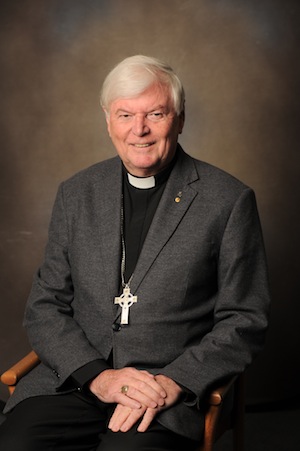 Herewith a bit of a report on the last three months or so. In mid-October, Br Ian Cribb joins myself and a Josephite Sister on a five-day visit to homesteads in the Far North, going by four-seater plane to thirteen destinations, spending a half day in each and staying overnight with the families or in the Shearers’ Quarters. People come in from outlying Stations and we meet them and say Mass in some of the homesteads. The Josephite is roving Pastoral Associate, and Ian will reflect on what we might do in the way of the Exercises for such remote people. Our pilot is a farmer, not a Catholic, who has a property out of Carrieton in the north, and who offers this time for the bishop each year.
The names of the destinations are evocative of the Outback – Mintibie, Coober Pedy, Arkaroola, Oodnadatta, Marree, Mungerannie, Birdsville, Innamincka. Birdsville is just outside the diocese, but when Bill Morris, Bishop of Toowoomba, comes that far down, he also visits Innaminka (Pirie diocese) and when the Bishop of Pirie goes as far north as Innaminka, he visits Birdsville. Very relaxed arrangement – no worries re police checks etc!
For the rest, it is a matter of getting around over big distances. I have just clocked up 15000kms in just under four months, but have not yet got to the northernmost point at Uluru nor the westernmost just beyond Ceduna (though the diocesan boundary goes to the border). The people make an occasion of the visit, so lots of shaking of hands after the Mass and confirmations, and then suppers or luncheons abounding in cream.
I am very grateful for the support of the brethren, from the frequent hospitality of the South Australian communities (Fr Celso Romanin brought the whole Norwood parish team to Pirie one day for lunch), to the offer from Jesuit Theological College for two or four scholastics to come and help out in parishes for a couple of weeks after Christmas, to Fr Brendan Byrne and Fr Richard Leonard, who will be taking part in an in-service programme I am arranging for the Pirie priests to commemorate the Year for the Priest (YFP), to the frequent assistance given by the Sevenhill community. We are pushing the YFP a lot in the diocese – special prayers each Sunday, parish retreats, priestly in-service, prayer cards for students and families, weekly Exposition in each parish for the needs of the diocese, which clearly include vocations, as we have no seminarians (yet). There is such a need to support these priests in their isolated locales. Our priests are heroic in their commitment and are wonderful men, revered by the people, but age and health are energy and money matters of the diocese are issues that can wake up a bishop in the night. Therapy for the occasional addiction problem can be so contentious, and can be in price beyond our means. We are not free from scandals from the past; a former Vincentian who worked in the diocese 24 years ago has been extradited from Indonesia for abuse issues and has pleaded guilty to several of the charges, and I am dealing with some of the victims. Re personnel, I have written to a number of Religious Congregations here and overseas, seeking possible recruits. All the male religious have withdrawn from the diocese; I am the only male religious here. The Sisters, as they become frail, are also being withdrawn to the city, where they can be cared for, so fresh blood is needed.
I am investigating how we might appoint a Business Manager for the diocese, within our means. I am looking for someone to be a Vicar or spokesperson on issues affecting aboriginal people in the diocese (apart from health, educational and social issues, the north-west traditional communities are growing in size as people move away from the Intervention impact in the Northern Territory), a vicar or spokesperson to comment on issues arising out of the three major prisons in the diocese, and a vicar for religious, to care for the isolated Sisters. I attended the recent NATSICC conference in Brisbane, where Fr Mauri Heading was also present, to get some idea of the national Catholic scene and persons involved in indigenous ministry.
There are two Bishops Commissions of which I am a member. This month I attended the Sydney meeting of the Bishops Commission for Justice and Development; members are the bishops of Hobart, Broome, Darwin, Pirie and Julian Porteous. Its areas of responsibility are the Catholic Social Justice Commission, Catholic Earthcare Australia, and Caritas Australia. Jack de Groot, former SJ, is the Executive Officer and he and Archbishop Doyle were swimming at a beach in Samoa that two days later was devastated by the tsunami; they were there conferencing about how Caritas might respond to a natural disaster, and two days later … As chairman of the Bishops Commission for Education, I received an invitation recently to join a couple from the NCEC executive to have dinner with Julia Gillard (Deputy Prime Minister and Minister for Education) to discuss educational issues. I can’t go because of the station-hopping mentioned above. I am much sadder to miss Fr Wieslaw Slowik’s jubilee party, because of the same hopping.
The size of the diocese, dotted with small communities, keeps amazing me. Extraordinary features abound, flora and fauna. For example, the Government has just given an estimate that there are one million (!) wild camels in the State. There is a plan for private enterprise to establish a plant at Port Pirie to “process” up to one hundred thousand of these camels a year, mainly for pet food!!
My admiration for Fr Alois Kranewitter, our pioneer Jesuit, grows each day as I drive around, me in the comfort of a Holden Captiva and he on a horse bought with the butter Brothers Schreiner and Sadler made and hawked through the countryside. What company we keep in this Society!
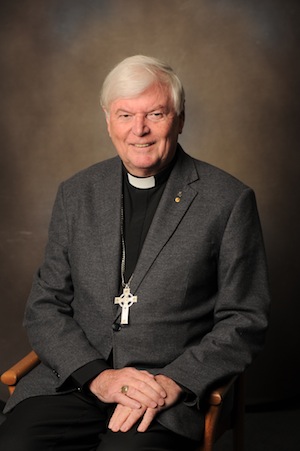
Bishop O’Kelly was appointed Bishop of Port Pirie 15 April 2009 and ordained bishop on 14 September 2009.
 What is Jesuit material? The former General of the Society of Jesus had this to say to someone who wished to be a Jesuit: “Stay at home if this idea makes you unsettled or nervous…Come if serving Christ is at the very centre of your life. Come if you have sufficiently broad shoulders, come if you have an open spirit, a reasonably open mind and a heart larger than the world.”
Old friends and family whom I have seen after our six-week foray into the mountains of Bukidnon are eager to know about how I lost weight or why my skin is as dark as the earth. Words betray the depth and breadth of this extraordinary journey known as the mission trials. Pausing, smiling, coupled with a look of pregnant bewilderment would be more apt. But though I know I will fall short, I write this to tell my part of the story, and to humbly offer my piece of Jesuit material.
The mission trial is the first exposure we have outside the novitiate. After being cooped up in Sacred Heart for close to eight months, the first year novices are sent to the Jesuit mission areas in the south. I was assigned to the Bukidnon mission district with two of my brothers for obvious reasons. I have never been to Mindanao, did not know how to speak in Cebuano, and my supposedly urbane background (not true) would be perfect for the experience to be, as the name suggests, a real trial.
We spent 25 days in Miarayon, 7 in Zamboanguita, and 6 in Cabanglasan to live with Jesuit missionaries and, at times, Lumad communities. Each place was distinct in the experience it offered, and the work of the Jesuits there as varied as their personalities. Trials as such are supposed to test one’s vocation to religious life, and if we have what it takes to be Jesuits.
Come if you have sufficiently broad shoulders. People say I have broad shoulders. Experience tells me though that my shoulders are not only weak, they are extremely fragile. I was reminded of this in cold and picturesque Miarayon. We were asked to help build a chapel on the peak of Kaulayanan, a much colder place with no electricity nor running water. Being novice mountaineers we decided to stuff as much “essentials” in our backpacks in the hopes of keeping dry on a rainy day. Midway through the amazingly steep trail I felt my broad shoulders crumbling under the weight of my bag. At one point, when we made a pit stop for the nth time, someone asked me, “Ano gusto mo pang mag Heswita?” Spurred by this comment, I lifted my lead bag and, together with my injured pride, continued along. I did make it on top, but my shoulders felt like rubber for a number of days. And when I had finally recovered it was time for the trek down. Different trail but same heavyweight bag.
The same thing happened when we had to make the return trip from a Lumad community in the mountains back to our home base in Cabanglasan. It took us 7.5 hours to complete what is, by far and bar none, the toughest walk of my life. It would be another story to narrate the entire experience. But what made it all the more challenging was having to walk on foot during the toughest part since my sandals broke down (and so did another pair I borrowed). Doing so was tolerable in the knee-deep mud, but it was impossible on the pebble-littered paths. It was so painful that I wanted so much just to stop, not to rest, but to cry.
Of course my backpack still bothered me. That’s saying much considering it weighed only a third of the load I carried up Kaulayanan. But if ever there was any consolation it was that my shoulders did not bother me as much as my feet. My feet—-muddied and bloodied, just plodded along waiting to succumb at any time. When I got home, with my shoulders and feet ready to retire, I learned that I also had a weak and fragile stomach. Diarrhea kept me awake the entire night together with the incessant question ringing in my head, “Ano gusto mo pang mag Heswita?”
The mission trial was very much a physical trial. Pushed to the brink, my body would nudge my soul to ask, “Why am I doing this?” At gustuhin ko man, ni minsan hindi ko ito nasagot. Many times I would trudge along just because I was too proud to quit. As I look back and remember the battering my body had to endure, I realize though that my great pride would have wilted on its own. Surely what fueled me was more than my pride. Surely, even if my shoulders are broad and strong, it would not have mattered.
What matters is not that one can carry the world on his shoulders, as many people think Jesuits can and do. What matters is if my shoulders can endure not only my own pain and suffering, but that of the world. Thus the requirement for broad shoulders, wide enough to cast the burdens of all the peoples of God on one’s shoulders and offer this up to Him who promises to make all things well. Shoulders that could not only carry heavy loads but endure through the treacherous journeys in life and offer hope to many who are tired and just about ready to give up. Shoulders, and yes even feet, that persevere when the head asks questions that baffle, and when the heart grows weary and doubtful.
Come if you have an open spirit, a reasonably open mind. It is no secret that my dream has always been to be a rock star. Fortunately for my potential listeners, I never really made any headway in singing or playing any instrument. As a Jesuit, even if but a novice, you learn that you are a public figure. And even if you can’t sing a tune, you are welcomed and treated like a rock star.
I felt like a rock star in Bukidnon. Mostly my fans were high school students ten to fourteen years younger. They would not scream and tug at my shirt nor would they shout “Group hug!” each time my brothers and I would pass by. But the attention, curiosity, and, dare I say it, reverence that they gave me, they gave us, was nothing short of overwhelming. The immediate feeling was not even of appreciation. I felt ashamed of it all. Nakakahiya. Eventually I told myself that I would just have to learn to live with it so I did. The danger was that I got so used to the attention that I craved for it. And I could not determine if my actions were just to increase my “fan base” or simply to do things, as Ignatius would say, for the greater glory of God.
One time I carelessly teased one of the students by commenting on her prom dress. My intention was to make a joke but apparently, since the songs of rock stars are infallible, she took it seriously. And she cried over the entire thing for much of the night. As I sat beside her, waiting for her to calm down before I could talk, I began thinking of excuses and ways to save myself from a guilty verdict. But as she continued crying her eyes out, I felt really, really terrible about myself. This time I was truly ashamed of myself. I was wrong, and I did not want to own up to that. I realized at that time, rock stars could sing off key.
The next morning, when things had settled already, a 14-year old student scolded me in front of the others. He scolded me in the way my mother used to tell me off, minus the spanking. I felt that he had gone too far. After all, things were already fixed between me and the girl, and I was much older than him. I wanted to remind him of who I was and how I deserved some respect. But I realized who I was back then was someone who had made a mistake. And as much as I wanted respect, he deserved some respect from me also.
Our novice master would always tell us, “You can never go wrong with humility.” That was one painful lesson in humility. Pride narrows our perspective; it closes us to the possibilities. Being humble makes us see that even if you are the “in thing” now, your 15 minutes of fame will pass and everything else fades. Being humbled opened me up, and taught me things that I would not have learned if I remained within this self-centered image of myself. To have an open spirit, an open mind, an open self means to know that one simply cannot learn to be a better person on his own, by his own efforts. And that is the reason why Jesuits are respected the world over, they are always open to the possibilities the Lord offers them. They are ready, willing, and always available to the infinite ways to build the Kingdom of God. No work is too small, no task too great for these men who find their life’s meaning in being humbled and surrendering to the grace of God.
Come if you have a heart larger than the world. In Sapang Palay, where we have been going for our weekly apostolate the past year, one of the most consoling experiences has been giving communion. The act just strikes to the core of my reason for entering the novitiate: I want to share Christ to others. Many times I have had to shy away the tears while people line up to receive the body of Christ from me. This was the same experience on my last morning in Miarayon. I realized I had, in some way, shared my Christ to them through the almost month-long stay there. As I gave communion to the students, all of whom were strangers to me before, tears welled up in my eyes. They had become my friends. Not because I knew them already. But because we all shared in knowing the same Jesus Christ.
The trial was the first time my feet touched Mindanao, the great land of promise more known for its armed conflict and kidnapping. I had traveled outside of Manila before, seen different cultures, and heard different languages. But the mission trial was my first time to really see and be in the world. It was the first time I moved out of the comforts not only of home, but of the city, and of the things I had learned to lean on for security and soothing familiarity.
It was more than seeing a greater piece of the greater world though. What amazes me to this day is how my heart was opened up to accommodate this greater world, and the desires, hopes, and joys of the people I have met. The student whose prom night I had almost destroyed ended up my closest friend from the trial. As we got to know each other more, she became more of a sister to me, very much like my own. When she would share about the pain of loss and hopelessness I would hear the voice of my own sister. When she would weep over her past and as her hands would tremble in fear of the future, I would remember the same fragile girl back home in Quezon City. And when she sought the guidance and comfort of the kuya she had lost some years ago, I would hold out my hand and smile. It felt so familiar and right to love a stranger in the same way I love my own flesh and blood.
What brought me overwhelming consolation was realizing I could love others without having to unlove those who have always been in my heart. I always thought I was a loving person, but only to those who are convenient to love. In Bukidnon I saw that the harvest is indeed great, and the laborers few. Yet the laborers have humongous hearts, ready to welcome the world. Loving more does not mean loving anyone any less.
It has been close to a month now since our trials ended. The wounds have healed, and the questions, still unanswered, have settled. But the richness of the experience lingers within still. What a tremendous gift these days were for me. Nothing beats being surprised by the Lord’s generosity, in ways unexpected yet, somehow, never out of place. I do not know if I have fulfilled Arrupe’s “requirements”, but I guess it does not really matter. It does not even matter if I am called to be a Jesuit or a rock star or simply a kuya. Any vocation in life, the invitation is the same: Come if serving Christ is at the very centre of your life. And yes, if coming for the sake of Christ makes you unsettled or nervous better stay at home and enjoy its creature comforts. But believe me, nothing beats traveling far and wide and deep to see the world and what it has to offer you.
– Robbie Paraan, nSJ
Robbie is an Ateneo de Manila alumnus. He was an active member of the Ateneo Christian Life Community during his college days. He worked as a banker before he entered the Society of Jesus in 2008. He is now in his second year of noviceship. As of this posting, he is on pilgrimage to the sanctuary of Our Lady of Manaoag in Pangasinan –traversing McArthur Highway from Bocaue to Pangasinan by foot and with minimum provisions.
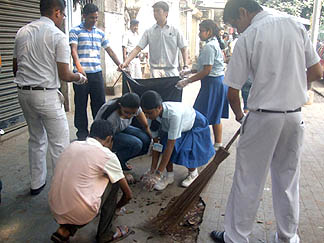
KOLKATA, India (UCAN) – Students, arming themselves with brooms, swept a busy street in Kolkata on Nov. 15 to highlight the need for civic consciousness. Students clean a stretch of a central
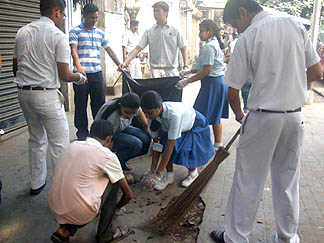
Kolkata street to mark Children’s Day
“We are responsible for the dirt and muck on the streets, so we need to take steps to keep the city clean,” said Tanay Saigal of St. Joseph’s College. Saigal was among some 160 young people from 20 educational institutions who cleaned a 200-meter stretch of Rafi Ahmed Kidwai Road that day.
The Jesuit-initiated Leadership Training Service (LTS) organized the initiative to mark national Children’s Day.
Students across India usually observe Children’s Day on Nov. 14, the anniversary of the birth of Jawaharlal Nehru, the country’s first prime minister, who loved children.
Jimmy Tangerine, a former LTS member who organized the event, said the group decided to hold the street clean-up a day late since most schools had their own programs on Nov. 14.
The LTS was introduced by the Jesuits of South Asia some 50 years ago to encourage leadership among students. The Kolkata-based service has thousands of members from various religions.
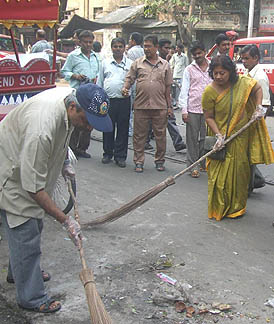
Father George Pattery and city councilor Sushmita Chatterjee clean Rafi Ahmed Kidwai Road
Saigal, 16, said he found the cleanliness drive useful. “At least it made us aware of the conditions of our city’s roads. Often the dirt on the road does not bother us because we are so used to it,” he told UCA News.
Radhika Kishore Puria of Loreto College said the clean-up helped her empathize better with those forced to live on the streets. She said prior to participating in the program, she had simply overlooked the dirt and filth.
Her friend, Upasana Rohia, said she was encouraged to see many bystanders volunteering to help the students. “I was fascinated by the people’s positive response,” she added.
Launching the event, Sushmita Chatterjee, who represents the area in the Kolkata Municipal Corporation, said the students have set an example for their elders whose lack of civic pride had spoilt the environment.
Chatterjee, a former teacher at Kolkata’s Don Bosco School, expressed regret at the lack of civic consciousness in the city and how people accept dirty streets as part of life. “We should be happy” if a few people “follow your example,” she told the students after symbolically sweeping part of the road with Calcutta Jesuit provincial Father George Pattery.
Tangerine, who owns a local shortwave radio station, said he hopes the “experimental drive” would become a movement with more schools joining in. The LTS has “great potential” to mobilize students, he said. His group plans to get more institutions to conduct similar initiatives regularly, he added.