


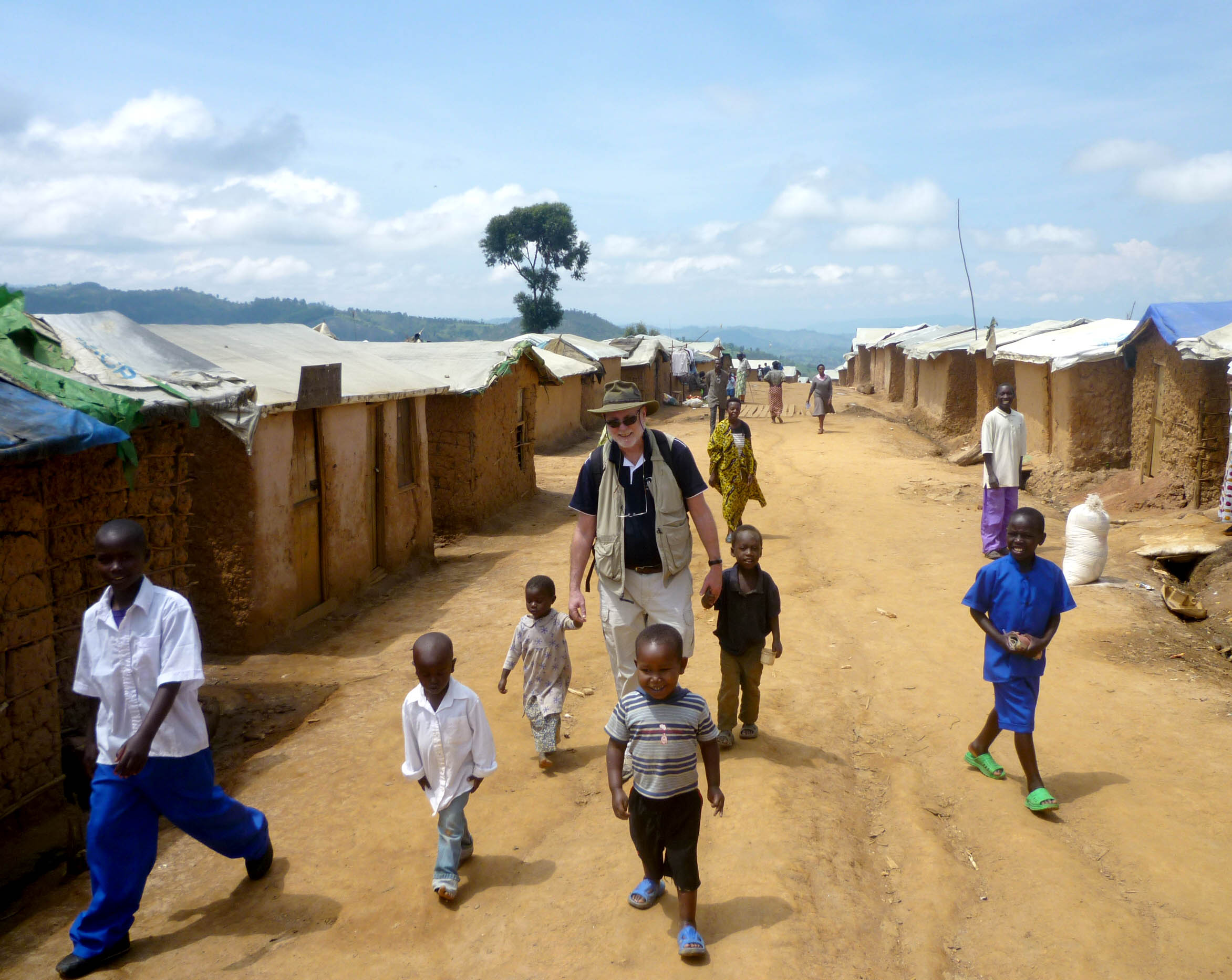
Michael S. Gallagher, S.J. and his young ‘escorts’ tour Kiziba Refugee camp in eastern Rwanda. (Jesuit Refugee Service)
Whereas most JRS people are in one place serving a specific population – albeit sometimes a very large one – we in the international office are in for a short period of time. Usually we are focusing on internal JRS issues such as training of local volunteers or fostering relations between JRS and the local church and intergovernmental organizations. For me a question arises: how do I accompany the forcibly displaced?
Michael Gallagher, S.J.
Reflections for prayer
Two images come to mind. The first was somewhere in Eastern Chad. The JRS team got into a truck and drove to a designated place where we met up with other non-governmental organizations, each in its vehicle. Two vehicles carrying armed members of the Department Intregré de Securité joined us and took up station, one at the head of the group the other as the last vehicle and we drove to the refugee camp. We were “escorted.”
The second image comes for Kiziba Refugee camp in eastern Rwanda. I was walking through the camp to see JRS works with the project director. A very young boy, between three and four years old came up and grabbed a finger on my left hand and began walking with me. Soon a small girl of about the same age came up and took hold of a finger on my right hand. We walked all around the camp looking at JRS schools, and other works. I was accompanied.
JRS’ mission is to accompany, serve and plead the cause of forcibly displaced persons. Accompaniment, I have learned, is by its very nature reciprocal. It cannot be done alone and it cannot be done in a unilateral fashion.
The two children who walked with me were undoubtedly born in Kiziba camp. They had never been in the Democratic Republic of the Congo which their parents fled. Kiziba was home to them. They did not feel displaced there. The two tykes accompanied me through the camp and I accompanied them. The three of us were not engaged in “doing for” but in “being with.” We entrusted each other with our time and presence.
In their wordless innocence, by the simple gesture of holding the hand of a person never seen before, these two natives of the camp became the embodiment of Jesus’ words in Mt. 25:35: “I was… a stranger and you welcomed me.”