


It seems to many that the true spirit of Christmas disappeared from American life some time ago. The traditional manger, with shepherds and angels adoring the infant Savior, is no longer seen in department store windows,
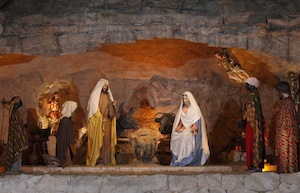
All the religious feasts of the season, however, are swallowed up in a consumerist frenzy of spending. Economists and broadcast journalists take the fiscal pulse of the nation by counting off the length of the shopping line at Best Buy on Black Friday. The biblical Christmas stories have been replaced by “How the Grinch Stole Christmas” and “Frosty the Snowman.” Even Frank Capra’s “It’s a Wonderful Life,” which attempted to redeem the spirit of generosity, in tune with the Gospel message, from the grasp of unregulated capitalism, has been replaced as a Christmas ritual by the nonstop broadcast of Jean Shepherd’s satirical film “A Christmas Story.” Culturally there is no doubt the Christian Christmas has been displaced, subverted and buried under a mountain of commercial trivialities and cultural kitsch.
It would be comforting, of course, if the wider culture re-enforced our faith and if pious Christian customs, like manger scenes and caroling, had broader appeal. The crass secularization of the season, however, could well spur us to reflection on a kind of spiritual asceticism that renounces unchallenging sentimentalism about Christmases past. For appropriating the Gospel spirit of identifying with the poor, as presented throughout Luke’s narrative, or with the persecuted and refugees, as in Matthew’s account of the flight into Egypt, is far more important for Christians than preserving reassuring public images of the Nativity.
Such attitudes are also more in keeping with the Evangelists’ intentions than the representation of their narratives. Neither Mark’s Gospel nor John’s contains an infancy narrative, and John’ s majestic prologue-“The Word was made flesh and dwelt among us”-focuses on the mystery of the Incarnation and our share in its blessings. If we feel deprived by the vapid secularity of “the holidays,” we would do well to consider instead how we who belong to the body of Christ can extend the grace of the Incarnation to our contemporary world.
Knowing that every person shares in the grace of the Incarnation, how should we celebrate? First, let us rejoice that God is with us, not just at Christmas but at all times, and that there is no corner of the world in which Christ is not present. The rest of the answer will be found in the morning headlines and evening television news from Afghanistan, Haiti and the Sudan. We will find it in a walk through the soup kitchens, homeless shelters and crime-ridden neighborhoods of our hometowns. There we will find, as Gerard Manley Hopkins, S.J., wrote, “Christ plays in ten thousand faces/ lovely in limb and lovely in eyes not his.” Our hearts will tell us what to do next. It is in our service of the world, in our defense of human rights, in our welcoming of migrants, in the promotion of forgiveness and the fostering of unity among peoples that the power of the Incarnation courses through today’s world.
At the same time, we should not neglect works of imagination that attempt to infuse the popular mind with the Christmas spirit. When Charles Dickens wrote “A Christmas Carol,” he intended to redeem the bleak work ethic of Victorian England with a renewal of Christian charity, just as in the wake of the Great Depression Frank Capra sought with “It’s a Wonderful Life” to revive a sense of community and the common good. Transforming imaginations is integral to incarnation. We who are the church-especially artists, writers, filmmakers, advertisers and broadcasters-need to do today what Dickens and Capra did for their times.
New campaigns of evangelization should enlist artists of every sort and utilize every new medium to spread the good news. Christian artists and communicators must find one another and imagine ways to communicate God’s love in an urban, digital culture, as St. Francis did with his crèche in the pastoral Italy of his day. Those with other talents should offer financial support and patronage to the promotion of new Christian art.
Even as we live out the Incarnation in charity and social commitment, through our creativity and inventiveness, Christians need to retell the Christmas story in ways that awaken the hearts of today’s Scrooges to the meaning of Christmas present.