
On 16 November 1989, Ignacio Ellacuría, Ignacio Martín-Baró, Segundo Montes, Arnando López, Joaquín López y López and Juan Ramón Moreno, together with Julia Elba Ramos and Cecilia Marisela Ramos, were murdered in El Salvador. The 20th anniversary has been commemorated by a resolution of the Congress and Senate in the United States.
Australian Jesuit Fr Andrew Hamilton SJ remembers the aftermath of the terrible tragedy and its impact on the Society.
 On the day that the six Jesuits, together with the community cook and her daughter, were murdered in El Salvador, I was at Cha Choeng Sau outside Bangkok. The Jesuit Refugee Service was holding a meeting, where we had heard from JRS workers of the suffering and resilience of refugees around Asia. We looked forward to hearing from Fr Jon Sobrino, the Salvadoran Jesuit theologian, who had been speaking at another meeting in Bangkok. But at breakfast we heard the dreadful news.
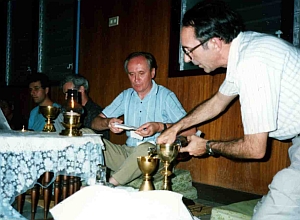
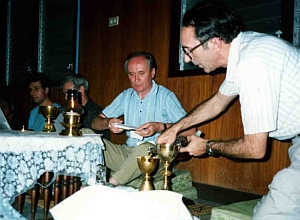
That evening Jon Sobrino did join us for the Eucharist, still in shock. The next morning, he read the account in the Bangkok Post. A photograph showed one of the dead Jesuits in a room. Jon looked at the photo, and said slowly, ‘That’s my typewriter: that’s my Bible. That is my room’. A Jesuit visiting from another community had spent the evening and died in Jon’s room.
Two years later, I spent six months in El Salvador. I wanted to understand Latin American theology and to visit the communities of refugees who had returned from camps in Panama, Honduras and Nicaragua. In the theological library where I worked there were still bullet marks in the walls from the night of the murders. In many communities there were other relics – the stole worn by Fr Martín Baró, and so on.
The Jesuits were still bearing the weight of their loss. They were determined not to allow the deaths to affect their commitments, and were intensely focused. One wit had remarked, ‘In 1989 the Salvadoran Army martyred the six Jesuits; in 1990 the six Jesuits martyred the rest of the Province’.
Although I had intended my stay to be a gesture of solidarity with the Jesuits in El Salvador, I came to realise that guests with less than fluent Spanish must have been more of a burden than an encouragement. The Jesuits in El Salvador lived under great pressure, constantly standing up to a government that had turned its arms against its little people, and following Jesus in the midst of a civil war. Those who were killed were good people, good Jesuits. They were not picture book saints, just ordinary martyrs. I was heartened to hear that one died swearing at the soldiers who had just broken in the door.
 It was in the campesino communities that I began to understand the six Jesuits and the theology evolving in El Salvador and other parts of Latin America. The figures of Julia Elba and Cecilia Marisela Ramos, the community cook and her daughter, then came into sharp focus. With that came some understanding.
These communities had been forced to leave the mountainous parts of El Salvador as the army conducted its counterinsurgency campaign. This consisted of sweeping through villages and killing indiscriminately, and more systematically murdering catechists. In this way they hoped to deprive the guerrillas of a population where they could hide and to intimidate its leadership. The families, all poor, fled and gathered in camps across the border. There they centred their lives around reflection on the Gospels, eventually returning to settle on deserted land. They lived precariously, protected to some extent by foreign volunteers who accompanied them.
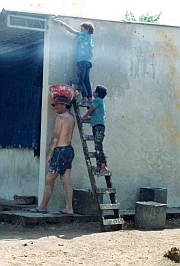
In the communities I was given simple tasks where I could not do too much damage. In one community that was preparing to celebrate its tenth anniversary, apart from joining the children in whitewashing the school for the occasion, I was asked to gather the names of their martyrs to remember in the Eucharist. It was deeply moving. The list grew and grew as each family remembered parents, sons and daughters, many of whom had been catechists. One lady offered the names of her seven sons, describing each, and how he had been killed. When she came to the last, Juan, she wept gently. ‘I had such hope in him’, she said.
Harvesting the names made me think of Julia Elba and Cecilia. The Jesuits had died because they refused to regard the poor of El Salvador as expendable, and would not allow those murdered to lie forgotten. They kept memories and hopes alive. Julia and Cecilia had thought they would be safer staying the night in the Jesuit house than at home. But the Jesuits had made themselves unsafe by joining themselves to the expendable poor like Julia and Cecilia. So I began to see the six Jesuits as just some of thousands who had died, represented by the faces of the cook and the daughter.
The theology done in El Salvador, too, was about listening to the Gospel through the lives and the simple words of the poor, and seeking larger, connected words in which to speak of it. It made sense in the communities that I visited. The learned criticism of it that I had read made no sense, just as the political analysis of the threat posed by the poor of El Salvador made no sense. It all began and ended in the wrong place.
The message that I learned from Julia Elba and Cecilia Marisela and the six Jesuits who died, and from the theology that honoured their faith, is that in the Kingdom of God the first will be last, and the last will be first. If we want to follow Jesus we must be simple, companions to those normally thought of last, like Julia and Cecilia Ramos, and so like Ignacio Ellacuría, Ignacio Martín-Baró, Segundo Montes, Arnando López, Joaquín López y López and Juan Ramón Moreno.
Pictured: (Top) Fr Jon Sobrino (right) at the eucharist in Bangkok, following the deaths of the six Jesuits in El Salvador. (Middle) Fr Andrew Hamilton in El Salvador.