
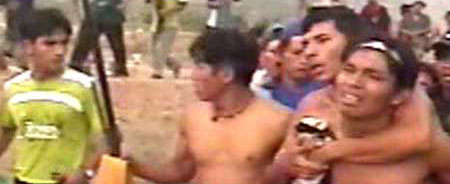
Violent clashes between police and indigenous people in northern Peru on 5 June left, according to official sources, 23 police officers and 10 protesters dead. Two hundred indigenous were injured, 61 are said to have disappeared and 83 have been arrested, of whom 61 are now on trial. Those who have been released from prison said they had been subjected to physical and psychological abuse. The indigenous had been peacefully blocking a road for weeks to protect their land from the effects of a law passed in 2008 allowing its exploitation through the growth of biofuels, mining and oil drilling The violence was unleashed when police officers, who were given the word from the capital Lima to remove the protesters, moved in with tear gas and automatic weapons. The protesters were armed largely with spears. The law was subsequently revoked on 18 June. A number of Jesuits are closely involved with the indigenous tribes of Awajun and Wampis in the area and are supporting the affected communities by reporting events, helping the wounded, visiting those in prison, advocating for detainees and facilitating the return of the displaced. César Torres SJ, coordinator of the social apostolate in Peru, said in a statement issued on 10 June: “It is our vocation to protect the life of all people and we feel sadness and outrage about any act to the contrary. Our presence in the area (Vicariato de Jaén) responds to a mission that the Society of Jesus has been entrusted with by the Holy Father; therefore we cannot stay on the sidelines of events.” YouTube video of the events on 5 June
Bringing Hippos to the Amazon: Alan García’s indigenous policy in Peru (Javier Arellano Yanguas, 8 June) Related SJS articles: Brazil: Indigenous people celebrate court victory (April 2009) WSF 2009: Indigenous people’s participation at the World Social Forum 2009 (January 2009) Latin America: Indigenous Apostolate meets (October 2008) Brazil: Indigenous peoples’ rights: join the Jesuit campaign (June 2008) Chile: Jesuit support for Mapuche people (April 2008) Picture above by Canal Telersat Service, Peru (enlacenacional.com)
Jesuits “cannot stay on the sidelines of events” in Peru
【Blog】Please Pray for Priests
Post by Ryan Duns, SJ

Dear Lord,
we pray that the Blessed Mother
wrap her mantle around your priests
and through her intercession
strengthen them for their ministry.
We pray that Mary will guide your priests
to follow her own words,
“Do whatever He tells you” (Jn 2:5).
May your priests have the heart of St. Joseph,
Mary’s most chaste spouse.
May the Blessed Mother’s own pierced heart
inspire them to embrace
all who suffer at the foot of the cross.
May your priests be holy,
filled with the fire of your love
seeking nothing but your greater glory
and the salvation of souls.
Amen.
Saint John Vianney, pray for us.
Church forum discusses Father Matteo Ricci’s work in China
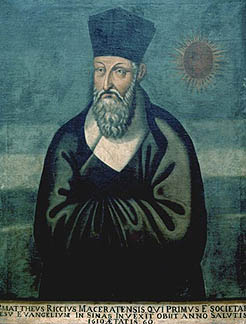
MACAU (UCAN) — The Macau Ricci Institute has marked the anniversary of the death of famous Jesuit priest Father Matteo Ricci, a Sinologist who promoted Christianity in China while introducing the country’s culture to the West.
 |
|
A portrait of Father Ricci
|
Next year will be the 400th anniversary of the death of the priest who lived the final 27 years of his life in China.
The Jesuit-run Macau Ricci Institute held a forum on May 11, the day Father Ricci died in Beijing in 1610.
The forum looked at the priest’s remarkable career in the country from the time he arrived in Macau, covering his travels through China to Beijing.
Father Gianni Criveller of the Pontifical Foreign Missions Institute (PIME) spoke on “Matteo Ricci’s Ascent to Beijing (1583-1610).”
Father Ricci, known as Li Madou to the Chinese, was a prolific writer, a Sinologist, linguist and an accomplished scientist.
Father Ricci, an Italian, began to learn the Chinese language on arrival in Macau, then a Portuguese colony and the gateway for foreigners entering China. After mastering the language, the priest set off for Beijing, arriving there in 1601.
Father Criveller, an Italian, told UCA News that he presented some lesser known aspects and misconceptions surrounding Father Ricci’s journey to Beijing. The priest made four lengthy stops between Macau and Beijing, at Zhaoqing and Shaoguan (then called Shaozhou) in Guangdong, Nanchang in Jiangxi and Nanjing in Jiangsu.
 |
|
Father Gianni Criveller (left) and Jesuit Father Artur
|
Father Criveller said the talk was a follow-up on his earlier forum speech last October, when he focused on Father Ricci’s life before coming to China. The two speeches will be published in a booklet in English and Chinese next year to commemorate the Jesuit’s 400th death anniversary.
Many people viewed Father Ricci’s life in China as a success.
“In fact, he had many setbacks and difficulties,” such as his discouragement upon seeing his companions die on the trip to Beijing, said Father Criveller.
Father Ricci was detained by officials when a crucifix was found among his gifts to the Chinese emperor. They believed it was a totem of black magic to have a figure nailed on a cross while the public depiction of a naked body was also unacceptable to the Chinese at the time.
Father Ricci is often remembered as a man of science, but he was much more than that, Father Criveller said.
 |
|
The tombstone of Jesuit Father
|
Some of the Jesuit’s techniques for introducing Christianity to China were controversial at the time. He preached the message that God was one and the same with the Chinese deity, the “Lord of Heaven”.
However, Father Criveller said Father Ricci had “talked and written about Christ … on certain occasions when people were ready to learn about Christ.”
The May 11 evening forum, chaired by Jesuit Father Artur Wardega, director of the Macau Ricci Institute, was followed by a concert and a cocktail party for the participants to exchange views.
Father Criveller, based in Hong Kong, has been living in Hong Kong, Macau, Taiwan and mainland China for 18 years. The PIME scholar researches, teaches and writes on the reception of Christianity in China.
Thai Jesuit ordained in Cambodia
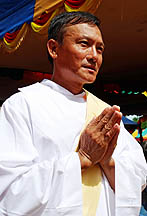
BATTAMBANG, Cambodia (UCAN) — The Church in Cambodia has ordained the first Jesuit priest since the Church revived in the country during the early 1990s. Father Phongphand Father Phongphand Phokthavi, a Thai national, was ordained by Bishop Emile Destombes, apostolic vicar of Phnom Penh, on May 24, in a special ceremony in Battambang attended by 2,000 people. The ordination of Father Phongphand, 53, brings the number of Thai priests serving in Cambodia to four. Ham Sok, one of the many people at the ordination, said the scale of the event was a sign that the Church in Cambodia is growing. During the ceremony, Jesuit Monsignor Enrique Figaredo, apostolic prefect of Battambang, said Father Phongphand “always gives himself to others, loves the poor and encourages people who have lost hope.” The monsignor, who has known the priest for 20 years, cited one occasion when Father Phongphand saw some people without shoes and offered them his own, saying, “I have another pair.” Cambodia has a special place in the Thai priest’s heart. During the 1980s he helped Cambodian refugees in Thailand while working with the Jesuit Refugee Service (JRS). Later in the 1990s he went to Cambodia with returning refugees and helped build a vocational center for the disabled near Phnom Penh. Talking to UCA News, the Thai priest said his inspiration for becoming a priest in Cambodia was when he saw the smiles of refugees despite the suffering they had endured during years of civil war. Monsignor Enrique Figaredo, apostolic He said the challenges he would encounter as a priest in Cambodia would not be cultural or linguistic, but would be in tackling poverty and suffering, and spreading the love of God. He added that his work from now on will be that of a parish priest in Kompong Thom in Battambang apostolic prefecture. He also said he wants to serve in Cambodia for the rest of his life. Besides the four Thai priests, there are also five Thai nuns serving in Cambodia. The last priestly ordination in the country took place in 2001, when four Khmer priests were ordained. Of the 50 priests or so presently in Cambodia, only about five are local Khmer.

Phokthavi at his ordination

prefect of Battambang, blesses Father Phongphand
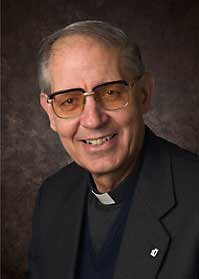
Father General Shares Strategic Priorities for Society
 Assembled for the February Jesuit Conference board meeting in Los Altos, Calif., Superior General Adolfo Nicolás gave the Provincials of the United States and English Canada an update on planning currently underway at the Roman Curia. Father General, in his first stateside visit since his election, shared an outline of five new strategic priorities. Developed during several days of prayer and discussion at a recent Curia retreat, the priorities will be refined and then distributed to the whole Society.
I. Spirituality
Continue to reinvigorate the process of ongoing Spiritual renewal desired by GC 35, nourished in the Spiritual Exercises, at the service of our universal mission and inspired by the best tradition of “Sentire cum Ecclesia,” the right Ignatian attitude towards the hierarchical church as expressed in our Formula Instituti and the Constitutions. This spiritual renewal has to strengthen the triptych: Identity, Community and Mission (GC 35 D2, n.19).
II. Apostolic Discernment
Encourage and focus our ongoing apostolic discernment in order to respond to the new demands of our vocation today, the directions of GC 35 and of the Holy Father. It is a call to the Society in different parts of the world and at every level to discern and chose “those physical and spiritual places” (GC 35 D2 and the Papal Discourse to GC 35) that represent important challenges to the spirit and the proclamation of the Gospel (frontiers). Father General said he is asking “every assistancy to reflect on what they can contribute to the world society.”
This apostolic discernment will require three strategies, among others: the determination of key apostolic frontiers in different regions and at every level of the Society; establishing regular and ongoing processes for initiating, implementing and evaluating the apostolic preferences of the Society, within the horizons of our commitment to faith, justice and dialogue with cultures and religions; and evaluating creatively and courageously all our apostolates in ongoing apostolic planning.
III. Collaboration with Others
The above goals will be impossible without the collaboration of others who share our vision and perspectives regarding the Gospel and Mission. Therefore, we will have to find strategies to develop new and “systematic” forms of collaboration with others in the spirit of Decree 6, n.29 of GC 34. “If we want to think dynamically about our mission and move forward, we must think of others and continue to search for forms of collaboration with laity,” Father General. He cautioned, though, that any systematic approach should “not create a hierarchy among laity.”
IV. Review and Reorganization of the Curia
Review, evaluate and reorganize the General Curia and all its administrative processes for a more agile, flexible and adequate service to the Society and in support of the General in his role as animator of the life and mission of the universal Society (GC 35, D5, n. 7.1). “The Curia is well organized with the experience of 460 years but has little time for reflection and consultation,” Father General said. He seeks to address this through enhanced delegation, simplifying correspondence and other structural changes announced in the coming months.
V. Formation
Give special attention to the challenges that formation presents today to Jesuit superiors and the central government of the Society. Implement directives already developed and officially published. Support programs of initial and ongoing formation in each Conference of Major Superiors that guarantee a solid human, spiritual, intellectual and ecclesial preparation and that equip our men for a better response to the new challenges of our mission as indicated by GC35. Monitor the different stages of formation to help bring to fulfillment the goals of each of the stages and transitions in formation.
“Formation is a time of testing and challenge” said Father General. One that requires “good accompaniment of men through each stage,” he added.
“In Rome, we are at a good moment.”
-Superior General Adolfo Nicolás
After briefing provincials on the strategic discernment, Father General offered a few comments on the current relationship between the Church and the Society. “In Rome, we are at a good moment,” he said. The General added, “Cardinal Levada (Prefect for the Congregation on the Doctrine of the Faith) wants to keep dialogue open … a great willingness for dialogue without judgment or punishment.”
Father General also took time to cite the important and unique role of Jesuit education in America. The “contribution of the United States to the world Society in higher education is exemplary; no other country has 28 colleges and universities,” said the Superior General. He recalled a quote from a friend in Japan commenting about the Jesuit identity of a local school, “it is not what happens in the chapel; when you enter the gate, everything is chapel.”
Father General concluded his remarks with a reminder to keep those less fortunate near our hearts. “Poverty is the wall of religious life; we must not be too far from the regular people.”
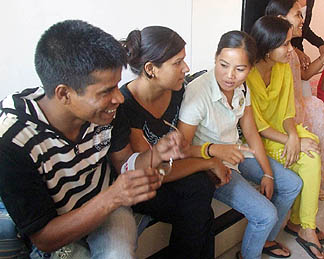
Bhutanese refugees learn leadership skills at Jesuit-run college
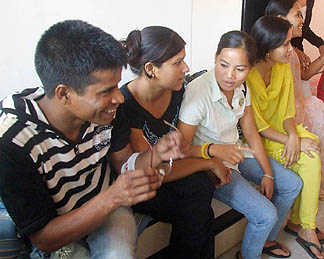 KOLKATA, India (UCAN) — Nearly two decades after a forced exodus from the Himalayan kingdom of Bhutan, thousands of refugees living in Nepali camps still miss opportunities for a better life, professional training, and home.
Bhutanese refugees at the exchange program
Santiram Khadka, 24, was just a boy when his family was expelled in the early 1990s, along with other mainly ethnic Nepalese. This was a result of the kingdom’s policies that sought to control alleged illegal immigration by ethnic Nepalese, even though some claimed they were born in the country. Bhutan has a population of only about 800,000.
Its army suppressed protests, killing and wounding many who opposed the policies. The government confiscated land, closed schools, and forced many of Nepalese origin to sign a “Voluntary Migration Form” before they had to leave. Khadka’s father faced accusations of supporting terrorists, and was tortured.
Khadka’s family members are among what the United Nations High Commissioner for Refugees (UNHCR) estimates are nearly 110,000 Bhutanese living in seven camps in and around Tamak town, eastern Nepal.
Still traumatized by what his family experienced, Khadka recently shared his pain during an exchange program for these young refugees, in a Jesuit retreat house close to Kolkata, India.
Now seeking to learn leadership skills they could use in their communities, 10 young men and nine women from the camps joined the All India Catholic University Federation (AICUF) members in the March 10-14 event to share experiences.
Four of the refugee youths were Buddhists and the rest Hindus. Forty AICUF members participated in the program, organized by AICUF’s Jesuit-run St. Xavier’s College unit.
“We felt the need to form leaders in the refugee camps who will work for their people, and that is what we did during the workshop,” explained Purna Siwapoti, 22, a member of the AICUF national team.
The program trainers included Jesuits and AICUF students. Jesuit Father John Rojerse, national promoter of Leadership Training Service, spoke on the simple ways in which young adults can act as leaders in their communities.
AICUF students, who often conduct workshops for youths based on their training, also shared their knowledge and experiences of leadership.
Siwapoti’s federation has identified refugees, tribal people, dalit (former untouchables at the bottom of the Indian caste system), and women for special attention.
Siwapoti said a previous exchange program included a team of AICUF members visiting the refugees in Tamak last year.
Jesuit Father Peter Jong Lepcha, 39, coordinator of the Youth Friendly Centre (YFC) in Tamak, said the young refugees were among 14,000 youths aged 18-25 who were in contact with Caritas-Nepal, the Nepal Church’s social-service agency. The YFC provides the youths with facilities for education, art, culture, sports and games.
Father Lepcha said the young participants in Kolkata already had leadership qualities and only needed further training.
While many of the young people in the camps find their future uncertain, Khadka said the participants were returning from Kolkata with greater self-confidence. The workshop “fine-tuned leadership qualities” they had, he said.
An AICUF member, Noel Francis, said the exchange program helped both groups. “This was the first time we heard the stories of refugees directly.”
Principal Jesuit Father John Felix Raj said his college admits one to two students from Tamak camps every year. “We realized exchange of this sort is sure to enrich both the refugees and our students.”
Refugee students in the college study for three years. The college offers bachelor’s degrees in arts, science and commerce, and technical studies in bio-technology and computer skills.
A 2007 UNHCR report said there were people from more than 50 ethnic and caste groups in the seven Nepali camps. An estimated 60-70 percent of the refugees are Hindus, 20-25 percent are Buddhists, 5-8 percent are indigenous Kirat, and 2-3 percent are Christians.
The report added that training opportunities in the camps, especially for occupations, were limited. About 40 percent were students, while 25-30 percent had no education. Only a few of the refugees have had university education in India.
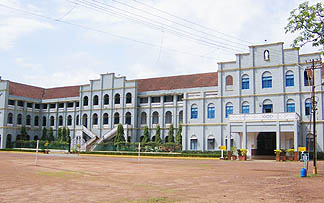
Hindu threats spark heavy security around Jesuit college
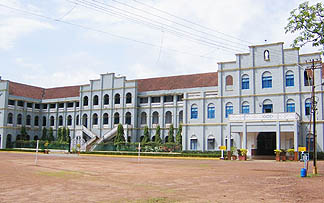
MANGALORE, India (UCAN) — Threats from Hindu radicals have forced a Jesuit college in southern India to conduct annual examinations under heavy police security. St. Aloysius College in Mangalore Radical groups have accused St. Aloysius College in Mangalore of discriminating against some Hindu students who were denied hall tickets — special admittance cards for examination participation. The groups have also threatened to attack the college’s principal and rector, forcing the civil administration to impose orders to prohibit outsiders entering the campus of 13,000 students during the March 13-26 examinations. “Now the examinations are being held with tight police security,” said Jesuit Father Richard Rego, who teaches in the college. The students affected by the heightened security are from the Pre-University Course (PUC) department of the century-old campus, that also has a primary school and a high school. The college conducts bachelor’s and master’s courses in various subjects. PUC principal John D’Silva, a Catholic layman, clarified the college had to refuse hall tickets to 12 students whose attendance fell short of the required minimum. Six of them are Hindus, four are Catholics, and two Muslims, he said. He pointed out that the college was only following a government rule on class attendance and the college action had “no communal angle” to it. The government requires 75 percent attendance in classes before a student is eligible to take examinations. However, it gives discretionary powers to colleges to reduce the percentage if absence was due to college-related activities. The affected students chalked up less than 50 percent attendance, the principal pointed out. Hindu groups, however, said the college had denied tickets to about 50 Hindu students. Srinidhi, a member of the national committee of the pro-Hindu Akhil Bharatiya Vidyarti Parishad (all India students’ council), told the press the college had initially penalized more students for low attendance, but later issued hall tickets to many of them after making them pay fines. He said the college had not informed students about their low attendance. However, Father Rego said the institution regularly informs parents about their children’s academic progress and attendance status. The propaganda against the college by Hindu radicals has been so strong that many people now believe the college has done some injustice to Hindu students, he added. The priest said the college acts every year on the issue of low attendance, but this year radical groups used it as another excuse to attack a Church institution. He added that these groups hope to divide people on the basis of religion. Karnataka state has witnessed several attacks on Christians and their institutions since the pro-Hindu Bharatiya Janata Party (BJP, Indian people’s party) came to power in May 2008. Rohit Someswar, a Catholic social activist, said the incident is part of harassment Christians have faced since then. According to him, the failure of 12 students, out of a total of 4,000, to meet attendance requirements, is “quite normal.”
【UCANews】Late Missioner Saw His Polio As ‘Gift From God,’ Served With Joy
TAIPEI (UCAN) — Contracting polio as a missioner inspired American Jesuit Father Robert J. Ronald to dedicate himself to help others in Taiwan overcome the limitations of that and another disabling disease.
 |
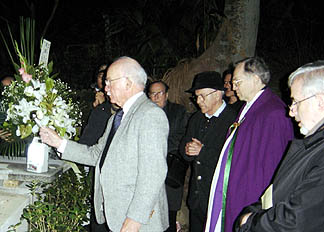
| Younger brother (extreme left) of deceased Jesuit Father Robert Ronald sprinkles Holy Water on the coffin during the burial at Chingshan Jesuit Residence in Changhua county on Jan. 10. |
Taipei-based Operation De-Handicap, which he founded in 1973, remains as a living legacy following his death at age 76 on Jan. 2. The funeral Mass was held on Jan. 10 at Jesuit-run Tien Educational Center in Taipei. His body was buried that evening at Chingshan Jesuit Residence in Changhua county, 145 kilometers southwest of Taipei.
Father Ronald, who contracted polio in Taiwan in 1958, a year after arriving as a seminarian to study Chinese, established Operation De-Handicap to empower youths with polio and muscular dystrophy to assume ultimate responsibility for their own rehabilitation. It also stresses the role of the family in this process.
Besides psychological and vocational counseling, it provides referral services for those who need medical equipment and social-welfare assistance. The center also organizes educational programs and recreational activities to help counselees build solidarity among themselves.
Father Ronald was born in the United States on Oct. 1, 1932, and entered the Society of Jesus in 1950. Polio, relatively common in Taiwan when it struck him eight years later, left him dependent on a wheelchair from that time.
This physical setback, however, did not stop him from serving the people of Taiwan. An obituary from Jesuit-run Kuangchi Program Service, which produces Catholic multimedia programs, quotes him as having once said: “I am healthy. More healthy than before polio even, just limited in local motion, that’s all.”
Father Ronald was ordained a priest in 1965 and returned to the United States three years later to work on a master’s degree in rehabilitation counseling. When he returned to Taiwan in 1971, he served as a consultant at Veteran’s Hospital in Taipei, a position he held until he retired in 2002.
People said they were often amazed at the “joyful disposition” of the priest, who often claimed that the “two greatest gifts he had received from God were his polio affliction and his car accident,” according to the obituary. Father Ronald suffered major injuries in that accident, which occurred in 1974. A year later, infection set in and doctors had to amputate his left leg.
Undaunted, he continued his work and was able to visit foundations and benefactors to support his organization through lecturing and fund-raising activities that included a 21,000-kilometer van trip across the United States.
 The missioner also produced manuals for people working with disabled people and their families, taught classes and workshops, and gave presentations at international conferences on rehabilitation throughout the world.
Ignatius Huang, director of Operation De-Handicap, who worked with the founder for 30 years, told UCA News on Jan. 13 that Father Ronald kept to himself but was always concerned about the needs of others.
The obituary also cites the priest’s care provider of the last seven years recalling how his own life changed through Father Ronald’s “kindness and patient companionship, always reaffirming and encouraging, never scolding, criticizing or complaining.”
Over the years, Father Ronald became recognized as an authority on rehabilitation in Taiwan. The prestigious Medical Contribution Award that the government’s Department of Health presented him in 2003 was one of many honors he received.
Although he seldom had the occasion to explicitly speak about God or the Church in his work, the obituary says he was well aware of the apostolic dimensions of his work. It quotes Father Ronald as having said, “My identity as a priest and as a Jesuit is nearly universally known and my motives respected.”
After his retirement, Father Ronald volunteered to edit English scripts for Kuangchi. In his final years, he became a prolific writer of editorials, poems and fables for the Jesuit Chinese monthly Renlai (flute of humankind), which publishes articles on social, cultural and spiritual issues for readers of all religions.
Europe/Latin America: Jesuits speak up on behalf of migrants
The Jesuit social apostolate delegates of Europe, Latin America and the Caribbean published a statement on 18 December, International Day of Solidarity with Migrants. The statement condemns a “recent negative trend” in the immigration policies of the European Union, listing five areas of concern regarding “the fine line between legality and illegality”. Among the areas of concern are the concept of “voluntary” return; the fact that returnees are given 7 to 30 days but can be detained for up to 18 months if they do not leave within that time frame; and a 5-year ban on entering Europe after departure. Read the full statement here.
In Italy, 18 December was marked by demonstrations opposing a new “security package” of laws which the government intends to pass. Centro Astalli (JRS Italy) was among the organisers of the protests. The proposed laws, if approved, contravene international human rights norms and the Italian constitution itself. They criminalise migrants for being undocumented, and hinder documented migrants from reuniting with their families. Further, separate classes are set up for migrant children and access to healthcare is restricted, requiring medical personnel to report irregular migrants who request assistance.
Europe/Latin America: Jesuits speak up on behalf of migrants
The Jesuit social apostolate delegates of Europe, Latin America and the Caribbean published a statement on 18 December, International Day of Solidarity with Migrants. The statement condemns a “recent negative trend” in the immigration policies of the European Union, listing five areas of concern regarding “the fine line between legality and illegality”. Among the areas of concern are the concept of “voluntary” return; the fact that returnees are given 7 to 30 days but can be detained for up to 18 months if they do not leave within that time frame; and a 5-year ban on entering Europe after departure. Read the full statement here.
In Italy, 18 December was marked by demonstrations opposing a new “security package” of laws which the government intends to pass. Centro Astalli (JRS Italy) was among the organisers of the protests. The proposed laws, if approved, contravene international human rights norms and the Italian constitution itself. They criminalise migrants for being undocumented, and hinder documented migrants from reuniting with their families. Further, separate classes are set up for migrant children and access to healthcare is restricted, requiring medical personnel to report irregular migrants who request assistance.