
KOLKATA, India (UCAN) — Suranjan Makhal was surprised when a Jesuit priest sang about the teachings of Jesus on an ektara, a one-string musical instrument, during a religious program in this eastern city. Father Chinnappan performs baul songs “It was the first time I listened to baul songs by a Catholic priest,” Makhal admitted. He had come from Keorapukur parish in Baruipur diocese to see two Jesuit priests use local art forms to explore biblical themes. The Aug. 23 program at St. Xavier’s College was titled “Bible, Baul and Bharatanatyam: An evening of song and dance meditations.” Baul, popular in West Bengal and Bangladesh, is a folksong tradition with philosophical overtones. Bharatanatyam is a classical dance form that developed in southern India. Father John Chinnappan, a self-taught baul singer, and Father Saju George, a trained Bharatanatyam dancer, together with their musical troupe, enthralled the audience for two hours. “I found it interesting to listen to Father Chinnappan’s rendering of the message of the Bible in an idiom which is easy for me to understand,” Makhal commented. Father Chinnappan sang about Jesus as the way to the Father, his invitation to people leave everything in order to follow him, his words of encouragement and other Gospel themes. The 41-year-old priest, who performed eight songs, told UCA News his vocation is to preach the Gospel in the vocabulary and idiom of Bengal, fulfilling the command of Jesus to share the Gospel with the whole world. He added that the people’s response to his presentation overwhelmed him. Makhal said Father George’s 15-minute solo Bharatanatyam performance of the passion, death and resurrection of Jesus also surprised him. Father George, 44, explained: “The Lord was nailed to the cross and requires my hands to reach out to the people in need, and he invites me to offer myself in the words of St. Ignatius of Loyola — ‘Take Lord, receive!'” He said he has performed this particular piece more than 100 times in Europe and several times in India. Father George enacts the crucifixion In the West, he added, people do not like to watch depictions of great suffering, whereas in India people are affected deeply by it. Father George said his other troupe members, all Hindus, go beyond the narrow boundaries of religion and find fulfillment in performing works with Christian themes. According to Christian baul singer Sonojit Mondol, who attended the program, baul is a spiritual tradition. With the Bible’s focus on spiritual values, it is easy to compose and sing baul songs based on biblical themes, he said. The program was part of the 150th anniversary celebrations of the Church’s presence in Bengal and the founding of St. Xavier’s School in Kolkata. Church leaders who attended included Bishop Salvadore Lobo of Baruipur and three heads of Religious congregations: Missionaries of Charity Sister Mary Prema, Missionaries of Charity Brother Geoff Brown and Daughters of St Anne Sister Florence Rozario.


of Jesus using Bharatanatyam dance
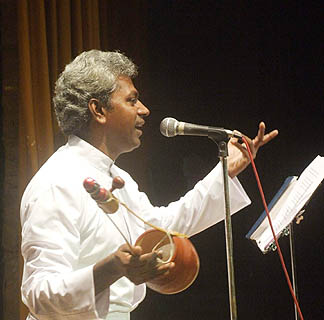
Jesuit artists use traditional songs, dance to portray biblical themes
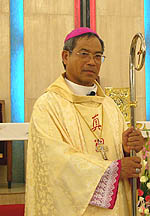
Taiwan bishop leaves FABC assembly in wake of flood crisis
MANILA (UCAN) — The president of Taiwan’s Chinese Regional Bishops’ Conference, Archbishop John Hung of Taipei, has left the Asian bishops’ plenary assembly to lead the Church’s response to deadly flooding back home. Archbishop John Hung “People have been texting me and calling to ask, ‘Where are you?'” Archbishop Hung told UCA News before leaving the Pius XII Catholic Center in Manila on Aug. 13, the third day of the 9th plenary assembly of the Federation of Asian Bishops’ Conferences (FABC). “I feel like a shepherd being called back to tend to his sheep,” Archbishop Hung said. The prelate added that he wants to find out for himself the extent of the damage and work out ways of getting Church aid quickly to those who need it. “I heard the estimated extent of the damage is too big for the government to deal with by itself,” he explained. Typhoon Morakot, the most powerful storm to hit Taiwan in the past 50 years, slammed into the eastern and southern parts of the island on Aug. 8. The government’s Central Emergency Operation Center (CEOC) said on Aug. 13 the storm had killed 108 people, injured 45, with 62 reportedly still missing. These figures are expected to rise as many villages are still cut off. Bishop Philip Huang of Hualien, whose diocese is badly hit, is attending the FABC assembly with Bishop Martin Su Yao-Wen of Taichung and Bishop Baptist Lee of Hsinchu. In Bishop Huang’s absence, Auxiliary Bishop John Baptist Tseng King-zi of Hualien is directing Church relief work in eastern Taiwan. Meanwhile, Kaohsiung diocese has stepped up its relief effort to victims in Kaohsiung and Pingtung counties, the two hardest hit counties in southern Taiwan. In an update, the diocese said it has set up a central relief aid collection center in a Church school downtown. It has also set up a relief command center at St. Joseph Church in Chishan town of Kaohsiung, and two centers in Pingtung — at the Immaculate Conception Minor Basilica in Wenluan township and the Holy Cross Church in Chiatung township. The “Daily Bread,” a charity group from Kaohsiung diocese, has called for donations of gasoline, rice, cooking oil, clothes, torches, candles, toiletries, canned food as well as other necessities. Dominic Kao Hung-po, 60, a Daily Bread organizer, told UCA News that they are now in need of volunteers and vehicles to deliver the relief aid. Though many indigenous laypeople live in the two counties, the Church is not yet able to get information on the number of Catholics dead and injured due to a breakdown in communication links, he added. In the Wutai township of Pingtung, Father Dominic Tu Yung-hsiung, vicar general of Kaohsiung, told UCA News that four Catholics and one Protestant in his neighboring village had died in mudslides. All in his village were accounted for as they managed to evacuate in time. Almost all the Lukai indigenous people in the mountain township are Christians, according to Father Tu, the first Lukai priest in Taiwan. In Manila, Archbishop Orlando Quevedo of Cotabato, the FABC secretary-general, conveyed an appeal by Archbishop Hung for help. Archbishop Quevedo said money and supplies are needed, especially drinking water. He advised participants of the plenary assembly to channel donations through Caritas Taiwan.

of Taipei — UCAN photo
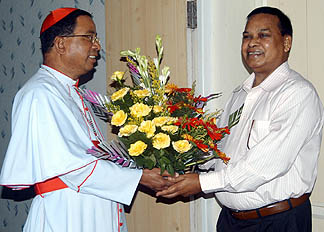
Jesuit’s vice-chancellor appointment delights Jharkhand residents
RANCHI, India (UCAN) — People of various religions have welcomed a Jesuit priest’s appointment as vice-chancellor of a new university in Chaibasa, in eastern India’s Jharkhand state. Cardinal Toppo (left) congratulates Father Ekka following the Jesuit priest’s appointment as vice-chancellor of Kolhan University Father Beni Ekka’s appointment as the first vice-chancellor of Kolhan University “is a matter of pride for Christians and others in Jharkhand,” says Cardinal Telesphore P. Toppo of Ranchi, head of the Catholic Church in the state. “It is also recognition of the Church’s contribution in the field of education,” the cardinal told UCA News. On Aug. 12, Jharkhand Governor K. Shankaranarayanan named Father Ekka to a three-year term as the effective director of the university, which is still being set up. Governors, who represent the Indian president in their respective states, serve as the chancellors of all state-run universities. The vice-chancellors function as chief executive officers. Father Ekka, 62, officially moved into his new office at the governor’s residence in Ranchi, the state capital, the day after his appointment. He had been director of Xavier Institute of Social Science (XISS), a Jesuit-managed business school in Ranchi, since 1994. The priest described the “unexpected appointment” as a challenge. “It is an opportunity for me to work in an area that is rich in natural human resources, but remains underdeveloped.” His first priority, he said, is to set up new colleges and introduce professional courses. “I have a vision to produce tribal youth professionals” to work in the region, he added. Cardinal Toppo called Father Ekka “the right person” to lead the new university, after proving his leadership ability as XISS director. “He can do much more than others. He understands this is a special role God has assigned him,” the prelate remarked. On Aug. 13, thousands of students from all religions held a rally in Chaibasa, a major town in the state, to celebrate the priest’s appointment. Madhu Koda, a member of India’s parliament and former state chief minister, led the celebrations. People in Jharkhand are “lucky” to get Father Ekka to head the new university, Koda later told UCA News. “He will provide a firm base for the university” as did for XISS, he added. According to Koda, who follows a traditional tribal religion, the new university will bring higher education to students in one of the state’s most backward regions. “I dreamt about such a university during my college days,” he added. In 2007, the state government Koda led promised to establish the university in Chaibasa. “Some vested interests delayed the foundation of the university. They opposed providing academic facilities to tribal students,” Koda alleges. Some students said they expect the Jesuit priest to make the university a shining light in the country. “Now we have our own university and are lucky to have Father Ekka as vice-chancellor,” enthused Sunita Sumbroi, a Ho tribal girl in Chaibasa. Former governments “left us educationally backward,” said Salkhan Soy, a Catholic tribal student. “Now we hope to have many colleges under this university.” Mohammad Bari, a Muslim leader in Chaibasa, acknowledges the university has brought “tremendous joy” for local people. Father Ekka’s appointment “has further increased our happiness,” he told UCA News. “We have high expectations for the Catholic priest.” In Ranchi, Muslim leader Naushad Khan said he would miss the Jesuit priest. Father Ekka maintained good relations with people from all religions and “always found time for people, especially in social work,” he said. Catholics now head two of the state’s five universities, and the two administrators are former classmates. Victor Tigga, vice-chancellor of Sido Kanhu University, studied with Father Ekka at St. Ignatius High School in Gumla and said the priest will do “his best for Kolhan University, since he is an able administrator.”


Catholics bid farewell to Jesuit educator
KATHMANDU (UCAN) — Catholics bade farewell to American Jesuit Father James J. Donnelly who died here on Aug. 17. The priest, who had dedicated his life to education in his adopted homeland, was 80 and suffering from various ailments. Portrait of Father James Donnelly at his funeral “Father Donnelly was a warm-hearted person and an astounding teacher,” Jesuit Father Augustine Thomas Amakkatt told the crowd at the funeral held at the Church of our Lady of Assumption on Aug. 17. The late priest was also a “walking encyclopedia of chronology of Nepal,” an expert on the Himalayan mountain peaks and a lover of Nepal’s natural beauty, Father Amakkatt said. Father Donnelly was born in Cincinnati, Ohio, and celebrated his 80th birthday on Aug. 5 this year. He came to Nepal as a young priest just after his ordination in 1961. He was assigned to teach English at Godavari St Xavier’s School, one of two Jesuit-run schools in Nepal. Over the years, he taught students who went on to become doctors, engineers and businessmen. Father Donnelly remained at the school till 1968 when he moved to St Xavier’s School at Jawalakhel, staying there until 1980. He then returned to Godavari St Xavier’s where he was principal until 1990. He began writing textbooks for schools in 1991. He wrote three English language textbooks — “The Writing Handbook,” “The Workbook I for the Writing Handbook” and “The Teachers’ Key.” The priest was among four Jesuits to receive the highest award given by the state to the public. Former King Gyanendra Shah gave him the Gorkha Dakshin Bahu III for his dedication to teaching young people in the country. The other Jesuit recipients of the award were Father Marshal Moran, Father Casper Miller and Father Lawrence Maniyar, the current regional superior of the Jesuits in Nepal. Father Maniyar told UCA News that Father Donnelly was also renowned for his trips abroad to raise funds, mainly for the construction of school buildings and houses for Jesuits in Nepal. Various people shared their recollections of Father Donnelly with UCA News. “His English was great and he taught the boys very well. He was strict but loving and caring as well,” said Rama Parajuli, a Catholic whose son was taught by the priest. Catholics paying their last respects to Father Donnelly at the Church of Our Lady of Assumption on Aug. 17. “He had this special gift of spirituality that touched everyone he met and had this amazing knack of remembering the names of all his former students.” Maggie Fetch, who knew Father Donnelly from her early childhood, “deeply regretted” his death. “Priests like him are rare and very few exist in the country,” she said. “No one can forget how friendly he was, his ability to recognize people and talk to them even if he had met them only once.” According to Father Amakkatt, Fr Donnelly’s most popular activity was showing his large collection of slides which featured the development of Nepal and the growth of the Jesuits among others. Father Maniyar said the priest had died with one regret — he failed in his attempts to become a Nepali citizen. Father Maniyar said Father Donnelly had always remarked: “Nepal is my home; Nepalis my people.”


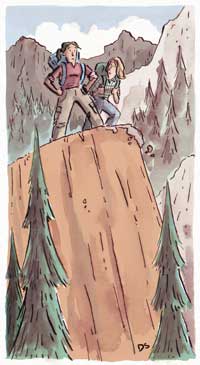
Spirituality in the Wild
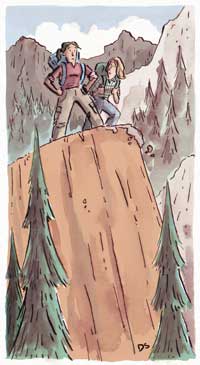
My companion said it out loud first: “Carol, we’re in trouble.” She was right. Early that morning we had set off for the last leg of a five-day backpacking trek through the beautiful but challenging Weminuche Wilderness in southern Colorado. We had survived fierce sun, raging creek crossings, snowy glaciers on the Continental Divide, avalanche crossings, a hail storm and climbs of over 11,000 feet. Now we stood on a seemingly endless ridge that dropped 50 feet to a mountain river ripping down the gorge on its way from a glacier lake to a reservoir, where a campground and our car awaited. The trail had simply vanished into endless overgrown forest, steep angles and craggy rock ledges. As the more experienced backpacker, I had to figure a way down with our 50-pound packs. No trail was in sight, and I knew the path of the river was the only road map to the car. After much thinking and silent praying, I decided we would go down the ridge on our bellies with our backpacks off, sliding them one at a time as we descended, using strategically positioned handholds and footholds. It was slow, painful and frightening but successful-so far so good! We regrouped on the edge of the river, strapped on our packs and hoped simply to walk alongside it until we could pick up the trail on the other side. This worked until we reached a point where the edge of the cold, crashing river met the wall of the gorge and there was nowhere to go but into the freezing water to continue our descent. I do not know how long I stood and looked into the river before finding the courage to take that first step. Just below the clear, deep and fast-moving water I could see a very large root submerged but jutting out from the side of the gorge. I put weight on it tentatively; it felt strong and stable. How it would respond to our weight with our heavy packs, I had no idea. I have used the phrase “leap of faith” cavalierly in the past, but this was the real thing. No matter how long I looked at that root, I would not know until I leapt whether I had made a wise decision. Then I stepped. It held me and my companion. Although it took us that evening and part of the next day, we worked our way down the river and found the trail, as we had hoped. In soggy boots and clothes we trudged quietly and painfully to the campground and our car. The wilderness areas are still wild, untamed and exist on their own terms. As yet they are untouched by human ideas of civilization. That is the attraction. Backpacking in the wilderness is an experience that never fails to put me in my place, not as a master of the natural world but merely a player, a small piece of the cosmic puzzle. The wilderness is a leveler for humans who base self-perception on education, age, race, gender, socioeconomic class or the like. The wilderness does not care who you are or what you have done; it will reward or punish you just the same. Money allows you to shield yourself through the use of gadgets, high-tech clothing and equipment, but these give a false sense of security. Such misplaced confidence makes you less watchful and less mindful; and these “crutches” can be negated by unexpected circumstances or when they simply do not work. Ironically, scientific research on the human brain shows that we have far more natural survival strategies than we realize or use. Underused skills rust in the urban confines of the 21st century; we have forgotten them. We have been lulled into a sedentary complacency of body and mind. We spend our brainpower figuring out ways to outsmart and “tame” the wilderness, with little time for understanding, appreciating and coexisting with it. It has been made into the enemy, something to conquer and control-an adversarial relationship that has made our time in the natural world all about winning or losing. In actuality that is not only a foolish paradigm but a false one, socially constructed and meaningless within the context of the natural world. I love the life of the mind and my academic life, but I never want to fail to appreciate the life of the body and spirit. My physical experiences have brought me into closer touch with my spirituality than almost any other aspect of my existence. I am more apt to find God in nature than in a building full of people. Backpacking in the wilderness focuses my attention, forcing me to be mindful of the present, not obsessing about the past or future. I have to find and stay on the trail using only a topographic map, compass and my powers of observation. I have to avoid the dangers around me and respect the fact that I am a visitor in a world of other living things. I have to be mindful of the weather and where to camp, obtain water, prepare food and sleep safely at night. My clever brain identifies the basic elements. Ultimately, it does not matter how technologically savvy I am, how many degrees I have or the amount of money in my bank account. The focus is here and now, and I must be ready to negotiate my survival for the next few days. I am not a biblical scholar or a trained theologian, but the story of Jesus in the wilderness makes complete sense to me. He went there to escape, think and clear his head of the social and political whirlwind. The temptations to bail, take the easier path and avoid the inevitable were there, as they are for all of us. But Jesus needed the wilderness to experience the fear, the uncertainty and the elemental aspects of who he was. I am convinced no other experience could have helped him crystallize who he was and what he needed to do. I am also convinced that the wilderness experience and his acute physical and spiritual survival skills, challenged by severe deprivations and temptations, gave him the courage to fulfil his destiny. Living as I do in the fast-paced 21st century, with a life full of demands and stress, going into the wilderness helps me understand my own existence. Compared with the life and purpose of Jesus, my life is insignificant, but his example holds powerful truth for me. In a small but significant way, it helps me move forward to whatever and wherever forward is. It gives me perspective and, more important, an understanding of who I am and why I am here. Ultimately, it nourishes my soul and provides balance in the crazy world I return to, helping me remember that life is much more than my daily to-do list. In The Soul’s Religion, Thomas Moore wrote: “To be spiritual is to be taken over by a mysterious divine compulsion to manifest some aspect of life’s deepest force. We become most who we are when we allow the spirit to dismember us, unsettling our plans and understandings, remaking us from our very foundations…. [It is] the invitation of the spirit to become who we are and not who we think we ought to be.” The wilderness connects me to life’s deepest force and challenges me to reach beyond the everyday-an invitation to infinite possibilities. Carol K. Coburn, an avid backpacker, is a professor of American religious history at Avila University in Kansas City, Mo. 
Leap of Faith
Wilderness as Leveler
Jesus’ Wilderness Experience
Spirituality in the Wild
My companion said it out loud first: “Carol, we’re in trouble.” She was right. Early that morning we had set off for the last leg of a five-day backpacking trek through the beautiful but challenging Weminuche Wilderness in southern Colorado. We had survived fierce sun, raging creek crossings, snowy glaciers on the Continental Divide, avalanche crossings, a hail storm and climbs of over 11,000 feet. Now we stood on a seemingly endless ridge that dropped 50 feet to a mountain river ripping down the gorge on its way from a glacier lake to a reservoir, where a campground and our car awaited. The trail had simply vanished into endless overgrown forest, steep angles and craggy rock ledges. As the more experienced backpacker, I had to figure a way down with our 50-pound packs. No trail was in sight, and I knew the path of the river was the only road map to the car. After much thinking and silent praying, I decided we would go down the ridge on our bellies with our backpacks off, sliding them one at a time as we descended, using strategically positioned handholds and footholds. It was slow, painful and frightening but successful-so far so good! We regrouped on the edge of the river, strapped on our packs and hoped simply to walk alongside it until we could pick up the trail on the other side. This worked until we reached a point where the edge of the cold, crashing river met the wall of the gorge and there was nowhere to go but into the freezing water to continue our descent. I do not know how long I stood and looked into the river before finding the courage to take that first step. Just below the clear, deep and fast-moving water I could see a very large root submerged but jutting out from the side of the gorge. I put weight on it tentatively; it felt strong and stable. How it would respond to our weight with our heavy packs, I had no idea. I have used the phrase “leap of faith” cavalierly in the past, but this was the real thing. No matter how long I looked at that root, I would not know until I leapt whether I had made a wise decision. Then I stepped. It held me and my companion. Although it took us that evening and part of the next day, we worked our way down the river and found the trail, as we had hoped. In soggy boots and clothes we trudged quietly and painfully to the campground and our car. The wilderness areas are still wild, untamed and exist on their own terms. As yet they are untouched by human ideas of civilization. That is the attraction. Backpacking in the wilderness is an experience that never fails to put me in my place, not as a master of the natural world but merely a player, a small piece of the cosmic puzzle. The wilderness is a leveler for humans who base self-perception on education, age, race, gender, socioeconomic class or the like. The wilderness does not care who you are or what you have done; it will reward or punish you just the same. Money allows you to shield yourself through the use of gadgets, high-tech clothing and equipment, but these give a false sense of security. Such misplaced confidence makes you less watchful and less mindful; and these “crutches” can be negated by unexpected circumstances or when they simply do not work. Ironically, scientific research on the human brain shows that we have far more natural survival strategies than we realize or use. Underused skills rust in the urban confines of the 21st century; we have forgotten them. We have been lulled into a sedentary complacency of body and mind. We spend our brainpower figuring out ways to outsmart and “tame” the wilderness, with little time for understanding, appreciating and coexisting with it. It has been made into the enemy, something to conquer and control-an adversarial relationship that has made our time in the natural world all about winning or losing. In actuality that is not only a foolish paradigm but a false one, socially constructed and meaningless within the context of the natural world. I love the life of the mind and my academic life, but I never want to fail to appreciate the life of the body and spirit. My physical experiences have brought me into closer touch with my spirituality than almost any other aspect of my existence. I am more apt to find God in nature than in a building full of people. Backpacking in the wilderness focuses my attention, forcing me to be mindful of the present, not obsessing about the past or future. I have to find and stay on the trail using only a topographic map, compass and my powers of observation. I have to avoid the dangers around me and respect the fact that I am a visitor in a world of other living things. I have to be mindful of the weather and where to camp, obtain water, prepare food and sleep safely at night. My clever brain identifies the basic elements. Ultimately, it does not matter how technologically savvy I am, how many degrees I have or the amount of money in my bank account. The focus is here and now, and I must be ready to negotiate my survival for the next few days. I am not a biblical scholar or a trained theologian, but the story of Jesus in the wilderness makes complete sense to me. He went there to escape, think and clear his head of the social and political whirlwind. The temptations to bail, take the easier path and avoid the inevitable were there, as they are for all of us. But Jesus needed the wilderness to experience the fear, the uncertainty and the elemental aspects of who he was. I am convinced no other experience could have helped him crystallize who he was and what he needed to do. I am also convinced that the wilderness experience and his acute physical and spiritual survival skills, challenged by severe deprivations and temptations, gave him the courage to fulfil his destiny. Living as I do in the fast-paced 21st century, with a life full of demands and stress, going into the wilderness helps me understand my own existence. Compared with the life and purpose of Jesus, my life is insignificant, but his example holds powerful truth for me. In a small but significant way, it helps me move forward to whatever and wherever forward is. It gives me perspective and, more important, an understanding of who I am and why I am here. Ultimately, it nourishes my soul and provides balance in the crazy world I return to, helping me remember that life is much more than my daily to-do list. In The Soul’s Religion, Thomas Moore wrote: “To be spiritual is to be taken over by a mysterious divine compulsion to manifest some aspect of life’s deepest force. We become most who we are when we allow the spirit to dismember us, unsettling our plans and understandings, remaking us from our very foundations…. [It is] the invitation of the spirit to become who we are and not who we think we ought to be.” The wilderness connects me to life’s deepest force and challenges me to reach beyond the everyday-an invitation to infinite possibilities. Carol K. Coburn, an avid backpacker, is a professor of American religious history at Avila University in Kansas City, Mo. 
Leap of Faith
Wilderness as Leveler
Jesus’ Wilderness Experience
Back from India II: On Caste — Probably Not What You Think
America magazine
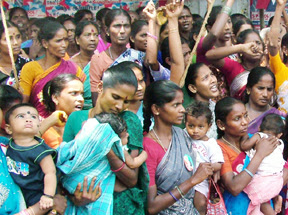
Cambridge, MA. In my last entry, I promised a series of five reflections on my India trip (unless your questions, comments, prompt a sixth). Today I would like to say something about caste in India – a reality all around us, whenever we travel there. I assume for this that you know that caste is very old in India, reaching back thousands of years, and that the simple classification of Brahmin (priest, educated leader), Kshatriya (warrior, ruler), Vaishya (farmer, businessman), and Shudra (worker, servant), was always too neat, and even in ancient times was subdivided into many smaller and more local birth categories, which governed who you could eat with and who you could marry. Moreover, the simple system was further complicated by the very large group of “untouchables” – Gandhi’s harijans (children of God), today’s Dalits (the crushed) – who make up a large section of Indian society today. You should also remember that Hinduism did not invent caste, but adapted to what seems to have been older patterns of social order. For millennia, Hindu and Buddhist religious intellectuals have had to juggle religious values that tend toward radical equality with a sense of the givenness and inevitability of hierarchy in society. It is very hard to be Indian without owning up to caste in some way or another; Christians in some parts of India, particularly the south, remain very caste-conscious, and so too Jesuits. Personally, I am rather clueless as to people’s castes, and try not to let what I do recognize make a difference. Like many an American in India, I have no tolerance for discrimination (though often I do not act strongly enough to resist social patterns of discrimination), but also in fact miss the clues as to caste, and treat people alike. Often I simply do not notice, and no one really expects me to. Two weeks ago I was at the railway station in Trichy at 10PM, waiting for the night train back to Madras (Chennai) with a senior Jesuit administrator from the college. When a friend of his joined us, a professor at another local college, our conversation made it clear that both of them were Dalits, and had fought long and hard for their rightful place as leaders in education. We have a fine conversation about the latest moves toward equality, and likewise about my studies in traditional orthodox Hinduism. For as this trip also made vividly clear, many of my longest-term friends in India are Brahmins, learned representatives of Hindu traditions, educated elites who know religion deeply and articulately. By instinct, I would turn away neither from a Dalit nor from a Brahmin, though I am offended if either a Brahmin or a Dalit thinks I should not talk to the other. 
There is a long history of Jesuits and caste in India. Even in the 17th century, Portuguese and Italian Jesuits were fascinated by Brahmins and their learning, accommodated to the system, and had high hopes for converting Brahmins, so as to open the door to convert everyone else. And when that did not happen, Jesuits tended to vilify Brahmins as selfish, ignorant, and ill-willed, because not open to our persuasive speech and example. In the 19th century, the French Jesuits saw caste as a fact of life, something we needed to take for granted in doing the work of the Church and in building what was to become a famous educational system. It has only been more recently, due to deep changes in Indian culture and new sensitivities to the demands of liberation, that many Indians, Christians included, have turned more harshly, in large numbers, against caste structures, and against Brahmins in particular, even to the point of rejecting learned Sanskrit religious traditions because of their caste taint.
Today the divisions are real, and the degree of progress since 1947 still leaves much to be desired. Just recently, Frontline had a piece on discrimination at temples in Tamil Nadu: people are still excluded at some temples, because they are Dalit. Positively speaking, though, there is much that Indians are now doing, at governmental and local levels, and in which the Church and Society of Jesus have important roles to play, to foster wider educational possibilities for the lowest castes, affirmative action in jobs at every level, and true fairness in society. All of this is wonderful, and I can only admire those who give their energies and lives to true equality.
But on this trip too, I spent time with a wide variety of people of different castes, and was very conscious of my affinity to the most educated Hindu religious leaders, who were usually Brahmins. This confirmed for me that it would be a great mistake to hope to polarize Indian society – Brahmins versus everyone else – or to dismiss thousands of years of culture for the sake of equality now. Anger is never a complete solution, and polarities do not help; animosity based solely on caste is not practical, and will not change Indian society deeply enough. Just as we realize that the old and new inequities of European society and of the Church do not justify entirely abandoning the riches of Christian tradition nor denying the religious heritage of our faith, we do well to work for justice and respect for all in India – while still be open to learning from the great literate traditions of Hinduism. 
While it is easier for me to say this as a foreigner (and white male American cleric and professor) who does not suffer any such discrimination, I think it is still true that for Indian Christians and Jesuits as well, some such balance makes the most sense, particularly in a society whose future that will not be determined by its tiny Christian minority. It is particularly important not to burden Indian society with the social ideals of the modern West, and likewise not to use caste as the latest in a long series of reasons for dismissing the value of learning from Hindu religious traditions. Oppression is evil, but the fact of oppression is no single group’s fault, and in any case it never a reason to miss the larger good realities surrounding us. And if we are against discrimination, best to root it out in the Church and Society first.
I close by admitting that India is changing greatly. The society is growing dynamically, change is everywhere, the vast cities are affecting deeply how people are relating to one another, and the large number of Indians living in the West are bringing new ideas about social relationships home with them to India. India is not the timeless East, and caste is no monolith. I suspect we will be seeing many more changes in the decades to come even if, at the end of it all, India will thankfully still not be the same as the United States.
But if you have other ideas, I’d love to hear from you.
Vocations, prayers stressed during Year for Priests
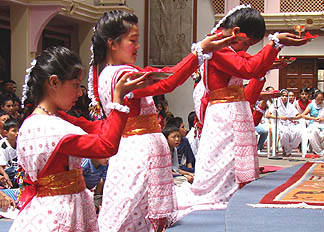
KATHMANDU (UCAN) — Catholic priests in Kathmandu say they will mark the Year for Priests by highlighting priestly and religious vocations for youths in Nepal. Young parishioners of the Church of Our Lady of Assumption bearing the offertory during the Mass that marked the launch They also say threats from Hindu extremists will not deter them and that they will work during this year with “greater determination” and “renewed vigor.” Priests from around Kathmandu gathered on Aug. 8 at the Church of our Lady of Assumption to mark the start of the Year for Priests. Bishop Anthony Sharma, apostolic vicar of Nepal, was the main celebrant. Talking to UCA News afterward, Father Silas Bogati, director of Caritas-Nepal, said the “ever growing challenges” for the priests in the country will not stop them from performing their duties, “but will help us move ahead with greater determination.” He was referring to the May bomb blast at the Assumption church and threats from Hindu extremist groups asking the 1.5 million Christians to leave the country or face dire consequences. The bomb blast on May 23 killed three Catholics and left 13 others injured. “This year is specially a year for prayers for and by the priests and a year to lay emphasis on increasing vocations in the country,” said Father Bogati. Of the 70 priests — 14 diocesan and 56 Religious — in Nepal, only six are Nepalis. The rest are foreigners, mostly Indians and Americans.
The Jesuit regional superior in Nepal, Father Lawrence Maniyar, echoed Father Bogati’s words. “Why should we be afraid and leave the country and go away when some terrorist or anti-social group asks us to leave?” he asked. “It is the people that we serve and if they want us to leave then we will, but not at the behest of a section of people,” he said. He added that the Year for Priests is a year for “all of us” to always remember that there is a group of ordained people serving God and a year to remember them in prayers. “It is also the year to lay special emphasis on the need for more priests from Nepal,” he added. According to him, the Jesuits have appointed a full time “vocational Father Robin Rai, parochial vicar at the Church of the Assumption, also said the year will be marked with prayers by and for priests. “There are great challenges for the priests in Nepal and I think we should face them as they come,” he said. Parishioners congratulating priests during During Mass on Aug. 8, leaflets containing prayers for priests were handed out to Catholics, while Father Rai urged all to remember priests in their daily prayers. Bishop Sharma, in his homily, said, “We want our young people to know that Religious life” is a viable option. “If you feel there is a calling, stop for a moment and think about it; don’t ignore it.” Meanwhile, parishioners and Religious in Kathmandu said the Year of the Priests will give them an opportunity to appreciate their priests “for what they do for us.” Brother Rakesh Zeno, founder of the Poor Servants of Jesus the Master,’ the first indigenous Religious community in Nepal, quoted Pope Benedict XVI in saying, “Without priests there would be no Eucharist and without the Eucharist there would be no Church.” Binod Gurung, president of Nepal Catholic Society, said it is the responsibility of all lay people to pray for the priests all around the world. According to him, a committee has been formed to plan and organize events to mark the Year for Priests. “Events having to do with the priestly vocation will be organized across the country to encourage young people to take up the religious life,” Gurung said.

of the Year for Priests in Nepal — Photo by Ashish Pradhan
promoter” for Nepal to encourage young men to take up the priestly vocation.

the Mass — Photo by Ashish Pradhan
Clergy’s Pauline pilgrimage experiences to be made into book
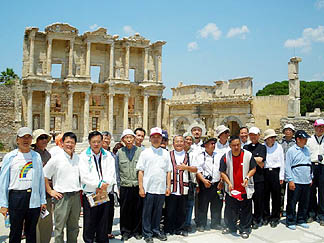
TAIPEI (UCAN) — Reflections by priests on their pilgrimage experiences in Turkey will be published into a book as a means of evangelization during the Year for Priests. Clergy from Taiwan at a pilgrimage site in Turkey — UCAN Photo Bishop Thomas Chung An-zu of Chiayi and 20 priests working in Taiwan visited Turkey June 28-July 11. Jesuit Father Mark Fang Chih-jung, spiritual director during the pilgrimage, said the trip, along the route that Saint Paul took in what was then Asia Minor, was especially meaningful for the priests as this was where Saint Paul did most of his evangelizing. He said that participants have been asked to write reflections on their experiences. These will be published into a book, illustrated with photos. “Such reflections are helpful for the priests and also are a good means of evangelization during the Year for Priests,” Father Fang said. “Though Turkey is an Islamic country, it is a significant place for Catholics too, as the early Church was planted and developed there,” said the 83-year-old theologian. Visiting the beginnings of the early Church with priests from all seven dioceses of Taiwan, some of whom are Koreans, Vietnamese and mainland-born clergy, helped him to experience the universality of the Church, he said. During the trip, he encouraged his fellow priests to model themselves after Saint Paul, not to fear challenges to evangelization and to build up the Church, he added. Father Joseph Huang Ching-fu, executive secretary of the Commission for the Clergy of the Taiwan bishop’s conference, said it was the first time for clergy in Taiwan to undertake such a pilgrimage to Turkey. It aimed to refresh their knowledge of the Church and to celebrate the closing of the Year of Saint Paul and the opening of the Year for Priests. June 29 concluded the Pauline Year, a year marking the 2,000th birth anniversary of Saint Paul. It overlapped with the start of the Year for Priests on June 19. Pope Benedict XVI promulgated both years. “The apostles of the early Church were in a dangerous environment, without freedom. It was not easy for them to keep their faith but yet they managed to do so,” said Father Huang, who is also rector of the Taiwan Catholic Regional Seminary. Priests celebrating Mass outdoors in Turkey — UCAN Photo “We as priests should learn to persevere as Saint Paul did, who gave his life for evangelization,” he added. Sharing his pilgrimage experience, Father Antonius Kuo noted how in Turkey, Catholics are a minority and “are unable to evangelize very openly” even though the “government allows religious freedom.” In contrast, though Taiwan enjoys freedom of religion, Father Kuo said he is worried about the declining number of local priestly vocations. Tour guide Chang Shu-tseng, the only layperson in the pilgrimage, said she felt nervous preparing for the trip “as the clergy were more familiar with the Bible” than she was. Throughout the trip, Chang said she noted the priests’ earnest attitude in “jotting down notes and taking pictures and videos at sites,” and how the young priests looked after the older ones.


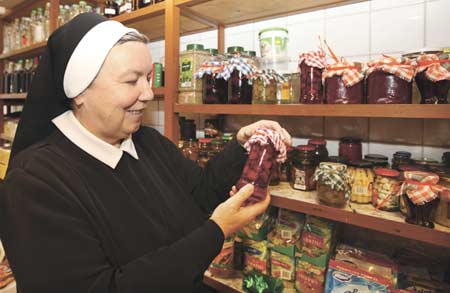
Nun becomes top-selling Polish cookbook writer
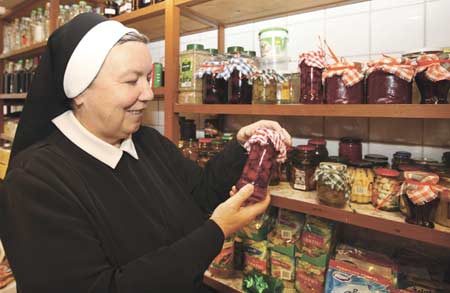 KRAKOW, Poland — Emerging from the quiet of her convent, Sister Anastazja Pustelnik was confronted by a jarring image – her smiling face on posters plastered around town to hawk the cookbooks that have made the 59-year-old nun one of Poland’s best-selling authors.It’s fame Sister Anastazja never bargained for when she left the material world as a young woman, expecting to toil in obscurity for God. But her ability to create easy-to-follow recipes for delectable cakes and traditional home cooking has resulted in five cookbooks since 2001 that have sold a combined 1.1 million copies in this country of 38 million.
Today, her cookbooks are found in shops and online, their glossy covers showing Pustelnik with an apron over her black nun’s habit and a mixing bowl or serving platter in hand, generating the unwelcome fame thrust upon her.
Sister Anastazja’s success comes amid a broader trend of men and women of God earning renown and profit in Europe with cookbooks and TV shows. A Spanish television channel, for example, broadcasts “Bocaditos de Cielo” – Little Mouthfuls of Heaven – in which Sisters Liliana and Beatriz of the Franciscan Conceptionist Sisters Convent guide viewers through the culinary steps for making ancient sweet recipes while also offering insight into their cloistered life.
In Poland, a deeply Roman Catholic country with a strong bond to the late Polish pope, John Paul II, the appeal of Sister Anastazja also reflects how the Catholic church is still present in daily life even as economic growth and European Union membership push the country toward secularization.
Priests and nuns are common characters in Polish television serials. And a nun is a much more likely kitchen guide to Polish village housewives than such sultry cooking superstars as Britain’s Nigella Lawson or the American Rachael Ray.
Despite worldly success, Sister Anastazja says all her efforts are in service to God. After morning prayers, she walks every day from her convent to the Jesuit center in downtown Krakow to cook lunch for 20 priests, giving them “strength when they go out into the world.” At Easter she bakes each priest a lamb-shaped cake to take on visits to their families.
One of her cakes, she said, came to her in a dream. The creation, dubbed “A Nun’s Secret,” layers cheesecake, pink fruity gelatin and yellow cake all beneath a shell of chocolate icing.
“It is only God who gives me the recipes. Who else?” Sister Anastazja, a member of the order Daughters of Divine Love, said in an interview with The Associated Press at the Jesuit center.Sister Anastazja had been cooking for the Jesuits for years when they got the idea to put some of her best recipes together in a brochure, said Father Bogdan Calka, a director at the Catholic publishing house WAM. That evolved into her first book, “103 Cakes of Sister Anastazja,” which was published in 2001 and became a surprise success. With 400,000 copies sold to date, it is her most popular book.
Later books include recipes for Polish classics: hearty casseroles, a cabbage-and-sausage stew called bigos, and golabki, or stuffed cabbage rolls. Her latest book, published this year, brings together 123 salad recipes.
The publishers say Sister Anastazja’s books owe their success to recipes that are easy to follow and don’t intimidate new cooks.
Most of her recipes are Polish classics, but a few international favorites are included, such as Greek moussaka, Hungarian lecso and Italian dishes like spaghetti carbonara. She said she began to embrace Italian dishes when some of the Jesuits priests requested them after returning from studies in Rome.
Through the years, Sister Anastazja has included more of her own inventions, recipes that get tweaked and perfected with feedback from the Jesuits.
“Her latest book would have never come out 10 years ago because there wouldn’t have been any way to prepare such unusual salads,” Calka said. The book offers up a ravioli salad with sun-dried tomatoes and other entrees that use capers, bamboo shoots and the leafy green known as rocket or arugula.