Category: Uncategorized

Church rushes to assist victims of Typhoon Morakot

Bookmark and Share


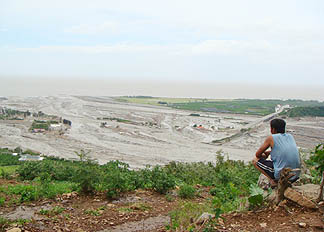
KAOHSIUNG, Taiwan (UCAN) — The Church in Taiwan has rushed relief aid to typhoon victims in the south of the territory, including an indigenous Catholic village which had been badly hit by a similar storm four years ago.

HK261_1.jpg

An indigenous Paiwan villager views the havoc caused by Typhoon Morakot, which damaged a bridge and leveled his village — UCAN photo

The Taiwan Catholic Mission Foundation and Caritas Taiwan are distributing relief aid and collecting donations from local Catholics to aid victims.

Bishop Peter Liu Chen-chung of Kaohsiung has also set up a relief command center in Pingtung county, where at least four townships were affected. “We never know what God’s plan is and why Taiwan has to suffer miserably. We can only pray for Christ’s mercy,” he said in his appeal for aid on Aug. 11.

“This is the moment for the Church to show the spirit of the Gospel,” he said, not only by assisting victims, but also “showing we are the instrument of God by bringing them the love of Christ.”

Typhoon Morakot, the most powerful storm to hit Taiwan in the past 50 years, slammed into its eastern and southern regions on Aug. 8. The government’s Central Emergency Operation Center (CEOC) said on Aug. 12 the storm had killed at least 67 people and injured 45. Sixty one people were reportedly still missing.

These figures could rise dramatically since media reports say that over 100 people from Hsiaolin village in Kaohsiung county alone are still unaccounted for and are feared buried under a mudslide which engulfed their homes.

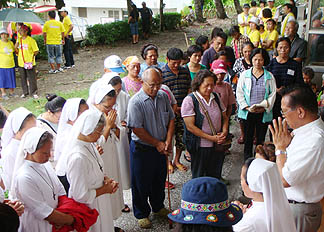
In Taitung country, eastern Taiwan, Auxiliary Bishop John Baptist Tseng King-zi of Hualien, a Puyuma tribal, and some other Catholics visited villagers at the Chialan mission station to console them and pray with them in a show of support.

The villagers in Chialan comprise Paiwan indigenous people, two-thirds of whom are Catholics.

They evacuated to a school and a community center on higher ground when the storm approached. Fortunately, there was no loss of life, said Father John Hung, who serves the mission station here.

However, half the houses were washed away in flashfloods, according to local sources. Many bridges and roads in the surrounding areas were also washed away or damaged. The situation in the nearby parishes of Chinlun and Tawu are unclear as communication links have been cut, the sources said.

HK261_2.jpg

Catholics, including Auxiliary Bishop John Baptist Tseng King-zi of Hualien (extreme right), praying for traumatized villagers in Chialan on Aug. 10. — UCAN photo

According to Taiwan’s bishops’ conference, 189 people in Chialan lost their homes in the flooding, including seven workers from Our Lady Hospital. Local sources say that 53 people are still missing.

Father Hung said Typhoon Morakot has left the Paiwan indigenous Catholics in Chialan heavily traumatized. “They are still recovering from the destruction wreaked by Typhoon Haitan in 2005,” he said.

Now that their homes have been destroyed again, he continued, some Catholics are resorting to praying to traditional deities.

“I can feel their pain when they cry out,” he shared. “I dare not offer empty words as it does not help them. I can only listen to them and stand by them.”

The church in Chialan, built 50 years ago, was destroyed by Typhoon Haitan. Reconstruction plans have not yet been finalized because a decision on the new church’s location has not yet been made, Father Hung said.

“Perhaps it is fortunate that we have not begun to construct the church since the whole place is now flooded,” he said.

Priests should preach God of mercy, says Jesuit Superior General

Bookmark and Share


The Superior General of the Society of Jesus, Fr. Adolfo Nicolás, SJ, explained at the opening of Year for Priests that the fundamental message that concerns every priest “is telling people that God is a God of mercy.”

The Jesuit Father spoke of the mission of priests during the Mass for the inauguration of the Year for Priests 2009 that took place in the Pontifical College Pio Brasileiro. The celebration came to a close at the same time as the 75-year jubilee for this college in Rome.

“I believe that all priests should be bearers of a Gospel that comes from Jesus Christ — and not our own Gospel. The priest should present the Gospel in such a way that he communicates a little bit of what the mystery of God is. Therefore, these 75 years are a moment of transition so that in the years to come priests can continue to be educated with the heart of Christ.”

Fr. João Roque Rohr, Rector of the Pontifical College Pio Brasileiro in Rome, also stressed the priests’ mission:

“I believe that the great message is to evangelize — I mean, to announce with a new strength and courage and with new means the same message of the Gospel: that Jesus Christ is the Savior of the world and that we are at the service of humanity.”

The successor of Saint Ignatius of Loyola underlined the need that the world has for hope and mercy:

“We are trying to educate priests that have — as said in the Letter to the Ephesians — the depth of the knowledge of Christ in order to transmit a message of mercy, of hope, and of joy to others. I believe that these are times in which the world needs hope and needs to know that God is not a demanding God that gets angry, but that He is a God of mercy and that He understands us and that He is with us always.”

A Jesuit in the dragon’s kingdom

Bookmark and Share


Next year will be fourth centennial anniversary of the death of Matteo Ricci, a Jesuit missionary who travelled to China. He was one of the greatest evangelizers of Christianity in China. He opened the way to the inculturation of the Christian message in Chinese society and brought about a great cultural transcendence by means of dialogue between the Oriental and Occidental worlds.

For this reason, the Vatican has presented a documentary called Mateo Ricci, a Jesuit in the Dragon’s Kingdom, which illustrates the life of this missionary to the Orient.

This 60-minute movie, filmed in both Italy and China, relied on the sponsorship of the Society of Jesus and the Italian diocese of Macerata, the birthplace of Mateo Ricci.

Gjon Kolndrekaj, director of the documentary, obtained permission from the Chinese government to freely enter their country and get footage of such places as the Forbidden City. He is the first director to have been granted such permission. Kolndrejak explained what interested him in Ricci:

“Because he fascinated me as a person: first as a man, secondly as a man of faith and this insight and knowledge that he wanted to transmit, his magnanimity that all men of goodwill can have.”

In commemoration of Mateo Ricci’s anniversary, Benedict XVI sent out a message praising the legacy of this Jesuit, saying that Ricci “continues to be, to this day, a model of the value of dialogue between the European and Chinese civilizations.”

“He went as a witness to bring our faith to people who knew nothing about it, but furthermore, he allowed Europe to get to know the Chinese people as well. This is extraordinary as it signifies that this interaction has been created thanks to his logistical capacities. That is why I believe a figure like him will be remembered for generations to come.”

Pope’s envoy visits typhoon survivors

Bookmark and Share


TAIPEI (UCAN) — A Vatican archbishop official has visited survivors of Typhoon Morakot in Kaohsiung, southern Taiwan, where he conveyed Pope Benedict XVI’s concern for them.


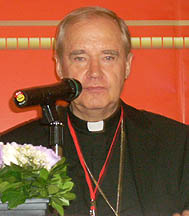
HK370_1.jpg 


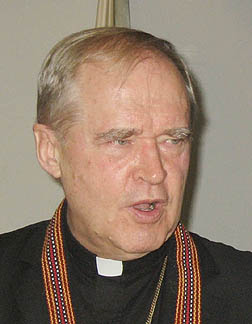
Cardinal Paul Josef Cordes


Cardinal Paul Josef Cordes, president of the Pontifical Council “Cor Unum” (one heart), is attending a conference of Church charity workers in Asia, which is being held Sept. 7-11 in Taipei.

In Taipei on Sept. 7, he told reporters at a press conference that he had visited typhoon survivors the day before and brought along Pope Benedict’s concern for them as well as aid donations. The pope also sent his condolences to those who lost loved ones in the Aug. 8 disaster, Cardinal Cordes said.

On a personal note, the 75-year-old German prelate said that even though it was not his first encounter with people struck by catastrophe, he felt “touched to see the faces of suffering people.”

Recalling a hug that a weeping, elderly woman in Kaohsiung gave him during the visit, Cardinal Cordes said it is not easy to put such an experience in words. He praised volunteers involved in rescue and relief work, noting that the catastrophe stirred in them the spirit of helping people selflessly.

Faith, the cardinal added, enables people to “look beyond the problem” and “leaves them trusting in God.” Even amid the typhoon’s devastation, they could see “the situation was not the end.”

Taiwan held three days of mourning Aug. 22-24 for hundreds of people killed or missing in the typhoon that ravaged the eastern and southern parts of the island, one of the deadliest storms to hit in half a century.

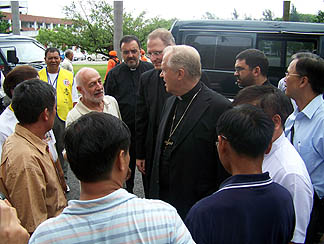
According to Taiwan’s Central News Agency, Cardinal Cordes celebrated Mass at Kaohsiung cathedral on Sept. 6 and visited a camp the military set up for people left homeless by flooding and mudslides.

Media reported that Cardinal Cordes told Massgoers the Pope had prayed for the typhoon victims in Taiwan during several Masses at the Vatican. The Pope expressed his sympathies and wanted to comfort those who lost friends and relatives, he said.

Monsignor Fitzpatrick Russell, the Holy See’s charge d’affaires in Taiwan, accompanied the cardinal on his visit.

HK370_2.jpg 


Cardinal Cordes visits people affected
by Typhoon Morakot in Kaohsiung


On Sept. 7, President Ma Ying-jeou led senior government officials at an island-wide memorial service in Kaohsiung to mourn the dead. That same day, Prime Minister Liu Chao-shiuan resigned following widespread criticism of the government for responding slowly to the disaster.

About 5,000 people attended the service, including members of bereaved families, other survivors, and Catholic and other religious leaders. After putting bouquets at a tablet honoring the deceased, Ma said he grieved and was remorseful as floods and landslides took away hundreds of lives, causing “everlasting pain in our hearts.”

The Pontifical Council “Cor Unum,” the Vatican agency for relief and charitable work, helps coordinate Catholic aid and development services worldwide.

Cardinal Cordes is attending the “Spiritual Exercises for Responsibles of the Church’s Diakonia on the Asian Continent,” which the council organized on the theme, “… you did it to me (Mt 25:40).”

The first such gathering in Asia brought five cardinals, more than 80 archbishops and bishops, and 450 workers in Church charity services from 29 countries and regions to Taipei. Participants are praying daily for the victims.


By Y.F. Low, CNA


TAIPEI, Taiwan — An envoy of Pope Benedict XVI will arrive in Taiwan this weekend for a week-long visit, during which he is expected to go to areas devastated by Typhoon Morakot to console victims of the disaster, officials said Thursday.
Cardinal Paul Cordes, president of the Pontifical Council Cor Unum, will participate on behalf of the Pope in an international conference on Asia humanitarian aid scheduled for Sept. 7-11 at Taipei’s Fu Jen Catholic University.

Wang Yu-yuan, Taiwan’s ambassador to the Holy See, told the Central News Agency in a telephone interview that his embassy is currently making arrangements for Cordes to visit the disaster areas in southern Taiwan to convey the Pope’s concern for the victims.

Given Cordes’ close relationship with the Pope and his influence in the Holy See, his visit fully demonstrates the importance the Pope attaches to Taiwan, Wang said.

According to officials at the Catholic Archdiocese of Taipei, eight other cardinals and 50 bishops from other countries, including South Korea, Japan and the Philippines, will also attend the upcoming conference.

Liu Chen-chung, bishop of the Catholic Archdiocese of Kaohsiung, said that the participants will not rule out the possibility of visiting the typhoon disaster areas, especially those in hard-hit Kaohsiung County, to pray for the victims.

Hindi scholars launch Jesuit linguist’s birth centenary

Bookmark and Share


RANCHI, India (UCAN) — Hindus outnumbered Christians to celebrate the birth anniversary of Father Camille Bulcke, a Jesuit missioner who gave common people easier access to religious texts of both communities.

HK367_1.jpg 


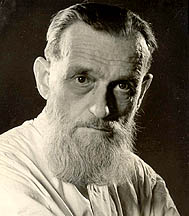
File photo of Jesuit Father
Camille Bulcke, who helped
Christians and Hindus in India appreciate their religious texts


Father Bulcke made Bible stories and the great Hindu epic Ramayana easy for common people to understand, Nalini Purohit, a scholar in the Hindi language, told a function on Sept. 1. The date marked 100 years since the missioner’s birth.

Around 2,000 people, mostly Hindus, attended two functions in Ranchi, capital of Jharkhand state, to mark the occasion.

St. Xavier’s College and the Camille Bulcke Research Centre, both based in Ranchi, jointly organized the events.

Father Bulcke, a Hindi scholar, died in New Delhi in 1982 at the age of 73. He was born at Ramskappelle in what is now West Flanders, Belgium, but spent most of life in Ranchi after arriving in India as a Jesuit seminarian in 1935. He became an Indian citizen in 1951.

His doctoral thesis “Ram katha utpati aur vikas” (Ram’s story: origin and development) is considered one of the best commentaries on the Sanskrit-language Ramayana. Other popular works include a Hindi translation of the Bible that Churches in northern India still use and a 40,000-word English-Hindi dictionary published in 1968.

Purohit, a Hindu and one of the Catholic priest’s former research students, pointed out that Hindus revere Father Bulcke’s “Ram katha” in the same way Christians respect his Hindi Bible.

Another speaker, Bhupendra Kalasi of Magadh University, hailed Father Bulcke as a maharishi (great sage) whose scholarship brought him international recognition. Although born in Belgium, he was a “jewel of India,” she said.

Pramod Kumar Singh of Bihar University, chief guest at the Sept. 2 seminar, said generations would remember Father Bulcke for promoting the Hindi language. The missioner gave a “new definition” to the story of Ram and taught people to become ethically upright, he added.

Hindi novelist Mahua Manjhi told UCA News many embassies today use the priest’s Hindi-English dictionary, which has become the “most authentic” reference book for people dealing with the two languages.

HK367_2.jpg 


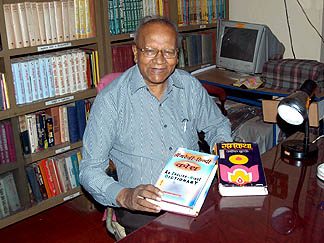
Jesuit Father Mathias Dungdung, director of the
Camille Bulcke Research Centre, showing Father
Bulcke’s English-Hindi dictionary and “Ram katha


According to Jesuit Father Mathias Dungdung, director of the research center named after Father Bulcke, the scholarly priest respected and studied all religions. He acknowledged that the missioner’s contributions to Hindi made him more popular among Hindus than among Christians.

“For Christians he is just another great missionary, whereas Hindus keep his name alive,” the researcher told UCA News on Sept. 4. He noted that Father Bulcke’s popularity among Hindus has increased greatly since his death.

Father Dungdung said Father Bulcke’s works have reached millions of people in India and overseas. Four editions of his “Ram katha” have been published since it first appeared in 1950.

“It is out of print at present and people want a fifth edition,” he added.

The priest, 83, explained that the Ranchi-based Jesuits opened the research center with 8,000 books they found in Father Bulcke’s personal library after his death. Since then its collection of books has reached 15,000.

The center’s director said it plans to conduct essay and poetry competitions, seminars, cultural programs and other activities to honor Father Bulcke’s birth centenary.

Interview with Father General

Bookmark and Share


During the month of July, as mentioned in previous editions of the S.J. Electronic Information Service, Father General made two important trips. In Asia he visited the Philippines, (the occasion was the celebration of the 150th anniversary of the return of the Jesuits to the country), and Indonesia, for the 150th anniversary of the “modern” presence of the Society of Jesus in that nation. In Africa, he visited Burundi (the occasion was the International Congress of Jesuit Alumni/ae), Rwanda and Bukavu region, in the Democratic Republic of Congo. After these trips, Father Nicolás agreed to share with us some of his impressions. We present here his responses to our questions.

– The trip to Philippines has been for you a “returning home.” What was your impression?

“You are very right that going back to the Philippines is like going home. What never fails to amaze me and make me feel immediately “at home” is the warmth and the always generous welcome of the Filipino people. It felt like I hade never left the country and that the old friendships had multiplied and intensified. Filipinos have this quality (or talent, or charisma, as you like to call it) in relating to people. It takes so little to be “one of them”; maybe sincere appreciation of their persons, life and culture, and that respect you owe to every person. In exchange they give you everything they are and they make a home in their hearts. I am always deeply touched by this generosity of heart, and the graciousness with which they do it in such a way that you are never embarrassed.”

– The occasion for the trip to the Philippines, which is practically the only Catholic Asian country, has been the celebration of the 150th anniversary of the return of the Jesuits to the country. Which has been the major contribution of the Society during this century and a half? And what about today?

“I think the contribution has been enormous, and I am aware I do not know half of it. The Society of Jesus has contributed to science, to literature, to research in many areas of human life and knowledge, to art, to music, you name it. If you ask me to underline one particular contribution that stands out, I would say that “Education” has been the greatest contribution, and it continues to be, with the cooperation of many dedicated and highly motivated lay persons and Religious of different Congregations. Naturally we are not the only educators; others were there before we arrived, still others came at the same time or later and have done equally well and contributed likewise, or even more to the Country. But Jesuit Education has been outstanding, of long range influence and continues to be such. The Society of Jesus in the Philippines has always been at the forefront of Social and Church issues in the country. These 150 years give us much material to thank the Lord for. I know that behind the contribution of the Society to the Philippines there are many lay and religious people who have sustained and supported us, as usual. We all know that behind every successful service, there are thousands of little deaths of Jesuits and others, who have given their lives in silence, praying and helping, serving and rejoicing in the fruit that they never harvested. With the words of Saint Paul we can literally say that along the 150 years, some Jesuits prepared the ground, some sowed, some watered, some harvested. It is a time of deep joy and thanksgiving to all those whose names are not in the official chronicle, but who made it possible for the Society to make its joyful contribution.”

– In Indonesia also the Jesuits have celebrated the 150th anniversary of their presence in a country that is in majority Muslim. In this context which is the role of the Society today and which role can it play in the future?

“Indonesia is a country with a long history of cultural and religious diversity. There are still parts of Indonesia where Hinduism is alive; parts where old Natural or Cosmic religions continue to have an influence in the life, religiosity and even Festivals of the people; whole Provinces with a strong Christian influence and a very vital community of Catholic or other Christian denominations. The cultural diversity and long term policies of tolerance and peaceful, cooperative co-existence make the exchange and communication with the Moslem population a reality without great difficulties – except when political interests or pseudo-religious motivations raise the level of tension and diffidence across the different groups. The Jesuits have been positively involved in dialogue with different Moslem groups and have worked side by side with them in social issues, at the service of the Conference of Bishops and in local initiatives. This role will continue and we hope that the cultural, more tolerant, South-Asian context will help in making dialogue a daily reality and offer new models of cooperation and communication with other Religions for the rest of the world.”

– Let’s talk about Africa. This was your second trip in this continent. Can you give us a glance at your general impression?

“My impressions are still very incomplete. For me Africa is still Africa, as a whole, as a Continent. I hope that, as I get to know different African countries better, I will also differentiate better and be a better observer of differences, backgrounds, cultural traditions and human realities. From this still tentative platform of my great ignorance and lack of differentiation, I see a Sub-Saharan Africa (the only part I have ever visited) full of magnificent people struggling with their past and present; eager to live and to grow; with a very high appreciation of education and development, and with big dreams for a better and much more hopeful future. The vitality and desire to live is very high, in clear contrast to other regions of the world where this desire is not so visible and where relationships are not nearly as important. Africa gives me hope and it is with great pleasure that I visit and encounter its many different peoples.”

– This time you visited three countries still very “hot” at the heart of the African continent. Which role can the Society play for reconciliation, peace and the start of a better future?

“You are right. I have come in contact with “hot” situations, even if I cannot yet define them accurately. I see an option for the future, for life and for peace. And the issues are so important and so vast that no single group can claim to be the protagonist of their solution. Peace, reconciliation, the creation of a better future are the tasks of the whole people and all the forces available, from politics to education and civic movements. I sincerely hope that the Jesuits will be positively and creatively involved in these processes, and exercise a positive influence in them through whatever we do, be it education, pastoral ministry or cultural expression. We will need to be fully committed to the important issues of the people and offer our best services with great humility and generosity in cooperation with all others.”

– In Africa the occasion was the International Congress of Jesuit Alumni/ae. What role may the Alumni/ae, and lay in general, have in our current apostolic commitment in the world and especially in Africa?

“I would like to think that the wonderful atmosphere that I saw and felt at the International Congress is a true expression of what our Alumni feel is their role towards Africa and society in general. The Alumni of Jesuit Schools are not people from other planets. They are – I am sure – people totally immersed in the affairs of today and with a deep sense of responsibility to contribute to make our world a little better, more just, more liveable, more fraternal and sharing, with a special concern with those who have greatest difficulties. It already is a general experience to find many alumni who are very generous and even eager to help us in our work and our mission. The point of this Congress was that this solidarity and concern for a better world for all should go beyond the “Alma Mater”, beyond the School where one has been educated to reach out to the whole world. If globalization has made all of us more aware of how much we are linked to each other and how much our systems are co-dependent in a world network; if we Jesuits today have become more keenly aware of our universal vocation; there is no wonder that this universal sense touches also our Alumni, and that their hearts and minds, educated in “concern for others” and other Christian values, should also change the direction of their cooperation and sense of responsibility making them aware of a wider world of concerns, peoples and open co-responsibility. Our former students are in the forefront of business, politics or research. I am confident that they will bring the concerns of the world, and particularly the concerns of Africa, into the activities, services and planning of their work and social position.”

The feast of St. Ignatius. On July 31st, feast of St. Ignatius, like every year Father General celebrated the Eucharist in the Gesù Church for the Roman Jesuits and friends and benefactors. We offer here a brief summary of his homily, as it was released by Vatican Radio.

“We need the change. We need others to remember what has been forgotten”: with these words Father Adolfo Nicolás explained, during the homily given at the Eucharistic celebration in honor of St. Ignatius, what is going on in the Society of Jesus, in which vocations show themselves today in geographical areas different from the past. The future of the Society of Jesus has the face of Asia and Africa. And to this change, which regards the whole Church, born in Middle East and grown in Europe, Father Nicolás looks with optimism: “This demographical change is not only a sociological phenomenon. I think it is a great opportunity for renewal for all of us, the opportunity to return to the origins. Asia and Africa will bring us back to dimensions of humanity, spirituality, ministry and service that in Europe maybe we have lost.

Fr. General’s experiences during his recent trips and in particular the witnesses of faith that he saw, encourage his confident attitude about the changes in sees in the Society. These are his reflections on Rwanda, a country teared to pieces by genocide, which received him with joyful dances and songs: “Saint Augustin said: when you sing you pray twice. So I ask myself: how many times they pray, these Africans who dance and sing their sorrow, who dance their hope, their joy and their fears? All this becomes dance. So they choose life. And we also will live with Africa, because the future of the Church is Africa”. So we have to give up the fear which attacks us in front of the change – Father Nicolás continued – and not be afraid for our identity that goes far beyond the geographical origin: “The Gospel says to us that this is not a threat, it is a new call. What will keep us together, what will keep us faithful to our vocation, are the central points of St. Ignatius spirituality and today’s Gospel remember us a central point: we have to die to ourselves to find Christ. Christ has to be what is really worth, let Him be the central point of our identity.”

‘Creativity, daring and great humility’ – Fr General

Bookmark and Share


‘Jesuit mission today’ was the issue addressed by Fr Adolfo Nicolas SJ, when he spoke to his fellow Jesuits, their co-workers and colleagues, in Gonzaga College on Sat Sept 12th. In his introduction to the Jesuit Fr General’s talk, Irish Provincial John Dardis SJ told those gathered that there were unprecedented challenges facing the Irish Church today. “But we all can make a difference if we respond to those challenges with creativity , discernment and courage”. Fr Nicolas outlined some of the challenges such as rapid change in technology and communications, globalisation and a rise in xenophobia, a pluralism that some choose to intepret as there being no absolutes, and a spreading decline in the influence of relgious belief . He spoke of the profund transition that had been made in Ireland from poverty to plenty and now to potential austerity. All this, allied to the Ryan report and the pending Dublin report, meant that the entire landscape of the church was changing. “Evaluation and change must be done,” he said “and all of you are part of that. And the Gospel mercy and justice for the poor must be preached with renewed vigour and dynamism to people who are angry but also hungry.”

He then went on to outline four key elements of the Jesuit mission, the first being the univeral nature of the call. Jesuits and their co-workers are called ‘to go where the need is greatest’. He commended the Jesuits present who had spent many years on missionary work in Africa, Japan, China, Hong Kong, and Cambodia. He was happy that the Irish Province was continuing to send its young men on the missions.

The second element was being ‘at the frontiers’, a term used by the 35th General Congregation and now being picked up by many religious. He said the frontiers could be geographical or less obvious. They needed to be discerned and in his opinion demanded three important qualities: creativity, daring and great humility! He said that every Jesuit work, be it in justice, spirituality, education, or whatever, should ask the question, “How are we at the frontiers?”
The third element was the pursuit of dialogue with different cultures and religions. He pointed out that this was something the present Pope modelled in his visits to various countries.

Finally he stressed the importance of the Spiritual Exercises of St Ignatius, the founder of the Jesuits. He said the founder’s principle of ‘finding God in all things ‘ meant that Ignatian spirituality was a particularly suitable one for these times. It took people where they were at and brought them forward when they made the choices. He cited the Jesuit prayer site www.sacredspace.ie, created in Ireland, as an excellent example of this process, and he urged those present to think in a similaraly creative way about how to make the Exercises relevant and accessible to people in all walks of life. “There’s no point expecting a mother with two children to go on an eight-day retreat!”

Finally he urged all present, Jesuits and their non-Jesuit colleagues, to continue to work with each other, as was the case with Jesuits since their foundation. They would only survive and move forward with energy, creativity and imagination if they worked together. It could not be done alone and the stakes were high because “‘There are people who need us, who need God”.

A Very Special Day Indeed!

Bookmark and Share


by Ryan Duns, SJ 

Today, September 27th, marks the 469th birthday of the Society of Jesus. Just 469 years ago, Pope Paul III gave formal approval to the Society of Jesus in the papal bull Regimini militantis Ecclesiae. Across a span of nearly five centuries, these opening words of the Formula of the Institute still serve to captivate the hearts and imaginations of men who desire to spend their lives as Companions of Jesus:

Whoever desires to serve as a soldier of God beneath the banner of the cross in our Society, which we desire to be designated by the name of Jesus, and to serve the Lord alone and the Church, his spouse, under the Roman pontiff, the vicar of Christ on earth, after a solemn vow of perpetual chastity, poverty, and obedience, to keep what follows in mind. He is a member of a Society founded chiefly for this purpose: to strive especially for the defense and propagation of the faith and for the progress of souls in Christian life and doctrine, by means of public preaching, lectures, and any other ministration whatsoever of the word of God, and further by means of the Spiritual Exercises, the education of children and unlettered persons in Christianity, and the spiritual consolation of Christ’s faithful through hearing confessions and administering the other sacraments. (From Exposcit debitum, July 21, 1550).
So how am I celebrating this joyous occasion?

First, by publishing this post, I have now written 600 blog posts since I first began blogging in 2004. It’s a small number compared to some bloggers, but 600 posts is still something!

Second, I’m writing an exam and preparing to teach for the week. We have parent/teacher conferences on Thursday and Friday, so I’m trying to make sure all my grades are up-to-date and that I have something helpful to share with parents.

I ask for prayers for all Jesuits this day as we celebrate our birthday. May God grace us with the strength to follow ever more nearly to the path of the Son and my our hearts be enkindled with the Spirit of their love that each of us may “set the world on fire” with the Good News.

Educating in the Jesuit Tradition

Bookmark and Share


ROBERT SPITZER, S.J.

Frequently our students come into the university domain thinking that all opinions are equally valid. This view has threatened the intellectual development of students since the time of Socrates because it allows students to think that incomplete, illogical, and nonsystematic thought is “good enough.” Unfortunately, it never is.

When I speak about Gonzaga, I say that we are trying to achieve the highest standards in the Jesuit


Rev. Robert J. Spitzer, S.J.

 educational tradition. People almost invariably ask, “What do you mean?” I normally give the “three-minute answer” which does not do justice to this deep, long-standing, remarkable enterprise. Thus, I decided to devote the next three issues of this column to “my take on Jesuit education.
The principles guiding the values of an Ignatian education derive from Part IV of the “Constitutions of the Society of Jesus,” and from the “Ratio Studiorum” of 1599. The ultimate goal of the Ratio Studiorum was not merely to develop rhetorical, writing, and thinking skills, but to help students understand and articulate the wisdom, knowledge, and habits benefiting their souls and the souls of others. One might rephrase this goal in contemporary terms as “to prepare the students to pursue their ultimate personal good and the common good.” The study of philosophy is central to helping students achieve this goal by providing essential background and foundations to understand and articulate: ·


  • Rationality (evidence, consistency, valid argumentation, and systematic avoidance of omissions)
  • The existence of God, and appreciating God’s love and justice
  • The ultimate end/ends (goals) of the human person
  • The highest end/ends of the polis (community), or society (i.e., the common good)
  • The means for pursuing the goals for human personhood and the common good (i.e., ethics).

The order of this list is significant, for without an understanding of the foundations of rationality, one could not achieve a rational awareness of God as Creator; without an awareness of God, one could not achieve an awareness of the ultimate end of the human person (not only created by God, but destined for God). In this view, one could never hope to achieve an adequate awareness of oneself without some awareness of the one Being capable of satisfying human desire.


Since Augustine’s time, Western philosophers believed that human desire was oriented toward an unconditional, perfect, and unrestricted end (in Truth, Goodness, Justice, Beauty, Being and Love). If this were true, human beings could never satisfy themselves, and indeed, could never be satisfied by anything except unconditional, perfect, and unrestricted Truth, Goodness, Justice, Beauty, Being and Love. Augustine’s famous exclamation in Book I of the “Confessions” expresses it succinctly: “For Thou hast made us for Thyself, and our hearts are restless until they rest in Thee.” If one believes that we are endowed with this desire for the unconditional, perfect, and unrestricted, then there are only two options: (1) One can come to affirm and relate to the God who alone can satisfy one’s ultimate ends; or, (2) one can deny or reject God, and admit that life is absurd, for if God did not exist and human desire is satisfied only by the unrestricted, the human person is destined to be frustrated in the very ground and height of his/her nature.

This sets the stage for the fourth contribution of philosophy, namely, understanding and articulating the common good. For Suarez (an early Jesuit philosopher who first articulated a theory of rights resembling our contemporary one), the objective of society is to optimize the common good. This requires not only an awareness of the ultimate good for humans, but also a means of assuring that the good of the whole does not annihilate the good of some individuals. The actualization of these two potentially diverse objectives moved Suarez to articulate his theory of rights (the very first articulation of rights in history).

The third and fourth contributions reveal the need for the fifth, namely, ethics, principle, and virtue. Since the days of ancient Greece, many understood that ends do not justify the means. One cannot use an unjust means to pursue a just end; such means are inconsistent with, and therefore undermine, the good end.

Jesuits appreciated the need for principles, because they realized that our capacity for rationalization is virtually infinite. I don’t know about you, but give me five minutes and I can rationalize any action as being good through utilitarian criteria (a harms/benefits calculus). If we are capable of such rationalization, it will never be sufficient merely to solve ethical cases or make ethical arguments. We must steep ourselves in principles and virtues which may not be absolutely applicable in all circumstances, but must stand at the ground of all ethical questioning and thinking, and which, therefore, cannot, without trepidation, be compromised.

These five dimensions of the Jesuit educational tradition are by no means restricted to philosophy. They permeate the study of literature, history, politics, law, the social sciences, the natural sciences, the health sciences, and even engineering. Of course, they interact with theological and pastoral studies and reflect upon the community life and spiritual life of the students. They form a powerful ethos giving rise to faith, self-awareness, justice, love and above all, a life dedicated to the common good.


In the discussion in part I, I delved into the first of three aspects of the Jesuit educational tradition: our intellectual tradition. I will now address the second aspect: The imitation of the love of Christ (agape). St. Ignatius saw agape as central not only to the Spiritual Exercises, but to every Jesuit apostolate and community.

In the University context agape is central to our community, that is, to the way in which we teach, the goals of our residence life, and the associations we have with faculty, staff, parents, alumni, community and friends. This one characteristic gives rise to care and spirit, to knowledge of the mind and heart, and to central meaning and purpose in life. It is what made and makes GU so special for all of us.

The objective of the Christian life is joy. Jesus summarized his intention for the world by saying, “I tell you all these things, that my joy may be yours, and your joy may be complete” (Jn. 15:11). As Jesus makes clear, the way to joy is agape. Agape may require sacrifice, but in the long run, it will always lead to joy. This is Jesus’ promise for eternal salvation.

What is agape? In brief, it is the habit of the heart giving rise to forgiveness and compassion which leads to unity, peace and joy within the human community. To explain this highest human call, it might be best to differentiate it from three other views of love.

The Greeks called the most “instinctual” kind of love storge. It is the natural affection we feel for other human beings, our responsiveness to a child, to a friend, or simply to someone who wishes us well. We do not have to think about this kind of love. It naturally emerges from us when we are not “stressed out” or being “socially retarded.” Agape can frequently include this kind of affection, but it is not reducible to it.

Philia (friendship) is based on a reciprocal commitment. When one friend commits time and energy to another, and the other reciprocates, a deep loyalty and emotional bond occurs. Though agape can be involved in friendship, it does not require friendship’s reciprocity, commitments, or emotional bondings.

Eros (romantic love) occurs in relationships of special intimacy and exclusivity. Again, agape can be involved in the romantic love intrinsic to family, but it is not dependent upon romantic feelings or special intimacy.

So what is agape grounded in? The God-given, human capacity to see the intrinsic dignity of another person irrespective of affection, friendship, or romantic feelings. This vision of the dignity, goodness, and mystery of the other gives rise to benevolent intention, compassion and forgiveness. We want the other to prosper even if we do not directly benefit. We want to prevent the other from suffering even at the cost of our time and energy. We want the human community to be better off for our time and effort because we know that this is the one purpose of life that is truly lasting and worthy of us.

This deep desire to invest ourselves in the well-being of others moves us to compassion (sympathy with others in their suffering). When this sympathy is detected by its recipients, it dignifies and elevates them and infuses in them an awareness of their true intrinsic dignity.

Similarly, the deep desire to invest ourselves in the well-being of others gives rise to one of the hardest of all virtues: forgiveness. Forgiveness is not forgetting, but the essential condition for future forgetting. It interrupts the cycle of “vengeance begetting vengeance” and “violence begetting violence,” and gives rise to the possibility of growth in the love and joy to which Christ has called us. It is the most important quality of agape for Jesus. Hence, I will discuss it in greater detail in my next Perspective.

Though forgiveness can be hard, and compassion inconvenient, they “switch on” the highest of human powers and callings. They elevate the plane of meaning and being on which we live. They optimize the goodness we can produce with our lives, and in the end, give rise to peace and joy in the human community.

Think back to your experiences at GU. Think of the messages you received on the Search Retreats. The moments of gratuitous kindness in the residence halls, and the hard-won moments of compassion and forgiveness amidst the inconveniences of collegiate growth. What was so special about our experiences at Gonzaga? I would wager that it was agape embodied by a community who truly believed in it. This is the central point of Jesuit education.


Welcome to the third and final part of my series on the Jesuit Educational Tradition. In the first part, I spoke of the Jesuit intellectual tradition, looking at the questions Jesuit universities explore through their core curricula: questions about life’s meaning, the full dignity of the human person, contributory verses, comparative identity, the existence of God, and the love of God.

In the second part of this series, I spoke of the development of Agape (the empathetic love, inducing forgiveness, compassion, and self-sacrifice) which stands at the core of Jesus’ teaching about the meaning of life and the fullness of humanity. I looked at how this is deepened through students’ experiences in the residence halls, the classroom, retreat programs, and other parts of the Jesuit university.

This third part will concern developing mental acuity (the skill of thinking, reasoning, creating, and expressing oneself clearly).

If one assembles these three parts, an overarching theme becomes evident: The heart liberates the mind, and the mind liberates the heart. “Heart” is a metaphor commonly used to speak of the human capacity to pursue meaning, ideals, love and transcendence with spirit, enthusiasm, empathy, belief, and even passion. The heart directs the mind to meaning and purpose in life. It orients the mind toward the highest possible aspirations, to living life to the fullest, to the highest human emotions, and to our most creative expression. The mind, in its turn, guides the heart to what is reasonable and responsible. It examines the heart’s objectives systematically, assesses what can be realistically done, and helps the heart to articulate its aims with clarity and precision. Educators in the Jesuit tradition commonly acknowledge Blaise Pascal’s memorable phrase, “the heart has reasons that the mind knows not of.” We also recognize that this attention to the heart is one of the most distinctive features of Jesuit education. Yet we hasten to add that the heart is in need of the clear, precise and systematic expression of the mind to bring its loves, ideals, and aspirations to an optimal and effective end.

So what does this cultivation of the mind consist in? In addition to the practical arts of writing and rhetoric (taught through individual attention in small classes), Jesuits have emphasized clear, complete, distinct, logical and systematic thought.

Frequently our students (out of respect for others) come into the university domain thinking that all opinions are equally valid. This view has threatened the intellectual development of students since the time of Socrates because it allows students to think that incomplete, illogical, and nonsystematic thought is “good enough.” Unfortunately, it never is. The fact is Einstein’s opinion about the universe is better than Newton’s because it is more complete and systemic. Educators in the Jesuit tradition try to instill the habit of “good opinions” by addressing completeness, logic, and systematics.

With respect to completeness of opinions, there is an old philosophical adage: “There are far more errors of omission than commission.” It is incumbent upon professors to show students methods for uncovering omissions, ways of ascertaining the completeness of databases, methods of research, and the use of technology.

With respect to logic, professors help students avoid the embarrassment of intrinsic contradictions manifest through formal and informal fallacies. They also show students how to construct sound arguments that will advance theoretical and practical knowledge toward the common good.

Finally, with respect to systematics, educators in the Jesuit tradition concern themselves daily with showing students road maps for the 10 categories of cultural discourse. These are truth, ethics, suffering, person, God, happiness, love, freedom, political philosophy, and economic philosophy. With respect to the road map about truth, for example, we speak of rationalists, empiricists, realists, etc. With respect to ethics, we speak about utilitarianism, deontology, virtue ethics, etc. With respect to the meaning of suffering, we speak of Epicureans, Stoics, Orphics, etc. With respect to personhood, we speak of materialists, hylomorphists, transcendentalists, etc. The other six categories of cultural discourse are set out in the same way.

Why spend so much time on these road maps? Because the mind’s guidance of the heart depends on knowing where one stands and where one wants to be amid the panoply of possibilities that the culture has to offer. Meaning in life, happiness, the pursuit of the common good, and even one’s response to God depend upon clarity and precision in these 10 areas.

There is another reason why these 10 categories of cultural discourse are so important. It has to do with another famous Jesuit adage: “When arguing, never deny, seldom affirm, always distinguish.” Intellectual progress will never occur if one completely denies the truth of an opponent’s position. The same can be said for being too affirming. If you tell me in the midst of an argument, “Spitzer, I want to affirm you, affirm who you are and all that you are,” and then walk away and think to yourself, “idiot,” we will not have achieved intellectual progress. If intellectual progress is to be achieved, then we must know how to make good distinctions. Good distinctions, in their turn, rest upon higher viewpoints about the 10 categories of cultural discourse. Those who have been through Jesuit education know well the power of these “road maps” for articulating thought, directing our personal lives, and achieving the common good. They are indispensable for the mind’s guidance of the heart.

Gonzaga accomplishes this mission well. It did this for me as a student and does it better than ever today.

ACKNOWLEDGEMENT

Spitzer, S.J., Robert J. “Educating in the Jesuit Tradition.” Gonzaga University President’s Message (2000).

Reprinted with permission of Fr. Robert J. Spitzer, S.J.


THE AUTHOR

Robert Spitzer, S.J., Ph.D., is the President of Gonzaga University, and cofounder of University Faculty for Life and the Center for Life Principles. He is the author of Healing the Culture: A Commonsense Philosophy of Happiness, Freedom, and the Life Issues and The Spirit of Leadership: Optimizing Creativity and Change in Organizations as well as many articles on leadership, culture and the common good.

 

Jesuits urged to widen scope of mission

Bookmark and Share


KOLKATA, India (UCAN) — Jesuits in Kolkata have been urged not to rest on their laurels but work harder to serve Indian society, during programs marking 150 years of their Bengal mission.

HK953_3.jpg

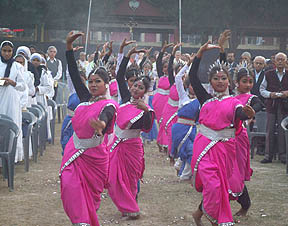
An entrance dance during the Mass celebrating
the 150th anniversary of the Bengal mission

The early missioners contributed a lot to the development of tribal communities in eastern India, noted Naresh Gupta, secretary of the national Jesuit Alumni Association of India, at a Nov. 28 function to mark the occasion.

However, he said he now wants the Jesuits to widen their scope and provide healthcare facilities in the country, which remain neglected.

Similarly, Jesuit Provincial of South Asia Father Edward Mudavassery, while paying tribute to the Jesuits’ contributions in Bengal, invited them not to bask in their past glory but get ready to face current challenges boldly.

More than 2,000 people, including 10 bishops, attended the jubilee celebrations at St. Xavier’s College in Kolkata (formerly called Calcutta), the capital of West Bengal state.

The program included a symposium on Jesuit contribution to the education and social life of people in eastern India, an exhibition on the Bengal mission’s growth and a multimedia presentation on the mission.

Cardinal Telesphore P. Toppo of Ranchi, in his homily during the jubilee Mass, compared the early Belgian Jesuit missioners to Abraham of the Old Testament, who left his homeland for a place that God had chosen for him. The cardinal expressed hope that the jubilee celebrations would renew the “missionary zeal in our time even though it may encounter many obstacles.”


HK953_4.jpg 


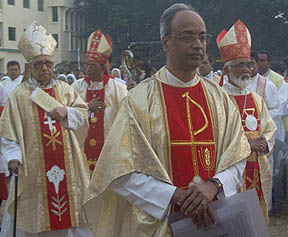
Concelebrants during the Mass: From left: Retired Archbishop Henry D’Souza of Calcutta, Cardinal
Telesphore Toppo, Calcutta Jesuit Provincial Father
George Pattery and Bishop Salvadore Lobo of Baruipur

Four Belgian and three English Jesuits landed in Kolkata port on Nov. 28, 1859. The mission they started now comprises two archdioceses, 21 dioceses, and seven Jesuit provinces, spread over Bihar, Chhattisgarh, Jharkhand, Orissa and West Bengal states.

Other guests at the event praised the pioneering spirit of the early missioners.

The Jesuits in Bengal have dedicated their life to enrich the lives of people with their quality education and cultural contributions, said Salomi Mamata, who works with Calcutta archdiocese’s social service center. “What I am today is thanks to the Kolkata Jesuits,” she said.

Snehashish Sur, a TV journalist, hailed the Jesuits’ values-based education and identification with local people. He said he was surprised when the late Belgian Father Gerard Beckers started living in a tribal Santal area after retiring from his work at St. Xavier’s College. “He moved around in a bicycle, and that was truly exemplary,” he added.