Category: Uncategorized

The Ballad of Jeff Bridges

Bookmark and Share


by Jake Martin, S.J.
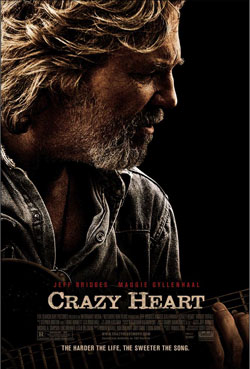
In

Momentum often trumps skill come Oscar time. Industry buzz plays as much a factor in deciding whose white knuckles clench the golden trophy in March as the quality of a performance. A savvy media campaign is just as important as acting chops in nabbing the highest prize in Hollywood, and the focus on sizzle over steak has often left film lovers scratching their heads when “the Oscar goes to…” yet another unworthy recipient. This year things may be different.

Jeff Bridges’ performance as a country crooner looking up from the bottom of a whiskey bottle in “Crazy Heart” is the perfect marriage of media hype and craftsmanship. Such is the weight of Bridges’ performance and the buzz surrounding it that the folks at Fox Searchlight saved it from the direct- to-DVD purgatory for which it was originally intended and give it a limited theatrical release. The producers must have been fairly certain that Bridges would get a nod from the Academy.

“Crazy Heart,” directed by Scott Cooper, is an unassuming, yet fully realized story of addiction and redemption. The narrative is direct and transparent; transitions are telegraphed from a mile away and nuance and deft sleight of hand are nowhere to be found. Yet this lack of subtlety in no way hinders the film’s agenda or makes its impact any less effective.

The film contains all the elements of a clichéd country ballad, complete with a dipsomaniacal protagonist, Bad Blake (Bridges), staggering through an endless series of one-night stands at half-empty honky-tonks. Perhaps the only thing surprising about “Crazy Heart” is its conclusion. It would seem almost an inevitability that a contemporary drama about a country-music singer would end in emptiness and despair. But Cooper, a first time director, who also adapted Thomas Cobb’s novel into the screenplay, seems utterly unconcerned with providing an existential chasm into which his hero can plummet. Indeed, he is more focused on advancing the remarkable story of an unremarkable man to allow trendy nihilistic undertones and hip narrative devices to interfere with the task at hand.

Historically, Hollywood’s portrayal of alcoholics has been, if not, entirely unrealistic, at least simplistically over the top. As anyone who has engaged with an alcoholic for any significant period knows, infrequently do their lives play out at the operatic levels of the celluloid drunks essayed in “The Days of Wine and Roses” and “The Lost Weekend.” More often, they are like Bad Blake, a man who manages to function just enough to get by, day by day, for years at a time.

The repercussions of addiction, while no less tragic, are often less dramatic than the standard didactic Hollywood offerings. The paint-by-numbers trajectory of alcoholism, which the film industry favors, often leads its audience to feel safely detached and immune from a disease that is far more subtle and destructive than the drunk-in-the-gutter portrayal that film industry has traditionally put forth. Not every alcoholic is like Nicolas Cage in “Leaving Las Vegas.” Some, like Bad Blake, manage to muddle through life in semi-coherent haze, and the tragedy is found, not in one moment of destructive excess, but rather in a lifetime of disintegration, as relationships, health and quality of life slowly but surely become compromised to the point of paralysis. The creative team behind “Crazy Heart” understands the complexities inherent in addiction and Bridges’ Blake, with his stubborn, almost blissful refusal to acknowledge his disease, makes for truthful and resonant movie watching.

Ultimately, it is all about Bridges, and he does not disappoint. The quintessential journeyman actor, if there can be such a thing in Hollywood, Bridges has gracefully moved through the better part of four decades giving one adroit, understated performance after another. Long overshadowed by peers with flashier styles and edgier personas, Bridges has always stood just outside the realm of the superstardom that seemed his right when audiences first beheld him in “The Last Picture Show.”

Bridges inherently unassuming and optimistic manner serves him well in the role of Blake, who, in less skilled hands would easily turn into a Saturday Night Live character gone bad. Instead, he manages to makes every move look natural. Bridges is the Spencer Tracy of his generation: never once are we aware that he is “acting,” and moreover, never does his performance get in the way of the story. The actor understands that at the root of all addictions is a myopic self-centeredness that impairs its victims to such a degree that even the simplest awareness of things outside the self are hard to come by. Yet because of his innate likeability we are never put off by his fundamental lack of cognizance.

Maggie Gyllenhaal, as the love interest, seems a bit too strident and impenetrable to be believable as a woman who would succumb to Bridges’ charms. While Bridges’ seems as if he was born with a bottle of Wild Turkey in his mouth, Gyllenhaal never manages to fully shed her actress persona, and she seems out of place in her Southwestern surroundings, as if waiting for the next bus out of Santa Fe and back to the familiar environs of Manhattan.

“Crazy Heart” bears more than a passing resemblance to “The Wrestler,” last year’s Oscar nominee, which resuscitated the career of Mickey Rourke. Unlike Rourke, however, Bridges does not need a comeback. He never went away. Rather, he’s been invisible, silently honing his craft year after year amidst a culture that seems only to affirm the damaging behavior of the kind Bad Blake and Rourke specialize. Yet that may change, if only for a brief few months, this Oscar season if Bridges finally receives the acclaim he so richly deserves. And it couldn’t happen to a nicer guy.

Jake Martin, S.J., is a Jesuit scholastic teaching theology and theater at Loyola Academy in Wilmette, Illinois.


Jesuit Conference President Fr. Thomas Smolich on Haitian Earthquake Relief Efforts

Bookmark and Share


In this short video clip, Jesuit Father Thomas Smolich, president of the Jesuit Conference of the United States, talks of the Jesuits’ efforts in Haiti to provide earthquake relief. Through the mobilization of the Society of Jesus’ missionary arm, Jesuit Refugee Service, the Jesuits are responding to God’s call to provide aid to the suffering and to stand in solidarity with the people of Haiti during their time of need.


Jesuit Conference President on Haitian Earthquake Relief Efforts from Jesuit Conference USA on Vimeo.


National Jesuit News is urging people to give to the Jesuit organization Jesuit Refugee Service to help those in Haiti.

To support JRS/USA’s humanitarian response to the emergency needs of the Haitian people, please click here to be directed to their secure website and choose “Haiti Earthquake Relief Fund.”

Or you may send a check to:

Jesuit Refugee Service/USA
1016 16th Street NW Suite 500
Washington, DC 20036

Checks should be made payable to “Jesuit Refugee Service/USA.”
Please clearly note “Haiti Earthquake Relief” in the memo field on the check.


Help Children Discover Their Catholic Identity

Bookmark and Share


Celebrating our Catholic Identity

As we begin the new year, let’s turn our attention to what makes us Catholic. When we share with children our appreciation of our Catholic identity, we can help them grow knowledgeable in their faith and comfortable discussing it with others.

A Few Lessons for Living

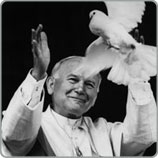
from Lessons for Living by John Paul II 

The words of John Paul II have long inspired Christians throughout the world. People of faith often turn to his wisdom in trying or difficult times.

In his gentle yet unflinching manner, the pope offered wisdom on such topics as the importance of forgiveness, how to respond to suffering in a Christian way, the necessity of unity in the Christian family, and the responsibilities of living as a Christian in this world. Below is a small sampling of inspirational lessons that encourage us to draw closer to God, helping us to live as faithful Christians in a sometimes challenging world.

The Gift of Peace
Become friends to those who have no friends. Become family to those who have no family. Become community to those who have no community. If we want peace, we must reach out to the poor. May the rich and poor of the world recognize that we are all brothers and sisters. May we all share what we have with one another as children of the one God, who loves everyone and who offers to everyone the gift of peace.

Suffering as Offering
A basic principle of our Christian faith is the fruitfulness of suffering and, hence, the call of all those who suffer to unite themselves with Christ’s redemptive sacrifice. Suffering thus becomes an offering, an oblation; this has happened and still does in so many holy souls…In [Jesus] they find the strength to accept pain with holy abandon and trusting obedience to the Father’s will. And they feel, rising from within their hearts, the prayer of Gethsemane: “But let it be as you would have it, Father, not as I.”

Every Life Is a Gift
Stand up for the life of the aged and the handicapped; stand up against attempts to promote assisted suicide and euthanasia. Stand up for marriage and family life. Stand up for purity. Resist the pressures and temptations of a world that too often tries to ignore a more fundamental truth: that every life is a gift from God our Creator and that we must give an account to God of how we use it, either for good or evil.

Faith Is Demanding
How can we profess faith in God’s Word, and then refuse to let it inspire and direct our thinking, our activity, our decisions, and our responsibilities toward one another? Faith is always demanding because faith leads us beyond ourselves. Faith imparts a vision of life’s purpose and stimulates us to action.

The Center
Prayer is not one occupation among many, but is at the center of our life in Christ. It turns our attention away from ourselves and directs it to the Lord. Prayer fills the mind with truth and gives hope to the heart.

Life Is a Talent
Life is a talent entrusted to us so that we can transform it and increase it, making it a gift to others. No person is an iceberg drifting on the ocean of history. Each one of us belongs to a great family, in which we can have our own place and our own role to play.

The True Face of Jesus Christ
Jesus says to us: “I am sending you to your families, to your parishes, to your movements and associations, to your countries, to ancient cultures and modern civilization, so that you will proclaim the dignity of every human being, as revealed by me, the Son of Man.” If you defend the inalienable dignity of every human being, you will be revealing to the world the true face of Jesus Christ, who is one with every man, every woman, and every child, no matter how poor, no matter how weak or handicapped.

May Our Faith Be Strong
May our faith be strong; may it not hesitate, not waver, before the doubts, the uncertainties that philosophical systems or fashionable movements would like to suggest to us. May our faith be certain. May it be founded on the Word of God; on deep knowledge of the Gospel message, and especially of the life, person, and work of Christ; and also on the interior witness of the Holy Spirit.

Every Area of Our Lives
There cannot be two parallel lives in the existence of the faithful: on the one hand, our so-called spiritual life, with its values and demands; and on the other, our so-called secular life, that is, life in a family, at work, in social relationships, in the responsibilities of public life, and in culture. Every area of our lives, as different as they are, enters into the plan of God, who desires that these very areas be the places where the love of Christ is revealed and realized for both the glory of the Father and service of others.

Featured Activities

Get children thinking about what it means to be Catholic with these activities:

Grade 1: Mirror of God 
Grade 2: Baptism Welcomes Us into the Large Community 
Grade 3: Welcome, Welcome, Welcome 
Grade 4: Say It with Virtues 
Grade 5: Building Unity 
Grade 6: Commandment Mobile 
Junior High: Come and Worship

Visit our online activity finder for more creative ways to teach children about their faith. You can search more than 500 activities available by age, grade, subject, or learning style.


Jesuit historian defends national hero from heresy charge

Bookmark and Share


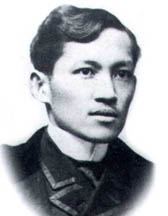
QUEZON CITY, Philippines (UCAN) — Filipino national hero Jose Rizal died 113 years ago but the controversy over his alleged heresies still rages.


Jose_rizal.jpg

Jose Rizal

This year, blogs and newspaper editorials continued the debate on the issue.

In one discussion forum, one post said that, if true, it is “sad … that the cradle of Catholicism in Asia is honoring as national hero, a Catholic heretic.”

Jesuit Father Jose Arcilla, a history professor and archivist who lectures to schools on Rizal, has no doubt Rizal believed in God and was not a heretic.

The priest acknowledges that Rizal was critical of the Church and religion in some of his writings, but claims he never denied God.

“Returning from Cuba, he wrote in his diary, ‘I think God is directing my life. He is allowing me to die in my country’,” Father Arcilla said. “Are those the words of a non-believer?”

Rizal, a polymath and intellectual, advocated political reforms during the Spanish colonial era and was executed by firing squad on Dec. 30, 1896, in Manila. The day is now a national holiday.

Spanish friars declared Rizal’s first novel “Noli Me Tangere” (Touch me not), published in 1887, as heretical, scandalous to the Catholic Church and injurious to the government.

The book’s characters include a young intellectual who returns home from Europe, a woman he falls in love with who turns out to be a Spanish friar’s daughter, and the protagonist’s father, who is killed after being falsely accused of heresy.


HK1217_1.jpg

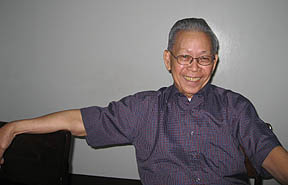
Father Jose Arcilla, history professor and archivist of the Philippine Province of the Society of Jesus.

The controversy over Rizal’s religious beliefs was further fueled by his membership of the Freemasons, a fraternity of men following a philosophy the Church regards as opposed to Christian doctrine.

A 1956 law requires all educational establishments in the Philippines to include Rizal’s life, works and writings in their curricula.

The Catholic Bishops’ Conference of the Philippines opposed the law, saying Rizal’s ideas were often opposed to Catholic dogma and morals. They accused him of “attacks” on the possibility of miracles, the concept of purgatory, sacraments, indulgences, Church prayers, and of questioning God’s omnipotence.

The bishops said he also disparaged the veneration of images and relics, devotion to the Blessed Mother and the saints, and that he questioned papal authority and other key Catholic teachings.

Father Arcilla says that despite his high profile in the Filipino psyche, Rizal remains under-appreciated as most schools focus on his novels.

To do so “is narrow,” the priest says, because Rizal wrote these as propaganda. “To know the mind and heart of Rizal, study his letters and diaries,” the history professor said.

He believes the bishops’ opposition failed because it lacked basis. He stressed that it is important to understand that Rizal did not reject religion but protested the colonial government’s “use of religion and the Church as a cloak for their abuses.”

He said many of Rizal’s ideas resonate in social movements in the Church and in the world today.

Science and religion are ‘inseparable companions’

Bookmark and Share


LONAVALA, India (UCAN) — Man’s mastery of nanoscience and nanotechnology will not diminish the attraction of religion, a Jesuit scholar says.


HK1266_1.jpg 


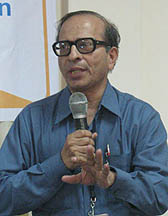
Jesuit Father Job Kozhamthadam

Father Job Kozhamthadam says people will still continue to be drawn to the mystery of religion even if scientists manage to answer all of nature’s mysteries.

Religion’s principal role is to help man find meaning and direction in life, the Jesuit priest told about 140 university professors, researchers and activists at a seminar.

The Jan. 1-5 event was titled: “Science-Religion Dialogue in the World of Nanoscience: The Encounter between the Mastery of Science and the Mystery of Religion.” It was held at the Indian Institute of Science and Religion (IISR), established by Father Kozhamthadam 11 years ago, in Lonavala, near Mumbai.

Father Kozhamthadam, who has a doctorate in the history and philosophy of science, delivered the keynote address.

Science and religion are inseparable companions, he asserted. While science helps man make sense of the world, religion assists him find meaning in life, he explained.

Understanding nature’s mysteries through research and study, particularly in nanoscience and nanotechnology enables man to have a better understanding of life and nature, he said.

Nanoscience is the study of the control of matter on an atomic and molecular level, while nanotechnology is the science of building machines at a subatomic level.

“Mastery and mystery should go hand in hand in our endeavor to build a better world and a better humanity,” he said.

He pointed out that although science has made “incredible strides” in understanding the universe, man still cannot say the age of mystery is over.

For instance, despite many neurological breakthroughs, several fundamental aspects of the human mind and brain remain unknown. Human understanding of the mind is “still laughably primitive,” he quoted US psychiatrist Peter D. Kramer as saying.

The priest said scientists still face “a formidable challenge” in cracking the neural code, the set of rules that transforms electrical pulses emitted by brain cells into perceptions, memories and decisions.

Thus, there is no sign that mysteries will disappear, “not even natural mysteries, much less religious mysteries,” he said.

Jnana Deepa Vidyapeeth (light of knowledge university), the pontifical seminary in Pune, together with three other colleges and a university helped organize the seminar.


Building faith, enhancing credibility

Bookmark and Share


In an interview with RNN’s Eileen Good, Gerry O’Hanlon explains the thinking behind his article on the future of the Catholic Church in Europe, in The Future of Europe, a recent book of the Centre of Faith and Justice.

‘Europe and the Roman Catholic Church’ is the title of an article by Jesuit priest Gerry O’Hanlon, featured in The Future of Europe, published by the Jesuit Centre for Faith and Justice. In the article, Fr. O’Hanlon says that many people no longer listen sympathetically or at all to what the Church officially teaches, despite the fact that the Church has so much to contribute to the debate on the future of Europe. What can the Church do to enhance its credibility? He spoke to Eileen Good.

Gerry O Hanlon: Well, I think you are right to say that the church does have a lot to offer, and in the article that I wrote I mentioned the Pope’s letter The Church in Europe. That is a very wide ranging analysis of Europe – particularly of the kind of values which he believes that the Catholic Church and Christianity can bring to the whole debate about Europe. Catholic social teaching has a very well developed theory of political action which he thinks is valuable for Europe. And I think he is right. I think the teaching is really valuable. The question I raised then was, given that it is coming from the Catholic Church, would people listen to it? The Pope himself is conscious of this issue; he does say in that letter about Europe that the Church has its own credibility problems. The ones I mention are a bit different from his. He is talking about conversion, the need to be holy, and I think he is right there. I think people sense that we have a relationship with Jesus Christ – there’s something transparent about that and very convincing, and it’s good. But I also raise the areas of sexuality and power as areas where the Church might have difficulties in being credible.

Eileen Good: That is true, and I suppose for a large percentage of a generation today, including people who would be now in positions in Europe where they can bring about change, one of the areas if you think about sexuality is Humanae Vitae and the teaching on contraception. Many people of that age group probably don’t even know about it.

Gerry O’Hanlon: Yes, and there’s a funny thing there – I suppose people have a way of putting things to one side and getting on with their lives. Many people do that, I think. And the people you are talking about, leaders in Europe who might have a Christian or a Catholic background, they carry on. Yet they are still inspired by their Christian faith, by their Catholic faith. But I think it’s not good for an organisation to have a body of teaching which is so widely ignored and put to one side. From the organisation’s point of view, from the Church’s point of view, it does raise questions, when people get into trouble in other areas, as to how reliable the Church is as a teaching body. So, for good reasons or bad reasons, the church is perceived as lacking wisdom in such an important area in life. We’re talking about relationships and love, and that’s the main thing that really is of significance to people in the end – there are many other things that are important, but in the end they feed off that. If the church is perceived to be lacking wisdom – if some of the good ordinary Christian faithful and the thinkers in the church can’t accept its teaching, it raises big questions. I think that’s, if you like, a running sore in the church, a wound. And I relate it to the issue of power, because I think it’s not healthy that issues can’t be addressed in a more open kind of way. I think that debate can be divisive in the short term, but it’s been clear throughout the history of the church that issues are resolved through talking and through listening. And often teaching changes as a result of that, in a way that makes it clear that the Holy Spirit is leading us. I’d like to see this happening more widely and more openly within the church than happens at the moment.

Eileen Good: When you talk about talking and listening – does the listening happen? And if it does, where does it lead? Where can change be implemented?

Gerry O’Hanlon: I think a certain amount of listening does go on, and that’s why I say there are signs of hope. I mention that in the article. I think, for example, that the voice of the laity in general is being heard more than it was before. I think the Vatican itself… Somebody did a survey recently and worked out that – what was it? – 15% of those working in the curial offices in the Vatican are women. And there have been attempts to bring in experts who are lay people, men and women, to advise the Vatican. But I think it needs to be a bit wider than this. Several years ago, Cardinal Martini, who is now retired, called for a Third Vatican Council, where these things could be aired more openly. A number of people have talked about that within the Irish Church too – that maybe we need something to give us hope and to give scope to people to share their ordinary experience. I do think there is a lack of structured consultation within the church. There have been beginnings – parish councils, for example – which I think are important. But it needs to go higher than that. And I think that’s one of the steps that needs to be taken to ensure that this debate is real, that people have confidence in it, and that it will lead to change.

Eileen Good: You used the phrase “the elephant in the room”. Will the elephant go away?

Gerry O’Hanlon: I’d be hopeful it will. I mean it’s very hard to be a prophet, to foresee when it might happen. I suppose I am old enough now to have seen big changes in the church in my lifetime. A lot of people were very fearful of what would happen when the current Pope was elected. Yet I think he has written a beautiful letter on love and sexuality. It just shows what can be done – people can listen to the Pope with great respect. A lot of the secular press, particularly in Britain, were very receptive to that letter. Also, the Pope has begun to listen even to somebody like Hans Küng. They had a discussion in Rome. And that was a great surprise to many people, not least to Hans Küng. He declared himself very happy with it afterwards. So I think the Holy Spirit can surprise us, and people can surprise us. I’d still be very hopeful that change can and will occur.

Exhibit Honors Jesuit Missionary on 400th Anniversary of Death

Vatican Celebrates Europe-China “Bridge”

By Carmen Elena Villa


HK735_1.jpg


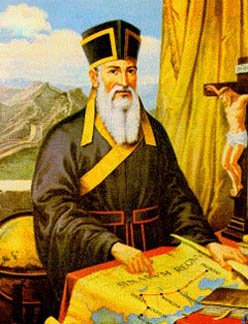
Father Matteo Ricci. He was a bridge between the West and China, promoting Christianity in the country while introducing its culture to the West.

VATICAN CITY, OCT. 29, 2009 (Zenit.org).- When Jesuit Father Matteo Ricci died in China in 1610, for the first time in the country’s history the emperor granted a plot for the burial of a foreigner.

A display at the Vatican is paying tribute to this missionary and what Benedict XVI called his “peculiar capacity” to reach Chinese culture and traditions “with full respect.”

A presentation of the exhibit “To the Heights of History. Matteo Ricci (1552-1610): Between Rome and Peking” was held this morning in the Vatican Press Office. Antonio Paolucci, director of the Vatican Museums and organizer of the exhibit, led the presentation.

The exhibit will be on display in St. Peter’s Square through Jan. 24, 2010. It was organized by the Committee for the Celebration of the Fourth Centenary of Father Matteo Ricci, in collaboration with the Vatican Museums, the General Curia of the Company of Jesus, and the Pontifical Gregorian University.

The exhibit includes pieces such as portraits of the Pontiffs who promoted evangelization in the Far East during the 16th century, as well as paintings of St. Ignatius of Loyola writing the Jesuits’ Constitution and St. Francis Xavier evangelizing Far Eastern lands.

Father Ricci’s manuscripts in Italian and Chinese are also included, as are maps drawn by him, and dozens of pieces representing the union between East and West, which show that Father Ricci understood that it is possible to proclaim the Gospel in all cultures.

“Considering his intense scientific and spiritual activity, one cannot but be positively amazed given the innovative and peculiar capacity he had in approaching, with full respect, Chinese cultural and spiritual traditions in their totality,” Benedict XVI wrote in a message sent to the Diocese of Macerata — Father Ricci’s birthplace — for the fourth centenary of his death.

Matteo Ricci’s “extraordinary missionary adventure led him to build, for the first time in history, a true bridge of dialogue and exchange between Europe and China,” the bishop of the diocese where he was born affirmed today.

Bishop Claudio Giuliodori of Macerata, Italy, added: “Besides paying homage to this giant of the faith and friendship between peoples, the exhibit seeks to provide all with an opportunity to learn about and be inspired by a model of evangelization of the Gospel culture and inculturation that, in many aspects, has no equal in the history of humanity.”

Following St. Francis Xavier

Born in Macerata in 1522, a town then located in the Papal States (at present in Italy), Matteo Ricci left for the Far East on May 18, 1577, when he was not yet an ordained priest, with the blessing of Pope Gregory XIII.

Together with 14 companions, he left on this mission journey with the hope of reaching China, where Jesuit St. Francis Xavier had died just two months after Ricci’s birth.

He was ordained a priest in 1580 in Goa, at the southern end of the coast of the Indian Ocean. In 1583 he went to live in the city of Zhoqing, in the province of Guangdong, after having endured six years of difficulties. Here he dedicated himself intensely to the study of the language.

In Zhaoquing, Ricci drew a map of the world based on European cartography, making the inhabitants of the area aware that there was a world beyond their wall. For the first time in history, China had a map that included the territories of Europe, Africa and America.

“Ricci brought with him the knowledge of the cartographers of his time, something absolutely new for the Chinese,” said Jesuit Father Federico Lombardi, director of the Vatican press office, during today’s presentation.

Little by little he won the esteem of the Chinese people, and succeeded in penetrating this very ancient culture. He also translated books on philosophy and mathematics into Chinese.

“I plan to end my life here. (…) Many have been converted, many come to Mass. They go to confession and Communion on the main feasts and are delighted to listen to the Word of God,” wrote Father Ricci in a letter to his brother Antonio.

Appreciating Chinese culture and knowing their language, Father Ricci worked exhaustively for evangelization and cultural dialogue in China. He wrote a catechism in that language and published his work “Treatise on Friendship.” He also translated Euclid’s first books of geometry in collaboration with his friend Xu Guangqi.

Several of his disciples called him “the strange man,” because of his European physical features, his different culture and the fact that he lived celibacy.

Father Ricci died in Peking on May 11, 1610. His tomb is still there. His cause of beatification opened in 1983.

Bishop Guidiolori said today that the community of Chinese Catholics residing in Italy is working enthusiastically so that Father Ricci will be raised to the altar.

A Commitment to Visibility


Download pdf 

Uta Sievers

Some impressions from Father General’s talk to the Social Apostolate Coordinators

The core of Father General’s talk to the coordinators this year was the question “Is the Society of Jesus moving away from the poor?” This had come up as an observation during our discussions and was a source of concern for our group.

Father General pointed out how a circle of invisibility has led to fewer and fewer young Jesuits wanting to live and work with and among the poor. The starting point is that there are now fewer Jesuits in all apostolates, not just in the social apostolate. This overall scarcity is one reason why Insertion Communities, which represent the closest way of “being with” the poor and marginalised and are often small, are sometimes the first ones to be closed when a province decides to consolidate its communities; and the closure of an Insertion Community means a story that will go untold to the next generation of Jesuits1. At the same time, there are fewer Jesuits who volunteer to live in Insertion Communities and provincials are aware that they cannot force people into this ‘difficult’ way of living. Why do the provincials perceive it as difficult? A possible reason is that however great the initial motivation based on the Gospel message to be with the poor, there is also a wish not to disturb other processes such as formation and university studies. Secondly (and this is the main reason for the small number of new faces in Insertion Communities), as we ourselves grow older in the social apostolate, we have lost contact with the Scholastics while focussing on the poor. Not all is lost, however. In places where the social apostolate has made visible a way to live as religious among the poor, where we have kept in touch with the Scholasticates, young Jesuits have in fact opted for this way of life.

Father General then shared some ideas with us as to what we, as persons active in the social apostolate, can do. One of his main concerns is the need to guard ourselves against the virus of success; working with the poor will never be ‘a success’ or make us successful in a secular sense. We need to discard the idea of success in our thinking, our mentality, our values – this is true for the whole Society of Jesus, but especially for the social apostolate. According to Father Nicolás’ vision of the Society, it is important to live in simplicity with the people whatever our field, pastoral or academic, or any other. This broad experience of commitment will inspire young people more than all-exclusive social justice work, which may send out the message that when you work with the poor, you cannot serve in any other way. In the same vein, he also warns against an “all or nothing” mentality in the social apostolate, since a purist’s vision of social justice will produce admirers but not followers. Instead, we need to plan this form of work with care; we need to plan our free time, our study, and our service in an interrelated and meaningful way. And last but not least, if we manage to make friends among the poor, we will never feel we are “moving away” even if we change assignments.

Father Nicolás also raised the issue of the way in which we deal with our institutions, especially those that have a long Jesuit tradition. He was quite clear in his analysis that attachment was one of the weakest points of our traditional ministries. We become attached to our ‘creations’ and are very reluctant to let go of the good works we are running. In the process, we are literally killing Jesuits, overloading them with up to five different jobs, infecting them with the virus of success. Mobility is essential to our charism; thus we need to learn a new way of discernment, to let go and move on. For example, when starting a school, we should immediately prepare our lay successors so that we can hand the work over to them after no more than 15 to 30 years. He also stressed the fact that the shrinking number of Jesuits is being compensated for by the growing number of competent lay people who wish to work in our institutions. This gives us the freedom to dream again, to be creative, flexible and mobile. He encouraged us to see our institutions as our children: let them go off, get married and go their own ways.

1For the stories of active insertion communities, see Promotio Iustitiae 100: http://www.sjweb.info/sjs/pj/.

Eight among many

On 16 November 1989, Ignacio Ellacuría, Ignacio Martín-Baró, Segundo Montes, Arnando López, Joaquín López y López and Juan Ramón Moreno, together with Julia Elba Ramos and Cecilia Marisela Ramos, were murdered in El Salvador. The 20th anniversary has been commemorated by a resolution of the Congress and Senate in the United States.

Australian Jesuit Fr Andrew Hamilton SJ remembers the aftermath of the terrible tragedy and its impact on the Society.

On the day that the six Jesuits, together with the community cook and her daughter, were murdered in El Salvador, I was at Cha Choeng Sau outside Bangkok. The Jesuit Refugee Service was holding a meeting, where we had heard from JRS workers of the suffering and resilience of refugees around Asia. We looked forward to hearing from Fr Jon Sobrino, the Salvadoran Jesuit theologian, who had been speaking at another meeting in Bangkok. But at breakfast we heard the dreadful news.
That evening Jon Sobrino did join us for the Eucharist, still in shock. The next morning, he read the account in the Bangkok Post. A photograph showed one of the dead Jesuits in a room. Jon looked at the photo, and said slowly, ‘That’s my typewriter: that’s my Bible. That is my room’. A Jesuit visiting from another community had spent the evening and died in Jon’s room.

Two years later, I spent six months in El Salvador. I wanted to understand Latin American theology and to visit the communities of refugees who had returned from camps in Panama, Honduras and Nicaragua. In the theological library where I worked there were still bullet marks in the walls from the night of the murders. In many communities there were other relics – the stole worn by Fr Martín Baró, and so on.

The Jesuits were still bearing the weight of their loss. They were determined not to allow the deaths to affect their commitments, and were intensely focused. One wit had remarked, ‘In 1989 the Salvadoran Army martyred the six Jesuits; in 1990 the six Jesuits martyred the rest of the Province’.

Although I had intended my stay to be a gesture of solidarity with the Jesuits in El Salvador, I came to realise that guests with less than fluent Spanish must have been more of a burden than an encouragement. The Jesuits in El Salvador lived under great pressure, constantly standing up to a government that had turned its arms against its little people, and following Jesus in the midst of a civil war. Those who were killed were good people, good Jesuits. They were not picture book saints, just ordinary martyrs. I was heartened to hear that one died swearing at the soldiers who had just broken in the door.

It was in the campesino communities that I began to understand the six Jesuits and the theology evolving in El Salvador and other parts of Latin America. The figures of Julia Elba and Cecilia Marisela Ramos, the community cook and her daughter, then came into sharp focus. With that came some understanding.
These communities had been forced to leave the mountainous parts of El Salvador as the army conducted its counterinsurgency campaign. This consisted of sweeping through villages and killing indiscriminately, and more systematically murdering catechists. In this way they hoped to deprive the guerrillas of a population where they could hide and to intimidate its leadership. The families, all poor, fled and gathered in camps across the border. There they centred their lives around reflection on the Gospels, eventually returning to settle on deserted land. They lived precariously, protected to some extent by foreign volunteers who accompanied them.

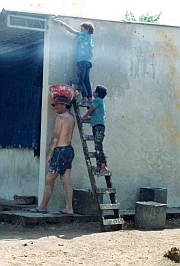
In the communities I was given simple tasks where I could not do too much damage. In one community that was preparing to celebrate its tenth anniversary, apart from joining the children in whitewashing the school for the occasion, I was asked to gather the names of their martyrs to remember in the Eucharist. It was deeply moving. The list grew and grew as each family remembered parents, sons and daughters, many of whom had been catechists. One lady offered the names of her seven sons, describing each, and how he had been killed. When she came to the last, Juan, she wept gently. ‘I had such hope in him’, she said.

Harvesting the names made me think of Julia Elba and Cecilia. The Jesuits had died because they refused to regard the poor of El Salvador as expendable, and would not allow those murdered to lie forgotten. They kept memories and hopes alive. Julia and Cecilia had thought they would be safer staying the night in the Jesuit house than at home. But the Jesuits had made themselves unsafe by joining themselves to the expendable poor like Julia and Cecilia. So I began to see the six Jesuits as just some of thousands who had died, represented by the faces of the cook and the daughter.

The theology done in El Salvador, too, was about listening to the Gospel through the lives and the simple words of the poor, and seeking larger, connected words in which to speak of it. It made sense in the communities that I visited. The learned criticism of it that I had read made no sense, just as the political analysis of the threat posed by the poor of El Salvador made no sense. It all began and ended in the wrong place.

The message that I learned from Julia Elba and Cecilia Marisela and the six Jesuits who died, and from the theology that honoured their faith, is that in the Kingdom of God the first will be last, and the last will be first. If we want to follow Jesus we must be simple, companions to those normally thought of last, like Julia and Cecilia Ramos, and so like Ignacio Ellacuría, Ignacio Martín-Baró, Segundo Montes, Arnando López, Joaquín López y López and Juan Ramón Moreno.

Pictured: (Top) Fr Jon Sobrino (right) at the eucharist in Bangkok, following the deaths of the six Jesuits in El Salvador. (Middle) Fr Andrew Hamilton in El Salvador.

Jesuits look back on 150 years of Bengal mission

KOLKATA, India (UCAN) — Belgian Jesuits are celebrating the 150th anniversary of the establishment of their Bengal mission in eastern India.

HK933_1.jpg 


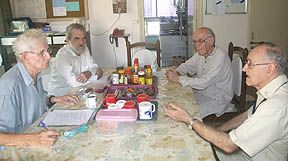
Belgian Jesuit missioners of Calcutta province have
a chat over a cup of coffee at the Jesuit provincial
house in Kolkata. From left: Father Jean Englebert, a liturgist, Father Charles Pollet, a theology professor,
Father Albert Huart and Father Andre Bruylants

The order has had a big impact on lives in the region through education, literary contributions and a translation of the Bible into Bengali.

Father Andre Bruylants, 83, former headmaster of the Jesuit-run St. Xavier’s College in Kolkata, has been working in the mission for 60 years. He is one of seven remaining Belgian Jesuits in the religious society’s Calcutta province.

Jesuit teachers had educated thousands of people and become icons of Catholic education in the region, he says.

Others have influenced the region’s socio-cultural leaders through scholarly interreligious exchanges, and reached out to Indians through the study of Hindu scriptures and engagement with Hindu intellectuals.

Jesuits have influenced literary thinking through publishing and translating Western Christian classics into Bengali, and also helped locals use their own language in worship.

Father Christian Mignon, 85, came to the mission at the age of 25. He was to make a unique contribution to religious life in Bengal, translating the Bible into Bengali over 40 years. The job, in which he was helped by Hindu poet and teacher, Sajal Banerjea, was completed in 2003.

He had previously translated liturgical texts after the Second Vatican Council, which opened the way to the use of local languages in the Mass.

English Jesuits first came to Kolkata in 1833 and started St. Xavier’s but left the country in 1849 after a conflict with the local bishop.

The Belgian Jesuits, who arrived in the city in 1859, were invited to restart the school, which they did within two months in January 1860.

Belgian Jesuit Father Albert Huart, 85, who translated a book on the Jesuits’ Bengal-mission history, is former vice-principal of St. Xavier’s College.

He said that the Belgians expanded from the English educational base to probe further the possibilities of village missions.

Initially the Jesuits’ focus was on the Chotanagpur area, in the present state of Jharkhand. This was where Jesuit Father Constant Lievens (1856-1893), whom the tribal Church reveres as the “apostle of Chotanagpur,” had worked to restore tribal dignity.

By 1869 the Jesuits were entrusted with the Bengal mission, at the time consisting of the present Indian states of West Bengal, Jharkhand, Bihar, Madhya Pradesh and Orissa.