Category: Uncategorized

Lenten Activities for Busy Families

Bookmark and Share


Given the many challenges facing today’s families, now is the perfect time and home is the perfect place to experience Lent. After all, home is where we rush and rest, where we hope and worry, where we love and forgive. It is home where we most often experience day-to-day salvation. Lenten experiences can take place in nearly every room of the house.

Here are some ideas to try to enrich your celebration of Lent at home:

Family Lenten Crafts

Make a decorative family “works of mercy” tree by following the directions on these PDFs. Work as a family to follow through on your promises. You can find more activities like this in Crafting Faith.


Crafting Faith

Praying Lent

A Prayer Book of Catholic Devotions 

Lenten Family Mealtime

In addition to “Friday fish day,” designate one evening a week to prepare a meal together. Assign a different dish or task to each family member. Before starting, discuss how each family member is giving to the others-giving time, effort, and care to nourish the entire family to go out and do God’s will. Begin with a prayer of thanks and petition.

Family Lenten Reading

Prominently display the Bible and other books that feature topics such as the following: Lent, forgiveness, prayer, Scripture, generosity, social justice and service for others. You might wish to display Praying Lent: Renewing Our Lives on the Lenten Journey, a small booklet by Andy Alexander, SJ, or A Prayer Book of Catholic Devotions by William G. Storey, which offers a special section dedicated to Lenten reflection in addition to prayers for other seasons and normal time. Invite family members to choose books and discuss what you read.

Family Kindness and Sharing

On slips of paper, write random acts of kindness, such as give a compliment, say hi to an old friend, carry someone’s heavy load. Present each family member with a slip of paper as he or she leaves in the morning. Invite each family member to perform the kindness without seeking recognition. Afterward, talk together about what happened. Pray with one another that your kindnesses will be passed on throughout Lent and beyond.

Giving to Charities

Ask each family member to find three to five high-quality, useful items that would be appreciated by those who are less fortunate. Donate the items to a favorite charity. Pray together for those who will receive them.


Former students pay tribute to Jesuit press

Bookmark and Share


KOLKATA, India (UCAN) – Former students of St. Xavier’s College, a premier Jesuit-run institution in Kolkata, have paid tribute to India’s first printing press that the Jesuits set up.

They helped erect the replica of the gate of the College of St. Paul in Goa at the popular Kolkata Book Fair . The Jesuits in Goa had set up India’s first printing press in 1556.


Former students pay tribute to Jesuit press thumbnail
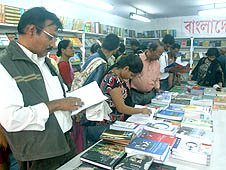
Visitors at the Kolkata Book Fair browsing books at the Jesuit stall

Since the book fair deals with printing, it is appropriate to pay tribute to the Jesuits who set up the first press, said Snehasis Sur, secretary of St. Xavier’s College’s alumni association.

The 10-day book fair scheduled to end Feb. 2 is regarded as the largest attended book fair in India. Media reports say more than two million people visit it annually.

Sur said the effort was undertaken to mark the completion of 150 years of St. Xavier’s College and 25 years of the alumni.

He said most people are unaware that Jesuit missioners began printing in India. The replica of the gate of St. Paul’s College will educate people of the Jesuit contribution, he added.

In 1542, Saint Francis Xavier, who was based in Goa at the time, requested the king of Portugal to send a printing press for India, Ethiopia and Japan. The ships sailing to Ethiopia had to pass through Goa since the Suez Canal was not in service then.

When the Jesuits in Goa received news that the king of Ethiopia was not keen on receiving the missioners with the printing press, it was setup at the college in Goa.

Sur, a journalist with a national television channel, said the College of St. Paul, began in 1542, was abandoned when a plague ravaged Goa in 1570, but the gate still stands as a historic witness to the first college the Jesuits built in India.

The replica of the gate at the book fair also is to acknowledge the Jesuits’ educational service to the nation, Sur told UCA News.

The alumni association has also setup a stall at the book fair with literature, books, photos of and on Calcutta Jesuits and their institutions. The gate of the College of St. Paul stands at one of the main entrances to the fair.

At the stall, visitors can read literature on the College of St. Paul, and appreciate the works of the Jesuits, said Sunil Ghorai, who manages the stall. Ghorai said this was the first time that the Jesuits had found a place at the annual fair.

“This is the only stall where Christian literature” including the Holy Bible in Bengali, lectionaries, lives of saints, is available at the fair, and “there is a lot of enthusiasm among visitors,” he said. He added that more than 300 people visited the stall on the first day.


Why Resolutions Fail

Bookmark and Share


by  Joe Paprocki

New Year’s resolutions are much maligned nowadays. Some people feel that they’re a waste of time. I think it’s admirable that people want to accomplish something positive, turn over a new leaf, and become a better version of themselves. So why do so many New Year’s resolutions fail?

I can only speak for myself. My resolutions often fail for two reasons: I think I can do it on my own and I think it can be “once and done” instead of ongoing. As for thinking that I can accomplish my resolutions on my own, I tend to forget one tiny little detail: I can do nothing without God! In her book, Simple Acts of Moving Forward: A Little Book About Getting Unstuck, Vinita Hampton Wright reminds us that “Sooner or later God figures in.” Personally, I prefer sooner rather than later. Ultimately, that’s why I go to Mass on Sunday and receive the Eucharist – it’s my way of admitting repeatedly that, at my deepest level, I am incapable of sustaining myself: “but only say the word and I shall be healed.” People in twelve-step programs know this well: change can only come with reliance on a higher power.

As for thinking that this can be “once and done,” I too often forget that Jesus said, “If anyone would come after me, let him deny himself and take up his cross daily and follow me.” (Luke 9:23) Not “take up his cross once” or “take up his cross for a little while” but “take up his cross daily.” At first that may sound like a downer, but when we realize that following Jesus doesn’t end with the cross but with Resurrection and new life, we can find the patience, endurance, and determination to remain committed to our goals even in the face of hardship.

And so, have a happy new year. And with the help of God’s grace, may we resolve each day of the new year to become the people God knows we can be.


This article is written by Joe Paprocki,
author of A Well-Built Faith

For further information on Ignatian Spirituality,
please visit our sister site: www.IgnatianSpirituality.com


Help Children Understand and Celebrate Lent

Bookmark and Share


Many of us have heard this question when we arrive at school, work, or home with the blackened cross on our forehead. The observance of Ash Wednesday is the most popular weekday celebration in the Catholic Church’s liturgical year. During the celebration, children and adults process to the altar to receive ashes on their forehead in the shape of a cross. Ash Wednesday is also a day when people discover how many Catholics there are in their community. This can nurture in children a greater sense of religious community. And because receiving the ashes is a sign of humility and contrition, children will also see how many people recognize the need for repentance.

The Ash Wednesday Ritual

Ash Wednesday is always the first Wednesday of the Lenten season and marks the beginning of Lent. The distribution of blessed ashes is typically done before the altar and, depending on the custom of the parish, people will hear the distributor say, “Turn away from sin and be faithful to the Gospel” or “Remember, man, you are dust and to dust you will return.” The atmosphere in the Church is quiet and the observance solemn. People reflect on how quickly human life can pass. All are reminded of the need for repentance.

Ash Wednesday Readings

The readings for Ash Wednesday offer a number of important images that help children understand the meaning of this experience. The first reading calls us to repentance but also emphasizes that God is gracious and merciful, slow to anger, and rich in kindness (Joel 2:13). In the second reading, Paul reminds us that the world sees the presence of Christ in the way we act. So, be reconciled to God today! (2 Corinthians 5:20-6:1). We are called to be the love and change we wish to see in the world. In the third reading, Jesus reminds us that the sacrifices and prayers called for in Lent are between God and us. It is insincere for us to show off contrite actions to win the praise of others-let others only see how our sacrifices and prayers help us love them.

Children and Preparing for Lent

Ash Wednesday begins a wonderful season of reflection and preparation. Receiving the ashes as a member of the church community helps children recognize that they are an important part of the Catholic community and are united with the Church in its Lenten preparation.


Resources that can help children reflect on Lent are:


The Story of the Cross  

Guided Reflections for Children, Volume 1

Guided Reflections for Children, Volume 2

52 Simple Ways to Talk with Your Kids about Faith

Raising Kids Who Will Make a Difference – for support with fasting and ideas for abstinence and almsgiving

Praying Lent


Come in, Stranger

Bookmark and Share

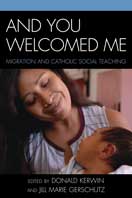
And You Welcomed Me

MIGRATION AND CATHOLIC SOCIAL TEACHING

BY Thomas Massaro, S.J.

Migration is a phenomenon with many faces. Some are visible to U.S. observers: day-labor pick-up points that dot our rural and urban landscapes, news stories about human trafficking and various exploitative practices, and angry rhetoric from anti-immigrant voices. Other aspects of migration remain invisible or at least in the shadows: the 33,000 hopefuls languishing in U.S. detention centers, the growing value of remittances sent by guest workers to their homelands, the thousands of aspiring immigrants who die each year on the high seas or while attempting dangerous border crossings through sweltering deserts.

This collaborative volume of six essays skillfully brings into the light all these faces of migration, and many others beyond the U.S. arena as well. Each essay provides a wealth of relevant information and rich analysis crucial to understanding this topic of growing importance in our interdependent world. Especially valuable are the sections that supply historical context for contemporary U.S. immigration policy debates, documenting how Americans have been arguing (rarely dispassionately) about migration for centuries. Two scholars of immigration law collaborate on a particularly insightful essay that situates U.S. immigration policy within the context of the larger legal establishment, along the way providing an eminently clear explanation of the often baffling array of visa categories in U.S. law. Other essays focus on the economics, sociology and theology of migration, but each finds a judicious way of situating its analysis solidly in the inescapable context of globalization.

The unity this volume achieves is rightly attributed above all to the deftness of each author in following the common thread of Catholic social thought. No single discipline is capable of providing as wide a perspective as Catholic social teaching in the evaluation of global migration patterns. The distinctive Catholic theological themes of the common good, human dignity and authentic human development cannot, of course, in themselves determine national policies or direct international relations to specific conclusions or reforms. But the values and ethical principles proposed by the social teachings of the Catholic Church (and reflected by many other religious traditions) do rule out certain practices. Contributors to this volume do not shy away from pointing out morally objectionable policies and institutions. Examples include the exploitation of undocumented workers, human trafficking, denial of basic services to vulnerable immigrants and policies that leave families separated by political borders.

Further, this volume exposes a fundamental pattern that lies behind these abuses and rights violations. When governments, market actors or international agencies focus only on a narrow slice of the overall human context, they invariably neglect vital values and overlook pressing human concerns. An exclusive and all-consuming focus on trade liberalization or labor market flexibility or national security, to cite three prime examples, in isolation from the wider social ecology that promotes the well-being of actual people, yields irrational and inhumane policies. The harvest reaped by adopting such narrow approaches includes arbitrary immigration raids, the heartless breakup of families and the criminalizing of people in desperate straits.

Without a doubt, each of these essays contains an advocacy angle, one that tends to favor a broad conception of migratory rights and fewer immigration restrictions. Yet nowhere does the volume oversimplify the picture or deny the reasonable principle, recognized in international law as well as Catholic teaching, that nations have a right and duty to control their borders and regulate the flow of immigrants. As Daniel Groody explains in the lead essay: “My primary purpose is not to make a case for or against open borders, but to give a new way of conceptualizing a difficult and contentious global issue.” Each of the contributors displays a refreshing tendency to pose insightful questions and a studied deliberateness about leaving somewhat open-ended these queries regarding appropriate approaches to migration.

By bringing together such excellent analysis from several disciplines, this volume fills a large gap in scholarship surrounding migration. In a package that could be used to good effect in many college courses on social ethics, it provides a satisfying theological perspective on the global forces that push and pull migrants across borders. The authors draw on the latest statistics and trends. They also display commendable rigor in defining the slippery and often contested terms applied to various categories of migrants (asylum seekers, refugees, forced migrants, undocumented and internally displaced persons, among other terms).

While And You Welcomed Me deserves praise for its attention to detail, its relentless focus on the “big picture” is its greatest contribution. These essays make a persuasive case for framing issues concerning global migration in the broadest of terms, that is, in light of the global common good, of universal solidarity and of human aspirations for favorable work opportunities upon which hopes for a good life depend. Without the type of scholarship found here, the world may never grow beyond the mistrust and hostility that all too often characterize discussions of migration.

Thomas Massaro, S.J., teaches social ethics at the Boston College School of Theology and Ministry, Chestnut Hill, Mass.


Index of Shalom February 2010

Bookmark and Share


Stories of Hope, Sadness Emerge from Earthquake Ruins

Bookmark and Share


Courage of Haitians “starts young,” says U.S. nun who nursed hundreds

Sister Mary Finnick, a nurse who directs the Matthew 25 House in of Port-au-Prince, found that “the courage of the Haitian people starts young” when she opened an impromptu triage and treatment center in a nearby soccer field after the quake.

“The children, though crying, did not have temper tantrums and cooperated as much as is possible for a 3-year-old when you make a splint, clean out a head wound and debride backs and legs,” Finnick said in a Jan. 13 e-mail.

“In all of this, we also hear the Haitian voices raised in song, praising God for being alive,” she added.

Sister Mary said she, two other Matthew 25 staff members, six guests from Pennsylvania and New York, and three Haitian doctors treated 300 to 400 people in the hours after the magnitude 7 earthquake.

“We began to see some very horrible conditions caused primarily from the cement blocks, which most of the houses are built with, poor and rich alike,” she wrote. “There were many head wounds, some so serious it surprised us the person was still alive. Most were deep wounds that should have been sutured, but we had no material to do that.” When supplies ran out, “we finally cut up pillowcases for bandages,” Sister Mary reported.

Matthew 25 House, established in 2005, provides hospitality to North Americans who come to Haiti with missionary or humanitarian organizations.

Although the downstairs of the house experienced no structural damage, Sister Mary said, the upper floors were affected and “the wall between us and the neighbor has quite a large hole.” She encouraged medical teams that had been scheduled to come to Haiti not to change their plans. “There is a great need for medical supplies, suturing, betadine, analgesics … everything … and personnel to bring it,” she said.

Earthquake claims first Haitian-born Salesian brother

One of the thousands of victims in the Haitian earthquake was Salesian Hubert Sanon, 85, the first Haitian to join the religious order as a brother.

Details surrounding Brother Hubert’s death were unknown, but Rev. Mark Hyde, the executive director of the Salesian Missions, said Hubert died in the Salesian compound that houses the National School of Arts and Trade.

Concern also was growing for 200 students believed trapped in the rubble at the school. Father Hyde said he last heard from someone at the school at midday Jan. 13, minutes before cell phone service was disrupted.

Brother Hubert professed vows in 1947 and worked at the school’s Lakay program for young adults and teenagers on the streets. The program tries to reunite the young adults with their families. For those unable to find their families, the program offers the young people a place to stay and teaches them a trade in preparation for employment.

Father Hyde said Brother Hubert was a graduate of the school and was so impressed with the work of the Salesians that he decided to join the order. The school’s director, Salesian Father Atilio Stra, was seriously injured during the earthquake and the school and the surrounding compound suffered extensive damage.

‘What is happening?’

Junior Sinsmyr thought Haiti had been attacked.

Sinsmyr, senior translator at an American-sponsored medical clinic in Port-au-Prince, was not exactly sure why his world was falling down all around him the evening after the earthquake hit.

Brent DeLand, a member of Christ the King Parish in Springfield, Ill., who established the SARTHE Medical Clinic, was on the phone with 24-year-old Sinsmyr when a major aftershock shook the Haitian capital.

“I was stunned when he answered the phone,” DeLand said. “His response was ‘What is happening?’ He asked me what an earthquake was. I told him. I’m not sure he really understood what an earthquake was.

“Then he sort of understood and I asked ‘What do you see?’ He said, ‘Well, I’m in the middle of the street. In all directions there are no buildings left.”

“As we were talking the second aftershock hit and I knew it because I was watching it on CNN. He said, ‘Oh, no, the world is shaking.’ That was a fairly profound comment. I asked what was happening. I couldn’t hear him because of all the screams and cries.”

Then the line went dead.

As of Jan. 14, DeLand had not heard from Sinsmyr or anyone else from the clinic since the night of Jan. 12. He was hoping to travel to Haiti with a small group of volunteers on Jan. 16, as originally planned. They were expecting to address more routine medical procedures.

Aid worker finds scene from Dante’s “Inferno”

“It looks like Dante’s ‘Inferno.'” That’s how Mike Henry, Haiti project director for Cross International Catholic Outreach, described the scene in Port-au-Prince after the quake.

“There are dead bodies everywhere,” Henry said in a Jan. 13 report from the Haitian capital. “It is hell on earth.”

Jim Cavnar, president of the Catholic aid agency based in Pompano Beach, Fla., said the magnitude 7 earthquake “has done more than shake the earth. It has shaken the fragile hopes and dreams of the Haitian people, who just last year were the victims of devastating storms and flooding.”

But even amid the devastation, there were signs of resilience.

“The girls were shaken up quite a bit when it happened,” said an unnamed person who works with Cross Catholic, in a message to Cavnar, “but now they are playing with the kids of the parents who are staying in our home.”


Jesuit Electronic News Service Vol. XIV, N. 1

Bookmark and Share


Father General

Interview to Father General.

On December 21st, just before leaving Zimbabwe, last stop of his third trip to Africa, Father General gave the following interview to Fr. Oskar Wermter. With the kind permission of Fr. Oskar, we are publishing it, for we believe the themes treated to be of interest to all.

1. Very familiar as you are with Asia, what strikes you as different in Africa, both in the Church and in society at large?

Let me start saying that one of the things I have learned in my Asian experience is to never trust first impressions. The main reason is that first impressions are the most conditioned by previous experience, expectations or prejudice. And the second thing is that it took me some time to realize that there is no Asia, an Asia we can speak about in one line of conversation. Asia is many countries, many cultures, many traditions, many histories and peoples. If Africa is still “one Africa” for me, it means that I do not yet understand it. I really hope that, as I grow in understanding Africa, I will come to the realization that there are many peoples, many languages, many traditions, many cultures… in Africa as well. And then comparisons become concrete and limited. I find it very hard – that is, impossible – to compare Asia and Africa. I would have to ask which Asia? And, which Africa?

2. There are going to be Secretaries for Dialogue with Hinduism, Islam and Buddhism, major world religions. How do you see dialogue with African Traditional Religion? And African contemporary religion (new religious movements, Indigenous Christian movements led by “prophets”, Pentecostal groups, etc. etc.)?

I would like to mention only two points before I answer this question. The first is that, as you could see in my letter, these Secretaries for Dialogue with Religions will be resident in their own apostolic place. I think that it is important that Dialogue is taking place; that something moves at the base, where people are and live their Religions. And that it is important that we differentiate; dialogue with Buddhism is totally different from dialogue with Islam. In other words, if something happens at the level of the life of the Church and the Society, then we can think about coordinating similar initiatives or experiences. I would not like to start at the top with someone sitting on high without roots in the life of people. I truly hope that dialogue with the people takes place in depth, touching their religious roots. Then we can think of a Secretary.

This gives me the opening to make my second point. I really hope that Jesuits working with people can relate so deeply with them that there is a real dialogue of hearts between our men and the people we serve. And if there is such a dialogue, the religious roots of people’s life will emerge and be part of our dialogue with them. It has been a biased view of European people, scholars included, to consider traditional religion as “less developed”, “more primitive”, “less sophisticated”, etc. The fact is that it has permeated our whole life to such an extent that even modern European agnostics (self-defining often as the most elaborate secularists) continue to have latent or overt behaviour that is understandable only in categories of traditional religion. As a Japanese scholar once said, Europeans have always been and continue to be “animistic”, even if they are reluctant to acknowledge it. Thus, I really hope that our men will take this dialogue seriously and will study traditional religions seriously, and will open avenues and possibilities for creative and deepening dialogue. Dialogue can help all of us because it helps us discover hidden meanings in our tradition and opens up possibilities of purification and growth that would remain unnoticed otherwise.

With these two remarks I can now address your question. I think the main thrust of our dialogue should not be with ideas or systems or concepts, but with people. Being person is being in dialogue. What matters is not the area of specialization we take; what really matters is people and in dialogue with them we come in touch with old and new religiosities, old and new fears, old and new ritual needs, old and new inner liberations. And if this is the case, then it is clear that we will need a far greater depth in our faith and a very wide training so that we can be of help to those with whom we dialogue.

3. “Inculturation” is the great catchword in African theology. Where do you think we should put the emphasis: on liturgy, ecclesiology, marriage and family, religious life, or statehood and governance (social justice)?


I do not think we can separate the issues so neatly. Inculturation, like any development in life or thinking that involves culture, does not happen by plan or theory. It happens when the people involved feel free to live and express themselves in the terms that best respond to their experience and the mental, or interactive frameworks within which they are most truly themselves. This applies to liturgy, ecclesiology, marriage, religious life and social justice. Culture is a reality that has a life of its own and keeps growing, changing, adapting and responding to new events and environmental changes. Inculturation is a way of living in the wider context of whatever makes human life human. Thus the encounter between culture and faith is ongoing, mutually influential, and, hopefully, a source of ongoing growth and purification.

4. Do you see a danger that our deep involvement as Jesuits in social work and social development may “secularize” us or alienate us from the priesthood, even the Church (I am asking this because we are in the Year of the Priest)?


It all depends on the kind of spiritual and human depth we have reached in our lives. Social work can be a distraction from deep spiritual living, or it could be a great help to encounter the living God in people who are suffering. Yesterday I received a book by a spiritual writer about a Jesuit who became a worker-priest and who lived in his new environment very high mysticism. The book is titled: “God, friendship and the poor. The mysticism of Egide van Broeckhoven, a worker Jesuit”. This Jesuit understood his call as one of teaching people “the mystical depths of friendship”. If we understand that one of the dimensions of Priesthood is to help people come closer to God, social work cannot be considered as alienating. On the other hand, a person totally dedicated to concrete temporal results in the social justice arena can become very alienated from his own spiritual religious mission and be totally at the mercy of political or social results of his effort.


5. Zimbabwe is struggling to overcome bad governance, corruption, violence and rebuild the country with a new democratic constitution. Do you think democracy (government by participation) has a chance? Would you say democracy has Christian roots so that we are obliged to promote it? Could you answer this in the context of your wide experience in other parts of the developing world, especially Asia?

I can only say that, from my own experience elsewhere, the chances of democracy to

succeed and take root go hand in hand with the development of education in a country. And I do not mean Western style of education. I mean growth in the ability to handle information, to understand reality, to make good judgments and to act accordingly. If the population are not given the needed and objective information; if they are not allowed to understand correctly right and false solutions; if judgment is disturbed with propaganda, oppression and superficial slogans; if, finally, responsible decisions are made practically impossible, then we cannot have real democracy.

In this sense we are all for democracy because we are all for human growth and maturity. It is not a choice for a political system as political and partisan. We are for valuing human ability to grow, to make choices, to understand reality and to act accordingly. We are for fair information and for an education that gives people the capacity to understand, judge and act responsibly. If this is called democracy, I am all for it. This is not a partisan choice because partisan choices disenfranchise people and we are for all the people and their participation in the responsibilities that touch their lives.

The fact that some “democratic” systems did not work well only means that democracy, like all other systems, need time to mature and are based on a number of conditions that require attention, investment and patience. We cannot expect from democracy the kind of “instant soup” approach that would think that the system has to work well from the very first hour of its existence. No system ever does. All systems need monitoring for effective and rational working out.

By the way, a note should be made about the fact that I do not know whether the roots of democracy are Christian or not. It is enough for me to know that the elements at work in terms of human dignity, information, responsibility, etc… are deeply harmonious with my Christian faith to be in its favour.

Appointments

The Holy Father Benedict XVI has named the following Jesuits as consultants to the general secretariat of the Synod of Bishops:


Father Paul Béré, professor of Old Testament and biblical languages at the “Institut de Théologie de la Compagnie de Jésus”, “Université Catholique de l’Afrique de l’Ouest”, Abidjan (Ivory Coast) and at “Hekima College Jesuit School of Theology” in Nairobi (Kenya);

Father Samir Khalil Samir, professor of History of Arabic Culture and Islamology at the “St. Joseph” University in Beyrouth (Lebanon).


Father General has appointed:


Father Miguel Gabriel Cruzado Silveri as Provincial of Peru. Father Gabriel was born in 1970, joined the Society of Jesus in 1995 and was ordained a priest in 2005. He returned recently to the Province after Tertianship and spirituality studies in Europe.

Father John Dardis, Irish Province, as president of the Conference of European Provincials. Father John was born in 1956, joined the Society of Jesus in 1974 and was ordained a priest in 1987. He has served as the Provincial of Ireland since 2004.

Father Louis Boisset as Regional Secretary for the Assistancy of West Europe. He will replace Father Hugues Delétraz at the end of July. Father Louis Boisset, who is a member of the Province of Middle East, is actually at the Jesuit Residence in Beyrouth.

From the Provinces

BELGIUM: New Database for Chinese Texts

A new instrument is now available for those searching for information on Matteo Ricci including what he wrote and what has been written about him. The Chinese Christian Texts Database, is a research database of primary and secondary sources concerning the cultural contacts between China and Europe in the seventeenth and eighteenth centuries, especially from 1582 to 1840. It was compiled and is regularly updated by Professor Ad Dudink and Father Nicolas Standaert, S.J., of the Sinology Research Unit in Leuven, Belgium. The multi-lingual database is divided between primary and secondary sources. The primary sources are composed of approximately 1050 Chinese documents and include printed books, manuscripts, pamphlets and maps. The secondary sources, over 4500 of them, are linked to the primary sources when possible.The primary and secondary sources are grouped by theme following the categorization of the Handbook of Christianity in China: Volume One (635-1800). Access to the database is free and is found at: http://www.arts.kuleuven.be/sinology/cct/cct.htm

ITALY: Rome Mayor Pays Visit to Centro Astalli

On Christmas day, Gianni Alemanno, Mayor of Rome, visited the dining room of Centro Astalli for refugees and asylum seekers, as one of a series of visits to social assistance agencies in the city. Father Giovanni La Manna, president of Centro Astalli, said: “every year at Christmas time, we open our dining room to offer refugees and asylum seekers in Rome a comfortable place to eat a hot meal. We succeed in guaranteeing good service on the 25th of December thanks to the generous support of many volunteers. For a number of years, Christmas at Centro Astalli is celebrated with men and women fleeing wars and persecutions, hundreds of people who again live the experience of Joseph and Mary, who could not find refuge at the time of Jesus birth and had to flee their country. The presence of the Mayor of Rome in our dining room on Christmas day is an important sign of welcome and solidarity the city of Rome offers to those arriving in Italy in search of protection.”

MALAYSIA: Promoting Interreligious Dialogue

In an interview with UCA News at the recent Federation of Asian Bishops’ Conference symposium on Religious Life, held in Hua Hin, Thailand, Bishop Paul Tan Chee Ing S.J. of Melaka-Johor underlined the commitment of the Church to promote interreligious dialogue in Malaysia. An increasing “islamization” is taking place in the country where 60% of its 28 million people profess Islam. The bishop spoke about the ongoing controversy surrounding Malaysian Christians use of the word “Allah” and the various issues connected with “islamization”. This year the government confiscated 15.000 Malay-language bibles because they contain the word “Allah”, used to refer to God. The Church has become embroiled in a dispute with the government to assert its right to use “Allah” arguing that the country’s home Minister had contravened the Constitution when he introduced new conditions banning the use of the word “Allah” to mean any God other than the Muslim God. The word was used in the Herald, a newspaper of the Catholic Church, meant only for Christians and distributed only in churches. The Church has appealed to the Constitution, which protects the fundamental rights of religious minorities to carry out their worship freely. In recent days, the High Court of Justice declared unconstitutional the Government’s decision to prohibit non-Muslims using the word “Allah” to refer to God. Unfortunately, extremist Muslims reacted to the ruling by setting fire to several Christian churches. The Government plans to appeal this ruling.

It’s Never Too Late to Have a Good Day

Bookmark and Share


By Tom McGrath

A friend called as I was in the midst of a difficult day. When he asked, “How’s it going?” I launched into a litany of woes: malfunctioning alarm clock, spilled grape juice on a new white shirt, three empty buses flying by as I hurried toward my bus stop, and an important and urgent e-mail inexplicably bounced back, missing a deadline. Now I’d begun to take out my frustrations on my coworkers. I was about to continue my griping when my friend gently interrupted: “Well, it’s never too late to have a good day.”

At first I wanted to hang up. I was looking for sympathy, and he offered me a strong dose of wisdom instead. I wanted to wallow in victimhood, and he offered me the opportunity to put my faith into practice.

I knew what he was trying to tell me. He’d shared his beliefs with me before, both in word and in example. I’d seen him handle difficulties with grace and patience and even a touch of humor.

“How can I do that?” I asked. He said I needed to stop agonizing and take a few deep breaths. Then I could ask God sincerely for help with whatever would come my way that day.

Finally, I simply needed to stop looking backward and instead do the next thing right in front of me, for that’s where God’s help would meet me. I took his advice, and since then I’ve become a big believer in these three steps:

Stop agonizing: It was hard for me to admit it, but agonizing over my day as if life were all about me was not only self-centered but showed a certain lack of faith. As long as I stayed in the self-absorbed mode of griping, I was failing to look for God in these challenging moments. Scripture tells us that nothing can “separate us from the love of God” Romans 8:38-39. And that certainly extends beyond minor irritations such as spilled grape juice and missed buses.
Ask God for help: This small change in attitude-from trying to handle everything on our own to inviting God’s help into our lives-makes an enormous difference in how our days play out. It’s not that God is withholding help unless we beg for it; God’s help is always available. The point is that unless we seek it, we won’t be open to recognizing that help when it’s all around us. The act of asking for God’s assistance predisposes our hearts, minds, imaginations, and wills to responding to it when it comes our way.
Do the next thing right in front of you: If you’ve been having “one of those days,” you may be tempted to try to address all your challenges at once. This can leave you disoriented, scattered, and confused. Instead, trust that God’s will for you can be found right here and right now in whatever situation you’re in. It’s in the present moment that we encounter God’s grace.
Our lives will never be free from challenges, disappointments, and difficulties, but God promises to accompany us if we invite him along. And that can make all the difference. Have a good day!

Tom McGrath is a writer and speaker on family-faith issues and spirituality. He is also the author of Raising Faith-Filled Kids


Start the New Year with God

Bookmark and Share


At the beginning of the year, we each turn our attention to improving ourself. We can also turn our thoughts inward to our relationship with God. With the help of his grace, we can resolve each day of the new year to become the people God knows we can be.