Category: Uncategorized

Jesuits launch ‘God everywhere’ program

Bookmark and Share


By Paul Hwang, Seoul

Korean Jesuits have launched a summer camp program for high school students to help them see “God everywhere.”


Jesuits launch ‘God everywhere' program thumbnail
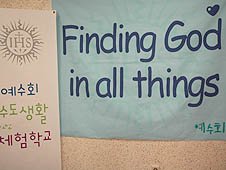
Logo of the Jesuit-run program for high school students

Jesuit Father Choe song-yong said the Korean Province of the Society of Jesus has previously run many programs for university students but none for those in high schools.

The Aug. 6-8 program aims to help students reflect on their daily life and relationships through a five-point spiritual technique called the Examen of Conscience.

This entails a prayerful reflection on the events of the day in order to detect God’s presence in one’s every day experience. The Examen of Conscience is the heart of the spirituality developed by Saint Ignatius of Loyola, founding father of the Society of Jesus.

“Due to the pressure of university entrance examinations, high school years are the hardest for young Koreans,” Father Choe said.

“We hope they can refresh themselves with this program,” he added. “Our program aims to illustrate the Jesuit spirit and help students learn from it.”

The Jesuit program also includes recreational activities as well as prayers and reflections on students’ relations with God and others.

Jesuits are expected to take about 15 minutes practicing the Examen at noon and after finishing work each day, Father Choe said.

This allows them to look at themselves, others and the world “with new eyes” and “cultivate a sense of solidarity.”

Father Choe said 70 students applied for the program but only 50 could be accepted.

Others will be invited to another session in September.

In recent years, several Catholic congregations have developed programs to help young people experience Religious life. These are modeled after various Buddhist “temple stay” programs conducted in Korea.

The Riches of the Rosary

Bookmark and Share


On August 15, we celebrate the  Assumption of Mary, body and soul, into heaven. We celebrate this mystery of our faith not only on this Holy Day of Obligation, but also each time we pray the Glorious Mysteries of the Rosary. This special feast day provides an ideal opportunity to reexamine the Marian devotion of praying the Rosary:

Rosaries have worked their way into my purse, my gym bag, my luggage, my computer case, my desk at work. They hang off my bedpost, sit in a tangle on my dresser, and have settled into countless drawers-just as they have settled into the very creases and crevices of my soul’s skin. My little anchors. And of course, they’re not just mine. As I was walking down the street a few days ago, a big, burly guy drove by in a big, burly vehicle with a rosary hanging from the rearview mirror. I smiled and thought to myself, Dude, I know exactly how you feel.

What is the appeal?

The rosary has been called “the epitome of the Gospel,” . . . used throughout the history of the church as a means of teaching the life of Jesus to audiences who either lacked access to books or could not read. The rosary was also a method of drawing believers into communal prayer and greater fellowship. . . . I have grown to love my rosaries and feel the need to have them close by, if not on my person. They remind me of my momma in heaven, that magnificent woman in the sky, always interceding for me, loving me home to heaven. The beads sound good jangling in my pocket or thumping gently against my chest when I go running. I don’t have to be praying a rosary-just as I don’t have to be at Mass or adoration-to feel the presence, strength, comfort, power, life, virtue, and mystery of all that these beads embody.


May Crowning, Mass, and Merton Excerpted from May Crowning, Mass, and Merton by Liz Kelly.

Jesuits celebrate jubilees

Bookmark and Share


Twenty members of the Jesuits’ Oregon Province will celebrate jubilees

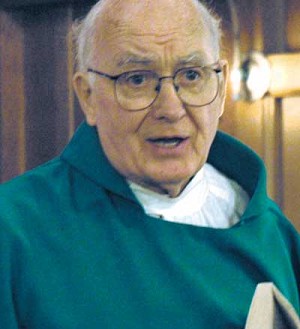
Fr. Jack Morris, SJ

as ordained priests or as Jesuits at a Mass, Saturday, Aug. 14, at Gonzaga University in Spokane.

Those marking 60 years as Jesuits include Father Jack Morris, a former Jesuit Volunteer Corps director, African missionary and western Oregon parish priest. He is now doing some writing from his residence at the Jesuit community in Southeast Portland.

With 25 years as a Jesuit is Father J.K. Adams, English teacher at Jesuit High School in Portland and superior of its Jesuit community.

Every year Oregon Province Jesuits gather in summer for ordinations to the priesthood, to honor jubilarians and celebrate first vows, and for discussion and fellowship.

There are 230 Jesuits living in the Oregon Province which is comprised of Alaska, Washington, Oregon, Idaho and Montana.


Taiwan biking pilgrims practice ‘magis’ spirit

Bookmark and Share


By Francis Kuo, Taipei

A group of three young men, led by a Filipino Jesuit priest, has completed a bicycle pilgrimage around the island of Taiwan.


Taiwan biking pilgrims practice ‘magis' spirit thumbnail
Father Jerome Emmanuel Guevara (far right) with his group of island-touring pilgrims

Father Jerome Emmanuel Guevara and his team began their 10-day tour from Taipei’s Church-run Tien Educational Center on July 19. They returned on July 29, in good time to celebrate the feast of Saint Ignatius of Loyola, founding father of the Society of Jesus.

“We intended to return by the feast day on July 31, so that I could truly report that I have put the Jesuits’ magis spirit into practice,” the priest said jokingly.

In Catholicism, magis, which can be translated from the Latin as “more,” refers to Saint Ignatius’ exhortation to constantly seek ways to do more for God.

The two-wheeled pilgrims had to endure exceptional heat and storms as they traveled through eastern Taiwan before turning north to Taipei. “It was exhausting, but we relied on prayers to sustain us through the tour,” said Father Guevara “and we dedicated our daily Masses to youth vocation and evangelization work.”

The group also offered prayers for women who have lost unborn children through abortion or miscarriage, when they visited the Franz Home in Chiayi city. The Catholic-run home takes care of babies left by mothers who have chosen not to have abortions.

One of the cyclists recalled that the sky suddenly turned dark with thunder as they neared the Immaculate Conception Minor Basilica, Taiwan’s oldest Catholic church, in Kaohsiung diocese.

“The storm began just as the church came into sight and we were so moved, we made the sign of the cross to thank God for his protection,” said 29-year-old Qubit Chiu, who was baptized this year.

The Paschal Mystery in Everyday Life

Bookmark and Share


The liturgy of the Church, the celebration of the sacraments, and the seasons of Lent and Easter are particular times when we pay attention to what Jesus Christ has done for us through his passion, death, Resurrection, and Ascension. Yet these are not the only times when we experience the Paschal Mystery. It is a part of our everyday life; it is the undercurrent of all that we do and all that we are.


The Paschal Mystery in Everyday Life

What does this mean? How do I experience the Paschal Mystery? How does it affect me on a day-to-day basis? How do I become aware of its presence in my life in a real way and not just something I know about?

First, let’s look at the Paschal Mystery in general terms, without any religious lingo. The Paschal Mystery is basically the process of dying and rising, death and new life. We see this all around us and in our own lives.

For example, we experience the process of dying and rising each year as we go through the different seasons. Summer is a time of vibrancy and life, which then gives way to fall, when leaves on the trees die and fall away and many plants seem to die. Winter comes and with it the frost and chill that seem to halt all growth and life. But after winter, when it seemed as if everything had died away, spring arrives. New life surrounds us. Daffodils and crocuses begin to push through the once-frozen ground. The bare branches of trees begin to show signs of new leaves.

Another example within nature is a process that many park rangers use-a controlled burn. Certain areas are purposefully set on fire in order to improve the habitat for plants and wildlife. It’s hard to believe that from the charred tree trunks and withered, blackened brush can come a healthy ecosystem with stronger trees and plants. But that’s exactly what happens.

We are a part of nature too. Not only do we experience the seasons and see the process of dying and rising, we also have our own dyings and risings. Sometimes these are obvious-for example, a grandparent dies or a baby is born. But other dyings and risings are less obvious. An experience of dying might be when you have an argument with a friend that leaves you feeling upset, or you see a homeless mother and child and don’t know what to do to help. An experience of rising might be reconciling with someone you hurt or who hurt you, talking with your family about the homeless mother and child and discovering that an organization like the St. Vincent de Paul Society has the people and the resources to care for people who are homeless. These are some of the dyings and risings that we experience every day.

Now when we look at the Paschal Mystery in the context of our religious beliefs and the life of Jesus Christ, we come to a deeper meaning of dying and rising. Jesus Christ’s passion, death, Resurrection, and Ascension are the ultimate event of dying and rising, of death and new life. We learn from Jesus that new life can come from death, that we can find meaning in tough times, that there really is light in the darkness. We learn that all life has this rhythm of dying and rising and that God is with us in good times and in bad. Jesus’ experience of suffering, death, and new life has forever changed us and given us a different way of living. Death no longer has the last word. Plus, when we encounter tough times, we have the comfort of knowing that God has “been there, done that” and the power of hope that new life will come from death. Becoming conscious of our own dyings and risings helps us have a greater sense of compassion for others and a greater willingness to reach out.

Think about your own life. What is a dying or rising that you have experienced today, this week, this year? Reflect on that experience in light of the event of Jesus Christ’s passion, death, Resurrection, and Ascension.

Saints Stories for Kids : Saint Dominic

Bookmark and Share


Saints Kit

Truth was Dominic’s motto and his goal. Dominic was born in Spain, the youngest of four children. He was educated by his uncle, a priest. Dominic became a priest and joined a religious community. Soon he became the prior, or head.

Dominic might have lived his whole life in that monastery if he had not gone with his bishop to northern Europe in 1204. As they traveled, Dominic saw that many people were following heretics, or false teachers. One heresy was Albigensianism, named for the French town of Albi where it had begun. These who followed this heresy taught that people do not have a free will. They taught that marriage was bad, but suicide and the killing of elderly or fatally ill people could be good. Because these heretics lived strict lives with little comfort, people believed them.

Dominic saw that the Catholics sent by the pope to preach against the heresies lived in comfort. The people would not accept their teaching because their lives did not support what they taught. Dominic, his bishop, and three Cistercian monks went from city to city preaching the truth of Christ, using the Bible. They went on foot, depending on others for food and a place to sleep. Soon people returned to the faith-not only because of what these preachers said, but because of how they lived.

In 1206 Dominic began an order of religious women. At one point the bishop died, and the three monks left Dominic. To make matters worse, war broke out between the heretics and some Church members. Dominic’s mission seemed to be failing. At this time he was greatly supported by the prayers and encouragement of the Sisters.

By 1215 a few men had joined Dominic in his work of preaching. He founded the Order of Preachers, better known as the Dominicans. Dominic urged his members to study and to pray. Then they would be ready to preach. Dominic realized that to be true witnesses of the Gospel, Dominicans could not be wealthy. His followers also deeply loved the Blessed Virgin Mary and spread devotion to her through the rosary.

Dominic’s community was different from most because his friars traveled and preached instead of staying in their monastery. Dominic’s order tried to reach the well-educated who were deceived by heresy, while the Franciscans went to the poor and uneducated.

While St. Dominic was on a preaching mission through northern Italy, he died, only six years after he had founded his community.

Dominic was able to draw the members of this community together and inspire them to love and forgive one another. He was outstanding for his love of truth, his clear thought, his organizing ability, and his sensitive, loving nature. For Dominic, love for people was part of his love for God.


  from Saints Kit © 1994 Loyola Press


Something Out of Nothing

Bookmark and Share


A look at the sitcom post-Seinfeld

Jake Martin

It began innocently enough in the summer of 1989, with a group of friends sitting in a New York diner, cracking wise about their lives and loves, a laugh track underscoring every quip. “Seinfeld” seemed no different from any of the situation comedies that had come before it. Yet, for better and most definitely for worse, the sitcom genre has never been the same.

Twenty years later, “Seinfeld’s” legacy as the first postmodern situation comedy still influences every television writer. NBC’s “Community” and FX’s “It’s Always Sunny in Philadelphia” are but two examples of the complicated situation that is situation comedy in the post-Seinfeld era.


Something Out of Nothing

Both “Community” and “It’s Always Sunny” send up the “pack of ragtag misfits” narrative that’s been around at least since the time Moses told the Hebrews about the land of milk and honey. But while “It’s Always Sunny” fails because it goes against the narrative tradition from which it came, “Community” succeeds because it reinforces the lesson inherent in its genre, that grace can be found through fellowship and shared experience.

The sitcom has always faced the demands of being a quintessential populist art form. Like its television sibling, the soap opera, the sitcom traces its roots back to the days of radio. “Fibber McGee and Molly” were the public’s favorite sitcom couple long before Ross and Rachel of “Friends” or Jim and Pam of “The Office.” Unlike the soap opera, however, which is dying a quick and ignoble death, and whose traces are found only within legal and crime-scene series, the sitcom remains as healthy as ever.

But it is no longer enough for a sitcom to tell a story with a few jokes; now both narrative and punch lines must be deconstructed, critiqued and referenced back to all previous TV shows in the span of 22 minutes. The result is usually a cool, clever product, but it is missing a heart.

Within the sitcom there has always been a tension between the subversive and the sentimental. One can never stray too far in either direction without missing the mark, the resultant extremes being either the cruel hardheartedness of a “Family Guy” or the insipid inanity of a “Full House.”

A new show that brilliantly negotiates the two polarities is ABC’s “Modern Family,” which takes on not only the sitcom genre, but the family melodrama. The show, which looks at the life of one extended family in Southern California, works because it upends our expectations about comedic structure and archetypes. For instance, the much younger, trophy stepmother with the low-cut blouse is characterized neither as villain nor as brainless bimbo but as the grounded voice of reason. (In one episode she intentionally loses at chess to her much older husband, in spite of her superior skills, in order to keep the peace.) “Family” also mocks the pathos of conventional family dramas like “Brothers and Sisters” yet never flinches in the face of authentic moments of loving concern. Both its writers and actors can move smoothly from ironic snarkiness to honest conversation in the blink of an eye. It is this kind of artistry that sets apart the best sitcoms.

“Community” is a show equal in caliber to “Modern Family.” Completing its debut season on NBC, it gives a weekly glimpse into the lives of a handful of students at the fictional Greendale Community College. Joel McHale, late of E!’s flagship snarkfest “The Soup,” leads the ensemble as Jeff Winger, an attorney of dubious repute who must return to school because his degree was invalidated. Jeff winds up in a study group with, you guessed it, a ragtag pack of misfits, who include: the well-meaning but humorless Britta, played with finesse and skill by Gillian Jacobs, the socially deficient film student Abed (Danny Pudi), the single African-American mother Shirley (Yvette Nicole Brown), the former high school football star Troy (Donald Glover), the nerdy Annie (Alison Brie) and a remarkably toned-down Chevy Chase as Pierce, an oft-married, always obnoxious, moist-towelette tycoon.

While McHale is the leader of this multi-ring circus, he puts the brakes on his sardonic “Soup” persona to allow space for the other actors. Never does the viewer sense that any of the performers are pushing for a breakout performance. Rather, one is watching an ensemble at the peak of its powers, working together for the good of the show; as opposed to the primetime monstrosity of a handful of actors elbowing one another out of the way. Or maybe the show is just very well written.

The first-rate writing never compromises the inherent dignity of its characters for the sake of low humor. Too often in sitcoms, character development and complexity are sacrificed for a cheap laugh, destroying the credibility of character and to a lesser extent the show itself. Here each of the primary characters is handled intelligently by writers who appeal to the audience’s sense of identification and affection-not, as is often the case, to their sense of superiority and revulsion.

In this regard “Community” follows in the fresh footsteps of CBS’s “How I Met Your Mother,” another show that emphasizes the importance of interdependence among colleagues and friends outside the structure of the traditional family unit. A throwback stylistically (it’s shot primarily on a soundstage, using a laugh track), “How I Met Your Mother” seems like a relic when compared with more sophisticated shows like “Community” and “Family.” But like them, “How I Met Your Mother” is irreverent without being alienating. It reflects the caustic sensibility of contemporary culture, while demonstrating the necessity and joy each of its characters finds in being a member of a makeshift support network.

All these series tell of broken, lonely people hoping for something better. But instead of exploiting the characters’ weakness for the sake of a mean-spirited laugh, the shows celebrate the hope they find in relationships with each other and the grace they find in unlikely places. A recent episode of “Community” focused on a falling out between the culturally insensitive Pierce and the African-American Shirley. Instead of making a series of cringe-inducing racial jokes, the episode emphasized the solidarity of the two characters as they discover their commonalities as the senior members of the group. Most shows would not attempt such depth in character relationships and instead would yield to the infantile desire for a laugh.

Which brings me to “It’s Always Sunny in Philadelphia.” While not nearly as ambitious intellectually as “Community,” “Sunny” cannot live up even to its own mediocre aspirations. It proves a cautionary tale for those who equate a lack of content restrictions on cable television with artistic freedom. In “Sunny” all that freedom allows for is undisciplined, mean-spirited humor infused with foul language.

Like “Community,” “Sunny” deconstructs the traditional “ragtag pack of misfits” convention. But whereas “Community” plays within the spirit of the tradition and never loses affection for its source, “Sunny” mocks it with neither the humor nor the sophistication to support this endeavor. The show focuses on a group of childhood chums working at a down-at-the-heels tavern in South Philadelphia. “The Gang,” as they call themselves, consists of: Mac (Rob McElhenney), Dennis (Glenn Howerton) and Charlie (Charlie Day), along with Dennis’s sister, Dee (Kaitlyn Olson), and Danny DeVito in the now seemingly requisite comedic stunt casting as Dennis and Dee’s morally bankrupt father. “The Gang” spend their days insulting one another and setting new standards for moral repulsiveness. These people do not seem to like one another; I cannot say I blame them.

The show would be helped by good writing and character delineation. As it is, each of the actors seems to be mouthing the words of a single stand-up comic. The show was conceived by its three lead actors, whose names are all over the credits. This might be part of the problem: the show feels like one big inside joke to which the audience is not privy.

The show’s graphic content and profanity will shock the first-time viewer. But after the shock wears off, the audience is left feeling as if it has watched the antics of a school bully, complete with the accompanying feelings of powerlessness and shame.

“Sunny” fails because of its contempt for its comedic ancestry. “Community” succeeds because of its affection for it. It is easier to present one-dimensional characters that repulse an audience within the parameters of a metanarrative than it is to create a group of lovable and loving, fully realized persons within that same structure. While “It’s Always Sunny in Philadelphia” is emblematic of all that is wrong with sitcoms in a post-Seinfeld era, hope and health for the genre spring forth in the beauty of communion like that found in “Community.”

Jake Martin, S.J., is a Jesuit scholastic who teaches theology and theater at Loyola Academy in Wilmette, Ill.

Raising Our Hearts and Minds to God

Bookmark and Share


Forms of Prayer

Prayer is the raising of our hearts and minds to God. We are 

able to speak to and listen to God because he teaches us to pray. The Catechism tells us that the Holy Spirit reminds the Church of all that Jesus said, and it teaches us about the life of prayer. In doing so, it inspires new expressions of the same basic forms of prayer: blessing, petition, intercession, thanksgiving, and praise.

Blessing

A blessing is a prayer that invokes God’s power and asks for his care for a person, place, thing, or special activity. The Bible is filled with examples of blessings-blessings on offerings to God, on individuals, on groups of people, and on ordinary actions throughout the day. Blessings help make us aware of God’s presence at every moment and in all things. They help us see the goodness available all around us and to remain close to God from whom all blessings flow. They express our own desires for God’s closeness and protection as well as God’s strength and healing.

Blessings call upon God’s love for creation. They are reminders of the goodness and holiness of what God created. We use words, symbols, and gestures to express what’s deep in our hearts.

Any person or object can be blessed. We bless our children, families, sick people, objects of prayer and worship, special occasions, people, relationships, food, buildings, work, animals, and many other situations and things. A common daily blessing is the grace before meals, in which we ask God’s blessing on our gathering, our eating, and our going forth, nourished, to do God’s will. Because we are blessed, we too can bless God and one another in thanks for God’s generous gifts to us and to the world.
Petition 

Prayers of petition acknowledge our dependence on God, who is our beginning and our end. This form of prayer springs from our heart’s desire to serve God’s kingdom here and to seek the realization of the kingdom to come.

The Catechism of the Catholic Church reminds us that asking forgiveness, coupled with trusting humility, should be the first movement of a prayer of petition. Jesus tells us to bring our every need to God in his name and assures us that “whatever you ask the Father in my name he will give you.” (John 16:23) What we must remember, however, is that in addition to the asking, there should be an acknowledging of our sinfulness and need for God.

A prayer of petition is a request to God that asks him to fulfill a need. When we share in God’s saving love, we understand that through petition we can ask for God’s help with every need no matter how great or small.
Intercession

Intercession is a prayer of petition in which we ask for something on behalf of someone else. Since Abraham’s time intercession has been characteristic of a heart attuned to God’s mercy. Following the example of Jesus, who on the night before he died prayed for us, we offer prayers of intercession for the Church, leaders in government and society, special needs, sick people, and those who have died.

Thanksgiving 

Every joy and suffering, and every event and need can become an offering of thanksgiving. The letters of St. Paul often begin and end with thanksgiving, and the Lord Jesus is always present in it: “In all circumstances give thanks, for this is the will of God for you in Christ Jesus.” (1 Thessalonians 5:18)
(from the Catechism of the Catholic Church 2638)

Praise

A prayer of praise is an expression of our response to God, not only for what he does but simply because he is. In the Eucharist the whole Church joins with Jesus Christ in expressing praise and thanksgiving to the Father.

Podcast : In Search of the Living Jesus

Bookmark and Share


Podcast : Catholic Workers

Biblical scholar Luke Timothy Johnson argues that historical scholarship alone cannot find the living Jesus. Though the study of history can help Christians to becomes responsible readers of the Gospels, engaging Jesus as a literary figure is ultimately a more fruitful exercise for the person of faith. Prof. Johnson also discusses why 14 years after the publication of The Real Jesus, his critique of historical Jesus scholarship, the popularity of John Dominic Crossan, Marcus Borg and other such scholars endures. Read “The Jesus Controversy” from the August 2-9 issue.


Download MP3

Indian radio station seeks larger community

Bookmark and Share


By Francis Rodrigues, Mangalore

Indian radio station seeks larger community thumbnail
Sangar Radio’s studio in Mangalore

A Jesuit-run radio station in southern India is looking to broaden its appeal by launching a host of new community-oriented programs.

Sarang Radio, a community station run by the Jesuits of St. Aloysius Autonomous College of Mangalore, says the introduction of the new services will also help mark its first anniversary on Sept. 23, 2010.

“We plan to start more community-oriented programs in regional languages like Kannada, Tulu and Konkani along with Hindi and English,” said Jesuit Father Richard Rego, who is in charge of the radio station and heads the Journalism Department at the college.

There are also plans to launch several weekly phone-in programs, such as Kannoonu Kacheri, on legal issues, Arogya Sparsha, a live program on health concerns, and a special program for children, he said.

The station will also invite leaders, writers, social workers, farmers and local artists for interviews, narration and feature presentations, he said.

Sarang Radio initially used to broadcast about four to six hours a day, but now it is on air for 14 hours, Father Rego said.

Disc jockey Antony D’Souza says Sarang Radio is determined to spread its message to a wider audience.

“Even though community radio is by the people, for the people, and for no profit, the public still prefer to listen to the big FM stations,” he said.

“Since people have not begun to come to us, we intend to go to them,” he said.