Category: Uncategorized

10 Gifts that Enrich the Sacrament of Confirmation

Bookmark and Share


In the Sacrament of Confirmation, the gifts of the Holy Spirit received in Baptism are sealed and strengthened. However, it is easy to let giving and receiving Confirmation gifts overshadow these greater gifts received through the sacrament. This year, choose a gift that reaffirms and enriches the real message and meaning of the sacrament of Confirmation…

Recognizing the Holy Spirit in Our Lives
Encourage those newly confirmed to continue to grow in their relationship with the Holy Spirit.


1. Gracious Goodness Gracious Goodness: Living Each Day in the Gifts of the Spirit
2. Acts: The Good News of the Holy Spirit: Six Weeks with the Bible for Catholic Teens: Exploring God's Word Six Weeks with the Bible for Teens: The Good News of the Holy Spirit


Knowing and Sharing the Catholic Faith
Confirmed Catholics are called to participate in the mission of the Church, an important part of which is understanding and sharing the faith. 


3. A Well-Built Faith: A Catholic's Guide to Knowing and Sharing What We Believe A Well-Built Faith: A Catholic’s Guide to Knowing and Sharing What We Believe
4. May Crowning, Mass, and Merton: 50 Reasons I Love Being Catholic May Crowning, Mass, and Merton: 50 Reasons I Love Being Catholic


Looking to the Saints for Guidance
Candidates are asked to choose a Confirmation name, often the name of a saint whom they can look to as an example of what it means to be a person of faith. Choose a Confirmation gift that explores their lives so they can continually look to the saints for guidance: 


5.

The Loyola Treasury of Saints: From the Time of Jesus to the Present Day

Loyola Treasury of Saints
6.

Saints of the Americas: Conversations with 30 Saints from 15 Countries

Saints of the Americas


Nurturing an Active Prayer Life
Prayer is an essential aspect of nurturing one’s faith life. Help those recently confirmed grow in their friendship with God through prayer: 


7. In All Things: Everyday Prayers of Jesuit High School Students In All Things: Everyday Prayers of Jesuit High School Students
8. 189 Ways to Contact God: Find the prayer starters that work for you! 189 Ways to Contact God


Continuing Christian Service
Emphasize the importance of community service even after confirmation by introducing candidates to the words and work of exemplary Christians: 


9. John Paul II: Lessons for Living John Paul II: Lessons for Living
10. Radical Compassion: Finding Christ in the Heart of the Poor Radical Compassion: Finding Christ in the Heart of the Poor

Publishers Weekly reviews “The Power of Pause”

Bookmark and Share


The Power of PauseRetreat leader and speaker [Terry] Hershey offers his growing fan base of faithful Christ followers a smart, sensible and so practical primer on the power of pausing. Hershey (Soul Gardening) presents 52 nifty ways to hit the pause button no matter what the season of life. In an eight-part text in which sections are defined by the four seasons, each with an early and late aspect-readers will find themselves removed from the tyranny of the urgent and moved to a peaceful, reflective and deliberatively inactive place of reflection. Hershey, funny and honest about his own foibles, will have thoughtful readers resonating with his human struggles while gratefully accepting his kindly offered yet stern cautions on the dangers of the busy life. Well-written and issuing continual invitations to pay attention, live in a centered way and say yes to the moment, Hershey shows people how to pause and makes them want to do so. (Sept.)

This review is from the August 16, 2009 issue of Publishers Weekly.

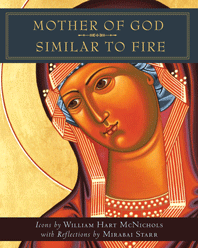
Mother of God, Similar to Fire

Bookmark and Share


by WILLIAM HART MCNICHOLS AND MIRABAI STARR
ORBIS BOOKS. 128 P $25


Jesus Our Brother: The Humanity of the Lord

by WILLIAM HART MCNICHOLS AND MIRABAI STARR
ORBIS BOOKS. 128 P $25

Father William Hart McNichols, hailed by Time magazine as “among the most famous creators of Christian iconic images in the world,” is joined here by writer, translator and retreat director Mirabai Starr in offering a powerful and inspiring blend of images reflecting the feminine face of the divine.

McNichols’ 50 images of Mary, each accompanied by meditative prayers, include a variety of depictions-from Greek and Italian, to Latina, Black and Native. He explains in the book’s Preface that he invited his friend Mirabai Starr “to come to these images as a person without familiarity, as a kind of ‘every woman’ meeting them for the first time.” Imbued with a poet’s sensibility, Starr writes of Mary in the book’s Introduction: “Mary melts the boundaries of religion and manifests in a thousand forms,” sometimes exuding mercy and compassion, other times burning “with the ferocity of protection and transformation.” The reader meets in these pages, and meditates upon, Our Lady of the Snows, Star of the Sea, Our Lady of Kazan, Black Madonna, Consoler of Women, Seeker After the Lost and Mother of God Given Eagle Wings, among others.

Mother of God, Similar to Fire is an exquisite book, rich in imagery and food for contemplation. Father McNichols sums it up best: “You gaze on the icon, but it gazes on you too…. We need to gaze on truly conversational, truly loving images, images that will return our love.”

Purchase Mother of God, Similar to Fire from amazon.com.

Teaching or Commanding?

Bookmark and Share


When bishops instruct the faithful

by Nicholas Lash

When the Second Vatican Council ended, several of the bishops who took part told me that the most important lesson they had learned through the conciliar process had been a renewed recognition that the church exists to be, for all its members, a lifelong school of holiness and wisdom, a lifelong school of friendship (a better rendering of caritas than “charity” would be).

Teaching or Commanding?

It follows that the most fundamental truth about the structure of Christian teaching cannot lie in distinctions between teachers and pupils-although such distinctions are not unimportant-but in the recognition that all Christians are called to lifelong learning in the Spirit, and all of us are called to embody, communicate and protect what we have learned. Much of what is said about the office of “teachership” or magisterium seems dangerously forgetful of this fact.

Aspects of Instruction

The concept of instruction is ambiguous. If I am “instructing” someone, I may be teaching or I may be issuing a command. Someone who is “under instruction” is being educated, but “I instructed him to stop” reports a command. “Instructions for use,” however, provide information and hence would seem to be educational. There may be cases in which it is not easy to decide the sense. It is, however, important not to confuse the two senses and even more important not to subordinate instruction as education to instruction as command.

I have long maintained that the heart of the crisis of contemporary Catholicism lies in just such subordination of education to governance, the effect of which has too often been to substitute for teaching proclamation construed as command. As Yves Congar said, it is impossible to make the function of teaching an integral element of jurisdiction because it is one thing to accept a teaching, quite another to obey an order: “Autre chose est agréer une doctrine, autre chose obéir à un ordre.”

Dissent and Disagreement

I have said that Catholic Christianity is a lifelong school of friendship, holiness and wisdom. Yet the tasks of those exercising the pastoral teaching office seem not, in fact, primarily to be teaching, at least as this activity is understood in most schools.

In 1975 a plenary session of the International Theological Commission issued a series of theses on the relationship between the magisterium and theology. In 1966 Paul VI had addressed an international congress on “The Theology of Vatican II” on the same topic, and the commission introduced its theses with two brief quotations from that address. The commission defined ecclesiastical magisterium as “the office of teaching which, by Christ’s institution, is proper to the college of bishops or to individual bishops joined in hierarchical communion with the Supreme Pontiff.”

What terminology might be appropriate to describe what someone is doing when, for whatever reason, he or she seeks to take issue with some particular instance of magisterial teaching? “Disagreeing” is the term that comes to mind. But because teaching is, in current ecclesiastical usage, usually construed as governance, as command, such taking issue is described in the recent literature not as disagreement but as “dissent.”

Francis A. Sullivan, S.J., reminded readers of his 1983 book Magisterium that Pius XII, in “Humani Generis,” announced that “when a pope, in an encyclical, expresses his judgment on an issue that was previously controverted, this can no longer be seen as a question for free discussion by theologians”; Father Sullivan goes on to point out, however, that “there is no such statement in any of the documents that were approved by the Council.” The silence of the Second Vatican Council notwithstanding, John Paul II, addressing the American bishops in Los Angeles in 1987, said without qualification: “It is sometimes said that dissent from the magisterium is totally compatible with being a ‘good Catholic’ and poses no obstacle to the reception of the sacraments. This is a grave error that challenges the teaching office of the bishops in the United States and elsewhere.”

If Father Sullivan’s study seemed content to work with the terminology of “dissent,” Ladislas Orsy, S.J., is more troubled by the notion. “Dissent has become,” says Father Orsy, “one of the dominant themes in Catholic theology in the United States,” but “is mentioned less in European writings.” Dissent, he says, “is an imperfect term under several aspects”: It is purely negative; it implies “deep-lying internal antagonism”; it is historically loaded; and so on. “It follows that if we abandoned the word ‘dissent’ altogether, we would lose little and gain much.” I agree. Yet, “All these arguments notwithstanding,” Father Orsy concludes, “it appears that for the time being at least” we must “live with an unsuitable word.” For goodness’ sake, why?

Here is a very simple model: The teacher looks for understanding, the commander for obedience. Where teaching in most ordinary senses of the term is concerned, if a pupil’s response to a piece of teaching is yes, the student is saying something like “I see” or “I understand.” If the response is no, the pupil is saying “I don’t see” or “I don’t understand.” When subordinates say yes to a command, they obey; when they say no, they disobey. Dissent is disobedience. The entire discussion about the circumstances in which it may be permissible or appropriate to dissent from magisterial utterances makes clear that what is at issue is when and in what circumstances it may be virtuous, and not sinful, to disobey. There could, in my opinion, be no clearer evidence that what we call “official teaching” in the church is, for the most part, not teaching but governance.

I am not in the least denying that governance, the issuing of instructions and commands, has its place in the life of the church, as of any other society. That is not what is at issue. The point at issue is that commands direct; they do not educate. It is one thing to accept a doctrine, quite another to obey an order.

Manuals and Rule Books

Commenting on Pope John Paul II’s encyclical “The Splendor of Truth” (1993), Herbert McCabe, O.P., contrasted manuals and rule books. A manual helps one to acquire some skill: as a football player or a piano-tuner or, if we extend the range of skills to those habits we call the virtues, as a just or generous person. A manual is an instrument of education. In addition to manuals there are rule books, which tell you what, in some particular context, you are and are not allowed to do. Father McCabe writes: “The rule book does not tell you anything about acquiring skills in football; it simply tells you the rules and the kinds of action that would break them.” The rule book is an instrument of governance. What worried Father McCabe about “The Splendor of Truth” was that it is, he said, “in great part, an attack on those who want to read the rule book as a manual by those who want to read the manual as though it were a rule book.”

Nowhere in “The Splendor of Truth” does John Paul II discuss disagreement in the church or the duty of episcopal authority to monitor and guide it. Indeed, near the end of the encyclical, in a passage denouncing “dissent” and “opposition to the teaching of the Church’s pastors,” the pope comes close to claiming that there is simply no place for disagreement on moral questions in the church: “While exchanges and conflicts of opinion may constitute normal expressions of public life in a representative democracy, moral teaching certainly cannot depend simply upon respect for such a process.” It “cannot depend simply” upon “exchanges and conflicts of opinion”-fair enough. But might Catholics not have expected him to say something about the part such “exchanges” should play?

‘Teachership’

“It is for ecclesiology,” said Robert Murray, S.J., an English Jesuit, “that [the term] magisterium till about the mid-nineteenth century referred to the activity of authorized teaching in the Church. The use with a capital ‘M’ to denote episcopal and especially papal authority was developed mainly in the anti-Modernist documents.”

The 19th-century shift from the name of a function, that of teaching, to the name of a group of officers or “functionaries” was for two reasons most unfortunate. First, it was unfortunate because it created the impression that in the church only bishops bear responsibility for witnessing to the Gospel. (We should never forget that most bishops were first catechized by their mothers.) Second, it was unfortunate because bishops seldom do much teaching in the ordinary sense, being preoccupied with the cares of middle management. As a result, the contraction of the range of reference of magisterium to the episcopate alone served only to deepen the subordination of education to governance that I have deplored.

There are, of course, exceptions to the claim that most bishops seldom do much teaching in the ordinary sense. Cardinal Carlo Maria Martini, when he was archbishop of Milan, could fill his cathedral with people who came to hear him interpret the Scriptures. And an encyclical like Pope Benedict XVI’s “Caritas in Veritate” (2009) is surely a quite straightforward exercise in teaching.

I have referred to the contraction of the range of “official teachers” to the episcopate. In fact, during the 20th century the magisterium contracted even further. John Paul II’s encyclical “Veritatis Splendor” is addressed “to all the bishops of the Catholic Church.” Near the end of it, the pope says: “This is the first time, in fact, that the Magisterium of the Church has set forth in detail the fundamental elements of this teaching,” thereby contracting the range of reference still further-to himself.

According to the church historian Eamon Duffy, John Paul II, like Pius XII before him, “saw the pope as first and foremost a teacher, an oracle.” However accurate the image of particular popes as “oracles” may be as a description, it remains the case that any pope who behaves within the church as an oracle misunderstands his office. The image of the oracle is of one who brings fresh messages from God. This no pope can do, for the church he serves as its chief bishop has already heard the Word and lives by that faith, which is its God-given response. It is the duty of those who hold teaching office in the church to articulate, to express, to clarify the faith by which we live.

Reception

Hence the importance of the doctrine of “reception.” In one of St. Augustine’s sermons (No. 272) he says: “When I hold up the host before communion, I say ‘Corpus Christi,’ and you reply ‘Amen,’ which means: ‘Yes, we are.'” The response of the faithful to sound teaching in the church is to say, “Yes, that’s it.” Where this response is lacking, the teaching is called into question.

Securus judicat orbis terrarum (“The judgment of the whole world is secure”). In the months leading up to the first Vatican Council, Cardinal John Henry Newman insisted that he “put the validity of the Council upon its reception by the orbis terrarum” (whole world). And when, after the council, he hesitated before accepting the definition of papal infallibility, Lord Acton remarked, “He was waiting for the echo.”

“Human community,” says Timothy Radcliffe, O.P., “is sustained by conversation.” That he regards this axiom as an ecclesiological and not merely an anthropological principle is clear from his later remark that “sharing our faith is always more than stating our convictions: it is finding our place in that conversation which has continued ever since Jesus began to talk with anyone whom he met in Galilee, and which is the life of the Church.” Disagreement is an unavoidable feature of serious conversation about the things that matter most. David Woodard, a brilliantly effective but somewhat eccentric parish priest with whom I had the privilege of working in the early 1960s, came back one day after visiting a neighboring parish and exclaimed: “Those people are completely lacking in Christian charity; they can’t even disagree with one another!”

In necessariis unitas, in dubiis libertas, in omnibus caritas (“Unity in essentials, liberty in open questions, in all things charity”). Pope John XXIII quoted this 16th-century motto in his first encyclical. It seems to me that where the relationships between governance and education and between the episcopate and teachers of theology are concerned, there are few more important tasks for the bishops to undertake than to act as moderators of disagreement, educators in Christian conversation.

From the archives, Nicholas Lash reports on contintent-wide meeting of European theologians.


Nicholas Lash was for 20 years the Norris-Hulse Professor of Divinity at Cambridge University. This article is adapted from his talk honoring the theological achievement of Michael Buckley, S.J., delivered at Boston College in 2009.

 

Jesuits Visit Kohima India

Bookmark and Share


by National Jesuit News

The Jesuits are probably best known for their work in education yet, the Society of Jesus is also the largest missionary order in the Roman Catholic Church. This vibrant apostolate dates back to St. Francis Xavier, the patron saint of foreign missions, and his work in South and East Asia.

The Wisconsin Province Jesuits recently renewed a bond with the Kohima region of northeast India. This area, known as the “seven sisters” (for seven states), spans a rugged triangular region of lower Himalayan terrain that borders Tibet, Myanmar, Bangladesh, and Bhutan. The Wisconsin twinning was created in a spirit of mutual sharing. It identifies particular areas of cooperation and a commitment to accompany indigenous people. Jesuit Father Tom Krettek, provincial of the Wisconsin province, and his international assistant John Sealey visited Kohima this year to help deepen this bond.

While there, Fr. Krettek and Sealey visited Jesuit schools, health clinics, the Jesuit novitiate in Kohima along with other Jesuit ministries in the area.


Distance-learning program provides hope

Bookmark and Share


By JRS Eastern Africa


Kenya: Distance-learning program provides hope

“I joined JRS as a student participant in basic counseling skills for two months, became a community counsellor, then I applied for this course [JCHEM] and am succeeding as a student. This is the only program like it here. I feel very happy to be here in this program, it is my interest now. Life is very difficult without studies, without school it is stressful in a refugee camp,” Bol said. (Sophie Vodvarka – Jesuit Refugee Service Eastern Africa)

(Kakuma, Kenya) – Every day Bol, a 26-year old paraplegic man, pedals his hand-powered tricycle an hour each way from his home through Kakuma refugee camp to attend the first introductory training sessions for the new Jesuit Commons Higher Education at the Margins (JC-HEM) distance-learning accredited university courses that are scheduled to begin in January.

Bol fled alone from his home in Sudan because of tribal conflicts and political difficulties nine years ago. He first stayed in Lobone, Southern Sudan, then settled in Kakuma refugee camp, located in the desert of the Turkana region of north-western Kenya. He was first introduced to Jesuit Refugee Service in Kakuma through the Mental Health Program.

“I joined JRS as a student participant in basic counseling skills for two months, became a community counsellor, then I applied for this course [JCHEM] and am succeeding as a student. This is the only program like it here. I feel very happy to be here in this program, it is my interest now. Life is very difficult without studies, without school it is stressful in a refugee camp. We think, after this, where will we be? If we go to Sudan we need an education to get a job,” Bol said.

The new distance-learning program will offer a two-year liberal arts certificate, with course subjects including leadership, business and Jesuit values.

“They are telling us there will be a leadership course – it is very important in my feeling. I want to be a leader somewhere so I can show despite being a disabled person I can do what ‘normal’ people [persons without any disability] say they can do. I want to be a lawyer, that is my first choice. To get access to education here in Africa is hard because of fees, if it wasn’t for JRS I couldn’t do anything, I’d just be sitting in my community not doing anything,” Bol said.

The referendum coming up on January 9, 2011, to help Southern Sudan decide on whether to become autonomous has been on the mind of Bol and other Sudanese who are afraid of more violence in their country and have heard rumors of forced return to Sudan.

“There is no chance for resettlement here [in Kenya]. If you are just waiting here you are killing your life. So this year I visited Sudan and I saw the situation, it is a difficult situation. That is why I feel better here. We disabled people are the first victims [in unstable countries]. In most communities disabled people are not respected. People think you’re not contributing to society. In the future I will be a productive person, to give services to other people and the community will use me,” Bol said.

JC-HEM is part of JRS’ latest initiative to bring higher education to refugees by promoting access to education. Each track of JC-HEM will include six months of study and application of learning in the camp. At the end of each year, students will receive certificates of completion from Regis University in Denver, and after three years of successful studies they will be awarded their diplomas.

A family celebration

Bookmark and Share


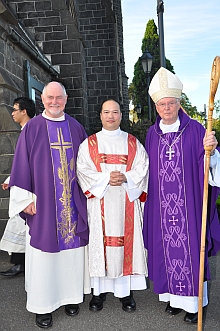
It was a big family celebration last Saturday, as Nguyen Hoang Trung SJ was ordained a deacon at St Ignatius Parish in Richmond, Melbourne.
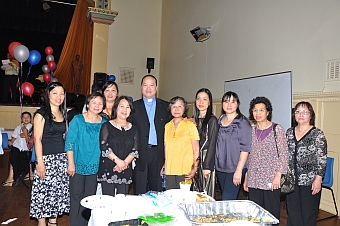
Trung said he was happy to have his mother and the rest of his family travel from Brisbane and Adelaide to be part of the celebration of his vocation.

‘It wasn’t just about me. The ordination was about my friends and family and all those people who are part of my life’, he said.

A number of family members were part of the celebrations. Trung’s nieces played violin and keyboard during the ceremony.

‘It was an awesome experience for me’, said Trung. ‘It’s also very affirming of my calling as well.’

It has been a journey of many homes so far for the Vietnamese-born Jesuit. He arrived in Adelaide as a refugee with his father and brother as a child, and was joined later by his mother and sisters. He lived in Adelaide for nine years, then moved to Brisbane for a time. As a Jesuit, he has spent time living in Sydney and Melbourne, as well as two years overseas in Beijing and Taiwan.

In his homily at the ordination, Bishop Greg O’Kelly SJ said the ordination was the beginning of a new journey for Trung. As a deacon he will be called by the Church to minister to the people.

‘In the vows you took as a Jesuit you offered yourself as a man to be vowed to serve God’s people as a member of the Society. Today it is somewhat different, in that the Church acts towards you, calls you to Holy Orders’, said Bishop O’Kelly.

Having completed his studies at Jesuit Theological College, Trung will be moving to St Ignatius Parish in Richmond for next year while he prepares for his comprehensive exams. His priestly ordination will be in July.

Trung says the journey will continue to take him to many places around the world.

‘I’ll be helping out in the parish after my ordination until the end of next year, then I’ll be off to China’, says Trung.

The First Noël

Bookmark and Share


A meditation on three dazzling mosaics

by James Martin,S.J.


The First Noël

W hen the chapel for Sacred Heart University in Connecticut was dedicated in 2009, much of the public attention was focused on the massive mosaic newly installed behind the main altar, which depicts Jesus Christ at the center of salvation history. Anthony Cernera, then president of the university, had retained the services of Marko Rupnik, S.J., an artist whose distinctive craftsmanship appears in the Vatican’s papal apartments and in the main basilica in Lourdes.

Overlooked at the time, however, was another, equally precious jewel: the Blessed Sacrament chapel. This intimate space, with just a few wooden benches, is now used for daily Masses and private meditation. What makes the space so astonishing is that its walls are covered from floor to ceiling with brilliantly colored mosaics of scenes from the Nativity story. It gives one the impression of having stepped into an icon. On these pages are reproductions of some of the mosaics with three brief meditations.

The Nativity

The mosaic of the Nativity of Our Lord, above, dominates the small chapel. Mary is robed in a deep red, a color that Eastern iconographers traditionally reserve for royalty. Here, at the beginning of her life with Jesus, she points viewers to her son, as she would do at the wedding feast of Cana, when she utters her last words quoted in the Gospels: “Do whatever he tells you.” Mary looks uncomfortable as she lies on the cold, hard stones. In places, the chunky tesserae that Rupnik used to fashion the scene are as large as an adult hand; they could be actual stones. But Mary’s ungainly posture presages her life, which, while filled with joy, would be painful at times. Joseph looks on pensively, as if exhausted from the journey to Bethlehem, and holds a flowering staff, the symbol of his chastity. The two seem to know that this respite is temporary. Their lives with Jesus, filled with joys and hopes, griefs and anxieties, have now begun.

The Wise Men


The First Noël

The Gospel of Matthew tells us that the “wise men” came from “the East” to worship the Messiah. Or as Christmas carolers sometimes sing, they came from “afar.” In Rupnik’s portrayal, though, the richly attired kings, sporting golden crowns to match their haloes, step on stones that are rather near. The artist incorporated into the mosaic pieces of a local Connecticut stone: shale. In the chapel, then, the connection between the exotic journey of the wise men and our own is made clear: our path to worship the Lord and to bring him our own good gifts can begin wherever we find ourselves.

Saints Joachim and Anne


The First Noël

This is perhaps the most unexpected part of the Blessed Sacrament chapel: a touching depiction of Joachim and Anne, the traditional names of Mary’s parents. (The names appear in the apocryphal Gospel of James.) It is one of the tenderest portraits of a married couple I have ever seen.

How rare it is in a Christian setting to see a couple portrayed in such a clear demonstration of physical affection. Even when Mary and Joseph are depicted as a couple, they are seldom shown touching each other, lest the art challenge the viewer’s image of the couple’s chastity.

But Joachim and Anne led a full, married life and had at least one child, Mary. In Rupnik’s mosaic, they rejoice in the birth of their new grandchild and embrace, their faces pressed together in utter joy.

When I saw this mosaic, I thought of the verse often used at weddings, something their grandson would later say, as recorded in the Gospel of Mark: “The two shall become one flesh.” Perhaps Jesus knew his grandparents well and reflected on their love.

Joachim and Anne are one in love and devotion.


James Martin, S.J., is culture editor of America.

Christmas Present

Bookmark and Share


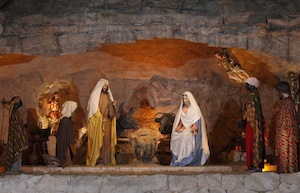
It seems to many that the true spirit of Christmas disappeared from American life some time ago. The traditional manger, with shepherds and angels adoring the infant Savior, is no longer seen in department store windows,

Christmas Present

and when one appears in a public space, it quickly becomes an occasion for litigation. Offering the traditional greeting “Merry Christmas” has become an affirmative act of Christian self-identification. In advertising and casual conversation it has been replaced by “Happy Holidays,” because, though the vast majority of Americans profess to be Christians, in this age of interfaith sensibilities Christmas shares billing with Hanukkah and Kwanzaa.

All the religious feasts of the season, however, are swallowed up in a consumerist frenzy of spending. Economists and broadcast journalists take the fiscal pulse of the nation by counting off the length of the shopping line at Best Buy on Black Friday. The biblical Christmas stories have been replaced by “How the Grinch Stole Christmas” and “Frosty the Snowman.” Even Frank Capra’s “It’s a Wonderful Life,” which attempted to redeem the spirit of generosity, in tune with the Gospel message, from the grasp of unregulated capitalism, has been replaced as a Christmas ritual by the nonstop broadcast of Jean Shepherd’s satirical film “A Christmas Story.” Culturally there is no doubt the Christian Christmas has been displaced, subverted and buried under a mountain of commercial trivialities and cultural kitsch.

It would be comforting, of course, if the wider culture re-enforced our faith and if pious Christian customs, like manger scenes and caroling, had broader appeal. The crass secularization of the season, however, could well spur us to reflection on a kind of spiritual asceticism that renounces unchallenging sentimentalism about Christmases past. For appropriating the Gospel spirit of identifying with the poor, as presented throughout Luke’s narrative, or with the persecuted and refugees, as in Matthew’s account of the flight into Egypt, is far more important for Christians than preserving reassuring public images of the Nativity.

Such attitudes are also more in keeping with the Evangelists’ intentions than the representation of their narratives. Neither Mark’s Gospel nor John’s contains an infancy narrative, and John’ s majestic prologue-“The Word was made flesh and dwelt among us”-focuses on the mystery of the Incarnation and our share in its blessings. If we feel deprived by the vapid secularity of “the holidays,” we would do well to consider instead how we who belong to the body of Christ can extend the grace of the Incarnation to our contemporary world.

Knowing that every person shares in the grace of the Incarnation, how should we celebrate? First, let us rejoice that God is with us, not just at Christmas but at all times, and that there is no corner of the world in which Christ is not present. The rest of the answer will be found in the morning headlines and evening television news from Afghanistan, Haiti and the Sudan. We will find it in a walk through the soup kitchens, homeless shelters and crime-ridden neighborhoods of our hometowns. There we will find, as Gerard Manley Hopkins, S.J., wrote, “Christ plays in ten thousand faces/ lovely in limb and lovely in eyes not his.” Our hearts will tell us what to do next. It is in our service of the world, in our defense of human rights, in our welcoming of migrants, in the promotion of forgiveness and the fostering of unity among peoples that the power of the Incarnation courses through today’s world.

At the same time, we should not neglect works of imagination that attempt to infuse the popular mind with the Christmas spirit. When Charles Dickens wrote “A Christmas Carol,” he intended to redeem the bleak work ethic of Victorian England with a renewal of Christian charity, just as in the wake of the Great Depression Frank Capra sought with “It’s a Wonderful Life” to revive a sense of community and the common good. Transforming imaginations is integral to incarnation. We who are the church-especially artists, writers, filmmakers, advertisers and broadcasters-need to do today what Dickens and Capra did for their times.

New campaigns of evangelization should enlist artists of every sort and utilize every new medium to spread the good news. Christian artists and communicators must find one another and imagine ways to communicate God’s love in an urban, digital culture, as St. Francis did with his crèche in the pastoral Italy of his day. Those with other talents should offer financial support and patronage to the promotion of new Christian art.

Even as we live out the Incarnation in charity and social commitment, through our creativity and inventiveness, Christians need to retell the Christmas story in ways that awaken the hearts of today’s Scrooges to the meaning of Christmas present.