Category: Uncategorized

Celebrate This Lent as a Parish

Bookmark and Share


This intergenerational event will help parishioners grow in their understanding of the three disciplines of Lent-prayer, almsgiving, and fastingóas it fosters community across generations in your parish.

The materials on this site should provide all you need to organize an event that brings children and adults together for a meaningful look at Lent. The first half of the event is an interactive presentation on the three disciplines of Lent, followed by a prayer service. In the second half of the event, families will create the building blocks of a home prayer center. The prayer center materials will help make the connection between parish and home, allowing them to carry the idea of a faith community out the door.

Overview

Getting to the Heart of Lent offers a fresh and meaningful learning opportunity for all ages. Use the materials on this Web site to create an enjoyable and meaningful Lent event.

You will need the free Adobe® Reader® to access many of these resources. If you do not have this free software for viewing and printing PDF (Portable Document Format) files, you may download it here. The event index at the end of this page has links to printable online instructions for each part of the event. The program has three parts:


     1. Presentation (25 to 30 minutes) 

The event begins with a presentation on the meaning of Lent and the Lenten practices of prayer, almsgiving, and fasting. Participants will also take part in a dramatized Scripture reading.

     2. Prayer Service (5 to 10 minutes)

After the presentation, Getting to the Heart of Lent continues with a short prayer service. Gather your participants together for prayer, reflection, and veneration of the cross.

     3. Activity Centers (45 to 50 minutes)

After the prayer service, participants will enjoy a variety of hands-on learning and community-building activities in which they will create crafts to use as part of their family’s prayer center.

Take-Home Kits
The event also includes Take-Home Kits filled with resources that families can use to put together a family prayer center and deepen their experience of Lent through Scripture study.

Getting Started

To make organizing your parish event easier, we have put together the following resources: Preparation Timeline Bulletin Article Flier (one editable Microsoft Word document and one printable PDF)

For more information and some free resources on the Lenten season, go to www.LoyolaPress.com/lent.


Pray, Give, and Sacrifice

Bookmark and Share


Catholic Lenten Practices

Giving up something for Lent, eating fish on Fridays and fasting from meat, almsgiving and penance throughout the forty days of Lent-these are some of the practices for which Catholics are known. But why do we as Catholics do this? Because through these commitments-known as “Lenten practices” or “Lenten disciplines”-the Catholic Church calls us each year to renew our discipleship in Christ. Specifically, each year during the liturgical season of Lent the Church asks us to pray, give alms, and fast.

Pray

We know the importance of prayer in our lives-as individuals, as families, and as a community. Prayer is especially important during Lent. The Lenten season is a time for reflection, evaluation, and repentance. As the booklet Praying Lent (Loyola Press, 2009) says, Lent asks us: “What needs changing?” Lent calls us to a personal conversion and renewal-to a recommitted life in Christ so that we might not just celebrate Easter forty days later but also feel the risen Christ alive in us and in the world. This means prayer. During Lent we set aside time for prayer that is reflective in nature and reveals places where we have failed to open ourselves to God.

Give

Every day we witness situations of injustice, violence, and hatred. Television and the Internet bring these into our living rooms, but we also observe and live them in our own cities and homes. The Church calls us during Lent to be especially conscious of the needs of others and to act accordingly. Giving materially to another is an act of Christian charity known as “almsgiving.” During Lent, the Church also calls us to first convert ourselves and then to transform the world for justice, so that we might serve the Kingdom which Jesus lived and preached.

Sacrifice

Fasting and abstinence are not sacrifices for the sake of pain or vain discomfort. Sacrifice for the sake of sacrifice is not a Christian virtue. We are asked by the Catholic Church to fast on Ash Wednesday and Good Friday, and not to eat meat on the Fridays of Lent. Feeling an empty stomach, or fighting the urge to have that juicy steak or candy bar does more than just remind us that for some people an empty stomach is their daily bread. Fasting and abstinence help us to ask ourselves the question: “What sustains me and gives me life?” What nourishes me on my journey of life? We will find the answer, not in the steak or the candy bar, but at the end of these forty days of Lent-in the Resurrection of Jesus. We fast and abstain because, when we do, we are reminded of who we are-followers of the risen Christ.

As Catholics, we joyfully engage in Lenten disciplines because we are disciples (and yes, both words have the same root). We pray, give (almsgiving), and sacrifice (fast) because we follow Christ, who loved us so much that gave his own life so that we might share in Eternal Life.


For related resources, see:

Praying Lent Praying Lent: Renewing Our Lives on the Lenten Journey
Seven Weeks for the Soul Seven Weeks for the Soul
A Prayer Book of Catholic Devotions A Prayer Book of Catholic Devotions
Being Disciples of Jesus Being Disciples of Jesus – Six Weeks with the Bible: Catholic Perspectives


10 Things Most Catholics Don’t Know

Bookmark and Share


by Paul Brian Campbell, SJ


10 Things Most Catholics Don’t Know

A few people here at the Press came to me with a rather abstruse question about the hierarchy and it has led me to ponder what other minutiae escape the vast majority of Catholics.

Most Catholics don’t know:

10. The distinctions among Monastic Orders, Mendicant Orders, Canons Regular, Clerks Regular, etc.

9. The difference between Diocesan clergy and Religious Order clergy.

8. What exactly a Monsignor is and does.

7. Why some Protestant clergy are given Pastor as their title, but pastors of Catholic parishes are never addressed as Pastor.

6. Why Catholic dioceses have Vicars. Isn’t that an Episcopalian term?

5. Why Catholics and Protestants tend to place different emphases on the role of Scripture.

4. Why we have both an Apostles Creed and a Nicene Creed.

3. Why bishops have pointy hats and staffs.

2. How opposed the Teaching Church is to war and to the death penalty.

1. Why the Pope wears “a dress”!

This is, obviously, a very subjective and partial list. What have I glaringly omitted?


Jesuits in Asia and in the Pacific: an enormous region, young and growing, with many challenges

Bookmark and Share


Jesuits in Asia and in the Pacific: an enormous region, young and growing, with many challenges

Jesuits in Asia and in the Pacific: an enormous region, young and growing, with many challenges
UN Photo/John Isaac

Singapore (Agenzia Fides) – Jesuit major superiors met at the Asia-Pacific Conference from 23 to 27 January in Singapore. Participating were, Superior General of the Society of Jesus Father, Adolfo Nicolás, accompanied by Father Daniel Patrick Huang. The following is a brief overview of this vast area of the world where the Jesuits find themselves living out their mission in very different contexts and as a result facing different challenges, according to the description given by Fr Huang, sent to Fides by the General Curia of the Jesuits.

The Jesuit Conference for the Asia-Pacific (JCAP) is composed of thirteen units: 7 Provinces (Australia, China, Indonesia, Japan, Korea, Philippines and Vietnam) and 6 Regions and Missions (Cambodia, East Timor, Malaysia-Singapore, Micronesia, Myanmar and Thailand). In January 2011 there were 1,640 Jesuits in this service, or about 9% of all 17,772 Jesuits in the world. JCAP is serving a huge part of the world, in terms of both geographical coverage and population. In addition to the vast continent of Australia, JCAP also includes China, the world’s most populous nation and second largest by territory, as well as Indonesia, which is not only a huge archipelago that extends over three time zones, but also the country with the largest number of Muslims worldwide.

Except for two predominantly Catholic Countries (the Philippines and East Timor), the Catholic Church in this part of the world is truly a “small flock”, a tiny percentage of the total population. For example, the Catholics in Japan, about half a million, represent less than 0.5% of the Country’s population. Similarly, the less than 300,000 Catholics in Thailand are little more than 0.4% of Thailand’s population. The vast majority of the peoples of the Asia-Pacific region have for centuries been part of one or other of the great religious traditions such as Buddhism, Islam or Confucianism. Currently, however, these ancient religions and cultural traditions in Asia are faced with a growing secularisation of cultures. The new “global” cultures emerging are especially influential on young people, so many of whom are from the Asia-Pacific region.
Besides being so different in terms of religion and culture (not only are there different languages, but also many different alphabets and writing systems!) JCAP countries are also faced with different challenges. In the Asia-Pacific, on the one hand, we are faced with economic giants like China, Japan, Korea, Australia and Singapore, but on the other hand, we have even some of the poorest countries in the world, such as East Timor, Myanmar and Cambodia. In Myanmar, Vietnam and China there are problems of political repression and restrictions on religious freedom. In reference to the various forms of Islam, today we have challenges in Indonesia, Malaysia and southern Thailand and the Philippines. Migration, for various reasons, is a major challenge for the entire region and involves millions of people (if you include internal migration in China, hundreds of millions!). Finally, on the whole, Asia-Pacific, with regard to the Society of Jesus, is a young and growing region. Approximately one third of the Jesuits of JCAP are under 40 and some even younger. The new Province of Vietnam, established only five years ago, has about 150 Jesuits, of whom 90 are in formation. Of the 45 Jesuits in East Timor, 30 are in formation. Of the 45 Jesuits who work in the Mission in Myanmar, 34 are in formation. (SL) (Agenzia Fides 5/02/2011)

8 Ways to Pray During Lent

Bookmark and Share


What do we do when we’re facing an upcoming big event, celebration, or special occasion in our lives? We prepare for it. Holy Week and Easter are “big events” in the liturgical year of the Church and in the spiritual life of a Christian. So, as Christians, we prepare spiritually for these through the forty days of Lent. This means that, during Lent, we rededicate ourselves to prayer.

There are as many ways to pray as there are pray-ers in this world, but a few prayer methods can help us in particular to spiritually prepare ourselves during Lent:

1. Make your abstinence a prayer-in-action.

As Catholics we are called to give up something for Lent. Chocolate, coffee, that extra helping of dinner, one less hour of video games or watching DVDs-whatever it is, you can make what you’re giving up for Lent a prayer as well: a prayer-in-action. Whenever you encounter the thing you are abstaining from or the time of day that you would normally enjoy it, take a moment to say a prayer in recognition of your wholeness in God even without the thing you have given up. Thank God for the freedom to be wholly yourself without this and, at the same time, acknowledge the gift of its existence in the world.

2. Renew yourself through personal reflective prayer.

Lent is a time of spiritual renewal. One easy step you can take is to use the many free online resources to jump-start or reinvigorate your prayer life. A few such resources are Loyola Press’s popular 3-Minute Retreats and Seven Last Words of Christ guided meditation, or try the prayer reflections offered by the Irish Jesuit site Sacred Space. If you’re seeking more traditional support for your personal reflective prayer, consider a book specially designed to nourish you during Lent, such as Seven Weeks for the Soulor Praying Lent.

3. Pray the Stations of the Cross.

One of the most common traditions of Lent is to pray the Stations of the Cross. This prayer helps us reflect on the passion and death of Christ in preparation for Good Friday observance and the Easter celebration. Check your local parish Web site or bulletin for listings of when a Stations of the Cross prayer service is being offered, or try one of the many online resources available, such as this one for praying the Stations with children.

4. Meditate on Holy Scripture with Lectio Divina.

Perhaps the oldest method of scriptural prayer known to Christians is lectio divina or “holy reading.” This method of prayer is characterized by the slow reading and consideration of a text from Scripture, with repetition and meditation on key words or phrases. Lectio divina is rooted in the belief that the scriptural word speaks in the human heart as the word of God and can reveal the thoughts of our hearts in response to God. In this way, lectio divina leads to a deeper communion with the Divine.

5. Reflect deeper on your liturgical prayer.

When you attend Mass during Lent, be conscious of and meditate on the words you pray in the liturgy. For example, the Eucharistic Prayer, the highlight of each Mass, has special significance during Lent. After receiving communion, you may want to sit and reflect more deeply on this great prayer of the Church.

6. Join or start a prayer group.

There are many benefits to praying with others. In group prayer you’re able to offer and experience a positive example, needed support and encouragement, different perspectives, and the inspiration to grow in the Christian life. A simple way to get started is to invite your spouse, a family member, or close friend to pray with you on a regular basis throughout Lent. You can also contact your local parish and inquire about prayer groups or prayer circles being sponsored. Or start your own communal prayer group. For example, the Meeting Christ In Prayer kit offers step-by-step instructions, guides, and all the necessary resources so even a beginner can start praying with others.

7. Pray with children or as a family.

Being a parent, guardian, or teacher is a holy ministry and a sacred promise. Share your faith with children by letting them see and hear you pray, and by praying together. Guided Reflections for Children: Praying My FaithPraying with Scriptures, and 52 Simple Ways to Talk with Your Kids about Faith are all practical, realistic resources to help you make the most of your prayertime with children. And don’t forget about family dinners. Dinnertime is a great opportunity to start or enliven a tradition of family prayer during Lent. For more children’s prayer resources, click here.

The Meal Box: Fun Questions and Family Tips to Get Mealtime Conversations Cookin’


8. Start a practice of daily prayer that will last after Lent.

Perhaps the best prayer advice is to use Lent as a time to instill prayer habits that will last long after Lent has concluded. Resources such as yearly prayer guides-for example, A Prayer Book of Catholic Devotions can get you started and help you stay consistent.

So enjoy your Lenten prayer. And don’t think you have to do all the above. Perhaps choose one or two of these prayer methods to concentrate on-and then you can more fully experience the pilgrim journey toward Easter that is Lent.


Accompaniment is a vital aspect of JRS’ work

Bookmark and Share


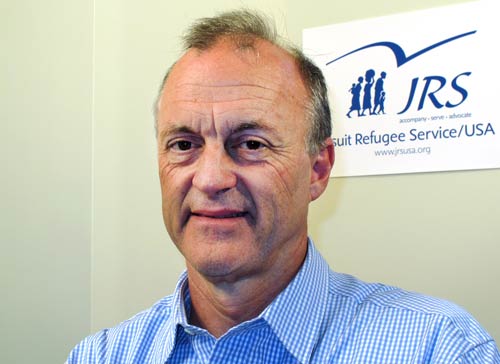
Fr. Holdcroft points out the need for for, and success of, JRS pastoral workers whose primary duty s to accompany refugees, to listen to the stories, their needs and their wants.

Fr. Holdcroft points out the need for for, and success of, JRS pastoral workers whose primary duty s to accompany refugees, to listen to the stories, their needs and their wants.

Fr. David Holdcroft, S.J., the Regional Director of Jesuit Refugee Service Southern Africa, discusses the necessity of accompaniment in JRS’ work with refugees.

Accompaniment is an essential element of the mission and methodology of Jesuit Refugee Service/USA. To accompany means to be a companion. We are companions of Jesus, so we wish to be companions of those with whom he preferred to be associated, the poor and the outcast.

Fr. Holdcroft points out the need for for, and success of, JRS pastoral workers whose primary duty s to accompany refugees, to listen to the stories, their needs and their wants. As Fr. Holdcroft says, the refugees themselves say “we can only rely on God. God is the only one who can help us.” Through accompaniment, JRS is able to help refugees celebrate “the God they know and love.”

To accompany is a practical and effective action. Not infrequently it is precisely the way in which protection is given. It is a way to ‘internationalize’ a situation. The presence of an international team can sometimes prevent an attack on refugees. Moreover, presence can be a sign. That a free person chooses willingly and faithfully to accompany those who are not free, who had no choice about being there, is itself a sign, a way of eliciting hope.

Our accompaniment affirms that God is present in human history, even in its most tragic episodes. We experience this presence. God does not abandon us.

As pastoral workers, we focus on this vision, and are not side-tracked by political maneuverings and ethnic divisions, whether they are among the refugees or among the agencies and governments who decide their fate.


Index of Shalom February 2011

Bookmark and Share


Accidental Pilgrims Ⅰ

Bookmark and Share


Unsuspecting Pilgrims

By Francis X. Hezel, S.J.


Unsuspecting Pilgrims

Manila in 1975, at the height of the Marcos era, was the capital of a troubled country. The super-rich ruled; the business establishment made the deals necessary to keep its stores open; and the average Filipino struggled to get by. Every other day, it seemed, the newspapers would carry a story of another violent confrontation between government troops and the National People’s Army, the guerilla insurgents who presented themselves as revolutionaries, agents of change and champions of the poor. As the Philippines became increasingly polarized, college students often took to the hills to join the N.P.A. One week it was a college basketball star another week it was a beauty pageant queen who donned fatigues and picked up an automatic weapon to join the liberationist movements.

I had come to the Philippines for the final year of religious formation (Jesuits call it tertianship), which included a 30-day retreat at the novitiate in Novaliches, north of Manila. For me, the retreat was an attempt at emotional engagement with the Lord, picking up conversation with an old friend but with long pauses when neither one spoke. We Jesuits prayed over the purpose of life, our own infidelities and the invitation of Christ to seek him wherever he was to be found. We looked for him in the solitude of contemplation, often on quiet walks through the wooded novitiate property, and in the song and prayer of the daily liturgies. It was a retreat in more than one sense of the word: a step back from the squalor and desperation of a land with too many people and too few decent-paying jobs.

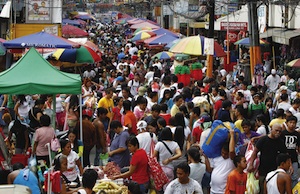
The day the retreat ended, Felix Yaoch, a Micronesian priest and fellow tertian, and I hailed a jeepney to Manila to attend a meeting. As we jumped out of the vehicle on one of the most crowded streets in Manila, I turned toward the intersection and caught sight of people rushing this way and that, dodging traffic and one another as they poured into the street. I was dazzled, as if hundreds of Manileños were caught in slow motion, their faces frozen. I thought I saw them with their eyes upturned in a kind of pantomime. Here they were: those people described by St. Ignatius in the meditation on the Incarnation in the Spiritual Exercises-“some at peace, some at war; some weeping, some laughing; some well, some sick.” These were the people from whom we had been carefully shielded during our retreat in the wilderness. Here they were again-street beggars, field workers, army troops, young N.P.A. recruits and businessmen among them-a cross section of humanity seeking salvation from poverty, from futility, from meaninglessness.

Perhaps the God who showed a bit of his face to us in the quiet of Novaliches was serving notice that here is where we could find him: in the bustle of the streets and on the faces of unsuspecting pilgrims.


Joan of Milwaukee

By James Martin, S.J.

The last place you might expect to find a 15th-century French chapel is Milwaukee. But plunked down in the middle of Marquette University is the Chapel of St. Joan of Arc. A speaking engagement last fall brought me to Wisconsin, and I was determined to see the inside of the chapel. The last time I was at the university, a friend pointed it out during a whirlwind tour and mistakenly said that the Maid of Orléans prayed here. Not exactly, said a guidebook that awaits visitors today. The compact white building was transported brick-by-brick to the United States from France in 1926 and then to Marquette in 1964. Though Joan probably did not visit the chapel, it contains a single stone on which she is supposed to have prayed. Inside are a rough-hewn altar and simple wooden seats.

Also inside is silence. In the middle of the fall semester, in the middle of a busy campus, I could hear no noise. Finally, I thought, some quiet after seemingly endless days of cars and trucks honking in New York. When I sat on the creaking chair, I felt a deep stillness. And I wondered whether it was quiet in the fields of Domrémy before Joan heard her famous voices. Much of her life was noisy: her family lived in crowded quarters; later, during battles, she was surrounded by shouts and cries; upon entering a town she was often greeted with deafening cheers. Perhaps she knew silence only in the fields-and in her jail cell awaiting her trial, when her voices temporarily deserted her. Silence can be a double-edged sword: for the lonely a torment, for the overworked a balm.

The red leaves blew about on the plaza outside, but I could not hear them.


Walk Into Repentance

By Drew Christiansen, S.J.

Said to be the site of Caiaphas’s palace, Jesus’ trial and Peter’s denial, there has been a church at the site of Saint Peter in Gallicantu-Saint Peter Where the Cock Crowed-since Byzantine times. The current church was built by the French Assumptionist étienne Boubet in 1931. In the 1990s it was beautifully renewed by Robert Fortin, an American Assumptionist who was rector, and the Palestinian Christian architect Samir Kandah. In keeping with the commemoration of St. Peter’s denial, a constant theme in the church’s art is repentance. A walk within the church takes one deeper and deeper into the spirit of contrition. There is no place quite like it.

Walk Into Repentance

On the upper level, Father Boubet designed the church in shades of violet and green, colors of repentance, and with little natural light. The altar is flanked by images of penitent saints, including the “good thief,” Dismas, and St. Mary of Egypt. On the second level, an extraordinary, blue-tinted bronze of the Suffering Servant invites visitors to contemplate the prophecies of Isaiah fulfilled in Jesus. Committed pilgrims should avoid the impulse to move ahead with the crowd and instead take time to meditate there on Isaiah’s Servant Songs, whose enactment began in this place.


Opposite the statue, a stairwell leads to a crypt chapel, where living stone flows into a white marble sanctuary. Three paintings in modern iconic style adorn the space. To the left, with a cock looking down from a pillar, a handcuffed Jesus gazes on Peter after his denial; in the center Peter weeps over his denial; and to the right one sees reconciliation as Jesus asks, “Peter, do you love me?” In the lower chapel, pilgrims cannot but reflect on their own failures to be true to Christ.

The walk then takes pilgrims into the rock below the church, to a cistern that was deepened into a holding cell. Its walls have been inscribed with crosses by centuries of pilgrims who have descended to the place where Jesus is said to have been held prisoner the night before his death. In this bleak setting, the custom is to recite Psalm 88, from which I have excerpted here verses 4 and 6:

For my soul is full of troubles,

and my life draws near to Sheol,

I am reckoned among those who go down to the Pit….


Thou hast put me in the depths of the Pit,

in the regions dark and deep.

A psaltery presents the prayer in more than 80 languages. When the recitation is complete, guides sometimes plunge the cell into a chilling darkness.

In “the Pit,” as pilgrims experience the depths of Christ’s abandonment, their walk of repentance runs its course. St. Peter Gallicantu is special among holy places because step by step it offers so many opportunities to enter into Christ’s passion and to stir up repentance in the heart.


God in the City

By Karen Sue Smith


God in the City

On my first visit to the cathedral in Milan, Italy, the Duomo di Milano, the largest Gothic cathedral in the world, I did as many tourists do on the recommendation of their guidebook: I went up onto the roof to view from there the magnificent piazza over which the church presides. It had rained that morning, which made the white marble facade slippery and, with no guardrails, a bit dangerous. Yet the payoff included much more than the view. Up there one can walk through the forest of saints’ statues and spires that give this building its distinctive appearance.

No guidebook, however, describes what I found inside the cathedral, which has proved most memorable. The place was bustling. The enormous structure begun in the 14th-century was full of modern people engaged in the very act of being the church. This parish was alive, even though no Mass was conducted there during the hour or more that I lingered. Although many churches in Europe seem to be shells, stuffed with the ghosts of congregations past, more than houses for contemporary worshipers, this duomo was different. Some tourists did look up at the windows, point and consult their maps, yet most of the people I saw were locals. They spoke Italian. Lots of Milanese, it seemed, were praying, lighting candles, making confession, gathering with friends, checking the bulletin boards, talking with the priests, coming and going routinely-giving the place a throbbing heartbeat of its own. The massive marble seemed to breathe.


The large tapestry banners hanging in the nave gave the interior a festive feel. What might otherwise have been a vast, cold cavern was instead inviting overall and cozy and intimate in places. The little rooms for the sacrament of reconciliation seemed to wait expectantly. A small alcove bedecked with a Bible and flowers, like a hospitable reception area of a fine restaurant, set the tone as one approached the quiet, inner sanctum for the reception of grace.

In the nave stood a very public glass chamber, and within it a priest sat behind a desk. A person entered and the two began to talk. This was no confessional, but rather a place to speak with a priest. The people in the church could readily see when a priest was present and available-transparency through architecture.

When I looked closely at one of the side altars, I saw on the wall handwritten scrawlings (purposely never removed): prayers, petitions and testimony of answered prayers. I could make out some of the Italian. The fingers of those who scribbled their gratitude to God in sacred graffiti on those walls reached out and touched me. Such good company! The faith of many generations of Catholics was palpable that day in a house of God for the people of the city.

I pray that it may still be so.

 

JRS lauds Cambodian refugee centre closure

Bookmark and Share


The Jesuit Refugee Service has welcomed the closure of a United Nations refugee centre in Cambodia on government orders.


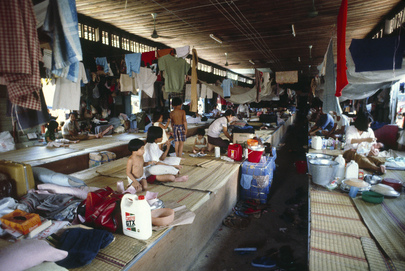
Refugees and Displaced Persons in South-East Asia

Refugees and Displaced Persons in South-East Asia
UN Photo/John Isaac

The centre had taken in indigenous mostly evangelical Christian Montagnard people from the central highlands of neighbouring Vietnam, BBC News reports.

Human Rights Watch says it is concerned that future asylum-seekers may not be treated “according to international standards”.

But the Jesuit Refugee Service says it is glad the facility is closing as it has been “the equivalent of a detention centre”.

Ten of the twenty detainees will be resettled in a third country – but the remainder failed to get refugee status and will be deported to Vietnam this week.

HK ‘Web Retreat’, evangelisation through the mass media

Bookmark and Share


Hong Kong (Agenzia Fides) – The “Web Retreat”, evangelisation through the mass media and formation are the action areas that marked the successful work done by the “Christian Life Community Hong Kong” (CLC) during the past year. According to reports from “Kong Ko Bao” (the Chinese language edition of the diocesan bulletin), during the Community’s annual Assembly, held in January, these initiatives have emerged, motivated by the promotion of evangelization and spirituality, according to their charism and mission.

On the community’s website a “Web Retreat” was launched, a spiritual retreat online, offering the Ignatian spiritual material to help the faithful to intensify their relationship with God. In its evangelising mission through the mass media, the community has also published various works and translations of Ignatian spirituality, such as “Sharing the Life of Christ” by Fr Laurence Gooley, S.J, and “Praying with St Paul”. As regards the scope of formation, more and more members of the community are taking the role of catechists or leaders of basic ecclesial communities. During the Assembly, seven members have made their permanent vows and eight temporary ones. There were also two new basic ecclesial communities formed.

The “Christian Life Community of Hong Kong” is part of the international community of “Christian Life Community”, founded by Father Jean Leunis, S.J., in 1563, following the spirituality of St Ignatius of Loyola. The Community has also grown in Hong Kong and Taiwan (since 1953). Today the community of Hong Kong has about 200 members in 19 communities. (NZ)