Category: Uncategorized

Jesus on the Edge

Bookmark and Share


by Francis X. Clooney, S.J. 


A Wisdom Story

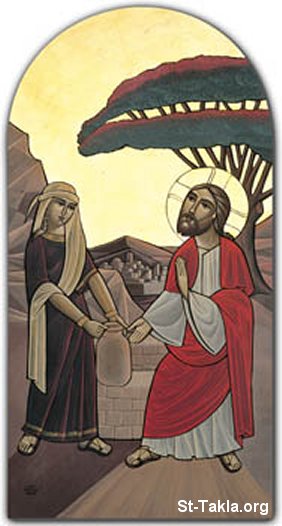
Cambridge, MA. Meeting Jesus on the edge of his religion, that is – in the Gospel for the Third Sunday of Lent, John 4, where Jesus meets a Samaritan woman at Jacob’s well. We find here wisdom on what to expect when we meet people of other faiths, insights into who really gets to recognize Jesus.

The easiest part, even if quite profound, is to see that Jesus shows up in out of the way places, without fanfare. He is in Samaria, among the Samaritans, near-neighbors of the Jews who believe that they were the ones who kept the faith after the Exile. Jesus is far from Jerusalem, yet not on the Samaritan holy mountain either: as is often the case, he is in-between, on the edge. He is by Jacob’s well, a site with long and holy memories, and to be sure, he comes to offer the water of life that everyone yearns for. But he does not ignore the well; he himself needs the water that if has been offering since the time of Jacob and Joseph. We can get quite far in interreligious affairs if we just take his words seriously: “But the hour is coming, and is now here, when the true worshippers will worship the Father in spirit and truth, for the Father seeks such as these to worship him.” (4.23)

More difficult, though, is how to interpret the people who are in the story with Jesus: the disciples, the woman, and the people of the town.

Easiest to account for are his disciples: well-meaning, they go looking for food, and miss his dialogue with the woman; upon their return, they are surprised that he would be seen talking to a woman, and alone at that; they do not understand his words, that his true bread is to do the will of his Father. (4.34) They are not even mentioned at the end of the account. They seem to gain no insight, even if years later it will all begin to make sense. It is easy then to see in the disciples ourselves, especially those of us who are religious, priests, leaders in the Church: right at the heart of things, there all the time, and yet too often clueless, grasping for physical bread and missing spiritual meanings; busy spectators at the drama of salvation, missing the important part and not having a clue how to preach the word that is Christ.

And then there is the unforgettable figure of the woman, interesting in the raw singularity of who she is: A lone woman out by the well in the heat of midday; cowed into assuming that men will not speak with her, even accept water from her; assuming that Jews will want to criticize her Samaritan religion, looking down on it; burdened, as we learn, with a series of bad relationships, five husbands and more. Yet she does not run away: she stands up straight, talks to the stranger, argues a few points of theology, admits her own neediness. In the end, she goes off to the town, and without shame speaks to everyone: “Come and see a man who told me everything I have ever done! He cannot be the Messiah, can he?” (4.29) Surely she offers a fine lesson on how to preach the Good News: Confession: I myself have been challenged, my life before my eyes; I simply share what has happened to me. A real question: Could this be the one we seek? It is not a rhetorical question; she is not simply belaboring a safe theological lesson for her audience, the ending already in place. She is asking: Is this person I just met, the one we’ve always been seeking? What do you think? An invitation: Come and see. Don’t just listen to me, as if I am authorized to tell you all you need to know about the Christ. Go to him yourself, he is nearby. This woman was a better apostle than those who spent all their time with Jesus.

And finally, the people of the town. With a graciousness rarely seen in the Gospels, after meeting Jesus, these Samaritans beg him to stay with them, and so he does for two days. They listen to what he says, and with a clarity that even the woman does not display, they see who he is. As they say to the woman, “It is no longer because of what you said that we believe, for we have heard for ourselves, and we know that this is truly the Savior of the world.” (4.43) She has not stood in their way, and they have benefited from allowing Jesus to come into their ordinary, Samaritan homes. They do not become Jews; do they become disciples? Yes, in their faith, but of course there is no record of how their lives changed after this encounter. We can presume that they worshiped on that same Samaritan mountain — yet now “in spirit and in truth.”

John 4 is not simply a lesson on Samaritan religion, nor even the evangelist’s larger version of the parable of the Good Samaritan told in Luke. Yet we would have to be blind and deaf if we did not realize that Jesus found in the woman someone he could talk to, sharing who he is, that in the townspeople, he found people quite capable of hearing his message and taking it to heart in a most profound sense. And he was among people not of his own religion.

The outsiders are able to hear; those whose religion is suspect, recognize and welcome Jesus; Jesus shows up in the most unexpected, unusual places. If we just take these points to heart, we will surely be more ready to see Christ at work “outside the Church,” and do a better job inside it too.

So it is our motivation, good or bad, that determines the fruit of our actions. 

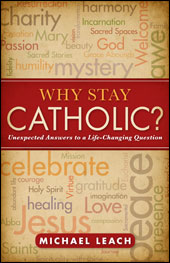
Why Stay Catholic?

Unexpected Answers to a Life-Changing Question

Bookmark and Share


Why Stay Catholic?

Why Stay Catholic?
by Michael Leach
ISBN 978-0-8294-3537-5
5.5″ x 8.5″ Paperback
224 Pages
$14.95

Why Stay Catholic? by Michael Leach is an uplifting book about what’s right in the Catholic Church today, and why tomorrow offers such hope and promise.

Scandals in the Catholic Church won’t go away. The uninspiring sermons keep coming, and lay people who don’t feel fulfilled find themselves asking Catholic questions, and looking for Catholic answers. This leads them to the greater question, Why Stay Catholic?

In Why Stay Catholic?, national best-selling author Michael Leach offers surprising, inspiring, and timely answers to this life-changing Catholic question. Leach joyfully offers readers plenty of reasons to celebrate being Catholic, reasons to celebrate the Catholic faith here and now, and reasons to believe that the Catholic Church can and will change.

This book is not theology lite, it is spirituality with spine. It is about the beauty at the heart of Catholicism. While many authors wax nostalgic about the way things used to be in the Church, Why Stay Catholic signs with one unique voice, backed up by a chorus of original voices of all ages and from all times.

Why Stay Catholic? answers the question Why Be Catholic? and is about the things that last because they are spiritual. As such, the book is really an invitation to “taste and see how good the Lord is.” Cradle Catholics, recovering Catholics, ex-Catholics, and even non-Catholics will love this healing antidote to a faltering faith and a wounded Church.


Download ‘ Michael Leach talks about his book Why Stay Catholic? podcast   


Index of Shalom April 2011

Bookmark and Share


Index of Shalom  April 2011 

Good Counsel

Bookmark and Share


Six lessons for the younger set

by Francis X. Hezel, S.J.


Six lessons for the younger set

Life gets simpler as you get older,” I said to a friend who has celebrated almost as many birthdays as I. He chuckled and then launched into a litany of ailments: arthritic joints, inability to climb stairs without getting winded, embarrassing memory loss, putdowns from younger colleagues at work and, worst of all, a general tedium vitae. When I tried out the same remark with another friend, it evoked an even longer list of woes.

At 72, I have experienced many of the symptoms my friends described. Transit card discounts and seats for the disabled are reminders of age. I’ve become a “senior citizen,” entitled to the sympathy and respect of the younger, more active set. But there is much more to old age than this. We seniors have something to share with the youngsters who relinquish their bus and subway seats for us. Here are six life lessons.

1. Relax and let instinct take over. When the young struggle aloud to “figure out” their lives, we seniors can smile sympathetically. Long ago we shared their concern as we, too, tried to decide a college major and a career path. But how do you tell earnest seekers that the most important things in life not only emerge, but they take control of you in a way you would never have thought possible when you were young?

We seniors recognize that we have never been in charge of our lives as we once thought we were. Most life-altering “decisions” are hardly decisions at all. They are not the product of our own choices. Take my decision to enter the Jesuits. It wouldn’t have happened if my uncle had not insisted that I enroll in a Jesuit high school rather than the Christian Brothers’ school I so badly wanted to attend. And the decision to volunteer for work in Micronesia, where I have spent almost all of my adult life, was impulsive rather than cool-headed. Perhaps “impulse” and “instinct” disguise something more mysterious at work.

“We old-timers have learned to run on instincts,” I used to tell the young Jesuit Volunteers in Micronesia who sought counsel. If they asked what I meant, I would explain that as one ages, one learns to put the purely rational and prescriptive in its proper place. We are constantly being handed formulas-prescriptions for finding happiness, losing weight, managing an office and raising a family. Formulas for belief are presented as church teachings. These formulas may help beginners (sheet music for the untrained), but why turn to the sheet music when we all have the melody playing in our heads? Young people may need formulas for a time, but with age one begins to trust intuition. Each year, one hopes, that intuition will be better honed.

2. The big choices are simple. If life becomes simpler with age, so do life choices. Some people my age would like to believe that unifying principles simplify existence. They are like scientists forever on the lookout for the unifying principles of energy, motion and matter itself. My experience with Pacific Islanders, Asians of every stripe, Americans and Europeans suggests that all of us, whether believers or not, are called to make one fundamental life choice: does a spiritual presence accompany or guide us, or do we walk alone? (This choice doesn’t necessarily determine theists and atheists because some may not name that spiritual presence “God.”)

In other words, all of us, equipped with wider horizons and greater hopes for ourselves and the world, must decide whether these horizons and hopes are deceptive or legitimate. Each must decide whether to reach beyond the narrow confines of limited self-interest to something richer that guides us to self-surrender. Perhaps that is what Karl Rahner meant by his assertion that all are called to, and ultimately judged on, a readiness to say yes to the divine invitation from within. What could be simpler, or more universal, than that?

3. We see better with our hearts. As we age, our vision blurs. We see men as trees, as the Gospel has it, Indians as Iraqis and Europeans as Africans. Or perhaps our vision is improving. The hues of ethnicity and the tones of language seem less important than they were. They become almost incidental. As our mental and physical powers decline, our hearts enlarge enough to embrace the whole world, it seems. “Cor ad cor loquitur” can mean more than the conversation between God and myself; it includes the strange bonds that develop between myself and any other human being, even the frauds and cheats of the world.

Sympathy also comes more easily with age. Why shouldn’t it when we’ve developed calluses on our rumps from landing on them so often? We, who have prodded others into battle, have acquired the scars to remind us of what we’ve been asking of them. No wonder we old-timers change tack and find ourselves whispering encouraging words much more often than shouting challenges. Halfway measures may be incomplete, but they can also be understood as honest attempts to do the right thing. Good intentions do not just pave the road to hell; they are the substrata of the path to heaven. Old age is wonderful, as we become more forgiving, more understanding, more tolerant. Why didn’t we learn all this earlier?

One could argue that as our minds become feeble, our judgments are necessarily less demanding. Still, the aged perspective gets better the farther down the road one moves. As we age, we begin to see the world from a greater distance, as if the camera moves back farther and farther until we can see the entire globe. Our view of the world and our life should become fuller as we age.

4. As life lengthens, the ego shrinks.

The long perspective also shrinks the ego. The sense of self-importance we had in youth diminishes in old age. We seem to have less concern for ourselves, our reputation and others’ approval of what we say and do. Sometimes this comes across as crankiness or inflexibility-a hardening of the aged brain. Yet it might be the beginning of a freedom we have long prized. We may begin to experience a lightness of spirit we have long sought. We see our life and all we have done as a gift of the Lord rather than as a list of accomplishments. We learn that the loss of ego is a blessing. Good riddance.

“Now I live-not I, but Christ who lives in me,” St. Paul wrote (Gal 2:20). For years I thought of this as pious drivel (though I would never have admitted that to my novice master). Age and experience have brought a change of heart. The question of who I am and what I am capable of becoming seems unimportant because the process is nearly complete and the end product is clear for all to see. The spiritual writers we once dismissed as inhabiting an alien universe may have been right after all. Once the fascination with ourselves drops off, we discover that we can become absorbed in Christ in a new way (not reserved for the saints). Evidently, this happens to the not-so-old as well, to lay people and to religious. (What else could explain the three searching conversations on prayer and self-surrender I’ve recently had in a single week with fellow seekers?)

5. Prayer is a warm-up for life. For years I had thought of prayer as an exercise, like push-ups or sit-ups or laps around the track. It was training, a test of endurance that would sometimes end in a warm but short-lived feeling called consolation. Whether or not one felt a surge of spiritual energy, one was developing spiritual muscle and strengthening the fiber of the soul. I could never imagine how to live “a life of prayer” as the saints did. Wouldn’t this be like living in the gym doing push-ups and sit-ups from morning to evening without respite?

Age brings insight: we old-timers now know that what we once called prayer is just a warm-up, not the real game. I have come to regard as prayer not just the 45 minutes in the morning when I twist myself into the semi-lotus position on my bed, but the whole day. I now see my whole life as one long prayer to the Lord. The most poignant moments often come not when I am engaged in the conditioning exercises called formal prayer, but as I walk to the subway, take a shower or wait for the elevator.

6. Our hearts expand as expectations contract. What about those great deeds we meant to do? Like many Jesuits, I once shared a fondness for knights on horses: the teams of Canisius High School in Buffalo, N.Y., were the Crusaders; McQuaid High School in Rochester had the Knights. All Jesuits aspire to do great things, I suppose: win over kingdoms and do battle with evil, like our founder Ignatius did. But as our hearts expand, our expectations contract. And the demons we fight can take strange shapes. What are we to do when we find the demons within us? These battles are not jousting contests, easily decided when one of the combatants is unseated, but long and painful campaigns in which it is not easy to tell whether one is winning or losing.

Old-timers may be battle-weary, but we are still swinging our swords. To put it another way, we have the same shortcomings, the same rough edges and pettiness as ever, but this just does not seem as important to us as it used to. While regretting that we are not better, we can integrate all we are into our offering to the Lord. As the years go by, my prayer increasingly is simply, “Lord, kindly accept the little I have to offer.” No dragons slain, no heads of enemies dangling from the belt, but we are still in for the whole campaign, however long it takes.

What could be simpler than that? So, maybe we elders have something to say to younger people, after all. I wish I could remember what it is.

Listen to an interview with Francis X. Hezel, S.J.

Francis X. Hezel, S.J., is a guest editor of America.

Call for works: World Music in Taiwan

Bookmark and Share


 We would like to invite you to participate in our compilation CD of World Music in Taiwan. The CD will be published in either the July-August or September issue of Renlai Magazine.

The main goal of the CD is to offer our readers a sample of the blend of various musical cultures that can be found in modern Taiwan.  We are inviting Taiwanese and foreign musicians who compose and perform contemporary forms of world music.

We hope that you are able to participate in this unique music compilation.

Please feel free to send any question to the following e-mail address [email protected] and refer to the important information below.

The deadline to confirm your participation is 15 April 2011.

We look forward to hearing from you.

Best Regards,

Cerise Phiv, eRenlai Magazine managing editor
Jose Duarte, CD Project organizer
Fabian Torres, CD Project manager

Important Information:

  1. Renlai Magazine periodically releases Music CDs distributed for free with the magazine.
  2. For this edition, active musicians and bands playing world music in Taiwan are invited to participate in the CD.
  3. Each band may submit up to three (3) pieces of music no longer than 6 minutes.
  4. The recording must be of professional standard.
  5. Each piece must be submitted with some information including title, name of the composer and performers, date, brief biography of the band/musician and contact details.
  6. All musical pieces must be sent digitally to [email protected] or in CD format:


Renlai Magazine (c/o Cerise Phiv)3F, N.22, sec.1, Xinhai RdZhongzheng DistrictTaipei City 10089


  1. By submitting a musical piece for the CD, the composer consents to publish the work on a CD which will be attached to Renlai Magazine. The composer retains the copyright.
  2. The list of the selected pieces will be announced on 1 May 2011 after having been evaluated by the Production Team. Quality of recording and relevance to the theme will be considered.
  3. The selected bands/musicians will have their songs published in an issue of Renlai Magazine, along with articles/interviews and a possible performance.
  4. For questions or inquiries, please contact Cerise Phiv [email protected]

Father General : Think globally

Bookmark and Share


by UCANews 


Father General

The superior general of the Society of Jesus has urged Jesuits in South Asia to undertake new works at the international level.

Transcend the narrow understanding of the Jesuit province and share the resources at regional and global levels, Father Adolfo Nicolas told 18 provincials and two regional superiors in South Asia during their meeting March 1-6 in Bangalore.

Father Nicolas is in India from February 26 to March 12 mainly to participate in the assembly of The Jesuit Conference of South Asia held in Bangalore. He will also visit Jesuits and their works in Bangalore, Mangalore, Calicut and Kolkata.

Father Nicholas told the provincials that the Vatican has also entrusted to the Jesuits several formation institutes to teach theology. The Jesuit superior general said Pope Benedict XVI sought the help of the Society of Jesus for the integrated formation of priests and stressed the need for a radical change in priestly formation, during a “one-on-one” meeting he had with the Pope.

Some 18,500 Jesuits work in 113 countries through communities and apostolic works organized by “provinces” which belong to one of 10 “assistancies” or regions around the world. South Asia, with more than 4,000 members, is the largest of the Jesuit assistancies. It includes Afghanistan, Bangladesh, India, Nepal and Sri Lanka.


Augustus Tolton

Bookmark and Share


by Tim Muldoon 

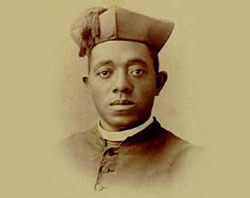
The Archdiocese of Chicago is opening the legal process for the canonization of Father Augustus Tolton, a late 19th century priest, and the first who was African-American.

The story is good on so many levels, but I’ll focus on two. The first is that it is communities who make saints. God’s work on us as a master craftsman is to shape us into a servant of those communities into which he sends us; sainthood is never for ourselves alone. And practically speaking, communities have to be the ones who advance saints’ causes.

The second lesson from Fr. Tolton’s life is that communities are awfully hard places to live out one’s sanctity. The Catholic Church of his day was grotesquely divided between the races. Blacks were often relegated to the balcony and sometimes could not even receive communion because it was forbidden to kneel at the rail next to whites. Father Tolton ministered wherever he was sent, often eliciting scorn from fellow Catholics, fellow priests, and even bishops. And yet he served faithfully. We do well to remember how Mother Teresa’s observation applies to figures like Tolton: our job is not to be successful, but faithful.

My prayer, in remembrance of Father Tolton, is this: may God send us to the communities for whom we must be leaven, and may our loving acts of dying to self give rise to the unfolding of his kingdom even when we can’t see it.


Direction

by Tim Muldoon 

A ship may be tossed on the seas, buffeted by storms of every sort. Its crew may be struggling mightily every day simply to keep it afloat, wearying themselves, becoming chilled to the bone. They may fear for their lives every day, and regret ever having set sail with the hopes of adventure and fame and wealth. There may be days when the supplies are running low when they fear starvation. Perhaps every now and again there may be a sunny day, with calm seas, when all is well in the world. The crew may find a moment of rest, such that they might gain some strength to again face the rigors of the voyage.

Prayer is like checking the compass every day to insure that the ship reaches its destination. It is the hope that comes from this knowledge which sustains the crew, so that they understand that none of the trials of their voyage are in vain.


Accidental Pilgrims ⅠⅠ

Bookmark and Share


Monks’ Walls

By Maurice Timothy Reidy


Monks' Walls

With a one-year-old daughter at home, my wife and I do not travel as much as we once did. Even on weekends, we do not wander too far afield, choosing to stay close to home rather than brave the subway ride to lower Manhattan. Yet on Tuesday nights I try to make time for a short trip, north from our apartment to Fort Tryon Park, a jewel of the New York City park system.

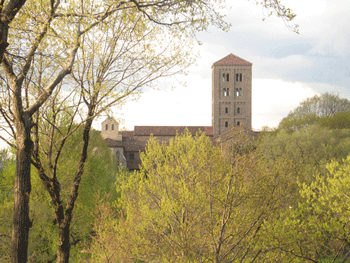
Bundled in my fleece, I jog slowly up Cabrini Boulevard, past the shrine to Mother Cabrini that gives the street its name, to the grand entrance of the park. After making my way through the park’s gardens, I climb a short hill and catch the first glimpse of my destination: the Cloisters, the northern branch of the Metropolitan Museum of Art. Built to look like a classic monastery, the Cloisters incorporates parts of five abbeys that were transported brick by brick from France and made into one monastery structure.

With its lone stone tower and arched windows, the building is a welcome interruption of the cityscape. Though I have not visited its collection in years, I know the outer layout of the museum well: the sloping lawn bordering its southern wall, the almost hidden path that leads to its entrance.

During my run, I sometimes think of Thomas Merton, who made frequents trips to the Cloisters when he was studying at Columbia University. Merton once wrote to his friend Robert Lax that he would gladly take a job as a night watchman at the museum. Later, when he was a monk at Gethsemani, Merton was sent a book of photographs of the Cloisters. Somehow they seemed foreign to him: “Just as if I had not been saved in those cloisters,” he wrote.

In the Cloisters Merton found both a connection to France, the country where he was born, and to the life he would eventually embrace. I am sure he was also comforted by the stillness of the park, which retains its air of peace even on busy summer weekends. I prefer to visit at dusk, when the sun has just set over the Palisades to the west. Sometimes, I slow down to take in the view, but I do not linger long. My wife and daughter are waiting for me at home.

Before they were shipped to Manhattan, the Cloister’s abbeys sat in ruins in France, remnants of the French Revolution. That they are no longer a formal place of prayer does not trouble me too much. It is enough that their stones are standing, a reminder of my ancient faith and of a monk who found salvation in their walls.


Where Jesus Swam

By Raymond A. Schroth, S.J.

At lunch the other day, a young woman graduate from Saint Peter’s College, just back from Latin America and on her way to Thailand, told me she had been to 21 countries. I felt threatened; at her age I had been to only nine. My current total, however, is 31.

Where Jesus Swam

What has been the religious impact of those trips? For me, there is a difference between the learning experience and the impact, or emotional result, of a visit. Impact means my heart jumped when it happened, and that flutter returns when I remember it. Here are three examples, moving backward in my memory.

A few years ago in Rome at a meeting of the editors of Jesuit journals, a small group toured the archives of the Society of Jesus. The archivist brought out a journal in the actual handwriting of Saint Ignatius Loyola. He let me hold it. There in my hands were pages where the ink flowed from the pen of our founder over 450 years ago. Had these lines not been written by this man I would not be standing there that day. Depending on other decisions, I might not be standing anywhere.

In 1983 I drove north to Galilee, properly impressed by the Church of the Holy Sepulcher and Jerusalem’s ancient wall, but anxious to get the feel of the turf where Jesus walked and talked. Archeologically, Capernuam was the highlight. Diggers had unearthed the walls of that first-century town where Jesus went to live and teach when he left Nazareth. There, with the Sea of Galilee a few yards away, a few feet from me were the black stones outlining what was most likely Peter’s home; it is where Jesus cured Peter’s mother-in-law. The spiritual highpoint came later, when I drove to Tiberias and stayed overnight on the lakeside. This, I told myself, was not only where Jesus and his disciples fished, it was where they swam—the same water Jesus swam in. I stripped down to my swimsuit, waded into the sea, then swam out farther. This water that enveloped the body of Jesus now enveloped mine. Or so it seemed to me.

A student for a year in Paris, I was invited to spend Christmas vacation in 1953 as the guest of the generous Bernard Thibaudet family in Tunis. During the day we had picnics and took field trips to Roman ruins. I was even their guest on a jackal hunt. On Christmas Eve we made our way to Carthage, to the St. Louis Cathedral, built in 1890 on a hilltop overlooking the Mediterranean. There in 1270, King Louis IX, on his way to a second crusade, died on Christmas day. The cathedral choir sang “O Holy Night” as I had never heard it before and have never heard it since.


A Place of Listening

By Kerry Weber

Last summer, my sister and I spent three days in Rome with a prioritized to-do list to make the best use of our time. The day of our arrival, jet-lagged, we made the first stop on our list—the Gesu, the Jesuit church that is home to the tomb of St. Ignatius Loyola.

The building was gorgeous, massive and ornate. We walked slowly through its cool interior, stopping to kneel by Ignatius’ tomb and waving to the hand of St. Francis Xavier, preserved behind glass. After taking time to pray, we stepped back into the sunlight, turned left and entered an unassuming doorway in the adjacent structure.

Compared to the Gesu, this building was nearly empty, but friends had said it was well worth a visit: on the second floor were the rooms of St. Ignatius Loyola. There he’d written the constitution of the order of the Society of Jesus; there he’d penned letters, prayed and slept. A newly minted editor for America, I couldn’t wait to see where the founder of the Jesuits had done some of his own writing.

My sister and I stepped up to a tall desk behind which sat two men. Before we could say a word, the angrier looking man spoke in broken English.

“Sorry, there is Mass. No visitors to rooms.”
“What if we’re very quiet?” I asked. “We won’t say a word.”
“You come back,” he said.


A Place of Listening

But given the limited hours and our packed schedule we couldn’t return, which I told the man. He suggested we console ourselves by looking at some drawings of historic Italian events along the hallways leading to the rooms instead. I gave one last sad look at the men. The first stared back unsympathetically. The other looked away. My sister and I walked down the hallway, a poor substitute. But after a few minutes, we heard footsteps. I saw the quieter man from the desk running toward us.

“Come, he is on break. I will take you.” Behind him we rushed up a set of stairs and entered an exquisitely painted hallway. Up another few steps were two wooden doors and in front of them a stooped, round man stood like a guard. He had a wide nose and salt-and-pepper hair slicked back from his forehead. The two men spoke in Italian for a few moments. Then the man from the desk smiled and gestured to us to follow the little guard, Jesuit brother Salvatore Angelo, into the rooms.

The rooms were plain but powerful. Low beams of dark wood hung overhead. There, my sister and I looked at pages of Ignatius’s own handwriting and quietly studied the walls. Brother Salvatore’s deep soft voice suddenly filled the room, “Italiano?” We shook our heads.

“Inglese,” we replied apologetically. He sighed. Then, as though he hadn’t heard us, he launched into an in-depth description of our surroundings in Italian. He pointed to various objects, beckoned for us to follow him to a mural outside the rooms and showed us how the painting changed when one stood at various angles within the room. At first overwhelmed, we drew on our knowledge of Spanish and picked up on some cognates, nodding. We didn’t understand everything, but were surprised by how much we could grasp when we made the effort to closely listen and Brother Salvatore made the effort to speak slowly and do a bit of pantomime. Listening and standing in those rooms established a connection not just to the Jesuit founder, but also to this little old brother who grinned as he pointed to painted angels and pushed postcards into our hands.

Now, when I find it hard to pray, I sometimes think back to that day and Brother Salvatore’s patient, persistent message, which we made such effort to understand. I try to maintain that same willingness to listen as I try to discern God’s will for me, even when it seems to make little sense. More often than not, I find, it just takes a little while for the message to sink in, for me to pick out a phrase or two that I can understand. Then I find that moment when it all seems to connect.