Category: Uncategorized

A Wisdom Story 16

Bookmark and Share


by Paul Brian Campbell, SJ  


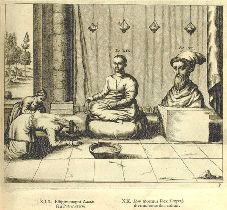
This image of a Dalai Lama was drawn by the 17th century scholar, Athanasius Kircher, S.J.

This image of a Dalai Lama was drawn by the 17th century scholar, Athanasius Kircher, S.J.

In answer to the observation that some people say they do not meditate because they are too busy, the Dalai Lama told the following story:

A monk keeps promising his student that he will take him on a picnic but is always too busy to do so. One day they see a procession carrying a corpse.

“Where is he going?” the monk asks his student.

“On a picnic.”


Wisdom Story 17

Bookmark and Share


by Paul Brian Campbell, SJ  


This image of a Dalai Lama was drawn by the 17th century scholar, Athanasius Kircher, S.J.

During the Middle Ages, a traveller once came upon a place in France where a great deal of building work was going on. He began to talk with the stone cutters and asking them about their work.

He approached the first worker and asked, “What are you doing?” The man, very disgruntled and obviously unhappy in his hard toil, replied, “I’m cutting these huge boulders with the simplest of tools and putting them together in the way I’ve been told to do. I’m sweating in this heat and my back is hurting. What’s more, I’m totally bored and I wish I didn’t have to do this hard and meaningless job.”

The traveller moved on quickly to interview a second worker. He asked the same question: “What are you doing?” The worker replied, “Well, I have a wife and children at home, so I come here every morning and I work these boulders into regular shapes, as I’m told to do. It gets repetitive sometimes, but it helps to feed my family and that’s all I want.”

Somewhat encouraged, the traveller went on to a third worker and asked, “And what are you doing?”

The third worker responded with shining eyes, as he pointed up to the heavens, “I’m building a cathedral!”


New Energy in Taiwan’s Social Movements

Bookmark and Share


eRenlai Newsletter June 2011

Dear friends,


New Energy in Taiwan's Social Movements

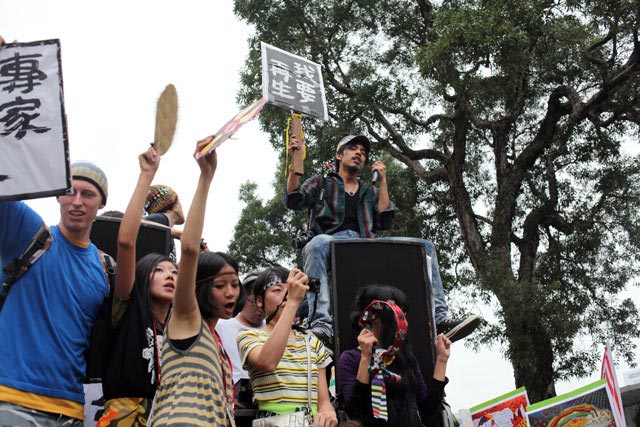
In this month’s Focus, eRenlai reveals the innovation and creativity of Taiwan’s most dynamic social movements, with activist Zijie Yang as our trusted guide. A scholar on local social movements, Professor Ho Ming-sho, first introduces the history of social movements in Taiwan. With this historical foundation in place, we then move on to look at more recent events with an exploration of the two contrasting opinions on the failure of the Wild Strawberry Student Movement, which was sparked off in November 2008 by alleged police brutality during a visit by Chen Yunlin, the chairman of the Association for Relations Across the Taiwan Straits of the People’s Republic, to Taiwan. The focus also includes a translation by Robert Voight of the first in-depth analysis of the student movement, an extract from Professor Ho Tung-Hungâ€TMs notes on the protests.

In the light of the perceived failure of the Wild Strawberry Movement, the focus goes on to explore the new energy and innovation that define or will go on to define social movements in Taiwan. One of these movements is what Sean Hsieh called “the opening of new spaces”. We introduce two of these spaces – Café Philo and Go Straight Café which cultivate, train and empower youth to take part in social and political activism, and which illustrate the key role that gathering places like coffee shops play in fortifying civil society. Go Straight Café has reflected on the lessons learned during the Wild Strawberries Protests to pursue more innovative and creative forms of protest. It is now home to a group of cultural activists called “NoNuke”, who employ music, art exhibitions and social events to foment dialogue within the wider public, and have fought for a nuclear-free Taiwan over the last two years. In the wake of the Fukushima Nuclear disaster in March, NoNuke also collaborated with Gon-li She, a group of young people attempting to promote punk music in Taiwan, to channel the anger and frustration of young punks and rave-goers into social activism. This cooperative effort bore fruit with the 4/30 manifestation against nuclear energy in Taiwan and in the subsequent art exhibition, ‘Don’t brush off what you see’, which brought together ten artistic works concerned with nuclear power and energy resources.

In a tribute to the American activist duo “The Yes Men”, the Academy of Interference, printed 10,000 hoax mock-ups of the front pages of Taiwan’s major newspapers, declaring falsely that the proposal for the controversial KuoKuang Petrochemicals factory had been rejected by the government. The stunt achieved its desired effect, garnering media attention. Eventually the government removed its support for the project which could have endangered the survival of the last remaining Chinese White Dolphins. Another group, concerned above all with nature and the land rights of indigenous peoples, is the Langyan Action Group, who every year since 2007 have lit pyres, setting off smoke signals that call for justice as well as a nuclear-free homeland.

Conor interviews a different type of activist – Vincent Huang took time to explain his experience in the Gay Movement and what bearing his disability has on his role within it and on his outlook on life in general.

Benoit Vermander imparts advice on the life-long process of moral development and warns us not give way to the overdetermined truths that logic might seem to provide. Benoit also summarizes the conclusions of the conference on “Interreligious Encounters, Peace-building and Theological Inventiveness in todayâ€TMs Asia†sponsored by the Xu-Ricci Dialogue Institute at Fudan University in Shanghai; Around 60 scholars debated the contribution that Christian studies bring to reconciliation and dialogue in an Asian context, from the perspective of cross-spiritual encounters, cooperation in the field of social and environmental justice, systematic theology and public philosophy.

In response to the Focus ‘Beyond the Pale: Architecture in Taiwan’ Pierre Maranda would like to introduce readers to what world-famous anthropologist Claude Lévi-Strauss wrote on the subject of religious and cosmic interpretation of traditional Chinese architecture.

Finally remember to look out for our world music CD which will come with Renlai Monthly magazine next month. The CD a sample represents the blend of various musical cultures that can be found in modern Taiwan. Congratulations to all the winning submissions and remember to check out the interviews with the bands that took part that will be online over the course of this month.

Happy Dragon Boat Festival and we wish you peace over the Feast of the Ascension!

Nick and all the eRenlai Team
www.eRenlai.com

Taipei Ricci Institute|eRenlai Magazine|Renlai Monthly
Hsin-hai Road, Section 1, No.22, 3fl.Taipei 100, TAIWAN
Tel: (886 2) 2368 9968 Fax: (886 2) 2365 4508
email: [email protected]


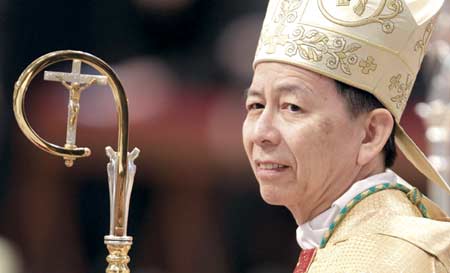
Chinese bishops should have no fear and say no to Beijing’s demands, says Mgr Savio Hon

Vatican City (AsiaNews) – Each “division [. . .] causes great pain to the entire body” and the “whole body is scarred and bleeding,” said Mgr Savio Hon, secretary of Propaganda Fide, in response to reports that another Episcopal ordination is being prepared without a papal mandate.
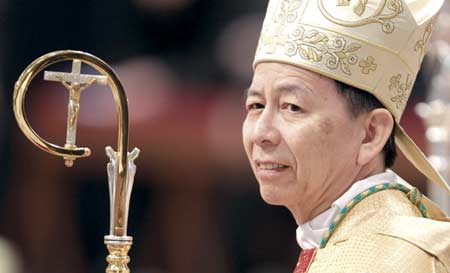
The bishop, a member of the Salesian order from Hong Kong, has been hard at work at his new job for several months now. He continues to stand in solidarity with the bishops and priests who are victims of pressures and threats. At the same time though, he urges them to reject the demands made on them by the Communist regime, whose goal is to set up a Church that is “independent” from the Holy See and totally subordinated to the state.

According to Mgr Hon, those who have resisted the will of the party, like Mgr Li Lianghui (Cangzhou, Hebei), are now in isolation, forced to undergo political education classes (brain washing). He insists that Chinese priests and bishops must show “some backbone” and resist the pressures out of love for Church unity, and the memory of the many heroic witnesses to the faith of the past decades.

The secretary of Propaganda Fide notes that unlawful bishops do not have the right to perform the pastoral ministry, adding that the Vatican Commission for the Church in China is coming up with guidelines to save the Chinese Church from division and the scandal caused to the faithful. He also notes that there are American and European theologians who are in favour of an “independent” Church and that their ideas are spreading the seed of division in China.

Mgr Hon, who for years visited and taught in Chinese seminaries, is in favour of the beatification of Card Ignatius Gong Pinmei, appointed cardinal in pectore by John Paul II, who passed away in 2000, and this despite some “technical problems”.

Finally, the bishop is embittered about the fact that the Vatican is continuously asking for the release of imprisoned bishops (Mgr James Su Zhimin of Baoding and Mgr Cosma Shi Enxiang of Yixian) but is not getting any answer from the government in Beijing.

Here is the full interview with Mgr Savio Hon:

Rumours have it that on 9 June there could be a new unlawful Episcopal ordination in Hankow (Wuhan, Hubei), one without papal mandate . . .

I am concerned about the report. The pope is concerned as well, as is the Church of China as a whole. From what I know, the faithful in Hankow have reacted by pleading with the government and the Chinese Patriotic Catholic Association (CPCA), citing the Code of Canon Law, not to carry out this ordination.

It would appear that the candidate, Fr Shen Guoan, is against it, too. Sadly, at present we do not know what the candidate actually thinks. However, from brother to brother, I want to tell Fr Shen, “I trust you to act the right way. The only right thing to do is to refuse.”

How serious is an unlawful ordination?

The Church is one Body with Christ as the head and the rest of us as the parts, perfectly united in the Holy Spirit. It is mystical and sacramental fact. Every act of division, like this unlawful Episcopal ordination, is an act of division of the Church and causes great pain to the entire body, like tearing a piece from a living body. Eventually, the whole body is scarred and bleeding.

There are also consequences. As more unlawful ordinations are made, the Church in China, or parts thereof, appear to be working for the constitution of a different Church, a community that wants nothing to do with the Holy Father.

How is it that they are still prepared to carry out unlawful ordinations fully knowing this? According to some reports, the CPCA appears to be planning at least ten Episcopal ordinations . . .

I cannot really say, but from what one can be see, it is clear that priests and bishops are under pressure. It is my impression that this pressure is not as strong as it was for our brothers in past decades. Today for instance, there is no risk of forced labour, prison or death. Nowadays, the government does not do that anymore.

Of course, if bishops and priests do not submit, they will be punished in some way. For example, they can lose public funds for their diocese, obstacles will be put up against their daily pastoral activities; or their careers might suffer (for example, they may not be appointed to the government’s consultative assembly). Alternatively, they may not be allowed to travel abroad or inside China, or may be forced to undergo re-education courses.

There are several examples of this. After Bishop Li Lianghui refused to take part in last December’s[1] assembly of Catholic representatives, he was sent to re-education. Yet, this also is evidence that it is possible to say no to submission. Forced isolation from other bishops, priests or faithful can be a heavy burden though. When faced with such punishment, some bishops resist better than others do. The government knows which candidates to pick, choosing the weaker, those more amenable to compromise.

As one might expect, there are also opportunists who will accept a compromise, alleging a number of reasons, such as the greater good of the Church, the need for public monies, the imperative of evangelisation, etc. Such claims are however false. When the Church is cut off from its rock, from Peter, it automatically becomes weak.

In any case, the punishment that might be meted out is no reason not to resist. Submission is a public act that causes scandal, sending the wrong message to the faithful. It undermines the heroic memory of so many bishops who have resisted.

At present, various Episcopal candidates resist and do not want to be ordained without the appropriate canonical assurance and the right papal mandate.

When he mentioned the Day of Prayer for the Church in China, the pope called for prayers on behalf of those who are tempted by opportunism . . .

All candidates to the priesthood are our brothers, and we should help them and show understanding. However, this does not mean that we should encourage them to follow the wrong path. Compassion must make one strong in difficult times. Besides, if one shows some backbone, the government will not touch you. If you show some weakness or a propensity towards compromise, the government will take advantage of you.

There are candidates who stood their ground and refused to be ordained by excommunicated bishops, at least until a papal mandate was issued. Faced with such firmness, the government could do nothing.

What does the Holy See do for these candidates?

For our part, we must work harder in training the clergy, so that strong leaders can come out of the seminaries. Unfortunately, we can do little from outside. At the same time, we can see that the government is keeping a close watch over its candidates, training them before forcing them into the mould they desire. However, no government likes opportunists because they can change their mind. They will always be used for as long as they are useful.

In China’s situation, we must counsel bishops and priests that if they do not feel up to the task or if they cannot resist pressure, they should simply ask to be released from their pastoral duties and have the courage to suspend their ministry.

Is setting up an independent Church useful for the government?

All the government wants is for the Church to perform the sacraments for Chinese Catholics and foreigners visiting the in the country. This creates an impression of religious freedom even it raises many questions from a canonical and theological point of view.

China follows one principle, the government comes first; religion comes second. However, it is unclear how subordinate religion has to be.

A system of self-selection and self-ordination (without papal mandate) will eventually destroy the Church, as the faithful will move to the bishops who are not in communion with the Holy See.

On the other hand, sacraments performed by an unlawful bishop are valid . . .

What the papal letter to Chinese Catholics said was that, for the good of the faithful, it was possible, under exceptional circumstances, to receive a valid but unlawful sacrament from an unlawful bishop. It this became the norm, I think the guideline should be revised and Chinese and foreign Catholics should be told not to receive any sacrament from unlawful bishops. If no clear-cut distinction is made, the faithful will not understand the difference between bishops who are loyal to the pope and those who are not. The faith of the simple people could be jeopardised.

Sacraments performed by unlawful bishops are acceptable in emergencies, but they do not enhance the communion of the Church. It is a modus non morientis, but not a modus Vivendi. It is a guideline to keep the Church alive, but it does not help the Church live and grow.

What I say corresponds to many requests that come from the Church in China, which call on the Vatican to clarify some issues and give clearer guidelines on how the faithful and priests should behave vis-à-vis unlawful bishops.

After the unlawful ordination of Chengde[2], the Holy See issued a very clear statement, condemning the act . . .

Yes, but it did not say which one. It did not differentiate between Episcopal power and the pastoral ministry. One becomes bishop through sacramental ordination, but pastor of a segment of the people of God through papal mandate. This means that an unlawful bishop who unlawfully secured his ordination has no right to lead the faithful because he does not have a papal mandate. In the case of Chengde, the ordination is valid (even though it was unlawful), but the bishop has not no power to lead his flock. This means that in Chengde, the faithful have no obligation to obey the bishop, who has no power to ordain priests.

Given all the difficulties and the threat of unlawful ordinations are there signs of hope for the Church in China?

Many priests and faithful adhere to Catholic doctrine and do not obey unlawful bishops. However, I do not know how long that will last. For this reason, seminary training is important.

One thing deserves closer attention, and that is how Chinese Catholics are inspired by new Blessed, John Paul II, who said, ‘Have no fear’. The pope said these words at the start of his pontificate after he left Poland, a country where the Church was persecuted and had few hopes of success. Yet, “Have no fear” was effective. Card Casaroli himself could not foresee the collapse of the Communist regime within a short period of time.

I think the way to eliminate this ambiguity is to ask the bishops who engaged in actions contrary to the papal mandate (for example, carrying out ordinations or taking part in assemblies) to make public amend.

What can the universal Church do?

We must help the Chinese Church to live the faith and not bend to demands that undermine the deep heart of the Catholic faith and the relationship with the pope. Sadly, a certain theology from the United States and Europe is penetrating the Chinese Church. This theology calls for autonomy in the realm of Episcopal appointments and independence from the Holy See. There are people in America and Europe who are pushing Chinese bishops towards this kind of action. “If you succeed,” they argue, “we will follow.”

As you can see, until recently the issues of “independence” and “autonomy” referred to the relationship with the government; now, it also touches the theological level.

Sometimes it appears that the Holy See is dominated by diplomatic fears rather than pastoral concerns, that it is too eager to establish diplomatic relations at any costs. For example, how many times did the Holy See ask for the release of bishops in prison?

Every time we meet representatives of the Chinese government, we demand the release of our brothers. However, the government will not listen. These bishops are old and sick. Their release would be a humanitarian gesture. Sadly, we never get an answer. Perhaps, we should make public appeals rather than speak to the authorities in person.

Some underground Catholics want the cause of beatification of Card Ignatius Gong Pinmei[3] to start. What do you think?

There are technical difficulties. It is up to Chinese dioceses, the local Church, to gather the documentation and present it to the Congregation of Saints. If this happens, the Vatican will certainly consider it. In the case of Card Gong, since he was the bishop of Shanghai, there is the matter of reconciling underground and official communities in Shanghai. But it is not impossible. The same is true for the martyrs of the Communist period, who died from hardships and privations in the camps or in prison, over the past few decades. Each diocese collects documentation on these martyrs, and determines whether to send it to Rome or not for the start of a formal process of beatification. If the diocese can start the process, we are happy.

[1] See W. Zhicheng – Z. Yuan, “Chinese bishops deported to attend Patriotic Assembly,” in AsiaNews, 7 December 2010 and Zhen Yuan, “Assembly elects new leadership, causing major harm to the Church,” inAsiaNews, 9 December 2010

[2] See Zhen Yuan, “Chengde, eight bishops in communion with Pope participate in illicit ordination,” in AsiaNews, 20 November 2010 and “Holy See condemns illicit Episcopal ordination in Chengde,” in AsiaNews, 24 November 2010.

[3] See Annie Lam, “Waiting for the beatification of Card Kung Pin-mei ten years after his death,” in AsiaNews, 25 February 2010.

The Impression Ignatius Made

Bookmark and Share


Stay Against Confusion: Essays on Faith and Fiction

by Ron Hansen
HarperCollins Publishers

“His holiness was unmistakable; he practiced self-mastery until there seemed to be no difference between God’s will and his own. “Eres en tu casa,” was his wide-armed greeting to anyone who visited him-“You are at home”-and all who talked with him left with the impression that he was kindliness itself: Michelangelo was so affected by Ignatius that he offered to build the Church of the Gesù for nothing.

“Ever a mystic, at times the saint was in the midst of an official transaction when his thoughts would lift up to God and hang there, and his witnesses would shyly shuffle their shoes until he got back to his papers again. But there were also stories of him surprising a melancholic with a jig in order to cheer him up, and his happiness was such that he said he could no longer apply his own rules for discernment of spirits because he was finding consolation in all things-he once said he saw the Holy Trinity in the leaf of an orange tree. Although children threw apples at him when he first preached in the streets of Rome-probably because of his horrid Italian-he soon was as genuinely beloved as the pope. In fact, he was so highly thought of by prelates that in the 1550 conclave at which Julius III was elected pontiff, Ignatius de Loyola received five votes.”

Ron Hansen
Stay Against Confusion: Essays on Faith and Fiction

Wisdom Story – 18

Bookmark and Share


by Paul Brian Campbell, SJ  


Wisdom Story

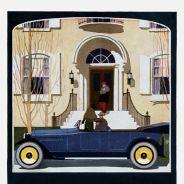
Shuaib received an automobile from his brother as an Eid present. On Eid day when Shuaib came out of his house, a street urchin was walking around the shiny new car, admiring it. “Is this your car, Uncle?” he asked. Shuaib nodded. “My brother gave it to me for Eid.” The boy was astounded.

“You mean your brother gave it to you and it didn’t cost you nothing? Boy, I wish…” He hesitated. Of course Shuaib knew what he was going to wish for. He was going to wish he had a brother like that. But what the lad said jarred Shuaib all the way down to his heels. “I wish,” the boy went on, “that I could be a brother like that.” Shuaib looked at the boy in astonishment, then impulsively he added, “Would you like to take a ride in my automobile?” “Oh yes, I’d love that.”

After a short ride, the boy turned and with his eyes aglow, said, “Uncle, would you mind driving in front of my house?” Shuaib smiled a little. He thought he knew what the lad wanted. He wanted to show his neighbors that he could ride home in a big automobile. But Shuaib was wrong again. “Will you stop where those two steps are?” the boy asked. He ran up the steps. Then in a little while Shuaib heard him coming back, but he was not coming fast. He was carrying his little crippled brother. He sat him down on the bottom step, then sort of squeezed up against him and pointed to the car.

“There it is, little brother, just like I told you upstairs. His brother gave it to him for Eid and it didn’t cost him a penny. And some day I’m gonna give you one just like it…then you can see for yourself all the pretty things in the Shop windows that I’ve been trying to tell you about.”

Shuaib got out and lifted the boy to the front seat of his car. The shining-eyed older brother climbed in beside him and the three of them began a memorable ride. That Eid, Shuaib learned what the RasulAllah (salAllahu alayhi wasalam) meant when he had said: “love for your brother what you love for yourself”.


Jesuit Electronic News Service Vol. XV, N. 11

Bookmark and Share


From the Curia


–  From May 20-22 to be held in Rome at the General Curia, the ordinary annual meeting of ICAJE (the International Commission on the Apostolate of Jesuit Education).  ICAJE is composed by 6 members elected by the Secretary for Secondary Education for each Jesuit Conferences, along with the Secretary for Secondary Education. Current members are: Edward Fassett SJ for North America Region; Norbert Menezes SJ for South Asia Region; Marie-Thérèse Michel for Europe Region; Alejandro Pizarro Bermúdez SJ for Latin America Region; Etsuo Sekine SJ for Asia-Pacific Region; Emmanuel Ugwejeh SJ for Africa Region; José Alberto Mesa SJ as Secretary for Secondary Education. “We will be presenting a report from each region – says Fr. José Albert Mesa – analyzing the challenges for Jesuit Secondary Education today, and preparing the Boston International Colloquium for Secondary Education in 2012 organized by Boston College High School.


–  From May 23rd to 28th  the Secretariat for Social Justice and Ecology will host the Coordinators of the Conferences for the Social Apostolate which will meet at the General Curia on the occasion of their annual meeting. During these work days they will outline, from the point of view of the Social Apostolate, an overview of the major challenges the Society of Jesus has to face today. The theme of the justice dimension inside the Society will be deepened and the different aspects regarding the future of the Social Apostolate will be taken into exam. Representatives from each Conference will be Fathers César Torres and Alfredo Ferro for Latin America, Andreas Gosele, Brendan McPartlin and Higinio Pi for Europe, Denis Kim for East Asia and Pacific, Ghislaine Tschikendwa and Rigoberto Minani for Africa and Madagascar, Tom Greene for United States and Xavier Jeyarai for South Asia.


– Office of Development Resources. Father Jorge Eduardo Serrano Ordoñez SJ, writes: “On 2007 the Father General P.H. Kolvenbach named Mr. Chuck Duffy (USA) as the first director of the development office created in the General Curia after the Major Superiors’ meeting in Loyola (2005). These first three years were to lay the foundations of this new and urgent service to the universal Society due to the great changes in the world’s economy, as well as to the new structures within the apostolic body of the Society and its government. This work done by Mr. Duffy with the support of the Assistants, Provincials and Treasurers was the basis for the proposal presented to the Father General, Fr. Adolfo Nicolás, and to the presidents of the Conferences in September 2010, called the Flagship Project.This proposal seeks to support one Province a year in each Conference until 2013, whether the Province is beginning a fundraising office, or in the midst of strengthening a fundraising program. What is important is that the Province desires to fundraise for the apostolic priorities not only of the Province but also of the shared priorities of the Conference and the world-wide Society.  The Conferences have already chosen the pilot Province: East Africa (AOR/Africa), Philippines (PHI /Asia Pacific), Madhya Pradesh (MAP/South Asia), and Malta (MAL/Europe). Latin America has postponed the selection of a pilot Province until the year 2012. The name of this General Curia service has been changed  from “Development Office” to “Office of Development Resources”, since it is not this office’s task to do fundraising, but to facilitate the growth of Development Offices in each of the Provinces and Conferences of the Society.”

Appointments


Father General has appointed:


– Father Bhausaheb Sansare Provincial of Pune (India). Father Bhausaheb, who is currently superior of the community and director of St. Joseph Technical Institute and Hostel in Pune, was born in 1970, entered the Society of Jesus in 1994 and was ordained a priest in 2004.


– Father Sebasti L. Raj  Provincial of  Madurai Province (India). Fr. Sebasti L. Raj, up to now director of the Xavier Institute od Development Action and Studies of Jabalpur (Madhya Pradesh), was born in 1945, entered the Society of Jesus in 1965 and was ordained a priest in 1976.

From the Provinces


CHAD: Recognition to Fr. Gherardi

On May 19 in Geneva, at the UN Headquarters, the WHO (World Health Organization) awarded the Chadian Community Association for Progress, founded by Father Angelo Gherardi, an Italian Jesuit missionary living in Chad for decades, the 2011 prize of the Foundation of the Union of Arab Emirates for Health, and the 2011 prize of Kuwait State for research and promotion of health. The reason for both prizes highlighted the excellent work done by the Association for the research and development of health.  In addition to the prestigious award, the prizes involve also a substantial sum of money.


EUROPE: Strategic Plan

A special meeting of the council of the Conference of European Provincials (CEP) was held recently in order to realize a strategic plan of action for the next three or four years.  Father John Dardis, the president, outlined the main points: “First we took into consideration evangelization and its importance across Europe, in a moment of big secularization. The Jesuit charism is open to culture, to meet God in all things and to help people to meet him too. This is our particular contribution to the Church. A second basic idea in our discussions was to pay particular attention to young people (…). Everywhere young people have a deep hunger and a great potential. Will we be able to bring out this potential and to develop it?  Regardinginterreligious dialogue, it was stressed that they are really more than one dialogue.Islam is not the only group with whom we have to interact, even though it is the most complex and difficult. We must not forget also the ecumenical call in Europe among all Christian Churches (…).  Then, we stressed the importance of helping the renewal of the Church all over Europe.”


INDIA: New Jesuit Center to provide media training

A newly opened Jesuit Center, the Lievens’ Institute of Film and Electronic Media(LIFE), aims to offer young tribal people media skills training with a certain ethical viewpoint and highlight issues related to their communities in Eastern India. Father Francis Kurien, head of the Hazaribagh Jesuit Province, opened theLievens’ Institute of Film and Electronic Media (LIFE) in Ranchi, the Jharkhand state capital, recently. Addressing the gathering, Father Kurien expressed hope that the center’s students would take up tribal issues in various media channels and will make tribal voices heard nationally and internationally: “Today the media is not reporting many events happening in Jharkhand,” he regretted. Ranchi Provincial Father Xavier Soreng, who blessed the building, hailed the Center as “a new chapter in the life of Jharkhand and a gift of the Central Zone Provincials to the tribal people of the region.” The Center will offer a course in film and television production from July 15, with the Mumbai-based Xavier Institute of Communicationsawarding diplomas to graduates from the Ranchi Center. In the near future it will also offer certificate courses in electronic media.


ITALY: The residence of Florence closes

A statement of the Italian Province announces the closing of the residence of Florence with these words: “After the decision to close the communities of San Remo and Gorizia, the Italian Province of the Society of Jesus has come to the point of having to carry on the painful closure of the community in Florence. In fact, the two younger fathers had to leave for other destinations and the remaining community, formed by the Superior and two elderly fathers, is no longer able to stand. This choice does not mean in any way that the Society leaves Florence.  Fr. Ennio Brovedani, director of the Stensen Institute, will remain in town and the Institute will continue with its programs of high cultural level which are widely recognized. The educational, spiritual and charitable activities will continue thanks to the generous hospitality offered from the neighboring parish as well as from the Stensen. They will continue under the responsibility of lay people helped by some Jesuits from other towns. The destination of the building has not yet been defined. We will try to find solutions according to the educational purposes that characterized its use up to now.”


ITALY: Global Campaign for Education

The Magis Foundation, together with other 15 GNOs, is one of the organizers of the Global Action Week (GAW), a week of global action promoted by the Global Campaign for Education. The event was held from 2-8 May in more than 100 countries around the world and involved millions of students and teachers.  The first edition, held in 2003, was attended by 2 million people. Over the years the number of participants in the initiatives increased steadily, reaching in 2008 the world record for the biggest ever lesson in the world which counted 8,8 million people and, in 2010, almost 20 million people. In 2011 the main initiative of the GAW was the Big Story. The theme that was handled and deepened during the week of action was the gender discrimination and the access to education for girls and women around the world.  Today there are still 69 million young people who have no access to primary education and 54% of these are girls, while of the 759 million illiterate adults, two thirds are women. Unfortunately in the last ten years this figure is increasing.  Convinced that the development of a country cannot be separated from education of its people (and thus also of its women) the aim of this week was to raise awareness and to take concrete action to help girls all over the world to have access to an inclusive education at all levels and to foresee an ongoing formation over the course of their lives.  For more information:www.cge-italia.org


PORTUGAL: Drama on Father Vieira

 Throughout the month of May, the Museum of San Roque (Lisbon) offers to secondary students a drama around the figure of Father Antonio Vieira (Portuguese Jesuit and famous preacher and writer in Portugal and Brazil), to be held in the exhibition areas of the Museum and the Church of San Roque, the very place where the “Emperor of the Portuguese language” uttered some of his most famous sermons. Are interpreters: Francisco Vaz, Sylvia Figueiredo and Paula Só. In June, the sessions of the show are directed to the general public, and will take place at night. Fr. Vieira was born in Lisbon on February 6, 1608. When he was 6 years old he traveled to Brazil to join his father who was already there. After joining the Society of Jesus in 1623 he distinguished himself as one of the most brilliant preachers of the XVII century. He played important diplomatic roles and was a great defender of the Brazilian indigenous people.


SLOVAK: Jesuits celebrate 450 Jubilee

The Slovak Jesuits are commemorating 450 years of the Society of Jesus in the area of Slovakia. The main celebration will take place in Trnava, 22 May 2011. Fr. Lubomir Pilarcik, jubilee coordinator, invites Jesuits from abroad to join the community for the occasion or to visit Trnava during the jubilee year. Different events for pilgrims are organized in the recently renovated Holy Trinity Church in Trnava where the relics of the Martyrs of Kosice are preserved. Plenary indulgences were granted by the Holy See for pilgrims prayerfully visiting any Jesuit church in Slovakia from the Easter till the Solemnity of Christ the King. The national postal company will issue a special postmark with a Jesuit theme to be applied over postal documents in the city of Trnava. The historical Jesuit Collegium in Trnava started from the 23 April 1561. In later centuries Jesuits were famous by the Trnava University (1635-1777). The main highlights of the program on May 22 in Trnava will be the sightseeing of the historic Jesuit places, Holy Mass presided by the Archbishop of Trnava Mons. Robert Bezak, followed by the blessing of the renovated exterior of the Jesuit Church and exhibition of artworks by Slovak Jesuits.


SPAIN: “The last Jesuit”

The latest historical novel of Father Pedro Miguel Lamet was presented on May 9 in the conference hall of ICADE in Madrid.  The book, titled The Last Jesuit, recounts the tragic persecution of the Society of Jesus during the reign of Charles III. The work, Father Lamet’s 37th, has been a major challenge for the author, who considered it “the most dramatic, exciting and rigorous historical novel” he never wrote. According to Lamet the expulsion and suppression of the Society is comparable to “the expulsion of the Moors and Jews.”  The reasons are many and various: the Order was at that moment in the zenith of its height and influence in Rome and in the world, theological issues such as Jansenism, the doctrine of Father Mariana on the tyrannicide, the publication of the famous novel “Fra Gerundio” by Father Isla, and especially the lies about the Reducciones in Latin America. But, according to Father Lamet, the main reason for this and other expulsions the Society of Jesus suffered during the centuries was “to work at the frontiers of faith and culture, and an independence of approach which has its basis in the inner freedom of spirit acquired through the Exercises of Saint Ignatius.”


SPAIN: Ignatian immersion in Manresa

The spiritual center at the Cave of St. Ignatius in Manresa has welcome 36 participants for the first international immersion course. The course has turned out to be such a success that it has been necessary to open a waiting list with 60 applications for the future. This is the first international course in English to take place at the Cave of St. Ignatius. There are participants from all over the world, from 20 different countries and from every continent including an important presence from Africa and Asia and representing 19 different languages. A third of the participants are lay and the majority of the rest are Jesuits. Over five weeks, the participants will be “immersed” in Ignatian spirituality. The course, said Father Francisco José Ruiz Pérez, Provincial of Spain, “demonstrates that Ignatian spirituality is alive and that there is everywhere a strong desire to know about it and bring it up to date and adapt it to the needs of the Church and mankind.” Spain’s Provincial reminded us that the spirituality of St. Ignatius does not only belong to the XVI Century but it is open to the challenges of every day and everywhere. A proof of the fact that this course is international is that the Spiritual Exercises can be followed in English and also in Chinese thanks to the presence of Colleen Wang, who is a member of the Center run by the Society of Jesus in Hong Kong. The course began on 27th April and will end on the 4th June.


U.S.A.: Jesuit chaplain of US House of Representatives

Jesuit Father Patrick J. Conroy, a chaplain and theology teacher at Jesuit High School in Portland, has been nominated to be the next chaplain to the U.S. House of Representatives. House Speaker John Boehner of Ohio announced the decision May 6 and said it was made in consultation with Nancy Pelosi of California, House Democratic leader. The priest will be the 60th House chaplain, the first Jesuit priest and the second Catholic priest in this role, succeeding Father Daniel P. Coughlin who retired in April after more than 11 years of service. “One does not aspire to become the chaplain to a chamber of Congress,” said Father Conroy and added: “This opportunity to serve is an extraordinary gift, and I hope to be worthy of the trust the Speaker of the House and the Minority Leader are extending to me. I am also humbled by the confidence my Jesuit superiors are demonstrating in making me available to answer this call to serve the people’s House.” He is expected to be sworn in late May. “We are honored that Father Conroy has agreed to serve as House chaplain,” Boehner said, “his dedication to God’s work, commitment to serving others and experience working with people of faith from all traditions will make him an asset to the House community. We look forward to having his counsel and guidance in the people’s House.”


The Words We Say to God

Bookmark and Share


The Words We Say to God

In the final analysis, talking about prayer doesn’t matter; rather, only the words that we ourselves say to God. And one must say these words oneself.

Oh, they can be quiet, poor, and diffident. They can rise up to God’s heaven like silver doves from a happy heart, or they can be the inaudible flowing of bitter tears. They can be great and sublime like thunder that crashes in the high mountains, or diffident like the shy confession of a first love.

If they only come from the heart. If they only might come from the heart. And if only the Spirit of God prays them together also.

Then God hears them. Then he will forget none of these words. Then he will keep the words in his heart because one cannot forget the words of love.

And then he will listen to us patiently, even blissfully, an entire life long until we are through talking, until we have spoken out our entire life.

And then he will say one single word of love, but he is this word itself. And then our heart will stop beating at this word. For eternity.

Don’t we want to pray?

Karl Rahner, SJ
The Need and the Blessing of Prayer


A Person Made of Light

Bookmark and Share


by William O’Malley, SJ 


A Person Made of Light

Suppose there were a reality faster than light, so superenergized that it would be at rest, everywhere at once. Every object we see-though it appears rock-hard-is actually just another form of energy: e = mc2. Couple that with all we know from religion; encounters with God are so often described as burning bushes and fiery pillars and tongues of flame. I Am is the pool of energizing existence out of which everything draws its ‘is,’ ‘the dearest freshness deep down things.’ It may not help everyone, but when I pray, I pray to a Person made of light.