Category: Uncategorized

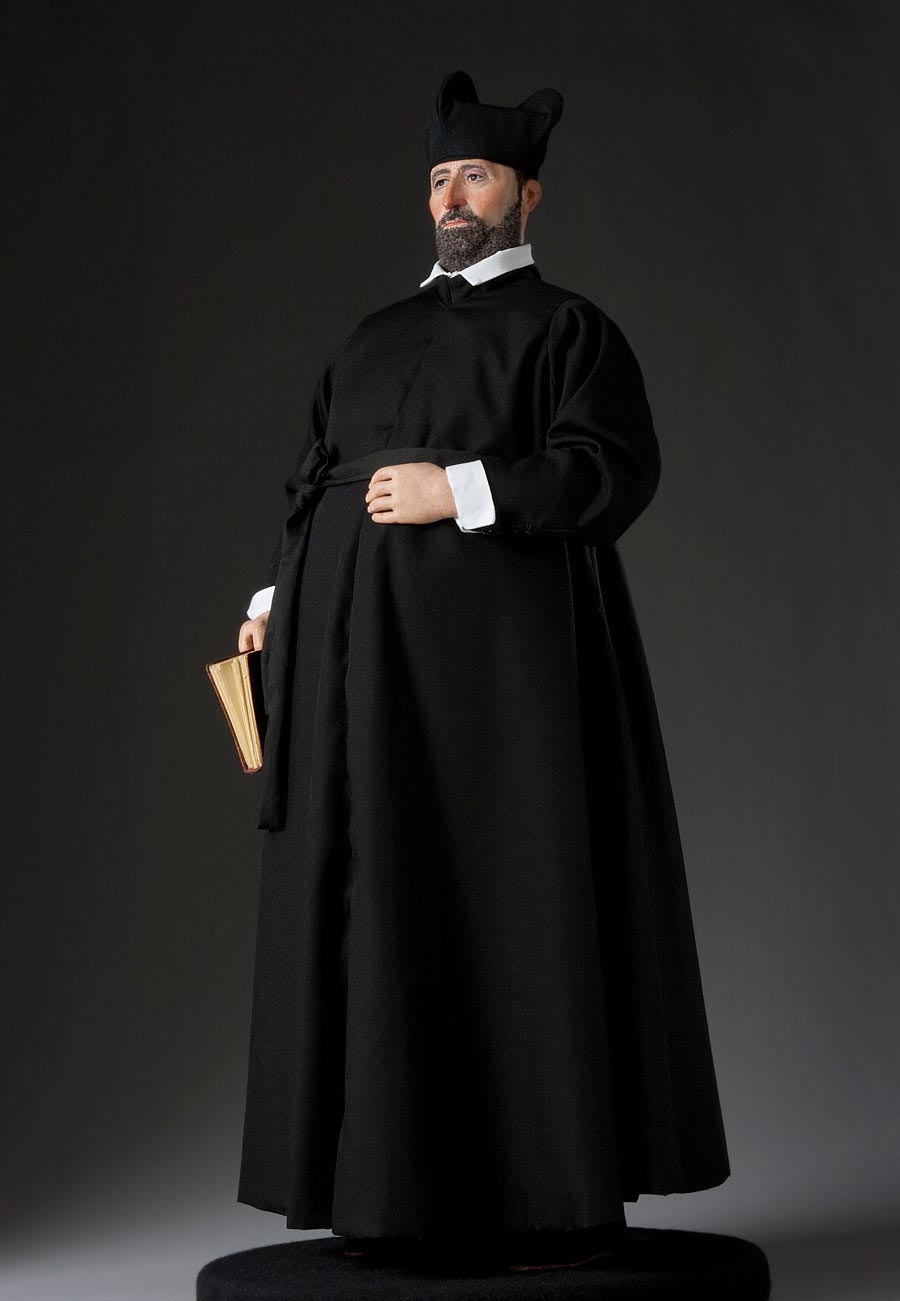
Saint Diego Aloysius de San Vitores

Bookmark and Share


Blessed Diego Aloysius de San Vitores, Priest and Martyr, SJ

Diego (James) Aloysius de San Vitores was born of a noble family in Burgos, Spain, in 1627.

His parents wanted him to follow a military career but Diego had a desire to be a Jesuit from the age of 11. He entered the Society of Jesus in 1640, studied philosophy and theology in Alcalá de Henares before being ordained on 23 December 1651. Despite his desire to be a missionary in China or Japan, the young Jesuit taught grammar at Oropesa and then taught young Jesuits studying theology in Madrid. Finally the superior general, Father Goswin Nickel, assigned San Vitores to the Philippines missions in 1659.
He left Spain on 15 May 1660 and sailed first to Mexico where we spent 18 months before continuing on to the Philippines. While in Mexico City he gave mission and preached in the streets. In 1662, on his way to the Philippines he stopped over in Guam and vowed to go back there some day. Three years later, through his close links to the royal court, he persuaded King Philip IV of Spain and Queen Maria Ana of Austria to order that a mission in the Ladrones group of islands about 1500 km northeast of the Philippines be established.

On arriving in the Philippines he spent some months learning the local language. He was made master of novices and dean at the university in Manila. During the five years he spent there, he also did missionary work in other parts of Luzon and on the island of Mindoro.

When a mission opened in the Ladrones Islands, Diego was chosen to lead it. In June 1668 , he set sail from Acapulco in Mexico to Guam. He gave the Chamorro archipelago the new name of “Islas Marianas” (Marianas Islands) in honour of the Queen Regent of Spain, Maria Ana of Austria, as well as the Virgin Mary. The missionary landed on Guam in the village of Hagatna where he was greeted by Chief Kepuha. Kepuha’s family gave him land to establish the first Catholic mission on the island. On 2 February 1669 Diego established the first Catholic church in Hagatna and dedicated it to the “Dulce Nombre de Maria” (Sweet Name of Mary).

Work in the new mission began very smoothly partly because of a shipwrecked Spaniard whose friendship with several island leaders opened a path for the Jesuits, who imitated the simple life of the natives by walking barefoot, eating frugal meals and wearing a garb made of matted fibres. After only six months the Jesuits had baptised some 13,000 people.

After Chief Kepuha’s death in 1669, relations between Spain and the Chamorro leaders deteriorated. Trouble began in 1670 when Fr Luis de Medina was martyred on Saipan, one of the Las Marianas islands. Diego began to pray for the grace of martyrdom. Then a war which broke out in 1671. Following several attacks on the Spanish mission, a peace was finally negotiated. Although he was inspired by the peaceful methods of St Francis Xavier, Diego recognised that a military presence would be necessary to protect the missionaries on Guam. In 1672, Chamorro resistance increased, led by Makahnas and Kakahnas (indigenous priests and priestesses) from the Chamorro nobility, who felt they would lose their leadership position and status under a Catholic mission and a male-dominated Spanish society.
On 1 April 1672, Diego set out with his Visayan companion Pedro Calungsod to save a servant from what they considered a dissolute life. When the two men entered the village of Tumon, they met a man named Matapang who was one of the mission’s first converts. Matapang threatened Diego, who left the village but did not go far away. When Matapang found him, he threw a spear without warning into the chest of Diego’s companion. The missionary, realising his own end was imminent, grabbed his crucifix and fell to his knees. A companion of Matapang struck the Jesuit in the head, killing him instantly. The bodies were then thrown into the sea.

Diego de San Vitores was beatified by Pope John Paul II in 1985.

He is remembered for his missionary zeal in preaching God’s word to native populations and is acknowledged as the “Apostle of the Marianas”.


Caring for the Catechist as a Spiritual Person

Bookmark and Share


by Kathy Henry


At this time of year when recruiting and training catechists is a top priority, it’s a good time to think about what we can realistically do to help nurture and form the spirituality of those who will have direct contact with the children in our communities. Much has been said about preparing catechists for their ministry. But what about caring for the catechist as a spiritual person?

New catechists often come to us with a bit of fear and trepidation along with the excitement of a new venture. Experienced catechists may come with varying degrees of confidence and/or over-confidence. They may feel refreshed and ready for a new year in the classroom. Or they may feel they’ve done this so long that no preparation is required. What can we do as catechetical leaders to ensure a healthy level of prayer and spirituality before the year begins?

Start by praying for your catechists, collectively and individually. If your program is large, you may find it difficult to pray for all of them individually. If this is the case, consider praying for all of the catechists in a particular grade level each day of the week. Send a note in the mail, a postcard, or an e-mail to each of them, personally welcoming them and letting them know you are praying for them. Include a prayer or Scripture passage you think might be helpful or meaningful. Encourage them to pray for God’s guidance in their ministry, for their students and their families, and for your parish.


Consider offering a day or evening of reflection for catechists, or include extended time in your catechist meeting specifically for prayer and reflection. Sometimes just gathering and praying with others who share a common ministry can invigorate and energize a group. Is there a regional or diocesan event for catechists they can attend that goes beyond the nuts and bolts of theology and classroom maintenance? Make shared prayer a priority.

Be sure catechists are aware of, and have access to, resources they can use on their own for personal study and growth. One of the hallmarks of using an Ignatian-based curriculum (for me) is having a program that addresses the spirituality and formational needs of each catechist. Are catechists aware of all the resources in their catechist manual? Have they been directed to the publisher’s website? Do you make available catechetical magazines or spiritual resources for their personal use? Does your parish have a library, and can you work with parish staff to suggest resources already on hand?

Remembering to minister to those who minister to children can be overlooked in this busy season of preparation. What else can you do to start the year off right?

One helpful resource for catechists is online faith formation webinars, such as those offered by Joe Paprocki. Catechists who can’t participate live can watch the recorded Joe Paprocki webinars at their convenience.


Saint Francis Borgia

Bookmark and Share


St Francis Borgia, Priest, SJ (Memorial)

Francis Borgia was born in Gandia, Spain, in 1510. He was the eldest son of the Duke of Gandia, great grandson of the notorious Pope Alexander VI (known as the ‘Borgia Pope’) and of King Ferdinand V of Aragon. He received a private education and was presented to the Emperor’s court at the age of 18. In the following year, 1529, he married Leonor de Castro and was made viceroy of Catalonia by the Emperor Charles V. He and Leonor had eight children.

In 1543 he succeeded his father as the fourth Duke of Gandia. Because of problems arising from his attempts to put an end to corruption by legal officials, he retired to his estate. He now devoted his time to the development of his property, including the setting up of a Dominican house and the restoration of a hospital.

His happy family life came to an end when his wife died in 1546. In the following year,1547, he quietly entered the Society of Jesus (Jesuits) and passed the dukedom on to his eldest son, while making provision for the rest of the family, including arranging their marriages. The news of this very distinguished candidate to the Society could not remain a secret for long and, although he tried to down play his social status, his genuine ability could not be hidden.

In 1551 he was ordained a priest. Because of his aristocratic birth, great abilities and wide reputation, he was immediately offered a cardinal’s hat. This he refused, preferring the life of a travelling preacher. However, in 1554 he was made Commissary General for the Jesuits of Spain and Portugal by St Ignatius Loyola, the founder and first superior general of the Jesuits. Here his previous experience of government and administration proved invaluable and he established many colleges and other Jesuit houses.

In 1561 he was called to Rome and in 1565 was elected Superior General of the Jesuits. For the remaining seven years of his life he was so active and effective in governing that he has been called the Society’s second founder. He worked for the reform of Christian life in Europe and set up a new Jesuit province in Poland as well as new colleges in France. He also promoted missionary work in other parts of the world, especially in the Americas. In Rome he was one of the founders of the Roman College (later known as the Gregorian University), he built the church of St. Andrew on the Quirinal as well as initiating the building of the Gesu church. Despite the high status of his office, Francis led a humble life and was widely regarded, even in his own lifetime, as a saint.

When the plague struck Rome in 1566, he organised relief for the poor as well as sending Jesuit priests to take care of the sick in hospital.

In 1571, he accompanied a papal ambassador on a visit to Spain, Portugal, and France, which was very successful. However, under the burden of both sickness and the cares of office, he died on 30 September 1572 soon after his return to Rome but not before giving his blessings to his children and grandchildren. He was 62 years old.

He was canonised by Pope Clement X in 1671.

Francis is remembered for his spirit of prayer and his humility that led him to renounce worldly honours in order to live for Christ alone.


Index of Shalom October 2011

Bookmark and Share


  Index of Shalom  October 2011 

Jesuits to Set Up Educational Institute in Timor Leste

Bookmark and Share


After years of consultation and planning and with the return of Colégio de São José to the Diocese of Dili, the Society of Jesus has decided to establish an educational institute in Timor Leste.


The proposed institute, Instituto de Educação Jesuíta, will have two departments: a basic education department, Colégio de Santo Inácio de Loiola, and a teacher education department, Colégio de São João de Brito. It will be located in Kasait, to the West of Dili. Colégio de Santo Inácio de Loiola, an Ignatian high school for boys and girls, will commence in 2013 with a limited intake at Level 7. It will teach in Portuguese, Tetun and English.

Colégio de São João de Brito will commence with the preparation of senior secondary school teachers in 2014. The three-year bachelor’s degree will focus on Portuguese, Tetun, English and Religious Education.


“As a Catholic institution in a Catholic country, there is a need to prioritise and develop competency in religious education and faith development in the local context. A distinctive characteristic of the Institute will be the embedding of the Jesuit mission and identity,” said Fr Mark Raper SJ, Acting Regional Superior, Region of Timor Leste and President of the Jesuit Conference of Asia Pacific.

Fr Raper added that the institute will focus on outreach service programs and extra-curricular activities that develop the whole person.

Ignatius’s Vision of the Holy

Bookmark and Share


by Gary Smith, S.J.

He was short; I’m tall; he grew up in a castle; I grew up on the wrong side of the tracks. He spent years in Rome; I’ve never been there. He was a mystic; I’m not.

But his vision of the Holy took me by force; it’s an invitation inside God’s country, where the world’s empty promises and life’s dead ends fall away before the size and power and distance of Christ; it’s an invitation to claim the centrifugal and centripetal passion of Love and Call, sweeping one into the heart of God and hurling one out to the hearts of God’s people.

Ignatius: Any takers? Smith: I’m in.

Gary Smith, SJ, works with the Jesuit Refugee Service in Kakuma Refugee Camp, Northern Kenya. He is the author of They Come Back Singing and Radical Compassion.

Book Club:Between Heaven and Mirth

Bookmark and Share


In Between Heaven and Mirth, James Martin, SJ, assures us that God wants us to experience joy, to cultivate a sense of holy humor, and to laugh at life’s absurdities-not to mention our own humanity. Father Martin invites believers to rediscover the importance of humor and laughter in our daily lives and to embrace an essential truth: faith leads to joy.

Holy people are joyful people, says Father Martin, offering countless examples of healthy humor and purposeful levity in the stories of biblical heroes and heroines, and in the lives of the saints and the world’s great spiritual masters. He shows us how the parables are often the stuff of comedy, and how the gospels reveal Jesus to be a man with a palpable sense of joy and even playfulness. In fact, Father Martin argues compellingly, thinking about a Jesus without a sense of humor may be close to heretical.

Drawing on Scripture, sharing anecdotes from his experiences as a lifelong Catholic, a Jesuit for over twenty years, and a priest for more than ten, and including amusing and insightful sidebars, footnotes, and jokes, Father Martin illustrates how joy, humor, and laughter help us to live more spiritual lives, understand ourselves and others better, and more fully appreciate God’s presence among us. Practical how-to advice helps us use humor to show our faith, embrace our humanity, put things into perspective, open our minds, speak truth, demonstrate courage, challenge power, learn hospitality, foster effective human relations, deepen our relationship with God, and … enjoy ourselves. Inviting God to lighten our hearts, we can enjoy a little heaven on earth.


Rev. James Martin, SJ, is a Jesuit priest, culture editor of America magazine, and bestselling author of The Jesuit Guide to (Almost) Everything and My Life with the Saints. A frequent commentator in the national and international media, Father Martin has appeared in such diverse outlets as The Colbert Report, NPR’s Fresh Air, The O’Reilly Factor, and PBS’s Newshour, as well as in the New York Times, The Wall Street Journal, and The Huffington Post. Before entering the Jesuits in 1988, Father Martin graduated from the Wharton School of Business. 


Jesus in the Gospels and the Eucharist

Bookmark and Share


by Pedro Arrupe, S.J.


The Eucharist is the center of my life. I cannot imagine a day without the celebration of the Eucharistic Sacrifice. But it is evident that there is a relationship with the Gospels. We find in the Gospels a realistic, historical image of Jesus as he lived in Palestine. And in the Eucharist we find Jesus Christ living today among us. In neither case can we see him with our own eyes, but the story of the Gospels is the word of God. With strong impact it communicates to us the vital meaning of that word. By reading the Gospels we perceive this Jesus of two thousand years ago as living and very near to us. It is as if Jesus of Nazareth continues to live as he lived in former days. On the other hand, the Eucharist is the body and blood of Christ risen, living, present, although he is hidden under the appearances of bread and wine. He makes himself present, he speaks to us, he inspires us, and he gives us strength.

Podcast:How Not to Read the Bible

Bookmark and Share


How Not to Read the Bible

Brian B. Pinter offers an intriguing account of his experiences teaching the Bible to Catholics in parishes in New York. A small but vocal minority of parishioners have taken issue with the historical/critical approach he espouses, preferring instead a literal account of Genesis and other Biblical stories. Pinter explains why some Catholics may be taken by a literal interpretation of the Bible and why a historical/critical approach actually enriches the reading experience. A campus minister at Regis High School in New York City, Pinter also offers some hopeful reflections on the faith of young people today. 


 Download