Category: Uncategorized

Podcast:Young Jesuit Evangelists

Bookmark and Share


How do you talk to young people about the Catholic faith in a way they can understand? For the editors of The Jesuit Post, the answer lies at the intersection of faith and popular culture. In this conversation, the Jesuit scholastics Paddy Gilger, Eric Sundrup, Jim Keane and Sam Sawyer explain the genesis of The Jesuit Post and how they hope to connect to young seekers via the Web.


Download MP3


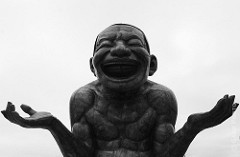
Why There’s No Laughter in Lent

Bookmark and Share


By Lisa Kelly

Sometimes the voice of God comes to me in different voices. That of my spiritual director. That of my husband. That of my fourth grader. Tonight it came to me in the voice of Tom Hanks.

A while back, before Lent, I had the most hysterical prayer experience. Really. Some people pray and speak in tongues. Others receive the gift of tears or wisdom. Me? I receive the gift of laughter.

I was sitting in my typical morning prayer space, chai tea at my side, walking through the steps of presence-ing, openness, and then, in good Ignatian fashion, reading the scripture for the day, placing myself in the scene, using all my senses, almost to the point where I could feel the breeze blowing off the Sea of Galilee as Jesus spoke. The reading was from Mark 5.

The apostles were in need of bread. Jesus was somberly warning them symbolically against seeking bread from the Pharisees. In my prayer I’m standing behind a few of the apostles, when one leans over and whispers to the other quizzically, “What is he talking about???” And the second leans in, and in the most annoyed voice says, “I don’t know. I think he’s pissed we forgot the bread.” At that second Jesus looks right at me and just rolls his eyes and sighs with a smirk and I, sitting in my prayer chair, just doubled over in laughter. Tears are streaming down my face as I read it again. It was better than an SNL skit. They were so utterly human. I could do nothing but laugh deeply at Jesus’ predicament, the straight man to the ignorant Will Ferrell-like apostles. It was such a wonderful gift of prayer.

But just as I sat to write about it, in comes Tom Hanks in the “There’s-no-crying-in-baseball!” voice saying “You’re laughing? You’re laughing? There’s no laughing in Lent!”

I am stopped cold at the keyboard. Seriously? Everything in my nature wants to fight that sentiment—why can’t there be laughter in Lent?

I turn to Ignatius. Teach me.

And there it sits. Note 80 of the Spiritual Exercises. The Eighth addition to Help for Prayer in the First Week: “[I try] not to laugh nor say a thing provocative of laughter.”

As translated by David Fleming, S.J., “I do not try to find occasions to laugh, knowing how often laughter can be the attempt to escape from the uneasiness of a situation.”

Now that’s a serious downer. But once again, I am hit over hit over the head with the Truth.

My desire to write about and fill my prayer with laughter may reflect my uneasiness with the realities that Lent calls me to face: the realities of sin, fear, hatred, suffering, sacrifice, and even death. None of these are a laughing matter. At some point, I have to grapple with them within the world, within myself, seriously. Lent is the Church’s way of making sure we all make some time for that point to happen. Yes, laughter is very much a part of the beautiful human nature that God has created and to not laugh for 40 days seems inhuman to me. I hear the author of Ecclesiastes say there is a time for everything. I trust that this time without laughter holds invitations for my growth. I trust that if I’m willing to make some somber space in my life, not hiding behind the surface laughter or “busyness” that really stems from my insecurities, there is much to be gained from this season.

And before I dive head first into this somber season, I find myself heartened by one thing in particular: I’ve seen this movie before and I know who gets the last laugh!

The Jesus of the Gospels Becomes Our Jesus

Bookmark and Share


by Jim Manney


To follow Jesus we must know him, and we get to know him through our imagination. Imaginative Ignatian prayer teaches us things about Jesus that we would not learn through scripture study or theological reflection. It allows the person of Christ to penetrate into places that the intellect does not touch. It brings Jesus into our hearts. It engages our feelings. It enflames us with ideals of generous service.

Imaginative prayer makes the Jesus of the Gospels our Jesus. It helps us develop a unique and personal relationship with him. We watch Jesus’ face. We listen to the way he speaks. We notice how people respond to him. These imaginative details bring us to know Jesus as more than a name or a historical figure in a book. He is a living person.

David L. Fleming, SJ

Discovering Wholeheartedness

Bookmark and Share


TED is a nonprofit devoted to spreading good ideas. It does this mainly through conferences featuring short talks, which are then published on the web. Here is a very good one by an academic researcher whose motto was “if you can’t measure it, it doesn’t exist.” She was disconcerted when her data showed that this simply isn’t true. (Watch it here if you’re getting this post by email.)


Jesuit advocates ‘do-it-yourself church’

Bookmark and Share


Catholics have to “face the fact that today we live in a do-it-yourself church,” step forward to “take responsibility,” and “no longer wait for Father or Sister to do it anymore,” said Jesuit Fr. Thomas Reese, who addresses that theme in a new book, A Survival Guide for Thinking Catholics.

The well-known author, social scientist and commentator mentioned the book, which does not yet have a publisher, during a recent NCR interview.

In the book, Reese says he advocates facing issues head-on, such as the exodus of faithful from the church.

“The problem with most books like this is that the last chapter begins, ‘The bishops should’ or ‘The pope should do X, Y and Z.’ I think, frankly, that is a waste of time,” Reese said. “I am tired of reading those books. I think what we have to do is say, ‘OK, these are the problems that are facing the church. What do I need to do? What do we have to do?’ “

One of the advantages of fewer priests and religious sisters in today’s church “is that the laity have to grow up,” he said.

“The church needs to develop a new style of teaching and proclaiming the Gospel, one that is dialogical, one that listens as much as speaks,” he added. “At times we seem totally incapable of doing that.”

At the same time, Reese said, “Clericalism is two sides of the same coin. There is authoritarianism on one side. The other is laity wanting [clerics] to do everything for them.”

Currently a senior fellow at the Woodstock Theological Center at Georgetown University in Washington, Reese was editor of the Jesuit weekly magazine America from 1998 to 2005. He resigned after prolonged tension with the Vatican over the magazine’s open treatment of sensitive church topics, from priestly celibacy and the ordination of women to stem-cell research and reception of Communion by pro-choice Catholic politicians.

Reese is the author of a half-dozen other books, most of which focus on church organizational and political structures and challenges. His 1989 book, Archbishop: Inside the Power Structure of the American Catholic Church, for example, was a nuts-and-bolts research volume based on more than 400 interviews and participation from 31 American archbishops, including all the cardinals.

An Exercise in Desire

Bookmark and Share


by Jim Manney

The theme of Week 5 of our Lent-Easter Ignatian Prayer Adventure is “What Do I Really Want?” This is an excellent question; a good one to ask at the halfway point in Lent. Ignatius believed that once we rid ourselves of disordered attachments and discover what we really want, we’ll discover what God wants for us too.

Here’s a way to pray about desire. It’s by Anthony de Mello, SJ, in his book Sadhana: A Way to God:

Place before God the desires you have for yourself: expose him to all the great things you desire to do in his service. The fact that you will never actually do them, or that you feel incapable of doing them, is irrelevant. What is important is that you gladden the heart of God by showing him how immense your desires are even though your strength is very small. It is thus that lovers speak when they express their immensity of their desires which far outdistances their limited capacity.


When We Can’t Have What We Want

Bookmark and Share


by Jim Manney

It’s a problem we’ve all experienced: we deeply desire something; we think God has put the desire in our hearts; but it seems impossible that we’ll ever have it. Ignatius had a suggestion, Lisa Kelly says:

Ignatius told his companions that the solution to dealing with this tension . . . is to step back in prayer and recognize and name both poles, the current reality and the future desire of our heart. As a detached observer, to walk around them in our minds and see them from all angles—looking for God’s invitation within them as well as our own over-attachment.

Sometimes the current reality will be really hard to admit because it hints at our failures. Sometimes we are too focused on the future to see the goodness we have right here and now. Sometimes the now is so good we fear a different future and act out, trying to keep anything from changing. Christ sits next to us in all of these, trying desperately to get us to see He is right here and will be no matter what the future holds.

Finding Your Way

Bookmark and Share


by Jim Manney

If someone you know is looking for direction in life, point them to “How to Discern the Elements of Your Personal Vocation” by Peter Ryan, SJ. It’s an excellent essay that sets forth “points to bear in mind,” the first of which is that “sincere discernment infallibly succeeds.”

Another point is that we “discern only what to try.”

After all, we do not know the future, and we could die at any moment. The real possibility that we could die before we carry something out or that other things could intervene and make something impossible should warn us not to conclude that we are definitely called to do something in the future, but only that we are called to try to do it. Often enough, all God wants is the effort; and if we make the effort, we produce the results he desires.

Life of a Spiritual Athlete: Learning to Sing

Bookmark and Share


by Matt Spotts, SJ 


Late last fall, I gave my first public singing performance. I had picked up voice lessons for the first time in my life just previously, and was totally shocked by how much I enjoyed it.

I appreciated the music I was learning. I liked my teacher, and, while I am not what one might refer to as a “good singer”, I enjoyed hearing myself get better bit by bit. A dear Jesuit friend, someone I’ve lived with for almost four years, said one day, “You know, your voice has really improved… like, noticeably.” I suspect he might have been saying as much about the “before” as the “after,” but I choose to remember the moment as a compliment.

As much as I liked my lessons, I was far less excited about singing for a “voice jury” at the end of the semester. I felt well enough while warming up, but as I walked into the room to sing I could feel my stomach and chest tightening as my nerves fired up like little engines.

Predictably, my performance was mediocre. I was off pitch, off time, and my voice had little passion or power. The nerves had taken over, and it showed.

But the performance wasn’t a total loss, as one of the jurors made an interesting observation on his evaluation card as the last notes of my performance were still fading from our ears. It’s an observation that’s stuck with me. “Singing,” he wrote, “is an athletic activity, not an intellectual activity!” And he was absolutely right, at least in my case.

Put in a situation where I was uncomfortable, where I was in the midst of the unfamiliar, I started to think about all the things I was supposed to be doing, thinking about the words of the song, the musical score, my breathing and technique. The trouble was that I thought so much about these things that I choked off the emotion, the athleticism, that would have brought the songs to life.

***

Often, when I talk to people about their prayer, I notice in their stories the same sorts of preoccupations that I notice in my own prayer. Even after several years of formation as a Jesuit, I sometimes still get preoccupied by thinking about whether I’m praying the “right” way; I get to thinking about whether I need to “fix” something in my prayer, or even whether I should be praying about something else altogether.

Eventually, I’m thinking about prayer so much that I can’t pray.

Thinking is a good thing. Here at The Jesuit Post we encourage thinking (mostly). However, especially in prayer, it can be really important to clear the clutter of thought out of the way. When that happens, when I remember that prayer is as much an athletic activity of the soul as an intellectual activity of the soul, I find myself rediscovering prayer the same way I rediscover my voice in a song. I feel that familiar lifeblood of passion and energy, that excitement that helps me fall topsy-turvy, head over heels, in love with God all over again.

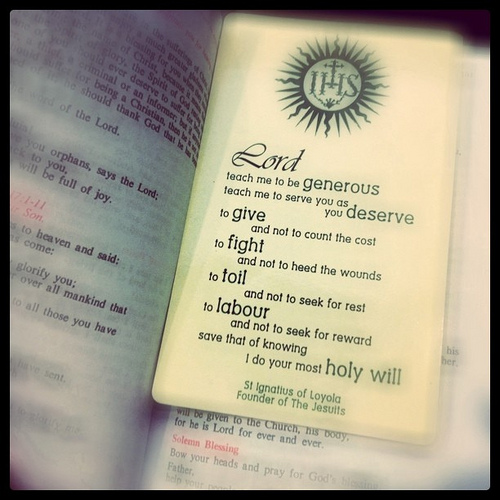
Teach Me to Be Generous

Bookmark and Share


by Jim Manney

A while back, I felt deflated when I discovered that the wonderful Prayer of St. Francis (“Lord, make me an instrument of your peace”) wasn’t written by Francis at all. It was written in 1912 by a writer for a small French Catholic magazine. My disappointment wasn’t on the level of discovering the truth about Santa Claus and the Tooth Fairy, but it stung a bit. I wish Francis had written it in the 13th century.

So imagine how I felt when I found out that something similar is likely true of St. Ignatius’s wonderful prayer for generosity. You know it, I’m sure:

Lord, teach me to be generous,

to serve you as you deserve,

to give and not to count the cost,

to fight and not to heed the wounds,

to toil and not to seek for rest,

to labor and not to look for any reward,

save that of knowing that I do your holy will.

Turns out that no one can find any reference to this prayer before 1897. The oldest publication of it dates from 1910, where it appeared as “The Scout’s Prayer” in a French Boy Scout manual. The author is unknown, but no one who has looked into the matter thinks that it was Ignatius.  British Jesuit Jack Mahoney has all the details on the website ThinkingFaith.org.

I’ve prayed the Prayer for Generosity many times, thinking that Ignatius wrote it. Does it matter that he didn’t?

I don’t think so. It’s a great prayer. It expresses wholehearted commitment, a desire to imitate Christ, a generous spirit, and a readiness to work hard–all sentiments associated with Ignatian spirituality and the Spiritual Exercises. They fit Ignatius perfectly. You feel like he could have written that prayer, just as St. Francis could have written the prayer attributed to him.

Maybe Ignatius didn’t write the Prayer for Generosity in the sixteenth century. But the spiritual movement he started was healthy enough in the twentieth century to produce a prayer that sounds just like him. That’s impressive.