Category: Uncategorized

Meeting between the General Council and CLC

Bookmark and Share


On Tuesday, 27 March 2012, Fr. General and his Council met with some members of the Executive Council of Christian Life Community (CLC). The purpose of this meeting was to explore how these two Ignatian bodies in the Church could continue their close collaboration. There was exchange of gratitude and appreciation for the constant support to one another. Then the members of the meeting looked into the various dimensions through which CLC, as a Lay Apostolic Body, could carry the Ignatian charism into all the areas such as their daily life, apostolic involvement, and responsibility for institutional works. Final discussion was on the oncoming celebration of the 450 years Jubilee of Ignation communities in the year 2013.


The Meaning of a Kiss

Bookmark and Share


by Tim Muldoon

During Holy Week I’ve encountered two very different and yet equally profound meanings in the act of a kiss. The first, of course, is the act by which Judas symbolized his betrayal of Christ: a tender, intimate act which was a lie and a travesty. The other was the act by which we show reverence for the cross of Christ in the liturgy of Good Friday.

I celebrated Good Friday liturgy with my family at Campion Center in Weston, Massachusetts, home to a community of retired Jesuits. There is a beautiful chapel there somewhat reminiscent of the baroque style of the Jesuit church in Rome, the Gesù, and being there calls to mind the grand sweep of Jesuit history symbolized by that church. As I looked around the congregation, I saw men who have spent decades in service to Christ. They have been professors, pastors, presidents. They have served in Beirut, Beijing, Boston, and Botswana. They have baptized, taught, built, preached, and given spiritual direction to thousands. Now, here they live out what is likely their final assignment: they move slowly with walkers, or are pushed about in wheelchairs, and spend much time in silence.

The celebrant raised the cross as he and two other priests approached the altar: “behold the cross of Christ, on which was hung the salvation of the world.” The three of them processed around the large chapel, pausing for those who were non-ambulatory, so that they might kiss the cross. The rest of us later processed up the center aisle in order to similarly revere the cross.

It was the faces of those old Jesuits who inspired me. For a moment, I saw not an old man in a wheelchair, but a missionary still responding to the Call of Christ the King. They would raise their arms and lovingly bring the wood of the cross to their lips and kiss the feet of the One for whom they had toiled their whole lives. There was something in their eyes. I could see it. They are still in love.

Ignatius writes in the Spiritual Exercises, “love shows itself more in deeds than in words.” A kiss is a small gesture, but it is a symbol, a manifestation of something deeper that stretches across years, lifetimes, and generations. It is a deed by which a person can render back to God the love that God has given. Once again the Jesuits have taught me something: the meaning of a kiss.

Podcast:Re-emphasizing the Jesuit Business of Values

Bookmark and Share


Fr. Joseph Christie S.J. 

Fr. Joseph Christie, SJ, presently the Director of LIBA (Loyola Institute of Business Administration), Chennai, India, was on a visit to Rome for participating in the annual meeting of The International Association of Jesuit Business Schools (IAJBS). He narrates about the environment where he grew up as Christian and the inspiration, which enabled him to become a Jesuit and eventually the Director of an esteemed business school in South India. Holding the leadership of the African Initiatives of IAJBS, Fr. Christie explores the possibility of developing business education in Africa. He stresses the point that Jesuit business education should differentiate itself from other business schools by giving certain value orientation and a holistic formation to its students.


Download MP3


Wisdom Story 33

Bookmark and Share


by Paul Brian Campbell, SJ 

The visiting historian was disposed to be argumentative. “Do not our efforts change the course of human history?” he demanded.

“Oh yes, they do,” said the Master.

“And have not our human labors changed the earth?”

“They certainly have,” said the Master.

“Then why do you teach that human effort is of little consequence?”

Said the Master, “Because when the wind subsides, the leaves still fall.”

source from: Tony de Mello, S.J. 


Higher Education at the Margins charts future course

Bookmark and Share


Higher Education at the Margins charts future course
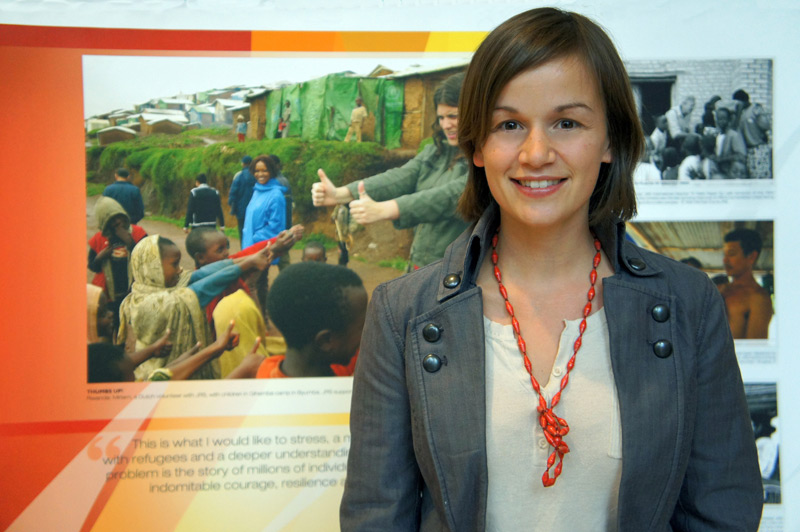
Clotilde Giner, site coordinator at the Dzaleka refugee camp in Malawi, is one of 120 attendees at the first international Jesuit Commons: Higher Education at the Margins ‘Think Tank’ at Regis University designed to envision and chart the future of a program that for the past two years has been providing online education to refugees in Kenya, Malawi, and Syria. (Photo by Rhonda Sheya, Regis University)

The first international Jesuit Commons: Higher Education at the Margins Think Tank at Regis University came to a rousing conclusion March 8 with a final round of spirited discussions, poignant presentations and the promise of recommendations that will guide the organization’s future in bring Jesuit higher education to those at the margins of our society.

Jesuit Catholic higher education leaders and innovators from nearly 30 countries were among 120 attendees at the four-day event March 5-8, designed to envision and chart the future of a program that for the past two years has been providing online education to refugees in Kenya, Malawi, and Syria.

The desired outcome of the ‘think tank’ is to expand the vision and outreach of JC:HEM to empower those at the very edges of our societies through access to Jesuit higher education so that together we may foster hope to create a more peaceful and humane world.

The final day of the conference featured a session on Learning and Synthesis, facilitated by author Paul Nakai and Mary McFarland, international director of JC:HEM and a Gonzaga University professor; a session on Commitments and Responsibilities for the Future with presentations by Fr. Michael Garanzini, S.J., president of Loyola University Chicago and Secretary of Higher Education for the Society of Jesus, and Fr. Stephen Privett, S.J., president of the University of San Francisco; and a closing session and forward steps by McFarland.

A fishbowl and large-group conversation the previous day proved beneficial for participants as well. That discussion included Father Garanzini, Lesley-Anne Knight, Jesuit Refugee Service International Administrative Council; Fr. Michael Lewis, S.J., Jesuits of Africa and Madagascar; Fr. Michael Smith S.J., MCD University of Divinity and Nakai.

The ambitious agenda also included a pre-conference on the first two days which focused on current JC:HEM education programs in Kenya, Malawi and Syria, and offered development and problem-solving discussions on topics such as curriculum, Ignatian pedagogy, human and fiscal resources, organizational structures, and technology. Luis Amaral, S.J., Kakuma Camp, Kenya; Clotilde Giner, Dzaleka Camp, Malawi; and Anne Ziegler, Aleppo, Syria; all also provided updates their respective camps.

Another major conference highlight included two keynote addresses featuring Vincent Cochetel, United Nations High Commissioner for Refugees regional representative for the U.S. and Caribbean, who spoke about “Lives at the Margins – The United Nations Looks at the Future” and Father Garanzini, who spoke on “The 450-Year Jesuit Mission at the Margins.”

Also among the ‘think tank’ attendees were Heroic Leadership author and Jesuit Commons President Chris Lowney; Peter Balleis, S.J., international director of Jesuit Refugee Service; author Paul Nakai who facilitated the conference; Fr. Gregory Lucey, S.J., president of the Association of Jesuit Colleges and Universities (AJCU); Fr. Charlie Currie, S.J., former AJCU president; and Michael A. Evans, S.J., National Director of Jesuit Refugee Service/USA.

JC:HEM is an initiative of the Society of Jesus that brings Jesuit higher education to those at the margins of our society. JC:HEM works with the Jesuit Refugee Service and more than 15 Jesuit universities that has enabled more than 250 refugees to study courses online and on-site in partnership with a global network of Jesuit universities. Those refugees can earn a diploma in liberal studies and pursue community service learning tracks for a certificate of completion that benefit daily life in the camps.


Listen MP3


The Pronoun “God”

Bookmark and Share


by Tim Muldoon 

The word “God” is a pronoun whose antecedent we do not know.

When we are struck by beauty, when it lays claim to our attention and nearly takes our breath away, or when beholding the beautiful makes us for a moment deeply aware that there is much more in the world than we can possibly understand, even if we should read all the books and gather all the data-then we are beholding God.

When we allow ourselves to fall in love-to release ourselves to love, to be overpowered by love such that we cannot control the cascading of emotions (heartsickness, profound desire, anguish, overwhelming joy), we are allowing ourselves an experience of God.

When we act in faith-that is, orient our lives toward something we can only partially understand right now, like who we’ll be when we grow up, or how we’ll make our way in the world, or how our talents might unfold in the future-we are breathing the breath (Lat. spiritus, Heb. ruah, Gk. pneuma) of God.

These and other experiences remain only experiences until the point at which we begin to reflect on who God is.

God is, as Augustine says, “more intimate to me than I am to myself.” But just as I may be unaware of the most interior parts of myself, I may be unaware of God. If I am of a discerning mind and heart, I will come to acknowledge God, but I will never come to know him. Only God can reveal himself to me.

We cannot name the experience of God, lest we limit it and thereby lose its full meaning. We cannot explain it to another, even with the cleverest of parables or allegories. The best we can do is point others to how they too might name their experiences of God. In the ancient days, the prophets reminded Israel that God was at the heart of who they were as a people. God revealed himself as the giver of the law, the principle of right action for the individual and the community.

John the Baptist, another prophet, said that the one who is to come will show us God. He reminded us that sin gets in the way, and that repentance is a clearing of obstacles to knowing God.

Jesus taught in parables in order that we might turn from sin toward God. Jesus showed us the way to the Father. He is the supreme parable, icon, sacrament of God.

Following him, what remains is the life of deepening friendship with God, whereby we gain our freedom. We deepen the life of God in us and move ever closer to God.

Jesuit Electronic News Service Vol. XVI, No. 5

Bookmark and Share


Father General


Interview to Father General. As we have been reporting in our previous Bulletinsin the last few months, Father General has visited Vietnam and Australia (January) and three Provinces in the “tribal belt” of India, Jamshedpur, Ranchi and Hazaribag (February). On his return, we approached Father Nicolás with some questions. Here are his answers.


Q. In recent months you have returned twice to Asia during the assembly of the Provincial Conference of Asia-Pacific (in Australia) and South Asia (in India), two very different areas of the world.  Could you describe briefly your feelings about the two regions?

A. It is impossible to answer “briefly” to such a question. I thought before that the plurality and variety of countries and cultures in Asia-Pacific made it impossible to speak of any kind of uniformity and that we had to accept diversity as the norm. After visiting the three Indian Provinces in the so-called “Tribal Belt” of India, I have to extend what I felt for East Asia to the Sub-Continent. No stereotype can do justice to the rich and varied reality of the people and their cultures. It is truly an overwhelming experience, that confirms in me the need to do research and study the different peoples and their lives with great respect and love for their different ways of life.


Q.  In your journey to Australia, you stopped for a few days in Vietnam. What impressions do you have ?after ?visiting this young Province?

A. That the Jesuits in Vietnam have great challenges to face. That they are in a moment of great creativity, regarding the life of the Church, the style and structures of Religious Life, the Vietnamese incarnation of the Gospel and of Ignatian spirituality, which is one way of approaching, incarnating and living the same Gospel in the Church. My hope is that they are courageous enough to dare live the Gospel in its radicality, and reflective enough to do it in such a way that they become a living help to the Christian Community and the whole of Vietnam. I have great expectations for this young Province. These expectations are based on the way they have gone through suffering, war and all sort of difficulties in their life of faith; on the way they are managing to comunicate their faith from one generation to the next; on the uncanny ability to harmonize incredible gentleness with enormous personal strength; etc.


Q. In the Asia-Pacific Assistancy there are many countries that are very different in every respect, including East Timor, the new state that emerged after a long war and great suffering.  How is the Society developing here?

 A. The Society is developing in East Timor in a way that is every time more “normal”. The screening of vocations is improving; Formation has been followed up with the needed changes; the Region has been going through a process of discernment and creativity regarding the new School being planned; Fr. Mark Raper, who is now the Major Superior of East Timor, is following up the major issues of the Communities and apostolates in a way that is very promising for the future.  


Q.  Briefly, what are the main challenges for the Society in Asia today?

A.  On the one hand and on account of the ‘de facto’ globalization of systems and values, that we are going through in the world, Asia has the same challenges we all have in terms of meaning, values, depth, pluralism, creativity, etc. On the other hand, Asia is the privileged repository of great Wisdom that finds itself under threat. I think the Society cannot allow that the loss of this Wisdom happen without an all out effort at learning from Asian Traditions, Asian Wisdom and Asian Spiritualities, for the sake of the Church and of the whole world.

A great challenge for us Jesuits, which we share with all other Religious in Asia, is to be so deep and so consistent in our life and message, that we can be credible in the midst of Traditions characterized by depth, compassion, detachment and inner freedom. Just living in Asia as a member of a so-called “Religious” group is a great incentive to live the Gospel in fullness. I hope that we take this challenge with all its implications.


Q.  What can we “old” Europeans (and I would say we “old” Jesuits) learn from this continent?

A. There is much that we, “old” Europeans and Jesuits can learn from Asia, Africa, or Latin America. After all, we are not that old: Chinese culture, wisdom, and even medicine are much older than any European claim at antiquity. Europeans have been great at some aspects of the human journey. But we have neglected other aspects, that other human groups in other parts of the world have nurtured and developed. To think that human progress and development have to follow the European model as the best, only indicates how deep and insensitive our ignorance of humanity can be. Fortunately I have always known Europeans who approach with great respect other Eastern or Southern Traditions, and who know that the best response to lack of understanding, when it happens, is silence.


2011 FACSI Report.  In a letter dated March 7th, Father General presents the 2011 FACSI Report.  Here, we present some data and reflections.  “In 2011, we distributed a total of 801,539 Euros (compared to 908,794 Euros in the previous year).  This amount was divided among 29 projects in diverse Provinces and continents, involving various works and initiatives of the Society.  I received 48 project proposals in 2011.  The committee which I had set up to examine these proposals had to reject many of them, especially early in the year, due to the lack of available funds.  A number of others were not considered because they did not correspond to the purposes of FACSI . . .   Considering the types of apostolates funded, education and intellectual apostolate are at the top of the list, with ten projects approved receiving 42% of FACSI’s available funds.  The pastoral sector came in second place, with ten projects approved, with these receiving 25% of the available funds.  The social sector comes next, with 22% of available funds distributed among seven projects.  Two projects, involving the means of social communication, received 10% of funds.  There were some other projects of various kinds.”  Finally, this year, emergency help was given especially to the flood disaster areas in Tanzania and the Philippines.  The letter concludes by detailing some data on the distribution of funds to different continents and the sources of these funds.


The Service of the Society of Jesus in Times of Disaster.  In a letter to all Major Superiors dated March 12th, Father General shares some thoughts on the service the Society of Jesus is called to give in times of natural disasters.  After highlighting the examples of Saint Ignatius, Saint Francis Xavier  and the first companions who “were committed to serving their neighbors both through Spiritual Exercises and works of charity”, according to the Formula of the Institute, Father General writes: “We turn to our world today, where many continue to suffer in similar ways from unforeseen disasters.”  After enumerating a few of them, he continues:  “These and other disasters have given rise to an impressive movement of compassion and solidarity among many groups, organizations and individuals.  Moved by the love of God that we ourselves have experienced, we are invited to collaborate with others in order to contribute what we can to alleviate the sufferings of people affected by these calamities.  Already, so many Jesuits and our collaborators are doing this.”  Eight practical guidelines follow to “help us render service that is both more effective and more evangelical.”  1. “The first and most important guideline rests with the Jesuit communities and institutions present in a location or country struck by a disaster.”  2. “Our care for disaster victims must be both practical and spiritual.”  3. Collaboration: “Whether we take the initiative or whether we cooperate with others in their initiatives, Jesuits are called to be open to and, indeed, to build up forms of collaboration.”  4. Share information.  5. Show and welcome international solidarity.  6. Transparency and accountability.  7. “Much support is often needed later after the immediate emergency phase, especially when other agencies have left the disaster area.”  8. “When the most immediate crisis is over, it is important to reflect on root causes of the destruction, so as to prevent the repetition of these catastrophes.”  And then he concludes: “I invite Jesuit communities and works to reflect on these guidelines, with a view to action and implementation.”

 

Ricci’s Lesson to a Modern Missionary

Bookmark and Share


by Mark White 

A Jesuit friend gave me his copy of Generation of Giants, by George H. Dunne, S.J., not long ago and told me that this history of the Jesuit mission in China in the 15th and 16th centuries reveals a particularly great hour in the saga of Jesuit history. Indeed it does; that much I really already knew. But in reading the book, I have come to see that the lives of the wonderful “friends in the Lord” who made up the Christian Church in China are more than an artifact to be cherished by Jesuits. They were witnesses to the meaning of our Christian mission to evangelize, now as much as ever.

At one point in the story, after the death of Matteo Ricci, the first great leader of the mission and a man of magnetic grace and genius (an Italian whose face now appears on a Chinese postage stamp), a rising Chinese bureaucrat launched a vicious crusade against the Jesuits in order to further his own political career. He succeeded in obtaining an imperial edict banning the Christians, and the modest inroads the mission had made into an acutely xenophobic land were destroyed. The Jesuits were sent packing, either into hiding with powerful Chinese friends or back to Macao, the Portuguese outpost on the southwest coast of China. They temporarily retrenched, determined to wait out the storm that Shen Ch’iieh had visited upon them, and they busied themselves studying the literature and languages of China.

At this nadir in the story I am moved to ask a question certain Jesuits seem to have had no trouble answering: Why? What exactly were they trying to do? What good would come of their toil? Weren’t they fooling themselves? How could they possibly have presumed to think that they had anything to offer the Chinese, especially after they have been shown the door so rudely? They brought scientific and mathematical knowledge the Chinese considered useful, but apparently not useful enough. Why not head back to Europe and work on the myriad problems back home? Some of their brothers in Rome were asking the same questions, wondering why, after nearly two decades, the mission had so few baptisms to show for its trouble. Weren’t Ricci and the others just wasting their time?

During my time with the Jesuit Volunteer Corps I often heard other volunteers, not wanting to be associated with anything that smacked of colonialism, adamantly rejecting the application of the term “missionary” to our undertaking. It is true that we were not sent to the inner-cities to “convert” the population. Our apostolates are in education, community organizing or social service. Jesuit volunteers have jobs to do, and ‘propagate the Gospel” is not part of any job description. Many of us have the idea that we are to be of some modest use, that we would work to make the world a more “socially just” place. We had joined up with J.V.C. in order to accomplish something. There is a religious dimension to our desire for justice, to be sure, but most of us are deathly afraid to talk about it.

Unfortunately, after two years working at a Jesuit middle school for inner-city boys, I have to face some facts. I have not been able to generate measurable results. I have worked till I went home practically weeping with exhaustion and frustration; yet the poor are still with us. The chaotic, dangerous world in which our students have to grow up has not changed. I have made some dear friends along the way among my fellow volunteers, teachers and students, but I cannot list my “accomplishments.” Perhaps my presence has changed lives for the better; perhaps not. There is no way to know. Why have I done it? What, after all, have I done?

Matteo Ricci and those who followed in his footsteps into the dangerous and mysterious depths of Ming China knew where to look for the answer. They looked to Christ, to the ministry–the “accomplishments”of Jesus. Ricci’s mission was so purely Christian, and therefore so elusive, that it mystified the pious bean-counters looking for mass baptisms in 1600 and it confounds the politically correct looking to expose cultural imperialism today. Matteo Ricci’s “mission” was to make friends. That was his apostolate, as, by the grace of God, it has been mine. Nothing was more important then; nothing is more important now; nothing could ever be more important, because the Gospel, I have come to see, is truly shared only among friends.

RICCI respected those he met so much that he wanted to know everything that they knew. He loved them enough to tell them that he knew something that was better than anything they had ever heard. Because he listened so carefully to them, Ricci’s friends paid attention to him as he told them of the Lord in their own language. There, I think, is where the Christian call to mission and the ideal of social justice come together and, in fact, become one: in a conversation between friends. “I do not call you servants, because I have revealed to you everything that the Father has revealed to me. I call you friends.” Jesus teaches us this: If you listen to everything that someone wants to tell you, no matter how painful or jarring it may be to hear, then, when you say, “God loves you,” perhaps that person will actually believe you.

Index of Shalom April 2012

Bookmark and Share


The Two Standards

Bookmark and Share


By Joseph A. Tetlow, SJ

From Making Choices in Christ

Jesus contrasted his way to the way of the world quite emphatically: “He who is not with me is against me” (Luke 11:23). Master Ignatius helps us apply this to ourselves in a key meditation in the Spiritual Exercises called “A Meditation on the Two Standards”—a “standard” meaning a flag.

Stand with Jesus or with the Way of the World

…All disciples have to choose where we are going to stand—with Jesus or with the world. No matter what life the Spirit has drawn us to, once we are baptized and confirmed we are called to stand in Jesus’ company under his flag.

We begin to move under Jesus’ standard when we join him in the living conviction that everything we have and are is God’s gift. However much or little we have, we say gratefully, “Look at all God has given me.” Then the way opens through the smoke of self-satisfaction and approval of others. “How can I help?” becomes a daily preoccupation. And through a life of love and service, the Spirit leads us to live as meekly and humbly as the Lord lived—whether we are a famous ballerina or an anonymous computer programmer.

The way of the world differs entirely. The starting point is getting as much wealth as you can. You say, “Look at all this stuff I have.” When the world’s way opens before you, you shift your focus, saying, “Look at me with all this stuff.” As those around you grow more deferential, you start saying, “Look at me.” You become convinced that you are the center of your world. You may not have sinned yet, but it is only a matter of time.

Three Forms of Collusion with the World’s Standard

Even without subscribing to theories of the subconscious, we can see that the world’s standard is as inviting to Christ’s disciples as it is to anyone else. In a way, even after we have made a solemn, lifelong choice to follow Christ’s standard, we have to purify our daily life of collusion with the world’s standard. The collusion comes in three forms.

First, there is benign secularism. Certainly, there are people who do not know Jesus Christ who lead deeply good lives. But even the baptized can live in a benignly secular way. We join civic movements and help the needy because that’s what our neighbors do. We are good to our families and honest in the workplace. There is no immediate harm in this way, but neither is there anything more than a secular spirit, even though people today call it spirituality.

The second form of collusion, seen particularly in the affluent first world, is the search for pleasure. We are surrounded by people who live what St. Paul describes as the way of the flesh. Those who follow this way are the target of advertising; they need to have whatever everyone else has right now. Their less lovely side manifests self-indulgence, lust, envy—all seen as acceptable social mores. The flesh has its own laws, and those who follow this way will readily obey those laws into sin.

Finally, there is the collusion of succumbing to darkness. Think of the report of an adult who forced a twelve-year-old to kill another and then drink some of his blood. It is evil manifest. But most of the works of the dark are not manifest. Hatred, vengeance, violence, self-destructive habits—these flourish in the dark corners of the sinful human self.

In your heart of hearts, you may loathe the dark and leap to the light. But in everyday life, you will find yourself in the twilight of benign secularism or the flesh over and over again. You will find safety in Christ’s standard only if you resolutely begin everything with thanks to God and keep watching what you are doing and why you are doing it.

Excerpt from Making Choices in Christ by Joseph A. Tetlow, SJ.