Category: Uncategorized

Jesuit Electronic News Service Vol. XVI, No. 11

Bookmark and Share


From the Curia


Meeting of JRS Regional Directors.  The two-week period between 25 May and 1 June was a busy time at the Jesuit Refugee Service International Office in Rome.  The Regional Directors of the ten JRS regions met with the International Director, Fr Peter Balleis, to address ways to implement the JRS Strategic Framework 2012 – 2015.  The group of directors focused on building “a stronger, more united JRS” by jointly developing more coherent governance and management standards, which are built on the values of subsidiary and participation, and which reflect transparency and accountability.  Specific topics addressed included continued implementation of JRS human resources policies, and the establishment of an international fundraising strategy.  Also considered were plans to follow up on the recent JRS Urban Refugee Workshop in Bangkok, as well as last March’s Advocacy and Communications Workshops in Rome.  During the annual meeting, the senior management team of the ten Regional Directors and the International Director also met with members of the JRS Administrative Council and with Fr. General.  This group discussed ways in which JRS can promote effective communication with the Provinces and Jesuit Conferences.  Prior to the full Regional Directors’ meeting, JRS’s five new Regional Directors attended a week-long orientation session with the JRS International Office team. 


The International Commission on the Apostolate of Jesuit Education (ICAJE)will meet in Rome from June 7 to 9. The annual meeting is an opportunity for the six regional delegates and the Secretary for Secondary and Pre-secondary Education to come together, share the state of Jesuit Education, evaluate the programs and plan the projects that can address the main task of becoming a global network. During the meeting each delegate presents a regional report on the development of Jesuit Education. Will also be discussed and reviewed such issues as some of the recent speeches of Fr. General on Education, the program and expectations for the upcoming International Colloquium of Jesuit Secondary Education in Boston (ICJSE); the need for a new document on Education dealing with our mission and identity and the possibility of a partnership agreement between the International Baccalaureate Organization and the Society. The meeting is a unique opportunity to contribute to the renewal of the Apostolate of Jesuit Education, another important goal of the Commission.


Appointments


Father General has appointed:

– Father Susaimanickam Arul  Regional Superior of Kohima Region (India). Father Susaimanickam, at present Superior of the Holy Family Centre of Pfuitsero, was  born in 1957, entered the Society of Jesus in 1980 and was ordained a priest in 1992.


From the Provinces


ALBANIA: Honor to Fr Valentini

On May 7, 2012, Bamir Topi, President of the Republic of Albania, conferred the highest honor of Gjergi Kastrioti-Scanderberg to the memory of Fr Giuseppe Valentini,S.J.  He “devoted his whole life to Albania, offering an essential contribution to the deepening of issues concerned with Albanian ethnicity, its culture and history.”  For these reasons, he is considered one of the founders of Albanology.  The presentation ceremony took place in the President’s palace in Tirana, in the presence of the Apostolic Nuncio, the President of the Episcopal Conference, the Jesuit community in Tirana, as well as the many Albanian intellectuals who had promoted the initiative.  Fr Gian Paolo Salvini, director emeritus of Civiltà Cattolica, received the award on behalf of the Italian Province.  Fr Salvini lived with Fr Valentini in Milan for a number of years.  Fr Giuseppe Valentini was born in Padua in 1900, and he died in Milan in 1979.  He arrived in Albania in 1922, and he remained in Scutari until 1943, when he had to flee after the death sentence was passed against him by the communist regime.  He studied the Albanian language and culture in depth.  Through his countless writings, and drawing on many aspects of the missionary methods of Matteo Ricci in China, he strove to build bridges between cultures, but always in the context of faith.  Many of his works in the Albanian language have been published in 20 volumes.  About another 40 will follow to complete his opera omnia.  Fr Valentini also explored the byzantine world, as well as the Venetian influence in Albania.  This is celebrated in the 22 volumes of Acta Albaniae Venetae.  Once back in Italy, Fr Valentini taught at the Oriental Institute in Rome, and was then named professor of the Albanian language and literature at the University of Palermo.  In Milan, he was the first director of Letture, the review published by the Jesuits of San Fedele.  He held the position until his death.


BURUNDI: For the Promotion of Women

“To help the women of Burundi to become protagonists in their own communities”: this is the goal of the project launched some days ago in Burundi by Jesuit Refugee Service (JRS).  The project, in partnership with the Rutana diocese, is situated in Kibimba.  The project comprises an educational farm where women and girls receive courses in literacy, civics, agricultural techniques and livestock rearing.  Through the participation of women, JRS staff seeks to promote food security of the whole population, and to strengthen the communal relations between the local people and the former refugees, who have returned to Burundi after many years of exile in Tanzania.  “Women are the driving force of the family”, says the project director, Herman Nakintije.  “If we want to pursue real societal development we have to focus on them.  By teaching them to read and write and to improve their land cultivation and livestock rearing practices, we will help them offer a better education to their children, and to produce better quality food to feed their families.”  The project is restricted to about 150 women in Kibimba.  The center has land, stables and chicken coops, which allow the participants in the courses to learn agricultural and animal rearing techniques.


CHINA: New Director for The Beijng Center

French Jesuit Thierry Meynard SJ takes over as the international director of The Beijing Center (TBC) from August 1, 2012.  He will succeed Fr Roberto Ribeiro SJ, who is stepping down after completing his three-year term as international director.  “Over the years I have seen TBC growing into a unique place for teaching and research on China,” said Fr Meynard, who is a professor in the Philosophy Department at Sun Yat-sen University, Guangzhou, where he has been teaching since 2006.  “TBC has offered an in-depth knowledge of Chinese language, culture and society to hundreds of students, and the TBC alumni are today engaged in China in many different ways.  We shall continue our mission to provide a rigorous training in understanding China and to foster academic exchanges between China and the world.”  Fr Meynard first arrived in China in 1988 and brings with him wide experience through his work in higher education and life in China, in understanding Chinese culture, and in bridging Chinese and Western cultures.  The Beijing Center was founded in 1988 by Fr Ron Anton SJ, who ran the centre for a decade before passing the reins to Fr Ribeiro.  Initially conceived as a standard Study Abroad Programme, TBC has expanded in unexpected directions – today, it offers scholarships, publications, and a varied menu of programmes.  TBC makes its resources available to students who wish to study in Beijing, to scholars who seek to explore the history and culture of China as it relates to other cultures, and to professional people who desire to understand and to build relationships with contemporary China. For more information: www.thebeijingcenter.org


EGYPT: A Jesuit Discovered the Sources of the Nile

Richard Francis Burton and especially John Hanning Speke have gone down in history as the discoverers, in 1858, of the sources of the Nile.  They located them in Lake Victoria.  But, in fact two centuries earlier, Spanish Jesuit Pedro Páez discovered the main source of one of the largest rivers in the world.  Marco Tosatti, an Italian journalist, speaks of this in his contribution to Antes que Nadie, published by the Spanish writer Fernando Paz.  In his book, Paz devotes a chapter to the heroism of the Madrid Jesuit, who predated by two centuries the unveiling of one of the great mysteries of history.  In fact, Burton and Speke located the origin of the White Nile in Lake Victoria.  But it is flow that matters in a river, and it is the Blue Nile which carries 80% of the water.  The Blue Nile holds up the waters of the White Nile, until they join together at Omdurman.   And these are the waters identified by Father Páez.  He was born in 1654 in Olmeda de la Cebolla in Spain.  He studied in Coimbra, became a priest in Goa, and then began a journey to reach the Somali coast.  It was an odyssey that took him through every kind of adventure: malaria, pirates, capture by the Turks, torture and imprisonment.  Finally, he was sold as a slave to the sultan of Yemen.  He then crossed the desert barefoot, eating locusts.  Páez traveled and described places such as the desert of Hadramaut, and Rub-al-Khali, the discovery of which other Europeans took the credit two centuries later.  In 1603, he left to evangelize Ethiopia, calling himself Abdullah.  He remained in Abyssinia for twenty years.  One day, while accompanying the king on a horse ride, he discovered the sources of the Nile.  It was April 21, 1618.   


INDIA: Training Tribals in Electronic Media

Students from Bangladesh, India and Nepal have benefitted from a course in video production conducted by a Jesuit institute in Ranchi, capital of the Eastern Indian state of Jharkhand.  The Lievens’ Institute of Film and Electronic Media (LIFE) organized a fifteen-day certificate-course on various aspects of electronic media.  The students were given training in communication and production processes, ranging from screenplay writing to cinematography, lighting, sound and online production.  The course was practice-oriented, and the students worked in groups.  Each group produced a news story and a short film.  The course ended with a live studio production in which students used a multi-camera setup to produce a talk show on tribal-related issues in Jharkhand.  Rituraj Sapkota, the course animator, said the course covered topics which are usually taught over a four to five month period.  He said the students learned new concepts and skills easily, although most had little or no prior training in communication and production.  The Jesuits of Ranchi set up the Institute last year in honor of Fr Constant Lievens, who is known as the apostle of Chotanagpur.  The Institute conducts regular courses for local people, especially tribals.


INDIA: Migrant Workers’ Movement in Kerala

Fr Martin Puthussery SJ, originally from Kerala but belonging to the Calcutta Jesuit Province, came to Kerala and began his mission of helping migrant workers in July 2011.  Thousands of impoverished Tamils, Bengalis, Oriyas and Biharis are flocking into the thriving state of Kerala, looking for work.  Many of these migrants are challenged by the locals who look down on them and consider them dirty, unhygienic and even possibly criminal.  Some of them, suspected terrorists, end up in jail, as it was the case of Kora.  Fr Puthussery was able to get him out of prison and to help him return home to West Bengal.  Fr Puthussery is conversant in both Malayalam, his mother tongue, and Bengali.  This skill alone makes him a highly valuable link between the locals and the migrants.  Local courts in Kerala seek his help as interpreter during interrogations with laborers from the Eastern States.  Now he and two religious sisters have formed the Migrant Workers’ Movement in the urban centre of Ernakulam.  This Movement provides legal aid to the migrants.  This is a highly challenging project, with an enormous workload.  “Officially there are 1.3 million migrant workers in Kerala now, but the unofficial figure is closer to three million,” says Fr Puthussery.  “About 40 percent of them are from underprivileged districts of West Bengal.” 


ITALY:  Encounter of Civilization

On May 10, the exhibition “Encounter of Civilizations: Father Matteo Ricci European Ambassador in Ming’s China” opened in Macerata, at the Biblioteca Mozzi Borgetti.  The exhibition presents an integrated narration, through documents and images, of the first significant meeting between the Chinese and European civilizations in modern era.  It was the Jesuit Matteo Ricci who inaugurated this meeting.  This explains the title of the exhibition: a meeting of civilizations.  It was Ricci’s desire and goal that this meeting should take place, and he was finally received at the imperial court, as “European ambassador”, on 24 January 1601.  Ricci never lost the European dimension of his mission, and he often signed himself with the title “European Matteo Ricci.”  The exhibition is comprised of both documents and an historical narrative, and it focuses on Ricci the man, his mission, and his work.  The exhibition is designed for the general public.


ITALY: Precious Discovery

In Modica, Sicily, hundreds of books from an old Jesuit library have been discovered and restored.  The discovery is invaluable.  It fills in the historical record and the cultural context of a span going back as far as five hundred years.  The books were found in some basements of the Study Centre, where they had been stored and forgotten.  This valuable legacy came to light again, and was restored to the community through the determination of some teachers of Campailla high school.  The 500 odd books deal with canon law, theology, moral philosophy, Lenten and other sermons: they were published mainly between 1500 and 1700.  All bear the stamp of the Capuchins, but they are the legacy of the Jesuits who had their residence and study center in that building, which is now the headquarters of the high school.  The authors are mostly members of the Order.  The content of this find enables us to understand the cultural, philosophical and moral trend of those times.  There are also some Latin classics, volumes which are now no longer available.  Among the interesting and curious is a volume on “The controversy on the consumption of a cup of chocolate during Lent.”  It is a philosophical dispute between Dominicans, Franciscans and Jesuits on the consumption of chocolate.  That dispute was understandable in Modica, a town famous for the production of chocolate.


SPAIN: A Magic Magazine

The University of Deusto launched El Diario Tomorrow, a magazine which invites you to participate in rewriting the news with a positive angle.  El Diario Tomorrowis a magic magazine; it focuses on the news of the future.  The participants choose a current news item, and rewrite it imagining how it will unfold in a few years.  The rule is to post positive messages, because negative ones have ample airplay every day.  The participants who rewrite the news in this virtual magazine can share their efforts through social networks.  The aim is to offer a positive and optimistic dimension to the crises and negative news which fill our airspace.  The focus of the exercise is directed mainly to young people.  It calls them to “change the world” by rewriting reality and imagining a better future.  But the initiative is open to everybody between the ages of 16 to 100.  The first aim of El Diario Tomorrow is to draw out a smile; but the magazine will offer a prize of an Interrail ticket for travelling Europe to the person (with three of his or her friends) who will demonstrate the strongest commitment to the positive news initiative.  The winner will be the author of the 10 June 2012 item which has received the highest number of “I like” hits on the webpage of El Diario Tomorrow.  What are the main qualities to participate in the contest?  A positive attitude, wit and sense of humor.  For more information visit: www.eldiariotomorrow.com   

A Catholic Look at ‘Mad Men’

Bookmark and Share


Is Megan a better fit for Don than Betty? Why did Joan do what she did? Why did Peggy leave Sterling Cooper? How does music inform the series? Does Pete have any morals at all? Are Roger and Don friends, enemies or frenemies? And the big question: Where is God in all this?

James Martin, S.J., and Tim Reidy discuss Season 5 of AMC’s “Mad Men.”


Download MP3

Wisdom Story 38

Bookmark and Share


by Anthony de Mello,S.J.

To the disciples who were always asking for words of wisdom the Master said, “Wisdom is not expressed in words. It reveals itself in action.”

But when he saw them plunge headlong into activity, he laughed and said, “That isn’t action. That’s motion.”

Jesuit Electronic News Service Vol. XVI, No. 10

Bookmark and Share


Father General


Visit to the Province of Romania. Father General will visit the Province of Romania from the 19th to the 21st of May. Fr. Pablo Guerrero Rodríguez writes: “I think there are three important events in this trip: the visit to JRS (Jesuit Refugee Service), the Eucharist in Cluj and the meeting with the Jesuits in Cluj. Fr. General wished to visit Romania since a long time and we succeeded in making it to coincide with the 10th anniversary of Centro Manresa in Cluj. Ten years ago, there were the Roman-Catholic Archbishop Mgr. György Jacubinyi, the Greek-Catholic Bishop Mgr. Florentin Crihälmeanu and Fr. General (Fr. Kolvenbach at that time). Both bishops are the same who in that day blessed the Centro Manresa, only our General is ‘new’. The Eucharist and the lunch will be an encounter of priests, religious and lay people with whom we work.  All the Jesuits working in Romania will be present, together with guests from neighboring provinces.  We hope the weather will be nice so as to celebrate outdoors (we expect about 300 people).  The following meeting is reserved for Jesuits.”


From the Curia


SJES: Annual Meeting of Conference Social Apostolate Coordinators. The annual meeting of the Conference/Assistancy Social Apostolate coordinators was held at the Curia in Rome, from May 14-18. This year the major area of discussion and reflection was on the responses of Jesuits to the Ecology document “Healing a Broken World” (Promotio Justitiae, n. 106/2011). These responses were gathered from the Province Social apostolate delegates based on a questionnaire sent from the Secretariat. They revealed a clear picture of our response to the challenges of ecology and environment today both in the Provinces and Conferences. On the last day, the team shared on the state of Global Ignatian Advocacy Network (GIAN) in each of their conferences and the way forward. The members had also an interaction with Fr. General, who complimented them for their committed work and shared his concerns of the Society of Jesus especially in the area of ecology.


Appointments


Father General has appointed:


– Father Peter J. Bisson, Provincial of the Jesuits in English Canada (CDA). Fr. Peter, at present Socius to the Provincial, was born in 1957, entered the Society of Jesus in 1983 and was ordained a priest in 1993.


From the Provinces


AUSTRIA: 450 Years as a Province

On June 10, 1563, the first Provincial of the newly founded Austrian Province, Fr. Nicolaus Lanoy (originally from Belgium), took office. This means that 2013 is the 450th anniversary of the foundation of the Province. Therefore, in April 2010, Fr. Provincial Gernot Wisser SJ appointed a preparatory group in order to compile possible scenarios for the celebration of the Jubilee. At the occasion of the Conference of Local Superiors in November 2010, all communities were asked to talk about the jubilee and the following basic question: “What do we as Austrian Province of the Society of Jesus want to celebrate in the upcoming anniversary year?” The result was a clear vote “for a basic orientation focusing on our way into the future. Equally clearly expressed was the wish to use the year 2013 as an apostolic opportunity and to especially pay attention to our spiritual heritage when defining the content of the presentation.” Then followed a discussion of motto proposals in the preparatory group and in the Province consult. Finally, Fr. Provincial opted for the motto: Companions of Jesus for men. 450 Years Austrian Jesuits. During the same period of time, it was discussed how to celebrate. Finally Fr. Provincial decided in favour of one big apostolic event for three days (7-9 June 2013) in Vienna. “So we are on the road to the Jubilee event and hope it will mean days of joy, of meeting with a lot of friends, of thanking God for his grace during 450 years”.


BELIZE: Jesuit Honored for Life’s Work

Jesuit Father Jack Stochl, of American origin, found his heart’s home when he first went as a Jesuit scholastic in 1948 to Belize, where he remains today at age 87. The government of that Central American nation recently recognized his commitment when it presented him with the Meritorious Service Award for his 64 years of helping the people of Belize by teaching English and, more recently, caring for prisoners. This disciplined man followed the same daily routine for years, rising at 4 a.m. to exercise, pray and teach English each morning at St. John’s College in Belize City. He ran the Extension School in the late afternoon and evening, returning home in time for bed at 9:30 p.m. Fr. Stochl founded theExtension School in 1957 in the heart of Belize City. The school’s academic offerings were limited but effective, and were aimed at helping students earn a grade school diploma that would qualify them for a government job. In 2005, when he turned 80, Fr. Stochl became pastoral minister to inmates of the Belize prison. Fr. Stochl’s work has grown. He goes to the prison at least five days a week and offers Mass on Saturdays for around 100 inmates with no guard present. He also runs three weekly counseling groups and visits men in the Maximum Security and punishment sections. He became a Belizean citizen in 1974, not as a political statement but as a sign that he would remain with the people.


CHINA: Media Praises Xu Guangqi

Mainstream media in China praised Paul Xu Guangqi highly when they reported on Shanghai city’s series of commemorative events to mark his 450th birth anniversary. Xu (1562-1633) was the first Shanghai Catholic convert, and the Holy See is reviewing his beatification along with his master and collaborator, the Italian Jesuit missionary Father Matteo Ricci (1552-1610). Well-known even among non-Catholics in modern times, Xu was regarded as the first Chinese to introduce advanced European scientific knowledge into the country in the late Ming Dynasty (1368-1644) and was also a famous scholar-official, mathematician, astronomer and agricultural scientist. Shanghai Daily, the most influential English newspaper in the municipality, published a report on April 24, Xu’s birthday, describing him as “one of China’s great men of applied science.” The report interviewed Huang Shulin, a cultural official, who said Xu’s “clear and open mind to all advanced knowledge and technology was very precious at his time and is still a legacy for Shanghai people today.”


FRANCE: Catholic Social Doctrine Online

CERAS, The French Centre for Social Research and Action has created a new web site on the social teaching of the catholic church that helps to understand the doctrines in the context of the tradition of the church, of the new theological perspectives and the reading of the signs of the times together with the contributions of the natural sciences. The articles that present the different questions come from very renowned authors. They show today’s position of the Church on about twenty themes, among which: cultures, ecology, laity, liberalism, property, work, politics, migrations, etc. There are eight principles that build the structure of the social doctrine of the Church: common good, charity, universal destination of goods, dignity of the human persons, justice, preferential option for the poor, solidarity and subsidiarity. This site offers to its users a trustworthy, and at the same time practical instrument for a rapid consultation. CERAS offers the texts for translation into other languages. www.doctrine-sociale-catholique.fr.  If you wish to translate them, kindly contact CERAS.


ITALY: Rights Under Construction

To invest in rights in view to promote development and to rethink welfare between justice and real growth:  this is the starting point of Rights under construction, a volume edited by JSN-Jesuit Social Network, the network of activities in social field of the Society of Jesus in Italy. It is a transversal analysis which is the result of a direct interaction between researchers and those groups of people most affected by cuts in spending and social protection. The book was presented in Rome at the beginning of May. In times of crisis, governments limit the costs, including those for welfare services for the citizens, social security, forgetting that where there is no investments on the rights there is no growth and development, and that during the emergency it is important not only to be there but also to be near and to give voice to the weakest, the needy, those who risk to see their dignity humiliated. “To start again from the rights does not mean to divert resources to the development of the country – said Fr. Giacomo Costa, director of Aggiornamenti Sociali, the magazine of the Milan Jesuits. On the contrary, in order to promote development, one has to invest in these rights.” With this contribution JSN wants to offer the legislator a valued tool for the definition of more adequate norms, but it wants also to accompany all public and private entities involved in the planning process and implementation of social policies towards common paths. 


ITALY: Valignano in the Third Millennium

“Valignano in the Third Millennium: the inventor of cultural diplomacy and today’s betting in Asia.”  This is the title of a conference sponsored by the Foreign Ministry and the Japan Embassy in Italy that was held in Chieti, hometown of Valignano, on May 4th.  Among the speakers there was Mons. Giuseppe Pittau, S.J., former rector of Tokyo’s Sophia University, who offered his testimony. Fr. Alessandro Valignano (1539-1606) entered the Society of Jesus in 1573 and was appointed  “Visitor”, that is head of the Oriental Missions. For half a century he organized the spread of the Gospel between India, China and Japan and the missions in those lands, becoming the great strategist of the development of the missionary work of the Society of Jesus, especially in India, China and Japan. The conference of Chieti was a mixing between history and enterprise, culture and economic exchange with Asia. 


NEPAL: Religious Freedom at Risk

“We really hope that the work on the new Constitution will be completed. We appeal to the responsibility and good will of all political forces. We ask, for the future, full respect for religious freedom in Nepal”: this is the appeal launched through Fides agency by the Apostolic Vicar of Nepal, Mgr. Anthony Sharma, while, with the deadline of May 27 approaching, the impasse in the preparation of the new charter has not yet passed.  “The Church, the Apostolic Vicar reaffirms, calls for the new constitution to enshrine full religious freedom.  We want a secular state, which protects the freedom and individual rights and recognize all religious communities. We hope for a Constitution that gives women equal rights, equal opportunities, overcoming finally the caste system.” If the text will not be completed, those principles may be in danger, says Mons. Sharma. “Nepal was a hindu kingdom.  Today there are still parties and groups that want to make Nepal a hindu state. This legagy gave life to the Nepal Defense Army (NDA), a radical hindu group that in the past hit people and cristian targets.  We suspect it is finance d by hindu extremist groups operating in India, such the Rashtriya Swayamsevak Sangh (RSS).” In Nepal Christians communities want to contribute to the development of the country, operating with respect for the dignity of every man.


SYRIA: Jesuit Solidarity

In Alep, Syria, Jesuits are assisting 500 families who fled the areas of fighting.  Other families are assisted in Damascus and in a center not far from Homs. It is an initiative authorized by the Syrian government that employs Christian and Muslim volunteers. A message of peace, the latter, accompanied by a sign of solidarity towards those who have been most unlucky and that stands out against those who right now are fanning the fire of intolerance and differences.  In a conversation with missionary agency Misna, Father Peter Balleis, JRS director, talked about the Jesuit commitment in Syria and the projects which, although small, compared to current needs, bear not only support but also significant messages of dialogue.  It is a humanitarian action effort at alleviating the suffering of large families which, because of the conflicts, had to leave their places of origin.  According to current estimates, refugees and inland displaced are about half a million, mostly from Homs, one of the towns where the confrontation between government troops and armed opposition forces has become more strong in spite of the peace plan of former UN secretary general Kofy Annan.


SOUTH SUDAN: Catholic University, First Graduation

The Pioneer Class of the Catholic University of South Sudan (CUofSS) has completed their four year degree program in Economics and Business Administration and Saturday 12 May marked the graduation event!  The Catholic University of Eastern Africa has agreed to grant CUofSS affiliation status. Fr. Michael J. Schultheis S.J., Vice Chancellor/President of the Catholic University of South Sudan, writes: “As you may be aware, many voiced the opinion at one time or another that it could not be done – at times I all but agreed with them… but the first fruits are here.  Other potential donors condition support on “special projects” such as “planting trees” or “piece-meal projects”, but in fact the University itself is the Project.  This year CUofSS has some 400 students in the Faculty in Juba and 120 students in the Faculty of Agricultural and Environmental Sciences in Wau.  In fact, the baby is born … and with proper nurturing, it promises to be a significant contribution to the Church and the new country of South Sudan, in forming lay people who are competent and committed and have a sense of the social ministry of the Church.” 


THAILAND: To Push for Mine Clearance

On April 4th , in more than 70 countries today, the International Day for Mine Awareness and Assistance in Mine Action,  thousands of people rolled up their trouser legs and stood side-by-side with survivors and communities affected by landmines. These campaigners have taken part in Lend your Leg, an inspirational global day of action launched to call for an end to the curse of anti-personnel mines. “Lend your leg today. With the simple action of rolling up your pant leg we want to remind the world that landmines still present a huge danger and continue to devastate many innocent lives. We want all landmines in Thailand to be cleared by 2018 in accordance with the deadlines set out in article five of the Mine Ban Treaty”, said Norwegian People’s Aid Thailand Programme Manager, Aksel Steen-Nilsen. In 2001, Thailand had around 2,557 square kilometres of mine-affected areas. After 10 years of de-mining by NGOs like the Thailand Mine Action Center(TMAC), around 528 square kilometres of suspected and confirmed hazardous areas are now left to be cleared, according to the Level 1 Survey by Norwegian People’s Aid. In addition to four humanitarian mine action units, four demining NGOs are working using a special methodology. “We believe this approach will speed up mine clearance operations, and if Thailand has commitment from the top, this will enable the country to meet its deadline”, added Aksel.

Sun, Storms, Wilderness, Deserts, and Spirituality

Bookmark and Share


by Ronald Rohleiser, OMI

A number of years ago, accompanied by an excellent Jesuit director, I did a 30-day retreat using the Spiritual Exercises of St. Ignatius. In the third week of that retreat there’s a meditation on Jesus’ agony in the garden. I did the meditation to the best of my abilities and met with my director to discuss the result. He wasn’t satisfied and asked me to repeat the exercise. I did, reported back to him, and found him again dissatisfied. I was at a loss to grasp exactly what he wanted me to achieve through that meditation, though obviously I was missing something. He kept trying to explain to me that Ignatius had a concept wherein one was supposed to take the material of a meditation and “apply it to the senses” and I was somehow not getting that part.

Eventually he asked me this question: “When doing this meditation, have you been sitting comfortably inside an air-conditioned chapel?” My answer was yes. “Well,” this wise Jesuit replied, “no wonder you aren’t able to properly apply this to your senses. How can you really feel what Jesus felt in his agony in garden when you are sitting warm, snug, secure, and comfortable in an air-conditioned room?” His advice was that I redo the exercise, but do it late in the evening, outside, in the dark, cold, subject to nature’s elements, and perhaps even a little afraid of what I might meet physically out there.

He made a good point, not just for my struggle with this particular spiritual exercise but about one of the major deficiencies within contemporary spirituality. Simply put: Our prayer and spiritual quests are not enough connected to nature. For all of our good intentions and hard work, we are too-platonic, too much trying to have our souls transformed while our bodies sit warm, safe, and uninvolved. The physical elements of nature and our own bodies play too small a role in our efforts to grow spiritually.

This is the major critique that Bill Plotkin, an important new voice in spirituality, makes of what he sees happening in much of Christian spirituality today. From our church programs, to what happens in our retreat centers, to the spiritual quests people more deliberately pursue, Plotkin sees too little connection to nature, to the sun, to storms, to the wilderness, and to the desert that Jesus himself sought out.

Plotkin, who doesn’t work out of an explicitly Christian perspective but is sympathetic to it, runs a wilderness center out of which he directs people who are searching spiritually. One of the things that his center offers is a wilderness quest. People are offered the option of going out into the wilderness for some days alone, taking very little to protect themselves from what they might meet there. While sensible precautions are taken and prudence isn’t irresponsibly bracketed, the people doing these quests nonetheless often find themselves pretty vulnerable to the elements and battling a good amount of fear.

And the quests are effective mainly because of that. Real transformation often happens and it is very much attributed to the battle that the one doing the quest had to wage in the face of fear and the physical elements. Plotkin’s book, Soulcraft, contains a number of powerful testimonies of people who share how what they experienced in the wilderness – real exposure and real fear – led to real transformation in their lives. For something to be real it has to be real!

Jesus knew that and went on his own “wilderness quest”, 40 days alone in the desert where, as the Gospels tell us, he did his own battle with “the wild beasts”. We read accounts in the Gospels too of how he spent whole nights outside, alone, praying. It’s no accident that his struggle to give his life over takes place in a garden and not in an air-conditioned church. Beautiful church buildings have power to transform but so too do the sun, storms, the wilderness, and the desert. It’s good to seek out both places, and lately Christian spirituality has been too negligent of the latter.

And it not just the things in nature that batter us and cause us fear to which we need to expose ourselves. Nature also waters the earth. There are few things in life that can induce the joy we can experience by drinking in nature. As the Canticle of Daniel (3,57-88) so wonderfully celebrates it, many things in nature nurture the soul and fill it with life: the sun, the moon, the stars, winds, fire and heat, cold and chill, dew and rain, ice and snow, light and darkness, lightening and clouds, mountains and hills, seas and rivers, plants and animals. Each of these can trigger special memories and special joys, if we stay awake to them.

We need to let nature touch more of our bodies and our souls, both for our spiritual health and for our health in general. For something to be real it has to be real!

Wisdom Story 37

Bookmark and Share


by Paul Brian Campbell, SJ 

A woman once came to Gandhi and asked him to please tell her son to give up eating sugar. Gandhi asked the woman to bring the boy back in a week. Exactly one week later the woman returned, and Gandhi said to the boy, “Please give up eating sugar.” The woman thanked the Mahatma, and, as she turned to go, asked him why he had not said those words a week ago.”

Gandhi replied, “Because a week ago, I had not given up eating sugar.”


The Ignatian Take on the Christian Journey

Bookmark and Share


by Howard Gray, SJ 

The Exercises represent a kind of spiritual journey, as they invite the one who makes them to consider the foundational truths of Christian life: creation as an act of love, human stewardship of creation, sin and forgiveness, the life and work of Jesus as a paradigm of discipleship, Christ’s suffering, death, and resurrection and, finally, the surrender of all human life into the hands of a loving God. The Ignatian take on the Christian journey is to insist that it is a movement, an active progress towards a radical decision to live one’s life in harmony with Christ’s vision and values. The movement towards Christ is both inward and outward, horizontal and vertical, contemplative and active.

Howard Gray SJ,
An Ignatian Spirituality Reader


Index of Shalom June 2012

Bookmark and Share


Broadcasting Faith

Bookmark and Share


by William F. Baker

Breaking into a career in television would have been impossible for me without the intellectual and emotional support of my religion. Summoning the courage to speak freely and truthfully to political officials, corporate leaders and television stars is much easier when you remember that everybody is equal in the eyes of God. That mixture of humility and courage has been present whenever my faith and my working life have intersected.

There were times when being a Catholic in the television business gave me an extra, though necessarily private, sense of pride in my work. In a television studio about a mile from ground zero on Sept. 12, 2001, my friend Msgr. Jim Lisante was a guest of Bill Moyers on a live national broadcast. Bill had invited religious leaders into the studio to discuss the moral and spiritual ramifications of the terrorist attacks. Monsignor Lisante was sitting next to a rabbi, who had just cited an Old Testament text calling for “an eye for an eye.” When he was asked what the Catholic tradition taught in the face of such aggression, Monsignor Lisante looked right into the camera and said, “Forgiveness.” For anybody who remembers the climate of fear and rage that pervaded the country during those weeks, Monsignor Lisante’s courage is something to be deeply proud of.

If my faith has sometimes enriched my work, it has also occasionally made it more difficult. About 20 years ago, I had to decide whether to broadcast a film called “Stop the Church,” about members of the gay rights group Act Up, which disrupted Mass and desecrated the host at St. Patrick’s Cathedral on Fifth Avenue. Though I supported and still support the struggle of gay people for dignity and equality, I found the actions of the protesters in the film deeply offensive. But like the other Catholics I have known who work in media, I kept the private covenant of my faith separate from the public duties of my job. As a Catholic I found abhorrent what as a journalist I was morally obligated to bring before the independent judgment of the public. So the film ran on New York’s PBS station. This made a lunch I had with my friend Cardinal John O’Connor, at his residence near St. Patrick’s some months later, rather tense. I asked him about forgiveness, and he asked me about righteous indignation. We never mentioned it again and remained friends.


I’ve been surprised at times how little even the most educated people in American society understand about the importance of religion in this world. So when Bob Abernathy approached me about producing the television show “Religion & Ethics Newsweekly,” I was a strong supporter, even when the head of the programming department said it was “illegal on PBS because of the separation of church and state.” Clearly education was needed.

Throughout my career, the spiritual vocabulary of the church has given me a big advantage. It has shown me how to see my work sacramentally, as the outward sign of an inward, if not grace, then purpose. Abundant purpose sustains a person or a company when money may not be as abundant. My successes as a manager in the media business, and specifically in the not-for-profit media business, came because I persistently kept the inner justifications for my work in view, whether times were good or bad. And I always encouraged my employees to do the same.

Since retiring from WNET-TV, I have enjoyed the blessing of bringing my work and my faith closer together. I am producing a feature film called “Sacred,” about the deep connections between Islam, Judaism and Christianity. I have also accepted a position on the faculty of Fordham, New York’s Jesuit university. Surrounded there by a community sustained by the faith that has sustained me for so long, I feel very much at home.

president emeritus of the Educational Broadcast-ing Corporation, parent company of WNET-TV and WLIW-TV, where he served for 20 years as chief executive officer, is journalist-in-residence at Fordham University and holds the Claudio Aquaviva Chair at its Graduate School of Education.

Listen to a conversation with William F. Baker.

Download MP3

William F. Baker, president emeritus of the Educational Broadcast-ing Corporation, parent company of WNET-TV and WLIW-TV, where he served for 20 years as chief executive officer, is journalist-in-residence at Fordham University and holds the Claudio Aquaviva Chair at its Graduate School of Education.


How long would you last?

Bookmark and Share


Imagine your feelings if every time you visited a particular friend you were searched, asked a series of intimidating questions and then taken to a hostile and foreign environment. What if that friend was more of an acquaintance? How long would you be able to handle such difficult visiting conditions? A week? Two weeks?

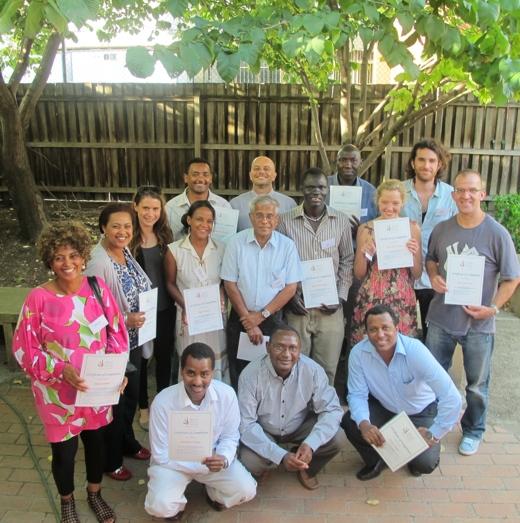
This is the searching question that Jesuit Social Services African case worker Tapuwa Bofu ponders when praising the volunteer mentors in the African Visitation and Mentoring Programme (AVAMP). The programme delivers mentoring support to people from African backgrounds, before and after their release from prison in Victoria, Australia.

“When we visit prisons we are searched thoroughly. You wouldn’t visit a friend if you knew you had to face this every time,” reflected Tapuwa.

“Our mentors are exceptional people,” said Mentor Joshua Futina. “It is all about just being a human being and wanting to so something to help out a fellow human being. A lot of the people we visit have no families here in Australia who can do that for them so we are trying to fill that gap. It is a big commitment and not something I do lightly but I thoroughly recommend it.”

AVAMP mentors are matched with the participants in remand on the basis of skills and shared interests, and visit Port Philip Prison, Melbourne Assessment Prison, and the Metropolitan Remand Centre.

“Relationships is what it’s all about,” said Daniel Clements, Manager of Brosnan Services, which runs AVAMP. “You don’t have to be an African to be a mentor; the idea is to guide them to somewhere they want to be – a place in life they want to end up.”

To ensure good outcomes for the prisoners and their mentors, the mentors receive ongoing support and are provided with training about culturally sensitive practice over 15 weeks. The training aims to develop a supportive mentoring relationship that continues following re-entry into the community.

For more information on AVAMP, contact Brosnan Services on +61 (03) 9387 1233.