Category: Uncategorized

We Can Trust Our Experience

Bookmark and Share


by J. Michael Sparough, SJ
    Tim Hipskind, SJ
    Jimmy Manny

Knowing that we can trust our experience is the first and perhaps the most fundamental lesson about discernment. Books and ideas and the counsel of the wise are all well and good, but the main arena for discernment is what we ourselves experience. We can discern the right direction by thoughtful reflection on our relationships with others, our work in the world, and on the feelings generated by these encounters. They are meaningful because God is in them. Our life is the classroom where the Schoolmaster teaches and guides us.

Whole systems of thought and belief challenge this idea. Ancient philosophical traditions hold that the physical world of matter and human bodies is a corrupt reflection of ideal forms that exist in the heavens. A theological tradition that began with Augustine and blossomed in Calvinism holds that human judgment and reason are hopelessly corrupted by sin, and that emotions are particularly suspect. One of the key ideas of Eastern religions is that this world is essentially an illusion, and that enlightenment comes as we rid ourselves of desires and ambitions and feelings.

In this argument, Ignatius stands firmly on the side of human experience. It is real; it is meaningful; it is trustworthy when we understand it properly.


New Provincials in Brussels

Bookmark and Share


From 28-30 May eight new European provincials came to stay at the St. Benedict community in order to brief themselves on our Jesuit works and ministries at European level.
In attendance were: Vincente Durá (ARA), Franck Janin (BML), Stefan Kiechle (GER), Dermot Preston (BRI), Guillermo Rodríguez-Izquierdo (BET), Francisco Ruiz (ESP), Ante Tustonic (CRO) and Johan Verschueren (BSE/NER).

On the first evening there was a briefing on the work and financial structures of the CEP and a presentation of the European Jesuit Communications Service followed by Mass and dinner with the Saint Benedict community.

On the following day there were visits to JESC, the Foyer Catholique Européen, the European school at Ixelles, a presentation of the work of JRS-E and finally Mass and a buffet supper at the Chapelle de la Résurrection with about 60 invited guests.

On the final morning the provincials had a very useful session with Fr. Dardis inviting them to give their suggestions and comments. The group then went to the European Parliament for a meeting with Sylvie Goulard (MEP). In a frank exchange she spoke about the issues of transparency in the European institutions, the relationship of the parliament with the churches and the current financial crisis.


Index of Shalom July 2012

Bookmark and Share


13th Week in Ordinary Time

14th Week in Ordinary Time

15th Week in Ordinary Time

16th Week in Ordinary Time

17th Week in Ordinary Time

World Union of Jesuit Alumni

Bookmark and Share


The World Union of Jesuit Alumni(ae) was established on July 31st, 1956 at Bilbao, Spain during the Congress of Loyola held on the occasion of the 400th anniversary of the death of Saint Ignatius of Loyola. Its intention was to unify all alumni(ae) of all Jesuit educational institutions through their local, regional, national and international organizations in one common apostolic effort.

The objectives of WUJA are as follows: (1) Preserve and develop bonds of friendship, communication and solidarity among alumni(ae) throughout the world; (2) Encourage alumni(ae) to co-operate actively with the Society of Jesus in its various missions: particularly in education, spiritual life, community service and social justice and (3) Inspire alumni(ae) to implement the education, which they were given, based on Christian humanism and Ignatian spirit, above all so that they play their part, through their personal life and their social action, in building a world where people can fulfill themselves with complete dignity.

Through the history of WUJA, there have been seven World Congresses. 1956 in Bilbao, Spain; 1967 in Rome, Italy; 1986 in Versailles, France; 1991 in Bilbao – Loyola to commemorate the 500th anniversary of the birth of Saint Ignatius. The subsequent congresses have been held outside Europe – in the year 1997 the congress was in Sydney, Australia; in 2003 it was in Kolkata, India. The Seventh Congress was held in 2009 in Bujumbura, Burundi.

The Eighth Congress will be in Medellin, Colombia between 14 and 18 of August 2013. The Ninth Congress will be in the USA in 2017.

For more information about the World Union of Jesuit Alumni, visit www.jesuitalumni.org

The Creator Deals Directly with the Creature

Bookmark and Share


by Jim Manney

A comment about the early Jesuits

There was, however, one “doctrine” that was fundamental for them, one that gave orientation to all their ministries and to the way they wanted to lead their own lives. It was the basic premise of the Exercises, even though it was buried unobtrusively in the fifteenth “Preliminary Observation”: the Creator deals directly with the creature, and the creature deals directly with the Creator—heart to heart, one might say. Upon this teaching Jesuits based their more characteristic themes—indifference, discernment, and inner devotion, or consolation.

John W. O’Malley, SJ
The First Jesuits


The Jesuit Alumni Meeting in Ranchi

Bookmark and Share


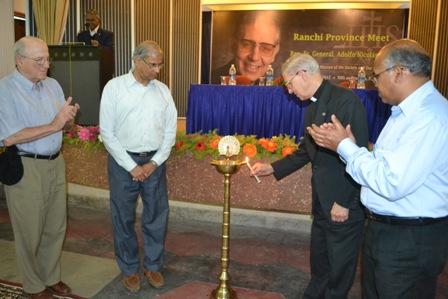
Fr. General, Fr. Adolfo Nicolás, S.J., was welcomed warmly at the Jesuit Alumni meeting in St. Xavier’s Doranda, Ranchi in February 2012. He was accompanied by Frs. Marcos Recolons, SJ and Fr. Lisbert D Souza, SJ (General assistants).

Fr. General’s talk highlights the features and values of Jesuit education while asking for transformation to build a better humanity and cautions the parents and teachers about the influence of Media and Internet on the growing children.


【R.I.P.】Fr Nguyen Dus Thu went to the Lord

Bookmark and Share


Dear Brothers in Christ,

Fr. Augustin Nguyen Duc Thu went peacefully to the Lord on June 26, 2012, 9:30am at St. Vincent’s Hospital, Melbourne.

Fr. Augustin was born in Thach-Bich, Ha-dong, Vietnam, on May 16, 1938. He was ordained to the priesthood at the Vietnamese Martyrs Church, Saigon on Dec. 21, 1967, entered the Society in Thu-duc, Vietnam, on July 13, 1968, and professed his last vows on Feb. 2, 1980 at St. Ignatius Church, Norwood, Adelaide, Australia.

All priests of the Chinese Province will celebrate one Mass first intention for Fr. Augustin’s eternal rest. Those who are not priests will offer one Mass and Communion and recite one “corona”.

Yours in Our Lord,

Luciano Morra, S.J.
Socius
Macau, June 26, 2012

Reviving the Sacred Heart

Bookmark and Share


by James Martin, S.J. 

If you read enough novels that feature Catholic characters, you’re bound to run across a Catholic family described as having an “oleograph of the Sacred Heart” hanging somewhere in their house (usually the kitchen, the dining room or the bedroom). It’s the lazy novelist’s shorthand for a certain kind of kitschy, overheated devotional stance that is supposed to “locate” for the reader the pious sensibilities of the (usually indigent or uneducated) Catholic characters.

The Sacred Heart is one of the few devotions that have probably suffered from its artistic representations. Many of the images with which older Catholics are familiar are both kitschy and off-putting: a doe-eyed Jesus pointing to his heart, which is always pictured outside his body. There is the yuck factor (the bleeding heart surrounded by a crown of thorns is often pictured in gruesome detail) and the disbelief factor (there’s no way that a carpenter from Nazareth looked so effeminate). It’s a tragedy that art has distanced many Catholics from a powerful way of looking at Jesus.

The devotion began with the mystical visions of Jesus and his Sacred Heart as revealed to St. Margaret Mary Alacoque (1647-1690), a Visitation Sister living in the French town of Paray-le-Monial. As is often the case, the sisters in her community were highly doubtful about her reported visions. At one point Margaret Mary was told in prayer that God would send her “his faithful servant and perfect friend.” Shortly afterwards, the mild-mannered St. Claude la Colombiere, a Jesuit priest living nearby, was assigned to serve as her spiritual director. Later, Margaret Mary would have a vision that showed their two hearts (hers and Claude’s) united with the heart of Jesus.

From that point the two worked together to spread the devotion, which became strongly associated with the Jesuits, who promoted it with vigor in the following centuries. As the devotion flourished, the paintings, mosaics, sculptures and yes, oleographs proliferated. So did parishes, hospitals, retreat centers, schools and universities named in its honor. Everything you know that is named “Sacred Heart” (including the great church of Sacré Coeur in Paris) stems from these two people-and Jesus of course.

(By the way, Fr. Claude wasn’t thought of too highly by his brothers either. Jesuit communities used to have house “historian” who would record the events of the community life. The final few days before Claude’s death were recorded as follows by the house historian: “Nothing worthy of note.”)

In time, though, devotion to the Sacred Heart fell off to such an extent that Pedro Arrupe, SJ, then the superior general of the Society of Jesus, had to remind his brother Jesuits in 1981: “I have always been convinced that what we call ‘Devotion to the Sacred Heart’ is a symbolic expression of the very basis of the Ignatian spirit.” He told them that the Sacred Heart is “one of the deepest sources of vitality for [my] interior life.” Yet Father Arrupe acknowledged, “In recent years the very expression ‘Sacred Heart’ has constantly aroused, from some quarters, emotional, almost allergic reactions.”

Those “allergic reactions” mean that we are missing a powerful and vivid symbol of the love of Jesus. For the Sacred Heart is nothing less than an image of the way that Jesus loves us: fully, lavishly, radically, completely, sacrificially. The Sacred Heart invites to meditate on some of the most important questions in the spiritual life: In what ways did Jesus love his disciples and friends? How did he love strangers and outcasts? How was he able to love his enemies? How did he show his love for humanity? What would it mean to love like Jesus did? What would it mean for me to have a heart like his? How can my heart become more “sacred”? For in the end, the Sacred Heart is about understanding Jesus’s love for us and inviting us to love others as Jesus did.

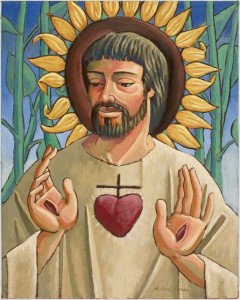
Perhaps newer images are needed to revive this storied devotion (like the one above, by Michael Moran, a Passionist). Or perhaps we just need newer ways of thinking about this Solemnity, which is today.

Last year I participated in the “Hearts on Fire” retreat, a young-adult retreat sponsored by the Apostleship of Prayer. It was a wonderful day-and-a-half of talks and prayers and songs and sharing led by a group of talented young Jesuits. (This summer Hearts on Fire is making its tour of the South.) During one session, Phil Hurley, S.J., the director of the program, gave a lively presentation to the young adults on the Sacred Heart. He recounted how he had recently shown some images of the Sacred Heart to some schoolchildren. “Why do you think Jesus’s heart is shown on the outside of his body?” he asked the children.

One girl spoke up: “Because he loves us so much that he can’t keep it in!”

Mind the Gap between Faith and Life

Bookmark and Share


by Jim Manney 

When I was a kid, my faith and my life went together pretty easily. I learned a very practical faith from the nuns in school and my parents at home. No lying. No violence. Cooperate. Be generous. Think of others. Be trustworthy. Work hard. Do what you’re told. It was a useful ethical code, grounded in the Sermon on the Mount, Jesus’ parables, and other teachings of the gospels. Faith and life were one.

Things got complicated when I went to high school. The Christian Brothers who ran the school taught the familiar Christian code, but other values were important among the students—things like popularity, swagger, and cunning. It seemed to me that my classmates were more like the pagan Romans we studied in Latin class than the early Christians—admiring power and beauty rather than humility and service. People who cheated got ahead of people who played by the rules. Boasting, threatening, and sneering got you into the in-crowd. Showing off got you dates. A gap began to open between what I believed and the way I lived.

Things got more complicated still when I went to work. One of my first jobs out of college was working as a newspaper reporter. I worked with many wonderful people, but I also regularly dealt with scoundrels and liars. I often had to do favors for these people to get what I needed. I learned the advantages of telling less than the full truth. I learned how to manipulate other people. I learned how to get what I wanted and not worry too much about what I did to get it. I went to Mass on Sunday, and for the rest of the week I did what I thought I needed to do to get by.

For some years now I’ve been trying to break down that wall between what I believe and what I do. It helps that my career has been in religious publishing; my colleagues are nicer than the fixers and “consultants” I dealt with as a reporter in New Jersey. But I still have challenges—at work, with my family, with my friends. Sometimes things don’t go my way, and I feel resentful. Sometimes I’m sure, absolutely sure, that I know what people should do, and I’m amazed and hurt when they do something else. Sometimes, hard as it might be to believe, I’m wrong. Sometimes I give into these feelings of resentment and pride, and make things miserable for other people as well as myself.

Two things have helped. One is to be aware of myself, especially of my weaknesses. Certain things touch me off. Certain reactions of mine are almost certainly excessive and inappropriate. I’m on the watch for them.

The other is to look for signs of God’s presence throughout my day. Breaking down the wall between faith and life isn’t just a matter of doing the right thing when you’d rather not. It’s also a matter of finding God in all things. God is there in church on Sunday. But he’s also there in the meeting at work, in the lunch date with a friend, in the errands you run. Just look.

The Grace of Detachment

Bookmark and Share


by Becky Eldredge

The grace of indifference or detachment is often what we hope for in prayer. It is the place where we have surrendered to God the outcome of our hopes, fears, and worries, and we trust God enough that no matter what happens, “God’s grace will be enough for me.”

Detachment is not always a gift I like receiving in prayer, at first. Intellectually, I understand that detachment or indifference can be a fruit of prayer. Intellectually, I also know that it is an important component to the Spiritual Exercises. If I am frank, though, detachment can occasionally be one scary place.

For the past year, my husband and I have been discerning our future steps after my husband’s graduate degree was complete. The choice was between relocating to one of two cities. The process of discernment was arduous due to a rather crazy day-to-day rhythm of life, which impacted my ability to find stillness in prayer, and because we felt we were choosing between two goods.

At one point this spring, about eight months into this discernment process, I shared with a friend that I was struggling to find peace about this decision. I told her, “We have learned all we can about both cities. We have prayed about this for months, and I no longer feel pulled strongly to either city. It’s driving me crazy! Why won’t God give me the answer?”

She gently smiled and chuckled and said to me, “Struggling a bit with the grace of detachment?”

That’s when it hit me. For months, I asked for God’s strength, enlightenment, comfort, and guidance in making this decision. Little by little God brought me to a point where I knew that no matter what city it was, I would be at peace. I was detached from the outcome.

I stood still for a moment as both fear and relief washed over me at this realization. The choice was now in our hands. We had discerned all we could with the help of friends and spiritual directors. We had gathered every piece of information we could about both cities. When we looked at the cities side by side and when we compared our pro and con lists, we knew that either city would work.

What does St. Ignatius say to do at this point? Make a decision! Act! And test the fruits of the decision along the way. So that’s what we did and are doing, and while it is still scary at times, it is invigorating to be free to make a decision. Making this decision brought inner freedom only found through God. This place of detachment is a grace-filled place that, despite the fear that can accompany it, brings deep peace and trust in God.