Category: Uncategorized

Chinese cardinal who considered cancer “A blessing”, dies in Taiwan


Gerard O’Connell
Vatican Insider

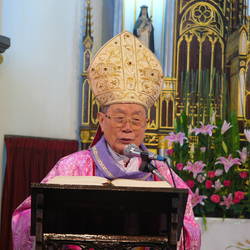
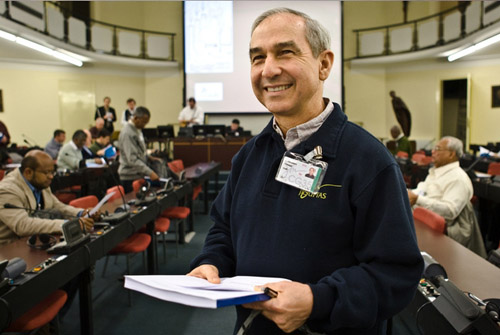
Cardinal Paul Shan Kuo-hsi, the oldest of the three Chinese members of the College of Cardinals, died in a hospital in Taipei, Taiwan, on August 22, after a six-year struggle with cancer.

On hearing of his death, Chinese Catholics worldwide prayed for him at masses in Taiwan, across mainland China, as well as in Hong, Macau and many other places, while Taiwan’s President Ma Ying Jiu and other civil and religious leaders payed high tribute to this greatly revered holy man.

“Like Blessed John Paul II he was an example of how to live and how to prepare to meet the Lord”, a religious sister who had worked closely with him told me. She recalled how when people asked him if he was afraid to die, he always responded: “No! Dying is falling into the loving arms of God.”

He had battled against lung cancer since 2006. When in the spring of this year he was informed that the cancer had spread to his brain, he moved from Kaohsiung to Taipei for further treatment, including cyber-knife surgery. It was the final stage in his long “farewell to life”, a journey conducted with deep faith and trust in God that has made him famous and greatly revered throughout Taiwan, mainland China and the Chinese speaking world.

He considered the cancer a “blessing” that had opened many doors and enabled him to explain the Catholic faith to non-Christians in Taiwan, where 97% of the population is non-Christian. “Many people are surprised that I am not afraid of death, and facing death I am still so calm. So they want to listen to me”, he told me.

Invitations kept arriving, and he decided to give priority to three categories: intellectuals like university scholars and doctors, condemned criminals in prison, and religious groups – including Buddhist, Taoists, Protestant and Catholics. “I have explained our Catholic faith to non-Christians much more in these years than I did in 60 years as a Jesuit”, he said.

When on 5 February 2007, for example, 100 lung-cancer specialists asked him, “‘what means besides medicine do you use?”, he replied, “One that you haven’t paid attention to – my faith!” He told them, “My faith, Christianity, is very simple. Just one word, love, because God is love and the nature of God is immense love.” He explained that he was “not afraid of death, because I know that after death I will enjoy the eternal life of God, which is a life of immense love.”

Cardinal Shan was born in Puyang, in north-eastern Henan province on 3 December 1923. He joined the Jesuits in Beijing in 1946 and took his first vows there in September 1948, but was sent out of mainland China to study for the priesthood just before the Communists came to power in 1949. Following his priestly ordination in the Philippines, he was sent to study at the Pontifical Gregorian University, Rome. Afterwards he was sent to work first in Vietnam and then in Taiwan where he spent the rest of his life, serving as bishop first in Hwalien and then Kaohsiung. John Paul II made him a cardinal in 1998 – the fifth Chinese cardinal in the history of the Church. That same year Shan was “General Relator” at the Synod for Asia, and in 2007 Pope Benedict appointed him a member of the papal Commission for the Church in China, whose situation was always close to his heart.

Since the early 1980s, Beijing has warmly welcomed cardinals from Italy, Belgium, France, Scotland, USA, the Philippines and Vietnam, but it has showed no such readiness to allow the only two living Chinese cardinals who were born in the mainland – Paul Shan Kuo-hsi and Hong Kong’s Joseph Zen Ze-kiun, to visit the land of their birth

Beijing only once allowed Shan to return to the mainland – in 1979. He dearly wanted to return there one last time before he died, and meet again his younger sister and other family members but the Chinese authorities refused to grant him a visa in 2011 because he would not accept their condition that he should go to Beijing too. He knew that if he went there his visit could be manipulated for political reasons by having him meet people in leadership positions in the government established bodies that control the life of the Catholic Church in China. Ever a man of principle, this great soul was not willing to make such a compromise to obtain a visa.

Months later, while visiting the closest point between Taiwan and mainland China, he looked across the straits and raising his hand, waved and said, “Goodbye my sister, we will meet in heaven!”

In an interview with me in Rome, March 2007, he expressed optimism about the future of the Church in the mainland because, he said, “We are in the hands of God, and from history we know that no dictatorial regime will last forever!”

Ordinary Lives, Extraordinary Purpose


by Chris Lowney,S.J.

Authenticity is the first test of my values and purpose. If I say I’m here on earth to repair the world or to be holy, do I really, really mean it? Do these ideas make me live and work differently, or do they ultimately hold no more significance than an empty slogan emblazoned across a glossy corporate annual report? Can I say that I’m here on earth for a reason, or am I simply drifting along, grasping after whatever suits a short-term need or a current fad?

If authenticity of purpose is the first test, then putting purpose into practice is the second and equally daunting challenge. For the loftier our purpose, the more we test our imagination to find everyday ways to demonstrate that purpose in how we live. I may be inspired enough to commit to building the civilization of love, but can I live that extraordinary-sounding purpose throughout life’s very ordinary routines of commuting to work, answering office e-mail, keeping a house clean, balancing a checkbook, and doing chores?

Our values are the answer; they are the means by which we translate purpose into practice all day, every day.


Regis Jesuit’s Missy Franklin


by Jim Manney

If you watched the Olympics, you probably were charmed by Missy Franklin, the 17-year-old swimmer from Colorado who won four gold medals. Missy will be a senior at Regis Jesuit High School in Aurora, Colorado. Lots of famous athletes have Jesuit school affiliations, but with Missy the connection seems especially meaningful. From an interview:

Going into Regis Jesuit my faith was not a very big aspect of my life. Taking my first theology classes, going to my first Masses, going on my first retreats, I began to realize how important God is in my life and how much I love him and need him. My relationship with (God) grew so much within my first three years at Regis Jesuit and I am very happy with where I am with him right now, although there is a lot of more work to do.

She hopes to go on a mission trip to Belize in the winter, and is even thinking about becoming a Catholic.

God is Trying to Catch Our Attention

Bookmark and Share


by William A. Barry, SJ

The Ignatian Exercises rest on the theological assumption that God creates this universe precisely in order to invite other persons into the relational life of the Trinity. God’s purpose or intention of inviting each person into the relational life of the Trinity is not episodic, occurring periodically in each person’s life. God is always acting to bring about this intention.

Another way of making the same point is to say that God is always in conscious relationship with each one of us as our creator, our sustainer, dear father or dear mother, our brother, our savior, the Spirit who dwells in our hearts. Ignatius presupposes that at every moment of our existence God is communicating to us who God is, is trying to draw us into an awareness, a consciousness of the reality of who we are in God’s sight. Whether we are aware of it or not, at every moment of our existence we are encountering God, Father, Son, and Holy Spirit, who is trying to catch our attention, trying to draw us into a reciprocal conscious relationship.

The World is Our House:Jesuit Worldwide Communities

The International Commission on the Apostolate of Jesuit Education (ICAJE) Panel

“It is as a worldwide community – and, simultaneously, as a network of local communities – that we seek to serve others across the world.” (G.C. 35, Decree 2, 20)

We will begin the ICJSE by taking the time to come to know one another through a panel discussion. Without having a better understanding of the global network, collaborative efforts will be more challenging. Brief presentations from each ICAJE member will include a short report on the state of Jesuit education in each region. Panel members will share basic statistics about the region, educational strengths of the region, the main educational challenges of the region, and current projects from the region.


“G.C. 35 and the Mission”
Curia Secretariats Panel

The Curia Secretariats Panel will be composed of four secretaries leading the following apostolic sectors: Promotion of Faith, Collaboration with Others, Social Justice and Ecology, and Higher Education.

The purpose of this session is for each secretary to share his perspectives on the challenges that lie ahead for the Jesuit schools in our present global context and to propose how our school leaders can go about meeting those challenges. This presentation aims to help the schools’ leadership frame the Colloquium within the broader picture of the Society’s mission today.

This session will also allow each secretary to share his reflections on General Congregation 35 as it relates to the Jesuit mission in our schools and educational institutions. After all the secretaries have given their presentations, there will be time allocated for questions and answers.

Collaboration Sessions

The Collaboration Sessions will be a flexible meeting time for participants to meet with one another and discuss issues of interest, exchange contact information, and explore collaboration ideas. The session will provide an opportunity for personal networking interests that arise during the ICJSE. For example, this could be time for two participants to discuss the creation of a partnership. The session may also serve as an opportunity for further group discussions regarding topics that have arisen during the ICJSE and warrant further attention. These “topics,” should they arise, will be posted with a room number and facilitator. This time can also be used for members of the network to connect on issues not necessarily pertaining to the ICJSE. Perhaps participants from the same region would like to discuss an issue only relevant to their region.

Regional Discussions and “Ite Inflammate Omnia

The purpose of the Regional Discussion session is to review, discuss and solicit feedback from participants that will help provide direction for our continued collaborative efforts – after all, the success of our gathering will very much be measured by our future work together as a network! Participants will be grouped according to ICAJE regions and will be lead by regional ICAJE members. The overall benefits of our time together, the vision we have as a network, and the possibility of a future gathering of Jesuit secondary schools will all be discussed during Regional Gatherings. The ICJSE Steering Committee has begun planning a vision statement for how we hope to proceed as a global network, and regional gatherings will ensure that the voice of each region is truly heard before a final vision statement is produced.

During the “Ite Inflammate Omnia” session, ICAJE members will share with the entire ICJSE audience suggestions, feedback, and hopes for the future direction of our network as discussed by each region during their separate gatherings.

Workshops


The following is a small sampling of workshops that will be featured at the ICJSE.


Ethos and Identity Review for Jesuit               An Ignatian Framework for Staff Formation

Schools                                                           in a Jesuit School

Christopher Gleeson                                          Dr. Kang John Tan

Australian Province                                            Wah Yan College

Hawthorn, Victoria, Australia                              Kowloon, Hong Kong, China


The Basics of Fundraising                               Fe y Alegría 

John Baptiste Ganza                                         Enrique Oizumi, S.I.

Saint Ignatius Secondary School                        Fe y Alegría

Kigali, Rwanda                                                  Bolivia         


Face to Faith: Engaging the Global                Jesuit High Schools and the Cristo Rey

Dimensions of Jesuit Education                      Work-Study Model

Johnny Go & Mary Katherine Sheena                  Michael O’Hagan & Gary Menard

Xavier School & Regis High School                      Arrupe Jesuit High School

Manila, Philippines & New York, NY, USA           Denver, CO, USA


Humanizing Globalization through                 20 Years of Experience of International     

Ignatian Arts Education                                   Partnerships

Christina Helms                                                 Olivier Surel

Istituto Leone XII                                                Le Caousou

Milan, Italy                                                        Toulouse, France


Pasión por La Misión, en un grupo de            Can We Teach Social Justice?

Laicos directivos de un Colegio de la             Emphasizing Social Justice in our

Compañia                                                       Curriculum

Claudio Vinicio Soliz Cortez                               Norbert Menezes, S.J.

Liceo Javier                                                       Jesuit Education Association

Zona, Guatemala                                               New Delhi, India 


De una Red de Escuelas Jesuitas,                  How Can We Guarantee Jesuit Ethos in

a unas Escuelas Jesuitas en Red                    a New African School?

Xavier Aragay                                                    Peter Henriot, S.J.

Fundació Jesuïtes Educació                               Loyola Jesuit Secondary School

Barcelona, Spain                                               Kasungu, Malawi


Reanimating IPP (Ignatian Pedagogical         A Multicultural and Multi-Religious

Paradigm) for Maximum                                 Population in a Catholic Jesuit High School:

Instructional Effectiveness                              Management and Strategic Choices

Jane Cacacho                                                   Johan Verschueren, S.J.

Xavier School                                                    Xaveriuscollege

Manila, Philippines                                            Borgerhout, Belgium

Introduction to Discernment of Spirits


St. Ignatius of Loyola began to learn about the discernment of spirits while convalescing from serious battle injuries. He noticed different interior movements as he imagined his future. In his autobiography, Ignatius writes (in the third person):

He did not consider nor did he stop to examine this difference until one day his eyes were partially opened and he began to wonder at this difference and to reflect upon it. From experience he knew that some thoughts left him sad while others made him happy, and little by little he came to perceive the different spirits that were moving him; one coming from the devil, the other coming from God (Autobiography, no. 8).

Good and Evil Spirits

Ignatius believed that these interior movements were caused by “good spirits” and “evil spirits.” We want to follow the action of a good spirit and reject the action of an evil spirit. Discernment of spirits is a way to understand God’s will or desire for us in our life.

Talk of good and evil spirits may seem foreign to us. Psychology gives us other names for what Ignatius called good and evil spirits. Yet Ignatius’s language is useful because it recognizes the reality of evil. Evil is both greater than we are and part of who we are. Our hearts are divided between good and evil impulses. To call these “spirits” simply recognizes the spiritual dimension of this inner struggle.

Consolation and Desolation

The feelings stirred up by good and evil spirits are called “consolation” and “desolation” in the language of Ignatian spirituality.

Spiritual consolation is an experience of being so on fire with God’s love that we feel impelled to praise, love, and serve God and help others as best as we can. Spiritual consolation encourages and facilitates a deep sense of gratitude for God’s faithfulness, mercy, and companionship in our life. In consolation, we feel more alive and connected to others.

Spiritual desolation, in contrast, is an experience of the soul in heavy darkness or turmoil. We are assaulted by all sorts of doubts, bombarded by temptations, and mired in self-preoccupations. We are excessively restless and anxious and feel cut off from others. Such feelings, in Ignatius’s words, “move one toward lack of faith and leave one without hope and without love.”

The key question in interpreting consolation and desolation is: where is the movement coming from and where is it leading me? Spiritual consolation does not always mean happiness. Spiritual desolation does not always mean sadness. Sometimes an experience of sadness is a moment of conversion and intimacy with God. Times of human suffering can be moments of great grace. Similarly, peace or happiness can be illusory if these feelings are helping us avoid changes we need to make.

Rules for Discernment

In the Spiritual Exercises, Ignatius provides various rules for the discernment of spirits (Spiritual Exercises, 313-336). Good and evil spirits operate according to the spiritual condition of the individual.

For people who have closed themselves off from God’s grace, the good spirit disturbs and shakes up. It stirs feelings of remorse and discontent. The purpose is to make the person unhappy with a sinful way of life. On the other hand, the evil spirit wants such people to continue in their confusion and darkness. So the evil spirit tries to make them complacent, content, and satisfied with their distractions and pleasures.

For people who are trying to live a life pleasing to God, the good spirit strengthens, encourages, consoles, removes obstacles, and gives peace. The evil spirit tries to derail them by stirring up anxiety, false sadness, needless confusion, frustration, and other obstacles.

Discernment of spirits is a challenging task. It requires maturity, inner quiet, and an ability to reflect on one’s interior life. Discernment takes practice. It is something of an art. Ignatius Loyola’s rules for discernment provide a framework, not a program. We must be ready to improvise and adjust because God works in each of us so uniquely. That is why most counselors recommend undertaking discernment of spirits with the assistance of a spiritual director.

Fr. Orlando Torres, SJ

Fr. Orlando Torres, S.J. is Fr.General’s Assistant for Formation at Jesuit Curia in Rome.

He talks about the preparations, mode of organization and the need of the Congregation of Procurators in the Society of Jesus.


How Do We Recruit New Catechists? INVITE Them!

by Margie Copeland


What is it that all DREs know about the majority of Catholic families today? They are overwhelmed by an overbooked schedule of events and work, and growing our faith is often deferred to those once in a while moments when things are quiet; that is not necessarily weekend Mass.

So how do we find future catechists? I propose we INVITE people to consider the call to be a catechist.

I = INITIATE a conversation.

  • Regular parent gatherings or intergenerational events bring together parents or families who are willing to answer an invitation.
  • The parents who drop off their children give us an opportunity to have conversations about the faith formation program and the faith formation of their family.
  • Begin by sharing about the child’s response to faith formation sessions.
  • Share how other parents became involved.

N = NOTICE who lingers and seems curious about the happenings at faith formation sessions.


Becoming a Catechist

Thinking of Becoming a Catechist? is a great page to share with prospective volunteers. It includes reasons to become a catechist, the Catechists in Action video series, and Joe’s popular webinars.

V = VALUE the time and the conversation shared. Listen for anything that sounds like:

I = INVITE these parents to help, even if it is just one time.

  • Helping in the child’s group gives a taste of how catechesis is done and allows the parent to see that it is not scary but enjoyable when the tools are provided.
  • If parents offer to assist in the office, have them come in to help some day to stuff envelopes or collate papers. This offers an opportunity to talk with them about becoming a catechist.

T = THANK everyone involved with the program:

  • The parent, grandparent, aunt, uncle, or whomever drops off the children; that adult is ensuring the children come to sessions.
  • Children for coming and sharing about Jesus. Children will share these kindnesses with their families.
  • Catechists-in front of children and parents. Constant support for these volunteers makes the role inviting to others.

E = ENCOURAGE everyone who enters into the catechetical space to:

  • Be a part of their child’s faith life.
  • Participate in weekend Mass so children understand better what they are learning about their faith.
  • Learn so much more about their own faith by joining the catechetical journey with the children of the parish.

May your efforts at catechist recruitment be fruitful!

What methods do you use to invite parishioners to consider becoming a catechist?


The Creative Fidelity of Pedro Arrupe


by Vincent T. O’Keefe, S.J.

He would have been 90 on Nov. 14, 1997. The man we knew as Pedro Arrupe or, more affectionately, Don Pedro. His brother Jesuits, led by his successor as superior general, Peter-Hans Kolvenbach. S.J., celebrated the day in a special way in the church of the Gesù in Rome. The ceremony had a disarmingly simple title: Commemoration of the Transferral of the Remains of Father Pedro Arrupe. S.J. In reality it was a family gathering of Jesuits and friends, including some members of Father Arrupe’s family, who filled the church. All shared in a Eucharistic celebration that was simple, prayerful, joyful and very moving.

As Father Kolvenbach pointed out, it was a fitting occasion for us to thank the Lord for his wonderful gift of Father Arrupe to the church and to the Society of Jesus. Four Jesuits flanked Father Kolvenbach at the altar, evoking different stages of Father Arrupe’s Jesuit life: Ignacio Echarte, S.J., the current provincial superior of Loyola, Father Arrupe’s original province in Spain; José María Maruri, S.J., and Giuseppe Pittau, S.J., his longtime associates in Japan; and I, who had been an assistant to Father Arrupe during his term as superior general from 1965 to 1983.

My thoughts kept drifting back to Feb. 5. 1991, when Pedro Arrupe died in his small, plain infirmary room after a long and painful illness of 10 years. We had gathered there day after day during the final week, and watched and prayed as life drained out of him. His body was waked in the church of our Jesuit curia for several days, and it seemed as though all of Rome passed by to pay their final respects.

His face had become utterly peaceful and composed and bore a striking resemblance to the death mask of Ignatius of Loyola. As I gazed at his face in profile, I recalled how Don Pedro loved to visit the rooms where Ignatius lived and died in the residence next to the Gesù. Before the feast of St. Ignatius on July 31 each year, he would take real delight in stealing away to spend three days there in prayer and reflection. He would laugh when 1 reminded him that he could not count on osmosis in this ease.

Father Arrupe’s funeral liturgy in the Gesù church had been marked by an appealing simplicity. An open book of the Scriptures lay on top of the simple wooden casket that rested on the bare floor of the church. (At Pope Paul VI’s funeral in August 1978, in St. Peter’s Square, a gentle breeze had played gracefully with a page of the Scriptures, also open upon his wooden casket.) When the final blessing had descended on Don Pedro’s remains, a group of his brother Jesuits carried the casket out of the church. Their measured pace met its counterpoint, a spontaneous burst of applause, both heartwarming and heartbreaking, from the congregation.

Father Arrupe’s body was taken to the Jesuit section of Rome’s communal cemetery at Campo Verano. There it remained until June of 1997, when it was brought back to the Gesù, the burial site of many Jesuit superiors general over the centuries, to be placed in the Chapel of St. Joseph Pignatelli. The return, although a quiet and simple ceremony, was the result of a long and patient effort to obtain all the necessary approvals from the Italian Government. (Italy can produce as much red tape as it does great pasta.)

At the start of the Mass commemorating the return of Father Arrupe’s body to the Gesù, Father Kolvenbach set the appropriate tone. He invited us, as we gathered together in the name of the Lord on this feast day of St. Joseph Pignatelli, which was also the anniversary of Father Arrupe’s birth, “to celebrate a Eucharist of thanksgiving and of praise, in affectionate and grateful recall.”

The Scripture readings had been chosen with the lives of St. Joseph Pignatelli and Father Arrupe very much in mind. The first reading, from the Second Letter to the Corinthians (4:6-15) seemed especially fitting:

We are only the earthenware jars that hold this treasure, to make it clear that such an overwhelming power comes from God and not from us. We are in difficulties on all sides, but never cornered; we see no answer to our problems, but never despair; we have been persecuted, but never deserted; knocked down, but never killed: always, wherever we may be, we carry with us in our body the death of Jesus, so that the life of Jesus, too, may always be seen in our body.

Many in the congregation, aware of the life of Pedro Arrupe and how this reading applied to him, were visibly moved. The Gospel passage read at the Mass was from Mark (3:31-35). Jesus asks the people gathered about him: “Who are my mother and my brothers?” He replies: “Anyone who does the will of God, that person is my brother and sister and mother.” Father Kolvenbach applied this text to St. Joseph Pignatelli and Father Arrupe: “Together with Father Jan Roothaan [superior general, 1829-52] who is buried in the same chapel, they are deeply united in the mission proclaimed in this evening’s Gospel: to fulfill the will of the Father of Jesus and in this way to become the brothers and sisters of the Lord; to gather in one family all those who live, in their flesh and in their hearts, according to the will of God in Jesus.”

Father Kolvenbach’s homily was masterful in depicting the parallel traits that linked St. Joseph Pignatelli to Father Arrupe, and the both of them to St. Ignatius. “We are together this evening…to celebrate a man who is a saint (un uomo santo), Joseph Pignatelli, and a saintly man (un sant’uomo), Father Pedro Arrupe. Both served the church in troublesome and critical times for the life of Society of Jesus. St. Joseph Pignatelli, with great patience and loyalty, acted as a bridge between the suppressed Society and the restored Society. Father Arrupe, with courage and enthusiasm, carried out what the Second Vatican Council desired for the renewal of all consecrated life, and thus also for the Society.”

A word about Joseph Pignatelli. Born in Spain in 1737 of an Italian father and a Spanish mother, both of noble descent, he joined the Society of Jesus in Spain and was ordained a priest at age 25 in 1762. When Charles III of Spain expelled the Jesuits in 1767, Pignatelli was placed in charge of 600 Jesuits, who embarked in 13 ships from Tarragona for Civitavecchia, near Rome on Italy’s western coast. Thus began an odyssey replete with physical hardships, heartbreaking rejections and endless wanderings that lasted 40 years.

After three difficult months at sea, the exiles were refused entry at Civitavecchia and also at Bastia in Corsica before finding refuge at Ajaccio, Corsica, where Pignatelli managed to house and feed them. This was the first demonstration of his legendary ability to provide lodging, food and work for his brother Jesuits in exile. When Corsica came under the control of France, the exiles had to put to sea again, since France had banished the Jesuits in 1762. On landing in Genoa, they learned that they could find asylum in Ferrara, a part of the Papal States. Pignatelli led his group of Jesuits, which had now doubled in size, on foot to Ferrara, 300 miles away. With the help of some of his relatives, Pignatelli managed to settle the exiles and provide classes and academic projects for them.

Then in 1773 the terrible blow fell. Pope Clement XIV suppressed the Society of Jesus. The Jesuits in Ferrara were disbanded, and Pignatelli moved to Bologna, where he lived from 1773 to 1797, working for the restoration of the Society. He managed to remain in contact with a group of Jesuits still in existence in White Russia. When Ferdinand became Duke of Parma and wished the Jesuits to return, Pignatelli encouraged him to seek the approval of Pius VI for this initiative.

With papal permission, Ferdinand received approval from the Jesuit superior general in White Russia to have a vice province in Parma, attached to the Society in White Russia. Pignatelli joined the group in Parma, renewed his vows in 1797 and was named provincial superior of Italy by the superior in Russia in 1803. When the French occupied Parma in 1804, once again the Jesuits were expelled; but they found a home in Naples. Many former Jesuits joined them; and, with the authorization of Pius VII, Pignatelli presided over the restoration of the Society in Naples. In 1806 the French seized Naples, and the Jesuits were again dispersed. This brought Pignatelli to Rome, where Pius VII turned over the Gesù and the Roman College to them. From Rome Pignatelli directed the restoration of the Society in Sardinia in 1807 and opened colleges in Rome, Orvieto and Tivoli. He died in 1811, completely exhausted from his life of continual struggle in exile, three years before the restoration of the whole Society of Jesus by Pius VII in1814. Pius XI beatified him in 1933 and Pius XII canonized him in 1954.

Father Kolvenbach, in his homily, pictured Pignatelli and Arrupe as true successors of St. Ignatius Loyola. The ruling passion of Ignatius, he said, “was to search for and discern what God wants for the life of the world, not in any abstract sense, but very concretely, here and now, in the life of each individual, of the church, and of the world.

For Ignatius this meant following Christ who came among us to do the will of the Father in all things. It is only in this way that we can become servants of the mission of Christ. Then Father Kolvenbach made some applications: “In this search for the will of God, St. Joseph Pignatelli looked for what the Lord was saying to us by means of the sorrowful suppression of the Society and then what he wanted from a Society that was reborn. In the same spirit, Father Pedro Arrupe read and sought to read in the conciliar movement what the Lord was asking of our Society in these modern and demanding times.”

Father Kolvenbach had arrived at the heart of the matter. The congregation listened, rapt, as he discussed the common concern of these two Jesuits “to maintain a creative fidelity to the spiritual experience of Ignatius.” Father Kolvenbach said: “It is the same passion for the will of God that energized the love of these two companions of Jesus for the church, which they loved as the spouse of the Lord. When he is faced with the painful decision of the suppression of the Society, Pignatelli reacts with a loving patience and understanding because he has seen in it the will of God whose ways are not always our ways, but are, however, always for our salvation. Father Arrupe, too, was sorely tried in his love for the church because his efforts to renew the Society in the dynamic movement of Vatican 11 collided with misunderstandings, and with painful interventions on the part of the church which he loved with an Ignatian heart. Both entered into the mystery of a will of God that involves suffering for the life of the church, but which also entails at times the need to suffer with loving humility from the church.”

The mission of the Society of Jesus must always be in the church and for the church. Therefore, explained Father Kolvenbach, “despite their passionate love for the Society of Jesus, neither Joseph Pignatelli nor Pedro Arrupe considers the apostolic body of the Society as an end in itself. If they desire the restoration and renewal of the Society, its growth and apostolic well-being is for a mission that they want to receive from the Lord for and in his church. With Ignatius, both want to help persons ‘to meet their Savior and Creator.’ This explains their passion to be of help, above all, whenever the will of God in Jesus for the world is not yet known or badly known. To prepare the Society for this mission-the continuation of the mission of Christ-was the end and meaning of the lives of these two Jesuits whom we commemorate this evening.”

Father Kolvenbach’s homily, as powerful as it was brief, gripped and moved the congregation. Words and phrases from it kept running through my mind as the Mass continued. After members of Father Arrupe’s family had brought the gifts of bread and wine to the altar, the liturgy of the Eucharist followed in a reverent, prayerful and joyous manner. The full-throated singing of the congregation revealed its vibrant mood. Just before the final blessing, Father Kolvenbach and the four concelebrants made their way to the Chapel of St. Joseph Pignatelli for a moment of silent prayer. Then came the final blessing, and it was over.

There was electricity in the air of the sacristy as we removed our liturgical vestments. A Basque television crew had filmed the Mass and was now asking for comments from us. It was clear that this had been no ordinary event. This was a day to savor and reflect on, a moment not to be forgotten, a defining moment.

Father Kolvenbach’s happy phrase, “creative fidelity to the Ignatian charism,” struck just the right chord. It is a graphic description of the whole generalate of Pedro Arrupe. He embraced with all his heart and soul the call of the church in Vatican II to return to the original charism of the founder. His last public statement in 1981, before the stroke that disabled him, was the last of a series on that charism and was entitled: “Rooted and Grounded in Love.”

Don Pedro worked tirelessly to carry out Vatican II’s mandate for renewal and adaptation to the changed conditions of the times. Fidelity, for him, meant change. Instead of a wooden and mindless repetition of what we had always done, he promoted spiritual discernment to read the signs of the times, to find God in all things, especially in our brothers and sisters in need, and in the major events and movements of the day. That is precisely the meaning of “creative” fidelity. He had taken to heart the mandate given him in 1965 by the 31st General Congregation, the Society’s legislative body: “In order that our Society may more aptly fulfill in the new age its mission under the Roman Pontiff, the 31st General Congregation has striven with all its power so to promote a renewal that those things may be removed from our body which could constrict its life and hinder it from fully attaining its end, and that in this way its internal dynamic freedom may be made strong and vigorous, and ready for every form of the service of God.”

Because of the consistency in his life between what he did and what he said, Pedro Arrupe had the great gift of making the vision of a truly Ignatian life, the life he articulated, not only credible but also infectious. And he did this both in the full vigor of his life and in the long years of silent and patient suffering.

Father Kolvenbach ended his homily with these words: “May St. Joseph Pignatelli and Father Pedro Arrupe unite us this evening in the bread that is broken and the blood that is shed, to celebrate the great paschal feast that God our Father has willed for our salvation, for the salvation of our planet, through the obedience of his Son.”

To which, I am sure, Pedro Arrupe would have added his favorite prayer: “Amen. Alleluia.”

On Ignatius Day, How to Disagree

Bookmark and Share


by Jim Manney

To mark St. Ignatius’s feast day, I thought I would tell one of my favorite stories about him.

In 1552, Pope Julius III announced plans to make another Jesuit a cardinal. Ignatius detested the idea; Jesuits were committed to poverty, and the office of cardinal at the time brought with it wealth and a luxurious life. Ignatius lobbied hard to scuttle the idea, writing that “If I did not act thus, I would be quite certain that I would not give a good account of myself before God Our Lord.” But he went on to say that others were free to disagree with him: “the same Spirit could inspire me to take one point of view for some reasons and inspire others to the contrary for other reasons.” (The pope eventually changed his mind.)

Think about that. Ignatius thought that it was OK for people to disagree with him about a matter he thought was important. In fact, God could be moving each party in the dispute to hold the views they had. Ignatius could be wrong (though he thought he was right). God could be allowing this clash of views for some larger purpose.

Imagine what debate in the church would be like if people held their views as humbly as Ignatius did. Imagine our politics conducted this way. That’s a lovely thought on St. Ignatius’s feast day.