Category: Uncategorized

Toward the Church’s Social Mission in Asia


by Denis Kim, SJ

Context: Asia in Development

It is a difficult task to describe the quality of democracy in Asia Pacific. A complexity is that Asia-Pacific has many interesting and diverse cases: communist (North Korea), post-socialist (China and Vietnam), post-civil war society (Cambodia), military dictatorship (Myanmar), liberal democracy (Australia). Many countries, such as Singapore, Malaysia, Indonesia, Thailand, Taiwan, Korea, and Japan can be either categorized as illiberal or situated somewhere between liberal and illiberal democracy.[1] In terms of the UN Human Development Index 2011, Japan is ranked as the 12th, Hong Kong as the 13th, South Korea as the 15th, and Singapore as the 26th, followed by Malaysia the 62nd, among the all countries in the world.[2] Most other countries, however, are ranked outside the 100th. In terms of corruption and transparency, similarly, only a few countries receive high rank: Singapore as the 5th, Hong Kong as the 12th, Japan as the 14th, Taiwan the 32nd, followed by South Korea as the 43rd.[3] Therefore, it is well-known that most Asian countries are low in terms of the quality of democracy and its poor governance. Even some countries are notorious for their brutal human rights violations.

Beyond the index, the historical change in the political and economic context of the region is more enlightening. Despite the differences in culture, language, history, and ethnicity, in addition to its geographical arbitrariness, East and Southeast Asia can be understood economically. It has been the fastest growing region in the world since 1965. Its economic growth has commonly been described in terms of a ‘flying geese pattern of economic development’.[4] Japan has taken the lead, followed by the ‘four tiger’ economies (Hong Kong, Singapore, South Korea and Taiwan), then the ‘little tigers’ of Southeast Asia (Indonesia, Malaysia, the Philippines and Thailand), and finally by the post-communist economies (China and Vietnam). To a lesser extent, Myanmar and North Korea are now expected to follow this pattern. The recent “liberalization” of Myanmar can be interpreted in this line. North Korea is reported to endeavour to imitate the Thai model in which both political kingship and economic development are simultaneously pursued.

Given the context of political diversity as well as the significance of economic development in the region, this article focuses on democracy issues of the “tiger” countries. The rationale for this focus is that many East and Southeast Asian countries belong to this category. Moreover, their politico-economic pattern is anticipated to be more accepted as an “Asian” model alternative to the Western one, grounded in market economy, liberal democracy, and human rights norms. The rise of China seems not only to confirm this alternative model but also to reinforce its diffusion. Interestingly, however, under the influence of enculturation discourse, the Church’s mission has paid attention to the religious-cultural context rather than that of political economy. This article aims to fill the gap by examining the politico-economic context and its implication for the Church’s social mission. It begins to examine the political economy of development, followed by the debate of the Asian democracy. Finally, it ends with its implication on the role of the Church in the region.

Developmental State or Developmental Authoritarianism

In the development of East and Southeast Asia, two characteristics deserve attention in relation to the quality of democracy. One is the role of cheap labour; and the other, the role of the state. Economic development has been mainly driven by labour intensive industrialization. Due to the increasing labour costs of the lead goose, older, more labour-intensive technologies were transferred down from the leader countries to follower ones where cheap labour could be found. This began with Japan transferring technologies to Southeast Asian countries, followed by the four tiger countries doing so. The rise of China is also largely indebted to its industrialization based on cheap and flexible labour, about which one might get a glimpse in the recent New York Times’ article on the Apple’s iPad production.[5]

On the other hand, the role of the state is significant in this labour situation. It differs both from that of the small government in liberalism and from that of the executive committee for the whole bourgeoisie in Marxism. It has played an active role of entrepreneur by planning, moderating the private sectors, and even running the business sectors directly. It also has assisted the TNCs (transnational companies) not only by providing the free-trade zones and tax benefits, but also by controlling labour rights and wage in order for the TNCS to secure cheap labour. Again the New York Times’ article illustrates how Apple has benefited through the exploitive use of labourers in China. The role of the state in East and Southeast Asian countries has received ambivalent evaluations. Surely, the state-driven industrialization has contributed to delivering the country out of poverty. However, it was accomplished by authoritarian regimes who disciplined labourers with carrots and sticks. Such regimes include not only post-socialist China but also the four tigers. Those who emphasize the former aspect, entrepreneurship, call these Asian states a “developmental state”; however, those who stress the latter, authoritarianism, name these states “developmental authoritarianism.”

The ambivalent evaluation sets the background for the well-known controversies on the “Asian values” and the universality of human rights. Before this article shall examine them, it is noteworthy that the following shadows of the rapid economic development are commonly pointed out in the region: the reservation of human and labour rights, the development of efficiency-driven bureaucracy, the superiority of the state over civil society, environmental degradation, etc. Industrialization has also resulted in the increase of inequality between its beneficiaries and those who are excluded from its benefits, for instance, between the emergent middle class and the working class, and between those regularly employed and those irregularly employed. The dynamic relationship between the two unequal sides has influenced the political landscape, and thereby the quality of democracy in the region.

Western Democracy or Asian Democracy

The East and Southeast Asia region constituted a significant part of the wave of democratization in the 1980s, together with the fall of communist countries. Countries from the Philippines and South Korea to Thailand and Taiwan became democratized by peoples’ power, and optimism prevailed that the authoritarian regimes would fade away in this wave. However, in the early 1990s, the so-called “Asian values,” in particular, vocally raised by then Singaporean and Malaysian Prime Ministers, challenged the Western liberal democracy. They advocated for an authoritarian discipline, presenting the “Asian values” as a cultural backbone in which hard work, frugality, discipline and teamwork can be generated. Soon, however, the 1997 Asian economic crisis blew up the triumphant presentation of the “Asian values”. They, once acclaimed as an engine for the Asian development, are now identified as a source of crony capitalism used to justify the absence of democratic checks and balances. Nevertheless, partly due to the rise of China and partly to the frustration of economic insecurity following upon de-regulation policy, people observe recently the resurgence of the “Asian values” and the spread of nostalgia for overthrown dictators, and a softening of the memories of autocratic rule among the middle class. In this context, a few years ago, Time, an American magazine, reported “Asia’s Dithering Democracies” in its New Year edition.[6]

Western observers point out several areas in which the Asian countries need to deepen democracy.

· Political culture: Citizens should cultivate their citizenship, differing from subjects or clients who depend on their ruler or patrons.[7]

· Institutions to check and balance power: Society should develop its independent institutions, such as media and court, which can check power.

· Political society: Political parties should represent the diverse interests and are able to mediate people with the state.

· Civil Society: Especially, public sphere should be independent from the state’s control and needs to be strengthened

These observations are based on the Western liberal democracy model. Those who believe that the Western model is not universal argue for Asian democracy. There is no definite consensus on the Asian values or a model of Asian democracy. However, it tends to stress the following aspects:

· social harmony and consensus over confrontation and dissent

· socio-economic well-being instead of liberal and political human rights

· welfare and collective well-being of the community over individual rights.

Sometimes it is presented as Asian communitarians over individualism and liberalism, together with the emphasis on nation or state over individuals. Therefore, it is no surprise that authoritarian regimes in Asia have used similar logic in order to justify their authoritarian exercise of power and repress political dissent. Moreover, this logic has been employed in the human rights controversy with regard to China, contending that human rights norms are a Western moral weapon to tame Asia by imposing their standard on Asia.

Despite cultural or political logic, the claim for the Asian mode of democracy can be made on the ground of the Asian state’s performance in development. Lee Kuan Yew, the founding father who built the modern affluent Singapore out of the de-colonized small city country with no natural resources, is bold to argue for Asian values. While constructing Singaporean capitalist development, he used to compare socialist with capitalist regimes. However, since the 1990s, he assesses countries by contrasting those possessing Asian values with those that do not. Invited to Manila where democratization took place in 1986 but the economy still suffered, He asserted “Contrary to what American commentators say, I do not believe that democracy necessarily leads to development. I believe that what a country needs to develop is discipline more than democracy. The exuberance of democracy leads to undisciplined and disorderly conditions which are inimical to development” In his view, the Philippines is handicapped both by its “American-style constitution,” which undermines social discipline and stability, and by its “lack” of Asian values. These two factors account for the country being less successful than other developing Asian countries. “The ultimate test of the value of a political system is whether it helps that society to establish conditions which improve the standard of living for the majority of people, plus enabling the maximum of personal freedoms compatible with the freedoms of other in society.”[8]

Lee’s assertion on Asian values has not only met Western criticism, but also Asian critiques as well. Above all, another Asian leader, Kim Dae Jung, later Nobel Peace prize winner and President of South Korea, refuted these advocators of the “Asian Values.” He argues that Asian cultural traditions support not only economic development, widely argued in the Confucian work ethics, but also political democratization, by pointing out in Mencius the people’s right to overthrow a tyrant. This reveals the diverse interpretations of the so-called Asian traditions.

The debates on the “Asian values” manifest several layers in the changing landscape of East and Southeast Asia. Above all, Lee and Kim represent top Asian political leaders. Lee has built Singapore, and it makes him credible. In contrast, Kim, as a political dissident, fought against Dictator Park with whom Lee shared similar political philosophy and style. Lee himself explicitly admired Park as the modernizer of Korea in his autobiography. The difference between Lee and Kim, thus, is natural. Successfully presenting himself as a democracy advocator, Kim finally won the Nobel Peace Prize after the summit conference between North and South Korea. In this sense, the debates on the “Asian values” have been rather politically constructed and presented by politicians’ raiding the rich storehouse of Asian cultural and religious traditions. The differences internal to Asia and their dialogical and dialectical development within Confucianism, Buddhism, or Islam have been ignored or merely selectively emphasized.

The Asian value debates reveal not only pride in what Asian countries have accomplished, but also a claim to superiority, at least in culture and morality, if not yet in economy, over the West, the former colonizers. Their advocates commonly point to the shadows that reveal the limits of Western modernity, such as racism, excessive individualism, rising crime and divorce rates. However, it is misleading to interpret the debate on the Asian values in the binary frame of “Asian” versus “Western” democracy. Samuel Huntington, a former Harvard political scientist, suffers this pitfall when arguing for the “clash of civilization.” His thesis essentializes the Orient as the symbolic opposite of the West and overlooks the political-economic structure that supports the difference and difficulties. In doing so, both the Asian value advocates and Huntington orientalize Asian traditions as timeless and irrefutably embodied in all Asians.

Rather than the civilizational difference, the Asian value debates can be better understood, as Aihwa Ong, a Berkeley anthropologist, points out, as the “legitimization for state strategies aimed at strengthening controls at home and at stiffening bargaining postures in the global economy.”[9]In other words, the difference between East and West can be better understood in the context of neoliberal globalization. Whereas American neoliberalism undermines democratic principles of social equality by excessively privileging individual rights, the dominant Asian strategy in the global market undermines democracy by limiting individual political expression by excessively privileging collectivist security. The recent nostalgia for authoritarian leaders illustrates that the emergent middle class, the main beneficiaries of economic development in these tiger countries, demands better government not so much in terms of democratic representation as in terms of the state’s efficiency in ensuring overall social security and prosperity.

Nation-State and Migration

The state-led development and its success have shaped the move of people. After decades of economic development, the leading economic powers in East and Southeast Asia, such as Japan, Korea, Taiwan, Singapore, Malaysia, have become target countries for immigrants, and thus the international migration has rapidly increased within the region. Obviously, the typical causes of international migration between the North and the South, such as the difference in economic structures, life expectancy, demography, social conditions and political stability, can also partly explain this regional migration.

The characteristics of state-led development, however, illustrate a different pattern of social exclusion from Western immigration countries. In terms of ethnicity and race, except Singapore and Malaysia, the receiving countries in the region are highly ethnically homogenous: 98% Koreans in Korea, 98.5% Japanese in Japan, 91.5% of Han Chinese in China, and 98% Han Chinese in Taiwan. It is not surprising that the citizenship law is based on ius sanguinis and that foreigners are not treated as equal. In other words, the fault line between ‘us and them’ is easily drawn in blood lines. It partly explains the nationalistic culture in these countries. State is conceived as an extension of family, and nation is a state. Therefore, foreign people easily become subjects the state pays attention to, takes “care” for and controls for the state’s agenda, which is usually interpreted as the national agenda. It is a consequence of a state which not only has orchestrated the economy but also has organized the whole society for economic development. Furthermore, these countries are proud of being a mono-ethnic country, and ethnic minorities have been easily ignored in the name of the national good. Korean descendants in Japan and Chinese descendants in Korea have long been discriminated against and marginalized.

In summary, focusing on the tiger economies in the region, this article has addressed economic development, in which the state has played a crucial role, as the main common characteristic of the region. The promotion of authoritarian leadership or Asian democracy manifests not only their pride in their accomplishment, but also their mode of social regulation, which can ensure continuing economic development while minimizing socio-political cost. Obviously, as stated earlier, these characteristics are different from North Korea, Myanmar or some other countries. However, the rise of China is anticipated to affirm and reinforce the diffusion of state-led development, together with its social regulation, in the region.

Toward the Church’s Social Mission

The political, economic context of East and Southeast Asia charges the Church to rethink its social mission. The reception and creative appropriation of the CST(Catholic Social Teaching) seem to vary among the local churches. Two factors, one internal and one external, may explain the variance of their reception. Internally, the “inculturation” discourse has led the church to focus on culture or religion. In spite of the importance of sensitivity to local culture, emphasized since Vatican II, however, the efforts toward inculturation have not been free from the danger of essentializing culture in a dualistic way, such as the civilizational discourse does. Some inculturation discourse assumes the so-called modern, Western, capitalistic culture to be bad whereas local culture is romanticized as a source of identity-giving. However, the West “is now everywhere, within the West and outside: in structures and minds.”[10] In practice, there is no pure local culture untouched by Western modernity. Inculturation can be void if it lacks analysis of political and economic context and the appropriate response to this context. Externally, the church is a minor religion[11] in a society where the state is a strong regulator. Thus, it has often been considered risky for the church to engage in public issues. This has resulted in the Church’s social mission being easily confined within the religious and spiritual realm and within the boundary of the pre-existing nexus between state and society, rather than implementing the CST challenges.

It is ironic, however, that the churches socially engaged for the common good have been more successful at gaining conversions in Asia. The fastest growing churches for the past half century in the region are those in Timor Leste and South Korea. In Timor Leste, the Catholic population has grown from about 25% in 1975 to 98% in 2005, whereas its counterpart in Korea has grown from about 3% in 1960 to 10.1% in 2010, an exceptional phenomenon in Asia. Despite the difference in the historical context and the social location of the churches, the common characteristic of the Catholic Church in both countries lies in its contribution to the historical task in their countries. The task for the former was decolonization from Indonesia; the latter, democratization. The former Bishops Belo in Dili, Timor Leste, and Cardinal Kim in Seoul, South Korea, responded to this historical task with the spirit of the Gospel and Vatican II despite high risk. Due to the leadership in and contribution to these historical tasks each has been counted as one of the most respected persons in their respective countries. As a result, the Catholic Church in both countries has enjoyed moral authority, perhaps a more important quality to any religion than political and economic resources. More importantly, although people know its Western origin, the Church is no longer perceived as a foreign religion. The transformation of its perception has taken place in both countries, because the Church has taken a significant part in their historical change. A true inculturation!

The Church in the region can learn the lesson from the historical experience of Timor Leste and South Korea. It is the Church’s contribution to the historical task of the larger society. Cardinal Kim asserted that the raison d’être of Church is not for its own sake, but for the good of the larger society and strove for its implementation in spite of internal and external opposition. Especially in a society where the state tries to domesticate society and present itself as an agent of national good, the role of the Church becomes more significant and has more potential. It should define the common good in its own context, a context where the state usually defines the national good differently from the CST. In a globalized world, the Church as a transnational institution can find favourable space and resources more easily than before to counterbalance the state and build networks for the common good. Jesuits as members of a global religious order can make many paths to serve for the Church in Asia in defining the common good, making strategic plans for it, and mobilizing and connecting the people and resources so that they can be implemented.


[1]Cf. Fareed Zakaria, “The Rise of Illiberal Democracy”, Foreign Affairs, November/December 1997.

[2]http://hdr.undp.org/en/data/trends/

[3]http://www.guardian.co.uk/news/datablog/2011/dec/01/corruption-index-2011-transparency-international

[4] Kasahara S. (2004) “The Flying Geese Paradigm: A Critical study of Its Application to East Asian Regional Development,” United Nations Conference on Trade and Development, Discussion Paper # 169, April. Mitchell Bernard and John Ravenhill (1995). “Beyond Product Cycles and Flying Geese: Regionalization, Hierarchy, and the Industrialization of East Asia.” World Politics 47, pp 171-209.

[5]New York Times “In China, Human Costs Are Built Into an iPad” (Jan. 25, 2010) http://www.nytimes.com/2012/01/26/business/ieconomy-apples-ipad-and-the-human-costs-for-workers-in-china.html?ref=applecomputerinc

[6]http://www.time.com/time/magazine/article/0,9171,1869271,00.html#ixzz1kcaURiND

[7] Cf. Robert D. Putnam, Making Democracy Work: Civic Traditions in Modern Italy (Princeton Univ. Press, 1993).

[8]Far Eastern Economic Review, 10 December 1992. Quote from Aihwa Ong, Flexible Citizenship (Durham, NC: Duke University) 1999, 71.

[9]Ong, op. cit., 11.

[10]Quote from A. Escobar, Encountering Development: The Making and Unmaking of the Third World (Princeton: Princeton University Press, 1995) 224.

[11]In East and Southeast Asia, only the Philippines, Timor Leste, South Korea and Vietnam have Catholics more than 5% of its total population.

Faith Adrift

The wondrous ‘Life of Pi’

by Karen Sue Smith


The wondrous 'Life of Pi'

Put on a pair of 3-D glasses and treat yourself to the sensuous Life of Pi, a film that offers viewers a succession of unforgettable screen images, beginning with a parade of exotic animals seemingly filmed in Eden. Other scenes depict terrifying thunderstorms at sea; starlit night skies of cosmic grandeur; glowing, undulating creatures, inhabitants of a mysterious underwater world; a whale leaping in an exuberant arc out of the ocean depths; and sunlight bouncing off the mirrored surface of an ocean becalmed.

Ang Lee has taken Yann Martel’s acclaimed philosophical/psychological novel about a zookeeper’s son who survives a shipwreck alone on a lifeboat with a Bengal tiger, and has animated it through ingenious effects, including a digitally enhanced tiger. But Lee (director of “Brokeback Mountain”) has done much more than assemble astonishing images. Namely, he has carefully preserved the underlying tensions and thought-lines that make this story provocative, relevant and even important in our day.

For despite its trappings as an adventure story or a coming-of-age journey, Yann Martel’s 2001 novel, which won Britain’s Man Booker Prize for fiction, lays out the religious side of the ongoing argument between science and religion, atheism versus belief. Rather than arguing his points, however, head-to-head in a classroom or through dialogue, as in the film “My Dinner With Andre,” Martel creates an appealing character who embodies faith, a young Hindu-Catholic with an interest in Islam and Judaism, too.

Piscine Molitor Patel is a modern Job figure. Don’t be thrown off by his name-from a swimming pool in Paris-one of many bits of humor in this serious, powerful story. You have to be introduced to faith, Piscine says, ever wiser than his years.

Lee’s film introduces us to faith through a screen hero so atypical as to be a kind of anti-hero. Pi, a self-made nickname pronounced like the mathematical constant 3.1416, shows how a believer responds to life, including its immense suffering. Though he loses his beloved parents and brother in the shipwreck, endures months without human companionship, undergoes injury, starvation and thirst, he survives without losing his faith. Indeed, Pi’s habit of gratitude to God-for his own life and for that of this marvelous universe-never wavers.

Suraj Sharma, in the title role, gives the teenage Pi a natural winsomeness, both innocent and knowing, that sustains our attention. Unlike a typical adventure hero, this 16-year-old does not fight the tiger and emerge the victor. Instead, he is a vegetarian animal lover, a studious reader and to his marrow a man of peace who says he is sorry when he kills his first fish. When the young Pi tells his father he believes animals have souls, his father urges him to rely on reason. On the lifeboat Pi heeds his father’s advice, using reason to train the tiger and subdue it, so that the two of them can survive. But survival is not his only concern. Pi fishes relentlessly in order to feed the tiger, when he might have killed it or at least let it drown and saved himself the effort. Once, when the tiger (whose name, for another laugh, is Richard Parker) plunges into the ocean and cannot get back into the boat, Pi thinks it over and makes him a ladder. Finally, in one pietà-like image, when Pi thinks they are both dying, he places the tiger’s head on his lap and strokes it. Few superheroes would claim, as Pi does, that Richard Parker actually saved his life.

We are helped to suspend our disbelief by the opening scenes. Pi is not just any boy, but a Hindu who has grown up with animals, the very animals his zoo-owning father has had packed onto the freighter on which he and his family are sailing across the Pacific to seek a new life in Canada. Pi has spent years getting to know Richard Parker and Orange Juice, the female orangutan who takes shelter on the lifeboat, along with one of the zoo’s zebras and a hyena, in the early lifeboat scenes.

Pi is also intelligent and resourceful, the kind of person who would scour the boat for supplies, read and reread the survival manual, be disciplined about eating the rations and purifying drinking water. He is a problem-solver, a boy able to build himself a life raft out of life jackets and boards, and he is an accomplished swimmer. Pi has shown internal fortitude, too, in seeking Christian baptism, for example, despite the contrary views of his uncle and father.

Few films based on novels can maintain the complexity of the printed word, but they may not need to. Directors can edit to help propel the story forward, which is what Lee has done. The story’s quickened pace and simplification-the removal of encyclopedic passages about animal behavior and the slow motion violence of the hyena’s attacks and demise, for instance-make the religious questions stand out more clearly. Lee has kept the novel’s framing conceit, so that in the opening and closing scenes viewers look on as the adult Pi tells his story to a writer. Especially in the final scenes, this device, which seems to let Pi step right out of the story, works. By this time we have heard two different stories. The second one sounds like a newspaper account about the survivors of a shipwreck, darkened by human brutality and their reaction to it. That story has few surprises and no animals, but could be true to the facts.

Just as Pi asks the writer to whom he has entrusted his tales, Lee asks us to choose which story we prefer. We are invited to step into the story ourselves. We have seen Pi’s example and we know, as moderns, the arguments for science and provable fact. Therefore we should be ready at least to consider the proposition put before us: Do we choose science or religion, atheism or faith?

Karen Sue Smith, newsly retired, is the former editorial director of America.

The Jesuit China Mission: A Brief History, Part I (1552-1800)


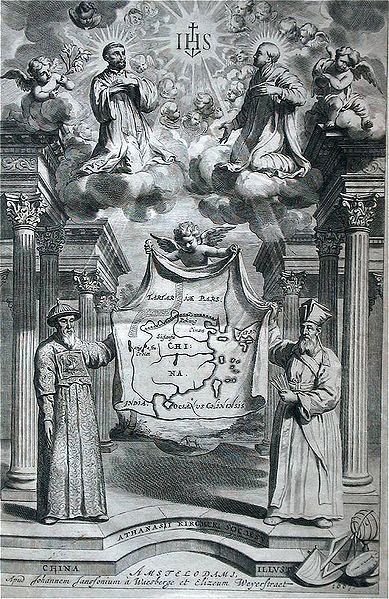
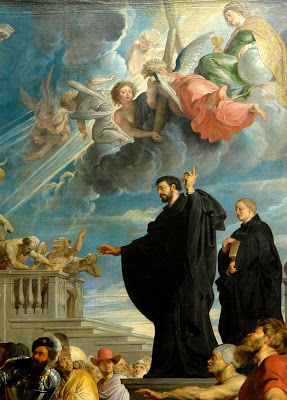
Above: Francis Xavier (left), Ignatius of Loyola (right) and Christ at the upper center. Below: Matteo Ricci (right) and Johann Adam Schall von Bell (left), all in dialogue towards the evangelization of China.

By Paul Mariani, S.J.

Fr. Paul Mariani is Assistant Professor of History at Santa Clara University. His book Church Militant: Bishop Kung and Catholic Resistance in Communist Shanghai has been recently published by Harvard University Press.

I. Introduction

Since its beginning, the Society of Jesus has had a close connection with China and the Chinese people. Perhaps no Catholic religious order has had such a strong relationship with a particular country as the Society of Jesus has had with China. This should not surprise us. St. Ignatius (1491-1556), founder of the Jesuits, himself wanted Jesuits to be available for worldwide mission. They were to be available for mission to the Turks and to “the region called the Indies” for “the defense and propagation of the faith.” In fact, the zeal with which these early Jesuit missionaries set out was one of the most impressive apostolic ventures in the history of the church. Some have even compared their efforts to a second apostolic era. And of the many places that the early Jesuits evangelized, they would soon prize China as one of their key missions.

In fact, the Jesuits were the third act in Chinese Christian history. The first Christian missionaries to what is today China had come as early as the 7th century. They were the so-called Nestorians, from the Church of the East. The second group was the Franciscans who came to China some 400 years later. They even built the first Catholic Church in Beijing in 1299. Neither of these early Christian communities survived. The third act would. For the Jesuits helped to found a vibrant indigenous church, and thus inaugurated modern Chinese Christian history.

The history of the Jesuit China mission is necessarily a vast subject. My purpose here, in this first of two articles, is simply to trace some of the key developments of the mission from its promising start in 1552, to its unfortunate decline and near destruction by 1800. Further, in order to help guide our path and focus our efforts, I will make use of several recent books, most of them published in the last ten years. Therefore, it is my hope that this essay may serve as a state of the field survey, in order to better acquaint the reader not only with the general contours of this fascinating history, but to highlight the contributions of the latest scholarship as well.

II. Francis Xavier and the Pioneers of the Early Jesuit Mission

It was none other than Francis Xavier (1506-1552), one of the original founders of Jesuits, whom Ignatius sent to be the first Jesuit apostle to “the Indies,” and this even before the Jesuits had received final approval for their new institute. After ten years of work in India, Indonesia, and Japan, Francis Xavier died on the small island of Shangchuan overlooking mainland China. In fact, over the years, St. Francis Xavier himself has come to symbolize some of the unbounded hopes and frustrated desires of the Jesuit China mission. For Francis Xavier never set foot in mainland China, but succeeding groups of Jesuit missionaries would attempt to fulfill his dream.

The story is familiar to many. After arriving in Japan in 1549-only six years after first European contact-Xavier soon learned that the Japanese looked to China as the source of culture, much like early modern Europeans looked to ancient Greece and Rome. Xavier was soon put on the defensive. If Christianity was such a great religion, why had the Chinese failed to mention it? To answer this objection, Xavier resolved to travel to China and even to the court in Beijing. His plan seems to have been first to evangelize China, and then resume his mission in Japan. Such a course of action might strike us today as being simplistic. Did Xavier really think he could accomplish this task so readily? His naïveté is apparent, but so is his zeal. For Xavier, no barrier was insurmountable-be it linguistic, cultural, or geographic-in the mission of evangelization. The following excerpt from a letter about China shows his boundless energy and aspirations: “Nothing leads me to suppose that there are Christians there. I hope to go there during this year, 1552, and penetrate even to the Emperor himself. China is that sort of kingdom, that if the seed of the Gospel is once sown, it may be propagated far and wide. And moreover, if the Chinese accept the Christian faith, the Japanese would give up the doctrines which the Chinese have taught them” (http://www.fordham.edu/halsall/mod/1552xavier4.asp). It was precisely a letter such as this that would stir the zeal of generations of would-be missionaries.

Yet problems abounded, including the fact that China was closed to foreigners. Xavier tried to get himself named as a papal ambassador. The plan failed. Xavier then tried to get smuggled into China on a boat. This attempt also failed. The boat never showed up and Xavier died of exhaustion in Shangchuan, a small island just off the coast of mainland China. 

Much of Xavier’s story is widely known. In fact, Franz Schurhammer wrote a four-volume biography of Xavier which has been translated into English. It is a painstaking and magisterial account of the life of the saint. Indeed, it is one of the most detailed biographies of all time. Another great source is the Letters and Instructions of Francis Xavier, translated by M. Joseph Costelloe and published by the Institute of Jesuit Sources.

In the thirty years after Xavier’s death some fifty missionaries-Jesuits, Franciscans, Dominicans, and Augustinians-tried to gain entry into China. Some embarked from Macau (Macao), which had been made a Portuguese trading post in 1557. Others set out from the Philippines. Often enough, their goal was to reach Canton or even coastal Fujian Province. However, since China was still off limits for foreigners, they risked imprisonment. In fact, none of these missionaries were able to establish a permanent base inside China. The most they could hope for was to work for the release of European prisoners in Canton. Others did pastoral work mainly with European, often Portuguese, sailors and merchants in Macau. It was in Macau that the Jesuits established a permanent residence, as well as a school and a church. (In fact, to this day one can still see the façade of St. Paul’s Church.) But the establishment of a permanent Christian presence in China would need to wait.

III. Matteo Ricci and the Christian-Confucian Dialogue

In 1552, the same year that Francis Xavier died in Shangchuan, Matteo Ricci (1552-1610) was born in Macerata, Italy. To this day, in both East and West, he remains the best known Jesuit missionary to China. 

Ricci arrived in China in 1583, guided by Michele Ruggieri (1543-1607), who had already made a successful entry into China. They had already secured permission to establish a residence in Zhaoqing, a small city upriver from the bustling port of Canton. It was from Zhaoqing that Ricci began his 18-year “ascent” to Beijing.

Ricci took his cues from and further refined the mission methods of Alessandro Valignano (1539-1606), who, in 1572, had been named the Visitor of the Jesuit missions in the East Indies. In this role, Valignano became the architect of a policy of missionary accommodation. In time, in China at least, this policy would come to mean that missionaries were to learn Chinese in order to dialog with the literati and to read the Chinese classics, to value China’s time-honored customs and culture, and to use Western science and technology as a method of attraction. The policy would also come to be associated with a top-down approach, whereby missionaries were to focus their efforts on the elite, in the hopes that this work would then trickle-down to the popular classes.

The story has been widely told. Ricci first wore the garb of Buddhist monks. Little did he know that Buddhism had been in decline for some time in China. He soon realized his mistake and recast himself as a Confucian scholar, a choice which would hopefully make him more credible with the leading officials. In this capacity, he set about mastering Chinese, which he did, even to the point of delving deeply into the Confucian classics, and being able to dialog with leading officials. With much help, he translated many western scientific works into Chinese.

Ricci’s own mission methodology is best exemplified in his most well-known book, The True Meaning of the Lord of Heaven. Ricci structured this book as a dialogue between two scholars, one from the West and one from China. They both speak generally about questions of human existence. It is only at the end that the Western scholar mentions the life and ministry of Jesus Christ. Ricci knew that to begin with the passion accounts would offend Chinese sensibilities, especially among the literati. A crucified God would have shocked them. Ricci would only tell the Chinese about the crucifixion and resurrection of Jesus after they had been adequately prepared.

What was Ricci like? Was this top-down approach correct? Was this his only approach? These debates occupy scholars today. They are also some of the issues that R. Po-Chia Hsia takes up in his 2010 work A Jesuit in the Forbidden City: Matteo Ricci, 1552-1610. Hsia is a deft guide, one who is uniquely capable of describing “the story of Matteo Ricci and his world.” Hsia is, by training, a historian of Early Modern Europe, a subject area on which he has written extensively. With this background, he is a natural fit to study Ricci. For Hsia has mastered not only the key European languages, but classical and modern Chinese as well. This allows him to probe the most important sources and archives relating to Ricci: the Fonti Ricciani by Pasquale D’Elia; the works of Pietro Tacchi-Venturi; the Jesuit China Archives in Rome; the 18-volume Documenta Indica, (1540-1597); and the official history of the Ming dynasty. Hsia is thus able to bring his considerable talents to bear on the subject of Matteo Ricci, a man who symbolizes the meeting point of East and West.
Hsia’s work is a delight to read not only for its breadth of knowledge, but also for the elegance of its prose. For example, describing Ricci’s world, Hsia says: “Born into a world torn asunder by the Protestant Reformation, he departed a Catholic Europe renewed in strength, restored in confidence, and restless in combat, against heretics and infidels, enemies of the Roman Church.” On Ricci’s project, Hsia writes in the prologue: “By his intelligence, charm, and endurance, the Italian missionary gained access into the inner realm of Chinese civilization, denied to almost all visitors. To use a metaphor of the Jesuits, he had hoped to enter the house and compel its residents to exit with him in allegiance to the Catholic faith.”

While Ricci and other Jesuits were set on increasing God’s glory in places like China, they, at times, overstated their case. Hsia is sensitive to this fact. For Ricci led some Chinese scholars to believe that one of the reasons for the success of Christianity was that Europe was without war for 1600 years! Hsia himself notes that he has recently become interested in things “Jesuitical.” Surely he knows this adjective has multiple meanings, not all of them complementary. I find this apt because, while he is respectful and even laudatory of Ricci, he is not above calling into question some of Ricci’s legacy. Perhaps Ricci was not above being “Jesuitical” himself. 

In the book, Hsia traces Ricci’s life from his birth in Italy, to his entrance into the Jesuits and his studies at the Roman College, to his inspiration and perception of a missionary call, to his departure from Portugal and his arrival in Macau in 1582, and finally to his successful entrance into the mainland and his long journey to Beijing. It was in Beijing that he was able to work near the center of imperial power. Hsia also has a chapter on Ricci’s The True Meaning of the Lord of Heaven. His epilogue deals in greater depth with the historiography of Ricci scholarship.

In his text, Hsia explains why Ricci, even 400 years after his passing, remains a compelling figure today. In Hsia’s estimation, part of the reason is due to the good public relations of fellow Jesuits. After all, they propagated the “master missionary with the master narrative.” And Hsia notes: “There is something irresistible in this narrative: by virtue of his intellect, a heroic individual bridges impossible chasms between civilizations, opening up a new world of understanding by the strength of his learning and genius.” Indeed, this is a fitting coda to Ricci, widely known in the West, and one of a few foreign missionaries still held in the highest esteem in China today. In fact, Ricci was the first foreigner in China to be given an imperial burial. Even today one can visit his tombstone at the Zhalan cemetery on the western edge of old Beijing.

IV. The Generation of Giants: Jesuits at the Court and in the Provinces

Other illustrious Jesuits followed in Ricci’s footsteps. Ricci and these others have been immortalized by George Dunne as the “generation of giants.” In fact, the contributions of Ricci’s generation and after can be divided into two major groups. The first group was those who labored in the Beijing court or with other members of the elite. These Jesuits employed a top-down approach. They were convinced that even if the faith never made it outside of elite circles, they could still consider their mission a success. This is because, according to Hsia, “Ricci thought it better to have a small, high-quality Christian community than a large multitude.” The second group of Jesuits was more involved in direct pastoral work in the countryside. They employed a bottom-up approach by focusing on the popular classes at the grassroots level. All told, according to Hsia, the number of Jesuits who labored in both groups numbered some 500 Jesuits between Ricci’s death and the suppression of the Jesuit order in 1773.

Let us first take up the contributions of the court Jesuits. Many of them would eventually be buried with Ricci as a sign of imperial favor. These missionaries made it to China in the first place through the efforts of Nicolas Trigault (1577-1628). In fact, it was Trigault’s On the Christian Expedition in China-a work which relied heavily on Ricci’s letters-which publicized far and wide the work of the Jesuit China mission. The book was a major success, especially in Jesuit circles. With such deft use of publicity, Trigault was able to recruit capable Jesuits for the China mission. They, in turn, were followed by many others. Trigault himself made other contributions as well. He got permission to translate the Bible into literary Chinese and to use the Chinese language in Mass. (Permission was given for a mass in Chinese, but, by the time it was given, it was too late to put into effect.) In sum, according to Hsia, Trigault “propagated the Riccian legacy” and was “the spokesperson of the Jesuit China Mission.”

Let us briefly describe the contributions of some of these Jesuits, both those recruited directly by Trigault, and others as well. A wonderful resource for much of this history is the Handbook of Christianity in China, Volume One: 635-1800, edited by Nicolas Standaert, and published in 2001. This book, nearly 1,000 pages in length, although not inexpensive, is indispensable for the researcher interested in the early years of Christianity in China. One article alone, by Nicole Halsberghe and Keizô Hashimoto, discusses the work of the Jesuit astronomers in China. The earliest of these astronomers was Adam Schall von Bell (1592-1666). Having been recruited by Trigault, he left for China in 1618 along with 21 other Jesuits. So dedicated was he to his mission, that he brought with him an entire science library. He ultimately wrote many treatises for the emperor, and he became a first class mandarin and the President of the Mathematical Tribunal. 

Schall also worked at the Bureau of Astronomy, which he directed from 1645 to 1664. As such, he was responsible for transferring much European astronomy to China. It was in this role that Schall and other Jesuits aroused antipathy within the court. It seemed clear why the foreign presence at the court was resented. For, as Halsberghe and Hashimoto note, the Jesuits “were in charge not only of the calendar, but also of the calculations and predictions needed to perform rites properly.” The performance of these rites was crucial in the smooth functioning of the government. But it offended some at the court that foreigners had such an important role in matters touching so closely on Confucian philosophy and matters of state. Thus, the Jesuits became embroiled in the famous “calendar case” when a certain Yang Guangxian brought the Jesuits to trial. They were accused of choosing an “inauspicious” date for the funeral of a prince (718). Schall was sentenced to death. In time, however, Yang’s own calendar was questioned, and Schall and the more accurate Western method of calendrical calculation were exonerated.

Ferdinand Verbiest (1623-1688) was then made Vice-Director of the Bureau of Astronomy. In this capacity, Verbiest is best known for continuing the work on the calendar and for building astronomical instruments that were used at the observatory. (Some of these instruments can still be seen in Beijing today.) Verbiest also revised astronomical compendiums, and he even helped to cast cannons for the Chinese government. 

Ricci, Schall von Bell, and Verbiest, are among the most well-known, but a host of other Jesuits also had impressive accomplishments. For example, there is the striking story of Bento de Góis (1563-1607), a Jesuit brother, who traveled overland to China from the court of the Great Mogul Akbar in current-day Afghanistan. He thus followed in the footsteps of Marco Polo and showed that China was the same place that medieval Europeans called Cathay. Luigi Buglio (1606-1682) translated into Chinese important liturgical books such as the Roman Missal and the Roman Breviary. Martino Martini (1614-1661) published an atlas of China. Giuseppe Castiglione (1688-1766) was an influential court painter. (For further information on some of these Jesuits, see Thomas F. Ryan’s 2007 short popular account simply titled Jesuits in China. A helpful online resource is the New Advent website.)

Up to this point, as we have seen, most of these Jesuits were from Portugal, Italy, Belgium, Germany or Switzerland. They were all part of the Portuguese Vice-Province and worked under the protection of the Portuguese Padroado. This status quo was soon to change. For it was Verbiest himself who wrote a letter requesting more Jesuit astronomers. An article by Claudia von Collani in the Handbook explains that Louis XIV responded to this request and sent French Jesuits as the “King’s mathematicians.” Five of them reached China in 1687. Thus began the French Jesuit mission. By 1700 this mission had its own superior and plot of land, and was made independent from the Portuguese Vice-Province. The French mission still had to answer to the delegate of the Jesuit superior general. Yet efforts to bring the French mission under the Vice-Province failed.

The French Jesuits were highly successful. Many of them worked at the court: some were tutors to the emperor; some were engaged in astronomy; and some worked on cartography. Regarding cartography, von Collani further explains that they began this work in 1708 and finished ten years later. These Jesuits traveled throughout China and eventually produced an atlas of the realm, the result of which was that China was now “better mapped than Europe” (315). Interestingly enough, some French Jesuits went beyond missionary accommodation and tried to harmonize biblical accounts with ancient Chinese history. Some tried to show that “religion in ancient China and Christianity were in principle the same” (315). The more radical among them were called Figurists, because, as von Collani notes, they often used typological exegesis to discover-what they believed to be-intimations of Christianity in the Confucian classics. The hope was that Chinese Christians now had a way “of preserving their tradition without having to refer to Judea” (669). Some Figurists even believed that some Chinese characters had an originally religious meaning. For example, the character for heaven-it was conjectured-was a composite of the characters for a human being and the numeral two. It thus referred to the second person of the Trinity!

All told, these French Jesuits also acted as mediators between China and Europe. They not only brought western science and technology to China, but they propagated their impressions of China to a European audience as well. One of the best known of these French Jesuits was Antoine Gaubil (1689-1759) who was not only an astronomer, but a historian and a translator of Chinese books as well. Many of their impressions, including those of Gaubil, were sent back to Europe by way of letters which have come down to us as the Lettres édificantes et curieuses (Edifying and Curious Letters). They describe the Jesuit mission and the Chinese situation in great detail. (Some of these letters can even be found online at http://www.archive.org.)

Let us now turn to those Jesuits that worked in the provinces. The fact is that even during Ricci’s time, there were Jesuits laboring far from the court. In fact, the over-emphasis on Ricci is now being corrected by scholars such as Liam Brockey, who in his prize-winning book Journey to the East: The Jesuit Mission to China, 1579-1724, makes a strong case that: “An exaggerated emphasis on Ricci and his successors in Peking, a view that has long characterized histories of the mission, has almost completely overshadowed the work of…[other Jesuits]…who were busy propagating Christianity at the Jesuits’ other residences” (51).

It was precisely at the other residences that the Jesuits had more time to engage in direct evangelization. These efforts bore fruit. In the region around contemporary Shanghai, they were able to introduce the Marian Sodalities, and other such devotional groups, which were quite effective in recruiting local Christians, and channeling their energies on behalf of the church. Some of them were inaugurated as early as 1609, one year before Ricci’s death.

Brockey also gives the telling example of Giulio Aleni (1582-1649) who traveled to distant Shanxi Province, and then to coastal Fujian Province where he founded a mission. (The history of Aleni’s work in Fujian along with later developments under the Dominicans can be found in Eugenio Menegon’s excellent 2009 book Ancestor’s, Virgins and Friars: Christianity as a Local Religion in Late Imperial China.) Aleni is responsible for authoring dozens of books including: an illustrated life of Christ, a manual on how to make a good confession, a life of the saints, and a popular catechism for children. This latter work was based on the Four Character Classics, which were popular primers for elementary school students. It was inculturated Christianity at its best: Chinese in form, and Christian in content. 

In sum, the Jesuit mission methodology was bearing great fruit. Yet, it was not without its detractors.

V. The Chinese Rites Controversy and the Decline of the Jesuit China Mission

The Jesuits’ accomodation to Chinese culture and their mission method were bearing fruit. Yet, when other missionaries, such as the Dominicans and Franciscans, came to China, they were not comfortable with some of the Jesuit accommodations. Thus began the Chinese Rites Controversy, which absorbed the energies of the Church for nearly one hundred years. 

A concise guide through this extraordinarily complex and freighted history is still Francis Rouleau’s 1967 article in the New Catholic Encyclopedia. I will rely heavily upon his account. Rouleau calls this controversy “among the most momentous” in the history of Christianity. For the sake of simplicity, he divides his treatment into two important parts. First, he defines the Chinese rites. Second, he describes the controversy between the Jesuit position and the position that the Vatican would eventually take.

In defining the rites, Rouleau describes three related issues. First, there were the Confucian ceremonies that the scholar class periodically held in temples and halls dedicated to Confucius. This class was duty-bound to honor Confucius much like, in today’s world, a civil or military official will salute the flag or sing the national anthem. 

Second, there was the “cult of the familial dead”, which “was manifested by the kowtow, incense burning, and serving food before the grave.”

Third, there was the “term question.” This revolved around the vocabulary the missionaries used to explain Christian concepts. For example, given the choice between introducing foreign words, or using Chinese words to describe God, the Jesuits chose the latter. This implied that the Confucian classics-where they found these terms-had a monotheistic view of God. 

After mastering Chinese and reflecting deeply on the Confucian classics, Ricci made a decision in 1603 which argued that the rites in honor of Confucius were civil, not religious acts. Second, honoring the dead was “perhaps” not superstitious, and he permitted them. Therefore, these two specific rites could be isolated from what other Christians might call a “pagan” or “superstitious” environment. Finally, the Chinese terms Tian (heavens) and Shangdi (Lord above) were permissible to describe the Christian God. All told, Ricci felt that permitting these ceremonies was a necessary requirement for large-scale conversion. Since these rituals and terms were fully embedded in the Chinese social and cultural context, Chinese converts should be permitted to continue using them. They need not cease being Chinese by becoming Christians.

Others were not convinced. Already by 1631, Dominicans were arriving on the scene, and the Franciscans returned in 1639. Some of them felt that the Jesuits were permitting idolatrous practices. In 1643, a Dominican went to Rome with some questions. Thus began what has become known as the Chinese Rites controversy. The Vatican first argued for the Dominican position. Then a Jesuit went to Rome and clarified the situation. Pope Alexander VII accepted the Jesuit understanding in 1656. The rites “as explained” were then permitted for the next 50 years. In fact, during these years, Chinese emperors continued to be happy with the Jesuits and their work at the court. The high water mark was reached in 1692, when Emperor Kangxi granted the Edict of Toleration which permitted Christian missionaries to preach throughout China. Thus, the missionaries now had imperial blessing as well. 

Yet, the controversy would not die down. In 1693, Charles Maigrot, the vicar apostolic of Fujian, once again called the rites into question, and, according to Rouleau, “the Holy See became involved in a judicial process of extraordinary complexity.” The Vatican now had to determine whether the rites were compatible with Christian doctrine. In doing so, it had to try to understand their role within the utterly foreign Chinese cultural context. Special church commissions were convoked from 1697 to 1704. Finally, in 1704, the Vatican reached a decision.

The key points of the 1704 decree were the following: It forbade the use of Tian and Shangdi for God. It also forbade ceremonies to honor Confucius and to honor ancestors. Even so, “a simplified commemorative name tablet” of the familial dead was permitted in Christian homes. This is what the decree did do. What it did not do was to determine whether the 1656 Jesuit explanation of the rites was true or misleading. Further, it made no statement as to the validity of the Confucian classics. This was beyond the competence of the Church authorities. The decree, then, simply stated that the rites were incompatible with Christianity. It made no further judgment on the validity of the Confucian philosophical system. Therefore, it argued against the Jesuit viewpoint that these practices could somehow be isolated or even purified from the “superstitious” Chinese cultural context. In other words, except for a few minor concessions, the rites would no longer be permitted.

As one might expect, this decision angered Emperor Kangxi, who had himself stated that these rites were civil in character. He took further umbrage that Europeans would dare explain to him the nature of Chinese practices. He then demanded that if the missionaries wanted to continue their work in China, they needed to obtain a certificate stating that they agreed with Ricci’s methods. Likewise, the Church also demanded its own oath of compliance. Thus, especially after 1707, mission work in China became especially precarious. The combined rulings of the emperor and the Vatican left missionaries in a bind. Should they obtain the certificate or sign the Church oath? Should they abandon China altogether? Should they stay on illegally? Should they stall for more time? A great irony in all of this is that these rulings were made when the missionary presence was larger than ever. For, at this time, the number of foreign missionaries, from all the orders that had congregations, had peaked at about 140.

Yet, for all of them, the situation became increasingly tenuous. The Vatican followed up with a further decree in 1715, and one in 1742 which definitely closed the controversy. In addition, in 1724, Kangxi’s son, Yongzheng, outlawed Christianity as a “perverse sect.”

Yet even under Yongzheng, some priests were permitted to stay on in Beijing. They put in long days of service at the court. They thus tried to create goodwill between themselves and the emperor. The hope was that this goodwill would take the pressure off those missionaries and Chinese priests that continued to labor in the countryside.

This was not the end. In a complex test of wills between the papacy and European governments, the Jesuit order itself was suppressed in 1773. The stream of Jesuit missionaries to China dried up. Further, those Jesuits that remained in China, both foreign and Chinese, now technically labored as diocesan priests. A notable example was Gottfried von Laimbeckhoven (1707-1787) who worked in the provinces. He ultimately became bishop of Nanjing and even administrator of the diocese of Beijing. However, for all intents and purposes, the Jesuit China mission collapsed. 

These were also dark years for the Church as a whole. The Enlightenment had called into question faith itself; the French Revolution ushered in a period of Church persecution; and the Napoleonic wars caused chaos throughout Europe. In sum, the upheavals in Europe affected Catholic missions worldwide.

In the 250 year history of the “old” Society, the Jesuits had left their mark. They had served emperors, brought in key scientific information, dialogued with top officials, served at the Bureau of Astronomy, baptized Christians, and put the local church on a solid footing. When Jesuit efforts are combined with the work of others, both local and missionary, the sum result is impressive. For, even in the troubled late 18th century, the number of Catholics in China-by many accounts-surpassed 200,000.

Would these local Christians weather the storm? Would the Society of Jesus be restored? Would the Church itself revive and send out missionaries? We will explore these issues in the second part.

Why Do We Pray?

By William A. Barry, SJ
From God’s Passionate Desire


Why Do We Pray?

Why do we pray? Do we pray for utilitarian reasons-because it benefits our physical or psychological health?

Honesty compels me to say that I often do pray for utilitarian reasons. First of all, most of my prayers of petition ask for some good result, either for me or for someone else or for all people. Moreover, I feel contented when I remember in prayer the people who mean much to me, even if my prayer is not answered. I notice, too, that I feel better about myself when I pray regularly. I feel more centered, more in tune with the present, less anxious about the past or the future. So I suspect that I do pray for the purpose of psychological or physical health. But does that exhaust my motivations for prayer?

Prayer Is a Relationship

Thinking of prayer as a conscious relationship, or friendship, with God may be illuminating. Why do we spend time with good friends? As I pondered this question, I realized that I relish times with good friends for some of the same reasons just adduced for spending time in prayer. If I have not had good conversations with close friends for some time, I feel out of sorts, somewhat lonely, and ill at ease. When I am with good friends, I feel more whole and alive.

Still, I do not believe that my only reason for wanting time with them is to feel better. I want to be with them because I love them. I am genuinely interested in and concerned for them. The beneficial effect that being with them has on me is a happy by-product. Moreover, I have often spent time with friends when it cost me trouble and time, and I did it because they wanted my presence. Haven’t we all spent time with a close friend who was ill or depressed, even when the time was painful and difficult? Such time spent cannot be explained on utilitarian grounds. We spend that time because we love our friend for his or her own sake.

Of course, there are times when we need the presence of close friends because we are in pain or lonely. Friendship would not be a mutual affair if we were always the ones who gave and never were open to receive. But if we are not totally egocentric, we will have to admit that we do care for others for their own sakes, and not just for what we can get from the relationship. We spend time with our friends because of our mutual care and love. Can we say the same thing about our relationship with God?

Our Deepest Desires

Prayer is a conscious relationship with God. Just as we spend time with friends because we love them and care for them, we spend time in prayer because we love God and want to be with God. Created out of love, we are drawn by the desire for “we know not what,” for union with the ultimate Mystery, who alone will satisfy our deepest longing. That desire, we can say, is the Holy Spirit of God dwelling in our hearts, drawing us to the perfect fulfillment for which we were created-namely, community with the Trinity. That desire draws us toward a more and more intimate union with God.

We pray, then, at our deepest level, because we are drawn by the bonds of love. We pray because we love, and not just for utilitarian purposes. If prayer has beneficial effects-and I believe that it does-that is because prayer corresponds to our deepest reality. When we are in tune with God, we cannot help but experience deep well-being. Ignatius of Loyola spoke of consolation as a sign of a person’s being in tune with God’s intention. But in the final analysis, the lover does not spend time with the Beloved because of the consolation; the lover just wants to be with the Beloved.

Thanks and Praise

Another motive for prayer is the desire to praise and thank God because of his great kindness and mercy. In contemplating Jesus, we discover that God’s love is not only creative but also overwhelmingly self-sacrificing. Jesus loved us even as we nailed him to the cross.

If we allow the desire for “we know not what” to draw us more and more into a relationship of mutual love with God, then we will, I believe, gradually take as our own that wonderful prayer so dear to St. Francis Xavier that begins O Deus, ego amo te, nec amo te ut salves me: “O God, I love you, and not because I hope for heaven thereby.” Gerard Manley Hopkins translated the prayer:

I love thee, God, I love thee-

Not out of hope for heaven for me

Nor fearing not to love and be

In the everlasting burning.

Thou, my Jesus, after me

Didst reach thine arms out dying,

For my sake sufferedst nails and lance,

Mocked and marred countenance,

Sorrows passing number,

Sweat and care and cumber,

Yea and death, and this for me,

And thou couldst see me sinning:

Then I, why should not I love thee,

Jesu so much in love with me?

Not for heaven’s sake, not to be

Out of hell by loving thee;

Not for any gains I see;

But just the way that thou didst me

I do love and will love thee.

What must I love thee, Lord, for then?

For being my king and God. Amen.

Excerpt from God’s Passionate Desire by William A. Barry, SJ.

Funding shortfall leads to education gaps


A funding pitfall in education for the Burmese refugees along the Thai border may negatively affect their preparedness to go home.

The focus of the international donor community is shifting from the camps towards Burma, and a lack of sufficient resources has forced many organisations working in the camps, such as Jesuit Refugee Service, to make cutbacks to critical programmes like schooling.

“It will be difficult for young people [to return to Burma] if they don’t have an education”, said Lee Reh* a Karenni student who has lived in to the camp since 2001. JRS hopes that support for education can be bolstered so that the school programmes, and students, do not suffer.

Inside Burma, the Peace Donor Support Group, including the government of UK, Norway, Australia, EU, UN and World Bank, have offered a net total reaching nearly $500 million US to support peace building. Meanwhile, in the camps in Thailand, up to 25 per cent of funding for essential services may be cut, according to Burma Campaign UK (BCUK), a London-based advocacy and research organisation.

The refugee community fears that it may lead to higher student dropout rates, premature return and less preparation for a durable solution. JRS partners with the Karenni Education Department (KnED) to implement education programs in two Mae Hong Son camps where the majority of the refugee population hails from eastern Burma’s Kayah state. However, JRS has been unable to attain the full amount – roughly US $800,000, or 24 million baht – needed to maintain the programmes in 2012.

JRS will struggle to stretch resources to cover the programme until the end of the year. Reviewing the secondary curriculum and staff recruitment have been suspended.

“We feel sad because of budget cuts”, said Khu Oo Reh, a refugee education official. Other sectors affected by funding shortages include support for basic humanitarian needs, such as food provision. Rations have been cut down to only 1,640 kcal per day per person – 22 percent less than the recommended 2,100 kcal required to meet international standards, according to the World Food Programme.

The risks of return

An estimated 160,000 refugees remain in the camps, fearful that the decline in assistance will inevitably force them to return before the country is safe.

“The government is trying to show the world the image that the country is changing into a democracy. It’s not true. There are still murders and tortures, as well as rape cases, uncleared landmines and [other forms of] violence”, Sha Reh, another student, told JRS.

While a number of ceasefire agreements have been signed in the last year, based on past experiences, this is no guarantee of peace. In January 2012 the Karen National Union (KNU) signed an agreement with the Burma government but renewed fighting broke out in the east only a few days later.

Similarly, in the northern Shan State, the rebel group, the Shan State Army was fired upon little over a week after signing a peace agreement at the end of January. The Burma military also refused to withdraw troops from agreed upon areas, according to local news sources. In addition, eastern and western areas are rife with landmines. Roughly five million people in ten out of Burma’s 14 states and regions are exposed to landmine contamination, according to Geneva Call, an international mine ban advocacy organisation. This poses serious challenges for repatriation.

“If repatriation does happen, the government will have to be ready to provide for people’s welfare, such as housing, security, education, food, healthcare and safety assurance”, Sha Reh added.

Education as preparation

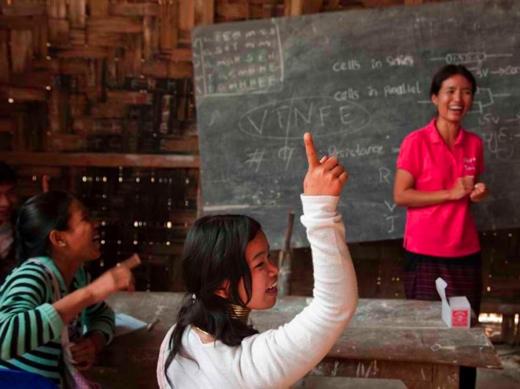
JRS education programmes in Mae Hong Son and Khun Yuam districts, ongoing since 1997, aim to prepare refugees for durable solutions. JRS provides basic education, teacher training, special education, school materials, vocational training and non-formal education to 5,200 students in Ban Mai Nai Soi and Ban Mae Surin from primary to secondary school.

“Education is very important for our people. We need many skills because we’re poor. Many people are illiterate”, said Than Maung, a refugee teacher. JRS education and vocational training provide refugees with skills that will enable them to find good jobs later on, according to Than Maung.

Similarly, in May, Aung San Suu Kyi spoke at the World Economic Forum in Bangkok and emphasised the importance of education that would allow young people to reach their potential.

“What I’m afraid of is not so much joblessness as hopelessness”, she said.

In the camps, where people are trapped without freedom of movement, education provides hope for the future. Cutting back on assistance may push refugees back to Burma despite ongoing fighting and the risk of landmine contamination.

“Education is really important for the students”, said Khu Oo Reh.

Without the legal right to leave the camps to find other schools or jobs, the funding shortages leave the refugees to face a difficult path ahead.

“If there is no support for education, where will the students go to school?”, Naw Kreh, a refugee education official asked. Refugees cannot adequately prepare for return if funding for education dries up, according to the Karenni refugee students.

“Only education can provide for a nation. Darkness cannot drive out darkness”, Naw Kreh added.

*Names have been changed to protect identity.

This was first published in the JRS Asia Pacific website

Jesuit Electronic News Service Vol. XVI, No.19

TAIWAN: A Film on Adam Schall von Bell


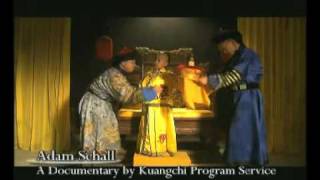
Adam Schall von Bell in the Service of the Emperors is a two-part documentary co-produced by Kuangchi Program Service in Taipei and Jiangsu Broadcasting Corporation in Nanjing (China). The docudrama tells the story of the seventeenth century German Jesuit missionary Fr Adam Schall von Bell. Adam Schall was a brilliant scientist and astronomer. His talent and ingenuity made him a valuable asset in the late Ming and early Qing empires. He became friend and adviser of three emperors. Having survived the fall of the Ming dynasty, Schall soon found himself serving the first emperor of the new Qing dynasty, the six-year old Chung-chi emperor. Schall was allowed inside the imperial palace because the emperor’s uncle had learned that Schall had completed work on a new and accurate calendar begun by Matteo Ricci during the former Ming dynasty. For Chinese emperors, nothing was more important than an accurate calendar. Schall became the friend of the young emperor, as well as his teacher and mentor. Schall never converted any of the emperors to Catholicism, but by his creative bridge-building he helped to establish the Catholic Church in China and to change the course of Chinese history.


AUSTRALIA: World’s Oldest Schoolteacher


Recently, just weeks short of his 100th birthday, Jesuit Fr Geoffrey Schneider has been declared the world’s oldest teacher by the Guinness World Records. The secret, according to the 99-year-old, is “a mountain of patience”. “If things are going wrong, don’t start shouting. Just proceed quietly, and things will settle down eventually,” says Fr Schneider, who turns 100 in December. The Jesuit priest has taught in schools in Sydney, Melbourne and Perth. He has shaped the intellects and values of leading Australian government, business, academia and sport figures, including the current leader of the federal opposition. As most workers switch between jobs or eagerly plan their retirement, Fr Schneider has no intention of ending his 47-year tenure at Sydney’s St Aloysius’ College, where he enjoys an enviable popularity. In the early 1990s, students were asked to name a new building after their favourite Jesuit saint. Innocently, three of them chose “Saint” Schneider. “I didn’t worry about it at the time, really, but after that we received a direction that Jesuits were not to have any buildings named after them while they are still alive,” he says.


BOLIVIA: International Congress of Fe y Alegría

The 43rd International Congress of Fe y Alegría on Inclusive Education and its Challenges was held in Cochabamba, Bolivia, from the 6 to 9 November. Father General participated in this meeting. Present were more than 2,500 young people, the representatives from 19 countries. Delegations from the various countries presented different aspects of the general theme of the Congress. For instance, representatives of Fe y Alegría Bolivia reflected on their experience of working with disabled people, while representatives from Guatemala spoke of their work with indigenous people. Fe y Alegría Chile explained the challenges and opportunities which arise from its work with people at risk, while their work with the heirs of the first African immigrants was introduced by the representatives from Honduras. “One of the cornerstones of Fe y Alegría is that everybody must have the basic right to education. We are to share our experiences and outcomes, and to provide the education which may be missing in any person’s life”, said Graciela Amo, who was responsible for communication during the Congress. On Wednesday, 7 November, Father General spoke to the Congress on Inclusive Education. During his three days in the country Father Nicolàs also met with the Jesuits of Bolivia. They opened up their apostolic works to him. Father General also paid a visit to Cardinal Julio Terrazas. For more information on the Congress visit: http://www.feyalegria.org/?idSeccion=40.


CHILE: Meeting of Jesuit Novices

From 28 to 31 October novices of the Provinces of Argentine-Uruguay, Bolivia, Chile and Peru met in Valparaiso. These were very intensive days. The novices visited Valparaiso and Viña del Mar to acquaint themselves with the significant works of the Society of Jesus: the Sanctuary of St Alberto Hurtado, Infocap, Techo, the Retreat House, and the community of the international theologate. There, they met with Fr Orlando Torres, who is responsible for Jesuit formation at the international level. They also visited the prisoners at the Valparaiso prison, and participated in a guided tour of the Congress of the Republic. The busy days helped to create an atmosphere of brotherhood, generosity, and acceptance of what God’s Spirit wants to convey to the novices through the Society. The meeting deepened fundamental aspects of the spirituality of their vocation. This is a spirituality which is embodied in the encounter with the needy, and an option for young people which leads them to search for a more just society. The responsibility to put their human, spiritual and academic formation at the service of others came to the fore in this meeting of novices.


CZECH REPUBLIC: Meeting of European Jesuits

A meeting of Jesuits and their collaborators, who work in the field of campus ministry, was held in Prague, the Czech Republic, from the 8 to 11 November. This was the third of such meetings. The theme of the gathering was: The new evangelization: the Ignatian way. The meeting was attended by about 30 delegates from all over Europe. Those present included James Corkery, a professor of systematic theology, Fr John Dardis, the President of the Conference of European Provincials, and Fr Gerald Blaszczak, director of the new General Curia’s Secretariat for the Service of Faith. “The main theme of the conference was particularly appropriate in this time when the Church is celebrating the Year of the Faith on the occasion of the 50th anniversary of the Second Vatican Council”, said Fr Jan Regner, the coordinator of the conference. During the event, there were two eucharistic celebrations open to the public: one on 9 November in the Church of St Ignatius, and a second on 10 November in the Church of St Saviour.


KOREA: A Second Jesuit Priest Imprisoned

In April of this year, it was widely reported that a Jesuit priest, Fr Joseph Kim Chong-uk, had been imprisoned for opposing and attempting to hinder construction of a naval base in Jeju Island, Sth Korea. Fr Kim has been released, but recently a second Jesuit priest, Fr John Lee Young-chan, has been put under court-ordered arrest. He is presently imprisoned without bail, awaiting trial. Fr Lee, together with five other peace activists, was detained by the police on October 24. He had been protesting about the excessive force the police used in detaining a woman activist. When the police manhandled him, they claimed his resistance amounted to use of violence. On October 26, the court upheld the Fr Lee’s arrest. The great majority of residents at the construction site, Gangjeong Village, oppose the project not only because it disrupts their lives but also because it destroys the desire of many residents of Jeju that it be an island of peace. The government has manipulated a small number of residents to voice their approval of the project. Furthermore, the government has proceeded extra-legally in the construction, and has been deluding the people into thinking it is not just a naval base, but a joint government-civilian harbor to boost tourism. The naval base will raise military tensions in NE Asia. Large numbers of peace activists, including many priests and religious, are supporting local residents in their efforts to physically hinder construction of the base. The Justice and Peace Committee of the Catholic Bishops’ Conference of Korea and the Korea Province of the Society of Jesus, among others, have issued statements in support of Fr Lee.


INDIA: Magis South Asia 2012

From 1 to 5 November, for the first time ever on such a large scale in Asia, the Jesuit Youth Convention (Magis), organized by Jesuits, was held at St Joseph’s Boys’ High School Campus Bangalore. The theme of the convention was ‘On pilgrimage with Christ at the Heart of the World,’ and the participants were called ‘pilgrims’. Youth and youth animators from Jesuit Institutions all over India participated in three days of exposure, reflection, and a variety of activities. Present were over 300 youthful pilgrims from twelve Indian states, from such diverse places as Kerala, Tamil Nadu, Gujarat, Pune, Bombay, Mangalore, Hazaribag, Andhra Pradesh, Ranchi, Delhi, Patna, Madhya Pradesh, Darjeeling, Goa and Dumka. Fr Brian Pereira SJ was the main coordinator of the Convention, assisted by Cyril and Lizzel, who were the coordinators of youth groups. Magis began with the solemn Eucharistic celebration. Fr Francis Serrao SJ, the Jesuit Provincial of Karnataka, was the main celebrant. He invited the pilgrims to have “squint (2 way) vision” – one towards God and the other towards one’s fellow human beings. The Convention was firmly rooted in the Jesuit motto Ad Majorem Dei Gloriam, and the major aspect of the convention comprised prayer, Eucharist, reflection and Examen. But the participants, together with their animators and guides, were exposed to the villages, slums, hospitals, homes for the aged, and leprosy colonies in and around Bangalore. See: http://www.daijiworld.com/news/news_disp.asp?n_id=154295.


INDIA: Ignatian Eco Retreat

From 8 to 17 November, an eco retreat was held for Jesuits. It encouraged them to experience and relish the presence of the Lord in His creation. It follows the Ignatian approach to God’s creation, and our relationship with Him in Nature. Robert Athickal SJ, who has introduced a “new Cosmology for our Times” for over two decades, was the animator for this retreat. God created the Earth. Adam (human) was created from Adamah (topsoil), and is therefore permanently linked to both God and the Earth. Fr Kolvenbach notes of this relationship: it is “so closely united that a person cannot find God unless he finds him through the environment and, conversely, that his relationship to the environment will be out of balance unless he also relates to God.” Ignatius affirms a “three-fold relationship of subjects” between God, humans, and the rest of Creation. This relationship is particularly evident in the Principle and Foundation and the Contemplation to attain love, both at the beginning and at the culmination of the Spiritual Exercises. In the Contemplatio, it is clear that Creation is both a source of God as well as a pathway to God. The Ignatian Eco Retreat was held at the Navsarni Diocesan Pastoral Centre in Sawantwandi, on the banks of a beautiful lake near Goa. The lake and lush green hills close by helped in the contact with God through nature.


LATIN AMERICA: Message for the Meeting of Provincial

The 25th meeting of the Conference of Latin American Provincial (CPAL) was held in Lima from 30 October to 3 November. At its end, a message was sent to all Provinces, Regions, Jesuits and their collaborators in Latin America. It aimed to communicate information about the meeting, as well as the spirit which informed it. Among other matters, it notes: “Father General has been with us at this time. He has thrown light on the process of the renewal of Provincial structures, service and mission. He has heard the accounts of conscience of the Provincial and Regional Superiors, and shared our prayer, Eucharists and meals. His presence and contributions have encouraged our confidence to tackle the problems about planning, mission and government in the Society in Latin America. On the evening of the first day, Father General invited us to draw our attention to three matters, both in this meeting and in our Provinces. The first is to analyze the realities in which we live, and to examine the demographics of our Provinces and Regions. He asked us to evaluate the mission and apostolates in which we are currently engaged, whether they should be maintained, expanded or developed, or whether we find it simply too difficult to enter this consideration. Secondly, he challenges us to express our vision of what we want, and how this fits in with the apostolates which we currently have. Thirdly, he challenged us to consider increased collaboration among ourselves for the future, wherever this is possible.” After considering some of the issues raised in greater details, the message to Provinces, Regions, Jesuits and collaborators sincerely thanks the Province of Peru which was the host for the meeting.


PERU: Fr. General Attends the Signing of a University Consortium

During his visit to Peru, Father General attended the signing of a new university consortium. The event brought together the Universidad Antonio Ruiz de Montoya (UARM), the Universidad del Pacífico (UP), and the Universidad de Ingeniería y Tecnología (UTEC). The new network aims to create a context for dialogue between the humanities, economics, and technological sciences. The signing took place during Father General’s visit to the Universidad del Pacífico and the Universidad Antonio Ruiz de Montoya, where he addressed lay collaborators in the educational apostolate of the Society in Peru. In his speech, Father Nicolás pointed out that Jesuit education had to be an education of high quality based on four pillars: it has to be free, interactive with the world, universal in its dimension, and with clear in its vision of history. That same evening, in the “San Juan Berchmans” Juniorate, Father General met Jesuits in formation, priests and brothers, as well as the members of the formation commission. He urged young Jesuits to form themselves in the best possible way in order to be available for the mission. He encouraged them to seek their own rhythms of prayer: “the spiritual life must not be separated from studies”. He also stressed the importance of asking oneself questions, without being satisfied with past answers, and to be always searching for God in their lives.


PERU: The Road of the Andean Baroque

The church of San Pedro Apóstol in Andahuaylillas, Cusco, was recently reopened after a restoration process which took four years. Now the church shines again in all its splendour, and it will be the main point of interest in a tour of the Andean Baroque (La ruta del barroco andino). This is an initiative which seeks to promote development in the area through tourism. The church was originally built in 1610. Today it again glories in the name that was given to it long ago: the Sistine Chapel of America. During the reopening ceremony, Hanaq Pacha Kusikuynin, a seventeenth century polyphonic composition in Quechua, resounded through its nave. It is an exciting, solemn choral piece which was performed by children accompanied by the “Youth Symphony Orchestra” of Peru. The composer was the Jesuit Fr Juan Pérez de Bocanegra, the first pastor of Andahuaylillas. He was also responsible for the original decoration of the church, which he considered an important aspect of his work of evangelization. According to his ideas, the indigenous population had to be led to wonder at the greatness of God and in this way appreciate the vastness of his divinity. The Society of Jesus, the World Monuments Fund, and a number of other organizations, launched La ruta del barroco andino. It is a tour of colonial churches of XVII and XVIII centuries Peru. The pilgrimage starts with the church of the Society in the Cusco Province, continues in the Province of Quispicanchis with the chapel de la Virgen de la Candelaria in Canincunca, leads to the church of San Juan Bautista in Huaro, and ends with the church of San Pedro Apóstol in Andahuaylillas.


Sacred Space promotes Chapel of Intentions


Sacred Space promotes Chapel of Intentions

For weary legs and prayerful spirits a silent physical Sacred Space acted as a welcoming haven in an otherwise busy exhibition hall. A key focus of the week was the promotion of the website’s Chapel of Intentions, a virtual oratory enabling visitors to the site to post and pray for individual prayer intentions.

Ann Martin, administrator (pictured here at the IEC), said “We were amazed at the positive feedback we received at the Congress. To promote the new Chapel of Intentions on our site, over 1000 prayer intentions submitted during the week were individually prayed for within the Sacred Space oratory.”

The online Chapel of Intentions provides an opportunity for visitors to post a prayer for the attention of the site’s worldwide prayer community, which includes three contemplative orders of nuns in Ireland and overseas.

Sacred Space, now 13 years old, has recently undergone a successful visual make-over. It has over 17,000 visitors daily and continues to grow. A team of Eastern European Jesuits is preparing to add Russian, Belorussian and Ukrainian to its current 14 languages.

The Chapel can be accessed at http://content.sacredspace.ie/chapel/intentions.php

St. Francis Xavier, SJ


Francis Xavier (Francisco de Jassu y Javier, 1506-1552), was the first Jesuit missionary and the prototype who inspired many men to enter the Society of Jesus and evangelize far off nations. One of the original group of seven men who founded the Jesuits, he was sent to India before the new religious order received formal approval from the Church.

Xavier was born in his family’s small castle in Navarre, in the north of Spain, and there received his early education. In September 1525 he went to Paris to begin university studies at the College of Sainte-Barbe where his roommate was Peter Faber (Pierre Favre) from the Savoy region of France. Four years later everything changed when an older student moved in, Ignatius Loyola (Iñigo Lopez de Loyola), a failed Basque courtier given to prayer. Loyola soon won Faber over to wanting to become a priest and work for the salvation of souls, but Xavier aspired to a worldly career and was not at all interested in being a priest. He earned his licentiate degree in the spring of 1530 and began teaching Aristotle at the College of Dormans-Beauvais; he remained living in the room with Favre and Loyola. When Faber went to visit his family in 1533, Ignatius finally broke through to Xavier who yielded to the grace God was offering him. Four other students also became close friends through their conversations with Ignatius who was became a spiritual guide and inspired the whole group with his desire to go to the Holy Land. Xavier joined his friends Aug. 15, 1534 in the chapel of Saint-Denis in Montmartre as they all pronounced private vows of poverty, chastity and going to the Holy Land to convert infidels.

Xavier and Loyola began studying theology in 1534. Two years later Xavier set out for Venice with the rest of the group except for Loyola who had returned to Spain earlier. Venice was the point of departure for ships going to the Holy Land. The companions spent two months waiting for a ship and working in hospitals, then went to Rome to ask papal permission for their pilgrimage and ordination of the non-priests among them. Xavier, Loyola and four others were ordained by the papal delegate in his private chapel on June 24, 1537. And they continued to wait for a ship, but because of Venice’s impending war with the Turks none sailed for a whole year, something quite extraordinary. The companions then decided that Ignatius should go to Rome and place the group at the disposal of the pope. Meanwhile, they would go to various university centers and start preaching. Xavier and Nicholas Bobadilla went to Bologna.

Xavier went to Rome in April 1538 and began preaching in the French church of St. Louis. He also took part in the famous deliberations during Lent 1539 in which the companions agreed to form a new religious order. Before Pope Paul III granted his approval of the plan, he asked Ignatius to accede to King John III of Portugal’s request to send two of the companions to the new colony in India. Ignatius chose Simon Rodrigues and Nicholas Bobadilla, but the latter got sick and could not go. Francis Xavier was the only one of the companions not already committed to a work so Ignatius asked him to go, even though they were the closest friends and the departure meant that they would never see each other again.

Xavier and Rodrigues left Rome March 15, 1540 and arrived in Lisbon by the end of June. The fleet had already left so the two priests had to remain in Lisbon until the following spring. They devoted themselves to preaching and caring for prisoners. The king was so taken by their work that he asked one of them to stay and start a school; Rodrigues was chosen, leaving Xavier to head off alone as the first Jesuit missionary. As Xavier boarded the ship Santiagio, the king’s messenger gave him a letter in which the pope named him apostolic nuncio, which meant that he had authority over all Portuguese clergy in Goa. The ship set sail April 7, 1541, on Xavier’s thirty-fifth birthday.

It took 13 months for Xavier to arrive in Goa, including a long wait in Mozambique for favorable winds. As soon as he arrived, the energetic Spaniard set about preaching to the Portuguese, visiting prisons and ministering to lepers. He also tried to learn Tamil, but had to rely on interpreters for his first mission to the Paravas, pearl fishers who lived on India’s southeastern shore above Cape Comorin. They had converted to Christianity but been without a pastor, so Xavier reinstructed them in the faith, baptized those who were ready and prepared catechists to remain with them as he moved on from one village to the next. By the end of 1544 he reached the western shore of India at Travancore; in November and December of that year he is reported to have baptized 10,000 persons. He moved northward to Cochin, and then sailed to the Portuguese city of Malacca in Malaya; from there he headed for his goal, the Moluccas, or the Spice Islands where he landed on Feb. 14, 1546. He visited the Christian villages and baptized over 1,000 persons at nearby Seran. Then he did a reconnaissance trip to the islands Ternate and Moro, known for its headhunters. He returned to Malacca in July 1547 and arranged for two Jesuits to take his place.


When Xavier returned to Malacca, he learned about Japan from a Japanese nobleman named Anjiro who was interested in becoming a Christian. This revelation of a culturally advanced nation that had not yet heard of Christ captured the Spanish Jesuit’s imagination. Before he could do anything about Japan, Xavier had to return to Goa to fulfill his responsibilities as mission superior and assign newly arrived Jesuits to their posts. He was not able to set sail for Japan with Anjiro and several Jesuits until April 1549. The party got back to Malacca easily enough but could find no ship’s captain willing to take the risk of sailing into unknown waters. So Xavier hired a pirate to take them. They left June 24, 1549 and landed on August 15 at Kagoshima in southern Japan, Anjiro’s home city.

At first the mission went very smoothly. The local prince gave permission to the foreigners to preach Christianity, but he himself would not convert. Xavier decided that the way to convert Japan was to begin with the emperor, but no one would tell him how to get to the Imperial City, Miyako (today’s Tokyo). They spent a year in Kagoshima but only made 100 converts, so the Jesuits left for Hirado, a port used by the Portuguese on the upper coast of Kyushu. Another 100 Japanese became Christians but Xavier remained eager to see the emperor, so he moved to the country’s second largest city, Yamaguchi. He preached in the streets but suffered a very unsuccessful meeting with the daimyo, so he left that city in December 1550 for Sakai.

Their fortune turned and they finally found a prince willing to take them to the Imperial City. Xavier and Brother John Fernandez were hired as domestic servants and arrived in January 1551, the first Catholic missionaries to see Asia’s largest and most beautiful city. For 11 days they tried without success to secure an audience with the emperor, so they returned to Hirado. They went back, though, with the knowledge that the most powerful lord in Japan was not the emperor, but the daimyo of Yamaguchi, whom they had failed to convince in their first meeting. Xavier resolved to try again, appearing not as a poorly-clad European but as an individual worthy of the daimyo’s attention.

The two Jesuits rented horses and a litter and dressed themselves in colorful silken robes. When they ceremoniously arrived in Yamaguchi, they were received at the daimyo’s palace without any suspicion that they were the same barbarians who had been brushed away only months earlier. Xavier presented the daimyo with expensive gifts of clocks, music boxes, mirrors, crystals, cloth and wine as signs of friendship; and he presented impressive credentials: letters from King John III of Portugal and Pope Paul III. The daimyo granted the Jesuit’s request to preach the Christian religion in the empire, and gave people the freedom to become Christians if they wanted to. He also gave the Jesuits a residence in the city, where many people visited. Within six months they had gained 500 converts.

Xavier thought it was time for him to move on so he brought Father Cosmas de Torres to replace him in Yamaguchi so he could return to India. Xavier set out in September 1551, and found a ship for Malacca. He hoped to return to Japan the following year, but the ship got caught in a typhoon that drove it 1,000 miles off course. On December 17, the vessel entered the Bay of Canton and anchored off Sancian Island. As Xavier looked towards nearby China, he felt that country calling him. The two Jesuits were able to board a ship that happened to be bound for Singapore, which they reached at the end of the month. There Xavier found a letter from Ignatius appointing him provincial of the “Indies and the countries beyond.”

He was back in India in January 1552 and found another letter telling him to return to Rome to report on the mission; he decided that visit could wait until he had first gone to China. In April 1552 Xavier set out from India and entered the Bay of Canton in September. He landed on Sancian Island which was both a hideout for Chinese smugglers and a base for Portuguese traders. None of the smugglers was willing to risk taking the Jesuit missionary over to China; one who said he was, took Xavier’s money and then disappeared. On November 21 he came down with a fever and could not leave his leafy hut on the island’s shore. Seven days later he fell into a coma, but on December 1 regained consciousness and devoted himself to prayer during his waking hours. He died on the morning of December 3 and was buried on the island, but his remains were later taken to Malacca and then to Goa where they were interred in the church Bom Jesus.

He was canonized in 1622 and made patron of the Propagation of the Faith in 1910 and in 1927 was named patron of the missions.


JCAP releases report for 2012


CJCAP releases report for 2012

The Jesuit Conference of Asia Pacific has produced a modest 16-page annual report, simply titled “Jesuits in Asia Pacific 2012“.

The 16-page document begins with a report by the President, Fr Mark Raper SJ, on the Conference in 2011, and contains articles on the four common priority areas across the Conference – Jesuit Formation, the education project in Timor Leste, Environment and Migration. It concludes with a brief description of our Conference.

In “Forming Jesuits for Asia Pacific“, we discuss the detailed JCAP document on formation entitled “A Profile of a Formed Jesuit for Asia Pacific”, and how the Loyola School of Theology is implementing the Asian mandate for theological education.

The vision of an educational institute” paints a picture of Instituto de Educação Jesuíta, the education project in Timor Leste that comprises a teacher education academy and a secondary school.

In “A sacred sense of ecology“, we discuss our Environmental Way of Proceeding, which was developed by the JCAP Ecology Task Force as an introduction to the action of reconciliation with creation.

For migration, we have chosen in “Living with our neighbours” to shine the spotlight on Yiutsari, the Jesuit centre for migrant workers in South Korea, as an example of the many local Jesuit works serving migrants in Asia Pacific.

To download Jesuits in Asia Pacific 2012, click here. If you would like a printed copy, please email [email protected].

Avoid Jargon

Fr General on New Evangelisation

by Jim Manney

Here’s timely advice for Ignatian “insiders” from Fr. Alolfo Nicolás, SJ, superior general of the Jesuits. Avoid jargon. Speak clearly and simply. He uses the word “discernment” as an example. You might know what it means, but the people you’re talking to might not. Fr. Nicolás tells some good stories in this video, from a conference about Jesuit partnership with lay people. (Click here to watch it on YouTube.)