Category: Uncategorized

St. Bernadine Realino

Bookmark and Share


Today’s saint of the day is St. Bernadine Realino, who is also known as the Apostle of Leece.

Bernadine was born in 1530 in Capri, Italy, a city located in the northern part of Italy, to noble parents. He studied law and medicine in Bologna and initially became an attorney, followed by a political career, in which he served as judge, tax collector, Superintendant of the fiefs of the marquis of Naples, and mayor of three different cities in Italy.

While in Naples, Bernardino, now 34 years old, met some priests of the Society of Jesus and made an eight-day retreat with them. During this retreat, he felt a strong call to the religious life and asked the Jesuits for admittance into their Society. He was accepted and ordained a priest in 1567. For ten years he served in Naples, preaching, teaching catechism, visiting the sick, the poor, and those in prison. He also served as the novice master there. Then he was transferred to Lecce, a small city in southern Italy, where he was sent to found a college. He remained in Leece for the last forty-two years of his life.

Bernadino was well-known and loved for his work in Leece. He was a model confessor, a powerful preacher, a diligent catechist to the youth, as well as a Rector of the Jesuit college and Superior of the Community there. His charity to the poor and the sick knew no bounds and his kindness brought about the end of vendettas and public scandals. One of the miracles attributed to him involved his small pitcher of wine, which was never empty until everyone present had had enough.

He was loved so much and venerated that, as he lay on his death bed in 1616, the city’s leaders requested that he take the city under his protection. Unable to speak, St. Bernardino bowed his head. He died with the names of Jesus and Mary on his lips.

St. Bernadino was canonized in 1947 by Pope Pius XII. He is the patron saint of Leece, Italy.

What helped to make St. Bernadino even more famous are the events that followed his death. Six years prior to his death, he fell and sustained two wounds that refused to heal. While he was in his last illness, those closest to him, who had witnessed his holiness, collected the blood discharged from these wounds in several small vials.

This blood acted strangely. In some of the vials, it retained its liquid consistency for over a century. In others it foamed or frothed, particularly on the anniversary of the saint’s death. Several witnesses testified to these phenomena during the investigation before his beatification. When his tomb was opened in 1711, some of his fleshy tissue remained incorrupt, floating in a dark red liquid. This too, proved to be human blood, and it gave off a sweet perfume. In 1713 it was also found to be frothing or bubbling, as it was again in 1804 and 1852. In 1985, however, none of the blood preserved showed any of these tendencies.
Be Men of the Frontier


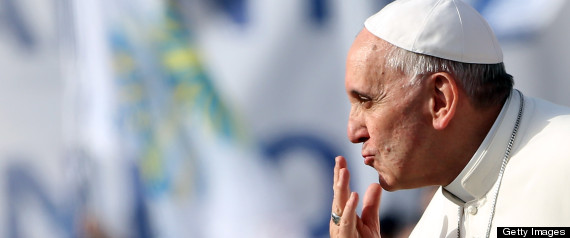
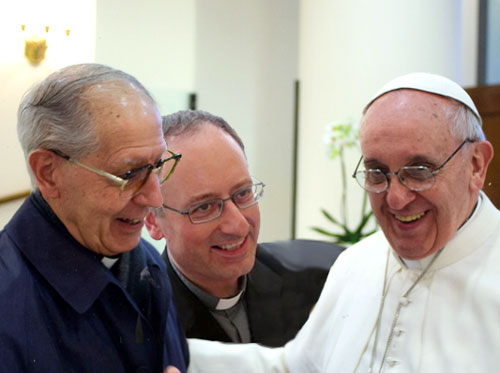
4 June, 2013. Dialogue, discernment and frontier, were the three words focused by Pope Francis this morning, during a private audience with the community of the “Catholic Civilization”(Civiltà Cattolica), the magazine of the Jesuits founded in 1850. The Pope asked in particular to the writers of the fortnightly, directed by Father Antonio Spadaro SJ, to be “men of the frontier”, committed to build bridges not walls. Therefore, urged them to engage in dialogue with those who do not share the Christian faith. The homage was addressed to the Pope by Rev. Fr. Adolfo Nicolás SJ, the Superior General of the Society of Jesus. Courtesy: Vatican Radio


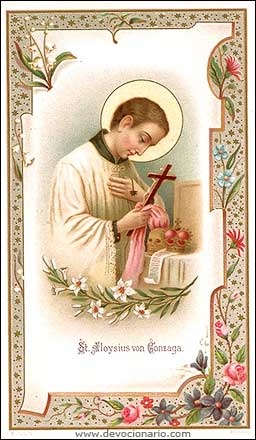
St. Aloysius Gonzaga, 1568-1591


Today’s saint was the eldest son of a prominent Italian nobleman who wanted him to follow in his footsteps. He even sent young Aloysius to be a page in the court of King Philip II of Spain. But Aloysius found life in the court—with its sensual temptations, riches, and intrigues—empty. He desired instead to serve the King of heaven and earth and made know to his father his desire to enter the Jesuits. At first his father opposed him but in time relented and in 1585 he joined the Society of Jesus. During his studies in Rome the plague broke out. Aloysius went around the city looking for the sick whom he carried to hospitals where he cared for them both physically and spiritually, preparing them for death. In time he contracted the plague and died on this day at the age of 23. In 1726 he was canonized and shortly thereafter was named the patron saint of youth.

As we continue our prayers that Christians in Europe may rediscover their true identity and participate with greater enthusiasm in the proclamation of the Gospel, let us ask St. Aloysius to intercede with us. We also begin today the “Fortnight for Freedom,” a special two week period of prayer that the U.S. bishops have initiated in response to the threats to religious liberty in our nation. The following is a prayer that St. Aloysius used to say.

Wisdom Story 62


Wisdom Story

by Paul Brian Campbell,SJ

From a very early age, Tao-hsin had been on a relentless quest to find the Truth. At the age of fourteen he approached the great Seng-tsan, the Third Zen Patriarch, with a resolution belying his tender years.

“Master, I humbly request that you show me the way of liberation.”

“Has anybody ever put you in bondage?” asked the great master with a frown on his face.

“No, Sir.” “If you are not in bondage,” said the master, “why should you ask for liberation?”

At that moment, young Tao-hsin experienced a profound awakening, and later went on to become the Fourth Zen Patriarch.


Preparing for MAGIS


Preparing for MAGIS
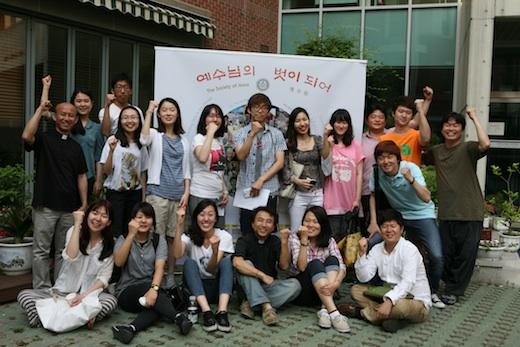
Energised and inspired by its first experience of MAGIS in Madrid in 2011, the Korean Province is deep into preparations for MAGIS-World Youth Day (WYD) 2013 in Brazil. Fr Joseph Songyong Choe SJ shares their preparations with us.

A group of 34 went to the MAGIS in Madrid – three Jesuits, one sister of the Religious of the Sacred Heart of Jesus, and 30 young adults. On their return from Spain, participants reflected on their experience of MAGIS, and we organized three prayer teams as follow-up. The prayer gatherings continued for about a year; and the group still meets occasionally.

For MAGIS-WYD2013 in Brazil, the Korean Province has a delegation of 27 pilgrims (12 men and 15 women) travelling from Korea, who include two Jesuits (Fr Jong-In Park SJ and Scholastic Hoi-Kang Jung SJ) and a priest of Daejeon Diocese who works in youth pastoral activities. Four university students studying abroad, in the United States, South Africa and Mexico, will join us in Salvador. Also in our group is a journalist from The Catholic Times in Korea who will report and introduce MAGIS Brazil to the Korea Catholic Church.

Since we recruited young adults to MAGIS Brazil last December, we have been holding preparation meetings twice a month. Using preparatory material from the organizing office of MAGIS Brazil, we pray and reflect together; and share our reflections on Facebook. We also spend time learning Ignatian spirituality, and we celebrate mass in different languages (Spanish, Portuguese, English and Korean) in rotation. In addition, we invite international exchange students of Sogang University to join us, and from them we are learning basic Portuguese, the country’s culture, and some songs. The Korean MAGIS team has recently begun preparing a short performance for the “Festival of Nations”, to introduce Korean culture and images through traditional dance and songs to the young adults of the world.


MAGIS 2013,Brasil

Before 2011, the Korean Province had organised somewhat static programmes, such as retreats, for youth and young adults. However, since 2011 we have been trying to have more active programmes. Some of these are Catholic Youth Talk, a programme to encourage greater passion and a freer life among young adults through discussions of issues encountered by those in their 20s and 30s; Rdv (Rendezvous), which seeks to build solidarity with neighbours through community reflection; Religious Life Experience School of the Society of Jesus, which uses the Spiritual Exercises to help in developing the personality and character of youth; and Catholic Academy, academic lectures on a variety of topics to help deepen the quality and depth of the life of youth.In the very early morning of July 12, the Korean MAGIS group will arrive in Salvador where the first Jesuit missionaries arrived to begin their mission in South America. The pilgrims will participate in a three-day festival with other Ignatian youth from around the world, after which they will be divided into four groups (Arts, Social Action, Cultural Immersion, and Ecology) and sent to various regions of Brazil such as the Amazon, northeast Brazil, Rio de Janeiro, São Paulo, and Rio Grande do Sul. The young pilgrims will meet again in Rio de Janeiro to share the richness of their experiences, and also to be united with millions of other youth from around the world for WYD.


Learning Portuguese
Learning Portuguese

We also organized Sogang MAGIS last summer. For seven nights and eight days, students of Sogang University and the Youth Ministry Team of the Society of Jesus visited the “Village of the Sacred Heart” for people afflicted with leprosy. During the day, the students spent time with the lepers, and in the mornings and evenings, they had a MAGIS programme comprising the five core elements of Morning Prayer, Liturgy, Activity, MAGIS circle, Examen. Through this voluntary programme, participants developed a sense of God in their own lives and experiences, and they increased their capacity to do something to build a better world. Sogang MAGIS is scheduled to be held again this year, at the Village of the Sacred Heart in August.

Fr Joseph Songyong Choe SJ is responsible for the preparations for the Korean province’s participation in MAGIS 2013.

MAGIS is the most important meeting of Ignatian youth in the world, and is sponsored by the Society of Jesus, in conjunction with World Youth Day. MAGIS 2013 will be held from July 12 to 22 in Salvador, Rio de Janeiro, and about 40 other Brazilian cities. It will be one of the largest delegations of WYD. Organizers expect 2,000 young people, between the ages of 18 and 30, to come from 50 countries, including the United States, Germany, France, Spain, Ethiopia, Mauritius, Jamaica, Kenya, Lebanon, Syria, Latvia and Lithuania, Singapore, Tanzania, the United Kingdom, and Zambia. For more information on MAGIS, visit www.magis2013.com.

Lunchtime Examen

Bookmark and Share


by Jim Manney

The Lunchtime Examen invites you to pause at noontime (or whatever time fits your calendar) to review your day in the presence of God. This six-session series is led by Jim Manney, author of The Prayer That Changes Everything: Discovering the Power of St. Ignatius Loyola’s Examen.

Lunchtime Examen

Each session in the Lunchtime Examen will focus on a spiritual theme, such as gratitude or forgiveness. New prayer presentations will be available on consecutive Wednesdays, starting March 9, making it a perfect weekly prayer practice for Lent.

Knowing that not everyone prays at the same pace, you have control over the pace of the Lunchtime Examen. On each screen, a Continue button will appear. Click it when you are ready to move on.

Please be patient if it takes a few moments to load the Flash presentations.


Lunchtime Examen Session 1 button March 9 (Ash Wednesday)
Session 1: Why is this a good way to pray?
Session 1 Journal Page (PDF)
Lunchtime Examen Session 2 button March 16
Session 2: Where can I find God?
Session 2 Journal Page (PDF)
Lunchtime Examen Session 3 button March 23
Session 3: What do I pray about?
Session 3 Journal Page (PDF)
Lunchtime Examen Session 4 button March 30
Session 4: What do our feelings have to do with prayer?
Session 4 Journal Page (PDF)
Lunchtime Examen Session 5 button April 6
Session 5: What does the Examen have to do with being honest with God?
Session 5 Journal Page (PDF)
Lunchtime Examen Session 6 button April 13
Session 6: What shall I do?
Session 6 Journal Page (PDF)


Pope Francis speaks about the need for financial reform


On the 16th of May Pope Francis addressed the new new non-resident ambassadors to the Holy See from Kyrgyzstan, Antigua and Barbuda, Luxembourg and Botswana. He spoke about the worldwide financial and economic crisis saying that this crisis highlights “the gravely deficient human perspective, which reduces man to one of his needs alone, namely, consumption. Worse yet, human beings themselves are nowadays considered as consumer goods which can be used and thrown away. We have started a throw-away culture. This tendency is seen on the level of individuals and whole societies; and it is being promoted!” He also said that there is a need for financial reform along ethical lines that would produce in its turn an economic reform to benefit everyone, something that would require a courageous change of attitude on the part of political leaders.


New book for reconciling with creation


by EcoJesuit

A new resource book is available for those interested in learning more about the ecological dimension of the Jesuit mission. Produced by the Jesuit Conference of Asia Pacific and Environmental Science for Social Change (ESSC) in the Philippines, Reconciling with Creation contains documents that will help people reflect on and engage in Reconciliation with Creation.

The documents in the book include Healing a Broken World and a reflection on the recent history of its development; and Our Environmental Way of Proceeding, which outlines JCAP’s overarching approach to ecological engagement. Also included are some of the ways that people are using Our Environmental Way of Proceeding and how they are adapting and applying it to specific contexts and programmes of activity. There is also a section on global advocacy in an Ignatian context.

Hard copies of Reconciling with Creation are available at the office of Environmental Science for Social Change. Copies can also be ordered through Ms Mariel de Jesus ([email protected]).

JRS directors received by Pope Francis


Pope Francis made the plea to extend hospitality and pursue justice for refugees during the final plenary session of the assembly of the Pontifical Council for the Pastoral Care of Migrants and Itinerant People.

Jesuit Refugee Service International Director, Peter Balleis S.J. and JRS Middle East and North Africa Director Nawras Sammour S.J. attended the final session of the three-day assembly promoting the theme of welcoming displaced people under the title, “The Church’s pastoral care in the context of forced migration,” and was attended by a conglomerate of church leaders, migration experts and pastoral workers.

The meeting fostered discussion about ways the Catholic community can best respond to the injustices causing forced migration for millions globally while also keeping the dignity of each individual person intact.

In Pope Francis’ address he said one of the Church’s roles is to be aware of the hardship faced by refugees and prepare to respond to the “wounds that mark their existence” such as the abuse of power, violence, traumatic events and anxiety about their futures.

These factors all dehumanize refugees. As such they should push every Christian and the entire community to a concrete attention, said Pope Francis.

Syria represents one of the places worldwide where people find themselves repeatedly traumatized, separated from their families and indefinitely trapped in a violent power struggle. Since the war erupted in 2011, nearly six million people have been displaced either within Syria or across the border into Lebanon, Jordan, Turkey and Iraq.

“Despite the tragedy in Syria, JRS has witnessed time and again the resilience of displaced communities. Throughout the ongoing insecurity more than 500 Syrian volunteers help with JRS projects of food distribution and educational projects in Aleppo, Homs and Damascus,” said JRS International Director Peter Balleis S.J.

Perseverance. The Holy Father expressed his admiration for those who persevere through displacement.

“I would like to invite everyone to see and take to heart the experiences and the rays of hope of refugees and forcibly displaced persons. This hope is expressed in their expectations for the future, desire for friendship, to participate in their host societies, including through language learning, access to employment and education for their children,” said Pope Francis.

This hope and enthusiasm has been exemplified not only in Syria, but throughout the world. In war-torn Afghanistan young students eagerly take part in the JRS and JC:HEM (Jesuit Commons: Higher Education at the Margins) online tertiary education program. In northern Thailand, Burmese refugees previously marginalized from the marketplace have learned skills allowing them to be hired by local businesses.

“We believe the work of JRS strongly reflects the call of Pope Francis to be a voice for the displaced, to advocate against unjust policies and to serve refugees in the most perilous times of their lives. In return, we have witnessed the hope the Holy Father mentions; hope for a more peaceful future and more hospitable communities,” said Peter Balleis S.J.

Best Ignatian Songs: Blessed


by Jim Manney

I love the song “Blessed” by the country singer-songwriter Lucinda Williams for its celebration of humility. It’s about people–mostly obscure and suffering people–who bless us by simply being who they are. It’s a kind of litany. It could be an examen–a recollection of the way God blesses us through the people in our lives.

We were blessed by the minister

Who practiced what he preached

We were blessed by the poor man

Who said that heaven was within reach

We were blessed by the girl selling roses

Who showed us how to live

We were blessed by the neglected child

Who knew how to forgive

We were blessed by the battered woman

Who didn’t seek revenge

We were blessed by the warrior

Who didn’t need to win