

Author: 爵醒
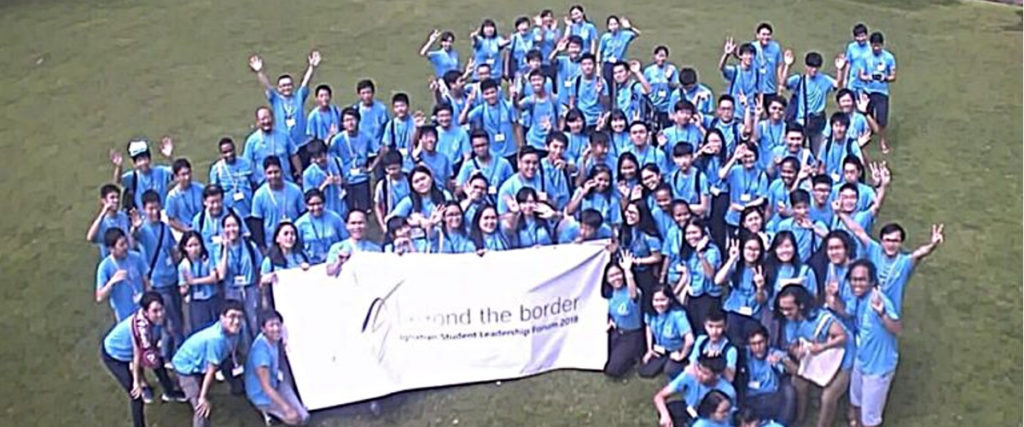
“Our language and culture might be different, but what mattered most is the emotional connection we had. This allowed us to be more open to cross our borders.” Yohana Pegas Syane of Gonzaga College (Jakarta) realised this after participating in the six-day 4th Ignatian Student Leadership Forum (ISLF).
More than 70 student leaders from 19 Jesuit secondary schools in Japan, Taiwan, Macau, Hong Kong, Indonesia, Philippines and Timor-Leste gathered in Tokyo for the forum. It was storming when they arrived on August 8, accompanied by their teachers, but by the time they reached the Sophia University Junior College Hadano campus on the outskirts of Tokyo, a full rainbow blazed in the sky to welcome them.
Fr Sali Augustine SJ, Sophia School Corporation Trustee for General Affairs, welcomed the delegates and presided at the opening Mass. It did not take long for the delegates to bond and make friends, especially with the sports activities the next day.
ISLF began six years ago when five schools in Asia Pacific decided to hold a gathering of student leaders together. They wanted to offer student leaders a chance to get to know their peers in other Jesuit schools and learn from each other about Ignatian leadership in their contexts and experiences. The first ISLF was hosted by Xavier School in Manila.
This year’s theme, “Beyond the Border”, challenged the student leaders to go beyond their own cultures and comfort zones as they discussed world issues such as migration, war and ecology. They also had an opportunity for immersion. Scholastic Naoki Ochi SJ, who conceived the theme, explained that he opted not to use the verb “cross” because “to cross the border is a grace”.
He also hopes that ISLF will help to “promote inter-province events more and more because differences of provinces are not boundaries”. Indeed, this is what many participants realised.
“I grew up in a country where it is so easy to create a lot of borders. But this is not helpful for my country and for the world,” said Ruka Matsumoto of Sophia Fukuoka (Japan). “I’ve realised that I can begin to change this perspective if I change my own perspective first.“
Jules Malhabour of Ateneo de Iloilo (Philippines) said that the most significant lesson he learnt is that people create their own borders. “We are the ones who create our own ‘borders’ and therefore, only we have the ability to erase them. The ISLF experience truly opened both my eyes, and my heart.”
For Danielle Francine Reyes, also from Ateneo de Iloilo, the ISLF was “a bridge among these differences, [that] built strong friendships among countries and brought us fruitful experiences”.
Aprilia de Jesus of Colégio de Santo Inácio de Loiola (Timor-Leste) agrees. “Our differences in cultures and languages do not separate us because we are united as sons and daughters of St Ignatius”.
The forum was also a rewarding experience for the teachers and organising team.
Wah Yan College (Hong Kong) teacher Kei Fung Vic Chan was pleased to see how the students grew as they were given the flexibility to discover what they could do and to explore their personal growth. “In the classroom, teachers at times focus on strategies rather than the person of the students. This is in itself a border that divides. With ISLF I saw how the students learnt more deeply than what is taught in the classroom,” she said.
Muyako Sakura of the Jesuit Education Center office helped to organise the event, and was happy to see the students gradually open up their eyes and hearts to issues of migrants, wars, and ecology.
For Yoshitoshi Kado, a volunteer from Tokyo University, the forum was an “unforgettable memory”. “It was the first time in my life to talk about faith in the Lord with teenagers from other countries and it was very stimulating,” he said.
At the end of the forum, Scholastic Kotaro Mori SJ, who headed the organising committee, likened the ISLF experience to that of the disciples on their way to Emmaus (Luke 24:13-35). They all felt a burning in their hearts, a common flame that will hopefully inspire them to go out into the world beyond their borders.
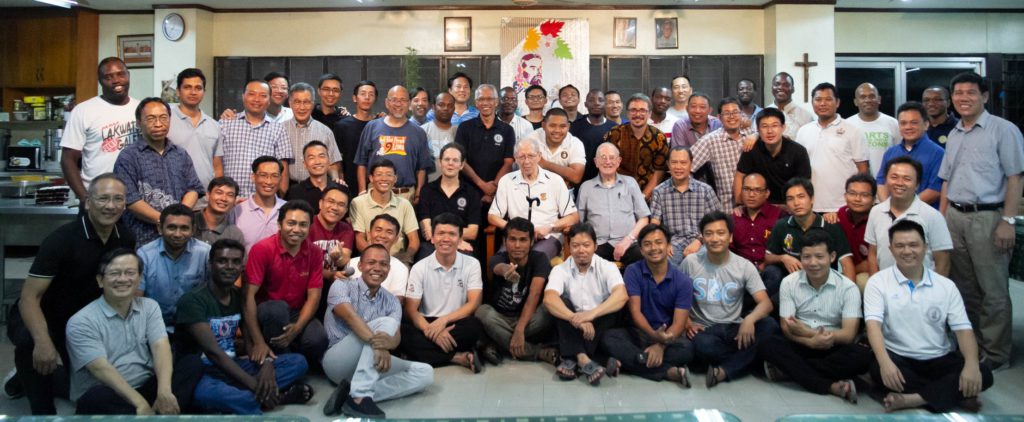
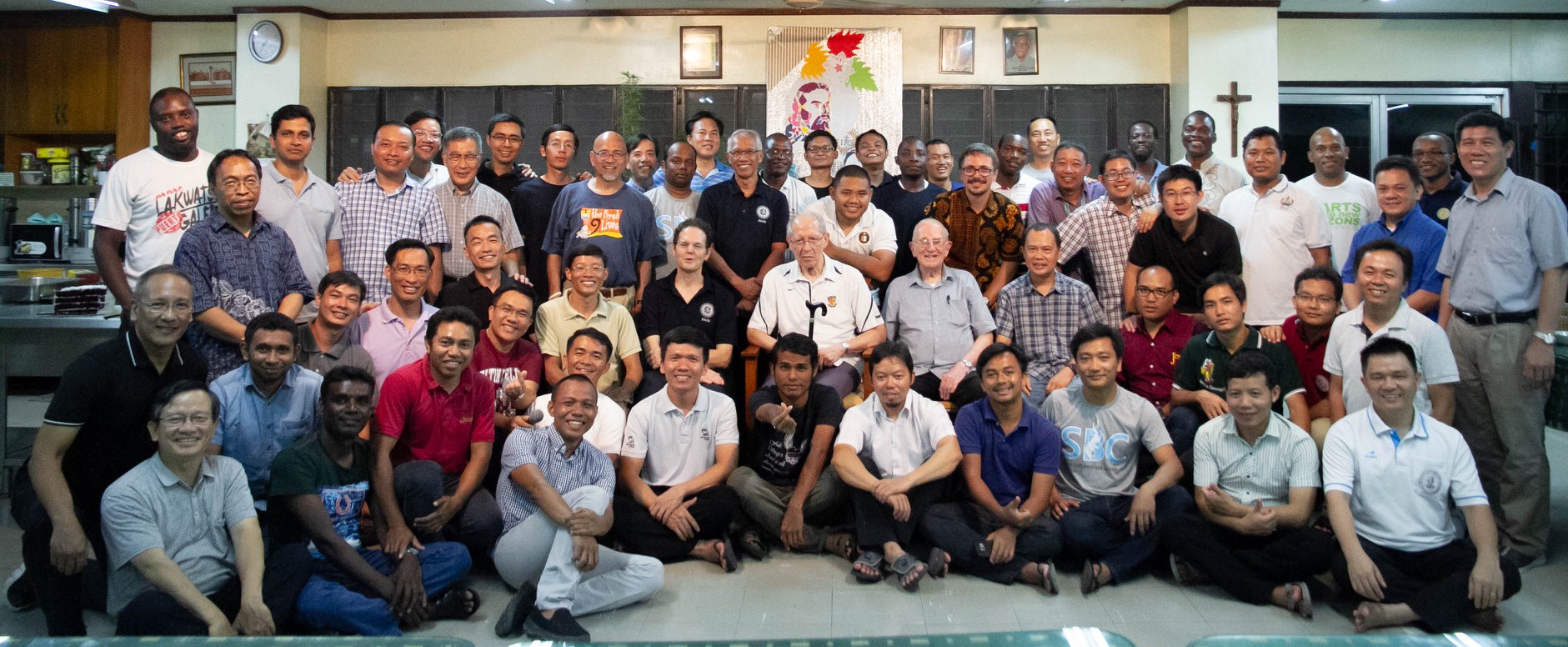
Fr Adolfo Nicolás’ returned to his home province of Japan on August 6, 2018. He left Manila early in the morning accompanied by Japanese Provincial Fr Renzo De Luca, and arrived safely in Tokyo where they were met by Fr Sanji Yamaoka, Socius, and Fr Yasunori Yamauchi, Assistant to the Director of Loyola House, Fr Nicolás’ new residence.
Before he left, JCAP and his communities in the East Asian Pastoral Institute and Arrupe International Residence gathered to thank him and bid him farewell.
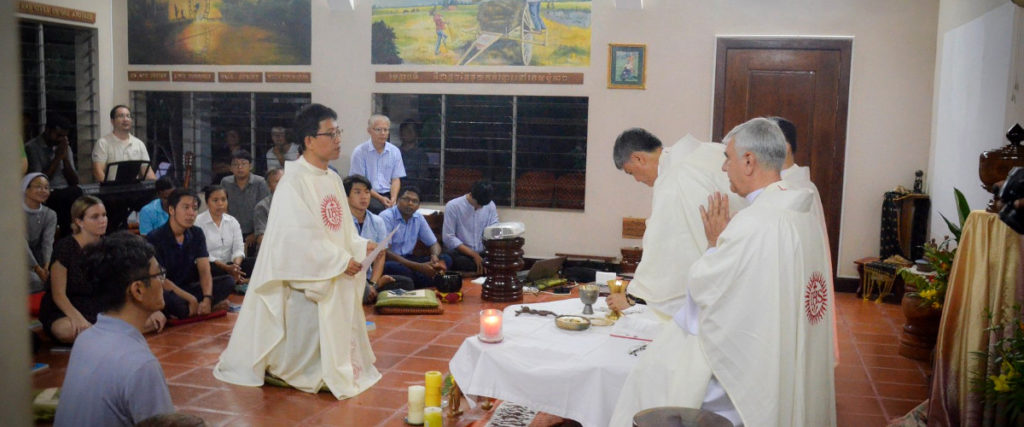
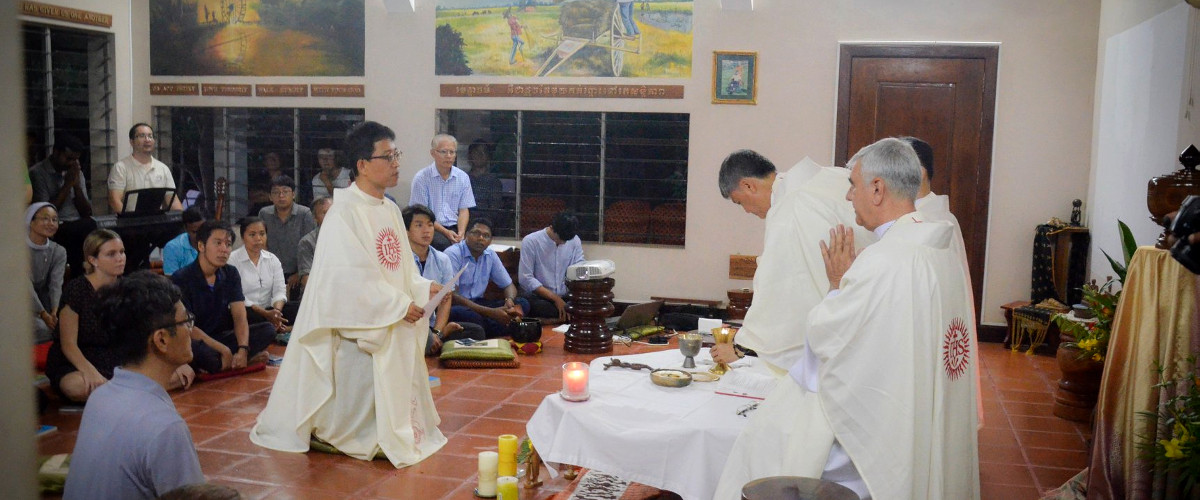
July 31 was a day of special joy for Korean Jesuit Fr Tae-jin Kim and the Jesuits and friends in Cambodia. Fr Kim made his Final Vows that day in a Mass celebrated by Fr In-don Oh SJ, Delegate of the Korean Jesuit Provincial to the Cambodia Mission. The joyful ceremony held on the feast day of St Ignatius Loyola reminded all those gathered of the passion and vision of the founder of the Society of Jesus.
The chapel of the Metta Karuna Reflection Centre in Siem Reap was filled with Jesuits and collaborators who have worked in the Cambodia mission alongside Fr Kim. His personal friends, one of whom is a Protestant minister, also came for the special occasion. He had helped to translate children’s books into Khmer and helped Jesuit Service Cambodia to publish some of the translated books. Many staff and parishioners from Kampong Koh, where Fr Kim had lived, as well as a volunteer and her guest from Italy, and Bishop Enrique Figaredo SJ, Apostolic Prefecture of Battambang, also came to witness him make his final vows.
During his homily, Fr Oh recalled personal memories and experiences of Fr Kim. “I met Fr Tae-jin when I went back to Korea after my regency in Cambodia,” he said. “At that time, he devoted himself to the poor, especially to the homeless, who had been living near Seoul Station. He visited them every weekend. He talked with them, drank with them and stayed with them overnight.”
Fr Oh said that Fr Kim’s love for the homeless, for the marginalised is a vocation that has remained deeply in him and is what brought him to Cambodia as a missionary. He thanked Fr Kim for all his efforts as a professor teaching philosophy at the Royal Phnom Penh University and Major Seminary in Cambodia.
Fr Kim thanked everyone for coming. In particular, he thanked his fellow Jesuits working with him, collaborators of the Jesuits, and the Protestant minister he had studied with and who had inspired him.
Sharing his reflection from a 10-day retreat in Korea, he said, “I found out that I could not face and endure my psychological darkness in my mind. That is why community life is not easy for me. Through Jesuit life and community, I, gradually, began to accept myself and realised God wanted to accept me despite my weakness. After this, I was given relaxation from God and I started to accept others. From now on, I would like to do the same to others as God and my community did to me.” He concluded by asking for prayers for his future ministry.
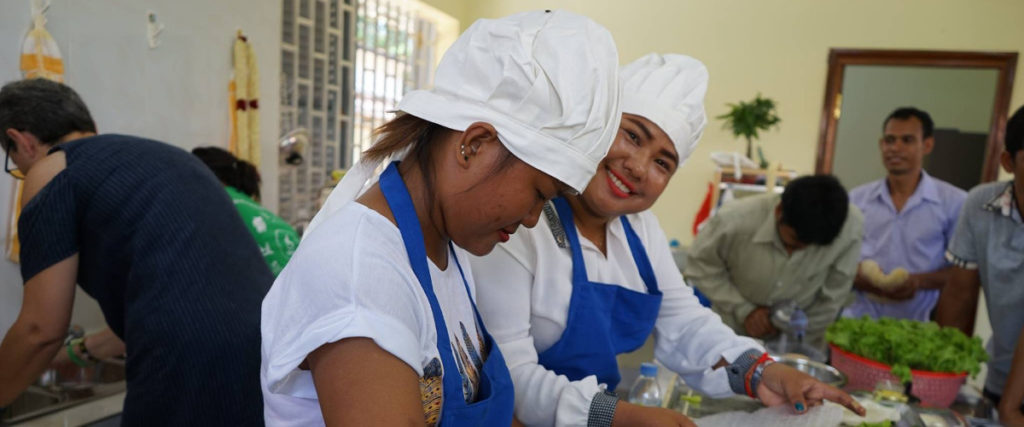
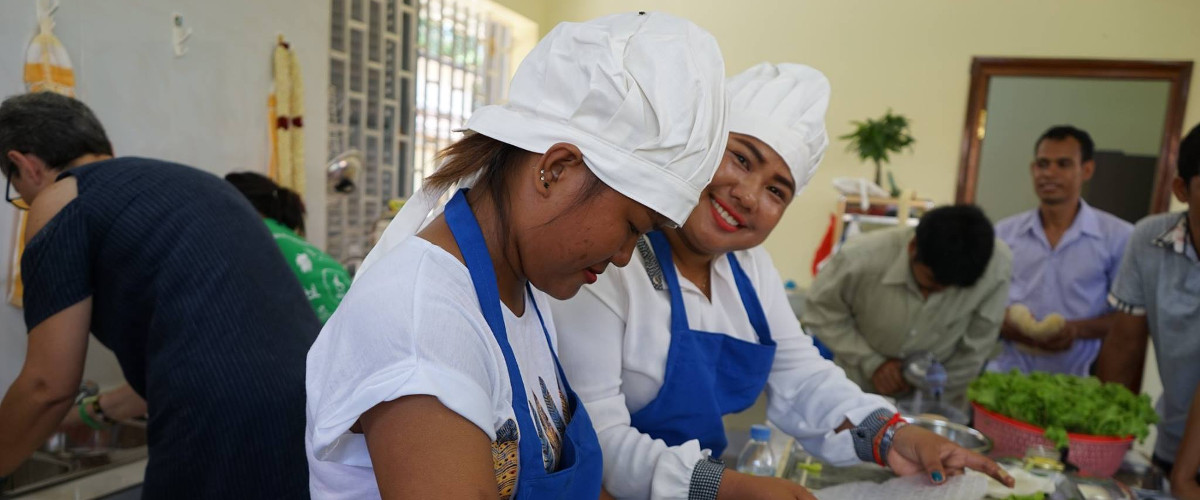 Banteay Prieb, the Jesuit vocational training centre in Cambodia, has opened a café managed and staffed by young people with intellectual disabilities. The café provides these young people with practical skills that can help earn a living.
The café serves traditional Cambodian coffee and tea, and Khmer breakfast and lunch menus. It also offers typical Italian coffees, such as espresso, Americano, cappuccino and latte, fruit smoothies and juices. It was built with funding support from the Korean Jesuit NGO Joy of Sharing Foundation and inaugurated on July 2.
“We hope that after they finish the Banteay Prieb café training, our students will become more financially independent. After the training they can start a small business to support themselves and their family,” said Phalla Kim, Special Education Programme Manager at Banteay Prieb.
Banteay Prieb (Home of the Dove) began its Special Education Programme in 2015 to help young people with intellectual disabilities who are often at risk of social exclusion. “These are persons who suffer great neglect back home and in their villages,” said Br Noel Oliver SJ, who was part of the original team that set up Banteay Prieb in 1990 to help landmine victims and those affected by polio.
In the years that have followed, the number of people with physical disabilities has greatly declined and a number of the centre’s students now are accident victims. The fewer number of physically disabled students inspired Banteay Prieb to expand its services to helping people with intellectual disabilities.
The Special Education Programme has 14 students whose intellectual disabilities include mental retardation, autism, epilepsy, Down syndrome, spasticity and cerebral palsy. The curriculum combines practical life skills with vocational skills training to help the students become independent and self-reliant.
In the first year, the students learn how to manage on their own activities of daily living, such as bathing, cleaning, washing clothes and using a cellular phone. In their second year, they learn other practical skills such as cooking, agriculture, taking public transportation, shopping for food and groceries and money skills like calculating correct change. In the process, they develop their social skills and become more socially integrated. After they graduate, the students have the option to do one or two years of practicum at the Banteay Prieb café to further develop their self-confidence and self-esteem, learn management skills and how to start up income-generating activities on their own.
The Banteay Prieb staff believes that having the Special Education students run the café demonstrates that people with special needs can lead productive lives and can contribute something of value to the community.
“It’s a great service to these youth who have been really neglected in the past,” said Br Oliver. “Their parents have already seen what their children can do if they are given the right atmosphere and opportunity to grow.”
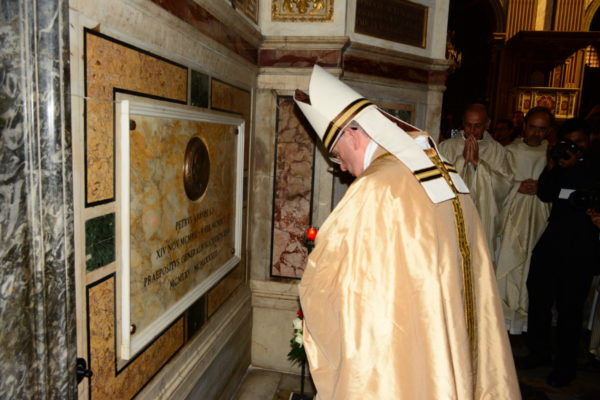

Fr General Arturo Sosa SJ announced this at the International Association of Jesuit Universities meeting in Bilbao, Spain when he addressed the 300 Jesuit and lay participants. “We are still at the beginning of the process, but the Cardinal Vicar of Rome, Angelo de Donatis, has given the approval that the Diocese of Rome open the process of beatification”.
Fr Sosa described Fr Arrupe as “a man of truth rooted in Christ and dedicated to the mission, whose greatest miracle is that we are here today”. He asked for prayers for Fr Arrupe’s cause and the collaboration of anyone with useful information about religious devotion to the former Superior General.
This massive task of compiling a list of 120 witnesses, especially those who personally knew Fr Arrupe, should “be finished in about a year,” Fr Pascual Cebollada SJ, General Postulator of the Society of Jesus, told Catholic News Service on July 13.
Fr Cebollada, who is responsible for overseeing the sainthood causes of Jesuits, will also collect all of Fr Arrupe’s writings. Once he has the list of potential witnesses and all the writings, the formal opening of Fr Arrupe’s sainthood cause will be opened by the Diocese of Rome, which is the diocese where Fr Arrupe died.
“I can tell you that these witnesses will be from various places: from Spain where he was born; Japan where he was first sent by his superiors; and from Rome where he lived the last years of his life,” Fr Cebollada said.
Fr Arrupe was the 28th Superior General of the Society of Jesus. He entered the Society in 1927 and was ordained in 1936. He then went to Japan as a missionary. He was master of novices at the Jesuit novitiate in Hiroshima in 1945 when the United States dropped the atomic bomb, almost entirely destroying the city. Fr Arrupe had studied medicine before joining the Society and he repurposed the novitiate into a makeshift hospital. His life and world view were profoundly affected by the experience.
In 1958, Fr Arrupe was appointed Provincial of the Japanese Province, then in 1965, General Congregation 31 elected him Superior General. French Jesuit Maurice Giuliani exhorted the electors with these words: “We need a General with vision for the universal good in the world and able to cooperate in the redemption of that world”. Fr Arrupe matched that profile.
While he was Superior General, Fr Arrupe encouraged his brothers and collaborators in ministry to heed the call of the Second Vatican Council to return to the Society’s roots and to follow the “preferential option for the poor”. General Congregation 32 Decree 4 (1974 to 1975) defined the Society’s mission today as “the service of faith and the promotion of justice”.
One of his most famous initiatives was the founding of Jesuit Refugee Service (JRS) in 1980 to meet the humanitarian and educational needs of the Vietnamese boat people. He wrote, “The help needed is not only material: in a special way the Society of Jesus is being called to render a service that is human, pedagogical and spiritual”. JRS Asia Pacific was set up the following year.
Fr Arrupe suffered a cerebral stroke on August 7, 1981 on a flight from Bangkok to Rome. He resigned as Superior General in 1983 as his ability to speak degenerated. He died on February 5, 1991 aged 83.
Fr Cebollada told CNS that Pope Francis and countless other Jesuits continue to be inspired by Fr Arrupe’s life and spirituality.
JCAP President Fr Tony Moreno was a pre-novice when he met Fr Arrupe in 1981 at a Philippine Province Eucharistic celebration of the Feast of St Ignatius. He still remembers the impact of meeting Fr Arrupe and welcomes the decision to promote his sainthood cause.
“At General Congregation 36, Pope Francis exhorted the Jesuits to have prophetic audacity to accomplish the mission of God. That describes Fr Arrupe’s leadership. As Superior General, he had the prophetic audacity to implement the reforms set out by Vatican II despite opposition from authorities and influential personalities. His emphasis on a faith that does justice continues to guide us as we serve the universal mission in Asia Pacific.”
Fr Mark Raper SJ had been charged by Fr Arrupe to set up JRS Asia Pacific. In 2104, when he was JCAP President, Fr Mark wrote a message remembering Fr Arrupe on his death anniversary. Read it here.
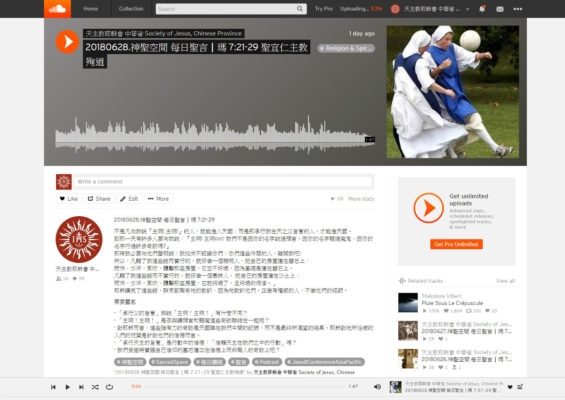

People praying in Chinese now have a new prayer resource with the launch of a daily prayer podcast by the Chinese Jesuit Province. The audio podcasts are based on Sacred Space, which was begun by the Irish Jesuits and is today the world’s leading interactive guided prayer site with the daily prayers available in more than 20 languages. The Chinese language version of Sacred Space has been available since 2014.
On May 2, the Chinese Jesuit Province launched the podcast service, which combines narration of the daily Sacred Space prayer in Mandarin with soothing music to draw the person into contemplative stillness. Each episode or prayer session has six stages and each stage is designed as a meditation on God’s presence in our lives. Since it was launched, the podcasts have been played more than 4,600 times.
“Although this kind of service is not a first in the Chinese area, it is a new attempt by the Society of Jesus,” said Zoe Hsieh, an editor in the communication office of the Chinese Province, which comprises China, Hong Kong, Macau and Taiwan.
Chinese Jesuit Province launches prayer podcast[/caption]
“People strain their eyes by staring at the computer or mobile phone too much. Our eyes tend to get hurt by the blue light of the screen,” Hsieh explained. It is also easy to get distracted while looking at our computer or mobile phone, she added. “We need to quiet down to fully immerse ourselves in the spiritual experience.”
An elderly follower of the Chinese Province Facebook page said that she likes the prayer podcasts because she can enjoy a quiet moment of contact with the Lord Jesus every day. In addition to the daily scripture and reflection, she also appreciates the professional narration, music and accompanying pictures.
Another user likes that she can make use of commuter time to pray and isolate the noisy environment by using her earphones. By just listening to the recording, she also gets a moment to rest her tired eyes. Even if she is busy in the office, she can still listen to the podcast and do other things with both hands.
Fr John Chih-cheng Jao SJ, Province Communication Office Director, described the venture into podcasting as “a new attempt for evangelical mission, as well as to respond to the needs of the readers”.
“The traditional way of evangelisation combined with new web technology is able to reach not only the young Internet generation, but also wider audiences around the world,” he said
Symposium 2018:
Exploring The Silk Road Economic Belt And The 21st-Century Maritime Silk Road: The Challenge Of Cross-Cultural Exchange And Communication
Main Themes
At the dawn of this 21st century, Peter Drucker made this observation about the common good: “This is not the first pluralist society in history. But all other earlier pluralistic societies destroyed themselves because no one took care of the common good. They abounded in communities but could not sustain community, let alone create it. If our modern pluralistic society is to escape the same fate, the leaders of all institutions will have to learn to be leaders beyond the walls.” (Peter Drucker, “The New Pluralism,” Leader to Leader, No. 14 Fall 1999).
Date:
22-23 November 2018
Languages:
English & Chinese
Context for the Call for Papers
China’s Silk Road Economic Belt and the 21st-Century Maritime Silk Road (B&R), announced in 2013, has clearly become a major focus for the country’s efforts to sustain and further develop cooperative relationships with its neighbours near and far, and to work out mutually beneficial policies of economic development for Asia, Europe, and Africa.
Most of the public discussion so far has focused on infrastructure development, that is, construction projects particularly aimed at facilitating communications, travel, and international trade. Yet the “B&R” also intends to promote greater appreciation of China’s own cultural and religious diversity, respect for its neighbours’ cultural achievements, and a realization of cultural values that we share through our common humanity. The “B&R”, quite properly, appeals to the historic legacy of the Silk Road, which for millennia provided opportunities for the exchange, not only of goods and services, but also of ideas as well as spiritual and religious practices, and engagement with the peoples who cherished them. Indeed, save for Daoism, China’s indigenous wisdom tradition, all its other spiritual and religious communities—Buddhism, Christianity, Islam and Judaism—first found a home in China along the Silk Road.
Quite appropriately, the Macau Ricci Institute’s (MRI) hopes to make a significant contribution to the “B&R”. The work of Fr. Ricci and his companions itself is a significant part of the Silk Road legacy, and the friendship that Matteo Ricci enjoyed with China’s scholars and officials is extended even today through MRI’s mission. MRI therefore is dedicating its third annual November Conference, in 2018, to exploring the cultural aspects of the Silk Road legacy.
Each of the three dimensions of the MRI mission provides an opportunity for such exploration:
• The comparative appreciation of spirituality will enable Conference participants to present and analyse the history of the Buddhist, Christian, Jewish, and Muslim communities in China, and the way these have formed bridges of understanding internationally.
• An understanding of how social innovation occurred as a result of the Silk Road can shed a welcome light on the challenges and opportunities that today’s innovators may face, encouraged by the remembrance of China’s deep history of engagement with its neighbours.
• The exercise of moral leadership within the “B&R” offers many challenges both theoretical and practical. The development of effective teaching and learning programs in international business ethics, a special concern of the MRI and its partners, is indispensable if the goals of the “B&R”, even at the level of economic development, are to be realized.
We would encourage submissions for the Conference that promote further discussion and insight of topics related to each of these. For example:
• Studies interpreting the Silk Road’s great religious and cultural artefacts, such as, the Buddhist caves at Dunhuang, the history of Nestorian Christianity, as well as the 16th century Jesuit impact in Beijing, dramatized in the architecture of the Old Summer Palace, “Yuanmingyuan”, as well as the Great Mosque of Xi’an, and Chinese Judaism in Kaifeng. We hope to learn more about how the Silk Road contributed to the development of China’s indigenous spiritual and moral traditions, and vice-versa.
• Analyses of how social innovation occurs through commercial—and thus inevitably cultural—interactions. The history of the Silk Road’s traders and emissaries will help us to understand not only the spread of technological advances, from East to West and vice-versa, but also changes in diet, agricultural practices, finance and local governance, and related areas of interest. The study of social innovation, of course, must be forward looking as well as informed by a realistic understanding of past failures and successes. Therefore, the Conference might also feature discussions of contemporary challenges highlighted by the B&R, for example, the development of intellectual property rights and protocols, the expansion of digital technologies through the internet, the dissemination of promising strategies for mitigating climate change, as well as models of universal health care for rich and poor alike.
• With the prospects for increased economic integration advanced by the “B&R”, the Conference participants might explore the opportunities for mutual learning implicit in pursuing our aspirations for moral leadership. The question of universality or convergence in moral values and ethics, the recognition of a common commitment to the rule of law, the perennial challenge of learning and teaching moral virtues cross-culturally—each of these will surely help to support the exercise of moral leadership in a world transformed by the “B&R”.
This is a preliminary list of topics that might be explored in MRI’s 2018 annual November Conference. The list is by no means exclusive but is meant to suggest a range of concerns that participants might hope to share within the general theme of our Conference.
Brief for Submissions
With this call for papers we invite submissions that broadly focus on the “B&R”, what it is, and how the opportunities for cross-cultural exchange and communication might be understood and responded to by scholars, entrepreneurs, business leaders, as well as students, faculty, netizens and others learning through social media. What can we learn from the historic experience of those who travelled the ancient Silk Roads that might help us to achieve spiritual wisdom as well as practical pathways of success? How might the “B&R” be used to advance the common good and enhance our capacities for moral leadership and social responsibility?
We encourage papers that reflect on the contributions made by the spiritual and wisdom traditions that flourished along the Silk Road—Buddhism, Christianity, Judaism, and Islam—and the ways in which these interacted with Chinese traditions of Confucianism and Daoism. What is the impact of these traditions on our understanding of the common good achievable through cultural exchange and communication, and the many paths open to those who pursue it? Are there practical proposals, informed by the “B&R”, that we should be promoting for the sake of building a harmonious society?
We are looking for papers that bring together theory and practice, research studies and case-based papers that address the opportunities opened by the “B&R”. We welcome both careful empirical studies and thoughtful and well-developed conceptual works that explore this topic. Empirical studies should be supported by rigorous qualitative or quantitative data analysis. Conceptual work should be clearly grounded in the existing literature. Practitioner papers are welcomed to contribute to our understanding of effective teaching and learning, through research, reports and case studies that address any of the questions suggested here, or others that they believe should be addressed.
Submitted papers should have the potential to make a significant contribution both to educational and academic literature and / or organizational development in order to qualify for inclusion in the Conference.
Accepted papers for the Conference will be considered for publication in the MRI Journal.
Submission Dates
Please submit papers or an abstract of 500-700 words for consideration to Anna Cheang, email: [email protected], by 30 July 2018. Authors of accepted papers will be notified by 30 September 2018, and at that time will be given a “Style Sheet” with instructions on the length of the paper, formatting, the use of APA guidelines, and other technical details. The deadline for final papers is 15 November 2018.
Organising Institutions
The Macau Ricci Institute
University of Saint Joseph Macau

Rome, 20 June 2018 – Pope Francis has urged the global community to adopt a shared response to the global refugee situation that may be articulated in four words: welcome, protect, promote and integrate. This World Refugee Day, the Jesuit Refugee Service (JRS) and Entreculturas are building upon Pope Francis’s words to advocate for refugee education with the campaign 4 Words to Open the World.
In countries such as Lebanon, South Sudan, Chad, and the Central African Republic, JRS and Entreculturas give concrete expression to these four words in our service to forcibly displaced persons, particularly through educational projects. With programmes ranging from formal to informal education, and early childhood schooling to teacher-training, we provide education that meets the needs and inspires the hope of refugees.
Education plays a critical role in sustaining, and sometimes even saving, lives. In emergencies as well as in protracted situations, where refugees are displaced for long periods of time, entire generations can be lost because of a lack of education.
“I really like going to school,” says Ali, a Syrian refugee attending one of our schools in Lebanon. “I don’t want to leave it. My only hope for the future is being able to read and write.”
Schools are safe places where children can bond with their peers, thrive after trauma, and regain a sense of normalcy and stability despite their displacement. Education is a way to monitor and foster their safety and wellbeing. Attending school protects children from being exposed to risks such as labour and sexual exploitation, military recruitment, and early marriage.
Access to early childhood and primary education is particularly important because this is the foundation for a lifelong learning process. Education is essential for displaced children to develop the tools necessary to fulfil their potential, and contribute to the growth and stability of their communities.
Nevertheless, refugee children are five times more likely to be out of school than children in non-refugee situations. Only 61 per cent of refugee children have access to primary school compared to 91 per cent of children around the world. There is an urgent need to increase refugee children’s access to schooling.
With 4 Words to Open the World, JRS and Entreculturas urge state authorities and the global community to increase their efforts to provide access to education for refugee children, so that they may feel welcomed, have their skills and talents promoted, know they are protected, and be prepared to integrate into their host communities.
Click here to visit the campaign page.

Holy Family Church in Taipei City was filled to overflowing on Saturday, June 9 as hundreds of people gathered for the ordination of Romio Brahma SJ and Aloysius Ming-te Hsu SJ to the priesthood. It was a momentous occasion and some, especially the relatives and friends of the new priests, were moved to tears by the melodious choir and sacred ritual.
Archbishop of Taipei John B Shan-Chuan Hung SVD officiated at the ordination. During the ceremony, Archbishop Hung praised the two new priests for their determination to respond to the call of their vocation and their wholehearted pursuit of perfect sainthood. He also inspirited them to start the mission of spreading apostolic devotion, stressing that ordination is not a completion, but a beginning.

Fr Stephen Sau-Yan Chow SJ, Provincial of the Chinese Jesuit Province, welcomed the two new priests to the Society of Jesus, and encouraged them “to empty oneself in order to serve others in the Lord”.
Fr Brahma, who is originally from India and belongs to the Kohima Jesuit Region, was very happy to see so many of his relatives and friends at his ordination. He wants to serve the poor and people in need, and asked all gathered to pray for him as he continues to strive to be a servant of God.
Fr Hsu, who is Taiwanese and from Kaohsiung, thanked all those who accompanied him in his vocation journey. He urged the youth present “to carefully discern, to courageously answer the call from God”. After all, he said, one has to take action besides feeling moved.
Many Jesuits joined the celebration, welcoming their brothers to the priesthood. It was a time to give thanks to God for this blessing.
“I am now 86 years old. I’m glad to see successors, and hope that these young priests will continue to carry forward the spirit of Jesus Christ,” said Fr Simon En-jung Chu SJ.
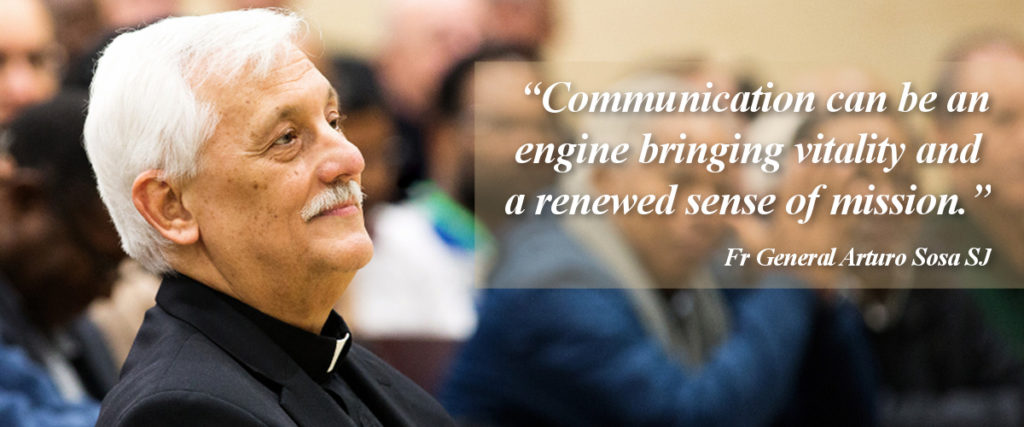
The Society of Jesus is in a new era of communication in service of the mission, and Fr General Arturo Sosa SJ made it clear recently that he is leading the efforts to make this new era an apostolic one. “We want to be focussed, urgent, passionate and strategic [in our communication] … and with a real sense of mission,” he told the heads of communication for the six conferences and the Roman Curia communication team at the start of their four-day meeting in Rome on April 17.
“My main point this morning is to stress my commitment to communication,” he told them. Communication is in the Jesuit DNA, it was “almost an obsession” for St Ignatius and it has been a key principle for the Society of Jesus since its foundation.
“A communicated universal apostolic body is an indispensable dimension of our way of proceeding,” Fr Sosa stressed, and he is keen to build a new culture of communications in the Society.
Fr General is determined that the Society take advantage of the many opportunities he sees in modern culture. “That is what St Ignatius would want from us,” he declared, adding that despite there being a lot of fake news, “we need to discern how to get involved but we should not hang back and be afraid,” he said.
If our mission is to “go out to the whole world and proclaim the Good News”, we have to take part in public discourse to bring the Good News to people, regardless of how we feel about some aspects. “The point is that we cannot be left out of the big dialogues of our age,” Fr Sosa stated.
General Congregation 36 showed that the Society can benefit much from a better communication system. “There was a sense of energy and passion. It showed a way forward and I have been trying to walk that way,” he said.
To this end, he shared that he has decided to say “yes” to many requests for interviews and has begun making short video addresses to the Curia staff and Jesuit meetings beyond Rome.
Come September, the Curia communication team will double from two to four persons. The Curia has also begun building a new website that will reflect what is going on in the Society. “We want a two-way flow of information,” Fr General said, asking for the conferences to help with this and the plan for a focussed presence on social media.
“We want to ensure a unity of hearts and minds across the Society; communications can do a lot to bring this about. Communication can be an engine bringing vitality and a renewed sense of mission,” he stated.
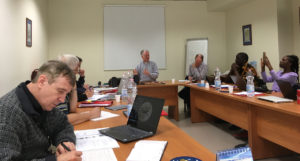 In addition to news of his visits, Fr General highlighted several other events he hopes to see widely covered in the websites, social media channels and written communication in the Society. These include an emphasis on youth especially in relation to the Youth Synod in October and the Magis programme in Panama in early 2019, the Universal Apostolic Preferences when confirmed in January 2019, and the Ignatian Year planned in 2021 and 2022 to commemorate 500 years since the conversion of St Ignatius (2021) and 400 years since the canonisation of Ignatius and Xavier in 2022.
“Our spirituality is now at the heart of this papacy,” he said, and the Ignatian year is a big opportunity to talk about discernment and Ignatian spirituality.
Fr John Dardis SJ, General Counsellor for Discernment and Planning, was with the group for most of their meeting. He too spoke of the opportunity we have now with communication.
“The Society is at a key turning point, a kairos,” said Fr Dardis, who has a background in communication. “Globalisation is giving us an unprecedented chance to network, to be a universal body in mission.
“We are called to ongoing and continual conversion – personal, community, institutional, a restructuring of minds and hearts – and communication is a catalyst of change. Go out and proclaim the Good News is our mission so we must communicate.”
The group also had the opportunity to meet Bishop Paul Tighe, Secretary of the Pontifical Council for Culture. Bishop Tighe spoke of communication as being about building relationships, about helping people to see a broader world.
“The question to ask ourselves is how are we going to be present in the digital world of today,” he told the group. If the Church is going to have prophetic voice it has to create platforms around which people can engage.
Quoting Pope Benedict XVI, he said, we need to listen, to converse, to encourage … to give the Internet a soul.