

Author: 爵醒
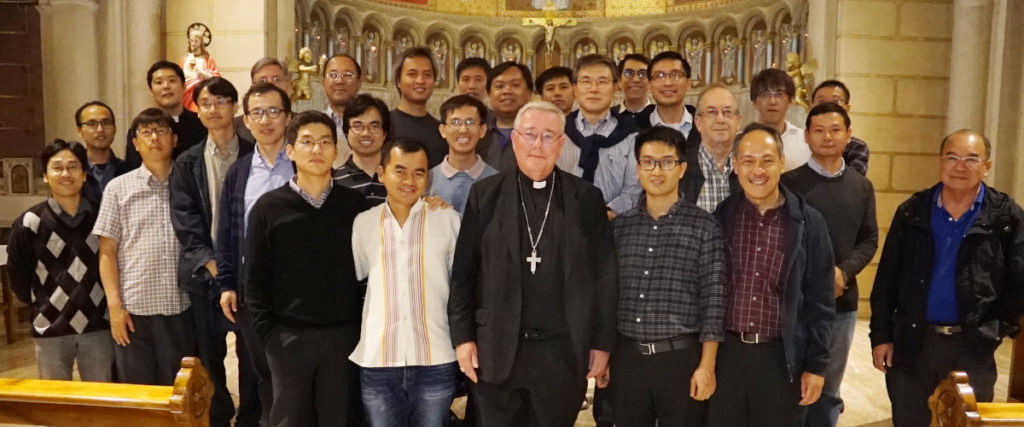
Jesuits from the Jesuit Conference of Asia Pacific (JCAP) who work or study in Rome got together on Sunday, October 20. Some 30 were present, including Jesuits who were visiting Rome from our conference, such as Vietnamese Provincial Fr Vincent Pham Van Mam SJ.
We began by celebrating the Eucharist in St Francis Borgia Chapel in the General Curia. The main presider was His Eminence, Jean-Claude Cardinal Hollerich SJ, Archbishop of Luxembourg, who had been created a Cardinal by the Holy Father in the Consistory of October 2019. Fr Jean-Claude is a proud member of the Japanese Province! Concelebrating with him were three other JCAP Jesuits – Fr José Magadia (Regional Assistant); Fr Gino Picca, an Italian missionary and parish priest in Taiwan; and newly ordained Fr Chang-joon Lee (KOR), who studies Canon Law at the Gregorian.
In his homily, Fr Chang-joon thanked all those in JCAP who have been praying for those of us in Rome. He expressed the hope that we would be able to dedicate ourselves even more to our study and work, and so prepare ourselves as best we can for the apostolate back in JCAP, or wherever the Lord might call us for service. Myanmarese Scholastic PV Joseph, who just arrived for his theological formation here, led the singing and played the guitar. After Mass, the group went for a simple meal at a nearby Chinese restaurant.
The JCAP Jesuits in Rome are engaged in different missions. Many of us are studying in various fields, mainly at the Pontifical Gregorian University and at the Pontifical Biblical Institute (the Biblicum). Others are currently assigned in the Curia, Vatican Radio, and as professors in the Gregorian and the Biblicum. Given this diversity, it is not always easy to come together. But on this occasion, we were happy to have found time to share with each other, and be nourished by spiritual food, a solid Asian dinner and the gift of reaffirming that we remain friends in the Lord, especially being so far away from home.
Fr Benedict Jung SJ from Korea is the Regional Secretary for Asia Pacific. He led in organising this festive semestral gathering.
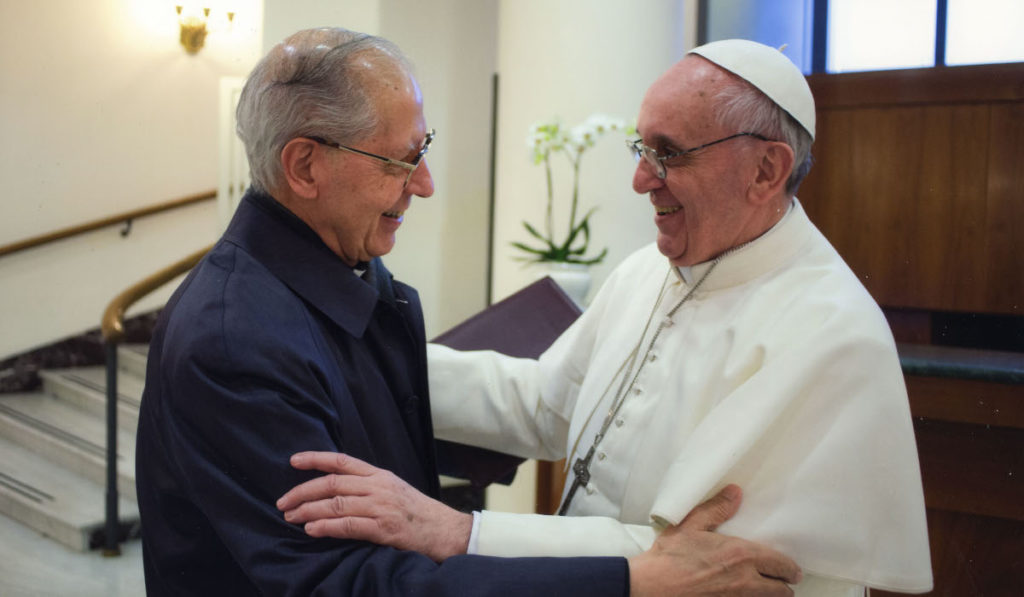
Some months ago, Fr Juan Masiá SJ interviewed his Jesuit brother and former Jesuit Superior General Fr Adolfo Nicolás SJ on Pope Francis’ upcoming visit to Japan. Fr Nicolás told Fr Masiá: “Francis will certainly come in the footsteps of Xavier, but he will not see the other religions as if they were the enemy or the competition, but as traveling companions to give each other life with the joy of the Gospel and the joy of love”.
Below is an unofficial translation of the interview, originally done in Spanish.
Conversations in Japan by Juan Masiá with Adolfo Nicolás
At Loyola House, the residence for elderly Jesuits who pray for the world, the Church and the Society, Fr Adolfo Nicolás, former Superior General of the Jesuits, received with satisfaction the good news of Pope Francis’ trip to Thailand and Japan. The news came precisely when he reviewed the text of a colloquium-epilogue on the posthumous work of K Kadowaki (Jesuit pioneer of inculturation and integrator of Zen spirituality with Christian prayer, well known for his book Zen and the Bible). It was the right time to pray with Francis for Japan and from Japan, to pray for Francis. In this context, these conversations about evangelisation arose; but they were interrupted when his health was affected by an illness in mid-September. We publish in the blog, with your permission, the first entries of the series, hoping to complete them, God willing, after the messages of Francis in Tokyo, Hiroshima and Nagasaki.
Adolfo Nicolás (AN): We are used to hearing from Francis his favorite refrain: “Pray for me.” May this go both ways: to pray with Francis for Japan and from Japan, to pray for Francis, supporting his evangelical spring.
Juan Masiá (JM): Too much for a post and too little for a complete article.
AN: Also, this fragment might help you think.
JM: Let’s start with the trip, a dream of the young Bergoglio is realised, a dream he had on the day he was missioned, but not granted because of health problems. Now he comes to evangelise in the footsteps of Xavier.
AN: To evangelise, yes, and also to let the West be evangelised. “The sower went out to sow and … it was found that the wheat was already sprouting.” It is the Spirit that had sown before. Our Asian colleagues said it and our companion, Fr Codina, says it about the Amazon…
JM: Xavier came in the footsteps of the Spirit.
AN: Francis will come after Xavier’s same footsteps, but with a different background and style from Xavier’s time. I took part in the Synod on the New Evangelisation, but I did not see the errors of the old evangelisation come to the fore. Xavier brought the theology of his time, he thought that “outside the church there is no salvation” and that the so-called “pagans were rushing en masse into hell.” Today, after Vatican II, the mission as colonisation and proselytism is no longer happening, nor are conversions captured with threats of eternal punishment. Francis will certainly come in the footsteps of Xavier, but he will not see the other religions as if they were the enemy or the competition, but as traveling companions to give each other life with the joy of the Gospel and the joy of love: Evangelii Gaudium, Amoris Laetitia , and to protect all life: Laudato si’.
JM: “Protecting all life” is the official motto of Francis’ visit to Japan, which includes central themes of those exhortations well received by the Japanese bishops that, when they appeal for peace, life and justice, or for the abolition of the death penalty, or for the suppression of nuclear weapons, or against the destruction of the environment and the “throw-away” economy, they do so by joining similar movements from within other religions and in union with them.
AN: That is especially true for cooperation with Buddhism, with which we agree and share four great themes that are very endearing to Francis: contemplation, mercy, discernment and the just protection of all life.
JM: This gives us a lot of stuff for the following posts. We will continue preparing for Francis’ coming with these conversations while we pray with him for Japan and from Japan, pray for him. [Religión Digital]
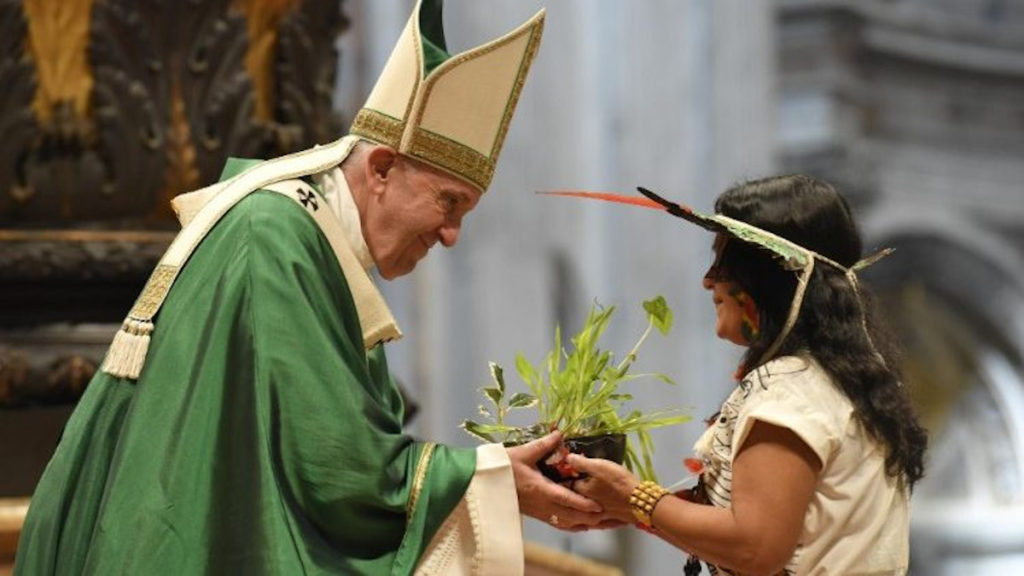
In his inaugural address based on the theme New Paths for the Church and for Integral Ecology, Pope Francis exhorted the 268 participants in the Pan-Amazon Synod not to chase the Holy Spirit away for the Creative Spirit is the main protagonist of the Synod. The Holy Spirit is discernible at work in the Pre-Synodal consultative process of honouring the magisterium of the baptised by listening to the 87,000 people in the Amazon. Based on the Pope’s key concerns, the discernible movement of the Holy Spirit is first of all a call to the Church in her evangelising presence to be a “prophetic and Samaritan ally” in the uphill journey of the Amazonian people.
God’s Spirit hovers over the Pan-Amazon region that covers Brazil, Bolivia, Colombia, Ecuador, Peru, Venezuela, Suriname, Guiana and French Guiana, a basin important for its source of oxygen for the whole earth, where more than one third of the world’s primary forest reserves and one of the largest biodiversity reserves on the planet are found. The region contains 20 per cent of the non-frozen freshwater that supports a population of 33 million inhabitants, of whom 3 million are indigenous belonging to 390 diverse groups or peoples.
It is a region plagued by “youth unemployment – the first and most serious form of exclusion and marginalisation of young people… with alarming situations of slavery in the fields or in the city, tragic also is the drama of child labour” (7th and 8th General Congregation of the Special Synod), “the unbridled corruption that fuels inequalities and injustices” (9th GC), “youth sexual exploitation” (10th GC), “trafficking of human beings in all its dramatic facets, including prostitution, forced labour and organ trafficking… economic, social and cultural ‘colonialism’, subjecting the Amazon to ‘fires’”, “wild capitalism and materialism” and the “violence of ethnocidal extractivism,” turning this “earthly paradise” into “hell” (8th GC).
The second pneumatic movement is to overcome “a homogenising centralism”, or as the Synod calls it “a healthy decentralisation according to synodality” (6th GC) rather than an ideology so irreverential to the local cultures. “Ideology is a dangerous weapon,” the Pope warned. “It’s reductive and leads us to exaggerate our pretense to intellectually understand [a culture] without admiring it or taking it up ourselves.” The subsequent movement is the need to approach the Amazon with a “disciple’s heart”, walking together with her people “on tip-toe,” respecting their diverse histories and cultures. This is echoed in the Synod’s call for ecumenical and interreligious dialogue (5 th GC), for a respectful liturgical inculturation in the traditions and languages of the local peoples based on humility, “an attitude of dialogue based on the common conviction of being co-responsible in the care of the Common Home” (12th GC). This Synodal path needs to take on the “values rooted in Jesus of a universal fraternity, of an integral ecology and of style of life inspired by the ‘good life’ [buen vivir]… promoting the heart of our Common Home, not only between friends, but also between those who are far away and think in different ways… as a response to the many egotistical proposals of our time” (5th GC).
This discernible call of the Pope is in line with an envisioned Church that is polyhedron (Evangelii Gaudium, n236). The term “polyhedron” explains that the different communities of believers “rich in their cultures, aspirations and potential” converge within the universal order, as advocated by the Synod, perceivably, “the Church as a complex ecosystem with a ‘wonderful spiritual biodiversity’” (2nd GC). And each still “maintains their own individuality”. This calls for “respect and fruitfulness [as] these dimensions are fundamental for a Church that is characterised by a multicultural context” where “interculturality is more than a challenge” without “imposition from on high onto their own proper cultures” (5th GC). As Cardinal Michael Czerny avers, “One size does not fit all. In this region at this time, the challenge is to be a Church with an Amazonia and indigenous face/identity.” The Synod affirms that the Amazonia Church must have “an indigenous face, favouring the logic whereby the peripheries move to the centre and the peripheries in a rich movement of mutual transformation” (5th GC) in order to “embrace a ‘symmetry of relationships’ rather than ‘imposition or appropriation’. In an Amazonian Church, the Amazonians’ rights to their culture, land, water and forests, their theology and their religion is a wealth that must be safeguarded in the interest of all mankind (12th GC).
This synod calls for “pastoral presence” rather than mere rare pastoral visits occasioned by the shortage of priests (12th GC). Structural change is needed in order to “ordain wise men of proven religious faith,” including an indigenous permanent diaconate, the need to value lay ministry, greater effective participation and pastoral responsibility for women “whose presence is the sign of reconciliation and covenant for a less clerical Church” (8th and 10th GC). By provision of Canon Law, Pope Francis can grant permission to the local bishops for such ordination of married men and the institutionalisation of the ministries of women (5th GC) in catechetical work, baptising, conducting the Liturgy of the Word, preaching, distributing communion, presiding at weddings and even hearing confessions of dying persons (even though they cannot give absolution), described as diakonia and thus be ordained as deaconess. As Sr Roselei Bertoldo ICM insists, “We are Church and we do Church” where women have a voice and a vote. At the same time, this Synod issues a clarion call to value the affective formation of the seminarians, revaluing celibacy and chastity (8th GC).
The crescendo of this synod, as indicated in the Final Document, is the call for “a true integral, ecological, synodal and pastoral conversion” towards a more inculturated Amazonian/Indigenous Church in solidarity with the universal Church. This Amazonian Church will embody “a preferential option for the indigenous peoples”, enjoying an “Amazonia Rite” and a “new ministerality” for women as ordained deaconesses, recognised catechists, acolytes and lectors, and for men as ordained married priests and permanent deacons for the remote indigenous communities who will boldly take up the pastoral responsibilities and the challenges of an integral ecology and readily responds to the cries of the indigenous communities and of the Amazon-Earth.
Fr Jojo M Fung SJ from the Malaysia-Singapore Region served as Coordinator of the Jesuit Companions in Indigenous Ministry of the Jesuit Conference of Asia Pacific from 1999 to 2019.
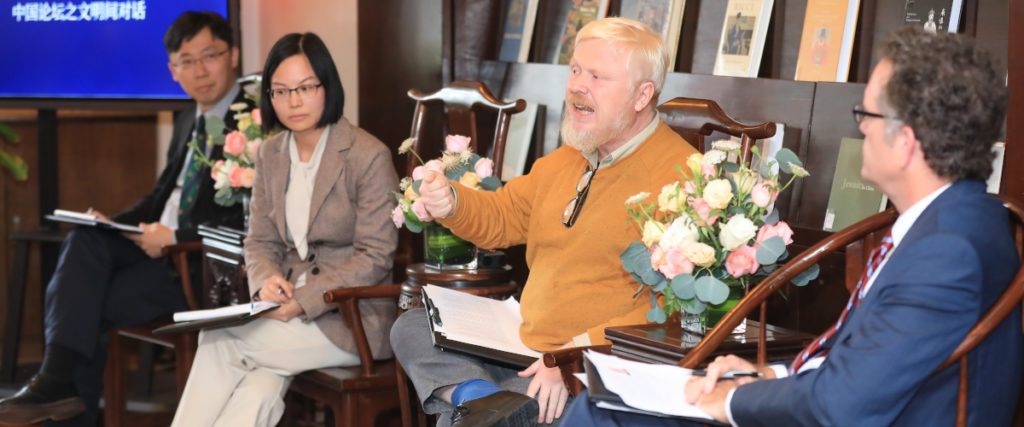
The Beijing Center for Chinese Studies (TBC) hosted the first China Forum to be held in Mainland China. A collaboration between Georgetown University and La Civiltà Cattolica, the China Forum convenes Chinese academics and public figures with international partners to discuss common challenges at the intersection of culture, ethics and global society. The forum on October 17 was premised on the view that today’s political and ideological divides make intercultural dialogue critically important to advance the global common good.
Dr Thomas Banchoff, Vice President for Global Engagement at Georgetown University, described the challenges faced by the Jesuits in cultural dialogue from the time the Society was founded in 1540, to its re-establishment in 1814 and continuing until today. As forum moderator, Banchoff asked the panelists for their take on Jesuit dialogue, what the successes and failures are and the implications of the Jesuit culture in the contemporary era.
Fr Benoit Vermander SJ, Professor and Doctoral Advisor at Fudan University, defined success and failure – two words not found in the gospel – as “taking a position”, where success is a process that can be achieved when one accepts what is happening. He provided an insightful selection of encounters that speak to the Jesuit process, in particular the Jesuit missions from 1842 to 1949, where it was not East against West, but two contributing nationalities present during each mission (Italians and/or French with Chinese). The Jesuits in China were challenged by new ways, such as biblical chronologies versus Chinese chronologies or “what to call God in Chinese”. This exchange of knowledge has paved the way for the “global endeavours in which all dialogues are crisscrossing”. Fr Vermander pointed out that Jesuits should not focus on a single dialogue but remain at the intersection of several dialogues – acting as facilitators for other interpreters.
To a certain extent altruism is necessary to initiate cultural dialogue, but Dr Simon Koo, TBC Executive Director, said it, alone, is not enough – both sides must engage equally. Koo outlined three constructs from the Theory of Planned Behavior – behavioural beliefs, subjective norm and perceived behavioural control – that speak to the motives and thought-process of adapting to a new culture. For example, the Jesuits used different mechanisms to bring science, mathematics, new music, among other things to China to provide incentives for dialogue. His parting message that knowledge and education used to be a luxury but is now widely accessible because of technology left the audience to question whether the incentives for continuing dialogue are minimised in the modern age.
Associate Professor Fangfang Ji from the Chinese Academy of Social Sciences spoke particularly on how Jesuits served as intermediaries in intercultural communication by establishing the first Chinese magazines/newspapers. In an effort to become accepted by local leaders, Jesuit missionaries wrote columns on teachings, science and technology. As “communicator”, Matteo Ricci dressed as a Chinese scholar (instead of a monk) to alleviate his “foreignness” and attempt to adapt to the local culture. Ji said this exemplifies the strategy of “accommodation”, which can be applied to the whole communication process.
Continuing Ji’s example of Matteo Ricci, Bin You from Minzu University of China, related the many ways that Ricci engaged with the Chinese people. Apart from changing his clothing, Ricci developed a theological system according to Chinese cultural terms. This includes his perseverance to achieve lingual adaptation by correctly describing parts of the soul and God. Ricci’s ability to integrate himself in Chinese culture can still be seen today in Chinese leaders’ enthusiasm for continuing intercultural dialogues.
Another example of intercultural dialogue in contemporary times is the Jesuits’ contribution to music. Music professor Lionel Hong from Fu Jen Catholic University shared how Jesuits used hymns and translated them to Chinese for locals to use in praise of God, while also incorporating the Chinese style in Western music. To demonstrate, Hong sang a hymn in both styles – a wonderful closing to the discussion.
The first China Forum resulted in an abundance of ideas and thoughts enough to make a person question their own part in facilitating intercultural dialogue. The audience raised how to incorporate dialogue today and how the exchange of knowledge can continue through a process of give-and-take, when it means something different in each place. The responses spoke to the individual effort and readiness of people to be able to engage in intercultural dialogue and how Jesuit sinologists have their share of contributions to make as well. [The Beijing Center]
Vukica Elenovska is the communications assistant at TBC. She is an alumnus of TBC and Loyola University Chicago focused on cross-cultural communication.
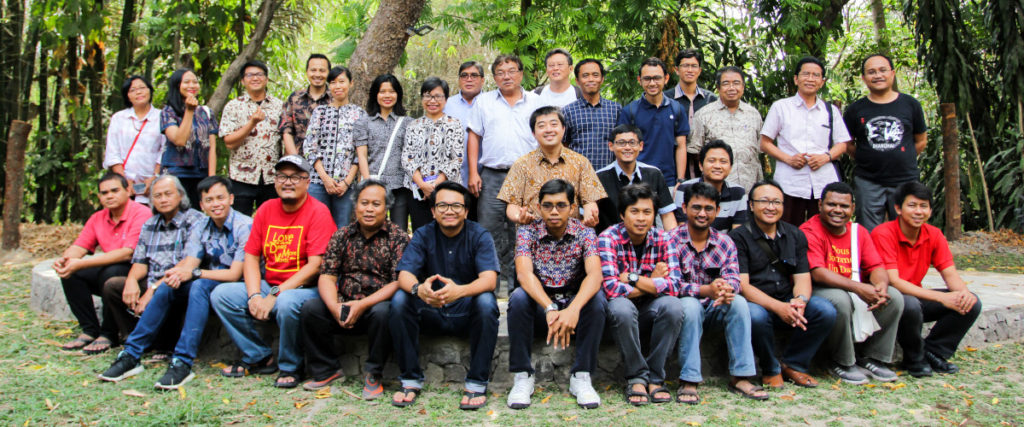
At the International Congress for Jesuit Education, Fr General Arturo Sosa said, “The Internet and social networks have changed how humans think, react, communicate and interact. It is not just a matter of new technology; it is a new world in which people live, especially the younger generations.” This statement became the foundation of the one-day workshop on the ministry of media and communications held at Studio Audio Visual Puskat, Yogyakarta on October 9.
Fr FX Murti Hadi Wijayanto SJ, workshop coordinator, chose “Rediscovering Media and Communications Ministry in the Digital Era” as the workshop theme. The participants included Jesuits and collaborators who work in the media and communications ministries of the Indonesian Province, particularly Kanisius Printing and Publishing, Basis Magazine (magazine on culture and literature), SAV Puskat Sinduharjo (audio video production centre), and Jesuit Insight (social media of Indonesian Jesuit scholastics).
The workshop was enriched by the participation of other lay collaborators, among them: Yulianus Ladung (photographer and social media influencer), Domunicuc Bernardus (founder of E-Katolik Android app), Gregorius Magnus Finneso (chief officer of Kompas Newspaper) and Arum (communications expert and professor at University of Atma Jaya Yogyakarta).
Fr Wijayanto said, “[The] Indonesian Province’s media and communications ministries work in a conventional way. Most of them are directed by older Jesuits. With Industry 4.0, we need to upskill in our use of digital platforms to reach the youth in our ministries. There is a technological generation gap, and the result is that media and communication ministries of the Indonesian Province have developed slowly.”
In his presentation, Fr Y Iswarahadi Ispuroyanto SJ, Studio Audio Visual Puskat Director, said, “Filmmaking has been decreasing. People can learn to make a film by watching YouTube. Moreover, our films shown on national TV now have fewer audiences.”
In the digital era, there should be convergence between conventional and modern ways. Finneso, who was the guest speaker at the workshop, said “Convergence in the digital era is a must. This is the answer in the shift to Industry 4.0. We should be on digital platforms to reach more customers. However, we continue to produce our brands in conventional ways. There should be a complement between [the traditional and modern].”
In light of Fr General’s comments at JESEDU-Rio in 2017 and the insight of the guest speakers, Fr Benedictus Hari Juliawan SJ guided all the participants in looking deeper into their respective ministries. He proposed a way of proceeding that can use our Jesuit worldview to animate our ministries and can be integrated in every Jesuit apostolic mission. In so doing, every Jesuit has the opportunity to influence and invite people to think, reflect and act in a manner worthy of Ingatian spiritualty.
From the participants’ evaluation of the Province’s media and communications ministries, Fr Juliawan suggested, foremost, that since no digital platforms of our media ministries are integrated, convergence might be one way of addressing the issue. Second, interactivity should be encouraged, so we can create a community among customers within and through platforms. Third, in the digital era, we cannot use digital platforms as secondary. If we want to work with the youth through digital platforms seriously, we have to invest not only in big budget items, but also have people who are passionate about digital media. Finally, our presence on social media is not to become followers of trending topics. Rather, we must be an influence on social media through our Ignatian worldview.
Second of two parts
Thingangyun township is a slum area in the eastern part of Yangon where over 200,000 people live in tiny huts in the most basic conditions. As we walk through the narrow and slippery mud paths between the shelters, it is hard to imagine how people can live their lives in such poverty. The shelters are made from anything residents can obtain – tin, bamboo, wood or plastic. The homes are so tiny that there is hardly space for people to cook, eat or even sleep. Their few possessions, maybe some cooking pots and utensils or perhaps some cloth or a broom, are stored carefully on the ground or thin walls. There is no electricity, no sanitation, no water and no privacy. The stench of rubbish and rainy season damp is everywhere. It regularly floods. Many of the residents eke out a living selling flowers, food items or collecting items to sell from the rubbish. Children miss school to help their families earn some kyat to buy rice for a meal. A daily meal is by no means guaranteed. Families living here are vulnerable to sickness and malnutrition. Many live here because they are excluded from economic and educational opportunities because of entrenched ethnic and religious discrimination. Belonging to the wrong ethnic group prevents them from obtaining the necessary identity documents to get a job or enrol in school. It is as though many in Myanmar society close their eyes to the conditions in which they are forced to exist. In contrast, here, amongst the marginalised residents of Thingangyun, the Jesuits accompany poor and vulnerable families, affirming their dignity and providing practical opportunities to improve their lives.
The Jesuits have established a housing project to improve their living conditions, micro-credit opportunities for small-scale loans to establish livelihoods and a community school. This is only possible through the building of trust and friendship with the residents. Community development workers visit the homes to identify and assess needs and monitor ongoing welfare concerns. In contrast to the squalid physical conditions, the meetings with the families were characterised by warmth and respect. Small basic houses are being built using new materials which provide a little more space and a clean area to live and sleep. Still no power, water or sewage but something more sturdy that provides some safety, privacy and dignity. The microcredit loans help families purchase equipment that can support their efforts to earn a livelihood such as a trolley to collect rubbish, a sewing machine to make clothes or a tricycle to transport people or goods.
This is the context for the small community school that has been built to provide children and young people of the area opportunities for education. In contrast to the spacious buildings, landscaped gardens and modern facilities of many of our schools in Australia, this school is small and sparse but it provides a dry and safe place for students to learn. Volunteer teachers run classes and study groups in the evening for children whose motivation to learn is not stifled by the precarious conditions of their lives. Poverty presents all kinds of challenges that affect the students’ ability to learn and progress. However the commitment to accompany and support these young people affirms that their lives are valued and encourages a tangible hope for a future of inclusion and participation in their developing nation.
An overnight bus trip brought me to Taunggyi, the capital city of Shan state, a bustling city located on a mountain ridge and home to a number of different ethnic groups. Here I was able to visit the Saint Aloysius Gonzaga (SAG) Institute where over 400 students study English, Humanities and Social Science. The students themselves represent the ethnic diversity of Myanmar coming from Kayah, Kachin, Intha, Karen, Shan and other ethnic backgrounds. Students from poor backgrounds and/or from distant regions can board in the hostels and access the nutrition programme provided by the College. The experience of learning and living together breaks down barriers and promotes positive relationships between different ethnic groups and religions. In this way SAG provides a space where dialogue based upon mutual respect can be promoted, so important in building peace in a society that has known so much conflict and division.
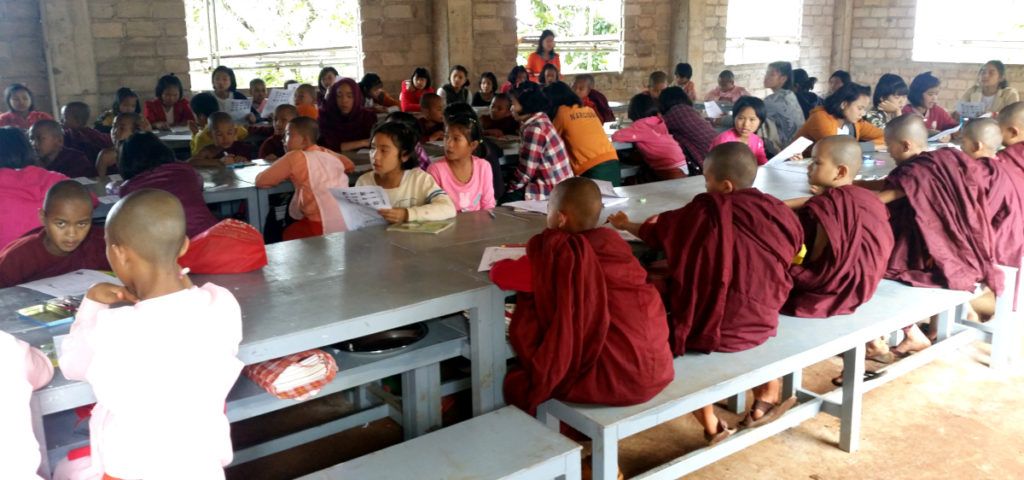
Jesuit Mission helps to provide student scholarships which includes their boarding and food expenses and also provides funding for teachers and administrators of the school. Classes for younger students are provided through the weekend and summer school programmes. The educational opportunities greatly serve the local Church in Myanmar. How inspiring it was to visit the monastery schools with the teacher interns from SAG in Taunggyi. Young, committed women from different ethnic groups and faiths running free English language classes at the monastery schools crowded with young children from outlying villages, many of whom are orphans. They run these after school hours every weekday. There might be up to 80 students in a class. The children live in very simple conditions at the monasteries. Classrooms are basic tables and benches in a hall that we might call a shed. The lessons were well-prepared and engaging, reflecting the passion of the young teachers and the students’ hunger to learn. The next day we visited two more monastery schools with a larger group of male and female final year students to meet the monks and students in preparation for their forthcoming classes.
Sometimes what is obvious can be refreshed or seen more clearly in a different setting. Whether in a classroom in Australia or a monastery class amongst the hills of Taunggyi in Myanmar, education opens opportunities for each individual student to fulfil their yearnings and their unique potential. Fostering this potential, nurturing the hope to achieve it, providing the knowledge and skills to reach it and accompanying students through all the barriers that might prevent it, is a commitment lived out daily by the Jesuits and their colleagues in Myanmar. They are supporting the most valuable resource in Myanmar – its people. By choosing to accompany the people who live on the margins of society, they are also fostering the aspiration that all people can live with dignity in a just and peaceful nation.

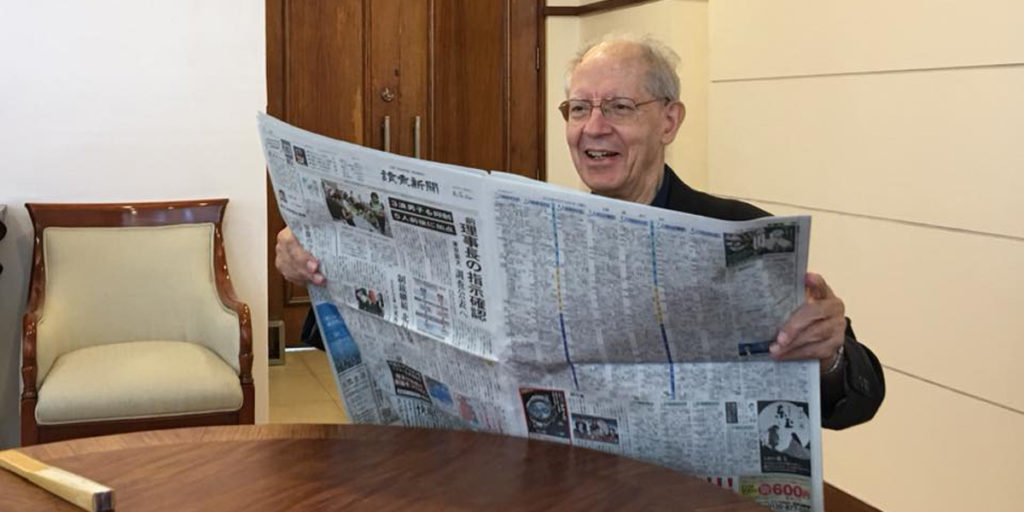
For more than three weeks now, Fr Adolfo Nicolás SJ has been in the hospital, receiving good medical treatment, and enjoying the close care of our brethren of the Japan Province. His condition is now stable. The Jesuits in Japan, the Conference of Major Superiors of Asia Pacific and the General Curia of the Society of Jesus request all Jesuits, partners in mission, and friends for prayers.
~Statement released by Fr Antoine Kerhuel SJ, Secretary of the Society of Jesus
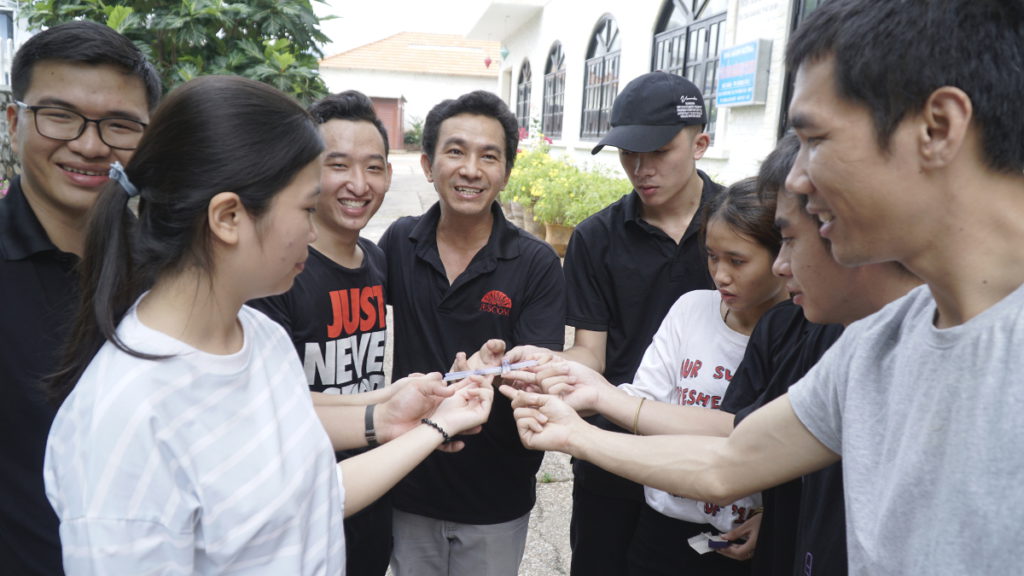
In a span of 18 months, Jesuit Communications (JesCom) Vietnam trained nearly 300 young Vietnamese Catholics in media literacy through their Media Education Project.
Inspired by the CommLab programme of SIGNIS, the project, which was started by Fr Nguyen Van Yen SJ and CommLab programme alumnus Vi Cao, aimed at providing media skills and knowledge to young people and to connect them as a network from which they could find spiritual and practical support.
A total of 22 courses have been conducted for 286 young Catholics across the country since March 2017. The alumni network is coordinated by members empowered by the JesCom committee in Vietnam.
On September 29, the programme officially ended with an evaluation workshop. Twenty-two participants representing the 22 courses shared their experiences and motivations along with their vision for a future project that echoes the success of the programme.
“Our workshop invitation received a prompt response from youth groups, parishes, dioceses and individuals. However, we must not only ask what JesCom Vietnam can do for us, but also what we have to offer to the church through communications and JesCom,” said Deputy Head of JesCom Vietnam Brother Thien Kinh SJ.
The evaluation sought to improve the programme further by asking the participants to identify gaps in human resource allocation, decision-making processes, training content, network management and financial resources.
At the end of the workshop, Vo Quoc Vuong, an alumnus from the 14th training course in the Vinh Province said: “There are 24 members of our course and after a year, we still keep in touch with each other. We connect with each other beyond the skills we shared, we perform online evaluation every day and we do mission trips even though our financial support is limited and most of us are still students. As millennials, traveling to extremely poor areas and discovering the real struggle of children without basic needs such as clothes, food or school materials, and seeing a dedicated parish priest who has to run back and forth between chapels that are 70 kilometres apart made us burst into tears. We found the true reason for our mission as communicators.”
The Media Education Project will be renewed with improvements to better empower the youth with adequate communication tools.

Superior General of the Society of Jesus Fr Arturo Sosa SJ has officially announced the celebration of the Ignatian year to commemorate 500 years since the conversion of St Ignatius in 2021 and 400 years since the canonisation of St Ignatius and St Francis Xavier in 2022. Continue reading “Ignatian year: a call to conversion”
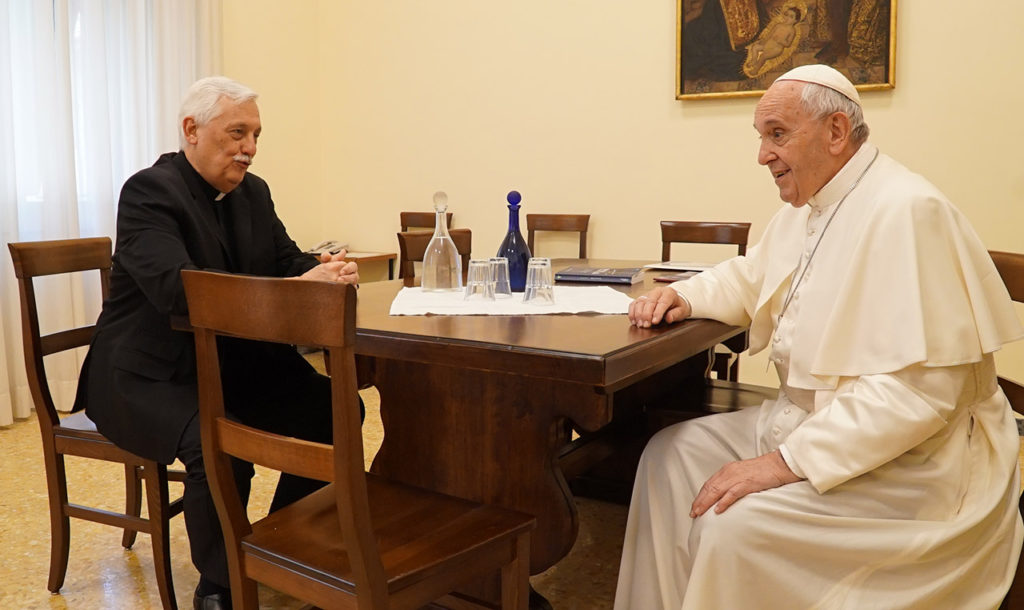
Pope Francis is a Jesuit. We asked the General of the Jesuits, Fr. Arturo Sosa, SJ, to tell us what he thinks of the current Pope and what he is bringing to the Church.