

Author: cfliao


QUEZON CITY, Philippines (UCAN) — Filipino national hero Jose Rizal died 113 years ago but the controversy over his alleged heresies still rages.
Jose Rizal
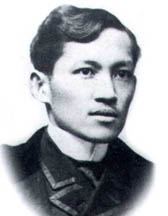
This year, blogs and newspaper editorials continued the debate on the issue.
In one discussion forum, one post said that, if true, it is “sad … that the cradle of Catholicism in Asia is honoring as national hero, a Catholic heretic.”
Jesuit Father Jose Arcilla, a history professor and archivist who lectures to schools on Rizal, has no doubt Rizal believed in God and was not a heretic.
The priest acknowledges that Rizal was critical of the Church and religion in some of his writings, but claims he never denied God.
“Returning from Cuba, he wrote in his diary, ‘I think God is directing my life. He is allowing me to die in my country’,” Father Arcilla said. “Are those the words of a non-believer?”
Rizal, a polymath and intellectual, advocated political reforms during the Spanish colonial era and was executed by firing squad on Dec. 30, 1896, in Manila. The day is now a national holiday.
Spanish friars declared Rizal’s first novel “Noli Me Tangere” (Touch me not), published in 1887, as heretical, scandalous to the Catholic Church and injurious to the government.
The book’s characters include a young intellectual who returns home from Europe, a woman he falls in love with who turns out to be a Spanish friar’s daughter, and the protagonist’s father, who is killed after being falsely accused of heresy.
Father Jose Arcilla, history professor and archivist of the Philippine Province of the Society of Jesus.
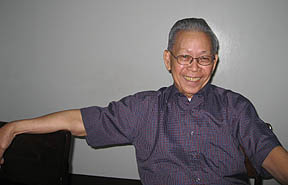
The controversy over Rizal’s religious beliefs was further fueled by his membership of the Freemasons, a fraternity of men following a philosophy the Church regards as opposed to Christian doctrine.
A 1956 law requires all educational establishments in the Philippines to include Rizal’s life, works and writings in their curricula.
The Catholic Bishops’ Conference of the Philippines opposed the law, saying Rizal’s ideas were often opposed to Catholic dogma and morals. They accused him of “attacks” on the possibility of miracles, the concept of purgatory, sacraments, indulgences, Church prayers, and of questioning God’s omnipotence.
The bishops said he also disparaged the veneration of images and relics, devotion to the Blessed Mother and the saints, and that he questioned papal authority and other key Catholic teachings.
Father Arcilla says that despite his high profile in the Filipino psyche, Rizal remains under-appreciated as most schools focus on his novels.
To do so “is narrow,” the priest says, because Rizal wrote these as propaganda. “To know the mind and heart of Rizal, study his letters and diaries,” the history professor said.
He believes the bishops’ opposition failed because it lacked basis. He stressed that it is important to understand that Rizal did not reject religion but protested the colonial government’s “use of religion and the Church as a cloak for their abuses.”
He said many of Rizal’s ideas resonate in social movements in the Church and in the world today.


LONAVALA, India (UCAN) — Man’s mastery of nanoscience and nanotechnology will not diminish the attraction of religion, a Jesuit scholar says.
Jesuit Father Job Kozhamthadam
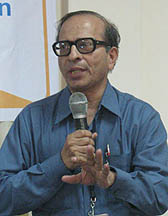
Father Job Kozhamthadam says people will still continue to be drawn to the mystery of religion even if scientists manage to answer all of nature’s mysteries.
Religion’s principal role is to help man find meaning and direction in life, the Jesuit priest told about 140 university professors, researchers and activists at a seminar.
The Jan. 1-5 event was titled: “Science-Religion Dialogue in the World of Nanoscience: The Encounter between the Mastery of Science and the Mystery of Religion.” It was held at the Indian Institute of Science and Religion (IISR), established by Father Kozhamthadam 11 years ago, in Lonavala, near Mumbai.
Father Kozhamthadam, who has a doctorate in the history and philosophy of science, delivered the keynote address.
Science and religion are inseparable companions, he asserted. While science helps man make sense of the world, religion assists him find meaning in life, he explained.
Understanding nature’s mysteries through research and study, particularly in nanoscience and nanotechnology enables man to have a better understanding of life and nature, he said.
Nanoscience is the study of the control of matter on an atomic and molecular level, while nanotechnology is the science of building machines at a subatomic level.
“Mastery and mystery should go hand in hand in our endeavor to build a better world and a better humanity,” he said.
He pointed out that although science has made “incredible strides” in understanding the universe, man still cannot say the age of mystery is over.
For instance, despite many neurological breakthroughs, several fundamental aspects of the human mind and brain remain unknown. Human understanding of the mind is “still laughably primitive,” he quoted US psychiatrist Peter D. Kramer as saying.
The priest said scientists still face “a formidable challenge” in cracking the neural code, the set of rules that transforms electrical pulses emitted by brain cells into perceptions, memories and decisions.
Thus, there is no sign that mysteries will disappear, “not even natural mysteries, much less religious mysteries,” he said.
Jnana Deepa Vidyapeeth (light of knowledge university), the pontifical seminary in Pune, together with three other colleges and a university helped organize the seminar.


In an interview with RNN’s Eileen Good, Gerry O’Hanlon explains the thinking behind his article on the future of the Catholic Church in Europe, in The Future of Europe, a recent book of the Centre of Faith and Justice. ‘Europe and the Roman Catholic Church’ is the title of an article by Jesuit priest Gerry O’Hanlon, featured in The Future of Europe, published by the Jesuit Centre for Faith and Justice. In the article, Fr. O’Hanlon says that many people no longer listen sympathetically or at all to what the Church officially teaches, despite the fact that the Church has so much to contribute to the debate on the future of Europe. What can the Church do to enhance its credibility? He spoke to Eileen Good. Gerry O Hanlon: Well, I think you are right to say that the church does have a lot to offer, and in the article that I wrote I mentioned the Pope’s letter The Church in Europe. That is a very wide ranging analysis of Europe – particularly of the kind of values which he believes that the Catholic Church and Christianity can bring to the whole debate about Europe. Catholic social teaching has a very well developed theory of political action which he thinks is valuable for Europe. And I think he is right. I think the teaching is really valuable. The question I raised then was, given that it is coming from the Catholic Church, would people listen to it? The Pope himself is conscious of this issue; he does say in that letter about Europe that the Church has its own credibility problems. The ones I mention are a bit different from his. He is talking about conversion, the need to be holy, and I think he is right there. I think people sense that we have a relationship with Jesus Christ – there’s something transparent about that and very convincing, and it’s good. But I also raise the areas of sexuality and power as areas where the Church might have difficulties in being credible. Eileen Good: That is true, and I suppose for a large percentage of a generation today, including people who would be now in positions in Europe where they can bring about change, one of the areas if you think about sexuality is Humanae Vitae and the teaching on contraception. Many people of that age group probably don’t even know about it. Gerry O’Hanlon: Yes, and there’s a funny thing there – I suppose people have a way of putting things to one side and getting on with their lives. Many people do that, I think. And the people you are talking about, leaders in Europe who might have a Christian or a Catholic background, they carry on. Yet they are still inspired by their Christian faith, by their Catholic faith. But I think it’s not good for an organisation to have a body of teaching which is so widely ignored and put to one side. From the organisation’s point of view, from the Church’s point of view, it does raise questions, when people get into trouble in other areas, as to how reliable the Church is as a teaching body. So, for good reasons or bad reasons, the church is perceived as lacking wisdom in such an important area in life. We’re talking about relationships and love, and that’s the main thing that really is of significance to people in the end – there are many other things that are important, but in the end they feed off that. If the church is perceived to be lacking wisdom – if some of the good ordinary Christian faithful and the thinkers in the church can’t accept its teaching, it raises big questions. I think that’s, if you like, a running sore in the church, a wound. And I relate it to the issue of power, because I think it’s not healthy that issues can’t be addressed in a more open kind of way. I think that debate can be divisive in the short term, but it’s been clear throughout the history of the church that issues are resolved through talking and through listening. And often teaching changes as a result of that, in a way that makes it clear that the Holy Spirit is leading us. I’d like to see this happening more widely and more openly within the church than happens at the moment. Eileen Good: When you talk about talking and listening – does the listening happen? And if it does, where does it lead? Where can change be implemented? Gerry O’Hanlon: I think a certain amount of listening does go on, and that’s why I say there are signs of hope. I mention that in the article. I think, for example, that the voice of the laity in general is being heard more than it was before. I think the Vatican itself… Somebody did a survey recently and worked out that – what was it? – 15% of those working in the curial offices in the Vatican are women. And there have been attempts to bring in experts who are lay people, men and women, to advise the Vatican. But I think it needs to be a bit wider than this. Several years ago, Cardinal Martini, who is now retired, called for a Third Vatican Council, where these things could be aired more openly. A number of people have talked about that within the Irish Church too – that maybe we need something to give us hope and to give scope to people to share their ordinary experience. I do think there is a lack of structured consultation within the church. There have been beginnings – parish councils, for example – which I think are important. But it needs to go higher than that. And I think that’s one of the steps that needs to be taken to ensure that this debate is real, that people have confidence in it, and that it will lead to change. Eileen Good: You used the phrase “the elephant in the room”. Will the elephant go away? Gerry O’Hanlon: I’d be hopeful it will. I mean it’s very hard to be a prophet, to foresee when it might happen. I suppose I am old enough now to have seen big changes in the church in my lifetime. A lot of people were very fearful of what would happen when the current Pope was elected. Yet I think he has written a beautiful letter on love and sexuality. It just shows what can be done – people can listen to the Pope with great respect. A lot of the secular press, particularly in Britain, were very receptive to that letter. Also, the Pope has begun to listen even to somebody like Hans Küng. They had a discussion in Rome. And that was a great surprise to many people, not least to Hans Küng. He declared himself very happy with it afterwards. So I think the Holy Spirit can surprise us, and people can surprise us. I’d still be very hopeful that change can and will occur.
Father General
– Trip to Croatia and Hungary. From the 4th to the 9th of September Father General visited Croatia and Hungary to celebrate the 100th anniversary of the birth of these two Provinces.
In Croatia he visited Zagreb where he met young Jesuits in formation (in their new building blessed by Father General), the Jesuits who are sick and elderly, and the Jesuit professors of our Philosophical Faculty and those of our School of Economics and Business Administration. In addition, Father Nicolás met with mayor of Zagreb; he paid a visit to Cardinal Josip Bozanic and held a press conference with journalists and representatives of catholic media. The visit ended with a solemn Mass in Sacred Heart Church; during the Eucharist two Jesuits pronounced their vows. On September 6th Father General travelled to Budapest by car.
The visit to Hungary was centered in Budapest and Miskolc. Father General met the members of the Hungarian province as well as a number of Jesuits from Slovakia, Slovenia, Rumania and Croatia celebrating Mass with them in the church of the Sacred Heart with a large number of thefaithful participating. September 7th was devoted to a Province Assembly celebrating the anniversary of the province’s foundation. The topics discussed included: the present reality of the province, its apostolic commitments and future commitments. Later, in the presence of Hungarian Jesuits, their collaborators and the representatives of the Ignatian Family, Father Nicolás spoke about the universal Society of Jesus after General Congregation 35. Following the Assembly, Father Nicolás traveled to the town of Miskolc in northern Hungary; it suffers a high rate unemployment rate due to the closure of several large factories following the collapse of the communist regime. In this city the Society opened a college in 1994 serving now more than 500 students. The purpose of the school is to offer students a high level education in a region that provides them little chance for advancement. Father General blessed a new College building. In addition to the college, the Jesuits administer a parish that focuses on ecumenical collaboration with the Greek Orthodox and Protestant Churches. The day ended with a visit to Saint Ignatius College. The final day of the visit he met with Cardinal Péter Erdö, President of the Hungarian Catholic Bishops’ Conference and of the European Catholic Bishops’ Conference; at the Bishops’ Conference Meeting Father Nicolás gave a brief talk.
– Trip to Ireland. Father General visited the Irish Province from the 10th to the 14th of September. He arrived in Dublin in the afternoon and traveled to Shannon for a meeting with the Province Consultors. The following day was devoted to the celebration of the 150th anniversary of Crescent College Comprehensive in Limerick: visiting the school, meeting with the parents of the students, the board and senior pupils; holding a question & answer session following the speech of Father Nicolás. In the afternoon he met with the Jesuit Refugee Service and some refugees before returning to Dublin for an evening meeting with the “Strategic Committee” that is carrying on negotiations with Trinity College of Dublin about setting up an Institute of Catholic Theology within the state university. The schedule for the weekend, 12 and 13 September, was quite ambitious: a visit to Gonzaga College; a meeting with the “Ignatian family” and Jesuits at work in various apostolates; a visit to Milltown Institute of Philosophy and Theology, followed by a Mass and a meeting with novices, with those responsible for communication for the Irish Province and with families and friends of the Society in Gardiner Street. The afternoon of September 13th Father Nicolás left for Belfast, Northern Ireland to meet the local Jesuit community and an invited group from the University of Ulster. On September 14th he returned to Rome after a meeting with Cardinal Brady and the Jesuits of the Portadown community.
Father General
Trip to Malta. Father General will visit Malta 15 to 23 October. From the 15th through the 20th he participated in the meetings of the Conference of European Provincials at St. Joseph Retreat House in Mosta. The remaining days will be spent visiting houses and ministries of the Maltese Province. These include: the Pedro Arrupe Residence, the Justice and Peace Center, the Paulo Freire Institute in Zejtun and a visit to Hal Far Detention Centre for refugee and asylum seekers from Africa. At the University of Malta a Eucharistic celebration will be held and he will have the opportunity to meet Jesuits and students. In Naxxar, Father Nicolás will tour the province offices and spend time with the Jesuits in the province infirmary. In Birkirkara he will visit St. Aloysius College, (enrolment 1.600) meeting with teachers, lay collaborators and students as well as participate in a Province Consult. The tour includes courtesy visits to various bishops and civil authorities.
Trip to Spain. From the 29th October through the 2nd of November Father General will visit Madrid, Salamanca and Palencia. In Madrid he will meet with the Spanish Provincials and the alumna/e of Areneros College. In Salamanca, he will visit the infirmary and meet with Jesuits in formation. From Palencia he will travel to his hometown of Villamuriel to inaugurate the Pabellón Deportivo Adolfo Nicolás, a sports centre named in his honour built by the civil administration (see n. 12 of June 22 edition of our Electronic Bulletin).
From the Curia
Meeting on Higher Education. The International Committee on Jesuit Higher Education met in Rome 16-18 October. Its primary task was to prepare for an International Conference entitled “Networking Jesuit Higher Education for the Globalizing World” which will be held at the Iberoamericana Jesuit University in Mexico City, April 2010. Presidents, administrators and faculty will meet with Father General to discuss future directions and global networking in higher education and the intellectual apostolate as well as the challenges on the frontiers of society including ecology, theology and contemporary culture, markets and the inequitable distribution of wealth.
Jesuits at the Synod. In the previous edition of this Electronic Bulletin we printed a list of the Jesuits participating at the Special Assembly of Bishops on Africa Synod that is being held in Rome. One member of the Synod is Alexis Habiyambere, bishop of Nyundo, Rwanda. Bishop Habiyambere was born in 1939, joined the Society of Jesus in 1960 and was ordained a priest in 1976. John Paul II named him a bishop on 17 January 1997. The ordination took place on 22 March 1997.
From the Provinces
AFRICA: A Jesuit University?
In a letter to all Jesuits of Africa and Madagascar, dated 22 August 2009, Father Fratern Masawe, president of the Conference of Major Superiors of Africa and Madagascar (JESAM), addressed the question of a Jesuit university in Africa. He began with a “history lesson.” The original idea was presented in 2005 during the meeting of major superiors at Loyola. “The proposal was received with much enthusiasm,” and many Provincials “pledged their support for its realization.” In July 2006 “a group of African Jesuits convened in Nairobi (Kenya) to explore higher education possibilities for Africa and Madagascar.” An electronic survey was sent to African Jesuits asking them to give their opinions. “The response, especially from among the Jesuit scholastics and those in special and graduate studies, was inspiring. The data from the survey provided valuable information as to future possibilities and possible obstacles.” A commission was appointed with members from each of the seven Provinces and three regions. In April 2007 Father Kolvenbach, as Superior General of the Society, asked Father Charles Beirne (New York Province), an expert in higher education in United States, Central America and Puerto Rico, to analyze the responses of the survey and develop relevant implementation models. This past April, at the meeting of JESAM, the decision was taken to dissolve the commission. Father Fratern writes, “It does not seem to us possible or appropriate at the present time to conceive of our response to this in terms of a Jesuit university but rather a policy for higher education… We consider that these existing institutions represent enormous creativity, courage and dedication by Jesuits within our Conference, and that they have already achieved a great deal.” The decision to suspend work on a Jesuit university has been taken given the reality that the Society of Jesus in Africa is experiencing great difficulty in finding staff for the existing common institutions. In addition, some of these institutions are moving towards university status thanks to the support of their respective governments. Father Masawe writes that he is aware that this decision will come as a great disappointment to those who welcomed the idea with enthusiasm, but he holds out hope for the future and ends the letter by noting, “An African proverb says: No one can uproot the tree which God has planted. The tree has been planted. Someday it will blossom.”
CANADA: Joining of Archives
As of the 23rd of September the two Jesuit Canadian Provinces of French Canada and English Canada, have a common archives, located on the lower level of Maison Bellarmin in Montréal. The entire basement was renovated to contain the archives, offices, library, research rooms, etc. “The archives of the Canadian Provinces of the Society of Jesus – wrote Céline Widmer, the archivist – witnesses to the activity of all the Jesuits who worked in Canada and its foreign missions since the arrival of the first companions in 1611. It recalls the memory of their living faith, of their efforts, of their spiritual values, and of their institutions.” The idea of joining the archives emerged in 2006 and Montréal was selected given its accessibility and central location. Bringing this project of relocating the Provinces holdings to realization involved the expenditure of resources and careful logistical planning. The archivist continues, “A single centre in a country as large as Canada might at first seem to limit availability, but the centralization of the archives certainly offers the advantage of a collective vision and a more effective management of resources and collections. In addition, new technologies and the infinite possibilities of the internet now permit access well beyond geographic boundaries.” For this reason the new archives has begun the process of digitalization which will facilitate more rapid and detailed searches making use of a computerized indexing system. It will be some time before this is completed, but the program is well under way.
CHINA: Tales and images
The Taipei Ricci Institute and Renlai monthly magazine recently launched a resource website (www.tale-image.com) collecting tales (stories) and images on places and peoples in the Chinese world, with special focus on cultural diversity, sustainable development and spiritual empowerment. Based on the extensive database of the Institute, the website, updated monthly, offers “ready to publish” stories and provides publication outlets with unique materials on villages, community leaders, spiritual experiences and creative social experiments in China, Taiwan and other parts of Asia. The website will be developed and enriched with the aim of becoming a world-wide resource center for a more narrative approach to developmental, cultural and spiritual issues. For more information email: [email protected].
CHINA: New publications by the Taipei Ricci Institute
The Taipei Ricci Institute has published a twenty-six volume (15.000 pages) collection that contains previously unpublished texts from the Bibiothèque Nationale de France. The editors are Nicolas Standaert, S.J., Ad Dudink (Leuven University), and Nathalie Monnet (Bibiothèque Nationale de France). All the 190 texts reproduced in the collection were published or written before 1820, and are quite unique and very rare. They reflect the characteristics of Chinese publications on Western science and religion in the seventeenth and eighteenth centuries. These publications cover a wide range of subjects such as anatomy, Aristotelian philosophy, geography, astronomy, a treatise on earthquakes, biographies of missionaries and converts, memorials and edicts. The history of the Chinese collection kept at the Bibliothèque Nationale de France spans more than three centuries. The four earliest specimens of Chinese printing entered the Royal Library in 1668, when it acquired half of the outstanding collection of the influential statesman and bibliophile Jules Cardinal Mazarin (1602-1661).
EUROPE: Xavier Network and Mission Procurators
The Xavier Network, a European association of non-governmental organizations (NGO’s) working in the field of international cooperation and closely tied to the Society of Jesus, met in Liverpool from the 1st to the 3rd of October. The meeting, the third for 2009, was held in conjunction with the meeting of European Mission Procurators. Marco Petrini, President of Magis (the Italian NGO) notes, “My immediate impressions about these two events are positive. The Xavier network is enhancing collaboration and exchange of information. In particular in Mozambique; the initial approach to come to know the local situation has become an operative collaboration on common or shared projects … The guidelines of this commitment are consistent with the spirit that animates the Xavier Network; that is not to scatter forces among many micro-projects, but to unite the specialties of all the NGO’s in a common broader and stronger initiative.” The Liverpool meeting was also the occasion to examine the situation in the Amazon region, another place of common cooperation. This meeting marked a major turning point for the group with the approval of an agreement between the Xavier Network and Região Brasil Amazonia da Companhia de Jesus (BAM) which foresees four different types of collaboration between these two entities: exchange of information, exchange of people, advocacy, and financial support. This meeting offered time to continue to reflect on the topic of advocacy that was first attempted nine months ago during the Nuremberg meeting and furthered during the Ignatian Advocacy Workshop, held in Madrid. For more information on the Xavier Network: www.netxavier.org
PERU: Colegio San Ignacio in Piura at the International School Meeting
Four representatives of the staff of Colegio San Ignacio de Loyola in Piura attended the International School Meeting (CENIT 2009) that took place in Lima from the 5th to the 9th of October. The meeting is organized every year by Colegio Santa Margarita as part of the CENIT program to encourage student participation which is sponsored by the Peruvian Ministry of external affaires, the Convention Andrés Bello, Santiago University in Cali, Simón Bolívar Andean University and Piura University. The theme of this year’s congress was, “Leadership and participation begins with the school”. Students who participate in CENIT and assisted by their teachers, prepare reports and conduct debates in order to arrive at conclusions that are later placed at the disposal of the authorities of the participating countries. The group from the Jesuit college submitted a report entitled, “school journalism, stimulus to leadership, participation and constructive criticism.” The representatives of the student council, in collaboration with representatives of Colegio San Ignacio in Medellín, Colombia, and Colegio Javier in Guayaquil, Ecuador, prepared a second report on the significance of being “men for others”, a motto of the collages of the Society of Jesus.
SUDAN: Cuts in educational budget
During the last three years, the Government of Southern Sudan has slashed its education budget by more than 25 percent, from US$134 million to US$100 million. This is particularly disappointing given the remarkable improvements in enrolment rates since the 2005 peace agreement. Budget cuts of this magnitude are likely to adversely affect the quality of education services. With literacy rates at 20 percent overall, and 10 percent among women, much remains to be done. Recently, on the occasion of the International Literacy Day, Jesuit Refugee Service/Eastern Africa (JRS/EA) highlighted the importance of education in Southern Sudan and encouraged the local government to allocate sufficient resources to protect and improve upon the achievements to date. JRS/EA also urged donors and the international community to provide sufficient assistance. According to a UNICEF report last year, school attendance rates in Southern Sudan have tripled in the last four years. Since 2005, they have increased from 343,000 – then the lowest in the world – to more than 1.3 million. Despite this improvement, attendance rates for girls remain much lower than those for boys. Economic hardship, in addition to socio-cultural values and practices, such as early marriage, continues to prevent girls from attending school. More needs to be done to convince parents and communities of the value of education, especially for girls. Shortages of trained and paid teachers pose another major challenge to education.
ZIMBABWE: 50 years of Sinoia Mission
On the 19th of September, all roads led to Chinhoyi Diocesan Pastoral Centre to celebrate the fiftieth anniversary of the establishment of the Jesuit Sinoia Mission. On September 8th 1959 Father General entrusted Sinoia/Chinhoyi Mission to the East German Province of the Society of Jesus. Later, it was integrated into the Zimbabwe Province and over the years Jesuits from the region and from a number of provinces have joined efforts to evangelize this portion of northern Zimbabwe. It started as a the pioneering effort by a band of mostly young, dynamic Jesuits under the auspices of the Archdiocese of Salisbury; it grew into a separate Apostolic Prefecture in 1974 and became a diocese in 1985 under the leadership of Bishop Helmut Reckter S.J. Now, under the guidance of Bishop Dieter Scholtz S.J., it boasts 26 local diocesan priests and 18 parishes, as well as a number of hospitals and schools. Ranging from Kutama, to Kariba to Marymount beyond Mount Darwin, it covers most of the north of the country. The 19th of September celebrations were capped off with a comical play presented by the youth of the diocese portraying how the Jesuits came to establish the mission, on donkeys; a far cry from today’s Toyota Landcruisers! Live donkeys were featured in the play which spotlighted some of the first works established in the diocese. A pictorial exhibition of the history of the diocese also helped many to appreciate the journey thus far and to look forward with faith and hope.
Towards the 4th centenary of Matteo Ricci’s death
Initiatives of Ricci Institute of Paris
Established in 1971 by Father Claude Larre, S.J., the Ricci Institute of Paris recently amalgamated with the Centre Sèvres-Facultés Jésuites de Paris. The Ricci Institute is a centre for research and publication and offers lectures on the philosophical traditions of China and Chinese society of today. At the present time, under the direction of Father Michel Masson, S.J., it is preparing for 2010 an elaborate program on the occasion of the celebration of the 4th centenary of the death of Matteo Ricci (11 May1610). The program envisions a Conference on the exchange of knowledge with China at the time of Matteo Ricci; the United Nations Education, Science and Culture Organization (UNESCO) will participate. The Institute has successfully in promoted the 4th centenary of Ricci’s death in China’s “National Celebrations” for 2010. For further information: http://www.institutricci.org.
Jesuitica
Bark to cure bite
Jesuit bark (or Pulvis Patrum) is the archaic name for the medicine, quinine, the most celebrated remedy for malaria. Extracted from the cinchona tree, it was discovered by the native peoples of Peru who noted its ability to reduce fever. Jesuits working in Peru brought it to Europe. Based on their recommendation, the wife of the Spanish viceroy in Lima, Peru, was cured of malaria in 1630, and this success greatly increased the renown of the remedy.
Vatican Celebrates Europe-China “Bridge”
By Carmen Elena Villa
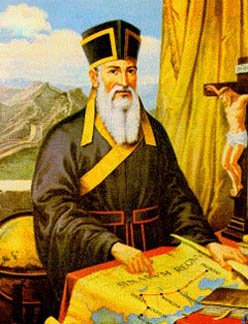
Father Matteo Ricci. He was a bridge between the West and China, promoting Christianity in the country while introducing its culture to the West.
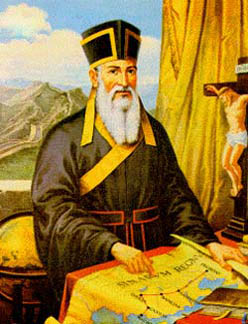
VATICAN CITY, OCT. 29, 2009 (Zenit.org).- When Jesuit Father Matteo Ricci died in China in 1610, for the first time in the country’s history the emperor granted a plot for the burial of a foreigner.
A display at the Vatican is paying tribute to this missionary and what Benedict XVI called his “peculiar capacity” to reach Chinese culture and traditions “with full respect.”
A presentation of the exhibit “To the Heights of History. Matteo Ricci (1552-1610): Between Rome and Peking” was held this morning in the Vatican Press Office. Antonio Paolucci, director of the Vatican Museums and organizer of the exhibit, led the presentation.
The exhibit will be on display in St. Peter’s Square through Jan. 24, 2010. It was organized by the Committee for the Celebration of the Fourth Centenary of Father Matteo Ricci, in collaboration with the Vatican Museums, the General Curia of the Company of Jesus, and the Pontifical Gregorian University.
The exhibit includes pieces such as portraits of the Pontiffs who promoted evangelization in the Far East during the 16th century, as well as paintings of St. Ignatius of Loyola writing the Jesuits’ Constitution and St. Francis Xavier evangelizing Far Eastern lands.
Father Ricci’s manuscripts in Italian and Chinese are also included, as are maps drawn by him, and dozens of pieces representing the union between East and West, which show that Father Ricci understood that it is possible to proclaim the Gospel in all cultures.
“Considering his intense scientific and spiritual activity, one cannot but be positively amazed given the innovative and peculiar capacity he had in approaching, with full respect, Chinese cultural and spiritual traditions in their totality,” Benedict XVI wrote in a message sent to the Diocese of Macerata — Father Ricci’s birthplace — for the fourth centenary of his death.
Matteo Ricci’s “extraordinary missionary adventure led him to build, for the first time in history, a true bridge of dialogue and exchange between Europe and China,” the bishop of the diocese where he was born affirmed today.
Bishop Claudio Giuliodori of Macerata, Italy, added: “Besides paying homage to this giant of the faith and friendship between peoples, the exhibit seeks to provide all with an opportunity to learn about and be inspired by a model of evangelization of the Gospel culture and inculturation that, in many aspects, has no equal in the history of humanity.”
Following St. Francis Xavier
Born in Macerata in 1522, a town then located in the Papal States (at present in Italy), Matteo Ricci left for the Far East on May 18, 1577, when he was not yet an ordained priest, with the blessing of Pope Gregory XIII.
Together with 14 companions, he left on this mission journey with the hope of reaching China, where Jesuit St. Francis Xavier had died just two months after Ricci’s birth.
He was ordained a priest in 1580 in Goa, at the southern end of the coast of the Indian Ocean. In 1583 he went to live in the city of Zhoqing, in the province of Guangdong, after having endured six years of difficulties. Here he dedicated himself intensely to the study of the language.
In Zhaoquing, Ricci drew a map of the world based on European cartography, making the inhabitants of the area aware that there was a world beyond their wall. For the first time in history, China had a map that included the territories of Europe, Africa and America.
“Ricci brought with him the knowledge of the cartographers of his time, something absolutely new for the Chinese,” said Jesuit Father Federico Lombardi, director of the Vatican press office, during today’s presentation.
Little by little he won the esteem of the Chinese people, and succeeded in penetrating this very ancient culture. He also translated books on philosophy and mathematics into Chinese.
“I plan to end my life here. (…) Many have been converted, many come to Mass. They go to confession and Communion on the main feasts and are delighted to listen to the Word of God,” wrote Father Ricci in a letter to his brother Antonio.
Appreciating Chinese culture and knowing their language, Father Ricci worked exhaustively for evangelization and cultural dialogue in China. He wrote a catechism in that language and published his work “Treatise on Friendship.” He also translated Euclid’s first books of geometry in collaboration with his friend Xu Guangqi.
Several of his disciples called him “the strange man,” because of his European physical features, his different culture and the fact that he lived celibacy.
Father Ricci died in Peking on May 11, 1610. His tomb is still there. His cause of beatification opened in 1983.
Bishop Guidiolori said today that the community of Chinese Catholics residing in Italy is working enthusiastically so that Father Ricci will be raised to the altar.


Uta Sievers
Some impressions from Father General’s talk to the Social Apostolate Coordinators
The core of Father General’s talk to the coordinators this year was the question “Is the Society of Jesus moving away from the poor?” This had come up as an observation during our discussions and was a source of concern for our group.
Father General pointed out how a circle of invisibility has led to fewer and fewer young Jesuits wanting to live and work with and among the poor. The starting point is that there are now fewer Jesuits in all apostolates, not just in the social apostolate. This overall scarcity is one reason why Insertion Communities, which represent the closest way of “being with” the poor and marginalised and are often small, are sometimes the first ones to be closed when a province decides to consolidate its communities; and the closure of an Insertion Community means a story that will go untold to the next generation of Jesuits1. At the same time, there are fewer Jesuits who volunteer to live in Insertion Communities and provincials are aware that they cannot force people into this ‘difficult’ way of living. Why do the provincials perceive it as difficult? A possible reason is that however great the initial motivation based on the Gospel message to be with the poor, there is also a wish not to disturb other processes such as formation and university studies. Secondly (and this is the main reason for the small number of new faces in Insertion Communities), as we ourselves grow older in the social apostolate, we have lost contact with the Scholastics while focussing on the poor. Not all is lost, however. In places where the social apostolate has made visible a way to live as religious among the poor, where we have kept in touch with the Scholasticates, young Jesuits have in fact opted for this way of life.
Father General then shared some ideas with us as to what we, as persons active in the social apostolate, can do. One of his main concerns is the need to guard ourselves against the virus of success; working with the poor will never be ‘a success’ or make us successful in a secular sense. We need to discard the idea of success in our thinking, our mentality, our values – this is true for the whole Society of Jesus, but especially for the social apostolate. According to Father Nicolás’ vision of the Society, it is important to live in simplicity with the people whatever our field, pastoral or academic, or any other. This broad experience of commitment will inspire young people more than all-exclusive social justice work, which may send out the message that when you work with the poor, you cannot serve in any other way. In the same vein, he also warns against an “all or nothing” mentality in the social apostolate, since a purist’s vision of social justice will produce admirers but not followers. Instead, we need to plan this form of work with care; we need to plan our free time, our study, and our service in an interrelated and meaningful way. And last but not least, if we manage to make friends among the poor, we will never feel we are “moving away” even if we change assignments.
Father Nicolás also raised the issue of the way in which we deal with our institutions, especially those that have a long Jesuit tradition. He was quite clear in his analysis that attachment was one of the weakest points of our traditional ministries. We become attached to our ‘creations’ and are very reluctant to let go of the good works we are running. In the process, we are literally killing Jesuits, overloading them with up to five different jobs, infecting them with the virus of success. Mobility is essential to our charism; thus we need to learn a new way of discernment, to let go and move on. For example, when starting a school, we should immediately prepare our lay successors so that we can hand the work over to them after no more than 15 to 30 years. He also stressed the fact that the shrinking number of Jesuits is being compensated for by the growing number of competent lay people who wish to work in our institutions. This gives us the freedom to dream again, to be creative, flexible and mobile. He encouraged us to see our institutions as our children: let them go off, get married and go their own ways.
1For the stories of active insertion communities, see Promotio Iustitiae 100: http://www.sjweb.info/sjs/pj/.
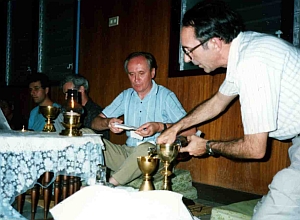
On 16 November 1989, Ignacio Ellacuría, Ignacio Martín-Baró, Segundo Montes, Arnando López, Joaquín López y López and Juan Ramón Moreno, together with Julia Elba Ramos and Cecilia Marisela Ramos, were murdered in El Salvador. The 20th anniversary has been commemorated by a resolution of the Congress and Senate in the United States.
Australian Jesuit Fr Andrew Hamilton SJ remembers the aftermath of the terrible tragedy and its impact on the Society.
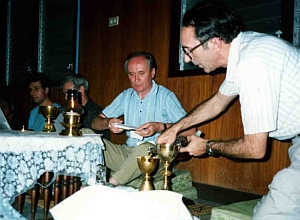 On the day that the six Jesuits, together with the community cook and her daughter, were murdered in El Salvador, I was at Cha Choeng Sau outside Bangkok. The Jesuit Refugee Service was holding a meeting, where we had heard from JRS workers of the suffering and resilience of refugees around Asia. We looked forward to hearing from Fr Jon Sobrino, the Salvadoran Jesuit theologian, who had been speaking at another meeting in Bangkok. But at breakfast we heard the dreadful news.
That evening Jon Sobrino did join us for the Eucharist, still in shock. The next morning, he read the account in the Bangkok Post. A photograph showed one of the dead Jesuits in a room. Jon looked at the photo, and said slowly, ‘That’s my typewriter: that’s my Bible. That is my room’. A Jesuit visiting from another community had spent the evening and died in Jon’s room.
Two years later, I spent six months in El Salvador. I wanted to understand Latin American theology and to visit the communities of refugees who had returned from camps in Panama, Honduras and Nicaragua. In the theological library where I worked there were still bullet marks in the walls from the night of the murders. In many communities there were other relics – the stole worn by Fr Martín Baró, and so on.
The Jesuits were still bearing the weight of their loss. They were determined not to allow the deaths to affect their commitments, and were intensely focused. One wit had remarked, ‘In 1989 the Salvadoran Army martyred the six Jesuits; in 1990 the six Jesuits martyred the rest of the Province’.
Although I had intended my stay to be a gesture of solidarity with the Jesuits in El Salvador, I came to realise that guests with less than fluent Spanish must have been more of a burden than an encouragement. The Jesuits in El Salvador lived under great pressure, constantly standing up to a government that had turned its arms against its little people, and following Jesus in the midst of a civil war. Those who were killed were good people, good Jesuits. They were not picture book saints, just ordinary martyrs. I was heartened to hear that one died swearing at the soldiers who had just broken in the door.
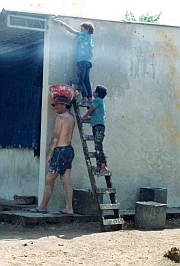 It was in the campesino communities that I began to understand the six Jesuits and the theology evolving in El Salvador and other parts of Latin America. The figures of Julia Elba and Cecilia Marisela Ramos, the community cook and her daughter, then came into sharp focus. With that came some understanding.
These communities had been forced to leave the mountainous parts of El Salvador as the army conducted its counterinsurgency campaign. This consisted of sweeping through villages and killing indiscriminately, and more systematically murdering catechists. In this way they hoped to deprive the guerrillas of a population where they could hide and to intimidate its leadership. The families, all poor, fled and gathered in camps across the border. There they centred their lives around reflection on the Gospels, eventually returning to settle on deserted land. They lived precariously, protected to some extent by foreign volunteers who accompanied them.
In the communities I was given simple tasks where I could not do too much damage. In one community that was preparing to celebrate its tenth anniversary, apart from joining the children in whitewashing the school for the occasion, I was asked to gather the names of their martyrs to remember in the Eucharist. It was deeply moving. The list grew and grew as each family remembered parents, sons and daughters, many of whom had been catechists. One lady offered the names of her seven sons, describing each, and how he had been killed. When she came to the last, Juan, she wept gently. ‘I had such hope in him’, she said.
Harvesting the names made me think of Julia Elba and Cecilia. The Jesuits had died because they refused to regard the poor of El Salvador as expendable, and would not allow those murdered to lie forgotten. They kept memories and hopes alive. Julia and Cecilia had thought they would be safer staying the night in the Jesuit house than at home. But the Jesuits had made themselves unsafe by joining themselves to the expendable poor like Julia and Cecilia. So I began to see the six Jesuits as just some of thousands who had died, represented by the faces of the cook and the daughter.
The theology done in El Salvador, too, was about listening to the Gospel through the lives and the simple words of the poor, and seeking larger, connected words in which to speak of it. It made sense in the communities that I visited. The learned criticism of it that I had read made no sense, just as the political analysis of the threat posed by the poor of El Salvador made no sense. It all began and ended in the wrong place.
The message that I learned from Julia Elba and Cecilia Marisela and the six Jesuits who died, and from the theology that honoured their faith, is that in the Kingdom of God the first will be last, and the last will be first. If we want to follow Jesus we must be simple, companions to those normally thought of last, like Julia and Cecilia Ramos, and so like Ignacio Ellacuría, Ignacio Martín-Baró, Segundo Montes, Arnando López, Joaquín López y López and Juan Ramón Moreno.
Pictured: (Top) Fr Jon Sobrino (right) at the eucharist in Bangkok, following the deaths of the six Jesuits in El Salvador. (Middle) Fr Andrew Hamilton in El Salvador.
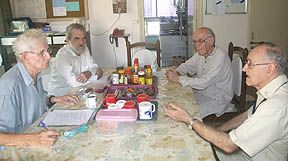
KOLKATA, India (UCAN) — Belgian Jesuits are celebrating the 150th anniversary of the establishment of their Bengal mission in eastern India. Belgian Jesuit missioners of Calcutta province have
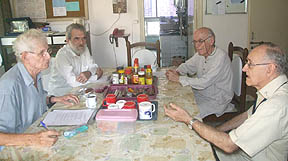
a chat over a cup of coffee at the Jesuit provincial
house in Kolkata. From left: Father Jean Englebert, a liturgist, Father Charles Pollet, a theology professor,
Father Albert Huart and Father Andre Bruylants
The order has had a big impact on lives in the region through education, literary contributions and a translation of the Bible into Bengali.
Father Andre Bruylants, 83, former headmaster of the Jesuit-run St. Xavier’s College in Kolkata, has been working in the mission for 60 years. He is one of seven remaining Belgian Jesuits in the religious society’s Calcutta province.
Jesuit teachers had educated thousands of people and become icons of Catholic education in the region, he says.
Others have influenced the region’s socio-cultural leaders through scholarly interreligious exchanges, and reached out to Indians through the study of Hindu scriptures and engagement with Hindu intellectuals.
Jesuits have influenced literary thinking through publishing and translating Western Christian classics into Bengali, and also helped locals use their own language in worship.
Father Christian Mignon, 85, came to the mission at the age of 25. He was to make a unique contribution to religious life in Bengal, translating the Bible into Bengali over 40 years. The job, in which he was helped by Hindu poet and teacher, Sajal Banerjea, was completed in 2003.
He had previously translated liturgical texts after the Second Vatican Council, which opened the way to the use of local languages in the Mass.
English Jesuits first came to Kolkata in 1833 and started St. Xavier’s but left the country in 1849 after a conflict with the local bishop.
The Belgian Jesuits, who arrived in the city in 1859, were invited to restart the school, which they did within two months in January 1860.
Belgian Jesuit Father Albert Huart, 85, who translated a book on the Jesuits’ Bengal-mission history, is former vice-principal of St. Xavier’s College.
He said that the Belgians expanded from the English educational base to probe further the possibilities of village missions.
Initially the Jesuits’ focus was on the Chotanagpur area, in the present state of Jharkhand. This was where Jesuit Father Constant Lievens (1856-1893), whom the tribal Church reveres as the “apostle of Chotanagpur,” had worked to restore tribal dignity.
By 1869 the Jesuits were entrusted with the Bengal mission, at the time consisting of the present Indian states of West Bengal, Jharkhand, Bihar, Madhya Pradesh and Orissa.


 “Are you ready for Christmas?” asked a guy I see at the train station every day. I thought of the long list of gifts I still needed to buy and the calendar crammed with holiday events and parties, and I shook my head. “Hardly,” I said, and we both laughed knowingly.
On my train ride downtown I turned off my iPod and let my mind ponder that question a little deeper. “Am I ready for Christmas?” This time I thought about the meaning of the holiday-the Son of God coming to earth to dwell among us and show us the way to eternal life. Again I shook my head and murmured to myself, “Hardly.”
It was then that I vowed to take advantage of every opportunity to prepare my heart for the coming of the Christ Child into the world-the world you and I live in.
What I discovered was that if we know what we’re preparing for, everything we encounter on the way to Christmas can prepare us for the coming of Christ, not only in Bethlehem 2,000 years ago but also into our homes, our families, our workplaces, and our communities. The usual December distractions can instead become holy moments when we find the Christ Child in our midst.
Having the right attitude and perspective on the season will help you and your family avoid the excesses that make certain Christmas preparations frantic, yet draining and disappointing. As theologian John Shea says, “The task seems to be the delicate one of learning to make the customs and traditions of Christmas serve the Spirit.”
Take a look at some of December’s demanding activities with new eyes, eyes that fully expect to find God in every moment of this season of hope.