

Author: cfliao



During Lent we take up practices that help us to become aware of and responsive to the needs of others. The three traditional practices of Lent are prayer, fasting, and almsgiving. A commitment to these practices during Lent leads to an awareness of God and conversion of the heart. Here are some suggestions on how to incorporate the traditional Lenten practices into your daily life.
Prayer
Prayer can help us to become more responsive to those who suffer. Find ways to pray often during Lent, focusing on the needs of those who are the victims of injustice. Here are a couple of suggestions.
1. Gather with your family to look through newspapers and news magazines, or browse the Internet to identify injustices occurring throughout the world. Select one injustice, learn about the causes of the injustice, and pray for those who are affected by it. Keep track of developing news about the situation and pray together before dinner or bedtime and at Mass as well. Here is a possible prayer:
God our Father, we know that you hear the cries of all those who suffer. Hear us as we pray for those who suffer unjustly so that their plight might be relieved. We pray also for their oppressors that they will have a change of heart and see the error of their ways. May they use their power for the good of all. We pray for ourselves that we might have the compassion and the courage to do whatever we can to alleviate the suffering and to address the causes of that suffering. We ask you this through Christ, our brother. Amen.
2. Read aloud one of the Church’s Readings for Lent with your family before one meal each week during Lent. You can find a list of the readings at www.usccb.org/nab/index.htm.
Fasting
Fasting can help us recognize our bad habits and overcome them. It can help us live with an awareness of our dependence on God’s love. Here are two ways you can incorporate fasting into your life during Lent.
1. Choose at least one meal each week of Lent at which you will eat less food than normal. Perhaps you can have a simple dinner of soup and bread. At that meal be especially aware that many people will go without a meal this day. Fasting is a means of expressing solidarity with those who are suffering around the world. Later that day when you feel hungry, use that sensation as a reminder to pray for those who have little food.
2. Fast from spreading gossip about others. We are often tempted by our own righteousness to want to say hurtful things about others to make us feel better about ourselves. Gossip dehumanizes people and renders us more likely to treat others without respect. When you feel the desire to speak negatively about others, pray instead for those you may have hurt with gossip. Pray for a more generous heart.
Almsgiving
We can become more like Jesus during Lent by being generous. With your family select a charitable organization and collect donation money. You may want to select an organization that addresses the injustices you identified earlier as part of the “Prayer” aspect of Lent. Here are some suggestions for collecting money.
1. Put a jar or container on the kitchen table. Contribute a set amount of money, determined by your family, each day of Lent.
2. Give up buying junk food and contribute that money to the jar.
3. If you have young children who cannot contribute money, let them contribute by decorating the jar or container.
4. Hold a yard sale and contribute the proceeds to the collection.
5. Invite friends to join your family in contributing to the charity.


KOLKATA, India (UCAN) – Financial constraints have prompted Salesians and a diocese to collaborate with a Jesuit media center to revive a radio program aimed at mainly Muslim listeners.
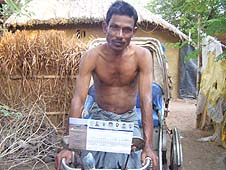
A villager with a Radio Veritas Asia Bengali program schedule on his rickshaw in West Bengal
Jesuit Father Joseph Pymbellykunnel, who directs Chitrabani (sight and sound) in Kolkata, told UCA News that his media center and Banideepti in Dhaka have been preparing Bengali radio programs for the Manila-based Radio Veritas Asia (RVA) listeners for over three decades.
However, the radio recently cut 30 percent of its subsidy it gave to the two South Asian centers to prepare the Bengali program and reduced the number of staff from three to two, the Jesuit priest said. Now, the Salesians and Krishnagar diocese in West Bengal have agreed to become partners in the mission, he added.
Chitrabani is involved in producing radio programs for the Church in West Bengal, and it was necessary to tap resources available in the state, said Father Pymbellykunnel, who is also secretary of the regional bishops’ council’s communication commission.
Salesian Father Robin Gomes, who produces two of the weekly RVA Bengali programs since 1998, said his center, Nitika, another media center in Kolkata, did not receive funds for the past year.
“We had to produce the programs from our resources, and therefore the Salesian superior has agreed to support the production of these two programs,” Father Gomes, who coordinated the Bengali program from Manila during 1995-2001, told UCA News.
Father Subhash Baroi, director of Prerona (inspiration), the pastoral center of Krishnagar diocese, told UCA News that his bishop and laypeople have come forward to help RVA’s Bengali programs because they are convinced about the “grave need” to collaborate to keep the programs going.
Father Baroi, who was also in the RVA Bengali section in Manila, said he is now working on details to support Chitrabani produce programs for Manila.
Dilip Majumdar, who produces RVA Bengali programs, said radio reaches millions and promotes interfaith dialogue with Muslims. He said RVA’s Bengali programs reach some 70 percent of the Muslims in the area. If Muslims of rural Bengal know about Christ and the Bible, it is thanks to RVA programs, he told UCA News.
India’s West Bengal state and neighboring Bangladesh have Bengali as a common language. Muslims form 25 percent of West Bengal’s total population of 80 million while 90 percent of Bangladesh’s 160 million people are Muslims.



In the course of our busy week, we most likely have times set apart for certain things that are important to us-a workout, a few social phone calls, or maybe even a short catnap-so that we can renew ourselves, our energy, and our perspective. Holy Week (March 29- April 3, 2010) is a time that is set apart in our Church’s liturgical year for our spiritual renewal. In fact, the word holy refers to anything that is set apart for God’s purposes. Holy Week is holy precisely because it is time that is set apart for us to focus on how we are spiritually renewed through the suffering, death, and Resurrection of Jesus.
The Symbols of Holy Week
The liturgies of Holy Week are filled with some of the richest and most ancient symbols of the Catholic faith. The waving of palms on Passion (Palm) Sunday reminds us that we are called to be followers of Jesus, not just fans who cheer from a distance. The washing of feet on Holy Thursday speaks to us of the selfless love that we are called to practice in imitation of Jesus. The veneration of the cross on Good Friday reminds us that, as Christians, we believe that Jesus can overcome anything, even death. The lighting of the Easter fire in a darkened church and the celebration of baptisms on Holy Saturday speak to us of the new life that is ours because of Jesus’ triumph over the darkness of sin and death through his resurrection.
Make Space to Renew Your Faith
In her book The Holy Way, Paula Huston explains that “a cluttered and overburdened mental space can be one of the biggest obstacles to simple living.” This Holy Week allow yourself time apart, holy time, to spend with Jesus. May it be a time set apart to unclutter your mind, lay down your burdens, and renew your faith in Jesus.
For related resources for Holy Week and spiritual renewal, see:


by Professor Zhu Jing,
Docteur-ès-LettresFudan University

A Story within a Story:André Gide’s The Counterfeiters André Gide was an explorative and entrepreneurial writer, with a solid foundation in traditional culture at his disposal. At the same time, he constantly endeavoured to renew his conceptual framework, always searching for new creative means and approaches. As Chinese people enjoy a deeper and deeper appreciation of Gide’s works, our studies of his work must also delve new depths. The research findings of Western scholars can serve as a mirror and reference point for Chinese readers, for they help us to broaden our vision as well as to discover new ideas, new perspectives and new approaches.
After I have finished reading Artur Wardega’s book titled “The Technique of mise en abyme (story within story) as employed in André Gide’s Les Faux-Monnayeurs (The Counterfeiters)”, I became enthralled. Wardega, a Polish scholar, possesses profound knowledge and is a meticulous thinker. While focusing on the ideological side of Gide’s works, he has also devoted a lot of his efforts to the careful analysis of the internal structure of his novels, especially the mise en abyme in The Counterfeiters.
By tracing the origin of mise en abyme in great detail and by expounding its unique structure and significance, Artur Wardega has found something new and fresh. By borrowing the repeated image of the “reflexive mirror”, he guides us as readers into the Gidean world of mise en abyme before he shows us how Gide organically combined the technique of “external narration” with that of “inserted narration”. It is a fascinating experience to read Wardega’s exposition of these themes.
In addition, Artur Wardega has vividly illustrated mise en abyme in Gide’s novel from the perspective of musicology. By comparing the novel to a multi-part musical composition featuring the technique of counterpoint, he guides the readers in their appreciation of “the story within the story” as created by André Gide. He goes on to say that all the events and characters in the novel are interrelated and juxtaposed; he thus helps the readers to experience the faithful duplication of mise en abyme of the main theme in Gide’s novel.


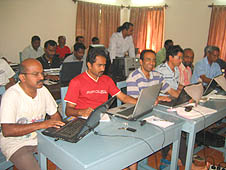
Participants at the workshop on web design
KONCHOWKI, India (UCAN) – A course on designing websites for their social service centers has taught Jesuits and their lay associates the importance of making their services known to others.
Presently, the work of Jesuits in the social service sector are not visible enough, because many work in places where there is little electricity, says Father Joe Victor, the Darjeeling Jesuit province’s social action coordinator.
The opportunity to design their own websites has made course participants realize the need to inform and involve others in Jesuits’ social work, he added.
Father Victor was one of 21 Jesuits and laypeople from 10 Jesuit provinces in India who attended a March 15-21 web-design course at Konchowki near Kolkata.
Father Victor says he now hopes to link the social service centers in his province through a common website for greater visibility.
His confrere, Father Ravi Sagar, 42, from the Jesuits’ Kohima region in northeast India, said the workshop provided simple tools on how to manage a website, and that this would be useful for obtaining feedback on the work of Jesuits.
He added that some viewers might be inspired by their work and may even ask to collaborate with them.
According to him, most Jesuits are busy with their work and do not know how to manage websites.
Father Xavier Jeyaraj, coordinator of the Jesuits in Social Action (JESA) in South Asia, the Jesuits in this region are involved in grassroots developmental works in some 120 social centers. However, only less than 10 of the centers are able to communicate what they do through websites.
The recent workshop, titled Making your Presence online, thus aimed to provide participants with the basic tools of web design.
The workshop also aimed to help participants reflect on their own perception of social reality, and help others learn from what they had achieved at the grassroots level, he said.
Electricity in Mindanao, the southern Philippines, comes largely from hydroelectric schemes and is cheap so people do not want to invest in the power sector, Father Jose Ramon Villarin said.
The region suffers brown-outs that can last up to five hours a day.
A dry spell resulting from El Nino has contributed to the crisis, but “here the problem is lack of investors,” Father Villarin, president of the Jesuit-owned Xavier University, said.
More energy is needed to keep pace with the fast growth of Northern Mindanao, he said.
This reflects the problem with privatizing a public utility, Father Villarin notes. “Public good is not always the top concern.”
The Aboitiz and Alcantara groups of companies around Mindanao are investing in the sector, if only to fuel their own businesses.
Others are wary also because of peace and order threats, Father Villarin said.
Bombing of transmitters is blamed on communist or other rebels in some provinces.
Edgardo Calabio, regional executive for Mindanao of the National Grid Corporation of the Philippines (NGCP), told UCA News that hydro plants generate 70 percent of Mindanao’s power supply.
With “so much” of the electricity coming from water, it can be sold at low rates.
“It’s a blessing and a curse because no one is putting up power plants when they cannot recover their investments,” Calabio said.
Calabio and other officials propose increasing power rates, but Father Villarin warns of consumer protests.
Mindanao consumers pay an average of 6.58 pesos (US$0.14) per kilowatt hour compared to 7.22 pesos in central Philippines’ Cebu City and Metro Manila’s 9.32 pesos.
Father Villarin says recent calamity aid that President Gloria Arroyo released for Mindanao’s power problems could only provide temporary relief. A more permanent solution needed to be addressed.
Arroyo’s declaration of a state of calamity last week saw the release of five percent of national calamity funds for the Mindanao power crisis.
“My concern is money is flowing when there seems to be no strong central authority directing the relief efforts,” Father Villarin said.


A Lenten Video Reflection
William Barry, S.J, author of A Friendship Like No Other and Seek My Face, discusses the opportunity to develop your relationship with God during Lent.


LONDON (UCAN) – A British charity, SPICMA (Special Projects in Christian Missionary Areas) is supporting efforts by Indian Jesuits to rebuild the lives of villagers still devastated by floods more than five months ago.
It has renewed an appeal for funds for the people of Manvi/Pannur in Raichur district, Karnataka. Most of the homes in 29 villages here were reduced in October last year to little more than rubble, in what the BBC at the time described as one of the worst disasters in the area for decades.
An initial appeal through SPICMA and Jesuit Missions raised £32,000 (US$48,000), which provided food, clean water and medical help. The Jesuits also helped several dalit (former low-caste) villages to build temporary accommodation of wood, reeds and corrugated iron.
But SPICMA says many of the people made homeless are still living in makeshift tents. Land has been bought above the flood plain for new houses, but £3,000 is needed to provide each family a home.
“We appeal again … for these poor people who had so little and lost all,” writes Jesuit Father Maxim Rasquinha, mission superior in the area, in the SPICMA appeal leaflet.


By Cindy Wooden
Catholic News Service
ROME (CNS) — Italian Father Matteo Ricci, the 16th-century Jesuit known for his positive relations with the Chinese, is a model for dialogue and evangelization in the 21st-century globalized society, said speakers at a conference in Rome.
Father Ricci’s experience and writings remind people “that there are basic similarities in all human beings, in human nature: hope, suffering, questioning the meaning of life. We all share those whether we are Westerners or Chinese,” said Jesuit Father Augustine Tsang Hing-to.
Father Tsang was born in mainland China to a Catholic family, “but I escaped by swimming to Hong Kong — four hours to Hong Kong, at night — and then went to the States.”
The priest, who now teaches at Fu Jen Catholic University of Taiwan, spoke to Catholic News Service March 1 before speaking the next day at a conference marking the 400th anniversary of Father Ricci’s death.
Father Ricci, who was born in 1552 and arrived in China at the age of 30, delved into studies of the Chinese language, culture and Confucianism. His respect for the Chinese gradually paved the way for his dialogue with China’s government and cultural leaders.
At the same time, “he was very frank and strict, explicit and direct on the goodness of the Christian faith,” Father Tsang said, and “he did not hesitate to point out the defects of Taoism and Buddhism.”
While Father Ricci found great fault with what he understood about Taoism and Buddhism, he believed that Confucianism in its purest form was a philosophy open to Christianity. After his death, missionaries developed the so-called “Chinese rites” — Confucian-based social rituals involving ancestor veneration and offerings to the emperor — which allowed Chinese converts to preserve elements of their heritage while being Catholic.
Centuries of controversy ensued and although the rites developed after Father Ricci’s death, he was so strongly identified with that disputed form of inculturation that his sainthood cause was not opened until the 1980s.
Father Tsang said it was unfortunate that the controversy led some to question Father Ricci’s holiness.
It is true, he said, that Father Ricci “was very friendly with the Chinese, respecting the Chinese culture, but in terms of the faith, he was very unabashedly Catholic.”
In his speech at Rome’s Pontifical Gregorian University March 2, Father Tsang said Father Ricci was not so “narrow-minded as to regard non-Christian cultures or religions as nothing good; indeed, he saw quite a lot of compatibility between early Confucianism and Christianity,” and recognized that Confucian teachings could be seen as preparing the Chinese to receive the Gospel.
Father Ricci’s respect for the Chinese and his commitment to sharing the Gospel with them offer the still-relevant lesson that Christians cannot claim God is at work only among Christians, but at the same time they cannot claim that all religions are equally valid paths to salvation, Father Tsang said.
Father Tsang said the Chinese today need the Gospel just as much as they did in Father Ricci’s age.
The country is enjoying economic prosperity, but “there are grave, hidden problems,” including the repression of human rights, a growing divide between rich and poor, widespread use of abortion and “alarming pollution.”
Father Ricci “did not befriend the Chinese and stop there. He intended to bring them the much greater blessing — the knowledge of Jesus Christ,” he said.
Italian Bishop Claudio Giuliodori of Macerata, where Father Ricci was born, said the Jesuit is still a model for dialogue and evangelization because “he entered into the Chinese culture without losing himself and in a way that allowed him to introduce themes from the Gospel into the culture.”
His relationship with the Chinese “took place in the context of dialogue, with respect, but without forgetting that his mission was to bring the Gospel,” the bishop said.
Roberto Sani, rector of the University of Macerata, said Father Ricci’s example could help people today deal with hopes and fears about their increasing contacts with people of other cultures and religions.
Just as the global expeditions of the 1500s gave Europeans a sense of an expanding world filled with previously unknown cultures, globalization today is challenging people to recognize their common humanity and share their knowledge and beliefs, Sani said.
“Ricci is a model for young people today. He was strong in his faith and culture, but able to establish a real dialogue with the Chinese,” he said. “He is a model of a Christianity that does not close itself within four walls, but goes out into the world.”


BAGI, India (UCAN) – In a rare thank-you gesture, former students of a Jesuit school have funded a new school building for village girls in eastern India.
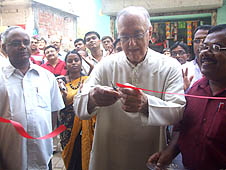
Father Andre Bruylants inaugurates the new school by cutting a ribbon as Father Jerome Francis (extreme left) looks on
Jesuit Father Andre Bruylants opened the new school building at Bagi village, some 20 kilometers south of Kolkata, on Sunday, the day before International Women’s Day.
Alumnorum Societas (ALSOC), the old boys’ association of St. Xavier’s Collegiate School in Kolkata, provided the funding to help girls’ education, its secretary Noomi Dorab Mehta said.
Association members contributed money and materials to complete the 12-room, two-storied building, which cost about 3 million rupees (US$67,000), Mehta said.
Some 150 students from grade five to 10 presently study at the 14-year-old privately-managed school, said principal Oli Kole. She said she was “excited” to have a new school building.
Kole, 32, said there are no other girls’ schools within a radius of five kilometers. She expressed hope that the new building would help give more girls an education.
School management committee member, Surya Sen Patro, said before ALSOC stepped in, the school lacked basic amenities. He said they could not get government help because the school was not officially recognized.
Father Bruylants said school officials sought his help in 2004 to get assistance for the school, which was “in a terrible condition.”
The 84-year-old Belgian missioner received help from the Loreto nuns in the city in repairing the roof, but no other help was forthcoming.
The missioner, a former principal of St Xavier’s Collegiate School and former president of ALSOC, then looked to his former students.
Such help “is also part of their commitment to society, and the education of young girls was a big concern for them,” Father Bruylants told UCA News.
Father Jerome Francis, principal of St. Xavier’s Collegiate School, said at the school building opening ceremony that ALSOC would continue supporting the school.
The Jesuit priest urged school staff and former students to do their best to ensure quality education for all young girls in the area.


