

Author: cfliao


In our churches, religious art, and liturgical prayers, we use a variety of symbols to represent the Holy Spirit, all of which come from the Bible. Here are some of those symbols.

Symbols of the Holy Spirit
One of the most common symbols of the Holy Spirit is a dove. It comes from the story of Jesus’ baptism, when Jesus saw “the Spirit, like a dove, descending upon him.” (Mark 1:10) The other three Gospel writers use similar wording to describe the event (see Matthew 3:16, Luke 3:22, and John 1:32).
Fire is another popular representation of the Holy Spirit. The fire that appeared on Pentecost (Acts of the Apostles 2:3) was reminiscent of the burning bush on Mount Sinai from which God spoke to Moses. (Exodus 3:2) During the Exodus, the people of God were led by a pillar of fire at night. (Exodus 13:21) Fire calls attention to the strength and force of the Holy Spirit.
The Holy Spirit is also represented by wind. In fact, the original Hebrew and Greek words for “Spirit” can be translated as “wind.” The wind that appeared on Pentecost (Acts of the Apostles 2:2) was reminiscent of the wind that blew over the waters at the beginning of Creation. (Genesis 1:2) The wind calls attention to the Holy Spirit breathing life into the Church.
Water signifies birth and life. From a faith perspective, it represents the cleansing and life-giving action of the Holy Spirit at Baptism. (Matthew 3:11; John 3:5) The symbolism of water is addressed in the Catechism of the Catholic Church (#694):
As “by one Spirit we were all baptized,” so we are also “made to drink of one Spirit.” (1 Cor 12:13) Thus the Spirit is also personally the living water welling up from Christ crucified (Jn 19:34; 1 Jn 5:8) as its source and welling up in us to eternal life. (Cf. Jn 4:10-14; 7:38; Ex 17:1-6; Isa 55:1; Zech 14:8; 1 Cor 10:4; Rev 21:6; 22:17)
The cloud is used as a symbol of the Holy Spirit because clouds provide life-giving water. In the Old Testament, God often leads his people with a cloud or appears to them in a cloud. (Exodus 16:10) The image of a cloud is often combined with the image of light to symbolize the God who is hidden and mysterious but also revealing and luminous.
Anointing with oil is a symbol of the Holy Spirit’s uniting us with Jesus, the Messiah, the Anointed One. (Acts of the Apostles 10:38; 1 John 2:20-27)
Official documents in the past (Nehemiah 9:38; Esther 8:8), and some documents today, were sealed with hot wax. Then an imprint was made on the wax with the official seal of the person sending the document. In a similar way, we are “sealed” by the Holy Spirit to show that we are forever part of God’s family. (Song of Songs 8:6; John 6:27)
If you were to draw a representation of the Holy Spirit, what would it look like? What would be your reasoning for drawing the Holy Spirit that way?
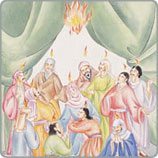
In our churches, religious art, and liturgical prayers, we use a variety of symbols to represent the Holy Spirit, all of which come from the Bible. Here are some of those symbols.

Symbols of the Holy Spirit
One of the most common symbols of the Holy Spirit is a dove. It comes from the story of Jesus’ baptism, when Jesus saw “the Spirit, like a dove, descending upon him.” (Mark 1:10) The other three Gospel writers use similar wording to describe the event (see Matthew 3:16, Luke 3:22, and John 1:32).
Fire is another popular representation of the Holy Spirit. The fire that appeared on Pentecost (Acts of the Apostles 2:3) was reminiscent of the burning bush on Mount Sinai from which God spoke to Moses. (Exodus 3:2) During the Exodus, the people of God were led by a pillar of fire at night. (Exodus 13:21) Fire calls attention to the strength and force of the Holy Spirit.
The Holy Spirit is also represented by wind. In fact, the original Hebrew and Greek words for “Spirit” can be translated as “wind.” The wind that appeared on Pentecost (Acts of the Apostles 2:2) was reminiscent of the wind that blew over the waters at the beginning of Creation. (Genesis 1:2) The wind calls attention to the Holy Spirit breathing life into the Church.
Water signifies birth and life. From a faith perspective, it represents the cleansing and life-giving action of the Holy Spirit at Baptism. (Matthew 3:11; John 3:5) The symbolism of water is addressed in the Catechism of the Catholic Church (#694):
As “by one Spirit we were all baptized,” so we are also “made to drink of one Spirit.” (1 Cor 12:13) Thus the Spirit is also personally the living water welling up from Christ crucified (Jn 19:34; 1 Jn 5:8) as its source and welling up in us to eternal life. (Cf. Jn 4:10-14; 7:38; Ex 17:1-6; Isa 55:1; Zech 14:8; 1 Cor 10:4; Rev 21:6; 22:17)
The cloud is used as a symbol of the Holy Spirit because clouds provide life-giving water. In the Old Testament, God often leads his people with a cloud or appears to them in a cloud. (Exodus 16:10) The image of a cloud is often combined with the image of light to symbolize the God who is hidden and mysterious but also revealing and luminous.
Anointing with oil is a symbol of the Holy Spirit’s uniting us with Jesus, the Messiah, the Anointed One. (Acts of the Apostles 10:38; 1 John 2:20-27)
Official documents in the past (Nehemiah 9:38; Esther 8:8), and some documents today, were sealed with hot wax. Then an imprint was made on the wax with the official seal of the person sending the document. In a similar way, we are “sealed” by the Holy Spirit to show that we are forever part of God’s family. (Song of Songs 8:6; John 6:27)
If you were to draw a representation of the Holy Spirit, what would it look like? What would be your reasoning for drawing the Holy Spirit that way?


Death Threats against a Jesuit in Colombia
Since April 22, 2010 in various places in Bogota, Colombia graffiti have appeared against the Jesuit priest and investigator of CINEP/PPP (The Center of Investigation and Community Education – Program for Peace), Father Javier Giraldo.
The graffiti express death threats against Father Giraldo because he has denounced crimes and assassinations committed by the Colombian National Army, the paramilitaries and guerrilla groups since July 1996 in the Peace Community of San José de Apartadó. Moreover, he has organized and signed petitions to denounce countless criminal actions by armed groups, the majority of which have gone unpunished.

Because of this, CINEP/PPP, as well as the the Jesuits of Colombia, demand that the National Government of Colombia conduct an investigation to find those responsables for these threats and clearly define the methods of protection that will be offered to those affected. Without this assistance from the Colombian Government there is no guarantee that the defenders of human rights will be able to continue their work in safety.


It is my first “Catholic” memory and my first memory as a Catholic: May Crowning. The songs are still-and always-in my head.
Hail, holy Queen enthroned above, oh Maria.
Hail, mother of mercy and of love, oh Maria.
Triumph all ye cherubim, Sing with us ye seraphim.
Heaven and earth resound the hymn.
Salve, Salve, Salve Regina.
I wish that all children were welcomed into the fold of Catholic faith with the innocence and tenderness of singing seraphim, with a mother of mercy and love.
One of the defining aspects of being Catholic is devotion to Mary. I favor no Marian celebration more highly than May Crowning, the feast that recognizes Mary as queen of heaven and earth. To a person of any age, this is a mighty big title, but to a child of five or six or seven, it expands to enchanting, magical proportions. How many queens does one get a chance to meet in a lifetime, much less crown?
Thus, preparing for the May Crowning procession each spring at St. Raphael’s, the church of my childhood, was a monumental and joyful task. My imagination may be filling in some of the details, but this is what I remember most. We practiced “Immaculate Mary” and “Hail, Holy Queen” until we knew the lyrics by heart. We girls put on our spring dresses and white tights, the boys their scratchy Sunday shirts and ties. We practiced “processing” with dignity and grace and with as few wiggles and squirms as our young bodies could manage. Some lucky second-grade girl would be chosen to crown Mary, not based on merit, but rather based entirely on whether she fit into the dress one of the local women had made for the ceremony many years earlier.
The rest of the children at St. Raphael’s were assigned a very simple but very important role in the procession: we were each charged with bringing one flower to place at Mary’s feet. We would literally cover the area around her in flowers, pretty much the most charming and romantic expression my young heart could imagine. I took on the selection of my flower with zeal: it was serious business, not to be dashed off quickly. The consideration required time and precision; like young parents trying to name their firstborn child, I thought about the future of the flower. How would it look lying prostrate as it was bunched with all the other local flora of the season? Would it hold its shape, its scent, its crowning beauty? Would it be worthy?
Spring came late to rural Minnesota. In the month of May, tulips were the first flowers to spring from the patch of garden in front of our garage. My mother (her name also Mary) planted them. As a five-year-old, I hovered over that patch of flora, examining each early bud while my large and loud family waited impatiently in the car. Finally, my mother, who often bore the brunt of my family’s size and volume and impatient energy, said, “Just hurry up and pick one.”
It was a strain to make a choice under such duress, but I finally settled on one pink and one yellow tulip-one flower for the Virgin Mary, and one flower for my mother, Mary. Scrubbed and dressed, with tights pulled up, and armed with my two prized tulips, I joined my brother and sisters in the backseat of our brown-paneled station wagon, and Dad drove us off to St. Raphael’s.
Once there, and with as much pageantry and pomp as a farming community church could muster, we processed away, singing our “Ave Maria” and crowning our Mary while the angels kept us company. I imagined angels turned out in especially big numbers for Marian events, those “singing seraphim” that seemed often to appear in Mary’s songs. I still think of that church as filled with angels, country angels, angels meant to protect country people, whose days were spent in labor over soil and crops and barnyard animals. Simple angels for simple people, scrubbed squeaky-clean for Mary and the Mass. I still remember the aroma of flowers, the coolness of the spring air, the lightness of spirit that lingered. The promise of everything made new.
May Crowning marked a new spiritual season. Our Mary, queen of heaven and earth, lifted us right out of the last long, cold days of winter and firmly planted our hearts in the warm and promising soil of spring.
I will be forever grateful to the church for bringing me Mary, and grateful to Mary for bringing me her Son. For that was my route. I might not have discovered the gaze of Jesus if I had not first felt the maternal, nurturing, and safe embrace of my mother in heaven. That’s why we crown her on our Catholic version of Mother’s Day. That’s why I hovered over the tulips in front of the garage looking for just the right one. Through Mary, I became enamored of the holy family. Through Mary, I was invited into the Catholic fold. It was her feminine presence and the safety of her motherhood that helped me grow. My child’s heart was so full of love for my mother in heaven and understood already what my head could not yet know: Mary would bring me to Jesus. The growing would be toward Jesus, for Jesus, with Jesus. Through Mary, Jesus was brought to you and to me. She was delivered up like an innocent, perfect spring flower to lighten our spirits, complete our senses, bring the very aroma of heaven to our world in need of warming, and welcome our hearts into the eternal mystery of spring and growing things.

from May Crowning, Mass, and Merton: 50 Reasons I Love Being Catholic © 2006 Loyola Press
“What is Jesuit Spirituality?” — “What is Ignatian Spirituality?”
In this episode of “Jesuits Revealed!” we hear Fr. Greg Boyle, SJ talk about his experience of Ignatian Spirituality and what it has meant in his life and formation as a Jesuit.
Fr. Gregory Boyle, SJ is a Los Angeleno born to a third-generation Irish-American family. He joined the Society of Jesus in 1972 after graduating from Loyola High School and was ordained to the Roman Catholic priesthood in 1984.
.
With a history of ministries to the poor in Los Angeles, Bolivia and Mexico, Fr. Greg was missioned to Boyle Heights in 1986 where he served as pastor of Dolores Mission until 1992. . In 1988, Fr. Greg created the “Jobs for a Future” program as a way to address the problems of gang violence in Boyle Heights.
.
This program would evolve into Homeboy Bakery, launched in 1992, which sought to find solutions to the civil unrest in Los Angeles. . Bringing rival gang members together to build a business that could provide job-training and an environment for personal growth, Homeboy Bakery proved that many gang members were eager to leave street life for a legitimate chance at a constructive future.
.
In 2001, Fr. Greg launched Homeboy Industries which expanded the mission of the bakery enterprises including Homeboy Silkscreen, Homeboy/Homegirl Merchandise, Homegirl Cafe and Homeboy Maintenance. Now more than two decades old, Fr. Greg’s ministry is recognized as the largest gang-intervention program in the United States and a model for such ministry around the world.


“What is Jesuit Spirituality?” — “What is Ignatian Spirituality?”
In this episode of “Jesuits Revealed!” we hear Fr. Greg Boyle, SJ talk about his experience of Ignatian Spirituality and what it has meant in his life and formation as a Jesuit.
Fr. Gregory Boyle, SJ is a Los Angeleno born to a third-generation Irish-American family. He joined the Society of Jesus in 1972 after graduating from Loyola High School and was ordained to the Roman Catholic priesthood in 1984.
.
With a history of ministries to the poor in Los Angeles, Bolivia and Mexico, Fr. Greg was missioned to Boyle Heights in 1986 where he served as pastor of Dolores Mission until 1992. . In 1988, Fr. Greg created the “Jobs for a Future” program as a way to address the problems of gang violence in Boyle Heights.
.
This program would evolve into Homeboy Bakery, launched in 1992, which sought to find solutions to the civil unrest in Los Angeles. . Bringing rival gang members together to build a business that could provide job-training and an environment for personal growth, Homeboy Bakery proved that many gang members were eager to leave street life for a legitimate chance at a constructive future.
.
In 2001, Fr. Greg launched Homeboy Industries which expanded the mission of the bakery enterprises including Homeboy Silkscreen, Homeboy/Homegirl Merchandise, Homegirl Cafe and Homeboy Maintenance. Now more than two decades old, Fr. Greg’s ministry is recognized as the largest gang-intervention program in the United States and a model for such ministry around the world.


This downloadable craft idea helps parents explain themes of our faith to children while spending creative time together.
Check back at the beginning of each month for a new craft related to the liturgical year.
 May’s activity – Holy Spirit Necklace


Index of Shalom May 2010
4th Week of Easter
5th Week of Easter
6th Week of Easter
7th Week of Easter
8th Week of Ordinary Time
9th Week of Ordinary Time


One of the best ways to learn about scripture is to read it and discuss it with other people. Consider joining a Bible study program in your parish. If your parish doesn’t have a program, start a group Bible study yourself. Here are some suggestions for getting started.
Be clear about your purpose.
People usually get together to apply the wisdom of scripture to their lives and to support each other. But there are other possible reasons. For example: to study the Sunday Mass readings; to get connected (or reconnected) with the Church; to do academic-level study.
Choose a scripture program that suits your purpose.
Many programs are available. The booklets in the Six Weeks with the Bible program are well-suited for groups that get together primarily to help each other apply scripture to their daily lives.
Agree on norms for discussion.
“We’re all beginners here” is good start. Other attitudes: “we want to read scripture prayerfully,” “we’re not here to give each other advice about our problems,” “what’s said in group meetings is confidential.” Be explicit about these norms.
Agree on the commitment to the group Bible study.
What priority does the group have in our schedules? Is everyone expected to do “homework” ahead of time?
Settle housekeeping matters.
Where and when will we meet? Who provides refreshments (if any)? How long will the meetings be? (It’s a good idea to agree to end the meeting on time.)
Agree on leadership.
Someone needs to facilitate meetings. This responsibility could rotate among group members or one person could do it all the time.
Put God at the center.
Scripture is the word of God. Approach your readings and discussions prayerfully. Listen for God’s word for you.


Shepherds were important in the world of the Old Testament. Without the shepherd and his dog, the herd of sheep could not survive, and this led to the use of shepherding as an image of ministry. The chief shepherd is God, “who has been my shepherd / from my birth to this day” (Genesis 48:15). Many of the major figures of the Old Testament were shepherds, including Abraham, Moses, and David. The prophets criticized the kings for not being good shepherds, and Jeremiah foresaw a time when God “will appoint shepherds for them who will shepherd them so that they need no longer fear and tremble” (Jeremiah 23:4).
In the New Testament, Luke has shepherds receive the heavenly message about Jesus’ birth. This shows Jesus’ lowly origins and ties in with a major theme of Luke’s Gospel-God favors the lowly when revealing himself. The 10th chapter of the Gospel of John contains a lengthy passage on Jesus as the Good Shepherd. John presents Jesus as the model shepherd, but at the end of his Gospel he also applies the shepherd imagery to Peter. Jesus tells Peter to feed his lambs and tend his sheep.