

Author: cfliao



Dominic might have lived his whole life in that monastery if he had not gone with his bishop to northern Europe in 1204. As they traveled, Dominic saw that many people were following heretics, or false teachers. One heresy was Albigensianism, named for the French town of Albi where it had begun. These who followed this heresy taught that people do not have a free will. They taught that marriage was bad, but suicide and the killing of elderly or fatally ill people could be good. Because these heretics lived strict lives with little comfort, people believed them.
Dominic saw that the Catholics sent by the pope to preach against the heresies lived in comfort. The people would not accept their teaching because their lives did not support what they taught. Dominic, his bishop, and three Cistercian monks went from city to city preaching the truth of Christ, using the Bible. They went on foot, depending on others for food and a place to sleep. Soon people returned to the faith-not only because of what these preachers said, but because of how they lived.
In 1206 Dominic began an order of religious women. At one point the bishop died, and the three monks left Dominic. To make matters worse, war broke out between the heretics and some Church members. Dominic’s mission seemed to be failing. At this time he was greatly supported by the prayers and encouragement of the Sisters.
By 1215 a few men had joined Dominic in his work of preaching. He founded the Order of Preachers, better known as the Dominicans. Dominic urged his members to study and to pray. Then they would be ready to preach. Dominic realized that to be true witnesses of the Gospel, Dominicans could not be wealthy. His followers also deeply loved the Blessed Virgin Mary and spread devotion to her through the rosary.
Dominic’s community was different from most because his friars traveled and preached instead of staying in their monastery. Dominic’s order tried to reach the well-educated who were deceived by heresy, while the Franciscans went to the poor and uneducated.
While St. Dominic was on a preaching mission through northern Italy, he died, only six years after he had founded his community.
Dominic was able to draw the members of this community together and inspire them to love and forgive one another. He was outstanding for his love of truth, his clear thought, his organizing ability, and his sensitive, loving nature. For Dominic, love for people was part of his love for God.
 from Saints Kit © 1994 Loyola Press


A look at the sitcom post-Seinfeld
Jake Martin
It began innocently enough in the summer of 1989, with a group of friends sitting in a New York diner, cracking wise about their lives and loves, a laugh track underscoring every quip. “Seinfeld” seemed no different from any of the situation comedies that had come before it. Yet, for better and most definitely for worse, the sitcom genre has never been the same.
Twenty years later, “Seinfeld’s” legacy as the first postmodern situation comedy still influences every television writer. NBC’s “Community” and FX’s “It’s Always Sunny in Philadelphia” are but two examples of the complicated situation that is situation comedy in the post-Seinfeld era.

Both “Community” and “It’s Always Sunny” send up the “pack of ragtag misfits” narrative that’s been around at least since the time Moses told the Hebrews about the land of milk and honey. But while “It’s Always Sunny” fails because it goes against the narrative tradition from which it came, “Community” succeeds because it reinforces the lesson inherent in its genre, that grace can be found through fellowship and shared experience.
The sitcom has always faced the demands of being a quintessential populist art form. Like its television sibling, the soap opera, the sitcom traces its roots back to the days of radio. “Fibber McGee and Molly” were the public’s favorite sitcom couple long before Ross and Rachel of “Friends” or Jim and Pam of “The Office.” Unlike the soap opera, however, which is dying a quick and ignoble death, and whose traces are found only within legal and crime-scene series, the sitcom remains as healthy as ever.
But it is no longer enough for a sitcom to tell a story with a few jokes; now both narrative and punch lines must be deconstructed, critiqued and referenced back to all previous TV shows in the span of 22 minutes. The result is usually a cool, clever product, but it is missing a heart.
Within the sitcom there has always been a tension between the subversive and the sentimental. One can never stray too far in either direction without missing the mark, the resultant extremes being either the cruel hardheartedness of a “Family Guy” or the insipid inanity of a “Full House.”
A new show that brilliantly negotiates the two polarities is ABC’s “Modern Family,” which takes on not only the sitcom genre, but the family melodrama. The show, which looks at the life of one extended family in Southern California, works because it upends our expectations about comedic structure and archetypes. For instance, the much younger, trophy stepmother with the low-cut blouse is characterized neither as villain nor as brainless bimbo but as the grounded voice of reason. (In one episode she intentionally loses at chess to her much older husband, in spite of her superior skills, in order to keep the peace.) “Family” also mocks the pathos of conventional family dramas like “Brothers and Sisters” yet never flinches in the face of authentic moments of loving concern. Both its writers and actors can move smoothly from ironic snarkiness to honest conversation in the blink of an eye. It is this kind of artistry that sets apart the best sitcoms.
“Community” is a show equal in caliber to “Modern Family.” Completing its debut season on NBC, it gives a weekly glimpse into the lives of a handful of students at the fictional Greendale Community College. Joel McHale, late of E!’s flagship snarkfest “The Soup,” leads the ensemble as Jeff Winger, an attorney of dubious repute who must return to school because his degree was invalidated. Jeff winds up in a study group with, you guessed it, a ragtag pack of misfits, who include: the well-meaning but humorless Britta, played with finesse and skill by Gillian Jacobs, the socially deficient film student Abed (Danny Pudi), the single African-American mother Shirley (Yvette Nicole Brown), the former high school football star Troy (Donald Glover), the nerdy Annie (Alison Brie) and a remarkably toned-down Chevy Chase as Pierce, an oft-married, always obnoxious, moist-towelette tycoon.
While McHale is the leader of this multi-ring circus, he puts the brakes on his sardonic “Soup” persona to allow space for the other actors. Never does the viewer sense that any of the performers are pushing for a breakout performance. Rather, one is watching an ensemble at the peak of its powers, working together for the good of the show; as opposed to the primetime monstrosity of a handful of actors elbowing one another out of the way. Or maybe the show is just very well written.
The first-rate writing never compromises the inherent dignity of its characters for the sake of low humor. Too often in sitcoms, character development and complexity are sacrificed for a cheap laugh, destroying the credibility of character and to a lesser extent the show itself. Here each of the primary characters is handled intelligently by writers who appeal to the audience’s sense of identification and affection-not, as is often the case, to their sense of superiority and revulsion.
In this regard “Community” follows in the fresh footsteps of CBS’s “How I Met Your Mother,” another show that emphasizes the importance of interdependence among colleagues and friends outside the structure of the traditional family unit. A throwback stylistically (it’s shot primarily on a soundstage, using a laugh track), “How I Met Your Mother” seems like a relic when compared with more sophisticated shows like “Community” and “Family.” But like them, “How I Met Your Mother” is irreverent without being alienating. It reflects the caustic sensibility of contemporary culture, while demonstrating the necessity and joy each of its characters finds in being a member of a makeshift support network.
All these series tell of broken, lonely people hoping for something better. But instead of exploiting the characters’ weakness for the sake of a mean-spirited laugh, the shows celebrate the hope they find in relationships with each other and the grace they find in unlikely places. A recent episode of “Community” focused on a falling out between the culturally insensitive Pierce and the African-American Shirley. Instead of making a series of cringe-inducing racial jokes, the episode emphasized the solidarity of the two characters as they discover their commonalities as the senior members of the group. Most shows would not attempt such depth in character relationships and instead would yield to the infantile desire for a laugh.
Which brings me to “It’s Always Sunny in Philadelphia.” While not nearly as ambitious intellectually as “Community,” “Sunny” cannot live up even to its own mediocre aspirations. It proves a cautionary tale for those who equate a lack of content restrictions on cable television with artistic freedom. In “Sunny” all that freedom allows for is undisciplined, mean-spirited humor infused with foul language.
Like “Community,” “Sunny” deconstructs the traditional “ragtag pack of misfits” convention. But whereas “Community” plays within the spirit of the tradition and never loses affection for its source, “Sunny” mocks it with neither the humor nor the sophistication to support this endeavor. The show focuses on a group of childhood chums working at a down-at-the-heels tavern in South Philadelphia. “The Gang,” as they call themselves, consists of: Mac (Rob McElhenney), Dennis (Glenn Howerton) and Charlie (Charlie Day), along with Dennis’s sister, Dee (Kaitlyn Olson), and Danny DeVito in the now seemingly requisite comedic stunt casting as Dennis and Dee’s morally bankrupt father. “The Gang” spend their days insulting one another and setting new standards for moral repulsiveness. These people do not seem to like one another; I cannot say I blame them.
The show would be helped by good writing and character delineation. As it is, each of the actors seems to be mouthing the words of a single stand-up comic. The show was conceived by its three lead actors, whose names are all over the credits. This might be part of the problem: the show feels like one big inside joke to which the audience is not privy.
The show’s graphic content and profanity will shock the first-time viewer. But after the shock wears off, the audience is left feeling as if it has watched the antics of a school bully, complete with the accompanying feelings of powerlessness and shame.
“Sunny” fails because of its contempt for its comedic ancestry. “Community” succeeds because of its affection for it. It is easier to present one-dimensional characters that repulse an audience within the parameters of a metanarrative than it is to create a group of lovable and loving, fully realized persons within that same structure. While “It’s Always Sunny in Philadelphia” is emblematic of all that is wrong with sitcoms in a post-Seinfeld era, hope and health for the genre spring forth in the beauty of communion like that found in “Community.”
Jake Martin, S.J., is a Jesuit scholastic who teaches theology and theater at Loyola Academy in Wilmette, Ill.


Forms of Prayer
Prayer is the raising of our hearts and minds to God. We are
able to speak to and listen to God because he teaches us to pray. The Catechism tells us that the Holy Spirit reminds the Church of all that Jesus said, and it teaches us about the life of prayer. In doing so, it inspires new expressions of the same basic forms of prayer: blessing, petition, intercession, thanksgiving, and praise.
Blessing
A blessing is a prayer that invokes God’s power and asks for his care for a person, place, thing, or special activity. The Bible is filled with examples of blessings-blessings on offerings to God, on individuals, on groups of people, and on ordinary actions throughout the day. Blessings help make us aware of God’s presence at every moment and in all things. They help us see the goodness available all around us and to remain close to God from whom all blessings flow. They express our own desires for God’s closeness and protection as well as God’s strength and healing.
Blessings call upon God’s love for creation. They are reminders of the goodness and holiness of what God created. We use words, symbols, and gestures to express what’s deep in our hearts.
Any person or object can be blessed. We bless our children, families, sick people, objects of prayer and worship, special occasions, people, relationships, food, buildings, work, animals, and many other situations and things. A common daily blessing is the grace before meals, in which we ask God’s blessing on our gathering, our eating, and our going forth, nourished, to do God’s will. Because we are blessed, we too can bless God and one another in thanks for God’s generous gifts to us and to the world.
Petition
Prayers of petition acknowledge our dependence on God, who is our beginning and our end. This form of prayer springs from our heart’s desire to serve God’s kingdom here and to seek the realization of the kingdom to come.
The Catechism of the Catholic Church reminds us that asking forgiveness, coupled with trusting humility, should be the first movement of a prayer of petition. Jesus tells us to bring our every need to God in his name and assures us that “whatever you ask the Father in my name he will give you.” (John 16:23) What we must remember, however, is that in addition to the asking, there should be an acknowledging of our sinfulness and need for God.
A prayer of petition is a request to God that asks him to fulfill a need. When we share in God’s saving love, we understand that through petition we can ask for God’s help with every need no matter how great or small.
Intercession
Intercession is a prayer of petition in which we ask for something on behalf of someone else. Since Abraham’s time intercession has been characteristic of a heart attuned to God’s mercy. Following the example of Jesus, who on the night before he died prayed for us, we offer prayers of intercession for the Church, leaders in government and society, special needs, sick people, and those who have died.
Thanksgiving
Every joy and suffering, and every event and need can become an offering of thanksgiving. The letters of St. Paul often begin and end with thanksgiving, and the Lord Jesus is always present in it: “In all circumstances give thanks, for this is the will of God for you in Christ Jesus.” (1 Thessalonians 5:18)
(from the Catechism of the Catholic Church 2638)
Praise
A prayer of praise is an expression of our response to God, not only for what he does but simply because he is. In the Eucharist the whole Church joins with Jesus Christ in expressing praise and thanksgiving to the Father.


Biblical scholar Luke Timothy Johnson argues that historical scholarship alone cannot find the living Jesus. Though the study of history can help Christians to becomes responsible readers of the Gospels, engaging Jesus as a literary figure is ultimately a more fruitful exercise for the person of faith. Prof. Johnson also discusses why 14 years after the publication of The Real Jesus, his critique of historical Jesus scholarship, the popularity of John Dominic Crossan, Marcus Borg and other such scholars endures. Read “The Jesus Controversy” from the August 2-9 issue.


By Francis Rodrigues, Mangalore
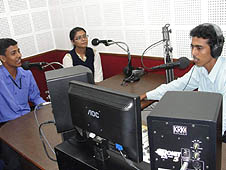
Sangar Radio’s studio in Mangalore
A Jesuit-run radio station in southern India is looking to broaden its appeal by launching a host of new community-oriented programs.
Sarang Radio, a community station run by the Jesuits of St. Aloysius Autonomous College of Mangalore, says the introduction of the new services will also help mark its first anniversary on Sept. 23, 2010.
“We plan to start more community-oriented programs in regional languages like Kannada, Tulu and Konkani along with Hindi and English,” said Jesuit Father Richard Rego, who is in charge of the radio station and heads the Journalism Department at the college.
There are also plans to launch several weekly phone-in programs, such as Kannoonu Kacheri, on legal issues, Arogya Sparsha, a live program on health concerns, and a special program for children, he said.
The station will also invite leaders, writers, social workers, farmers and local artists for interviews, narration and feature presentations, he said.
Sarang Radio initially used to broadcast about four to six hours a day, but now it is on air for 14 hours, Father Rego said.
Disc jockey Antony D’Souza says Sarang Radio is determined to spread its message to a wider audience.
“Even though community radio is by the people, for the people, and for no profit, the public still prefer to listen to the big FM stations,” he said.
“Since people have not begun to come to us, we intend to go to them,” he said.


31 Days of St. Ignatius
A month-long celebration of Ignatian spirituality.
On July 31, Catholics celebrate the Feast of St. Ignatius. Loyola Press was founded by the Jesuits and we are celebrating our leader for the month of July. Therefore, please join us for a 31-day journey to get to know St. Ignatius better. This calendar has links to information about St. Ignatius and Ignatian Spirituality, reflections, prayers, videos, and activities.

IgnatianSpirituality.com is a service of Loyola Press, a ministry of the Chicago Province of the Society of Jesus. It offers information on and experiences of Ignatian spirituality from Jesuit and Ignatian sources around the world. IgnatianSpirituality.com serves all audiences-the curious, the knowledgeable, and the expert.

dotMagis is a blog about Ignatian spirituality and Jesuit ministry, inspired by Ignatius Loyola’s love of “magis” -the greater, the excellent, the best.


At the final mass during the Russian Regional meeting with Fr. General, he was presented with an original icon by the regional superior, Jesuit Fr. Tony Corcoran, (New Orleans Province; left) , Jesuit Clemens Werth (right), in the novitiate chapel in Novosibirsk. Deacon Bredelyev Oleksiy, in the background. (Photo Courtesy Jesuit Fr. Don Doll)
Dear Reader
Peace,
We appreciate your interest in AMDGChinese.org website. AMDGChinese.org is available on most W3C standard browsers, and we aim to produce a standards compliant site with backwards compatibility. For full functionality and surfing safety we recommend you use Google Chrome, FireFox as your default browser.
Google Chrome
To setup Google Chrome:
– Install or upgrade to the latest stable release of the Google Chrome browser from www.google.com/chrome
– Follow the instructions to finish installing Google Chrome.
FireFox
To setup FireFox:
– Install or upgrade to the latest stable release of the FireFox browser from www.mozilla.com/firefox
– Follow the instructions to finish installing FireFox.
Apple Safari
To setup Apple Safari:
– Install or upgrade to the latest stable release of the Safari browser from www.apple.com/safari/
– Follow the instructions to finish installing Safari.
Other browsers
We recommend you surf AMDGChinese.org with the Google Chrome, FireFox and Safari browsers as described above. The site has however been produced to work in as wide a range of browsers as possible while supporting a full feature set.
Older browser versions will display with a simplified visual appearance and JavaScript features will be disabled. We use PNG images in AMDGChinese.org and some older browsers may not be able to display them.
Internet Explorer may have some limitations in visual appearance and you may see some JavaScript errors.
For web surfing safety and security reasons, We would recommend you upgrade to the latest stable release of your browser.


Joseph Cosgrove’s journey as a Catholic lawyer
by GEORGE ANDERSON, S.J.
It’s as much a part of me as my breath.” Those are the words Joseph (Joe) Cosgrove used in a recent interview to describe the strong sense of social justice that has been his since growing up in a small Pennsylvania town. It was a sense that led him into studying both law and theology at the University of Notre Dame as he increasingly became an advocate
The friendship with Martin Sheen began when the two were introduced by Fr. Berrigan when the actor was working on a social justice film (“You’ve got to meet this fellow,” Berrigan told Cosgrove). Later, Mr. Sheen was involved in a protest in New York against former President Reagan’s Star Wars project. The peaceful demonstration resulted in the arrest of Sheen, Berrigan, Cosgrove and others, all of whom Cosgrove offered to defend gratis in court. Cosgrove first became aware of Martin’s anti-death penalty views on seeing him play the lead in the film, “The Execution of Private Slovik.” Slovik was the only soldier in World War II executed for desertion, and the unjust way Slovik was treated nourished Cosgrove’s commitment to justice and opposition to the death penalty.
Defending the Poor
While pursuing joint degrees in law and theology at the University of Notre Dame (he received both degrees on the same day), Cosgrove’s mother fell ill with cancer. He knew that Fr. Berrigan at the time was working in Manhattan as a volunteer in a hospice for cancer patients. “A mutual friend put us in touch,” Cosgrove said, and he expressed gratitude for “Dan’s being so pastoral with me and my family in a difficult time.” But he added that even earlier, through a teacher at his Catholic high school, he felt an appreciation for Fr. Berrigan and his brother Philip for what he termed “their conscientious witness” during the Vietnam War.
Through their influence and that of others, Cosgrove began to develop a deep belief in God’s love for the disenfranchised of the world. The vast majority of his cases as a criminal defense attorney, he said, have been in the area of representing the poor. Aware that the resources available to public defenders are far more limited than those available to prosecutors (money for expert prosecutorial witnesses like psychiatrists, for example), Cosgrove has became a strong supporter of increased funding for the indigent defense system. “For the better part of the last ten years I’ve been shouting about this very issue,” said Cosgrove, who also serves as president of the Pennsylvania Defense Lawyers Association. “The Sixth Amendment right to counsel is a promise that has all too often not been fulfilled.”
The same impulse to see Christ in the poor brought Cosgrove into contact with Mother Teresa of Calcutta. The two first met in the early 1990s. They spoke about capital punishment and the first Gulf War-to which, like Cosgrove, Mother Teresa was opposed. Cosgrove had written a brief discussing the international law implications of that war, he said, “and early one morning a priest who was talking with her in Rome called me and said, ‘Joe, Mother Teresa is on the line’, and there she was…” Later, Cosgrove would work with Blessed Mother Teresa on several death penalty cases.
Cosgrove has defended several people arrested at non-violent peace demonstrations, including Catholic Workers and activists like John Dear and Martin Sheen, for whom he has served as personal attorney. “My focus in peace activist cases, like many other matters in the criminal justice system, has been to uphold certain basic principles, like presumption of innocence and the right to a fair trial–concepts that can be threatened in the heat of these cases,” he observed, “where public sentiment might be strongly against the defendants.” Otherwise, he continued, “the process isn’t fair and liberty is jeopardized.”
A Role in ‘The West Wing’
It was Martin Sheen who first encouraged Cosgrove to act. He and Cosgrove were working on a project together, and met in Paris where Sheen was filming “The Maid.” Then, in an unexpected complication, an actor in the film abruptly quit on the last day of the filming, and, as Cosgrove explained, “I could speak English and so I got the part.” (This led to his membership in the Screen Actors Guild.) Some years later, when “The West Wing” was being made for television with little expectation that it would become the success it did, Cosgrove was offered a minor part. “I wondered how ‘West Wing’ would succeed. It had no romance, no violence, so how could it be a hit?” But, he went on to say, “it became one of the most well-written, well-acted dramas in television history.” Initially, he was simply asked to advise the producers on a legal issue that was in the script. When a particular Supreme Court issue came up, though, they not only sought him out for advice, but also “cast me as a lawyer in that episode.”
On the day it was filmed, he said, “my character was a Supreme Court attorney, who the reappeared in several later episodes, in 2000, 2001 and 2004.” He mentioned that Martin joked on the set in that episode, which was filmed on a stage in Burbank. After the filming (in which the Supreme Court denies Cosgrove’s motion), Sheen shouted, “You’re not acting! You’re in court and losing-you do that every day!” Cosgrove responded with equal humor, “I guess everybody’s a critic!”
Then as now, Cosgrove was teaching constitutional law at King’s College in Wilkes-Barre, Pa., where he has held the position of adjunct professor of law for two decades. (One of his former students, Patrick J. Murphy, is a Democrat member of the House of Representatives from Pennsylvania.) Last year, he offered a seminar on the Supreme Court that led to a visit with Justice Ruth Bader Ginsburg. “We studied a case that was coming up there, and so I took a group of the students to Washington to hear the oral arguments in the case,” Cosgrove said. Ginzberg invited the group to visit her afterwards in her chambers. Cosgrove had met her on several previous occasions and was himself co-counsel in a death penalty case six years ago, not as the lead counsel but as the “second chair.” Cosgrove was admitted to the bar of the U.S. Supreme Court on the motion of former Attorney General Ramsey Clark, whose father was a Supreme Court justice and with whom Cosgrove had been co-counsel in a federal civil rights case in the past.
From Leprechaun to Judge
Besides his degrees in law and theology from Notre Dame, Joe also has a master’s degree in studio art from Marywood College in Scranton, Pa. He spoke of this aspect of his life as a manifestation of the optimism that infuses all that he does, “whether it’s the minor aspect like my occasional acting, or studying ceramic art.” Along with that hopefulness goes a sense of humor that carries with it a ministerial side. As an undergraduate at Notre Dame, he became a costumed leprechaun mascot at sports events, moving along the sidelines to evoke spirited support for the home teams. He attributes the leprechaun role to his Irish heritage. “Every ethnic group brings something of value to the human community, and one of those things the Irish have brought is a sense of wit and wry humor that transcends even the tragedies of their sometimes historically difficult existence,” he said.
Cosgrove’s turn as a leprechaun put him in contact with Special Olympics and special education groups that were often present both at the sports events and at the Logan Center in South Bend, an organization formed by faculty, students and others that offers opportunities for people with disabilities. “It was a moving aspect of the leprechaun role, sharing with these great kids who bring with them a joyousness,” he said. “Some would call them disabled, but that’s a very limited view of what their lives really are.” For Cosgrove, they are “well-abled” at the most important things-generosity, love, compassion and being non-judgemental. “They taught me a great deal,” he added.
This past January, Cosgrove’s career underwent a shift. He was appointed by the Pennsylvania governor to complete the term of a civil court judge who had been removed from the bench in a corruption scandal. “As a judge, my role in the justice system has vastly changed,” he said. “My personal opinions are set aside, but the most important thing I can do is to assure everyone, no matter their state in life, that they will be treated fairly, respectfully, and have a chance to be heard. That is the essence of justice.”
Will he return to his practice as an attorney when the two years as a judge in Luzern County are over? “I have been fortunate to have always been guided and placed where I needed to be. In two years, I trust that will still be true,” he said. But whatever the future may hold-he is still only in his early 50s-advocacy for the poor and outcast, in one form or another, will surely be a part of what lies ahead, both in terms of his profession and his faith.
George Anderson, S.J., is an associate editor at America.
by Shea Zirlott
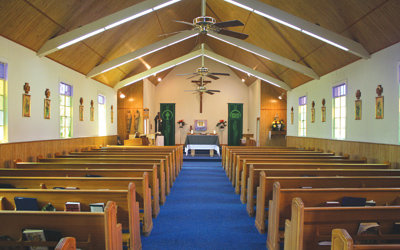
In a small church in west Anniston the Sunday before last, about three dozen faithful were spread out amongst the 25 pews. The pews may not have filled, but parishioners were not all that was missing from All Saints Catholic Church.
There was no priest present, due to a “miscommunication with the cathedral” about plans for a visiting priest to celebrate Mass.
Instead, deacon Mike Cova said his first Mass of many that day to the worshippers gathered in the cozy, 75-year-old church.
Mass without a priest is something the parishioners at All Saints have grown accustomed to over the past two decades, and they have learned to adapt and make the most of their situation.
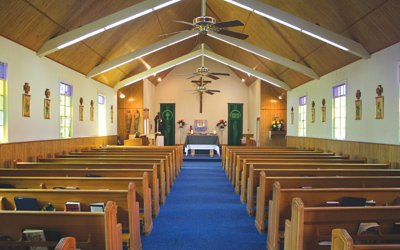
Going without a resident priest dedicated to their parish is an option that many in the congregation prefer to the option they were forced to accept in the past. In the late 1980s, because there were not enough priests to go around, the archdiocese of Birmingham closed the doors of All Saints and merged the congregation with the much larger Sacred Heart of Jesus Catholic Church in Anniston. “We felt like outcasts there,” said parishioner Rose Munford. “We wanted our church back.”
The doors reopened after about a year, and since then Mass has been led by whomever was available, including deacons and local priests who could fit Mass at All Saints in with Mass at their own parishes.
All Saints has not always been without a priest. When the historically African-American church was established in the 1940s, in the midst of Jim Crow and segregation, the church was home to a Catholic school as well.
“I have always felt that we were given a wonderful education because we were exposed to the orders, and we were held to a higher standard than other kids, and learned art and music,” said Munford. “This is what formed me. Their dedication is why I do so much in the community.”
This past year, All Saints had the same priest come every weekend to lead Mass, but he was not solely responsible for All Saints parish. Then the archdiocese assigned him to a bigger church in Birmingham.
“They pulled our priest and left us with no one,” Munford said. “We are smaller and don’t bring in a lot of money. Our money barely keeps us open.”
Munford considers her church to be “a very blessed church that has been very fortunate.”
Many of her fellow parishioners like the experiences and insights that the visiting priests have brought with them throughout the years, saying they have helped them grow as a parish.
Priests declining nationally
In recent years, the Catholic Church has faced a decline in the number of men and women called to vocations – priests, deacons or members of any holy order – especially young men and women in the United States.
Also, a substantial number of older priests have retired from the active priesthood.
The church has been forced to close or reshuffle parishes. Many priests have come from countries such as India, which has a booming Catholic population and has ended up with more priests than it needed.
What some are calling a priest shortage is actually a “relative phenomenon,” according to M. Rev. Mark Lewis, S.J., provincial supervisor of the Jesuits of the New Orleans Province. “Compared to the 1950s, the numbers are lower, but the biggest drop in clergy numbers seems to have occurred in the 1970s, and it has leveled off now,” he said. “We notice it more because the population of priests is now divided between the much older majority and a growing number of young priests, a group too small to replace every older priest.”
Locally, there are two Catholic churches in Anniston, one in Jacksonville, one in Piedmont and a Catholic school in Anniston.
In the archdiocese of Birmingham, which covers 54 parishes in the state, the number of priests has declined while the number of Catholics has grown, according to Rev. John Martignoni, director of the office of new evangelization and stewardship.
There are 103 priests in the diocese for those 54 parishes. But some parishes do not have a priest, and some share priests amongst parishes. There are 89,000 Catholics in the diocese, which averages out to one priest for every 864 Catholics.
Parishes have been affected because each priest is responsible for more people than in decades past. The ratio, Martignoni said, makes it “harder on the individual priests because they are busier with sacraments, and it is making the priest’s schedules more hectic and their lives busier.”
The archdiocese is taking steps to reverse the trend, Martignoni said, working with a vocations consultant to boost the number of seminary students over the next five to 15 years.
There are many factors influencing the decline in seminarians, including the rising cost of seminary and the recent sexual abuse scandals that have rocked the Catholic Church. Lewis said the real concern should be about quality, not quantity. He thinks changes arising from the abuse crisis, including psychological screenings, have helped the church ordain better priests. “Increasingly, the need for good, holy and well-adjusted priests comes to the forefront,” he said. “If there are fewer, they should be better, stay healthier and be good leaders of the community.”
Not just a Catholic crisis
Rev. Bryan Lowe of Sacred Heart Catholic Church in Anniston says the decline in ministries and vocations is not unique to Catholicism.
“It is just not seen as something valuable to do by as many young people as used to see it as something valuable,” he said.
Society has pushed some, he said, to be overly concerned with how much money they can make, or how prestigious they can become. He thinks the church needs to introduce the idea of vocation to its young people, so that when they are thinking about what they will become, religious life can at least cross their minds.
Rev. James Macey of St. Charles Borromeo Catholic Church in Jacksonville became a deacon 10 years ago. After his wife died, he began the process to become a priest.
Macey is part of a growing trend of “second career priests.” Macey is a retired military officer and former university professor. Lowe of Sacred Heart Catholic Church is also a second career priest, answering the call after also retiring from the military.
Macey thinks the decline in religious vocations is due, at least in part, to the culture in America.
“I think it has to do with a general deterioration of moral values, that there is this move away from faith and morals. We live in a very secular society,” he said. “A religion that says, ‘thou shalt’ and ‘shalt not’… these aren’t conditions that are conducive to generating a lot of vocations.”
The rise of deacons
As the number of priests has declined, there has been a rise in the number of deacons, like Mike Cova. Deacons are not priests, but can perform many of the tasks of priests. They can lead Mass, bury the dead, marry, baptize and visit the sick. Deacons cannot give absolution by hearing confessions, or consecrate the Eucharist (also called transubstantiation, when the bread and wine become the body and blood of Christ). Instead, deacons can lead Mass and use previously consecrated bread and wine.
Prior to 1961, there were no deacons in the Catholic Church, according to Cova. Today, there are close to 16,000. There are 54 deacons in the archdiocese of Birmingham.
One of the major differences between deacons and priests is marital status. Priests are “married to the church,” whereas deacons are allowed to be married. According to Cova, 95 percent of the deacons in the United States are married. (Interestingly, there are no deacons in India because there is such a large number of priests in the country.)
Cova acknowledges there may be a shortage of priests if you just look at the numbers, but thinks the real shortage of priests is because “we want priests to be accommodating for us.”
“We are in a society of convenience. We want it when we want it, and we want it now,” he said. Parishioners want to be able to go to Mass at a time that is convenient for them, he explained, and not necessarily when the clergy is available.
He pointed out that there have been congregations in remote areas that have survived for centuries without the constant guidance of a priest. Instead, the local people carried on and held the church together as a community.
The future of All Saints
Munford said she looks forward to a time when All Saints will once again have its own priest. She feels the church needs a priest who will be able to bring more people into the congregation, especially children. The congregation now consists of mostly adults with very few children.
“If you don’t bring younger people in to carry on, the church will stop existing,” she said.
Munford has high hopes for the future of her church, and the potential of her fellow parishioners. “Church is a community. If we really learn the Word, any of us should be able to go up and read the Scripture and give a sermon, if we have learned God’s word and speak it in his name.”
There is potential good news for All Saints. According to Cova, parishioners can expect to see the same priest presiding over Mass every Sunday in the near future. The archdiocese has realigned some priests, although the changes have not gone into effect yet.
He said the parishioners at All Saints have dealt well with not having a full-time priest, but he knows they “would be tickled pink to be able to have a daily Mass.”
Read more: Anniston Star – A shortage of priests Catholic church struggles to serve its growing membership
